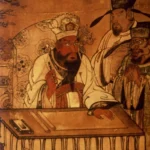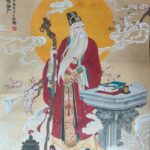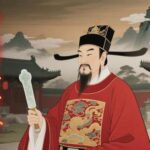
Taishang Laojun (太上老君, Tàishàng Lǎojūn), usually translated “Lord Lao the Most High” or “Supreme Old Lord,” is the deified form of Laozi, the sage traditionally credited with the Daodejing. In religious Daoism he is a high god who personifies the Dao, reveals teachings, and appears on earth in a long series of transformations. In formal Daoist ritual he is usually identified with Daode Tianzun, one of the Three Pure Ones.
Most English readers first meet him in Journey to the West, where he is the white-bearded alchemist whose furnace fails to destroy Sun Wukong. That comic figure is only the latest layer. Behind it sit a historically uncertain sage, a god honored by Han emperors, an ancestor claimed by the Tang ruling house, and a central deity of Daoist liturgy.
| Quick facts | Taishang Laojun |
|---|---|
| Chinese name | 太上老君 (Tàishàng Lǎojūn); short form 老君 (Lǎojūn) |
| Common English renderings | Lord Lao the Most High; Supreme Old Lord; Lord Lao |
| Identified with | Laozi (老子, Lǎozǐ); Daode Tianzun (道德天尊, Dàodé Tiānzūn) |
| Main tradition | Religious Daoism, with a large presence in popular religion and vernacular fiction |
| Classification | Deified sage and high Daoist deity; not an “immortal” in the ordinary xian sense |
| Heavenly realm | Taiqing (太清, Tàiqīng), “Grand Clarity” |
| Early imperial worship | Sacrifices to Laozi under Emperor Huan of the Eastern Han, 165–166 CE |
| Common attributes | White hair and long beard, fan or fly whisk, elixir furnace or gourd, green ox |
| Traditional birthday | 15th day of the 2nd lunar month |
Who Is Taishang Laojun?
Taishang Laojun is Laozi understood as a god. Daoist scriptures describe him as existing before Heaven and Earth, as a manifestation of the Dao in a form people can approach, and as a teacher who descends repeatedly to instruct rulers and ordinary people. The human Laozi who wrote the Daodejing is treated as one of these appearances rather than the whole of his identity.
That distinction matters. The Dao itself is not a creator god or a person with a face. Laojun is a personified figure through whom Daoist tradition makes the Dao teachable, worshipable, and present in ritual.
He also should not be filed simply under “immortals.” Figures such as the Eight Immortals are xian (仙), people who attained transcendence. Laojun is placed far higher, as a cosmic deity who existed before the world. For the terminology, see the difference between Taoist gods and immortals.
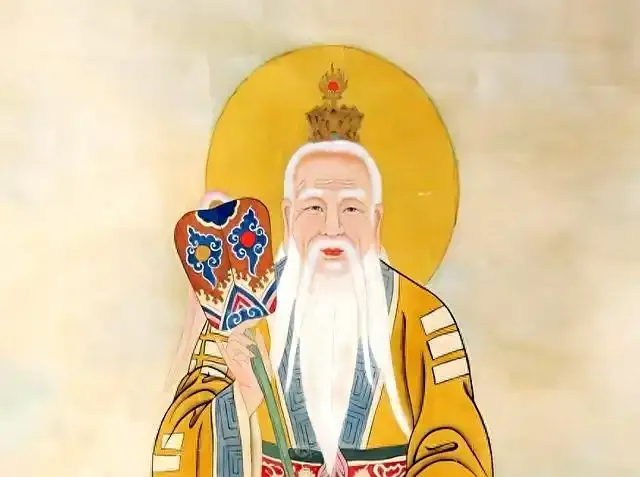
Names and Titles
Laojun has collected many names, and each reflects a different stage of his history.
- Laozi (老子, Lǎozǐ) – “Old Master,” the name of the sage and of the book later called the Daodejing. The Shiji gives his personal name as Li Er (李耳, Lǐ Ěr), also called Dan (聃).
- Laojun (老君, Lǎojūn) – “Lord Lao” or “Old Lord,” the standard short name for the deity.
- Taishang Laojun (太上老君) – taishang means “most high” or “supreme.” This became the main title in early Daoist movements.
- Daode Tianzun (道德天尊) – “Heavenly Worthy of the Way and Its Virtue,” his title within the Three Pure Ones.
- Taishang Xuanyuan Huangdi (太上玄元皇帝) – an imperial title granted by the Tang court in 666.
Later Daoist ritual literature does not always treat Laozi and Daode Tianzun as perfectly interchangeable. A common way to read the relationship is that the human sage is one form of the cosmic deity, not the limit of it.
From Laozi to Lord Lao: How a Sage Became a God
The uncertain historical Laozi
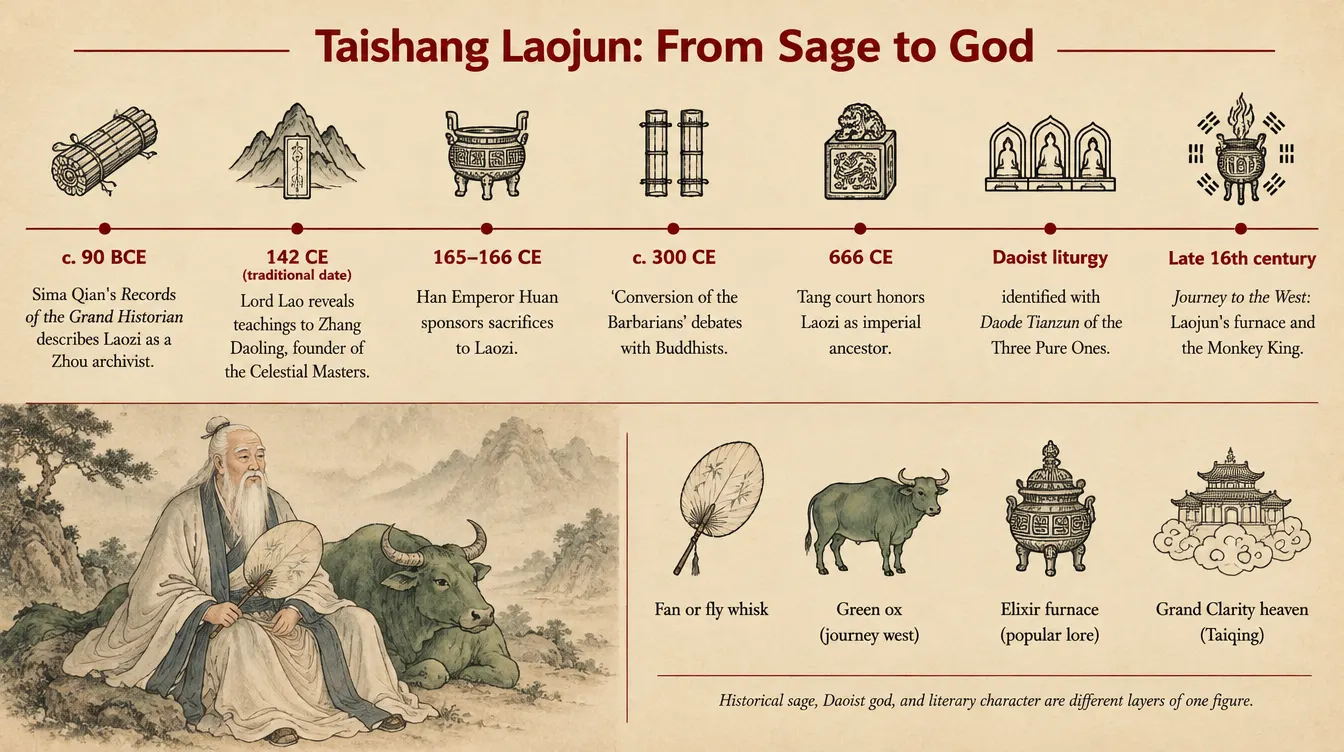
The earliest biography of Laozi appears in Sima Qian’s Shiji (史记, Records of the Grand Historian), completed around 90 BCE. It presents him as Li Er, a keeper of archives at the Zhou court who met Confucius. Seeing the Zhou in decline, he traveled west. At the border pass, the gatekeeper Yin Xi (尹喜, Yǐn Xǐ) asked him to record his teaching, and Laozi produced a short work in two parts before disappearing.
Sima Qian himself was uncertain. He records competing identifications, including Lao Laizi (老莱子) and a Zhou historian named Dan, and does not resolve them. Modern scholars remain divided on whether a single historical Laozi existed. The oldest surviving Laozi manuscripts, the bamboo slips from Guodian, date to around 300 BCE, which shows the text circulated in some form well before the Han.
Han dynasty worship
By the 2nd century CE, Laozi was being treated as far more than a philosopher. In 165, the local official Bian Shao (边韶, Biān Sháo) composed the Laozi ming (老子铭, Inscription for Laozi) for imperial sacrifices at Laozi’s reputed home in Ku county, modern Luyi (鹿邑) in Henan. The inscription presents Laozi as coeval with primordial chaos and as an adviser to the ancient sage-kings. Emperor Huan sponsored rites there in 165 and 166 and honored Laozi in the palace in 166.
Around the same time, the Laozi bianhua jing (老子变化经, Scripture on the Transformations of Laozi) described him descending again and again to teach humanity, with appearances listed down to 155 CE. It urged followers to recite the Daodejing and confess their faults.
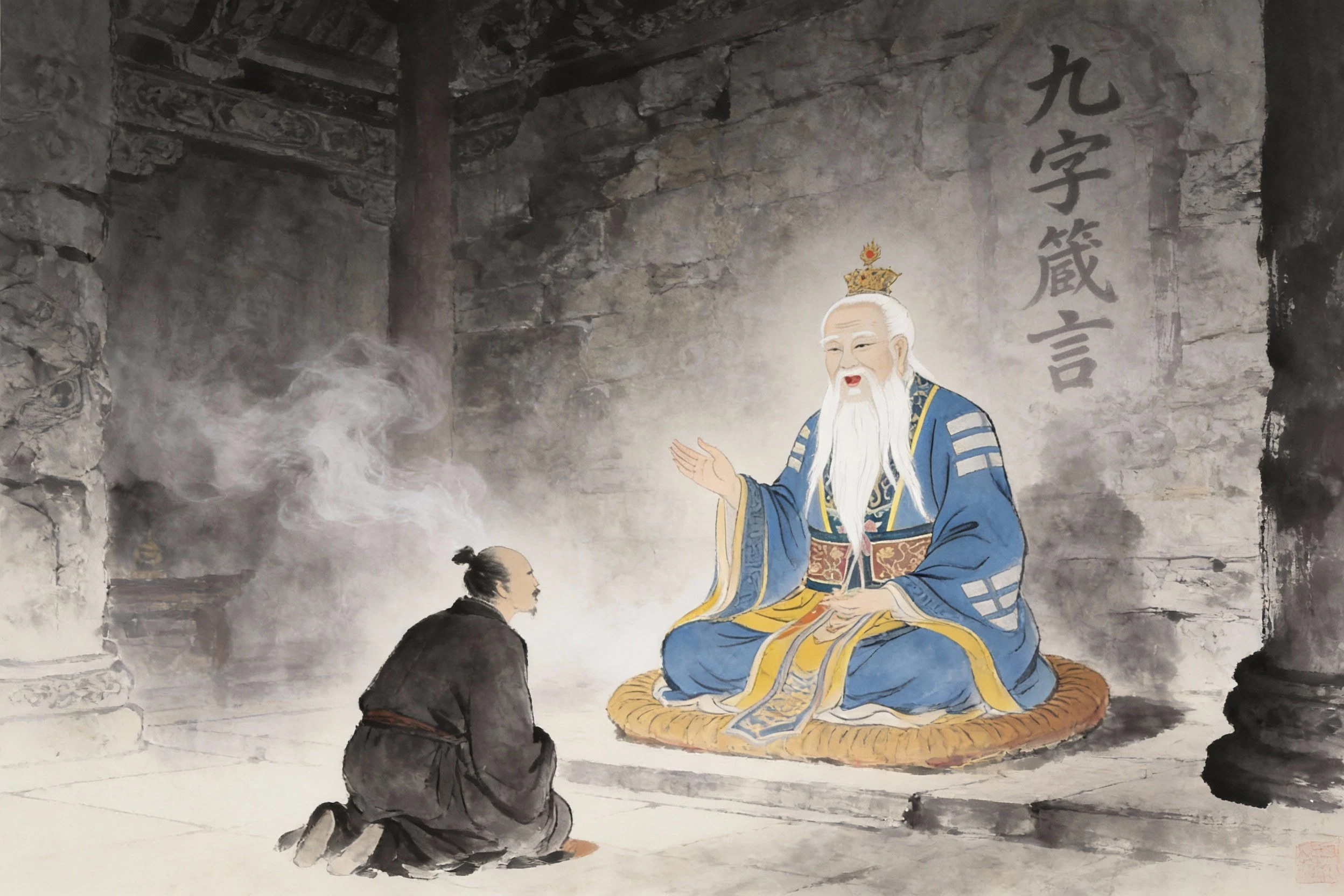
The Celestial Masters
The decisive step came with the Way of the Celestial Masters (天师道, Tiānshī Dào), usually counted as the first organized Daoist religious movement. Its founder Zhang Daoling (张道陵) is said to have received a revelation from Taishang Laojun in Sichuan, traditionally dated to 142 CE. Here Lord Lao is a living god who issues covenants, scriptures, and talismans. The Xiang’er (想尔) commentary on the Daodejing, associated with this movement, reads Laozi’s book as divine instruction.
From this point on, Laojun stands near the center of Daoist revelation. Later practices aimed at transcendence often trace their authority back to him; see how Daoist traditions approached immortality.
Laojun as Daode Tianzun in the Three Pure Ones
In mature Daoist liturgy, the highest deities are the Three Pure Ones (三清, Sānqīng). Each presides over a heaven of purity:
- Yuanshi Tianzun (元始天尊) in Yuqing (玉清, Jade Clarity)
- Lingbao Tianzun (灵宝天尊) in Shangqing (上清, Highest Clarity)
- Daode Tianzun (道德天尊) in Taiqing (太清, Grand Clarity)
Laojun is identified with Daode Tianzun, the third of the group. In this setting he is less a storyteller’s character than a liturgical presence addressed in formal ritual. The Three Pure Ones guide explains how this triad took shape, and the overview of Taoist divine hierarchy shows why no single ranking applies in every school or era.
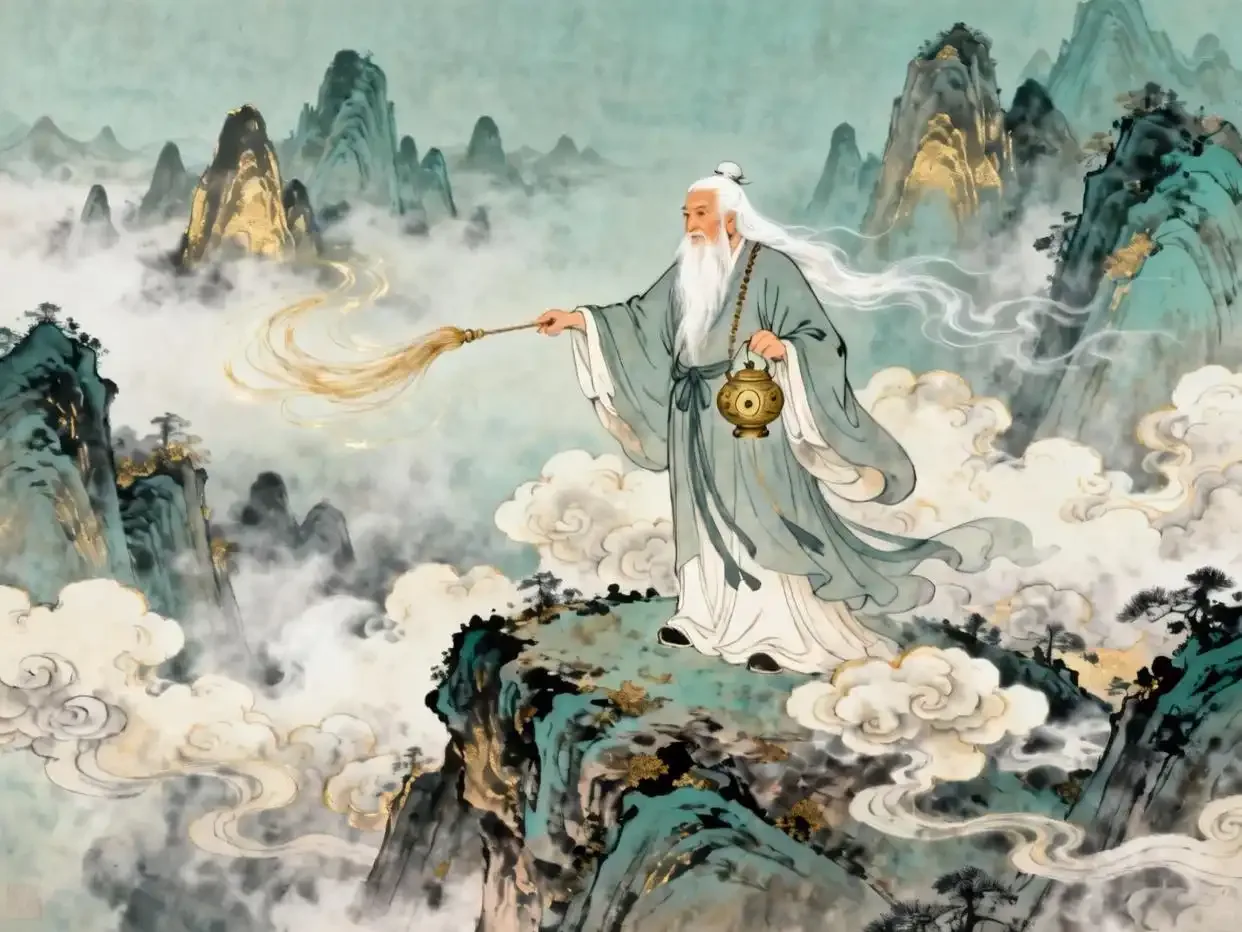
Is Laojun higher than the Jade Emperor?
The answer depends on context. In classical Daoist theology, including the Celestial Masters tradition, the Three Pure Ones rank above the Jade Emperor, so Laojun outranks him. In popular religion and in late imperial novels, the Jade Emperor rules the heavenly court, and Laojun appears there as a revered elder and adviser who still answers the emperor’s summons. Neither picture is “the” correct one; they belong to different layers of tradition.
Transformations and the “Conversion of the Barbarians”
The idea that Laojun repeatedly takes human form produced a substantial body of hagiography. Medieval and Song works such as Du Guangting’s compilation of 884, the Youlong zhuan (犹龙传, c. 1086), and Xie Shouhao’s Hunyuan shengji (混元圣纪) traced his manifestations through Chinese history.
One claim became highly controversial. The “conversion of the barbarians” (化胡, huàhú) theory held that after leaving China through the western pass, Laozi went on to teach, or even become, the Buddha. Around 300 CE, after debates with the Buddhist monk Bo Yuan (帛远), the Daoist Wang Fu (王浮) composed the Laozi huahu jing (老子化胡经). Buddhists rejected the argument as polemic, and the dispute ran for centuries. Tang emperors proscribed huahu writings twice.
The conflict peaked under the Yuan. An illustrated work, the Laojun bashiyi hua tu (老君八十一化图, Eighty-One Transformations of Lord Lao), openly counted the Buddha among Laojun’s transformations. After Buddhist–Daoist court debates went against the Daoists, the Yuan government in 1281 ordered Daoist texts it judged to be forgeries destroyed, sparing the Daodejing. The episode is a reminder that Laojun’s legends were sometimes shaped by rivalry, not only devotion. For the wider exchange between the two religions, see Buddhist influence on Chinese mythology.
Ancestor of the Tang Emperors
Laojun reached his greatest state prestige under the Tang dynasty (618–907). The ruling house shared Laozi’s traditional surname, Li, and claimed him as its ancestor. In 666, Emperor Gaozong granted the title Taishang Xuanyuan Huangdi (太上玄元皇帝). Emperor Xuanzong went further, naming Laozi the dynasty’s “Sage Ancestor” (圣祖, Shèngzǔ) in 743 and expanding his titles through the following decade.
Imperial patronage continued after the Tang. In 1014, the Song emperor Zhenzong added another title built on the epithet hunyuan (混元, “primordial chaos”), rendered Taishang Laojun Hunyuan Shangde Huangdi (太上老君混元上德皇帝). The Taiqing Gong (太清宫, Palace of Grand Clarity) at Luyi, the site of the Han sacrifices, remained a major center of his cult.
Political use of Laozi was not new. In the Han, “Huang–Lao” thought had already paired him with the Yellow Emperor as twin patrons of good government.
Laojun in Journey to the West and Popular Fiction
The late 16th-century novel Journey to the West gave Laojun his best-known modern image. The novel places his residence in the Tushita Palace (兜率宫, Dōushuài Gōng), a name borrowed from a Buddhist heaven, which shows how freely the novel mixes traditions.
- The stolen elixir. Sun Wukong raids Laojun’s palace and eats his golden elixir pills.
- The capture. Laojun helps subdue the Monkey King by striking him with his diamond snare (金刚琢, jīngāng zhuó).
- The furnace. Wukong is sealed for forty-nine days in Laojun’s Eight Trigrams Furnace (八卦炉, Bāguà Lú). Instead of being destroyed, he emerges with “fiery golden eyes” (火眼金睛) and breaks free.
- Escaped servants. Later episodes reveal that some demons on the pilgrims’ road are Laojun’s own attendants, including the Golden Horn and Silver Horn kings and his green ox, who descends as a monster armed with the stolen diamond snare.
The Ming novel Fengshen Yanyi (封神演义, Investiture of the Gods) gives Laozi a very different role as a senior master in a cosmic war between rival schools of immortals. In one famous episode he splits his single breath into three figures, a literary play on the Three Pure Ones.
These portrayals are fiction. They shaped how many readers picture Laojun, but they should not be read as the theology of Daoist temples or as ancient myth.
Iconography and Symbols
Images of Laojun vary by period and setting, but several features recur:
- White hair and a long beard. His appearance plays on the name “Old Master,” and some legends describe him as born already aged.
- Long earlobes. Some images and texts give him distinctive ears, linked to his personal name Er (耳, “ear”).
- A fan or fly whisk. In Three Pure Ones sets, Daode Tianzun is commonly shown holding a fan.
- A green ox. Later tradition pictures Laozi riding an ox (青牛, qīngniú) westward to the border pass, one of the most popular subjects in Chinese painting.
- An elixir furnace or gourd. Popular art links him with alchemy, reinforced heavily by Journey to the West.
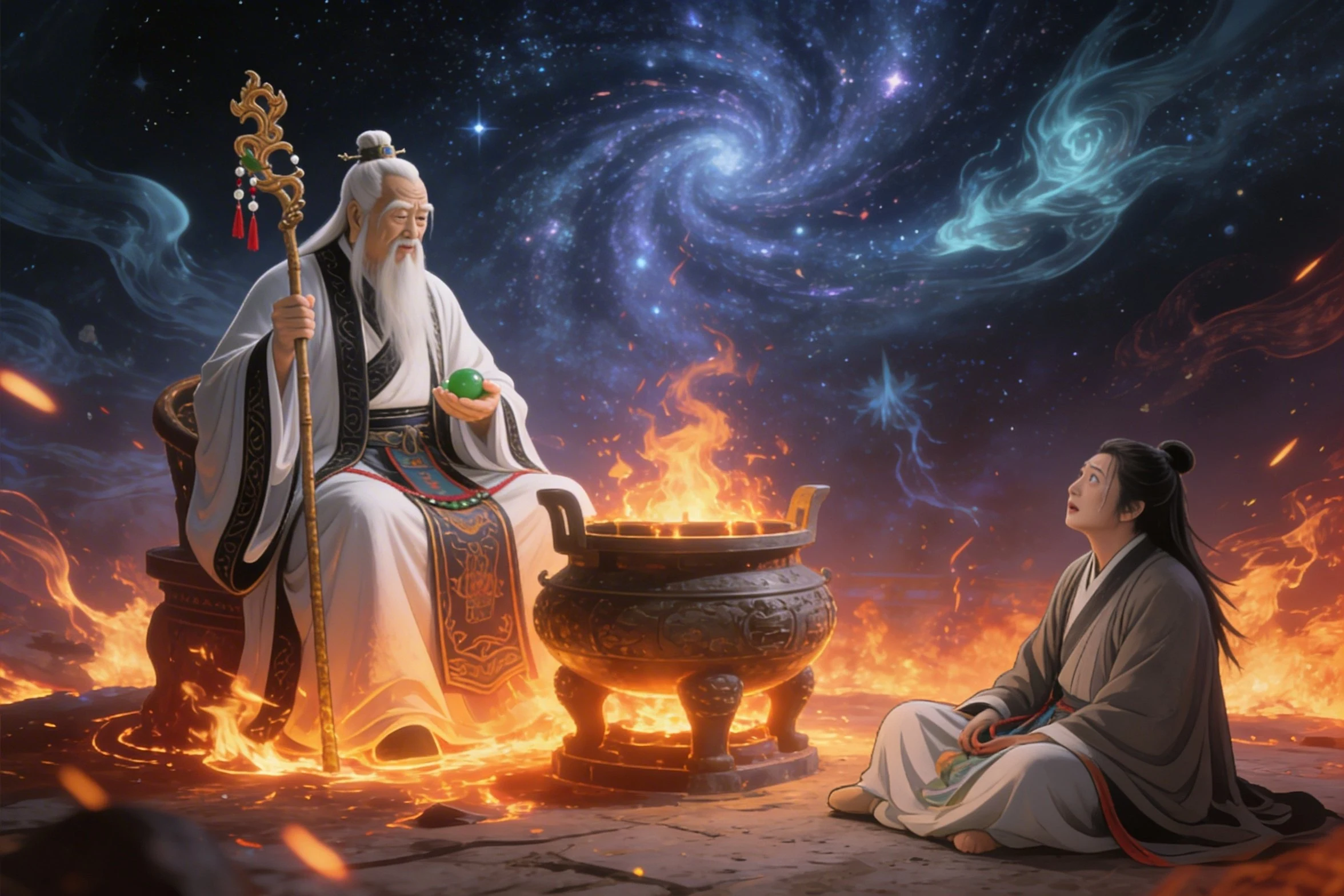
Religious images of Laojun are old. A carved limestone stele of Laozi as a deity, dated 564 CE, is held by the Museum of Fine Arts, Boston. A well-known large stone statue of Laozi on Mount Qingyuan in Quanzhou, Fujian, is commonly attributed to the Song period, though its dating has been debated.
Worship, Temples, and Festivals
Laojun is honored throughout the Daoist temple network, especially in shrines devoted to the Three Pure Ones. Several sites carry special associations with him:
- Taiqing Gong, Luyi (Henan) – his reputed birthplace and the site of the Han imperial sacrifices.
- Qingyang Gong (青羊宫), Chengdu – the Palace of the Black Ram, linked in legend to his reunion with his disciple Yin Xi.
- Baiyun Guan (白云观), Beijing – a major Quanzhen Daoist monastery with a shrine to Laojun.
His birthday is traditionally celebrated on the 15th day of the second lunar month. In Hong Kong and Singapore, Daoist organizations mark this date as Taoist Day. Popular lore about his furnace also made him a patron figure for some furnace-based crafts in parts of China, though such trade cults varied from region to region.
For a broader directory of figures in this tradition, browse the Taoist Deities section.
Related Figures
- Yuanshi Tianzun and Lingbao Tianzun – the other two members of the Three Pure Ones.
- The Jade Emperor – ruler of the heavenly court in popular religion, ranked below the Three Pure Ones in classical Daoist theology.
- Yin Xi – the border guard who received the Daodejing and became Laozi’s model disciple in later legend.
- Zhang Daoling – founder of the Celestial Masters, who received Laojun’s revelation.
- Li Tieguai – one of the Eight Immortals, said in popular legend to have studied under Laozi.
- Sun Wukong – Laojun’s most famous literary antagonist.
Frequently Asked Questions
Is Taishang Laojun the same as Laozi?
Yes, in religious Daoism Taishang Laojun is the deified Laozi. Daoist texts treat the historical sage as one human appearance of a cosmic deity who existed before the world, so Laojun is more than the author of the Daodejing.
Is Taishang Laojun higher than the Jade Emperor?
In classical Daoist theology, yes: as Daode Tianzun he belongs to the Three Pure Ones, who rank above the Jade Emperor. In popular religion and novels like Journey to the West, the Jade Emperor rules the heavenly court and Laojun serves as an honored elder.
Is Taishang Laojun a god or an immortal?
He is a god. Immortals (xian) are people who achieved transcendence, while Laojun is described as a primordial deity who existed before Heaven and Earth and only appears in human form.
Why is Laojun associated with alchemy and elixirs?
Daoist traditions of longevity and transcendence looked to him as a source of teaching, and later popular imagery gave him an elixir furnace. Journey to the West made that image famous through the Eight Trigrams Furnace and the elixir pills stolen by Sun Wukong.
When is Taishang Laojun’s birthday?
His birthday is traditionally observed on the 15th day of the second lunar month. Daoist groups in Hong Kong and Singapore celebrate this date as Taoist Day.
Did Daoists really claim that Laozi became the Buddha?
Some did. The “conversion of the barbarians” theory, set out in texts such as the Laozi huahu jing, claimed Laozi went west and taught or became the Buddha. Buddhists rejected it, and the dispute led to bans under the Tang and the destruction of Daoist texts in 1281.
References and Further Reading
- Livia Kohn, God of the Dao: Lord Lao in History and Myth (Ann Arbor: University of Michigan Center for Chinese Studies, 1998). University of Michigan Press
- Judith Magee Boltz, “Laozi,” Encyclopedia of Religion. Encyclopedia.com
- Alan Chan, “Laozi,” Stanford Encyclopedia of Philosophy. plato.stanford.edu
- Fabrizio Pregadio, “Laojun (Lord Lao): Laozi as a God,” Golden Elixir Press. goldenelixir.com
- Roger T. Ames, “Laozi,” Encyclopaedia Britannica. britannica.com
- Benjamin Penny, “Lord Lao’s Eighty-One Transformations, Illustrated,” ANU Library Rare Books and Special Collections. anulib.anu.edu.au
- Hong Kong Government, Hong Kong Yearbook 2006, “Religion and Custom.” yearbook.gov.hk