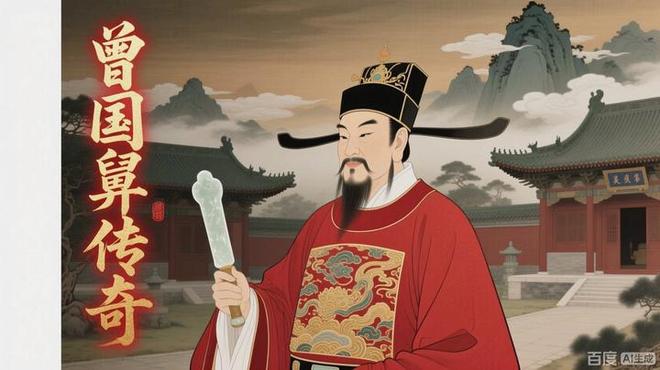
The Cao Guojiu story is one of the quieter legends within the Eight Immortals cycle, but it carries a moral weight that the louder, stranger stories sometimes lack. There are no dragons to subdue here, no dramatic duels or magical contests. What the legend offers instead is a question that cuts through the centuries: what should a person do when family privilege is being used to shield wrongdoing?
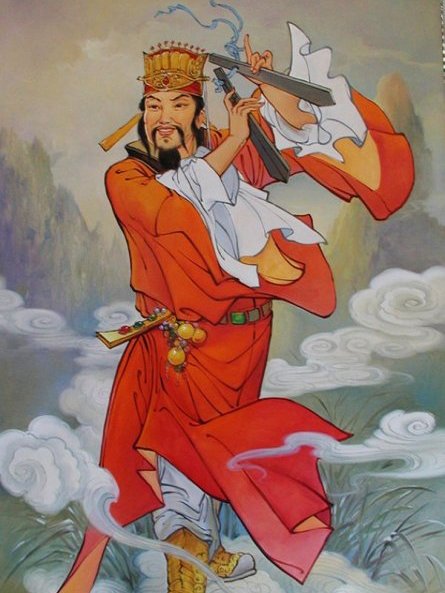
Cao Guojiu — written 曹國舅 in traditional Chinese, 曹国舅 in simplified — is typically described as a nobleman connected to the imperial family of the Song dynasty. His title, Guojiu, translates roughly as “imperial brother-in-law” or a male relative of the emperor through an empress. In traditional imagery, he is the most formally dressed of the Eight Immortals: court robes, an official hat, and either a jade tablet or a pair of castanets in his hands.
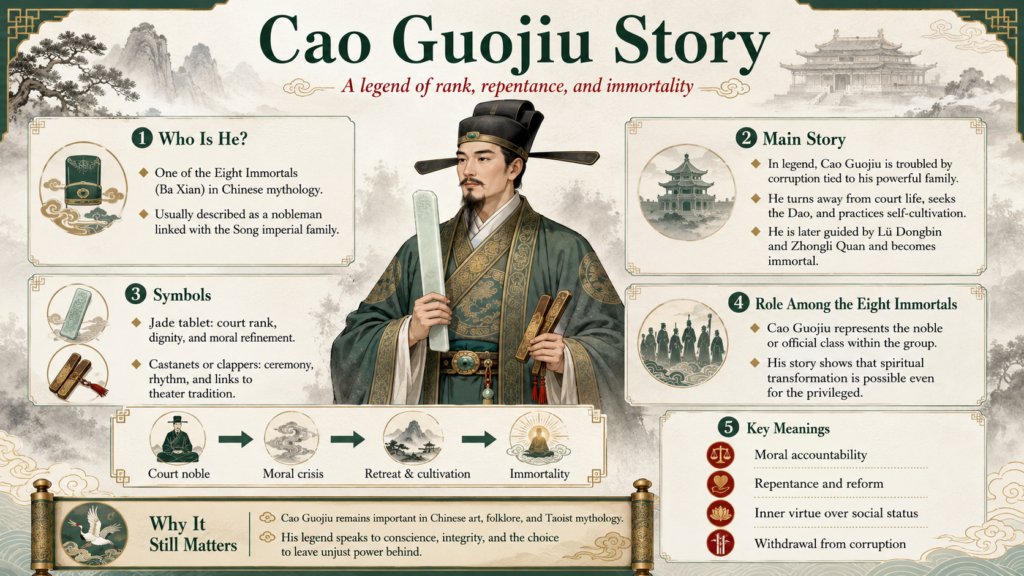
For English-speaking readers new to Chinese mythology, Cao may be less immediately recognizable than Lü Dongbin the scholar-swordsman or Li Tieguai the iron-crutch wanderer. But his role within the group is essential. He brings the world of aristocratic rank into a collective that otherwise includes eccentrics, wanderers, musicians, and the poor — and he asks whether someone surrounded by privilege can still feel the call to something better.
Who Is Cao Guojiu? Background and Identity
Cao Guojiu is one of the Eight Immortals (Ba Xian, 八仙), perhaps the most beloved group of figures in Chinese popular religion and Taoist-inflected mythology. The group includes figures of strikingly different backgrounds: He Xiangu is remembered as the sole woman among them; Li Tieguai appears as a disabled beggar; Lan Caihe is associated with unconventional, gender-ambiguous freedom; Han Xiangzi carries a flute. The diversity is deliberate and meaningful. Together, they suggest that the path toward the Dao is not restricted to any one kind of person.
Cao Guojiu represents the world of official rank and elite culture. He is the nobleman of the group.
In most tellings, he is linked to the Song dynasty imperial family, positioned as a brother of an empress or a relative with direct access to the emperor. Some accounts suggest he may be loosely connected to historical figures within the Song court, but the legendary Cao Guojiu should not be read as a historical biography. He is a mythological figure whose story was shaped over time by Taoist storytelling, popular religion, and moral tradition. Like most of the Eight Immortals, his biography exists in multiple versions and carries more symbolic weight than historical precision.
What makes him distinctive is not simply his rank but the way his rank becomes a moral problem. His story begins at court and ends in a cave. The journey between those two points is what the legend is about.
The Cao Guojiu Story: Privilege, Shame, and Transformation
The Weight of a Corrupt Family
The most familiar version of the Cao Guojiu story begins with comfort and status. Cao is born — or placed by circumstance — at the center of Song imperial life. He has access that few people could imagine: wealth, connections, the emperor’s proximity. But in the legend, this privilege quickly becomes a source of anguish rather than pleasure.
Cao has a brother who abuses the family’s imperial standing. The details vary by telling, but the pattern is consistent: the brother behaves corruptly, wrongs ordinary people, and escapes accountability because his status places him beyond the reach of ordinary law. No one dares challenge him. His rank is his protection.
Cao is ashamed. He tries to reason with his brother, to persuade him toward better conduct. In some versions, he warns that even if a man can escape human judgment, he cannot escape what the tradition describes as the net of Heaven — the moral order that operates beyond courts and officials. This is not merely a pious phrase. It reflects a serious idea in Chinese moral thought: that consequence and accountability are built into the fabric of the universe, not dependent on whether anyone with authority chooses to act.
The warnings fail. His brother does not change.
Withdrawal and Cultivation
When Cao cannot reform his brother, he faces a choice: remain within the system, or leave it. He chooses to leave. In most versions, he uses whatever wealth he has to help those harmed by his family, then withdraws entirely. He gives up his position, his robes, his access — everything that the court represents — and retreats to the mountains or countryside to live as a recluse.
There he practices what Taoist tradition calls self-cultivation: quiet reflection, inner discipline, alignment with the Dao, the underlying way or pattern of reality that Taoist thought holds as the source of all things. His transformation is not sudden or dramatic. It happens slowly, through years of withdrawal and practice.
This is where the story connects to two other immortals: Zhongli Quan and Lü Dongbin. In the legend, they encounter Cao during his period of reclusion and, recognizing his sincerity, guide him further along the path. Eventually, he achieves immortality and joins the Eight Immortals.
An Alternate Version
In another tradition, the story takes a somewhat different turn: Cao himself becomes entangled in wrongdoing or legal trouble before his spiritual awakening. In this version, the emphasis shifts from vicarious shame to direct personal guilt. Cao is not only troubled by what someone else has done; he must confront his own failures.
The emotional texture changes, but the underlying message remains. Whether he is fleeing someone else’s corruption or his own, the legend insists that transformation is available. A person may begin in privilege, error, or disgrace. Through sincerity and discipline, he can still move toward something better. This is very much in keeping with how the Eight Immortals as a group are portrayed: not as perfect beings, but as figures whose immortality was earned through human-scale struggle.
Historical and Cultural Background
The Song Dynasty World
Cao Guojiu’s legendary association with the Song dynasty places him in a world of sophisticated bureaucracy, court culture, and literary refinement. The Song (960–1279 CE) is remembered as a period of remarkable cultural development in China — landscape painting, poetry, and philosophy all flourished. It was also a period of complex official hierarchies in which rank carried immense social consequence.
The visual signs of that world — court robes, ceremonial tablets, official headgear — became Cao Guojiu’s identifying symbols. To a traditional Chinese audience, his clothing would have communicated his social position immediately. There would be no need to explain who he was; the robes told you.
This matters to the legend because Cao’s departure from that world is meaningful precisely because of what he leaves behind. A hermit who was always poor loses nothing by going into the mountains. A nobleman who gives up imperial access loses everything that his society valued.
The Eight Immortals in Chinese Culture
The Eight Immortals are not confined to formal religious practice. They belong to the broader fabric of Chinese cultural life: painting, porcelain, woodblock prints, opera, theater, decorative arts, birthday imagery, and household objects. Their stories circulated across temples, teahouses, stages, and markets.
In this sense, Cao Guojiu is simultaneously a figure in Taoist religious tradition and a character in popular entertainment. The distinction between “religious” and “cultural” is often less sharp in this context than Western readers might expect. The Eight Immortals could carry spiritual meaning, tell a good story, and decorate a birthday gift — all at once.
Cao Guojiu’s Role Among the Eight Immortals
Each of the Eight Immortals occupies a recognizable social position, and part of the group’s appeal is that together they represent a wide cross-section of human experience. Zhongli Quan is the powerful elder master. Lü Dongbin is the scholar and swordsman. He Xiangu represents purity and feminine immortality. Zhang Guolao is the old eccentric. Li Tieguai brings in suffering, reversal, and physical hardship. Han Xiangzi is the musician. Lan Caihe defies easy categorization.
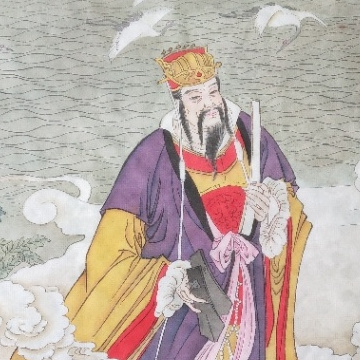
Cao Guojiu is the one who comes from the top of the social hierarchy. He brings court rank and official culture into a group that already includes wanderers and beggars. His presence makes a point that is easy to miss: spiritual awakening is not reserved for the poor, the eccentric, or those with nothing to lose. It is also available — perhaps especially available — to those who have everything and choose, clearly and deliberately, to put it aside.
He also completes the visual range of the group. When the Eight Immortals are depicted together, Cao’s formal dress creates a contrast with the rougher, freer appearance of his companions. That contrast is not incidental. It reinforces the idea that all kinds of people can find their way to the Dao.
Symbols and Visual Identity
The Jade Tablet
Cao Guojiu’s most recognized symbol is the jade court tablet (hu, 笏), a ceremonial object that officials held during imperial audiences. In traditional court practice, such a tablet denoted rank, ceremonial duty, and the right to appear before the Son of Heaven.
In Cao’s imagery, the tablet carries layered meaning. On the surface, it identifies his social standing. At a deeper level, because jade in Chinese culture is traditionally associated with purity, moral uprightness, and refined character, the tablet also points toward his spiritual quality. He carries the symbol of court rank, but transformed — what began as a political credential becomes an emblem of moral refinement.
Castanets or Clappers
Cao is also depicted at times holding castanets or clappers (paiban, 牌板), instruments associated with rhythm, theater, and traditional performance. This is one reason he is sometimes connected with actors and the performing arts, and in some communities he has been regarded, informally, as a patron figure for theatrical traditions.
The clappers may also carry a subtler meaning: order, timing, and disciplined expression. In Chinese performance culture, rhythm is not merely musical — it carries moral and ceremonial weight.
Court Robes and Official Hat
Cao’s formal clothing is perhaps his clearest visual signature. It immediately communicates that he once belonged to a world of hierarchy and protocol. But read against his legend, the robes work as a kind of irony: the most formally dressed of the Eight Immortals is the one whose story most directly questions what formal status is worth.
He does not become immortal by discarding his past. He carries it with him, transformed.
Symbolism and Cultural Meaning
The Cao Guojiu story operates on several levels at once.
Most obviously, it is a story about moral accountability. His brother believes rank can insulate him from consequence. Cao understands it cannot — at least not ultimately. Heaven’s net, as the tradition has it, is wide enough to catch what human courts miss. This idea is not unique to Cao’s legend; it runs through much of Chinese moral storytelling, from courtroom dramas to ghost tales. But Cao’s version is quiet where many such stories are sensational.
The legend is also a story about shame used productively. Cao is not destroyed by his shame — he uses it. In traditional moral frameworks, the capacity for shame was often treated as evidence that one’s conscience was still intact. A person who felt nothing after witnessing wrongdoing was the truly hopeless case. Cao’s distress signals that something in him is still working correctly.
Then there is the theme of leaving privilege behind. Cao does not try to reform the court from within, file a petition, or appeal to a higher official. His answer is withdrawal and self-cultivation. This is a Taoist inflection, distinctly different from the Confucian model of the loyal official who remonstrates with the emperor and accepts punishment. Cao opts out entirely. His solution is inward rather than political, and the legend treats this as a form of strength, not weakness.
Finally, the story makes a case that true refinement is inward. Outward refinement — beautiful robes, correct manners, ceremonial tablets — means nothing if it is not matched by inner virtue. This is the central irony of Cao’s appearance: the most elegant of the Eight Immortals is the one who demonstrated that elegance, in the end, was not the point.
Is Cao Guojiu a God, an Immortal, or a Historical Person?
English readers sometimes ask whether Cao Guojiu should be called a god. The short answer is: not exactly.
In Chinese mythological and Taoist contexts, he is typically described as one of the xian (仙), a category often translated as “immortals” or “transcendents.” A xian differs from a creator deity or supreme god. In many stories, immortals were once human beings who achieved a higher spiritual state through cultivation, moral practice, or extraordinary transformation. Their origin in human experience is part of what makes them meaningful.
Cao Guojiu may reasonably be called a Taoist figure or a deity in the broad popular-religious sense — the Eight Immortals are honored in temples and associated with blessings — but his core identity is that of an immortal within the Eight Immortals. He is not a cosmic creator or a judge of the dead. He is a former nobleman who cultivated himself toward the Dao.
As for history: some accounts connect Cao with figures in the Song imperial family, and the name “Cao Yi” has sometimes been mentioned in this context. But the legends themselves are not historical records. It is most accurate to describe him as a mythological figure with possible historical associations — the distinction matters if you want to understand what the story is actually doing.
Common Misunderstandings
Cao’s story celebrates aristocratic privilege. It does not. His noble birth provides the story’s starting point and its central tension, but the legend questions privilege throughout. Rank in the Cao Guojiu story is a moral burden, not a moral endorsement.
He became immortal because of his imperial connections. His family ties set the stage for the story but contribute nothing to his immortality. His spiritual achievement comes after shame, withdrawal, and sustained practice. The legend is careful to ensure that nothing about his rank shortcuts the process.
There is one definitive version of the legend. Like most Chinese folk traditions, the Cao Guojiu story exists in multiple variants. The differences between them — whether it is his brother’s corruption or his own that drives the plot — reflect how oral and literary traditions adapt moral material across time and audience. Neither version is simply “wrong.”
The Eight Immortals belong only to Taoism. Formally, yes — they are rooted in Taoist tradition. But the Eight Immortals long ago migrated into Chinese cultural life more broadly. They appear in secular art, popular theater, decorative crafts, and festival imagery. Understanding Cao Guojiu well means keeping both contexts in view.
His symbols are decorative details without meaning. The jade tablet, castanets, court robes, and official hat are all meaningful. Each one connects Cao to the world he came from — and, read against his legend, each one becomes a symbol of what was transformed rather than simply abandoned.
Why Cao Guojiu Still Matters
Cao Guojiu’s legend raises a question that does not age: what does a person with power owe when that power is being used to protect wrongdoing?
Modern readers will not recognize the specific setting — Song dynasty courtly life is remote enough — but the moral structure is familiar. Families still protect their members from accountability. Status still makes challenge difficult. Loyalty and justice still pull against each other in ways that offer no comfortable resolution. Cao’s legend does not provide a legal or procedural answer. Its answer is personal and inward: recognize the wrong, refuse to excuse it, and be willing to change your own life as a result.
The story also matters because of what it contributes to the image of Taoist immortality. In Cao’s case, immortality is not a magical reward or an escape from reality. It is the result of self-discipline, moral clarity, and willingness to give up what other people spend their lives accumulating. His transformation suggests that spiritual depth is available even — perhaps especially — to those who have looked closely at what privilege actually costs.
For readers of mythology and comparative religion, Cao Guojiu offers something valuable: a Chinese legend that does its moral work without heroics, without violence, and without a dramatic villain to defeat. The obstacle in the story is social and ethical, and the resolution is quiet. That quietness is the point.
Cao Guojiu in Art and Popular Culture
In traditional Chinese art, Cao Guojiu is among the more readily identifiable figures of the Eight Immortals precisely because of his formal dress and ceremonial objects. He appears alone in some works but far more often alongside the full group.
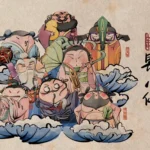
The Eight Immortals frequently appear together in scenes associated with celebration, longevity, and auspicious blessing — on birthday scrolls, porcelain vases, carved wood panels, and embroidered textiles. Among the best-known visual narratives is the Eight Immortals Crossing the Sea, in which each figure crosses the water using only his or her symbolic object, revealing individual power and character in the process. In such group scenes, Cao contributes dignified formality and the reminder that their paths to immortality were genuinely different.
His connection with theater and performance — carried by the castanets — is also worth noting. Traditional Chinese theater had its own patron figures and ceremonial associations, and in some communities Cao Guojiu was informally regarded as a protector of the performing arts. This is a localized tradition rather than a universal one, but it shows how a figure from mythology can gather specific cultural roles over time.
Moral Lessons in the Cao Guojiu Story
Stripped to its core, the Cao Guojiu legend teaches a set of ideas that appear throughout Chinese moral thought but rarely arrive in this particular combination:
Power does not dissolve moral responsibility. Rank can delay accountability, but in the Taoist moral universe, it cannot erase it.
Shame is a faculty, not a weakness. Cao’s capacity to feel ashamed of his family’s conduct is what makes his eventual transformation possible.
Withdrawal can be a form of integrity. Not every moral problem is solved by staying and fighting. Sometimes the principled response is to leave the system that enables the wrongdoing.
True refinement is inward. Outward elegance — fine clothes, correct behavior, ceremonial objects — is hollow without the inner cultivation to match.
Immortality, in this tradition, is earned. Not through power, bloodline, or divine favor, but through sustained moral and spiritual effort.
Comparing Cao Guojiu with the Other Eight Immortals
Cao Guojiu is quieter than most of his companions, and that is part of what makes him interesting. Lü Dongbin has the sword, the romantic misadventures, and the vast body of legend. Li Tieguai is visually arresting — the deity in a beggar’s broken body. Lan Caihe confounds categories. Zhang Guolao rides a donkey backwards and folds it up like paper.
Cao Guojiu has none of that eccentricity. His power lies in restraint and in the moral seriousness of his backstory. He is the member of the group who asks what a life of privilege is actually worth, and whose answer is: not much, compared to a clear conscience.
Among the Eight Immortals, this voice is necessary. It broadens the group’s moral range and ensures that the path to immortality is shown to begin not only from poverty, suffering, or eccentricity, but from wealth and social position too. Every kind of starting point is represented. Every kind of person can, theoretically, walk this road.
FAQ
Who is Cao Guojiu? Cao Guojiu is one of the Eight Immortals in Chinese mythology and Taoist popular religion. In legend, he is a nobleman connected to the Song imperial family who achieves immortality through moral reflection, repentance, and Taoist cultivation.
What does the name Cao Guojiu mean? The title Guojiu can be translated as “imperial brother-in-law” or “imperial uncle,” reflecting his legendary connection to the emperor through an empress. Cao is his family name.
What is the main Cao Guojiu story? In the most common version, Cao is ashamed of a powerful brother whose corrupt behavior is protected by imperial privilege. After failing to reform him, Cao withdraws from court life, practices Taoist self-cultivation, is recognized by the immortals Zhongli Quan and Lü Dongbin, and eventually joins the Eight Immortals. An alternate version centers on Cao’s own wrongdoing before his transformation.
What are Cao Guojiu’s symbols? His main symbols are the jade court tablet (hu), castanets or clappers (paiban), official court robes, and a ceremonial hat. Together they identify him as someone who came from the world of imperial rank and courtly culture.
Is Cao Guojiu a Taoist god? He is best described as a Taoist immortal (xian) within the Eight Immortals group. The Eight Immortals may be venerated in temple settings, but Cao’s specific identity is that of an immortal who was once human — not a cosmic deity or supreme god.
Was Cao Guojiu a real historical person? His legend is sometimes loosely associated with the Song imperial family, but the stories about him are legendary rather than biographical. It is most accurate to call him a mythological figure with possible historical associations.
Why does Cao Guojiu hold a jade tablet? The jade tablet is a traditional court object representing rank and ceremonial access. In Cao’s iconography, it marks his social origin — and, because jade is associated with purity and moral quality in Chinese culture, it also points toward his spiritual refinement.
Why is Cao Guojiu connected with theater? His castanets link him with traditional performance culture. In some local traditions, he was informally regarded as a patron figure for actors, though this association is not universal and should be understood as a popular tradition rather than a formal religious designation.
Conclusion
The Cao Guojiu story is, at its heart, a legend about choosing conscience over comfort. It does not offer heroic battles or miraculous escapes. What it offers is a portrait of someone who had everything that his society valued — imperial connections, wealth, ceremonial rank — and found it insufficient when those things were implicated in wrongdoing.
His court robes and jade tablet show where he came from. His immortality shows what he became. The distance between those two points is the story, and it is a story that the Chinese mythological tradition tells without fanfare and without rushing to a resolution.
For modern readers, Cao Guojiu is a reminder that mythology does not always operate through spectacle. Sometimes the most enduring figures are the quiet ones — the ones who ask the uncomfortable question, acknowledge the uncomfortable answer, and then act accordingly.