Taoist Deities and Sacred Cosmology
Three Pure Ones in Taoism: Meaning, Names, and Roles
The Three Pure Ones Taoism meaning is best understood as the highest triad of deities in formal Taoist theology. Known collectively as the Sānqīng 三清, they are Yuanshi Tianzun, Lingbao Tianzun, and Daode Tianzun. They are not three competing creator gods. Instead, they represent supreme levels of sacred purity and different dimensions of the Dao’s manifestation, including primordial origin, revealed scripture, cosmic order, and divine teaching. Their identities developed gradually within medieval Taoist traditions. In many formal hierarchies they rank above the Jade Emperor, although the Jade Emperor remains the best-known ruler of Heaven in popular religion.
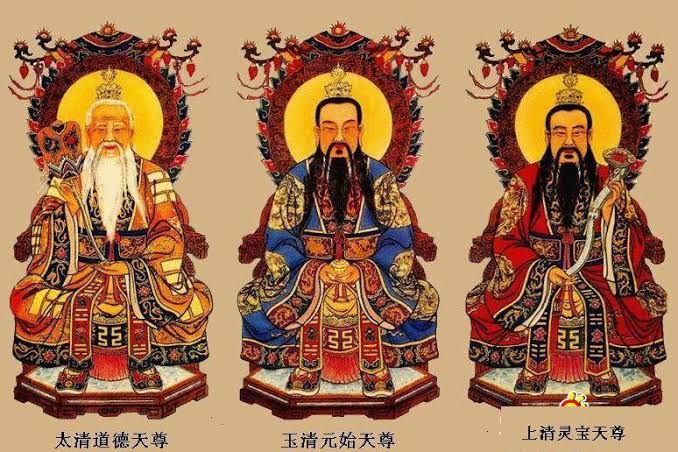
Who Are the Three Pure Ones?
The Three Pure Ones are the supreme triad in many formal descriptions of the Taoist sacred world. Their collective Chinese name is Sānqīng 三清, translated as the “Three Pure Ones,” “Three Purities,” or “Three Clarities.” The Chinese word qīng can convey purity, clarity, refinement, and freedom from the obscurity of ordinary material existence.
They belong specifically to religious Taoism rather than to a single, fixed system called “ancient Chinese mythology.” The familiar Sanqing triad emerged from the scriptures, revelations, ritual systems, and cosmologies of medieval Taoism. Earlier Chinese texts discuss the Dao and cosmic transformation, but they do not present the Three Pure Ones in their later standard form.
Calling them the “three highest Taoist gods” gives beginners a useful starting point, but it can also be misleading. The Dao is not simply another human-shaped ruler sitting above them. It is the Way, source, order, and process through which existence arises and changes. The Three Pure Ones give divine, visual, and ritual expression to realities understood as originating in the Dao.
For a broader overview of related figures, see the site’s guide to Taoist deities, gods, and immortals.
The Three Pure Ones: Names, Realms, and Roles
| Deity | Chinese name and pinyin | Associated realm | Main association |
|---|---|---|---|
| Celestial Worthy of Primordial Beginning | 元始天尊 Yuánshǐ Tiānzūn | Jade Clarity 玉清 Yùqīng | Primordial origin, the beginning of cosmic order, and the highest source of revelation |
| Celestial Worthy of Numinous Treasure | 靈寶天尊 Língbǎo Tiānzūn | Upper Clarity 上清 Shàngqīng | Sacred scripture, ritual revelation, cosmic order, and transmission of teachings |
| Celestial Worthy of the Dao and Its Virtue | 道德天尊 Dàodé Tiānzūn | Great Clarity 太清 Tàiqīng | The divine Laozi, the Daodejing tradition, teaching, and the Dao made accessible through revelation |
Yuanshi Tianzun: Primordial Beginning
Yuanshi Tianzun 元始天尊 is commonly translated as the “Celestial Worthy of Primordial Beginning.” He is associated with Yùqīng, the realm of Jade Clarity, and usually occupies the central position in images of the triad.
His title presents him as a deity beyond ordinary historical time, linked to the primordial emergence of sacred order. Later religious sources give him different cosmic roles and narratives, but there is no single universally accepted biography. His central importance is theological: he represents primordial sacred authority and the highest source of revelation.
Lingbao Tianzun: Numinous Treasure and Revelation
Lingbao Tianzun 靈寶天尊 means the “Celestial Worthy of Numinous Treasure.” The term lingbao is often translated as “Numinous Treasure” or “Spiritual Treasure.” It is closely associated with an influential collection of Taoist scriptures and rituals that developed during the early medieval period.
Lingbao Tianzun is connected with sacred texts, cosmic cycles, ritual order, and the transmission of revelation. He is a divine embodiment of scriptural and ritual authority rather than a historical person whose life can be reconstructed as an ordinary biography.
Daode Tianzun: The Divine Laozi
Daode Tianzun 道德天尊 is the “Celestial Worthy of the Dao and Its Virtue.” He is also widely known as Taishang Laojun 太上老君, often translated as the “Supreme Venerable Lord Lao.” He is associated with Tàiqīng, the realm of Great Clarity.
Daode Tianzun is the deified Laozi, traditionally associated with the Daodejing. Taoist religious traditions present Lord Lao as a cosmic teacher who appeared in different ages to reveal teachings. These sacred narratives should not be treated as straightforward historical evidence about the author of the ancient text.
What Does Sanqing Mean?
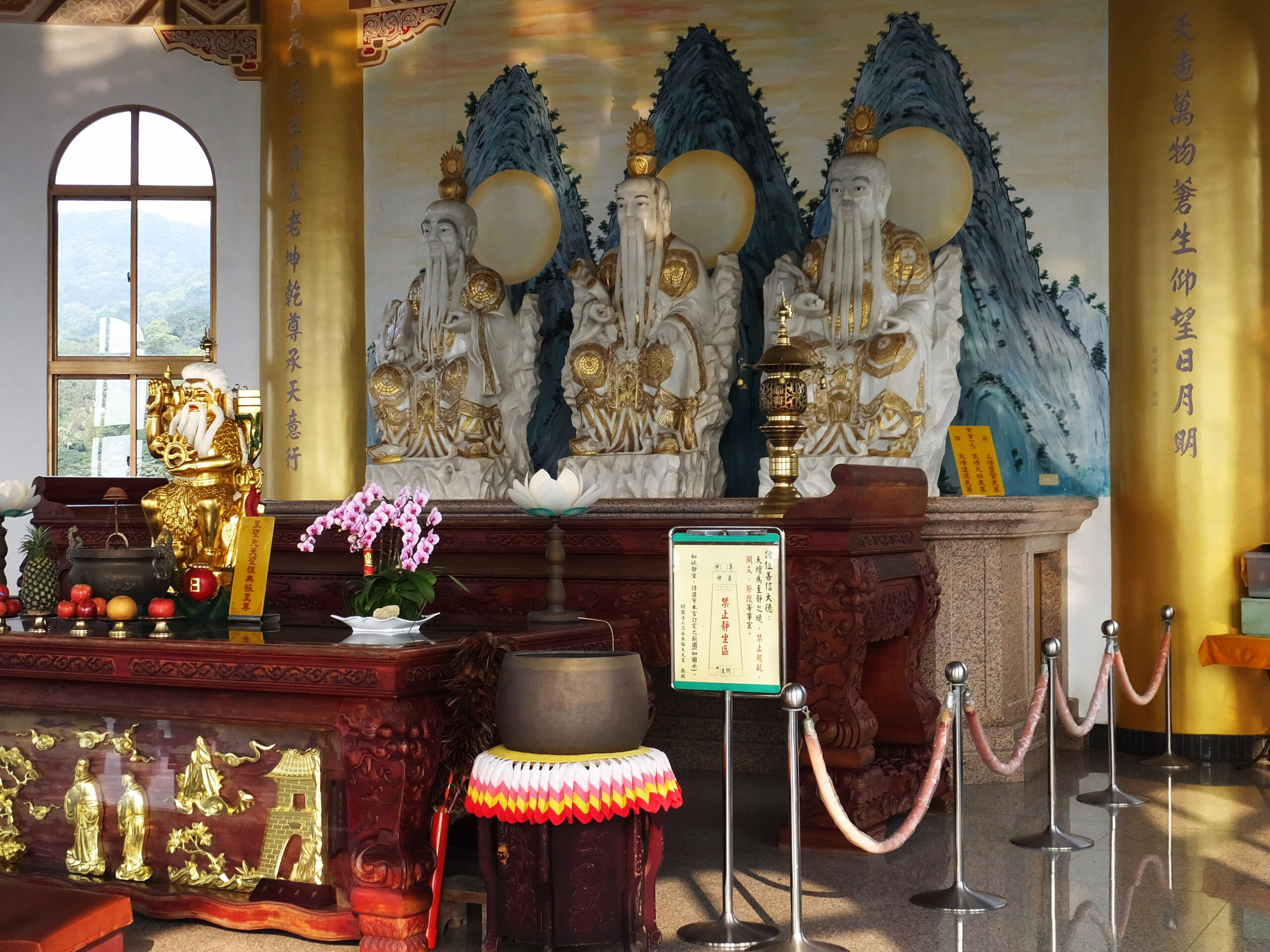
Sānqīng 三清 combines the Chinese words for “three” and “pure” or “clear.” The term can refer to the three supreme deities, the pure celestial realms associated with them, or the complete triad as a theological unit.
“Three Clarities” is a close translation when discussing celestial realms and cosmology. “Three Purities” emphasizes their transcendence beyond ordinary material conditions. “Three Pure Ones” is now the most familiar English name for the deities themselves.
The name does not simply mean that three gods are morally good or spiritually clean. It identifies an exalted level of existence closely connected with the Dao and links the triad with cosmic origin, scripture, revelation, ritual authority, and divine teaching.
All three are called Tianzun 天尊, an exalted title commonly translated as “Celestial Worthy,” “Heavenly Venerable,” or “Celestial Venerable.” Differences between these English forms do not necessarily indicate different deities.
How Did the Three Pure Ones Develop?
The mature Sanqing triad did not appear fully formed in the earliest Chinese philosophical texts. The Daodejing and Zhuangzi discuss the Dao, transformation, nonaction, naturalness, and the limits of ordinary distinctions, but they do not describe the familiar three enthroned deities under their later titles.
Religious Taoism developed through successive communities, revelations, scriptures, ritual lineages, and institutions. Lord Lao became a major divine revealer in early organized Taoist movements. During the fourth and fifth centuries, Shangqing and Lingbao revelations introduced new scriptures, heavens, perfected beings, ritual systems, and models of salvation.
These traditions did not simply replace one another. Later Taoists organized different bodies of scripture within larger canonical systems. The Three Caverns classification of the Taoist Canon helped connect major scriptural traditions with supreme divine sources. Yuanshi Tianzun, Lingbao Tianzun, and the divine Laozi gradually came to form a stable triad represented in temples, ritual manuals, paintings, and sculpture.
This development explains why individual sources sometimes emphasize different details. A ritual text may focus on divine authority, a cosmological text on celestial realms, and a later story on personal relationships. These are related but historically layered traditions, not chapters of one unchanging biography.
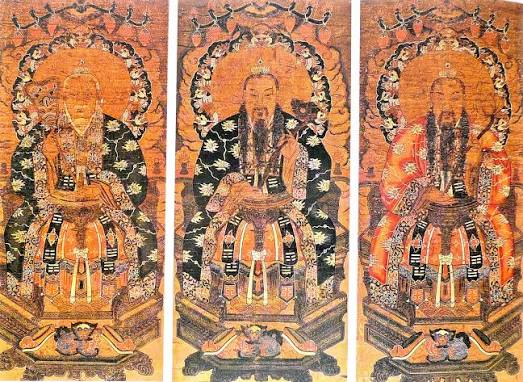
“One Qi Transforms into the Three Pure Ones”
A well-known Taoist formula states that “One Qi transforms into the Three Pure Ones,” written 一炁化三清. Here, qi refers to primordial cosmic breath or vital energy rather than ordinary air.
The phrase expresses unity becoming differentiated without losing its common source. The Three Pure Ones are distinct sacred manifestations, but they arise from one underlying reality. This is one reason they should not be understood as three independent gods competing for ultimate control.
The formula is often connected with Chapter 42 of the Daodejing, which states that the Dao produces One, One produces Two, Two produces Three, and Three produces the myriad things. That ancient passage is an important background for later Taoist cosmology, but it does not name Yuanshi Tianzun, Lingbao Tianzun, or Daode Tianzun.
The Three Pure Ones are distinct sacred expressions of realities rooted in one Dao, not three competing ultimate creators.
Are the Three Pure Ones Higher Than the Jade Emperor?
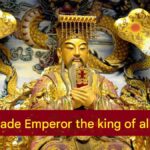
In many formal Taoist hierarchies, the Three Pure Ones occupy a higher theological position than the Jade Emperor. The Jade Emperor governs the celestial administration, while the Three Pure Ones represent primordial source, revelation, sacred scripture, and the highest levels of the Taoist cosmos.
A useful comparison is the difference between ultimate sacred authority and executive government. The Three Pure Ones stand at the highest theological level, while the Jade Emperor rules the offices, officials, and administrative processes of Heaven.
| Question | Three Pure Ones | Jade Emperor |
|---|---|---|
| Primary identity | Supreme theological triad and divine expressions rooted in the Dao | Heavenly sovereign and ruler of celestial administration |
| Main function | Cosmic origin, revelation, scripture, and sacred authority | Government, judgment, appointments, reports, and heavenly order |
| Common context | Formal Taoist cosmology, canon, liturgy, and temple halls | Taoist ritual, popular religion, festivals, folklore, and literature |
| Typical ranking | Usually placed above the Jade Emperor in formal theology | Often portrayed as the highest active ruler of Heaven |
Chinese religion does not have one organizational chart followed identically in every period, school, temple, and local community. Popular narratives often give the Jade Emperor greater visibility because a heavenly emperor and his court are easier to use in stories than abstract deities associated with primordial realms.
For a more detailed comparison, see who the Jade Emperor is and the site’s guide to the Taoist gods hierarchy.
The Three Pure Ones in Art and Worship
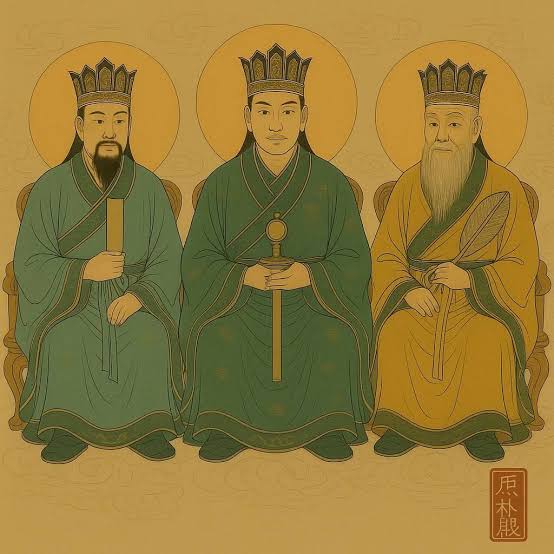
The Three Pure Ones are usually represented as enthroned male deities wearing elaborate ritual robes and formal headgear. Yuanshi Tianzun commonly appears in the central position. Daode Tianzun is often shown with an older face and white beard because of his identity as the divine Laozi.
Artists may distinguish the figures through facial age, hand gestures, tablets, fans, fly whisks, scepters, halos, or other ritual attributes. These details are not completely standardized. A color or object associated with one deity in a modern chart may not appear consistently in historical paintings or temple sculpture.
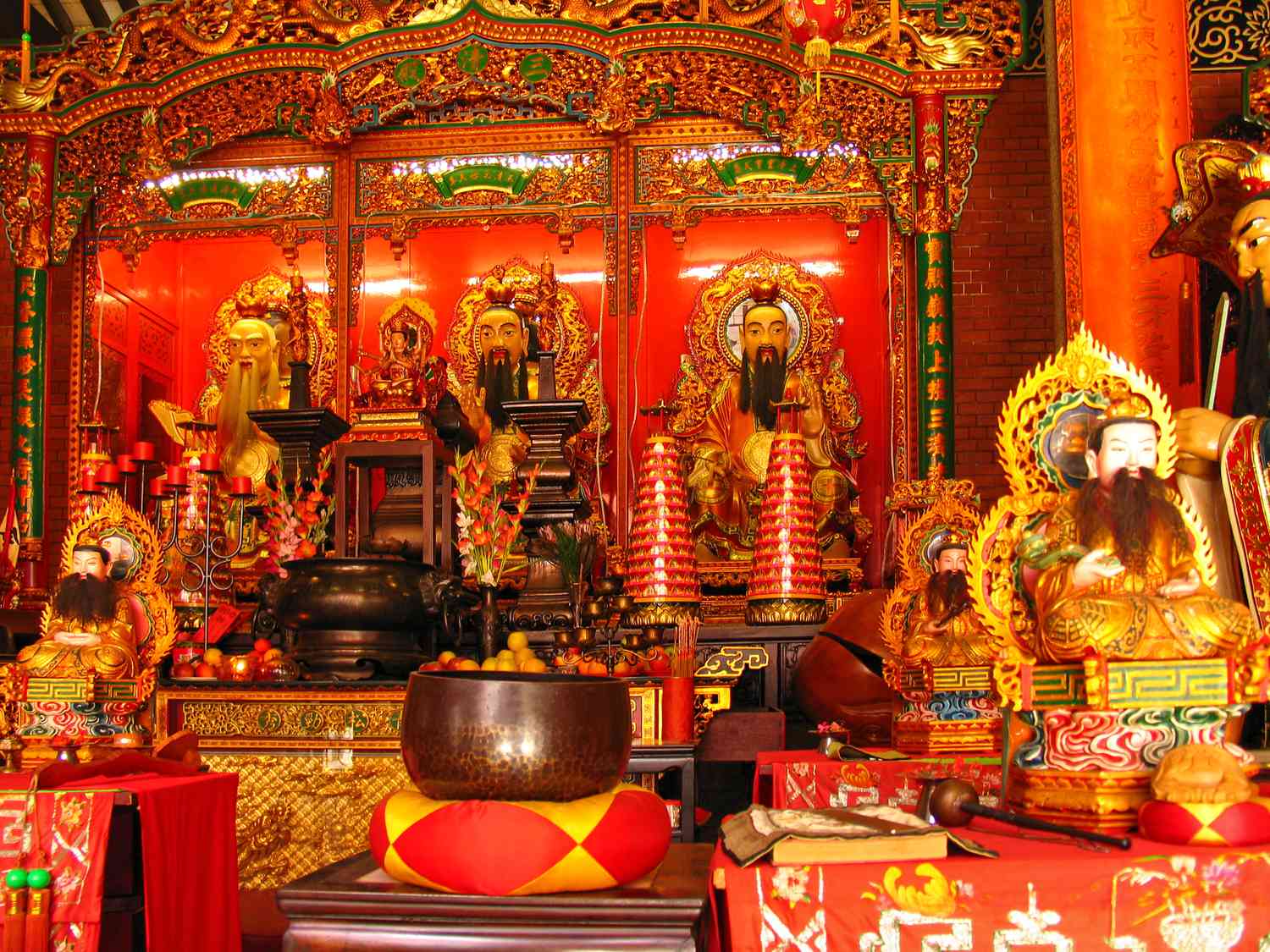
Many Taoist temples contain a Sanqing Hall, written 三清殿, dedicated to the triad. Their religious importance is especially visible in institutional worship, liturgy, scripture, and ordained ritual traditions.
Practices vary between Taoist schools, regions, temples, and historical periods. It is therefore inaccurate to describe one household ritual, festival date, or offering pattern as universal to all followers of Taoism.
Common Misunderstandings
They are not simply a Chinese version of the Christian Trinity
“Taoist trinity” is convenient shorthand, but Christianity and Taoism developed different concepts of divine personhood, creation, revelation, and unity. The comparison can help readers recognize a threefold sacred structure, but it should not replace explanation of the Sanqing in their own religious context.
They are not the same kind of figures as the Eight Immortals
The Three Pure Ones are supreme Celestial Worthies rooted in formal Taoist theology and scripture. The Eight Immortals are a group of legendary transcendents whose identities and stories developed through religion, folklore, art, drama, and literature.
The Dao is not merely a fourth god above them
The Dao is more fundamental than a ruler in a celestial palace. It is described as the Way, source, order, and process of reality. Diagrams that turn every Taoist concept into a person on a power-ranking ladder can obscure this difference.
Hongjun Laozu is not their universally accepted teacher
Modern charts sometimes place Hongjun Laozu above the Three Pure Ones and describe him as their teacher. This arrangement draws heavily on later literary and popular synthesis, especially traditions influenced by Investiture of the Gods. It is not a universally authoritative Taoist doctrine.
Novels do not define one official Taoist pantheon
The Three Pure Ones, Taishang Laojun, the Jade Emperor, and other sacred figures appear in novels such as Journey to the West and Investiture of the Gods. These works are culturally important, but they adapt religious figures for plot, satire, conflict, and entertainment. Their character relationships should not automatically be treated as formal ritual theology.
Why the Three Pure Ones Matter
The Three Pure Ones show how Taoism connects abstract cosmology with religious life through sacred names, scriptures, celestial realms, images, recitation, and ritual practice.
They also demonstrate why Chinese mythology and religion cannot be reduced to one fixed family tree of gods. Their identities emerged through historical development, and their meaning changes with context. A canonical text may emphasize scriptural origins, a ritual may emphasize divine authority, a temple may emphasize hierarchy, and a novel may present one of them as a character.
Recognizing these layers gives readers a more accurate understanding than forcing early philosophy, medieval religious texts, temple worship, folklore, and later literature into one supposedly uniform story.
Readers can continue with the broader directory of Chinese gods and sacred figures, which helps distinguish Taoist deities from Buddhist figures, local gods, legendary heroes, and deified historical people.
Frequently Asked Questions
Who are the Three Pure Ones in Taoism?
They are Yuanshi Tianzun, Lingbao Tianzun, and Daode Tianzun. Together they form the supreme triad in many formal Taoist cosmological and ritual systems.
What does Sanqing mean in English?
Sanqing 三清 is commonly translated as “Three Pure Ones,” “Three Purities,” or “Three Clarities.” The term can refer both to the three supreme deities and to the pure celestial realms associated with them.
Are the Three Pure Ones higher than the Jade Emperor?
In many formal Taoist hierarchies, yes. The Jade Emperor nevertheless remains the supreme administrator of Heaven in much popular religion, which is why he often appears more active in myths, festivals, and literary stories.
Are the Three Pure Ones mentioned in the Tao Te Ching?
They are not named there under their later identities. Chapter 42 describes the Dao producing One, Two, Three, and the myriad things, but directly identifying that “Three” with the Sanqing is a later religious interpretation.
Which of the Three Pure Ones is Laozi?
Daode Tianzun, also called Taishang Laojun, is the divine Laozi. Religious stories about him should not automatically be treated as historical biography about the author traditionally associated with the Daodejing.
Do Taoists worship the Three Pure Ones?
Yes, especially in formal temple and liturgical contexts. Many temples have a Sanqing Hall, although iconography, ritual practice, and local emphasis vary between traditions and regions.
References and Further Reading
- “Religious Daoism,” Stanford Encyclopedia of Philosophy. Background on the Three Clarities, Taoist heavens, scriptures, and religious traditions.
- Pregadio, Fabrizio, editor. The Encyclopedia of Taoism. Routledge, 2008.
- Schipper, Kristofer, and Franciscus Verellen, editors. The Taoist Canon: A Historical Companion to the Daozang. University of Chicago Press, 2004.
- “San Qing: The Three Purities,” Kenyon College. Introductory material on the three deities and their visual identities.
- Daodejing, Chapter 42, Chinese Text Project. Chinese text and translation of the passage describing the Dao, One, Two, Three, and the myriad things.
- “Figure of Daode Tianzun,” National Heritage Board, Singapore. Museum record identifying Daode Tianzun as one of the Three Pure Ones.