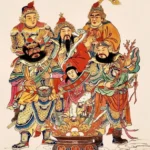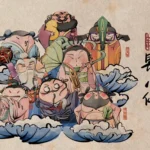
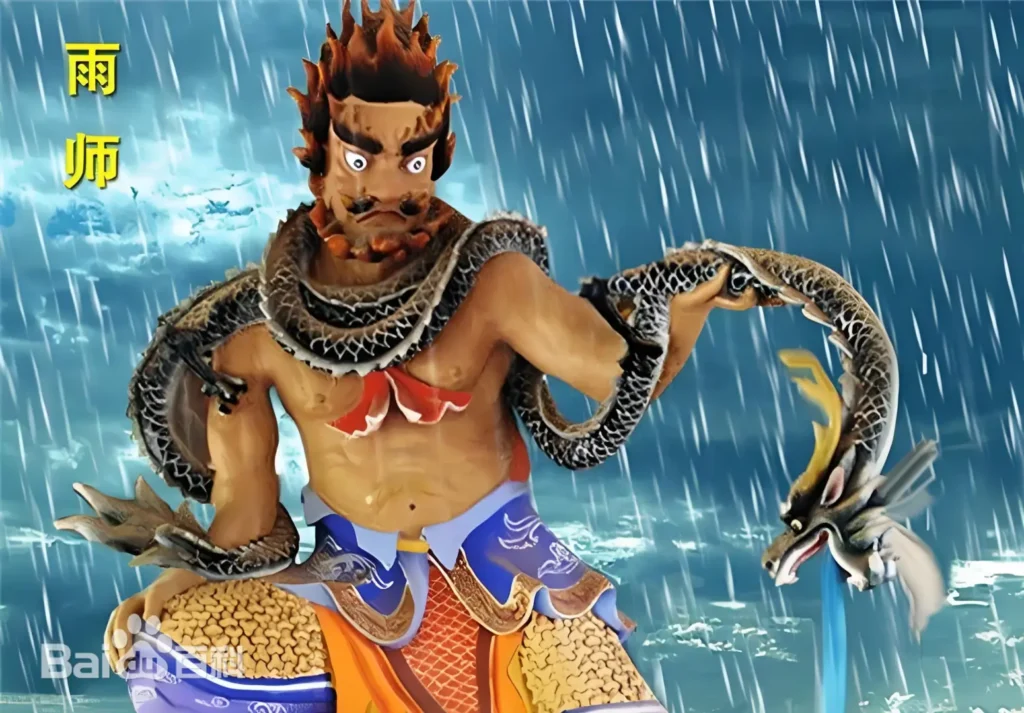
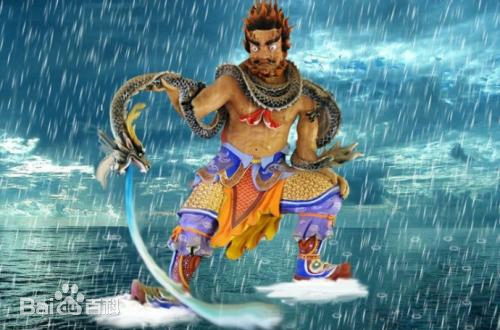
Yu Shi (雨師) is an ancient Chinese rain deity who, according to Chinese mythology, works closely with the wind deity Feng Popo (風婆婆). Yu Shi’s name is comprised of the character’s for “rain,” yǔ (雨), and shī (師), which means “master,” translating literally to “rain master.”
Mythology
According to legend, Yu Shi had a fearsome appearance with a black face, snakes in his fists, and snakes coming out from his ears. He was said to have ended a severe drought during the reign of Shennong (神農) by sprinkling rain over the land from his earthenware pot.
Yu Shi was also associated with Feng Popo, with whom he partnered to rebel against Huangdi (黃帝). Both Yu Shi and Feng Popo were both unhappy with the reign of Huangdi. The drought goddess, Nüba (女魃), who was a daughter of Huangdi, had defeated them.
Pop Culture
Although he isn’t an incredibly popular deity in Chinese mythology, people still pray to Yu Shi in times of severe drought. This is particularly true for those living in Southern China.
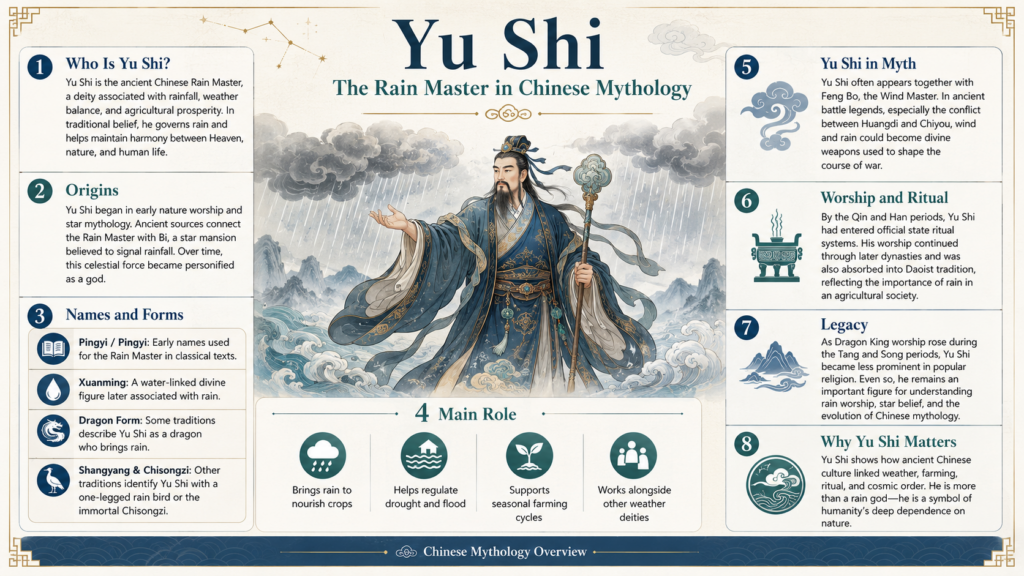
In Chinese mythology, Yu Shi is the ancient Rain Master, a deity responsible for rainfall, seasonal moisture, and the delicate balance between drought and flood. His name is simple but powerful: Yu means rain, and Shi means master or official. Together, Yu Shi can be understood as “Master of Rain” or “Rain Governor.”
Unlike some mythological figures with one clear personality and story, Yu Shi is more fluid. Across different periods, he appears as a star spirit, a dragon, a one-legged divine bird, a Daoist immortal, and even a mysterious weather god who joins great battles of antiquity. This shifting identity makes him one of the more fascinating figures in Chinese mythology.
Yu Shi reflects something deeply practical in ancient Chinese belief: rain was not just weather. It was survival. For an agricultural society, good rainfall meant grain, stability, and life. Too little rain brought drought and hunger; too much rain brought floods and ruin. So it is no surprise that the power to command rain became sacred.
Who Is Yu Shi?
Yu Shi is the god or divine official who governs rain in Chinese myth and religious tradition. He is often mentioned together with other weather deities, especially Feng Bo, the Wind Master. In many stories, rain is not caused by one god acting alone, but by a whole cosmic team: wind, thunder, clouds, lightning, and rain each have their own spiritual force.
Yu Shi’s main duties include:
- Bringing rain to nourish crops
- Regulating drought and flood
- Supporting seasonal agricultural cycles
- Working with wind, thunder, and cloud deities
- Appearing in myths where weather becomes a divine weapon
Because rain was so important to farming, Yu Shi was not only a mythological figure. He also entered official ritual systems, state sacrifices, Daoist pantheons, and folk religious imagination.
The Ancient Origins of Yu Shi
The belief in Yu Shi grew out of early nature worship. Long before he became a named deity, ancient people already prayed for rain, feared drought, and performed rituals to influence the sky.
Oracle bone inscriptions from the Shang period include records of rain prayers, rain-stopping rites, and sacrifices connected with weather. This shows that rain worship was already deeply rooted in early Chinese civilization.
In early texts, Yu Shi was closely connected with astronomy. One important tradition identifies the Rain Master with Bi, a star mansion in the western section of the Twenty-Eight Mansions system. In ancient Chinese astronomy, Bi was associated with rain. A famous line from the Book of Songs says that when the moon approaches Bi, heavy rain follows.
This early connection is important because it shows that Yu Shi was not originally imagined only as a human-like god. He began as part of a larger cosmic pattern: stars, seasons, omens, and weather were all linked.
Yu Shi and the Bi Star Mansion
One of the oldest explanations of Yu Shi says: “The Rain Master is Bi Star.” Bi was the fifth mansion of the western White Tiger constellation group, made up of several stars.
To ancient observers, the movement of the moon and stars could signal changes in weather. When the moon appeared near Bi, it was believed to foretell rain. Over time, this celestial sign became mythologized. The star that “brought rain” became associated with a rain deity.
This is a common pattern in Chinese mythology. Natural forces first appear as signs in the heavens, then become ritual objects, and finally take on divine personalities. Yu Shi’s development follows this path very clearly.
He begins as a rain-associated star, then becomes a state-recognized deity, then appears in stories as a named figure with different forms and legends.
The Many Names of Yu Shi: Pingyi, Xuanming, and More
Yu Shi is not always called by the same name. Several names and identities appear in different traditions.
One early name is Pingyi or Pingyi / Pingyi-style variants, sometimes written as 萍翳 or 屏翳. In Han-period sources, this name is used for the Rain Master.
Another important identity is Xuanming. In some traditions, Xuanming is connected with the north, darkness, water, and winter. Since rain belongs to the world of water, Xuanming could naturally be interpreted as a rain-related deity.
This variety can feel confusing at first, but it actually tells us something useful: Yu Shi was not a single fixed character like a modern fictional hero. He was a religious role. Different regions, texts, and ritual systems could place different figures into that role.
That is why Yu Shi can be a star, a god, a dragon, a bird, or an immortal depending on the source.
Yu Shi as a Dragon
One of the most powerful images of Yu Shi is the dragon.
In Chinese culture, dragons are strongly associated with rain, rivers, clouds, and water. Later dragon kings became especially important in popular rain worship. But even before Dragon King worship became dominant, some texts already connected Yu Shi with dragon imagery.
The Baopuzi describes a being in the mountains who claims to be Yu Shi and is identified as a dragon. This fits naturally with the larger Chinese idea that dragons rise with clouds, stir water, and bring rain.
Over time, the dragon image became so strong that it gradually overshadowed older versions of the Rain Master. As dragon worship became more popular in the Tang and Song periods, many people came to pray to Dragon Kings for rain instead of worshiping Yu Shi directly.
In that sense, Yu Shi did not disappear completely. His function survived, but it was increasingly absorbed into dragon-based rain worship.
Yu Shi as Shangyang, the One-Legged Divine Bird
Another striking version identifies Yu Shi with Shangyang, a legendary one-legged bird that knows when rain is coming.
According to ancient descriptions, Shangyang dances on one leg before rainfall. The philosopher Wang Chong wrote that Shangyang was a creature that understood rain: when the sky was about to rain, it would lift one leg and dance.
Later religious texts describe Shangyang as a divine bird that can become large or small and has the power to draw up waters and release rain. In this version, Yu Shi is not a dragon or star, but a strange rain bird with supernatural control over moisture.
This bird image may preserve very old layers of rain mythology. Birds often appear in ancient myth as messengers between heaven and earth. A bird that dances before rain may reflect folk observation, ritual dance, or symbolic weather magic.
Yu Shi as Chisongzi
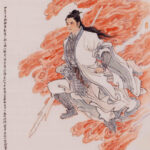
Another important tradition identifies Yu Shi with Chisongzi, an immortal associated with the age of Shennong.
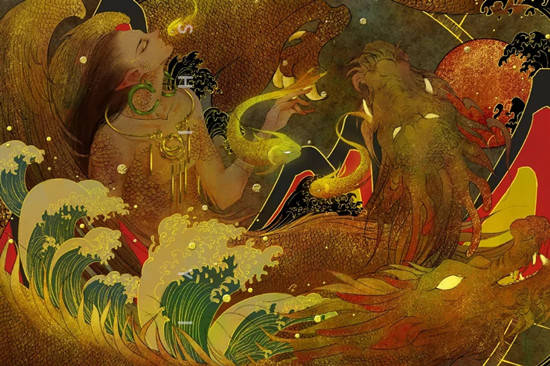
The Soushen Ji says that Chisongzi served as Rain Master during the time of Shennong and later returned to the human world in the time of Gaoxin to govern rain again. In later Daoist imagination, Chisongzi appears as a powerful immortal who can move with wind and rain, enter fire without being burned, and even transform into a red dragon.
This version gives Yu Shi a more human and immortal character. Instead of being a star or animal spirit, he becomes a perfected being with divine authority over weather.
The Chisongzi tradition also shows how Yu Shi was gradually absorbed into Daoist religious systems. Daoism often organized older nature spirits into a more structured pantheon of immortals, heavenly officials, and ritual deities.
Yu Shi and Feng Bo: Wind and Rain Together
Yu Shi often appears beside Feng Bo, the Wind Master. This pairing makes perfect mythological sense. Wind and rain are closely linked in real weather, and ancient mythology often treated them as cooperative powers.
In some stories, Feng Bo clears the way with wind while Yu Shi sprinkles rain. Together, they can bless the land, nourish living things, and support the agricultural world.
But they are not always gentle figures. In battle myths, wind and rain can become weapons. Storms, fog, and violent weather may be used to confuse enemies or overwhelm armies.
This dual nature is important. Yu Shi is not only a benevolent farming god. He is also a deity of atmospheric force. Rain can save life, but it can also destroy.
Yu Shi in the Battle Between Huangdi and Chiyou
One of Yu Shi’s most famous mythological appearances is connected with the war between Huangdi, the Yellow Emperor, and Chiyou.
In one tradition, Yu Shi and Feng Bo once served in the divine order around Huangdi. In another, they appear on Chiyou’s side during the great conflict. When Chiyou fights Huangdi, he calls upon Feng Bo and Yu Shi to unleash fierce wind and rain.
Their storm power creates great difficulty for Huangdi. Wind, rain, and mist confuse the battlefield. In later retellings, Huangdi must rely on divine help, including the drought goddess Hanba and the dragon Yinglong, to overcome Chiyou’s weather magic.
This story shows Yu Shi’s power in a dramatic way. Rain is no longer just agricultural blessing. It becomes a strategic force in a cosmic war.
After Chiyou’s defeat, weather deities like Feng Bo and Yu Shi are often imagined as returning to a proper role: serving the world by regulating nature rather than disturbing it.
Yu Shi in State Rituals
Yu Shi was not merely a folk figure. By the Qin and Han periods, worship of the Rain Master had entered official ritual practice.
The Zhouli includes Yu Shi within a system of state sacrifices. During the Qin period, there were dedicated state temples for rain deities. Later dynasties continued to include Yu Shi in official ritual categories.
In the Tang dynasty, Yu Shi’s sacrificial status was raised to the level of middle sacrifice. Records indicate that local commanderies were expected to establish altars for worship. Ritual offerings could include sheep and formal vessels.
This official recognition tells us how seriously ancient governments treated rain. In an agricultural empire, weather was political. A drought could threaten food supply, public order, and even the legitimacy of a ruler. Rituals to Yu Shi were part of a wider attempt to maintain harmony between Heaven, the state, and the people.
Yu Shi in Daoist Tradition
After Daoism developed, Yu Shi was incorporated into Daoist divine systems. Daoist texts and later religious compilations connected the Rain Master with figures such as Shangyang and Chisongzi.
In Daoist religion, weather gods were not random spirits. They became part of a bureaucratic cosmos, where divine officials governed natural processes just as earthly officials governed human society.
This is one of the most distinctive features of Chinese religion: Heaven often mirrors the structure of government. Rain, wind, thunder, and clouds are administered by divine offices. Yu Shi is therefore both a god and a cosmic functionary.
Some Daoist traditions also link specific ritual dates to rain-related deities. Over time, however, Yu Shi’s independent cult became less visible as Dragon Kings became the more familiar recipients of rain prayers.
Why Did Yu Shi Decline?
Yu Shi’s decline does not mean that rain worship disappeared. Rather, the focus shifted.
During the Tang and Song periods, Dragon King worship became increasingly popular. Dragons were vivid, powerful, and easy for ordinary people to imagine as rain-bringers. Local temples to Dragon Kings spread widely, and people often prayed to them during droughts.
Compared with the Dragon Kings, Yu Shi was more abstract. His identity was divided among stars, dragons, birds, immortals, and official ritual texts. As a result, he gradually became less central in popular worship.
Another reason is that official ritual and folk practice did not always follow the same path. Yu Shi remained important in older state and textual traditions, but ordinary communities increasingly turned to more localized and emotionally accessible rain gods.
So Yu Shi faded as a distinct popular deity, while his role continued through the Dragon Kings and other rain-related spirits.
Yu Shi in Art and Visual Culture
Yu Shi also appears in ancient visual culture. One notable example is a Han tomb image known as the Wind and Rain Picture, discovered in Nanyang, Henan.
The scene shows divine figures working together to produce weather. In the upper section, gods pull or guide a celestial vehicle, while the lower section includes figures holding jars and pouring water downward like waterfalls. These streams symbolize rainfall. Nearby cloud imagery fills the space, showing the connection between wind, cloud, and rain.
This kind of image is valuable because it shows how ancient people visualized natural forces as divine labor. Rain is not just falling from the sky by itself. It is poured, guided, summoned, and coordinated by supernatural beings.
The image also reflects a deeply human idea: nature may be vast and frightening, but it can be understood through symbols, stories, and ritual relationships.
The Meaning of Yu Shi in Chinese Mythology
Yu Shi matters because he reveals how ancient Chinese culture understood rain.
Rain was not treated as a simple natural event. It was a sign of cosmic order, agricultural hope, political stability, and divine cooperation. Through Yu Shi, we can see the connection between mythology, astronomy, farming, government, and religion.
He also shows how Chinese deities often evolve. Yu Shi began as a rain-associated celestial power, became part of state ritual, took on different mythic identities, entered Daoist pantheons, and was eventually overshadowed by Dragon Kings.
This long development makes him more than a minor weather god. Yu Shi is a window into how Chinese mythology transforms natural forces into living symbols.
Yu Shi and the Agricultural Imagination
At the heart of Yu Shi’s story is agriculture.
For ancient farmers, rain determined everything. A timely rain could mean a full harvest. A missed rain could bring famine. A violent storm could destroy fields. This made rainfall one of the most emotionally charged forces in daily life.
Yu Shi represents the hope that rain could be guided, requested, and harmonized. People prayed not simply for “more rain,” but for the right rain at the right time.
That is why Yu Shi was associated with abundance, seasonal balance, and good harvests. His worship reflects a practical and humble wish: may Heaven send enough rain, may the crops grow, and may people live in peace.
Conclusion: Yu Shi, the Forgotten Rain Master
Yu Shi may not be as famous today as the Dragon Kings, Lei Gong, or other Chinese mythological gods, but his role is ancient and important. He stands at the meeting point of star worship, weather mythology, state ritual, Daoist religion, and agricultural life.
His identity changes from text to text: Bi Star, Pingyi, Xuanming, a dragon, Shangyang, Chisongzi, or a storm deity beside Feng Bo. Yet behind all these forms is the same essential idea: rain is sacred because life depends on it.
Yu Shi reminds us that mythology often begins with the most basic human needs. Before rain became poetry, legend, or ritual, it was water falling on fields. And for the people who waited under uncertain skies, the Rain Master was not an abstract god. He was the hope of harvest.
FAQ About Yu Shi
Who is Yu Shi in Chinese mythology?
Yu Shi is the Rain Master in Chinese mythology. He is a deity responsible for rainfall, seasonal moisture, and the regulation of drought and flood. He often appears together with other weather gods such as Feng Bo, the Wind Master.
What does the name Yu Shi mean?
The name Yu Shi means “Rain Master” or “Master of Rain.” In Chinese, yu means rain, while shi can mean master, teacher, or official.
Is Yu Shi a dragon?
In some traditions, Yu Shi is described as a dragon. However, this is only one version. Other sources identify Yu Shi with Bi Star, Pingyi, Xuanming, Shangyang, or Chisongzi.
What is the connection between Yu Shi and Shangyang?
Shangyang is a legendary one-legged divine bird associated with rain. Some later texts identify Shangyang as Yu Shi, saying the bird had the power to summon or control rainfall.
Who is Chisongzi?
Chisongzi is an immortal figure who is sometimes described as the Rain Master during the age of Shennong. In later Daoist tradition, he is associated with wind, rain, transformation, and immortality.
Why was Yu Shi important in ancient China?
Yu Shi was important because ancient China was an agricultural society. Rain directly affected crops, harvests, food supply, and social stability. Worship of Yu Shi reflected the hope for timely rain and good harvests.
Was Yu Shi worshiped officially?
Yes. Yu Shi entered state ritual systems by the Qin and Han periods. In the Tang dynasty, sacrifices to Yu Shi were raised to the level of middle sacrifice, showing his importance in official religious practice.
Why did Yu Shi become less popular?
Yu Shi became less visible as Dragon King worship grew during the Tang and Song periods. People increasingly prayed to Dragon Kings for rain, while Yu Shi remained more strongly connected with older texts, official rituals, and Daoist systems.
Are Yu Shi and Feng Bo connected?
Yes. Yu Shi, the Rain Master, is often paired with Feng Bo, the Wind Master. Together they represent the combined forces of wind and rain in Chinese mythology.
What does Yu Shi symbolize?
Yu Shi symbolizes rain, agricultural fertility, seasonal balance, and humanity’s dependence on nature. He also represents the ancient belief that natural forces could be understood through ritual, myth, and divine order.