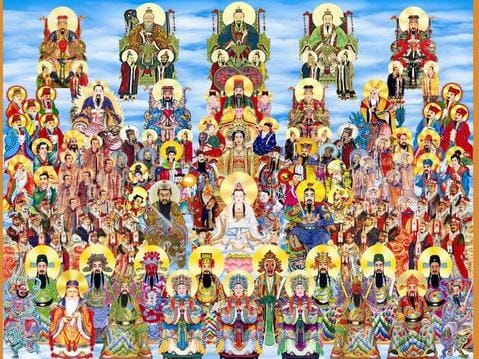
The Taoist gods hierarchy is one of the most fascinating and sometimes confusing parts of Chinese mythology. English-speaking readers often encounter names such as the Three Pure Ones, the Jade Emperor, Laozi, the Eight Immortals, the Kitchen God, the City God, and the Dragon Kings, but it is not always clear who ranks above whom or what each deity actually does.
The first thing to understand is that Taoist hierarchy is not exactly like the pantheon of ancient Greece or Rome. It is not a single family tree of gods, and it is not one fixed list accepted in the same way everywhere. Taoist deities appear in scriptures, temple rituals, popular religion, local worship, imperial culture, literature, and folklore. Because of this, the hierarchy can change depending on whether we are looking at formal Taoist theology, popular Chinese religion, temple practice, or mythological storytelling.
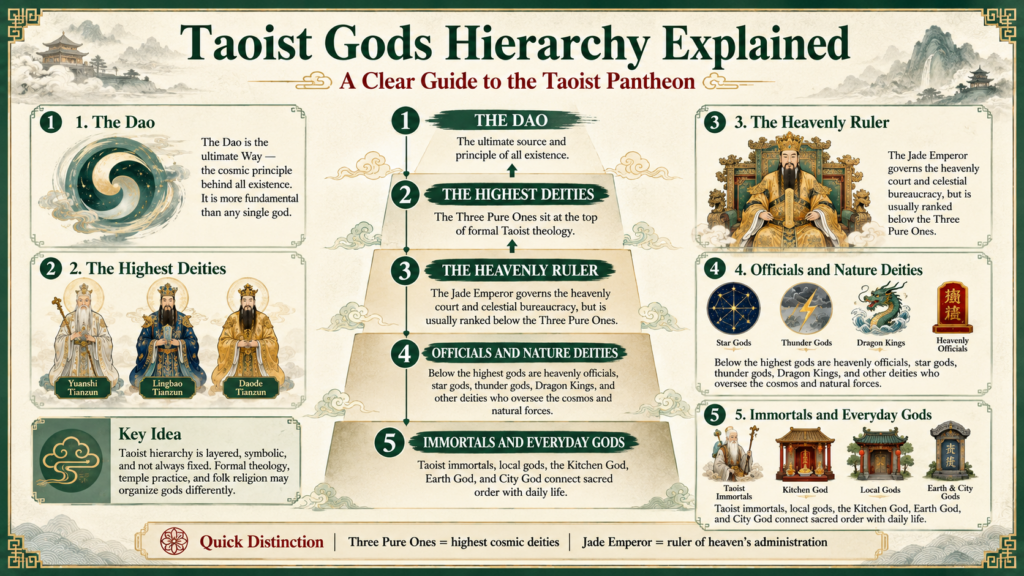
Still, there is a clear pattern. At the highest level are cosmic principles and supreme deities associated with the Dao, the mysterious “Way” or underlying order of reality. Beneath them are great celestial rulers and heavenly officials. Below those are specialized gods, immortals, protectors, local spirits, household deities, and underworld officials. Together, they form a sacred universe that often resembles a vast heavenly administration.
This guide explains the Taoist gods hierarchy in a simple, culturally respectful way, while also showing why different sources may arrange the gods differently.
What Does “Taoist Gods Hierarchy” Mean?
The phrase “Taoist gods hierarchy” refers to the way deities, immortals, spirits, and sacred officials are arranged within Taoist and Chinese religious imagination. In many traditions, the divine world is imagined as ordered, structured, and full of offices, much like an imperial government.
This does not mean every god is simply a government worker in the sky. Some Taoist deities are cosmic and abstract. Some are ancient sages. Some are local protectors. Some are mythological heroes who became divine. Some are spirits connected with nature, stars, mountains, thunder, rivers, or the household.
A beginner-friendly way to understand the hierarchy is to see it as having several layers:
- The Dao as the ultimate cosmic principle
- The Three Pure Ones as the highest Taoist deities
- The Jade Emperor and the heavenly bureaucracy
- Great officials and cosmic administrators
- Nature, star, thunder, and underworld deities
- Immortals and perfected beings
- Local, household, and folk deities
These layers overlap. A deity may appear in Taoist ritual, Chinese folk religion, Buddhist-influenced belief, or literary mythology. That is why a careful explanation should avoid forcing every figure into one rigid chart.
Taoist Gods Hierarchy Explained: A Simple Beginner’s Map
Below is a practical map of the Taoist pantheon for readers who want a clear starting point.
| Level | Main Figures or Groups | Basic Role |
|---|---|---|
| Highest principle | The Dao | The ultimate Way, source, or cosmic order; not a personal god in the usual sense |
| Supreme Taoist deities | The Three Pure Ones | Highest triad of the formal Taoist pantheon |
| Celestial ruler | The Jade Emperor | Ruler of the heavenly bureaucracy in popular and religious imagination |
| Great officials | Three Officials, high emperors, celestial ministers | Administer blessings, sins, misfortunes, fate, registers, and cosmic order |
| Specialized deities | Thunder gods, star gods, Dragon Kings, wealth gods, martial protectors | Govern natural forces, stars, weather, prosperity, protection, and ritual functions |
| Immortals | Xian, Eight Immortals, perfected beings | Humans or beings who attained transcendence through cultivation, virtue, or mythic transformation |
| Local and household gods | City God, Earth God, Kitchen God, Door Gods | Protect communities, homes, kitchens, boundaries, and daily life |
| Underworld officials | Ten Kings or Magistrates of Hell, Fengdu figures | Judge, record, and administer the dead in underworld traditions |
This table is not a universal official ranking. It is a teaching tool. Taoist temples, ritual manuals, and local traditions may organize divine figures differently.
The Dao: The Highest Principle, Not Simply a God
At the deepest level of Taoist thought is the Dao, often translated as “the Way.” The Dao is not usually treated as a personal creator god. It is the underlying pattern, source, process, and reality through which the world arises and changes.
In mythology and religious Taoism, the Dao may be expressed through divine forms, sacred names, heavenly realms, and ritual symbols. But the Dao itself is more fundamental than any individual deity. It is not a king sitting above the gods. It is the ultimate order that makes the sacred cosmos possible.
This is one reason the Taoist pantheon can be difficult for beginners. At the top is not simply “the strongest god,” but a principle that can be represented through divine beings.
The Three Pure Ones: The Highest Taoist Deities
The Three Pure Ones, or Sanqing, are usually placed at the highest level of the formal Taoist pantheon. They are associated with the highest heavens or pure realms and represent supreme expressions of the Dao.
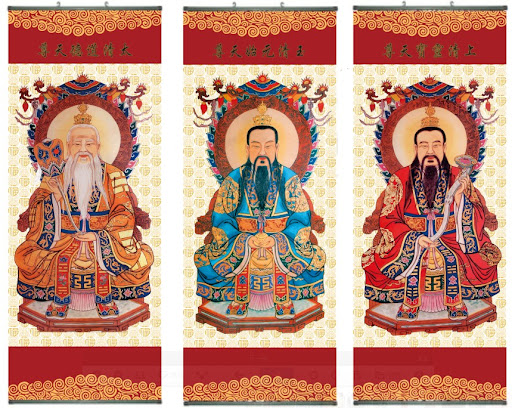
The three are commonly known as:
Yuanshi Tianzun: The Celestial Worthy of Primordial Beginning
Yuanshi Tianzun is often understood as a primordial deity associated with the beginning of cosmic order. His name can be translated as “Celestial Worthy of Primordial Beginning.” He represents an extremely high and abstract level of Taoist divinity.
Lingbao Tianzun: The Celestial Worthy of Numinous Treasure
Lingbao Tianzun is associated with sacred teachings, ritual order, and the transmission of divine truth. The term “Lingbao” means “Numinous Treasure” or “Spiritual Treasure,” and it is also connected with an important Taoist scriptural and ritual tradition.
Daode Tianzun: The Celestial Worthy of the Dao and Its Virtue
Daode Tianzun is closely associated with Laozi, the traditional author of the Daodejing. In religious Taoism, Laozi is not only remembered as a sage or philosopher but also revered in a divine form as Taishang Laojun, the “Supreme Venerable Lord Lao.”
The Three Pure Ones are not simply three powerful characters in a myth. They are cosmic and theological figures. They stand for different dimensions of the Dao, sacred teaching, cosmic origin, and spiritual authority.
Is the Jade Emperor Above the Three Pure Ones?
This is one of the most common questions about Taoist gods.
In many popular stories, the Jade Emperor seems like the highest ruler of heaven. He presides over the heavenly court, gives commands, receives reports, and governs many gods. In that sense, he is the emperor of the celestial bureaucracy.
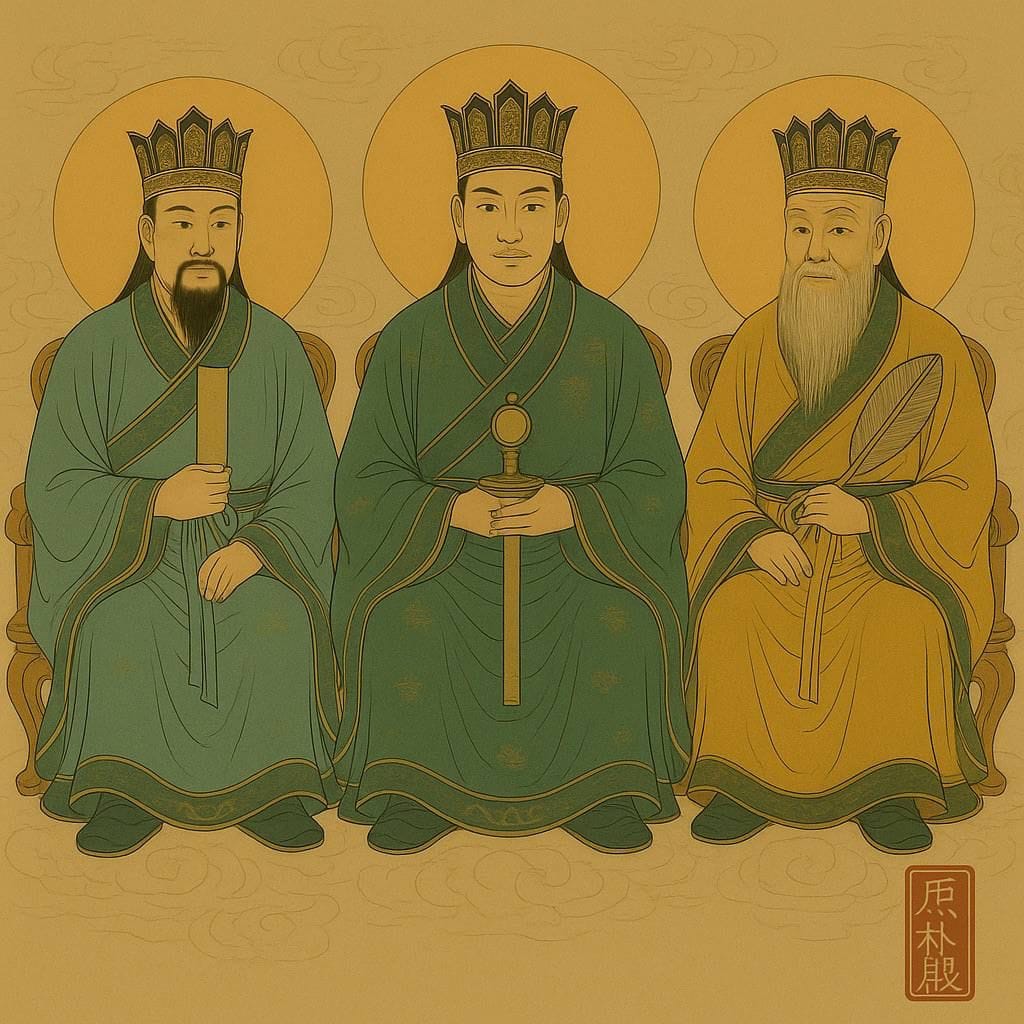
However, in formal Taoist hierarchy, the Three Pure Ones are usually placed above the Jade Emperor. The Jade Emperor is better understood as the supreme administrator of the ordered universe, while the Three Pure Ones represent a higher cosmic or theological level.
A simple comparison may help:
- The Three Pure Ones represent supreme cosmic principles and sacred authority.
- The Jade Emperor represents heavenly rulership and administration.
This is why two statements can both be true in different contexts: the Jade Emperor is often the highest ruler in popular Chinese heavenly bureaucracy, but the Three Pure Ones are generally higher in formal Taoist theology.
The Jade Emperor: Ruler of the Heavenly Bureaucracy
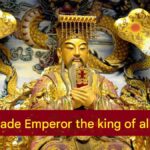
The Jade Emperor, known in Chinese as Yuhuang Dadi or Yudi, is one of the most familiar deities in Chinese mythology. He is often imagined as the ruler of Heaven, presiding over a vast court of gods, officials, messengers, and divine departments.
His role is easier to understand if we remember the influence of imperial Chinese government. Just as the human emperor ruled through ministries, officials, reports, ranks, and local administrators, the Jade Emperor’s heavenly court was imagined as a cosmic government.
In stories and popular belief, deities such as the Kitchen God may report human behavior to the heavenly court. City Gods may govern local spiritual affairs. Underworld officials may keep records of the dead. Weather gods, thunder gods, and star gods may each have their own responsibilities.
The Jade Emperor is not always portrayed as a creator god. His importance lies in order, judgment, hierarchy, and cosmic administration. He symbolizes the idea that the universe is morally and ritually structured.
The Celestial Bureaucracy: Why Taoist Heaven Looks Like a Government
One of the most distinctive features of Chinese religious imagination is the celestial bureaucracy. This means that the divine world is arranged like an imperial administration, with ranks, offices, reports, petitions, documents, and specialized departments.
This idea appears strongly in Taoist ritual culture. Taoist priests may submit petitions to deities, invoke celestial officials, use registers, and communicate with divine offices through ritual forms. The structure reflects both religious imagination and historical Chinese political culture.
For English-speaking readers, this can feel unusual. In many Western mythologies, gods are often organized as families, tribes, or rival personalities. In Chinese religion, gods may also be personalities, but they are frequently understood through office and function.
A god is important not only because of personal power, but because of jurisdiction. What does this deity govern? Which realm does this deity oversee? What reports does this deity receive? What blessings, judgments, or protections can this deity grant?
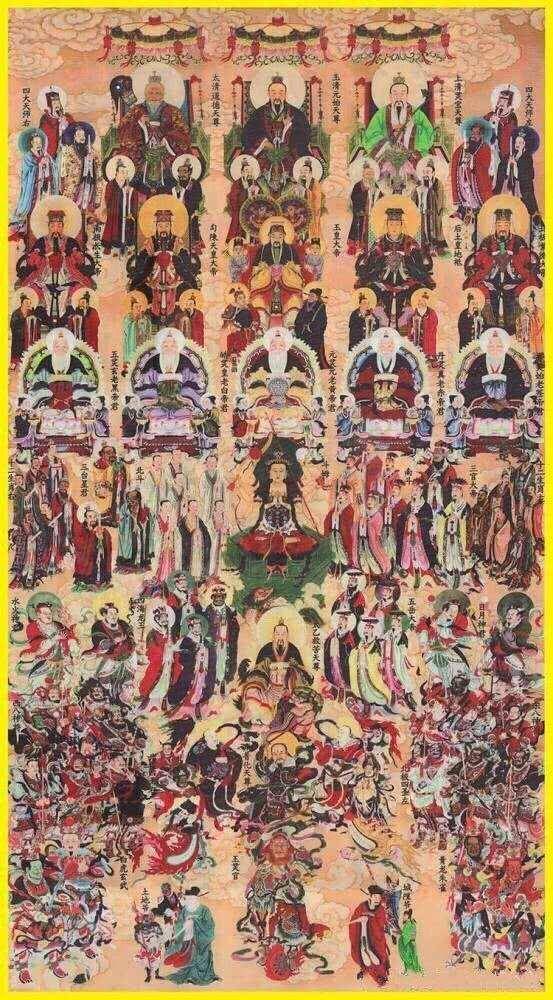
This administrative model helps explain why there are so many gods in Taoist and Chinese folk religion. A complex world requires many offices.
The Three Officials: Heaven, Earth, and Water
The Three Officials, or Sanguan, are important high-ranking Taoist deities. They are usually known as:
- The Heavenly Official, who grants blessings
- The Earthly Official, who absolves sins or relieves burdens
- The Water Official, who removes misfortunes
They are connected with the realms of Heaven, Earth, and Water. In ritual tradition, petitions could be offered to them in different ways, such as burning, burying, or submerging written petitions, symbolically sending them to the proper cosmic realm.
The Three Officials show how Taoist hierarchy is not only about power but also about ritual function. They are important because they administer moral and cosmic processes: blessing, judgment, repentance, misfortune, and relief.
They also connect Taoist religion with older Chinese patterns of reverence for Heaven, Earth, and Water. In this sense, Taoist deities often absorb and reorganize older religious ideas into a more structured sacred system.
High Deities, Star Gods, Thunder Gods, and Nature Officials
Below the most supreme deities are many powerful gods associated with stars, thunder, weather, mountains, rivers, directions, and cosmic forces.
These include figures such as:
- Thunder deities who control storms, punishment, and ritual power
- Star deities associated with fate, longevity, destiny, or cosmic order
- Dragon Kings who rule waters, seas, rain, and rivers
- Mountain gods connected with sacred peaks and local power
- Wind and rain deities who govern weather
- Wealth gods who are invoked for prosperity
- Martial protectors such as Guan Yu in some religious contexts
These figures may not all be “Taoist” in a narrow sense. Some come from folk religion, local cults, imperial recognition, Buddhist influence, or popular mythology. But many were incorporated into Taoist ritual and temple practice.
This is one of the key features of Chinese mythology: the pantheon is not closed. It grows, adapts, and absorbs important figures over time.
Immortals: Xian and the Path of Transcendence
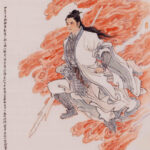
Taoist immortals, or xian, are different from many gods because they are often imagined as beings who attained transcendence. Some may have once been human sages, hermits, alchemists, masters, or legendary figures. Through cultivation, virtue, spiritual practice, or mythic transformation, they became immortal or semi-divine.
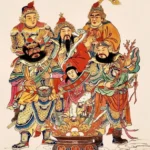
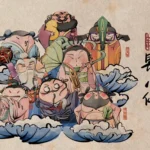
The most famous group is the Eight Immortals. They are widely loved in Chinese art, opera, folklore, and popular storytelling. Each has a distinct personality and symbolic object, and together they represent different social types: old and young, male and female, rich and poor, official and outsider.
Immortals are important because they make Taoist mythology feel more accessible. Supreme deities may seem distant and cosmic, but immortals show the possibility of transformation. They represent the idea that humans may harmonize with the Dao, cultivate spiritual power, and transcend ordinary limits.
This does not mean every Taoist tradition teaches immortality in the same literal way. In some contexts, immortality may be physical, spiritual, symbolic, moral, or mythological. But the figure of the immortal remains central to Taoist imagination.
Local Gods: City God, Earth God, and Kitchen God
At the more familiar level of daily life are local and household gods. These deities are often closer to ordinary people than the high celestial gods.
The City God
The City God, or Chenghuang, protects a city or district. He may be imagined as a supernatural magistrate, similar to a local official in the imperial government. His responsibilities can include protecting the city, handling spiritual justice, and overseeing local souls.
The Earth God
The Earth God, often called Tudi Gong, is a local land deity. He is usually friendly, accessible, and close to community life. Villages, neighborhoods, and even small places may have their own Earth God.
The Kitchen God
The Kitchen God, or Zao Jun, protects the household and is associated with the family stove. In popular tradition, he reports the family’s conduct to Heaven before the Lunar New Year. This makes him both a household guardian and a moral messenger.
These gods show how the Taoist and Chinese religious world reaches into ordinary life. Heaven is not distant. It is connected to the kitchen, the doorway, the village, the city, and the family altar.
Underworld Officials and the Moral Order
Chinese religious cosmology often includes an underworld bureaucracy. This may involve the Ten Kings or Magistrates of Hell, judges, record keepers, messengers, and punishments or processes for the dead.
These ideas are not purely Taoist. They developed through the interaction of Chinese folk religion, Buddhism, Taoist ritual, and popular morality. In many stories, the underworld works like a court system. Deeds are recorded, souls are judged, and consequences are assigned.
In the broader hierarchy, underworld officials are part of the same moral cosmos as heavenly officials and household gods. Human actions matter because they are observed, recorded, reported, and judged.
Historical and Cultural Background
The Taoist gods hierarchy developed over many centuries. It cannot be traced to one founder, one book, or one moment.
Early Taoist thought emphasized the Dao, naturalness, transformation, non-forcing action, and harmony with the cosmic order. Later religious Taoism developed priestly lineages, scriptures, rituals, heavens, deities, sacred registers, and liturgical systems.
At the same time, Chinese society already had traditions of ancestor worship, local gods, mountain worship, imperial rituals, and reverence for Heaven and Earth. Buddhism also entered China and influenced ideas of the afterlife, salvation, compassion, and underworld judgment.
The result was not a simple replacement of one religion by another. Instead, Chinese religious culture often blended, reorganized, and reinterpreted older and newer ideas. A deity could be important in local worship, honored by the state, adopted into Taoist ritual, and appear in popular stories.
This is why Taoist gods are best understood as part of a living cultural system, not merely as characters in a mythology book.
Symbolism of the Taoist Divine Hierarchy
The Taoist divine hierarchy carries several layers of meaning.
First, it symbolizes cosmic order. The universe is not random or chaotic. It has patterns, offices, rhythms, and relationships.
Second, it reflects the connection between heaven and society. The heavenly bureaucracy mirrors the human bureaucracy, showing how ancient Chinese culture imagined moral order through administration, rank, and responsibility.
Third, it expresses the importance of ritual communication. Humans can pray, petition, repent, give thanks, seek protection, and align themselves with the sacred order.
Fourth, it shows the range of Chinese divinity. Some gods are cosmic and abstract. Others are local and personal. Some are stern judges. Others are compassionate helpers. Some govern thunder and stars. Others guard a stove or village gate.
Finally, the hierarchy expresses the Taoist idea that spiritual reality has many levels. The ordinary world, the body, the household, the city, the mountains, the heavens, and the Dao are not completely separate. They are connected through patterns of correspondence.
Common Misunderstandings
Misunderstanding 1: The Jade Emperor Is Always the Highest Taoist God
The Jade Emperor is extremely important, especially in popular Chinese religion and stories about the heavenly court. However, in formal Taoist hierarchy, the Three Pure Ones are usually placed above him. The Jade Emperor is best understood as the ruler of the celestial bureaucracy, not necessarily the highest cosmic principle.
Misunderstanding 2: Taoist Gods Form One Fixed Family Tree
Taoist deities are not arranged like a single family genealogy. The hierarchy depends on scripture, ritual tradition, temple practice, local belief, and popular storytelling. There are common patterns, but no single chart explains everything.
Misunderstanding 3: All Chinese Gods Are Taoist Gods
Many Chinese deities appear in Taoist contexts, but not all Chinese gods are originally or exclusively Taoist. Some belong to folk religion, Buddhist tradition, local worship, imperial cults, or literary mythology. Chinese religious culture is highly interconnected.
Misunderstanding 4: Immortals and Gods Are the Same Thing
Immortals, or xian, are often beings who attained transcendence through cultivation or transformation. Gods may be cosmic beings, officials, nature powers, deified heroes, or local protectors. The categories overlap, but they are not identical.
Misunderstanding 5: Taoist Mythology Is Just Fantasy
Taoist mythology includes wonderful stories, but it should not be reduced to fantasy entertainment. These deities are connected with ritual life, moral values, local communities, art, festivals, temples, and centuries of cultural memory.
Why This Figure/Story Still Matters
The Taoist gods hierarchy still matters because it helps us understand Chinese mythology as a system of meaning rather than a random collection of gods.
For mythology readers, it explains why the Jade Emperor appears as a ruler, why immortals are so beloved, why household gods matter, and why heavenly officials are so common in Chinese stories.
For students of culture, it reveals how religion, government, family, morality, and cosmology shaped one another in Chinese history. The heavens were imagined through the language of earthly administration, while earthly life was understood as part of a larger cosmic order.
For modern readers, the hierarchy also offers a window into how people made sense of daily life. A kitchen was not just a kitchen. A city was not just a city. A mountain, river, family altar, doorway, or thunderstorm could all belong to a sacred network of relationships.
Even for readers who do not practice Taoism, learning this hierarchy makes Chinese literature, temple art, festivals, folklore, and classical novels much easier to understand.
FAQ
Who is the highest god in Taoism?
In formal Taoist hierarchy, the Three Pure Ones are usually considered the highest deities. At an even deeper level, the Dao is the ultimate principle behind all things, though it is not a personal god in the ordinary sense.
Is the Jade Emperor the ruler of all Taoist gods?
The Jade Emperor is commonly portrayed as the ruler of Heaven and head of the celestial bureaucracy. However, he is usually placed below the Three Pure Ones in formal Taoist theology.
Who are the Three Pure Ones?
The Three Pure Ones are Yuanshi Tianzun, Lingbao Tianzun, and Daode Tianzun. They represent the highest triad of Taoist divinity and are associated with supreme heavens, sacred teaching, and cosmic order.
Are Taoist gods the same as Chinese folk gods?
Not always. Some Chinese folk gods are worshipped in Taoist temples or incorporated into Taoist ritual, but many come from local religion, ancestral traditions, Buddhist influence, popular stories, or imperial recognition.
What is a xian in Taoism?
A xian is an immortal or transcendent being. In many stories, xian were humans or sages who achieved immortality or divine status through cultivation, spiritual discipline, virtue, or mythic transformation.
Why does Taoist heaven look like a government?
Chinese religious imagination often modeled the divine world after the imperial bureaucracy. This helped people understand gods as officials with ranks, duties, jurisdictions, and responsibilities.
Are the Eight Immortals Taoist gods?
The Eight Immortals are usually understood as Taoist immortals rather than supreme gods. They are beloved figures in folklore, art, opera, and popular religion, and they represent transformation, blessing, and transcendence.
Is there one official Taoist pantheon?
There is no single universal chart accepted by all traditions. Taoist hierarchy varies across scriptures, sects, temples, regions, rituals, and popular stories.
Conclusion
The Taoist gods hierarchy is best understood as a layered sacred order. At the highest level is the Dao, the ultimate Way. The Three Pure Ones represent the supreme divine triad of formal Taoist tradition. The Jade Emperor rules the heavenly bureaucracy in popular and religious imagination. Beneath them are great officials, star gods, thunder gods, nature deities, immortals, local protectors, household gods, and underworld judges.
This hierarchy is not a rigid ladder but a living cultural system. It combines theology, ritual, mythology, politics, family life, and local belief. That is why it can seem complex at first, but also why it is so rich.
To understand Taoist gods is to understand a world where heaven, earth, household, body, morality, and community are connected. The divine order is not far away. It appears in temples, festivals, stories, kitchens, city gates, mountains, rivers, and the long memory of Chinese culture.