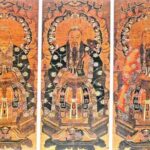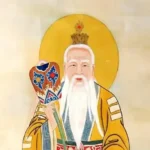
Lu Dongbin (吕洞宾, Lǚ Dòngbīn) is the best-known member of the Eight Immortals (八仙, Bāxiān) and one of the most widely worshipped immortals in Chinese religion. In Daoist tradition he is a xian (仙), a person believed to have reached transcendence through self-cultivation, rather than a god who was divine from the start. Later hagiography makes him a Tang-dynasty scholar who abandoned an official career after a dream showed him the emptiness of worldly success.
The historical person behind the legend is hard to pin down. He first appears in Song-dynasty writings, and his image then kept growing: patriarch of internal alchemy, healer, swordsman, poet, wine-loving wanderer, and the voice behind countless spirit-written scriptures.
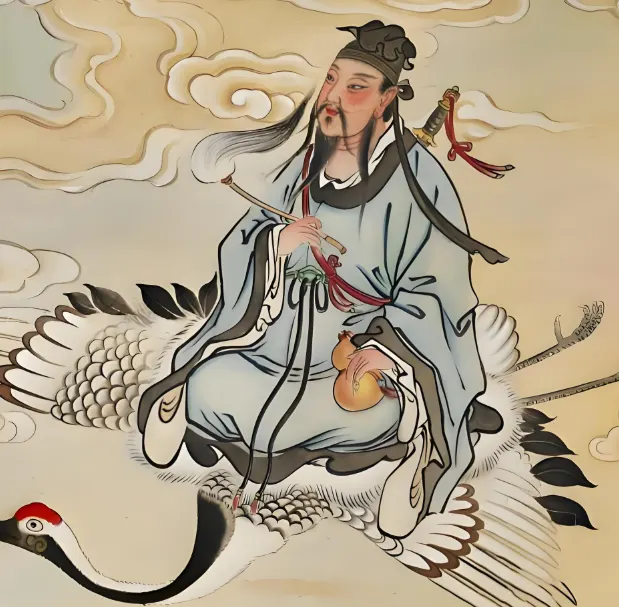
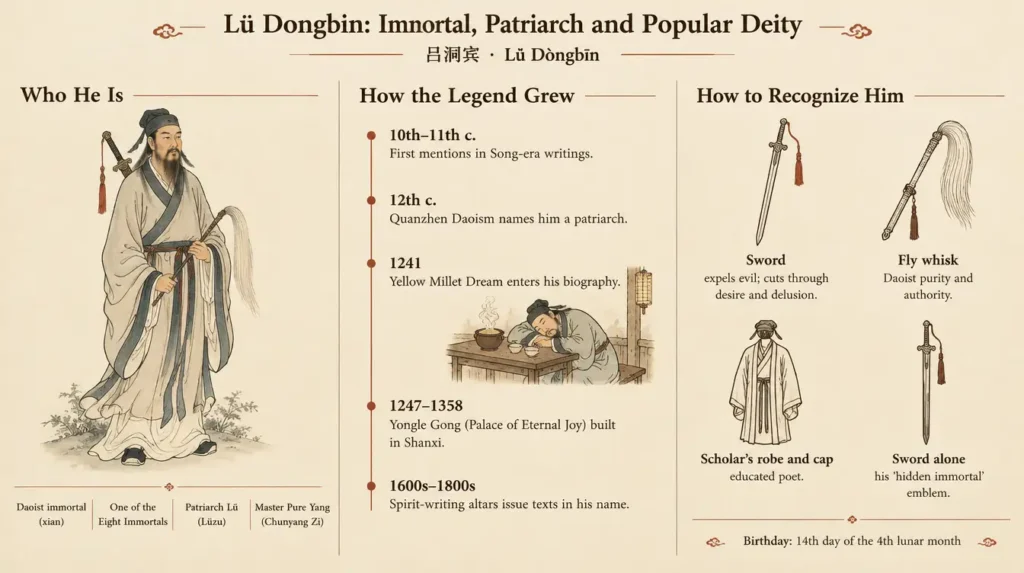
Quick answer: Lü Dongbin is a Daoist immortal, revered as Patriarch Lü (吕祖, Lǚzǔ) and Master Pure Yang (纯阳子, Chúnyáng Zǐ). He is a member of the Eight Immortals, a patriarch of the Zhong-Lü and Quanzhen internal-alchemy traditions, and a popular deity whose sword, fly whisk and scholar’s dress make him easy to recognize.
| Topic | Lü Dongbin at a glance |
|---|---|
| Chinese name | 吕洞宾 / 呂洞賓, Lǚ Dòngbīn |
| Personal name | Lü Yan (吕岩 / 吕嵒, Lǚ Yán); Dongbin is his courtesy name |
| Main titles | Lüzu (Patriarch Lü), Chunyang Zi (Master Pure Yang), Fuyou Dijun (孚佑帝君) |
| Classification | Daoist immortal (xian), later worshipped as a deity in temples and spirit-writing altars |
| Group | Eight Immortals (Ba Xian) |
| Teacher in legend | Zhongli Quan (钟离权, Zhōnglí Quán) |
| Attributes | Sword, fly whisk, scholar’s robe and cap; sometimes a wine gourd |
| Traditional birthday | 14th day of the 4th lunar month |
| Major cult site | Yongle Gong (永乐宫, Palace of Eternal Joy), Ruicheng, Shanxi |
Who Is Lü Dongbin?
Lü Dongbin sits at the meeting point of several traditions that are easy to blur together. In religious Daoism he is a master of neidan (内丹, internal alchemy) and a lineage patriarch. In popular religion he is a responsive deity who heals, gives advice and answers prayers. In fiction and drama he is a lively, sometimes flawed character: a drinker, a trickster and a flirt as well as a teacher of the Way.
That range is the main reason he became the most famous of the Eight Immortals. Other members of the group are known chiefly through a single emblem or a handful of stories. Lü has an alchemical literature, a temple network, an imperial title, a body of poems attributed to him and a living cult.
His classification matters. Calling him “the god Lü Dongbin” is not wrong in a temple setting, where he is worshipped, but it can hide the core idea of his story: he was a human being who became immortal through cultivation. The distinction between deities and immortals is explained in more detail in our guide to the difference between Taoist gods and immortals.
Names and Titles
Tradition gives his personal name as Lü Yan, with Dongbin as his courtesy name. “Dongbin” is often read as “guest of the cave,” a fitting name for a hermit, though it functions as a name rather than a description.
His religious titles show how his status rose over time:
- Chunyang Zi (纯阳子), Master Pure Yang: a Daoist sobriquet. In internal alchemy, “pure yang” describes the fully refined state of a cultivator who has transcended mortality.
- Lüzu (吕祖), Patriarch Lü: the title used especially in Quanzhen Daoism and in spirit-writing communities.
- Zhenren (真人), Perfected Person: the Northern Song emperor Huizong (r. 1100–1126) granted him an honorary zhenren title.
- Fuyou Dijun (孚佑帝君): a title associated with Yuan-dynasty imperial honors in the early 14th century, which raised him to the rank of dijun, “imperial lord.” Temples in Taiwan and elsewhere still use it.
Was Lü Dongbin a Real Person?
The honest answer is that a real person may stand behind the legend, but his life cannot be reconstructed with confidence.
Later Daoist hagiography gives him a full Tang-dynasty biography. A widely repeated version has him born in 798 in Yongle county (in today’s Ruicheng, Shanxi), into an official family, and failing the civil-service examinations before turning to Daoism. A Jin-dynasty stele first carved in 1228 at his shrine in Yongle already presents this kind of life story, including his conversion by Zhongli Quan. These are devotional sources, however, written centuries after the life they describe.
The earliest surviving mentions are thinner and later. Livia Kohn’s study of the Zhong-Lü texts notes that the first work to name him is attributed to Tao Gu (903–970), followed by scattered references in early Song geography, anecdote collections and poetry. On the basis of such early material, the scholar Zhu Yueli argued that a historical Lü most likely lived from the Five Dynasties into the early Northern Song, roughly the 10th century, rather than in the Tang.
Paul Katz, in his book on Lü’s cult at the Palace of Eternal Joy, emphasizes a different point: the search for one “historical” Lü can be misleading, because the sources present many different Lüs. A careful reading treats the Tang biography as part of the cult’s history, not as a reliable record of an individual.
Main Legends of Lü Dongbin
The core story of his conversion took shape gradually. According to Kohn, a basic version of his life and trials appears in an early 12th-century source, while the famous dream episode was attached to his biography only in a Quanzhen hagiography of 1241.
The Yellow Millet Dream
In the best-known version, the young scholar Lü meets Zhongli Quan at an inn. While a pot of yellow millet (黄粱, huángliáng) is cooking, Lü falls asleep and dreams an entire career: examination success, high office, marriage and wealth, followed by disgrace, exile and the loss of his family. He wakes to find the millet still not done. Understanding that worldly glory passes as quickly as the dream, he asks Zhongli Quan to teach him.
The motif is older than Lü’s legend. A Tang tale, “The World Inside a Pillow” (枕中记, Zhěnzhōng jì), tells of a Daoist “Old Man Lü” who lends a magic pillow to a frustrated scholar named Lu. Later tradition reworked the story so that Lü Dongbin himself became the dreamer and Zhongli Quan his teacher. Yuan drama, including a play associated with Ma Zhiyuan, helped make this version famous on stage.
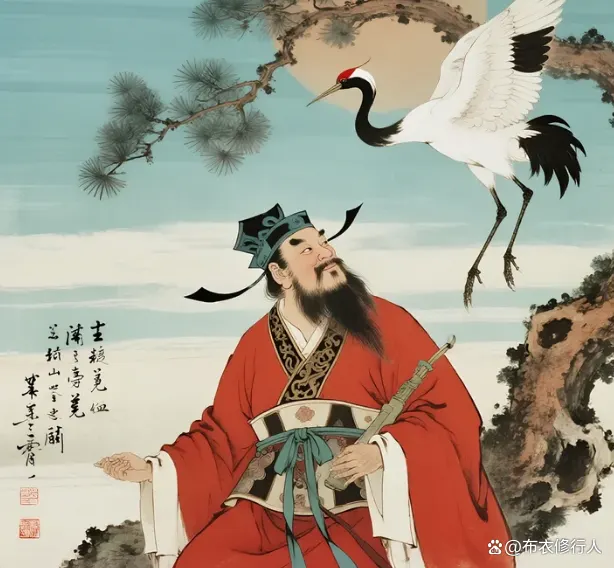
The Ten Tests of Zhongli Quan
Before transmitting his teachings, Zhongli Quan tests Lü ten times. The episodes vary between versions, but they check the same virtues: calm in the face of grief, indifference to money, patience under insult, courage before danger, and resistance to sexual temptation. In one test Lü returns goods that turn out to be gold; in another he protects animals from a hungry tiger. Only after passing them all does he receive instruction in the methods of immortality.
Wine, Yueyang Tower and Healing Miracles
Many later stories show Lü wandering in disguise among ordinary people. He rewards hospitality, punishes greed and cures illness. One familiar tale has him turn an honest old woman’s well water into wine. Another cycle places him at Yueyang Tower overlooking Dongting Lake, where he is said to have appeared, drunk and unrecognized, more than once; the Yuan play Lü Dongbin Gets Drunk Three Times at Yueyang Tower dramatized the theme.
White Peony and the Less Saintly Lü
Not every Lü story is edifying. In popular fiction he tries to convert, or in bawdier versions to seduce, a courtesan named White Peony (白牡丹, Bái Mǔdān). Scholars of late imperial narrative have paid attention to these “infamous” sides of his character. They show how popular storytelling made him approachable: an immortal with human appetites, not a remote saint.
“A Dog Bites Lü Dongbin”
His name also lives on in everyday speech. The saying 狗咬吕洞宾,不识好人心 (gǒu yǎo Lǚ Dòngbīn, bù shí hǎorén xīn), “a dog bites Lü Dongbin and doesn’t recognize a kind heart,” describes someone who repays good intentions with hostility.
Lü Dongbin and Daoist Internal Alchemy
Lü’s religious importance rests above all on internal alchemy, the Daoist practice of refining the body’s essence, energy and spirit to achieve transcendence. Two key texts of the so-called Zhong-Lü (钟吕) tradition present teachings attributed to Zhongli Quan and Lü Dongbin: the Zhong-Lü chuandao ji (钟吕传道集, Transmission of the Dao from Zhongli Quan to Lü Dongbin), a dialogue between teacher and student, and the Lingbao bifa (灵宝毕法, Complete Methods of the Numinous Treasure). Modern scholars generally date these texts to the Song, most likely the 11th or 12th century, not to the Tang.
The Quanzhen (全真, Complete Perfection) school, founded by Wang Chongyang in the 12th century, adopted Zhongli Quan, Lü Dongbin and Liu Haichan as the immortals who had instructed its founder, and counted them among its patriarchs. Lineages of the southern internal-alchemy tradition also traced their teachings back through Lü. For readers interested in what “becoming immortal” meant in practice, see how immortality was pursued in Taoism.
The Palace of Eternal Joy
Lü’s most important surviving temple is Yongle Gong (永乐宫), the Palace of Eternal Joy, which Quanzhen Daoists rebuilt on the site associated with his birthplace in Shanxi. Construction ran from the mid-13th century until 1358. Its Yuan-dynasty murals are among the finest in China; the Hall of Pure Yang (纯阳殿, Chúnyáng Diàn) carries a long narrative cycle of Lü’s life and miraculous appearances, including a scene of Zhongli Quan instructing him. In the late 1950s and 1960s the entire complex was dismantled and moved about 20 kilometers to escape flooding from the Sanmenxia reservoir.
Symbols and Iconography
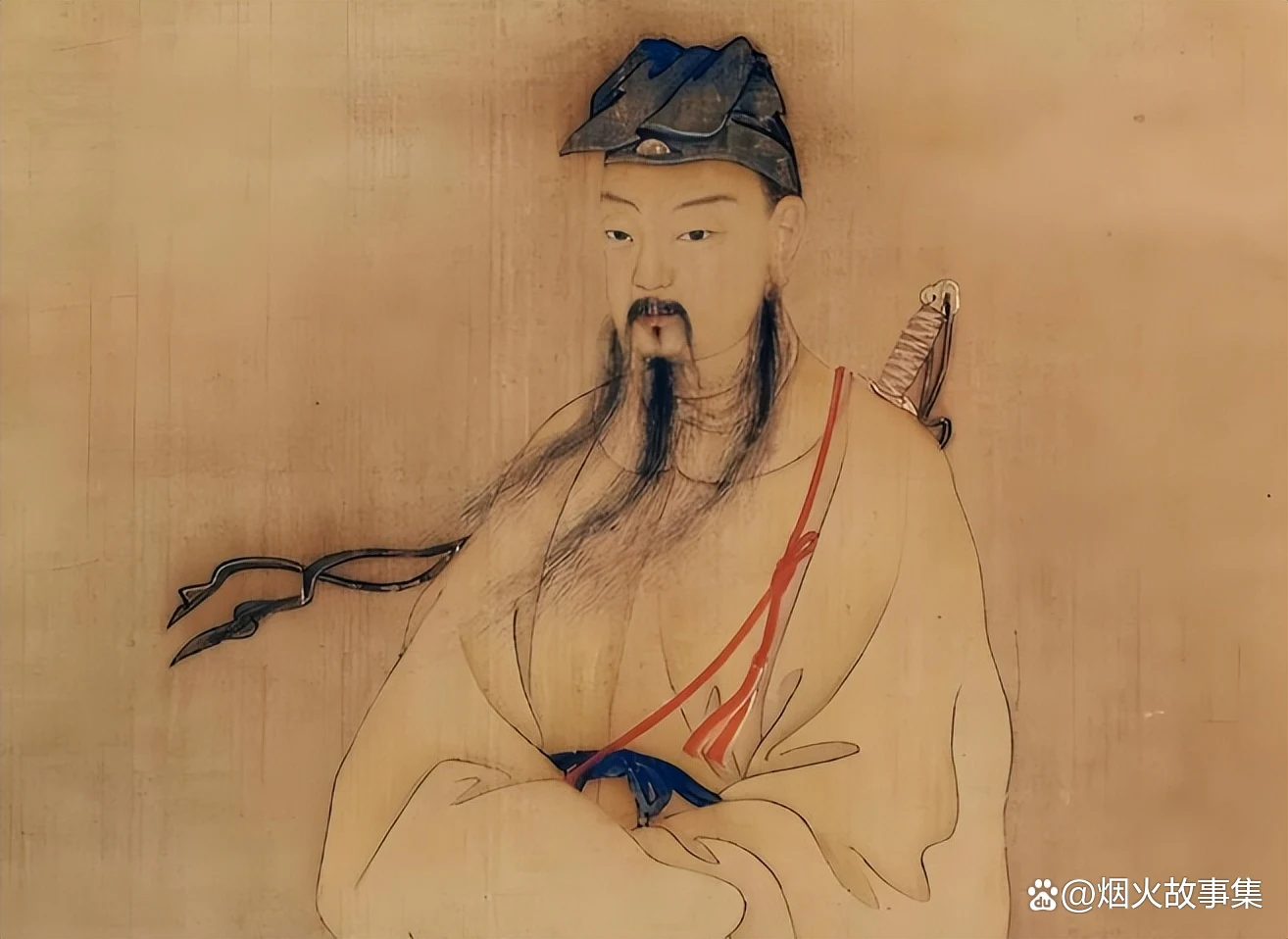
Lü Dongbin is one of the easiest immortals to identify in Chinese art.
| Attribute | How it appears | Common meaning |
|---|---|---|
| Sword (剑, jiàn) | Carried in the hand or strapped across the back | Expelling demons and evil influences; in Daoist teaching, often read as cutting through desire, anger and delusion |
| Fly whisk (拂尘, fúchén) | Held in one hand | A standard Daoist emblem of purity and authority |
| Scholar’s robe and cap | Flowing robes and a soft cap with hanging flaps | His background as an educated man and a poet |
| Sword as “hidden immortal” emblem | On ceramics and textiles, a sword alone can stand for him | Part of the an baxian (暗八仙) set, where objects represent the Eight Immortals |
Museum examples follow this pattern. A Ming-dynasty bronze figure in the Victoria and Albert Museum shows him in a scholar’s robe and cap, and the museum describes his sword as a weapon against evil influences. A Yuan marble group shown at the Sichuan Museum in 2026 places an attendant carrying a sword beside the seated Lü, which the curator suggested may be an early stage of the sword-bearing image.
Lü Dongbin Among the Eight Immortals
The Eight Immortals did not begin as a fixed group. Jin-dynasty tomb carvings and Yuan dramas show varying line-ups, and the familiar eight members were standardized in the Ming period, notably in Wu Yuantai’s novel Journey to the East (东游记, Dōngyóu jì). Throughout this development Lü was a constant presence, usually paired with his teacher Zhongli Quan.
Popular culture often calls Lü the leader of the Eight Immortals. That reflects his fame rather than a formal rank; there is no single fixed hierarchy within the group. His stories also connect him with other members. Folk tradition links him with He Xiangu, the only woman in the standard group, and in Ming fiction he and Zhongli Quan guide other members, including Cao Guojiu, toward the Way.
Worship, Spirit-Writing and Living Tradition
Lü became one of the most popular deities of late imperial China, but his cult worked in several registers at once.
- Temple worship: He is honored as Lüzu or Fuyou Dijun in Daoist and popular temples. His birthday is traditionally celebrated on the 14th day of the 4th lunar month.
- Patron of trades: Katz notes that Lü was claimed as a patron by groups as different as ink-makers and the entertainment quarters, a sign of how widely his image spread.
- Spirit-writing: From the late Ming and especially the Qing, Lü became a leading deity of fuji (扶乩) spirit-writing altars, where messages were received through a planchette. Many scriptures, poems and moral teachings were issued in his name.
- Regional devotion: In the 19th and 20th centuries Lüzu altars spread strongly in Guangdong and Hong Kong. In Taipei, the hillside Zhinan Temple (指南宫), dedicated to Lü, is famous for a piece of local lore warning unmarried couples not to visit together.
The best-known spirit-written text linked to him is The Secret of the Golden Flower (太乙金华宗旨, Tàiyǐ jīnhuá zōngzhǐ), made famous in the West by Richard Wilhelm’s translation and Carl Jung’s commentary. Research by Lai Chi Tim and others shows that the text was revealed at Lüzu spirit-writing altars in Changzhou in 1668 and 1692, and later printed in the large Complete Works of Patriarch Lü (吕祖全书) in 1775. It is a Qing revelation attributed to Lü, not a Tang document written by him.
Common Misunderstandings
- “Lü Dongbin is a Tang official whose life is well documented.” The detailed Tang biography comes from later devotional sources; the earliest datable references belong to the 10th and 11th centuries.
- “He is the highest Daoist god.” He is an immortal and a patriarch, highly revered, but he is not placed above figures such as the Three Pure Ones. See our explanation of the Taoist gods hierarchy, which also varies by tradition.
- “He wrote The Secret of the Golden Flower.” The text is attributed to him through spirit-writing in the Qing period.
- “His sword is only a weapon.” In religious interpretation it is as much a symbol of inner discipline as a demon-slaying blade.
For more Daoist figures, immortals and celestial officials, browse the Taoist Deities directory.
Frequently Asked Questions
What is Lü Dongbin the god of?
He is not a god of one natural force or profession. He is a Daoist immortal revered as a teacher of internal alchemy, a healer and a helper who responds to prayers. Different groups have also adopted him as a patron, and spirit-writing communities treat him as a source of moral and religious guidance.
Is Lü Dongbin the leader of the Eight Immortals?
He is often described that way because he is the most famous member, but the Eight Immortals have no formal ranking. In many stories he is closely paired with his teacher, Zhongli Quan.
How do you pronounce Lü Dongbin?
In Mandarin it is Lǚ Dòngbīn, roughly “lyoo dong-bin.” The ü is pronounced like the German ü. In English it is often written Lu Dongbin without the umlaut.
Why does Lü Dongbin carry a sword?
Stories describe him using the sword to drive away demons and evil influences. Daoist interpretation often treats it as a symbol of cutting through desire and delusion, and on decorative objects the sword alone can represent him.
When is Lü Dongbin’s birthday?
His birthday is traditionally celebrated on the 14th day of the fourth month of the Chinese lunar calendar, which usually falls in May or June.
What is the Yellow Millet Dream?
It is the story of how Lü, while waiting for millet to cook, dreamed a whole life of success and ruin. On waking he realized that worldly ambition is fleeting and became Zhongli Quan’s disciple. The dream motif adapts an earlier Tang tale.
References and Further Reading
- Katz, Paul R. Images of the Immortal: The Cult of Lü Dongbin at the Palace of Eternal Joy. Honolulu: University of Hawai’i Press, 1999.
- Kohn, Livia. The Zhong-Lü System of Internal Alchemy. Three Pines Press / University of Hawai’i Press, 2020.
- Zhu Yueli 朱越利. “An Introduction to Inner Alchemists of the Cantong Tradition: Lü Dongbin, Liu Haichan and Others in the Northern Song Dynasty” (in Chinese). Daoism: Religion, History and Society 1 (2009): 281–311.
- Lai Chi Tim 黎志添. “The Jingming Origin of the Taiyi jinhua zongzhi: The Spirit-Writing Community in Changzhou and the Jingming Tradition in the Early Qing” (in Chinese). Daoism: Religion, History and Society 9 (2017): 103–140.
- Daozang jiyao Project, Chinese University of Hong Kong. International Conference on Lüzu Cult, Lay Groups, and Religious Innovations in Qing Daoism (2014), abstracts and program.
- Encyclopaedia Britannica. “Lu Dongbin.”
- Victoria and Albert Museum. Figure of Lu Dongbin, cast bronze, China, 1550–1640 (71-1889).
- China News Service. Report on the Sichuan Museum exhibition of Lü Dongbin and Eight Immortals artifacts (in Chinese), August 12, 2026.