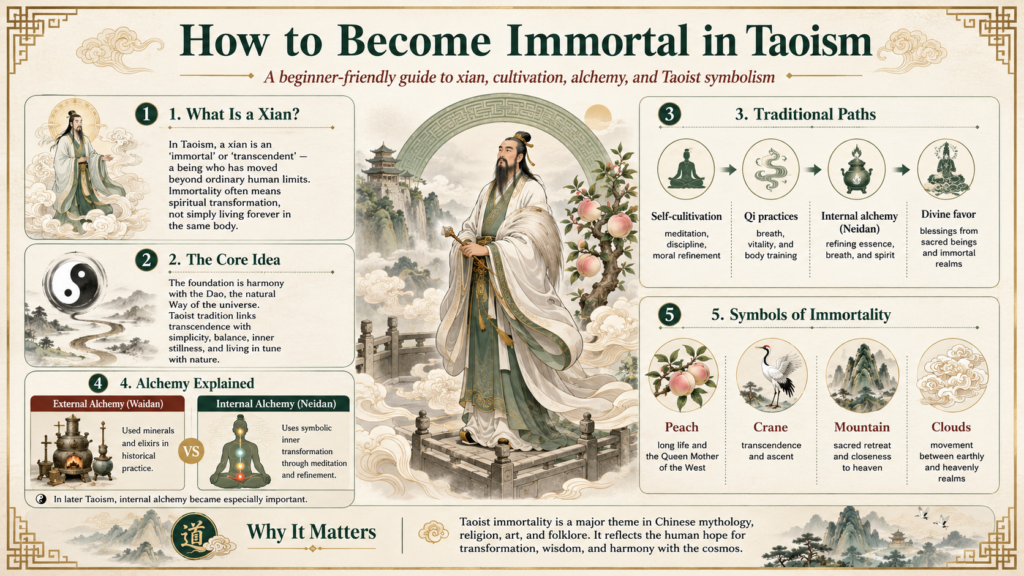
The question “how to become immortal in Taoism” sounds simple at first, but the answer leads into one of the richest parts of Chinese mythology and religious history. Taoist immortality is not only about avoiding death. It is also about transformation, spiritual refinement, harmony with the Dao, and the mysterious beings known in Chinese as xian.
In English, xian is often translated as “immortal,” but many scholars also use “transcendent.” This second translation is important because Taoist immortality is not always imagined as the ordinary human body lasting forever. In many texts and legends, the immortal becomes a different kind of being: lighter, freer, closer to heaven, able to travel between realms, and no longer bound by the usual limits of age, sickness, and decay.
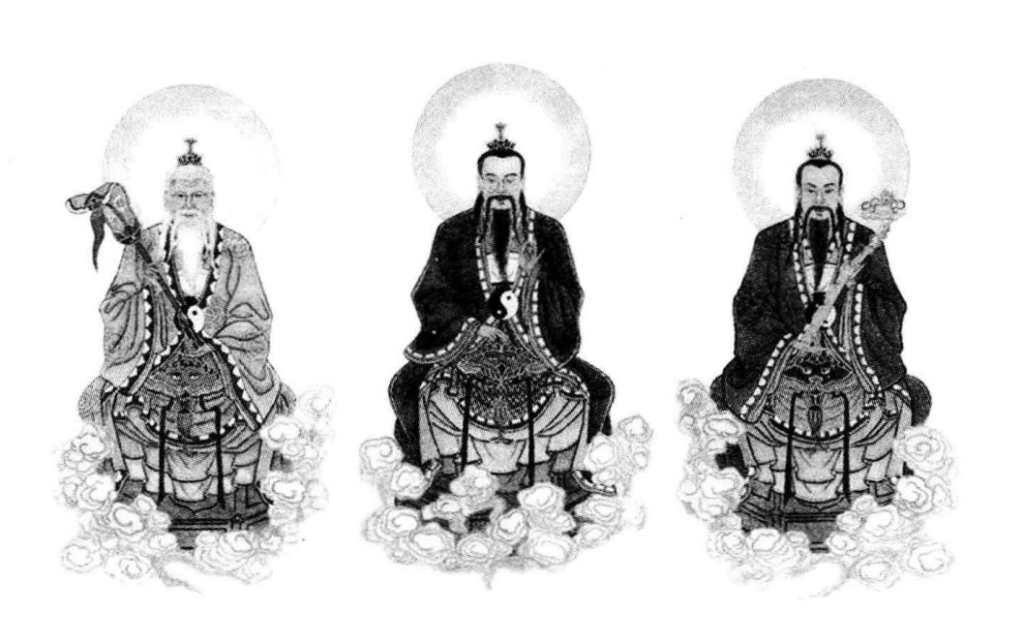
For readers of Chinese mythology, the Taoist immortal appears in many forms. Some immortals live on sacred mountains. Some attend the banquets of Xiwangmu, the Queen Mother of the West. Some carry gourds, swords, lotus flowers, castanets, or flutes. Some are sages, hermits, healers, eccentrics, or wandering figures who appear in human society only to vanish again. The Eight Immortals, or Baxian, are the most famous group, but they are only one part of a much wider tradition.
This article explains how immortality is understood in Taoism, what traditional paths were associated with it, and why the idea still matters in Chinese mythology, art, literature, and popular culture.
What Does Immortality Mean in Taoism?
In Taoism, immortality can mean several related but different things.
At the most basic level, it means freedom from ordinary death. A xian is someone who has crossed the boundary between the human and the divine. Such a being may live in the mountains, ascend to heaven, appear and disappear at will, or dwell in a hidden paradise.
But Taoist immortality is not always the same as physical eternal life. Some early and medieval Taoist traditions imagined immortality as a transformation of the body. Other traditions treated it as spiritual liberation, a rebirth into a subtler form, or a way of joining the cosmic order of the Dao.
This is why “immortal” can be slightly misleading if readers imagine a person simply living forever in the same body. In Taoist thought and mythology, immortality often involves becoming something more refined than an ordinary human being.
A Taoist immortal may be described as:
- A perfected person who has attained harmony with the Dao
- A transcendent being who can enter heavenly or hidden realms
- A sage whose body has been spiritually transformed
- A legendary figure who gained long life through cultivation
- A divine or semi-divine being honored in temples, stories, and art
In mythology, these meanings often overlap. A xian can be a religious ideal, a folklore figure, a symbol of longevity, and a character in a mythological story all at once.
How to Become Immortal in Taoism: The Traditional Paths
To understand how to become immortal in Taoism, it helps to separate the mythological image from the historical traditions behind it. Taoist texts, legends, and later folklore describe several paths toward immortality. They do not form one single system. Instead, they reflect different periods, schools, and religious imaginations.
The main paths include self-cultivation, moral refinement, breath and body practices, external alchemy, internal alchemy, divine favor, and symbolic rebirth.
1. Living in Harmony with the Dao
The deepest foundation of Taoist immortality is harmony with the Dao.
The Dao, often translated as “the Way,” is the underlying order, process, and source of reality. To live according to the Dao means to move with the natural pattern of things rather than forcing life through ego, ambition, excess, or artificial control.
In early Taoist philosophy, the ideal sage is not aggressive, rigid, or obsessed with status. The sage is simple, flexible, quiet, and responsive. This attitude is often connected with wu wei, usually translated as “non-forcing” or “effortless action.” Wu wei does not mean doing nothing. It means acting without strain, vanity, or unnecessary interference.
In the context of immortality, harmony with the Dao suggests that the person who no longer fights the natural order becomes less bound by ordinary limitations. Mythologically, this harmony may appear as lightness, flight, freedom, or the ability to move between worlds.
This is one reason immortals are often associated with mountains, clouds, cranes, and remote landscapes. They are not merely powerful. They are free from the noise and pressures of ordinary society.
2. Self-Cultivation and Moral Refinement
Many Taoist immortality stories emphasize cultivation. This word is important. Immortality is rarely presented as a random gift. It is usually connected with long discipline, simplicity, purity, and inner transformation.
Cultivation may include:
- Quiet meditation
- Breath training
- Ethical discipline
- Detachment from greed and fame
- Study with a master
- Living close to nature
- Ritual practice
- Refinement of the body, breath, and spirit
In myths, the person who becomes immortal often withdraws from ordinary ambition. He or she may leave the city, enter the mountains, meet a hidden teacher, or receive a secret scripture. These stories express a cultural idea: immortality belongs not to those who conquer the world, but to those who transform themselves.
This does not mean that every Taoist story portrays immortals as solemn saints. Many famous immortals are eccentric, humorous, poor, disabled, drunk, or socially unconventional. Li Tieguai, one of the Eight Immortals, is often shown with an iron crutch and a gourd. Lan Caihe appears as an ambiguous wandering figure. These images suggest that transcendence may appear in forms society does not expect.
3. Breath, Qi, and Longevity Practices
Taoist traditions have long connected life with qi, the vital energy or breath that animates the body and the cosmos. Many practices associated with longevity involve regulating breath, calming the mind, strengthening vitality, and aligning the body with natural rhythms.
Historical Taoist longevity practices included breathing exercises, meditative stillness, diet, physical movements, and techniques later associated with traditions such as qigong. These practices were not always identical across time and place. Some were religious, some medical, some meditative, and some belonged to esoteric lineages.
In mythology, breath and qi are often linked with lightness and transformation. The immortal does not seem heavy or trapped. He or she may float, ride a crane, ascend a mountain, or travel through the clouds.
For modern readers, it is important not to reduce these traditions to a simple health routine. In Taoist religious culture, breath and qi practices were part of a much broader view of the body as a small cosmos. The human body mirrored heaven, earth, yin and yang, the five phases, and the movement of the Dao itself.
4. External Alchemy: Elixirs of Immortality
One of the most famous and misunderstood paths to Taoist immortality is external alchemy, known in Chinese as waidan, or “external elixir.”
External alchemy involved preparing substances, often minerals and metals, in the hope of creating an elixir that could transform the body and confer long life or immortality. Cinnabar, mercury, gold, and other substances appear in historical alchemical traditions.
This was not simply early chemistry in a modern sense. It was also ritual, cosmological, and religious. The alchemical vessel could symbolize the cosmos. The transformation of substances could mirror the transformation of the adept. The elixir was not merely a medicine but a sacred object connected with divine powers and cosmic processes.
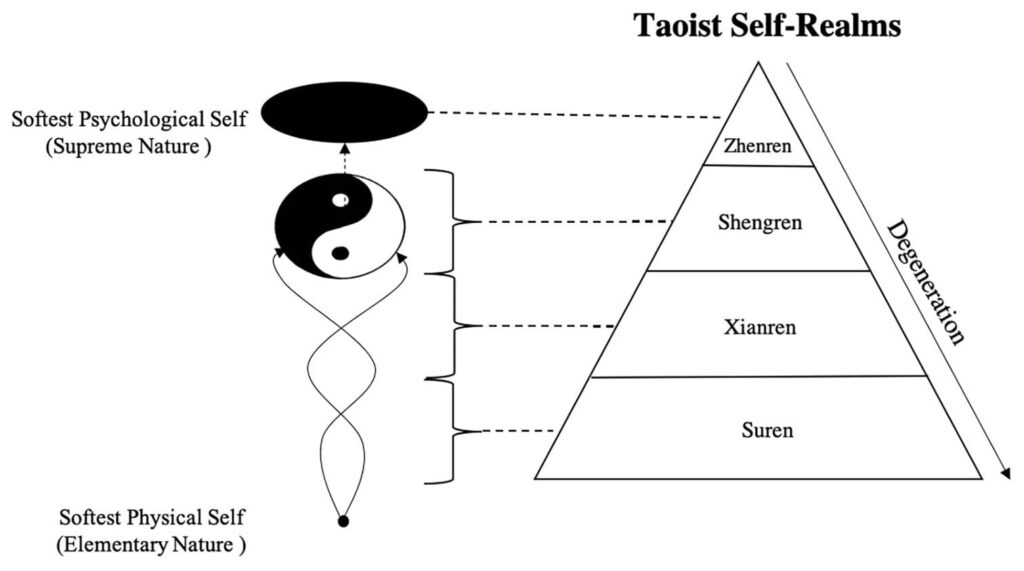
However, external alchemy was also dangerous. Some substances used in historical elixirs were toxic. Chinese history includes accounts of elites and even emperors harmed by attempts to consume immortality elixirs. For this reason, external alchemy should be understood as a historical and mythological tradition, not as something to imitate.
In mythology, elixirs remain powerful symbols. They represent the dream that death might be overcome through hidden knowledge. They also show the risks of mistaking material power for true transformation.
5. Internal Alchemy: Refining the Self
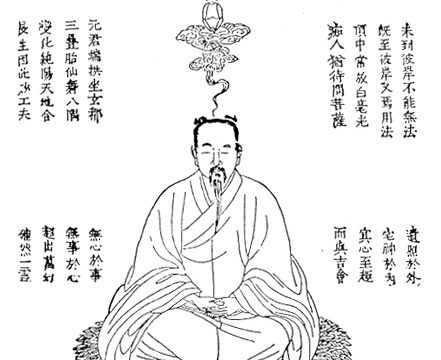
Over time, internal alchemy, or neidan, became one of the most important Taoist ways of discussing immortality. Unlike external alchemy, internal alchemy does not focus on making a physical elixir in a furnace. Instead, it uses alchemical language to describe transformation within the practitioner.
In internal alchemy, the body becomes the furnace. The vital energies become the ingredients. The goal is to refine essence, breath, and spirit into a higher state of being.
Because neidan texts are often symbolic, they can be difficult for beginners. Terms such as “golden elixir,” “embryo,” “furnace,” “cauldron,” “true lead,” and “true mercury” do not always refer to physical substances. They often point to meditative and spiritual processes.
In mythology and religious imagination, internal alchemy offers a more inward understanding of immortality. The immortal is not simply someone who swallowed the right potion. The immortal is someone whose entire being has been refined.
This is one of the most important differences between Taoist immortality and a simple fantasy version of eternal life. The deeper ideal is not endless survival, but transformation into a more complete, subtle, and harmonious state.
6. Divine Favor and the Peaches of Immortality
Chinese mythology also describes immortality as something granted by divine beings. The most famous example is Xiwangmu, the Queen Mother of the West.
Xiwangmu is one of the great figures of Daoist mythology. She is associated with a western paradise, divine attendants, and the famous peaches of immortality, known as pantao. These peaches grow in her garden and ripen only after a very long cycle. When they ripen, immortals gather for a celestial banquet.
The peach became one of the most recognizable symbols of long life in Chinese culture. It appears in paintings, birthday imagery, ceramics, decorative art, and stories. In myth, eating the peach is not simply eating fruit. It means receiving access to a divine order where ordinary time no longer rules.
The peaches of immortality show another side of Taoist myth: immortality is not always achieved through discipline alone. It may also require divine recognition, destiny, or entrance into a celestial community.
This is why the Eight Immortals are often connected with Xiwangmu’s peach banquet. Their immortality is not isolated. It places them within a larger sacred world.
7. Release from the Mortal Body
Some Taoist traditions describe immortality through a mysterious process often translated as “release from the corpse” or “corpse liberation.” The basic idea is that the adept appears to die, but the true transformed being departs and continues in another form.
This idea is difficult for modern readers because it does not fit neatly into the categories of physical immortality or ordinary afterlife belief. It is a form of transformation. The visible body may be left behind, replaced, hidden, or spiritually transcended, while the perfected being continues elsewhere.
In mythology, this helps explain stories in which an immortal seems to vanish, leave behind a strange corpse, or reappear after death. The point is not always that the body never died in a normal sense. The point is that the adept escaped the ordinary finality of death.
This concept also reminds us that Taoist immortality is often about crossing boundaries: human and divine, body and spirit, visible and invisible, earth and heaven.
The Xian: Taoist Immortals and Transcendents
The xian are the central figures in Taoist immortality lore. They are not all the same. Some are ancient sages. Some are legendary hermits. Some are deified humans. Some are mythological beings who belong almost entirely to the world of legend.
Common features of xian include:
- Long life or freedom from death
- Association with mountains or hidden realms
- Spiritual powers
- Unusual appearance or behavior
- Ability to travel between worlds
- Connection with cranes, clouds, gourds, swords, or peaches
- Detachment from ordinary wealth and rank
The mountain is especially important. In Chinese mythology, mountains are places where heaven and earth meet. They are remote, sacred, and difficult to access. Immortals often dwell on mountains because mountains symbolize distance from ordinary life and closeness to divine realms.
Islands also appear in immortality lore. Myths of eastern islands of the immortals, such as Penglai, express a similar idea: the immortal realm is real within the mythic imagination, but hard for ordinary people to reach.
The Eight Immortals and the Human Face of Immortality
The Eight Immortals, or Baxian, are among the most beloved immortal figures in Chinese mythology. They are usually named as:
- Lü Dongbin
- Zhongli Quan
- Zhang Guolao
- Li Tieguai
- He Xiangu
- Han Xiangzi
- Cao Guojiu
- Lan Caihe
One reason the Eight Immortals became so popular is that they represent different kinds of people. They are not all kings, priests, or perfect sages. Their group includes old and young, male and female, rich and poor, refined and eccentric. This variety made them widely appealing in folk religion, drama, painting, opera, and decorative art.
Their most famous collective story is “The Eight Immortals Cross the Sea.” In this tale, each immortal uses a personal object or power to cross the ocean. The story is often summarized by the saying that each shows his or her own divine ability. Symbolically, the tale suggests that there are many paths to transcendence.
The Eight Immortals also make Taoist immortality feel more human. They are powerful, but they are not distant abstractions. They have personalities, flaws, symbols, and stories. They appear in homes, temples, paintings, carvings, and festival imagery as signs of blessing, longevity, and good fortune.
Ge Hong and the Serious Search for Immortality
Any serious discussion of Taoist immortality should mention Ge Hong, a major figure of early medieval China. Ge Hong is closely associated with the Baopuzi, often translated as “The Master Who Embraces Simplicity.”
Ge Hong wrote about longevity, transcendence, alchemy, and self-cultivation. His work shows that the search for immortality was not only folklore. It also belonged to intellectual, religious, and technical traditions. For Ge Hong, immortality required discipline, knowledge, and access to special teachings.
He also distinguished between merely extending life and truly becoming immortal. This distinction is important. Longevity means living longer. Immortality means crossing into a different state of existence.
From a mythology website perspective, Ge Hong helps bridge two worlds: the legendary world of immortals and the historical world of Taoist adepts who took the quest seriously.
Symbols of Taoist Immortality
Taoist immortality is surrounded by a rich visual language. These symbols are common in Chinese art and folklore.
The Peach
The peach symbolizes long life, divine blessing, and the promise of immortality. It is strongly associated with Xiwangmu and her celestial orchard.
The Crane
The crane is a bird of longevity and transcendence. Immortals may ride cranes or be shown with them, suggesting flight between heaven and earth.
The Gourd
The gourd often appears with immortals such as Li Tieguai. It may hold medicine, spirits, magical power, or a hidden world.
The Pine
The pine tree remains green through winter, making it a symbol of endurance and long life.
The Mountain
Mountains represent sacred distance, retreat, and closeness to heaven. Many immortals are mountain dwellers.
The Elixir
The elixir symbolizes transformation. Whether external or internal, it represents the hope that the human condition can be refined into something deathless.
Clouds
Clouds suggest movement between realms. In art, immortals often appear among clouds, showing that they belong partly to heaven.
Common Misunderstandings
“Taoist immortality simply means living forever in the same body.”
This is too simple. Some traditions did imagine physical immortality, but many Taoist sources describe transformation, rebirth, or the creation of a subtler spiritual body. Immortality often means becoming a transcendent being, not merely extending ordinary biological life forever.
“Taoism has one clear method for becoming immortal.”
There is no single universal method. Taoist immortality traditions include meditation, breath practices, moral cultivation, ritual, external alchemy, internal alchemy, divine favor, and mythological motifs. Different schools and texts understood the goal differently.
“The elixir of immortality was just a magic potion.”
In mythology, the elixir may look like a magic potion, but in Taoist religious history it had complex ritual and cosmological meanings. In internal alchemy, the “elixir” may be symbolic rather than physical.
“External alchemy is safe because it is ancient.”
This is false. Historical external alchemy sometimes involved toxic substances. It should be studied as history and mythology, not copied as a health practice.
“Xian are the same as gods.”
Xian and gods overlap in Chinese religion and folklore, but they are not always identical. A god may be a deity by cosmic office, worship, or divine identity. A xian is often imagined as a human or sage who became transcendent through cultivation, alchemy, divine favor, or spiritual transformation.
“Taoist immortals are the same as modern xianxia characters.”
Modern xianxia fiction draws inspiration from Taoist immortality, but it is a modern fantasy genre. Traditional Taoist immortality is more complex, religious, symbolic, and culturally rooted than power-level cultivation stories.
Why This Figure/Story Still Matters
The Taoist quest for immortality still matters because it shaped Chinese culture far beyond religious texts.
It influenced painting, poetry, fiction, opera, temple imagery, medicine, birthday customs, decorative arts, and popular storytelling. The peach of immortality is still recognizable as a symbol of long life. The Eight Immortals still appear in art and festival culture. Xiwangmu remains one of the great divine figures of Chinese mythology.
The idea also matters because it expresses a universal human question: can we overcome decay, fear, and death?
Taoist mythology answers this question in a distinctive way. It does not only imagine immortality as power. It imagines it as refinement, harmony, lightness, and freedom. The immortal is not merely someone who survives. The immortal becomes transformed.
For modern readers, this makes Taoist immortality more than a strange ancient belief. It is a symbolic language for thinking about how human life might become more aligned with nature, less trapped by ambition, and more open to mystery.
Taoist Immortality in Chinese Mythology and Literature
Taoist immortality appears across many forms of Chinese storytelling. Immortals may enter a tale to test a person’s character, offer a warning, reward humility, or reveal that worldly success is temporary.
In some stories, a poor or overlooked person becomes immortal because of sincerity and discipline. In others, an emperor fails to gain immortality because he seeks it through power and possession. This contrast is important. Chinese immortality legends often criticize greed and impatience.
Sacred mountains, hidden caves, magical islands, and celestial banquets all belong to this mythological world. These settings are not random decorations. They represent the distance between ordinary life and the realm of transcendence.
The immortal’s strange behavior also has meaning. Many immortals appear eccentric because they no longer follow ordinary social expectations. Their freedom may look foolish to the world, but in the logic of Taoist myth, it reveals a higher wisdom.
Is Taoist Immortality Religious, Mythological, or Philosophical?
It is all three.
Taoism is difficult to divide into neat Western categories. It includes philosophy, religion, ritual, meditation, mythology, gods, immortals, sacred texts, and local traditions. The question of immortality belongs to this whole landscape.
Philosophically, immortality is connected with harmony with the Dao and freedom from artificial striving.
Religiously, it is connected with practices, lineages, rituals, scriptures, divine beings, and sacred realms.
Mythologically, it appears in stories of peaches, elixirs, mountains, cranes, and immortals who cross the sea.
For a beginner, the best approach is not to force these categories apart. Taoist immortality is best understood as a cultural and religious imagination of transformation.
FAQ
What is a Taoist immortal called?
A Taoist immortal is commonly called a xian in Chinese. The word is often translated as “immortal,” but “transcendent” is also useful because it suggests transformation beyond ordinary human life.
Can humans become immortal in Taoist mythology?
Yes. Many Taoist legends describe humans who become immortals through cultivation, alchemy, divine favor, or spiritual transformation. These stories are mythological and religious, not modern scientific claims.
What are the main ways to become immortal in Taoism?
Traditional sources describe several paths, including self-cultivation, breath practices, meditation, moral discipline, external alchemy, internal alchemy, sacred teachings, and divine favor from beings such as Xiwangmu.
What is the difference between external and internal alchemy?
External alchemy, or waidan, involved preparing elixirs from substances outside the body. Internal alchemy, or neidan, uses alchemical language to describe inner spiritual transformation. Internal alchemy became especially important in later Taoist traditions.
Are Taoist immortality elixirs real?
They are real as historical and mythological concepts, but they should not be treated as safe or literal modern medicines. Some historical elixir practices involved toxic materials.
Who are the Eight Immortals?
The Eight Immortals, or Baxian, are a famous group of Taoist immortals in Chinese mythology. They include Lü Dongbin, He Xiangu, Li Tieguai, Zhongli Quan, Zhang Guolao, Han Xiangzi, Cao Guojiu, and Lan Caihe.
What do peaches have to do with immortality?
In Daoist mythology, the peaches of immortality grow in the garden of Xiwangmu, the Queen Mother of the West. They ripen after a long cycle and are served at a celestial banquet attended by immortals.
Is Taoist immortality the same as xianxia cultivation?
No. Xianxia fiction is a modern fantasy genre inspired partly by Taoist and Chinese mythological ideas. Traditional Taoist immortality is rooted in religion, folklore, symbolism, and historical practice.
Conclusion
The question of how to become immortal in Taoism opens a doorway into one of the most fascinating parts of Chinese mythology. Taoist immortality is not just the desire to live forever. It is a vision of transformation.
To become a xian is to cross the boundary between ordinary human life and a more refined state of being. Different traditions imagined this path in different ways: harmony with the Dao, moral discipline, breath and qi practices, external alchemy, internal alchemy, divine peaches, sacred mountains, and spiritual rebirth.
Some of these ideas belong to historical Taoist practice. Others belong to myth, art, and folklore. Together, they reveal a culture deeply interested in longevity, transformation, and the possibility that human life can be refined beyond its ordinary limits.
For English-speaking readers, Taoist immortality is best understood not as a fantasy shortcut to eternal life, but as a serious and symbolic tradition. It asks what it means to live in harmony with the Dao, to loosen attachment to ordinary ambition, and to imagine a form of life no longer ruled by decay.