
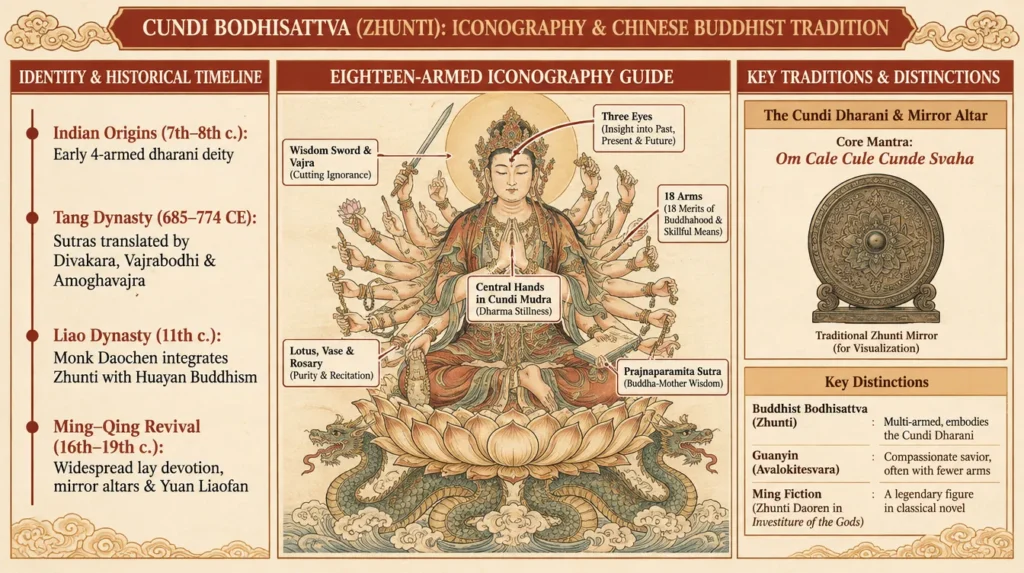
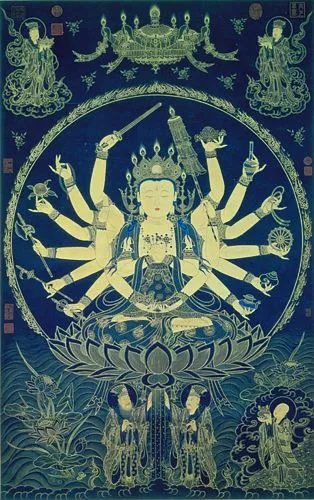
Cundi Bodhisattva (准提菩萨 / 準提菩薩, Zhǔntí Púsà) is a major bodhisattva and esoteric Buddhist figure revered across Chinese Mahāyāna Buddhism as the personification of the Cundī Dhāraṇī—one of the most widely chanted protective and purifying mantras in East Asia. Known in Chinese as the Mother of Seven Koṭis of Buddhas (七俱胝佛母, Qījùzhī Fómǔ), she is most recognizable in Chinese art as a serene, three-eyed, eighteen-armed figure seated on a lotus throne.
Although English sources frequently describe Cundi as a “Buddhist goddess,” her primary identity in Chinese religion is that of a bodhisattva and Buddha-mother rooted in Indian Buddhist dhāraṇī traditions, rather than an indigenous Chinese mythological deity. Over more than a millennium in China, Zhunti practice moved from Tang-dynasty esoteric ritual manuals into mainstream Chan, Pure Land, and lay literati devotion—and eventually inspired a separate literary character, Zhunti Daoren, in Ming-dynasty vernacular fiction.
Who Is Cundi Bodhisattva (Zhunti)?
In Chinese Buddhism, Cundi occupies a distinctive intersection between exoteric Mahāyāna devotion and esoteric (Tantric) ritual practice. Whereas figures such as Amitabha Buddha are primarily tied to Pure Land rebirth and Ksitigarbha (Dizang) is known for his vow to aid beings in the underworld, Cundi is celebrated for accessibility: her texts promise both ultimate spiritual awakening and practical worldly protection to laypeople and monastics alike.
Her exact classification varies across East Asian Buddhist schools:
- Independent Esoteric Bodhisattva and Buddha-Mother: In Tang-dynasty esoteric scriptures and later Chinese manuals, Cundi stands at the center of her own liturgical cycle as the embodiment of the Cundī Dhāraṇī, credited with generating wisdom and purifying karmic obstacles.
- One of the Six Forms of Avalokiteśvara: Within several East Asian classifications—most notably the Japanese Shingon tradition, where she is called Juntei Kannon (准胝観音)—Cundi is grouped as one of the Six Avalokiteśvaras, connecting her directly to Guanyin (观音, Guānyīn), the bodhisattva of compassion. In the Tendai school, however, her place in that sixfold group is typically filled by Amoghapāśa instead.
- Popular “Goddess” Perception: Because her Chinese title includes Fómǔ (佛母, “Buddha-Mother”) and late imperial lay devotees prayed to her for children, health, and career success, English-language summaries often refer to her simply as a goddess. In Buddhist doctrinal terms, however, she remains a bodhisattva and personification of awakened wisdom rather than a worldly deva or folk deity.
Name, Sanskrit Roots, and Titles
The Chinese name Zhunti (准提, also written 準提 or 准胝) is a phonetic transliteration of the Sanskrit Cundī (also spelled Cundā). Like many Sanskrit names of Chinese Buddhist deities, the exact etymology of Cundī has been discussed by scholars, but Chinese Buddhist exegetes consistently glossed the name as meaning “purity” or “spotless cleanliness” (清净, qīngjìng), emphasizing her power to cleanse mental defilements and karmic stains.
Her most famous honorific is Qijuzhi Fomu (七俱胝佛母, Sanskrit: Saptakoṭibuddhamātṛ), literally “Mother of Seven Koṭis of Buddhas.”
- What “Seven Koṭis” Means: In classical Indian numeracy, one koṭi equals ten million, making seven koṭis seventy million. In Mahāyāna scriptural idiom, the phrase does not denote a literal family tree; it is a poetic way of saying that countless Buddhas of the past, present, and future have spoken and realized this dhāraṇī.
- Why “Buddha-Mother” Matters: In Buddhist literature, “mother of Buddhas” is a standard metaphor for transcendent wisdom (prajñāpāramitā) or a sacred formula that gives birth to Buddhahood. As The Princeton Dictionary of Buddhism notes, the epithet links Cundi to the generative power of the dhāraṇī itself. Interestingly, the phrase “Buddha-Mother” appears in Divākara’s and Vajrabodhi’s Tang translations, though it is absent from Amoghavajra’s version of the sutra text.
Origins and Textual History in China
Cundi originated in Indian Buddhism as a dhāraṇī deity associated with early esoteric and Mahāyāna texts. Surviving Indian and Southeast Asian iconography—including seventh- and eighth-century reliefs at Ellora in India and Borobudur in Java, as well as later descriptions in the Sanskrit Sādhanamālā—typically depicts her with four or six arms, holding attributes such as a manuscript on a lotus and a begging bowl.
Her transformation into the iconic eighteen-armed bodhisattva familiar in China began during the Tang dynasty (618–907 CE), when Indian esoteric masters translated the Cundī Dhāraṇī Sūtra and related ritual manuals into Chinese:
- Divākara (地婆诃罗, 685 CE): Translated the Foshuo qijuzhi fomu xin da zhunti tuoluoni jing (Taishō Tripiṭaka, T. 1077), introducing the core scripture and dhāraṇī to Tang China.
- Vajrabodhi (金刚智, 723 CE): Translated an expanded ritual scripture (T. 1075) incorporating detailed esoteric visualization and iconographic instructions.
- Amoghavajra (不空, 8th century): Produced another influential translation (T. 1076) closely tied to Tang esoteric lineage practice.
- Śubhakarasiṃha (善无畏, 8th century): Attributed with a concise ritual manual (T. 1078) outlining altar procedures, mudrās, and the mirror-visualization method.
The Liao-Dynasty Synthesis: Monk Daochen
While Tang esoteric institutions declined after the ninth century, Cundi practice did not vanish. During the Liao dynasty (916–1125), the Huayan monk Daochen (道㲀, also romanized Daoshen) compiled the Xianmi yuantong chengfo xinyao ji (显密圆通成佛心要集, “Collection of Essentials for Attaining Buddhahood through the Perfect Penetration of Exoteric and Esoteric Teachings,” T. 1955).
Daochen placed the Cundi Dharani at the pinnacle of Buddhist practice, famously comparing it to a vast ocean that encompasses all rivers while no single river can contain the ocean. By weaving Tang esoteric visualizations into mainstream Huayan philosophy, Daochen gave Chinese Buddhists a self-contained framework for practicing Zhunti devotion without needing an unbroken Indian tantric initiation lineage.
The Eighteen Arms: Iconography and Symbolism
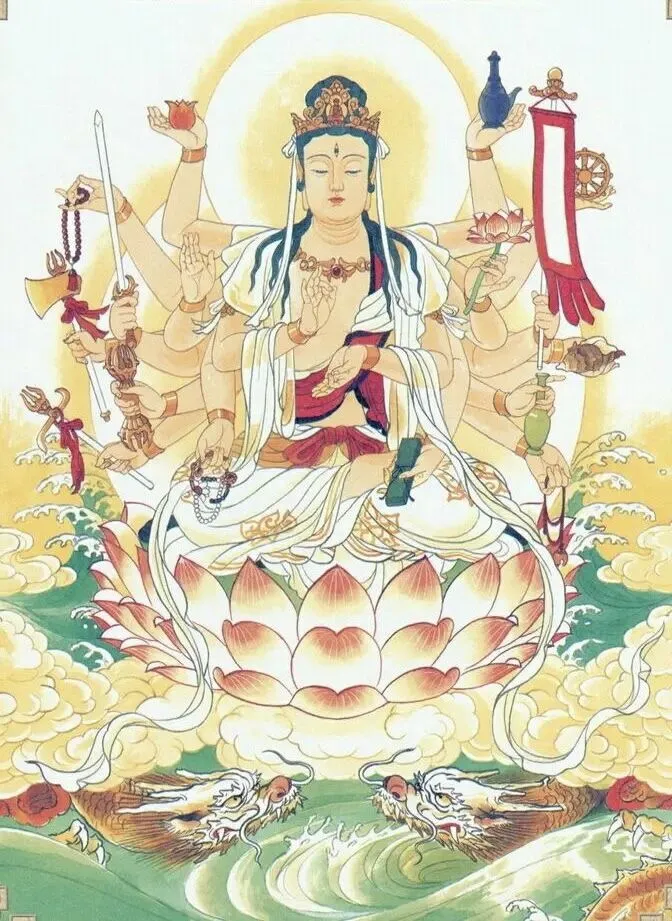
In Chinese temple sculpture, Ming–Qing hanging scrolls (such as the gilt-and-color painting preserved in the National Palace Museum in Taipei), and bronze statues, Cundi is most commonly depicted with one face, three eyes, and eighteen arms. Her body is traditionally described as pale yellow or golden-white, adorned with a jeweled crown bearing a small Buddha image, pearl and jade ornaments, and flowing celestial robes.
According to appendices attached to the Tang-era Cundi scriptures, the eighteen arms symbolize the eighteen unique qualities of a Buddha (aṣṭādaśāveṇika-buddhadharma) and the boundless skillful means (upāya) through which awakening responds to suffering. Beneath her lotus throne, two nāga (dragon) kings—Nanda (难陀) and Upananda (跋难陀)—often rise from the waters to support the lotus stalk.
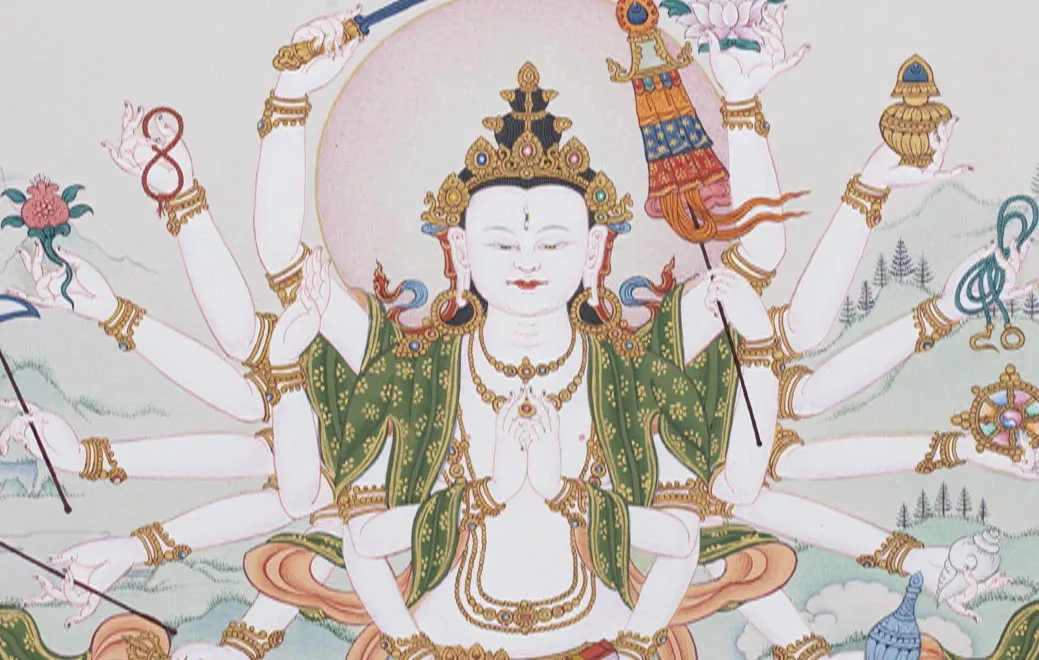
Exact hand-by-hand inventories vary slightly between ritual texts and regional artworks, but the core visual vocabulary remains remarkably consistent:
| Iconographic Feature | Visual Appearance | Traditional Buddhist Meaning |
|---|---|---|
| Central Pair of Hands | Joined at the chest in the Cundī teaching mudrā (shūofǎ yìn) | Expounding the Dharma; stillness and non-dual wisdom at the center of compassionate activity |
| Three Eyes | Two ordinary eyes plus a vertical third eye on the forehead | Clear insight into past, present, and future; unity of Buddha-eye, Dharma-eye, and wisdom-eye |
| Fearlessness Gesture (Abhaya Mudrā) | Upper right hand raised with palm facing outward | Protection from fear, calamity, and spiritual obstacles |
| Wisdom Sword & Vajra | Held in right-side hands | Severing ignorance, greed, and anger; indestructible awakened resolve |
| Dharma Wheel & Conch | Held in left-side hands | Turning the wheel of Buddhist teaching and proclaiming the Dharma across all realms |
| Lotus, Rosary & Vase | Distributed across lower right and left hands | Purity untainted by worldly defilement, continuous mantra recitation, and the nectar of spiritual empowerment |
| Axe, Hook, Noose & Banner | Held in outer hands | Breaking karmic attachments, gathering sentient beings toward liberation, and victory over afflictions |
| Prajñāpāramitā Sutra | Palm-leaf manuscript held in a left hand | Direct link to transcendent wisdom and her title as “Buddha-Mother” |
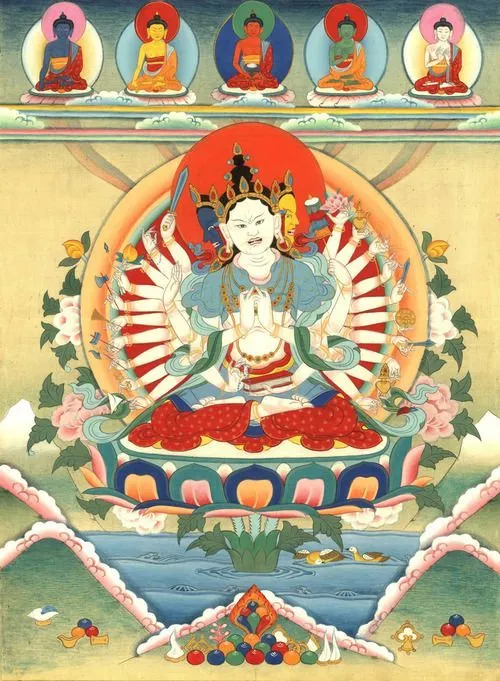
Outside China, Cundi’s form varies further. Tibetan collections preserve peaceful white depictions with four, eighteen, or twenty-six arms (the latter three-faced form recorded by the scholar Tāranātha), while Japanese iconography occasionally shows variants ranging from two to more than eighteen arms.
The Cundi Dharani and Mirror Visualization Practice
At the heart of Zhunti devotion is the Cundī Dhāraṇī (准提神咒, Zhǔntí Shénzhòu), which remains part of the daily morning liturgy in many Chinese Buddhist monasteries as one of the Ten Short Mantras (十小咒). Its Sanskrit form and standard Chinese phonetic transcription are:
Sanskrit: Namaḥ saptānāṃ samyaksaṃbuddha koṭīnāṃ tadyathā oṃ cale cule cunde svāhā
Chinese: 南無 颯哆喃 三藐三菩陀 俱胝喃 怛姪他 唵 折隸 主隸 准提 娑婆訶
Literal Sense: “Homage to the seven koṭis of perfectly awakened Buddhas. Thus: Oṃ cale cule cunde svāhā.”
Chinese devotees traditionally precede the mantra with a four-line verse attributed to the Tang and Liao traditions, paying homage to the seven koṭis of Buddhas and requesting Cundi’s compassionate protection. What made the Cundi Dharani unusually popular in China was its explicit inclusivity. Unlike strict esoteric rites requiring monastic ordination, vegetarian vows, and elaborate temple altars, the Chinese Cundi scriptures emphasize that laypeople—whether married or unmarried, regardless of diet or ritual impurity—can recite the mantra with a sincere mind.
The Zhunti Mirror Altar (准提镜, Zhǔntí Jìng)
One of the most distinctive features of Chinese Cundi practice is the use of a polished bronze mirror as a portable mandala, a practice analyzed in detail by Buddhist studies scholar Robert M. Gimello. Rather than constructing an expensive multi-figure altar, a practitioner could place a consecrated mirror on a clean stand, face it while reciting the mantra, and visualize Cundi appearing within the reflective surface.
Over time, artisans cast specialized Zhunti mirrors featuring an image of the eighteen-armed bodhisattva or the Siddhaṃ/Chinese characters of the dhāraṇī inscribed on the reverse side. For practitioners, the mirror acted as both ritual tool and philosophical metaphor: just as a mirror reflects every image without being stained, awakened awareness responds to the world while remaining fundamentally pure.
How Zhunti Worship Evolved in Ming–Qing China and Literature
During the late Ming (1368–1644) and Qing (1644–1911) dynasties, Zhunti devotion experienced a remarkable surge across Chinese society. Eminent monastic reformers—including Yunqi Zhuhong (云栖袾宏) and Hanshan Deqing (憨山德清)—endorsed Cundi recitation alongside Chan meditation and Pure Land practice, demonstrating how deeply esoteric dhāraṇī worship had been integrated into mainstream Chinese Buddhism.
Among educated laypeople, the cult gained immense momentum through Yuan Liaofan (袁了凡, 1533–1606), whose moral autobiography Liaofan’s Four Lessons (了凡四训, Liǎofán sìxùn) recounted how reciting the Cundi Mantra alongside cultivating ethical merit helped him overturn a fatalistic horoscope, pass the imperial examinations, and father a son. As historian Tianyu Lei has shown in a 2024 study in the Journal of the Royal Asiatic Society, Ming–Qing literati frequently turned to Zhunti for worldly fortune, heirs, and scholarly success—functional roles that overlapped with popular devotion to Wenchang Wang, the god of literature and examinations.
Zhunti Bodhisattva vs. Zhunti Daoren in Investiture of the Gods
Readers of Chinese mythological fiction often encounter a figure named Zhunti Daoren (准提道人, “Daoist Master Zhunti”) in the late-Ming novel Investiture of the Gods (封神演义, Fēngshén Yǎnyì). In the novel, Zhunti Daoren is a powerful western sage who assists the Zhou cause, wields a Seven-Treasured Magical Tree, and manifests a twenty-four-headed, eighteen-armed cosmic form.
It is essential to separate this literary adaptation from Buddhist religious history. The novelist creatively blended the well-known Buddhist imagery of eighteen-armed Cundi into a fictionalized “Western Sect” (西方教) sage dressed in Daoist-inflected terminology—a striking example of Buddhist influence on Chinese mythology and vernacular storytelling. While the novel’s character borrowed Cundi’s name and eighteen-armed motif, Zhunti Daoren is a Ming literary invention, not an authoritative Buddhist or Daoist scripture.
Cundi Bodhisattva vs. Guanyin and Related Figures
Because museum visitors and readers frequently confuse eighteen-armed Cundi with Thousand-Armed Guanyin, the table below highlights how Cundi compares to closely related figures in Chinese Buddhist art and devotion.
| Figure | Primary Buddhist Role | Signature Iconography | Key Devotional Focus |
|---|---|---|---|
| Cundi (Zhunti) | Esoteric bodhisattva and “Buddha-Mother” (sometimes grouped with the Six Avalokiteśvaras) | One face, three eyes, 18 arms, central hands in Cundī mudrā, lotus supported by two nāga kings | Cundī Dhāraṇī recitation, mirror visualization, purification, protection, and lay accessibility |
| Thousand-Armed Guanyin | Esoteric manifestation of Avalokiteśvara, bodhisattva of compassion | Multiple heads (often 11) and 40 or 1,000 radiating arms with an eye in each palm | Great Compassion Mantra (Dàbēi Zhòu), universal rescue from suffering |
| Guanyin (Standard Form) | Bodhisattva of compassion across Mahāyāna and folk devotion | Two arms, white robes, willow branch, and pure-water vase | Mercy, protection in danger, childbirth, and Pure Land guidance |
| Vairocana Buddha | Cosmic Dharma-body (Dharmakāya) Buddha in Huayan and Esoteric Buddhism | Two arms in the wisdom-fist mudrā (zhìquán yìn) or seated on a thousand-petal lotus | Cosmic enlightenment and the philosophical foundation of Huayan and Tang esoteric mandalas |
If you are exploring how Buddhist figures fit alongside indigenous Chinese religious traditions, see our directories of Buddhist Deities in China and Chinese Gods.
Frequently Asked Questions
Is Cundi Bodhisattva the same as Guanyin?
Not always. In some East Asian esoteric lists—especially Japanese Shingon Buddhism—Cundi (Juntei Kannon) is classified as one of the Six Forms of Avalokiteśvara (Guanyin). In Chinese Buddhist practice and Tang scriptures, however, she is frequently venerated as an independent bodhisattva and “Buddha-Mother” centered on her own dhāraṇī and eighteen-armed iconography.
Why does Cundi Bodhisattva have eighteen arms?
The eighteen-armed form became standard in China through Tang-dynasty esoteric translations by Vajrabodhi and Amoghavajra. According to scriptural appendices, the eighteen arms symbolize the eighteen unique merits of Buddhahood and the diverse skillful means (upāya) used to help sentient beings overcome suffering and ignorance.
Why is Cundi called the “Mother of Seven Koṭis of Buddhas”?
In Sanskrit, Saptakoṭibuddhamātṛ (Chinese: Qījùzhī Fómǔ) means “Mother of Seventy Million Buddhas.” Rather than literal motherhood, the title expresses the Mahāyāna idea that countless awakened Buddhas of the past, present, and future have realized enlightenment through the wisdom embodied in the Cundī Dhāraṇī.
Why do Zhunti practitioners use a mirror?
Chinese Cundi ritual manuals prescribe placing a consecrated bronze mirror on an altar as a portable mandala. Practitioners look into the mirror while reciting the mantra and visualize Cundi within it, symbolizing how pure awareness reflects all phenomena without being stained.
Is Zhunti Daoren from Investiture of the Gods the real Cundi Bodhisattva?
No. Zhunti Daoren is a fictionalized Ming-dynasty literary character in Investiture of the Gods (Fēngshén Yǎnyì) who borrows Cundi’s name and eighteen-armed imagery, blending Buddhist motifs into a dramatic novelized sage. He should not be conflated with the historical Buddhist bodhisattva.
References and Further Reading
- Gimello, Robert M. “Icon and Incantation: The Goddess Zhunti and the Rôle of Images in the Occult Buddhism of China.” In Images in Asian Religions: Texts and Contexts, edited by Phyllis Granoff and Koichi Shinohara, 225–256. Vancouver: UBC Press, 2004.
- Lei, Tianyu. “The making of a goddess: rethinking the history of the cult of Zhunti (Cundī) in China.” Journal of the Royal Asiatic Society 34, no. 4 (2024): 871–893.
- Buswell, Robert E., Jr., and Donald S. Lopez Jr. The Princeton Dictionary of Buddhism. Princeton: Princeton University Press, 2014. (See entry on “Cundī.”)
- National Palace Museum, Taipei. “Cundi (Ming Dynasty Hanging Scroll, 明人畫準提菩薩軸)” and “Seated Cundi Bodhisattva (Bronze, 准提菩薩坐像).” National Palace Museum Digital Archive.
- Divākara, Vajrabodhi, and Amoghavajra (translators). Cundī Dhāraṇī Sūtra texts (Taishō Tripiṭaka, vol. 20, nos. 1075, 1076, 1077) and Śubhakarasiṃha (attributed), Cundī Ritual Manual (T. 1078).
- Daochen (道㲀, Liao dynasty). Xianmi yuantong chengfo xinyao ji (顯密圓通成佛心要集, Collection of Essentials for Attaining Buddhahood through Exoteric and Esoteric Teachings). Taishō Tripiṭaka, vol. 46, no. 1955.
Related posts:
 Vairocana Buddha in Chinese Buddhism: Meaning, Art & Role
 Amitabha vs Shakyamuni Buddha: Key Differences
 Heng and Ha Generals in Chinese Temples: Origins & Meaning
 Shancai Tongzi (Sudhana): Guanyin’s Young Disciple
 Akasagarbha Bodhisattva (Xukongzang): Meaning & Symbols
 Manjushri Lion and Sword Symbolism in Chinese Buddhism
