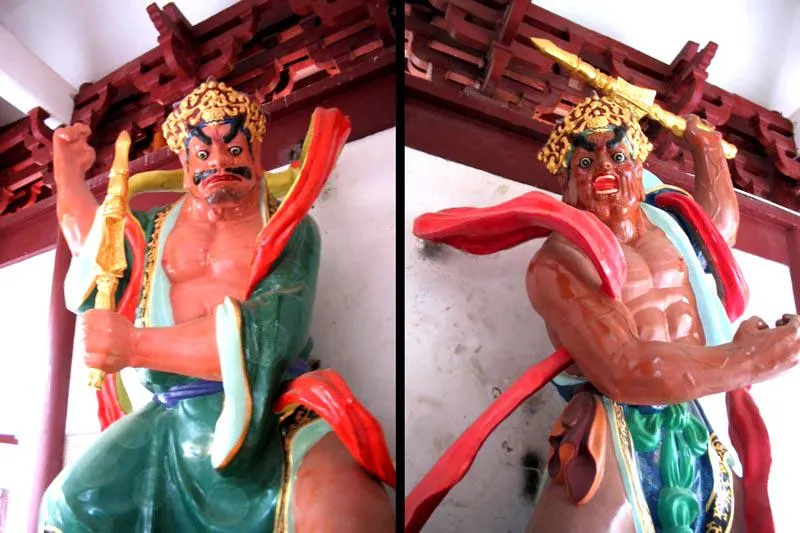
The Heng and Ha Generals (哼哈二将, Hēnghā Èrjiàng) are a pair of protective figures commonly found at the entrances of Chinese Buddhist temples. General Heng is traditionally depicted with his mouth closed, while General Ha has his mouth open. Their powerful bodies, threatening expressions and martial postures symbolize the protection of Buddhism and its sacred spaces.
Although Chinese popular tradition identifies them as Zheng Lun and Chen Qi from the Ming dynasty novel Investiture of the Gods, their religious and artistic origins belong to a much older Buddhist tradition of protective deities.
Who Are the Heng and Ha Generals?
Visitors entering a traditional Chinese Buddhist temple may encounter two enormous warrior statues positioned on opposite sides of the entrance. Unlike the peaceful images of Buddhas and bodhisattvas found deeper within the temple, these guardians appear ready to confront anything that threatens the sacred grounds.
In Chinese popular culture, they are known collectively as the Heng and Ha Generals, or Heng Ha Er Jiang (哼哈二将). Their names imitate two distinct sounds: a forceful nasal snort and an open-mouthed exclamation.
In Buddhist religious art, comparable guardians belong to the tradition of the vajra warriors, known in Chinese as Jingang Lishi (金刚力士). They are protectors rather than enlightened Buddhas.
| Chinese name | 哼哈二将 / 哼哈二將 |
|---|---|
| Pinyin | Hēnghā Èrjiàng |
| Common English name | Heng and Ha Generals |
| Religious background | Chinese Buddhism and popular religion |
| Buddhist guardian tradition | Jingang Lishi (vajra warriors) |
| Literary identities | Zheng Lun (郑伦) and Chen Qi (陈奇) |
| Principal role | Protection of Buddhist temples and teachings |
| Typical location | Temple entrance or mountain gate (山门) |
| Identifying features | Contrasting closed and open mouths, muscular bodies and fierce expressions |
How to Tell General Heng and General Ha Apart
The easiest way to distinguish the two generals is to examine their mouths. Clothing, weapons, skin colors and poses can vary between temples, but the contrast between a closed mouth and an open mouth is their best-known identifying feature.
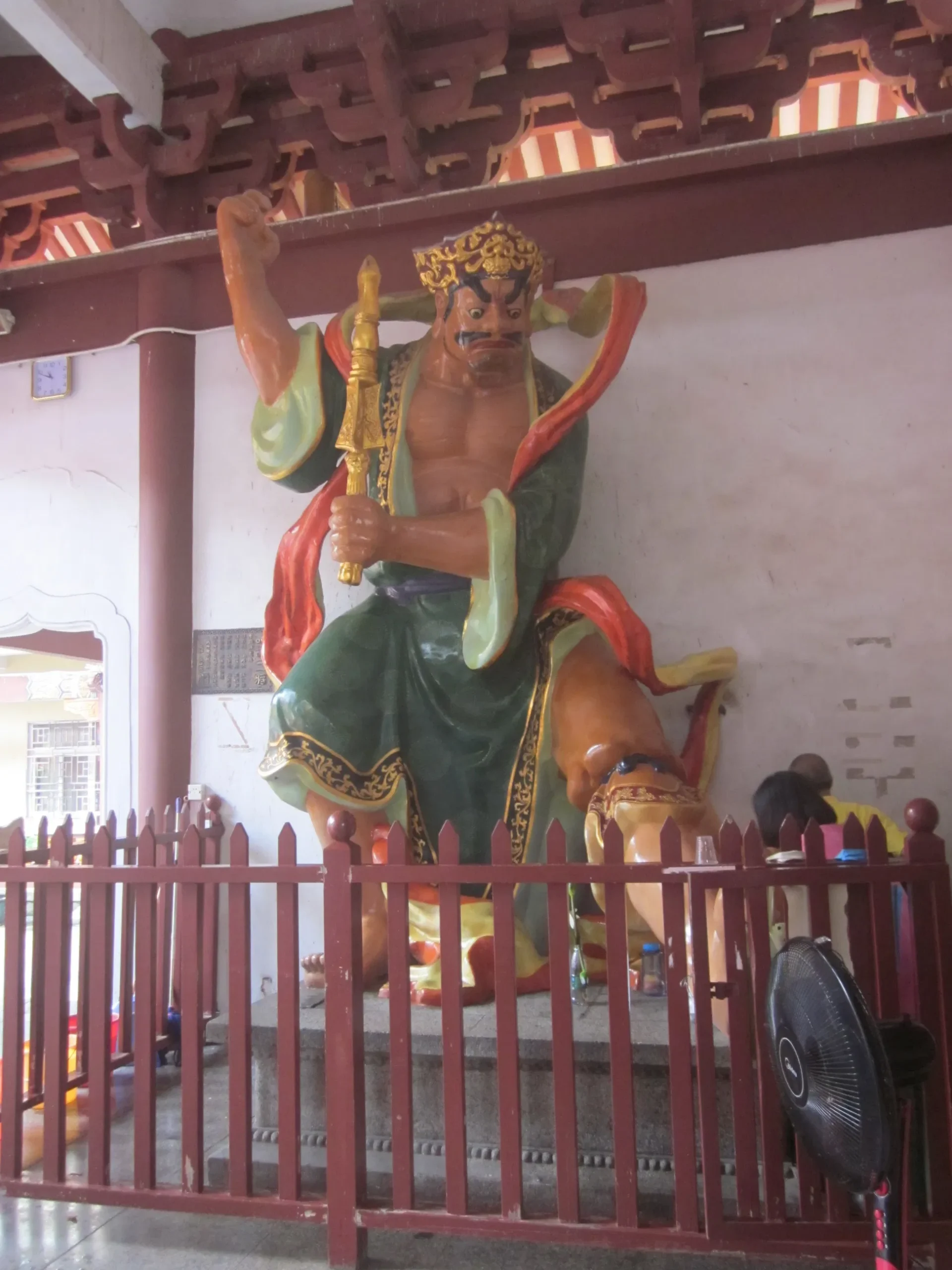
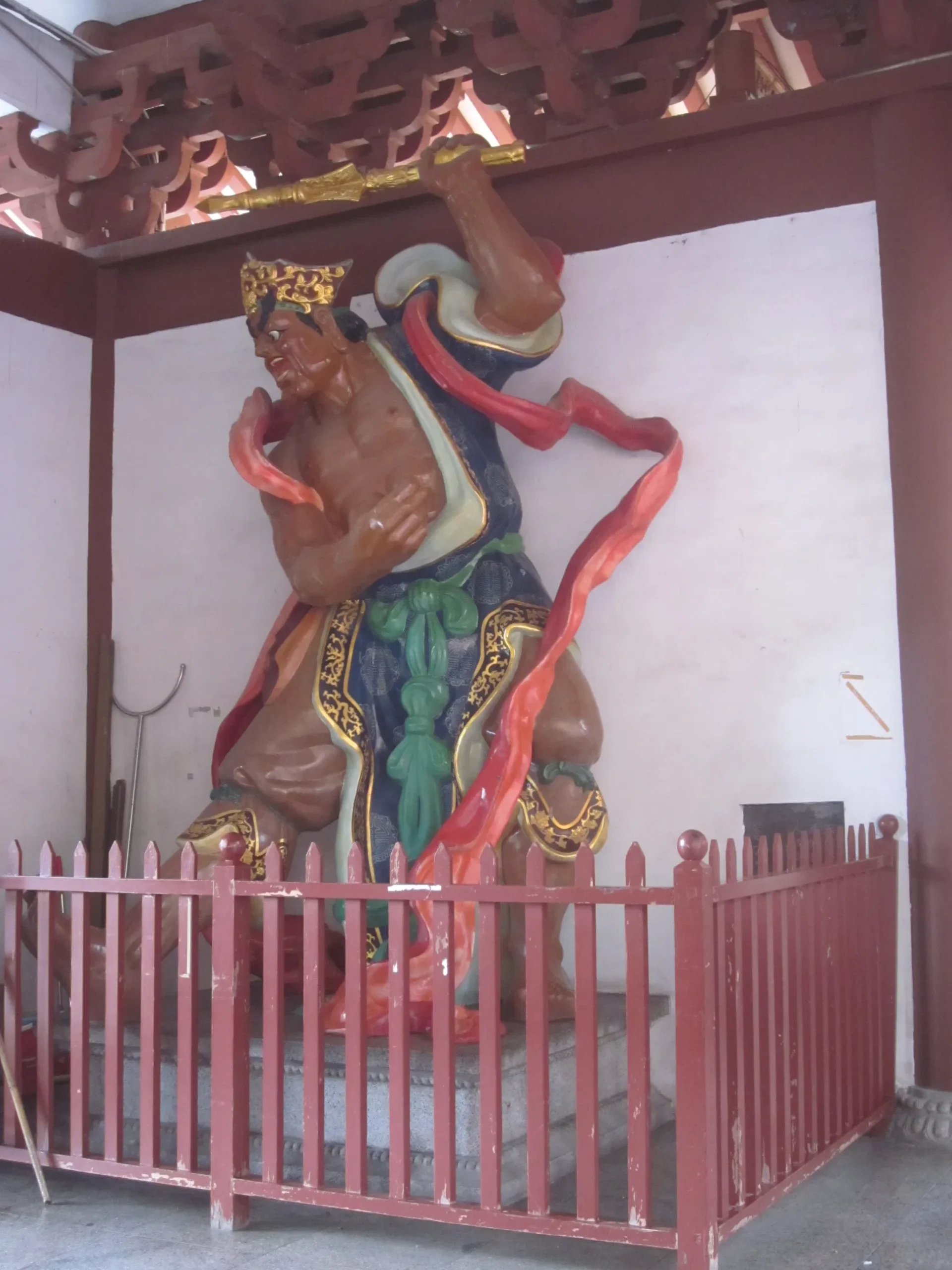
General Heng (哼将)
General Heng is conventionally represented with his lips closed or tightly compressed, as if producing a powerful sound through his nose.
In Investiture of the Gods, he is identified as Zheng Lun, a warrior capable of releasing supernatural white energy through his nostrils.
General Ha (哈将)
General Ha is traditionally shown with his mouth open, suggesting a forceful shout or exhalation.
His literary identity is Chen Qi, whose supernatural ability allows him to release yellow energy from his mouth and incapacitate opponents.
| Feature | General Heng | General Ha |
|---|---|---|
| Chinese name | 哼将 | 哈将 |
| Mouth | Closed | Open |
| Characteristic sound | Nasal snort | Vocal exhalation |
| Literary identity | Zheng Lun | Chen Qi |
| Literary supernatural power | White energy from the nose | Yellow energy from the mouth |
| Religious function | Temple protection | Temple protection |
The Buddhist Origins of Heng and Ha
The religious background of the Heng and Ha Generals extends much further into history than their familiar Chinese names.
Early Buddhist traditions developed a variety of protective beings responsible for safeguarding the Buddha, Buddhist teachings and religious communities. Among the most important figures associated with this tradition is Vajrapani (Vajrapāṇi), whose Sanskrit name means “holder of the vajra.”
The vajra is a ritual and symbolic object associated with thunderbolt-like force and indestructibility. In Buddhist imagery, it became an emblem of spiritual power capable of overcoming obstacles to enlightenment.
As Buddhism traveled from India through Central Asia into China, its protective imagery developed alongside Chinese artistic and religious traditions. Muscular guardians, formidable facial expressions and powerful gestures became familiar features of Buddhist sacred art.
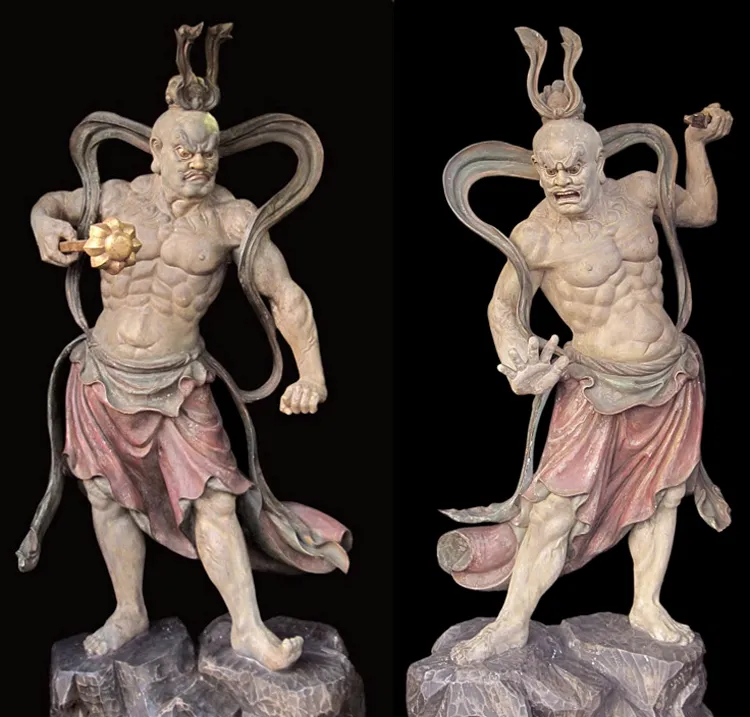
Surviving Chinese sculptures and paintings demonstrate that Vajrapani and related protective imagery were already established during the Tang dynasty (618–907 CE), centuries before the appearance of Investiture of the Gods.
Chinese Buddhist sources and temple traditions sometimes associate the paired guardians with Miji Jingang (密迹金刚), or Guhyapāda, and Naluoyan (那罗延), or Nārāyaṇa. However, their identification and arrangement are not completely uniform across different traditions.
The figures popularly called Heng and Ha therefore represent a Chinese interpretation of an older Buddhist guardian tradition rather than two figures whose religious history began with Ming dynasty literature.
Historical distinction: Buddhist vajra warriors existed long before Zheng Lun and Chen Qi became famous literary characters. The Chinese novel supplied a memorable local story and personal identities for guardians whose religious imagery was already familiar.
Why Does One Guardian Have an Open Mouth and the Other a Closed Mouth?
The contrasting mouths are not simply artistic devices used to make the two statues look different.
In East Asian Buddhist iconography, paired guardians are often depicted in association with the Sanskrit syllables a and hūṃ. The open mouth corresponds to the initial sound, while the closed mouth represents the concluding sound.
These sounds have traditionally been interpreted as representing the beginning and end of existence. The pair may therefore suggest completeness, encompassing everything from emergence to dissolution.
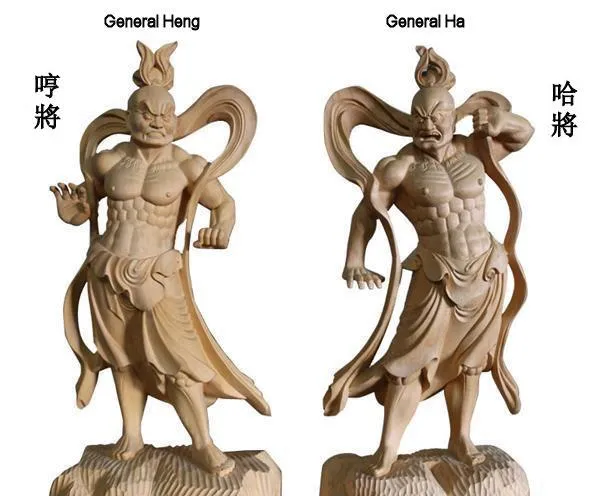
A comparable arrangement survives in Japan, where paired Buddhist gate guardians are known as Niō (仁王). The open-mouthed figure is called Agyō, and the closed-mouthed figure is called Ungyō.
In Chinese popular storytelling, the same visual contrast acquired another interpretation through the supernatural abilities of Zheng Lun and Chen Qi.
These religious and literary explanations belong to different historical layers. Both help explain why the open-and-closed-mouth arrangement remains so recognizable today.
Heng and Ha in Investiture of the Gods
The most familiar Chinese story of the two generals comes from Fengshen Yanyi (封神演义), usually translated as Investiture of the Gods or Creation of the Gods.
This Ming dynasty mythological novel reimagines the overthrow of the Shang dynasty and the rise of the Zhou dynasty as a supernatural conflict involving immortals, divine beings, magical weapons and extraordinary warriors.
Among its many characters are Zheng Lun and Chen Qi, two military figures whose remarkable abilities provide a literary explanation for the names Heng and Ha.
Zheng Lun: General Heng
In the novel, Zheng Lun (郑伦) learns supernatural techniques from the immortal Du’e Zhenren (度厄真人).
His unusual ability allows him to produce a powerful nasal sound while releasing two streams of white light or energy from his nostrils. The technique can overcome an opponent by disrupting the soul and causing the victim to collapse.
Originally associated with the Shang forces, Zheng Lun eventually joins the Zhou side of the conflict.
His ability to overcome opponents through a forceful nasal exclamation provides the literary basis for his identification as General Heng.
Chen Qi: General Ha
Chen Qi (陈奇) serves the Shang dynasty and possesses an extraordinary ability that resembles Zheng Lun’s technique.
Rather than releasing energy through his nose, Chen Qi stores supernatural yellow energy within his body. When he opens his mouth and exhales, the energy can overwhelm an opponent and cause unconsciousness.
The confrontation between the two warriors is presented in Chapter 74 of the novel, where their closely matched supernatural powers are brought into direct competition.
How the Two Warriors Become Divine Guardians
Both characters eventually die during the conflict described in the novel.
In Chapter 99, Jiang Ziya carries out the great appointment of gods, assigning divine positions to numerous figures who participated in the war.
Zheng Lun and Chen Qi are appointed together as the Heng and Ha Generals, with duties connected to guarding Buddhist entrances, supporting religious teachings and protecting sacred treasures.
This conclusion connects the two literary warriors with the recognizable guardian figures standing at Buddhist temple gates.
It is an especially clear example of how Buddhist traditions influenced Chinese mythology, while Chinese literature simultaneously reshaped the popular identities of Buddhist figures.
Why Are the Heng and Ha Generals Found at Chinese Temple Entrances?
The position of the two guardians is as significant as their appearance.
In traditional Chinese Buddhist architecture, the principal entrance is commonly known as the shanmen (山门), or mountain gate. The term remains in use even for temples that are not located in mountainous areas.
The gate represents a transition from ordinary surroundings into a space dedicated to Buddhist practice. Placing protective figures at this boundary emphasizes the distinction between the outside world and the religious environment within.
The guardians are traditionally associated with several complementary responsibilities:
- Protecting sacred spaces: guarding the entrance and the religious community within.
- Defending the Dharma: representing the preservation of Buddhist teachings.
- Repelling harmful influences: symbolically confronting malevolent forces and disturbances.
- Marking a religious threshold: announcing that visitors are entering a sacred environment.
Their function is fundamentally protective. They are not presented as the principal teachers of Buddhism or as the main figures of devotion in the Buddha hall.
Temple layouts vary considerably, however. Some monasteries have dedicated gate halls containing vajra warriors, while others arrange their guardian images differently or do not display this pair at all.
Why Do Buddhist Temple Guardians Look So Fierce?
For visitors unfamiliar with Buddhist religious art, the intimidating appearance of Heng and Ha can seem surprising. Buddhism is widely associated with compassion, peace and meditation, yet these statues display glaring eyes, tense muscles, clenched fists and aggressive postures.
The apparent contradiction reflects the distinction between the appearance of a deity and its religious purpose.
Fierce imagery in Buddhism does not necessarily indicate evil or uncontrolled anger. In the context of protective figures, it can express the strength required to overcome harmful forces and defend religious practice.
The guardians’ exaggerated bodies and dramatic gestures communicate vigilance and determination. Their purpose is defensive, even when their appearance suggests considerable physical power.
In some modern Buddhist interpretations, the external threats represented by fierce guardians can also be understood metaphorically as internal obstacles, including ignorance, hatred and attachment.
Heng and Ha Generals vs. the Four Heavenly Kings
The Heng and Ha Generals are sometimes confused with other protective figures in Chinese temples, particularly the Four Heavenly Kings (四大天王).
Although both groups have protective functions, they represent distinct religious traditions and usually occupy different positions within the temple complex.
| Guardian | Typical position | Principal role |
|---|---|---|
| Heng and Ha Generals | Temple entrance or shanmen | Guarding sacred entrances |
| Four Heavenly Kings | Hall of the Heavenly Kings | Protecting the four directions and the Dharma |
| Weituo (Skanda) | Often behind the central image of Budai in the Heavenly Kings Hall | Protecting monasteries and Buddhist teachings |
| Men Shen (Door Gods) | Household entrances and some temple doors | Protection against harmful spirits and misfortune |
The Four Heavenly Kings represent the Buddhist guardians of the four cardinal directions. They are usually portrayed as elaborately armored figures carrying distinctive symbolic objects.
Heng and Ha, by contrast, are most readily recognized as a pair whose contrasting expressions emphasize the protection of an entrance.
While these figures share a broader protective purpose, their identities and iconographic traditions should not be treated as interchangeable.
Are Heng and Ha the Same as Chinese Door Gods?
Heng and Ha share certain visual and functional similarities with the Chinese Door Gods known as Men Shen (门神).
Both are frequently arranged in pairs, both protect entrances, and both are associated with preventing harmful influences from entering a protected space.
Their religious backgrounds, however, are different.
Familiar household Door Gods, such as Qin Qiong and Yuchi Gong, belong primarily to Chinese popular religious traditions. They are commonly represented in printed images attached to residential doors, particularly during Chinese New Year.
Heng and Ha are more closely associated with Buddhist protective imagery, although their literary identities and popular worship demonstrate the interaction between Buddhism and Chinese folk religion.
In Chinese religious life, the boundaries between these traditions are not always rigid. Protective figures can acquire new identities, stories and functions as they move between religious institutions and local communities.
Heng and Ha and the Japanese Niō Guardians
The paired guardians found in Chinese Buddhist temples have close artistic parallels elsewhere in East Asia.
Japanese Buddhist temples frequently feature Niō guardians, particularly at gates known as Niōmon. Like their Chinese counterparts, these figures often possess muscular bodies, dynamic poses, fierce expressions and contrasting mouth shapes.
Similar protective imagery also developed in Korean Buddhism.
These parallels reflect the transmission and adaptation of Buddhist guardian traditions across Asia. They do not mean that every Japanese or Korean guardian should be identified as Zheng Lun or Chen Qi.
Those two personal identities belong specifically to the Chinese literary and popular religious interpretation of the guardian pair.
The Cultural Significance of the Heng and Ha Generals
The Heng and Ha Generals occupy an unusual position in Chinese religious culture. Their appearance reflects Buddhist protective art, their popular identities are reinforced by mythological literature, and their continuing presence in temples connects these historical traditions with everyday religious life.
They demonstrate how Chinese mythology developed through the interaction of imported religious ideas, local artistic conventions and imaginative storytelling.
A guardian statue may therefore carry several meanings at once. It can represent an ancient Buddhist protector, recall a supernatural warrior from a Chinese novel and serve as a familiar symbol of security at the entrance to a sacred place.
Understanding these different historical layers helps explain why the Heng and Ha Generals remain among the most recognizable protective figures in Chinese Buddhist temple culture.
Frequently Asked Questions
Who are the Heng and Ha Generals in Chinese temples?
They are paired protective figures associated with the entrances of Chinese Buddhist temples. Their religious imagery derives from Buddhist vajra warriors, while Chinese popular literature identifies them as Zheng Lun and Chen Qi.
Which general has his mouth open?
General Ha traditionally has his mouth open. General Heng is usually represented with his mouth closed, suggesting a forceful nasal sound.
Are Heng and Ha Buddhist gods?
They are Buddhist protective deities in their temple context. Their popular Chinese identities also reflect mythology, literature and folk religion. They are not Buddhas.
What are the powers of Zheng Lun and Chen Qi?
In Investiture of the Gods, Zheng Lun releases supernatural white energy through his nose, while Chen Qi releases yellow energy through his mouth. Both abilities can incapacitate opponents.
Did the Heng and Ha Generals really exist?
Their familiar biographies and supernatural abilities belong to mythological literature. There is no reliable historical basis for treating the novel’s accounts of Zheng Lun and Chen Qi as verified historical events.
Are Heng and Ha the same as Vajrapani?
The paired guardians are related to the Buddhist tradition of Vajrapani and vajra-bearing protectors. However, their individual identities vary across religious traditions, and the Chinese literary figures should not simply be equated with every representation of Vajrapani.
Why are Heng and Ha placed at temple gates?
The temple gate marks the boundary between ordinary surroundings and sacred space. The two guardians symbolically protect this boundary and defend Buddhist teachings and religious practice.
Are the Heng and Ha Generals the same as the Four Heavenly Kings?
No. Heng and Ha are a pair of entrance guardians, while the Four Heavenly Kings are four Buddhist protectors associated with the cardinal directions. Their positions, attributes and religious identities differ.
Do all Chinese Buddhist temples have Heng and Ha statues?
No. The arrangement depends on the temple’s history, regional traditions, architecture and religious community. Some temples display the paired guardians prominently, while others use different protective imagery.
References and Further Reading
- Fengshen Yanyi (封神演义), Chapter 74: 哼哈二将显神通. Ming dynasty Chinese mythological novel. Primary literary source for the supernatural abilities of Zheng Lun and Chen Qi.
- Fengshen Yanyi (封神演义), Chapter 99: 姜子牙归国封神. Primary literary source for their appointment as divine guardians.
- Hangzhou Lingyin Temple. Buddhist cultural materials discussing traditional temple entrances, vajra warriors and the localization of Buddhist guardian imagery.
- Getty Research Institute. Cave Temples of Dunhuang: Buddhist Art on China’s Silk Road. Historical and artistic context for Buddhist protective figures.
- Smithsonian National Museum of Asian Art. Standing Figure of Vajrapani (Guardian King). Chinese sculpture, Tang dynasty.
- Smithsonian National Museum of Asian Art. Guardian Figures. Educational materials on Japanese Niō guardian statues.
- Japanese Architecture and Art Net Users System (JAANUS). A-un (阿吽). Reference on the symbolism of open-mouthed and closed-mouthed guardian figures.
- Singapore Buddha Tooth Relic Temple and Museum. Gate Guardians. Contemporary interpretation of Buddhist entrance guardians in a Chinese temple tradition.