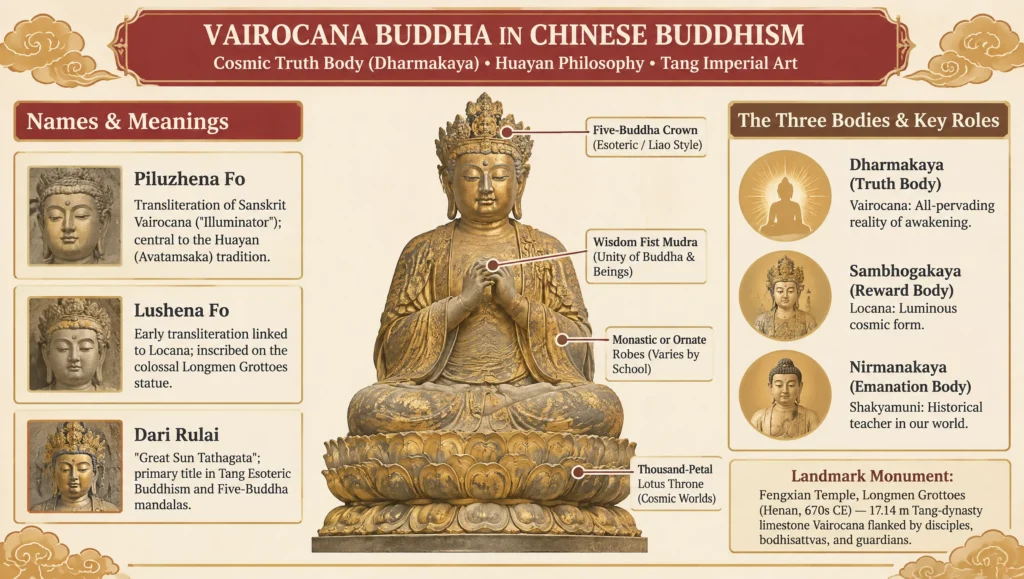
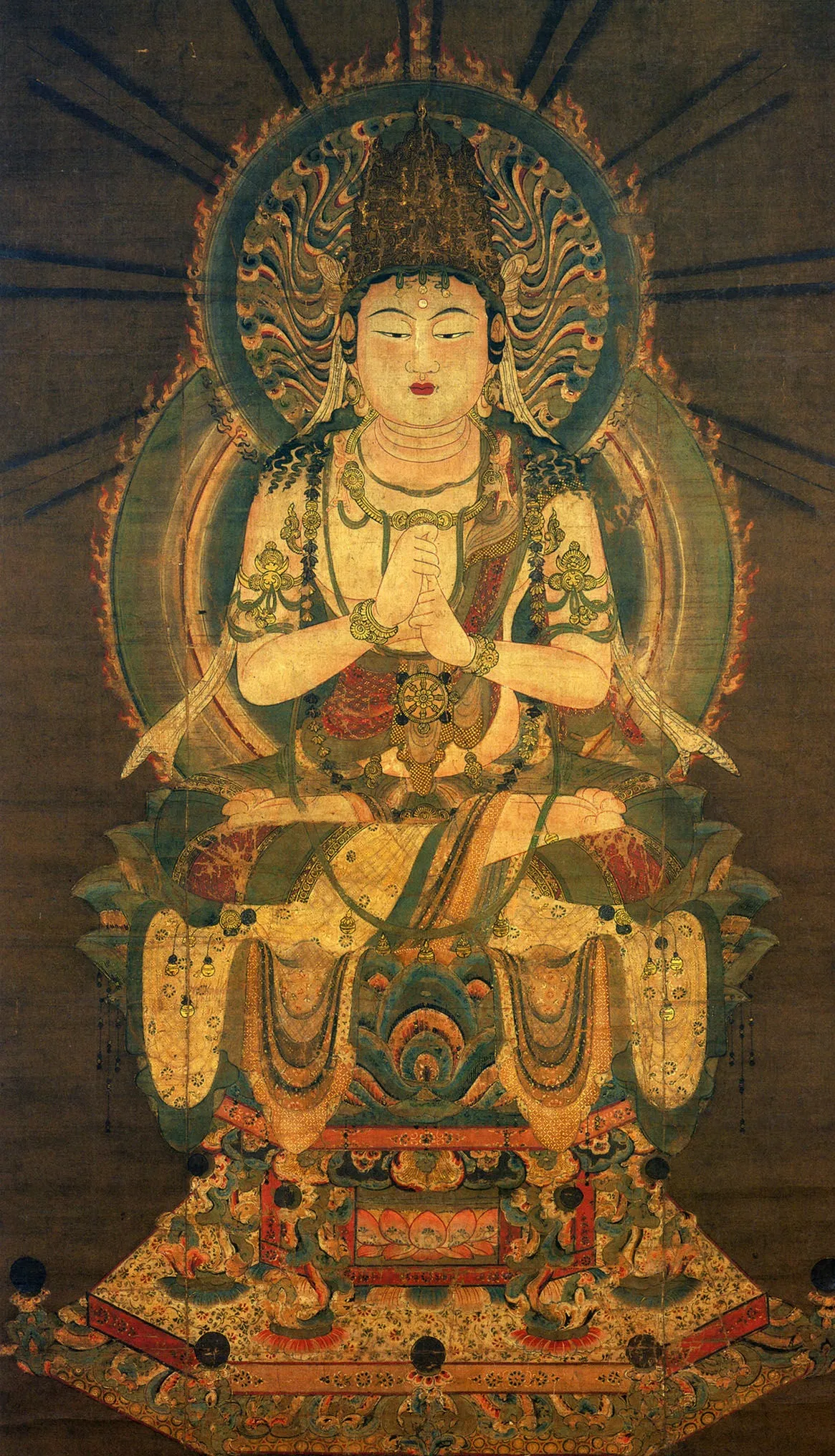
Vairocana Buddha—known in Chinese as Piluzhena Fo (毗卢遮那佛, Pílúzhēnà Fó), Lushena Fo (卢舍那佛, Lúshěnà Fó), or Dari Rulai (大日如来, Dàrì Rúlái, “Great Sun Tathāgata”)—is a transcendent cosmic Buddha in Mahayana and Esoteric Buddhism. Rather than a historical teacher born in ancient India like Shakyamuni, Vairocana represents the all-pervading reality of awakening itself: the ultimate truth body (Dharmakāya) from which innumerable worlds and buddhas arise. In Chinese Buddhism, he stands at the center of the Huayan (Flower Ornament) school, Tang-dynasty esoteric ritual, and some of China’s most monumental Buddhist sculpture, including the colossal stone Buddha at Longmen Grottoes.
Because English-language sources often group Buddhist figures under general labels like “Chinese gods,” it helps to be precise from the start. Vairocana is a Buddha within Buddhist scripture and liturgy, not a Daoist celestial official or a folk deity. His prominence in China grew out of Indian Mahayana texts, Chinese philosophical schools, and imperial patronage—especially during the Tang dynasty (618–907). For broader context on how Buddhist figures are categorized alongside other traditions in China, see the Buddhist Deities directory.
Vairocana Buddha at a Glance
- Chinese names: Piluzhena Fo (毗卢遮那佛), Lushena Fo (卢舍那佛), Dari Rulai (大日如来)
- Sanskrit name: Vairocana / Mahāvairocana (“Illuminator,” “Of the Sun,” or “Great Illuminator”)
- Classification: Cosmic / transcendent Buddha in Mahayana and Esoteric (Vajrayana) Buddhism
- Primary Chinese traditions: Huayan school (华严宗), Tang Esoteric Buddhism (唐密), monastic ordination and mandala traditions
- Key scriptures: Avataṃsaka Sūtra (华严经), Brahmajāla Sūtra (梵网经), Mahāvairocana Sūtra (大日经)
Who Is Vairocana Buddha?
In early Buddhism, “the Buddha” referred primarily to Siddhārtha Gautama, known in East Asia as Shakyamuni (释迦牟尼佛, Shìjiāmóuní Fó), who taught in northern India around the fifth century BCE. As Mahayana Buddhism developed in India and spread into Central Asia and China, thinkers articulated a broader vision of Buddhahood: awakening was not confined to one human lifetime in one world, but was a timeless, cosmic reality that manifests across countless realms.
Vairocana is the clearest expression of that cosmic vision. In Mahayana philosophy, Buddhas are often understood through the doctrine of the Three Bodies (Trikāya; Chinese 三身, Sānshēn):
| Buddha Body (Trikāya) | Chinese Term | Meaning | Typical Figure in Chinese Buddhism |
|---|---|---|---|
| Dharmakāya (Truth Body) | 法身 (Fǎshēn) | The unconditioned, all-pervading reality of the Dharma itself | Vairocana (Piluzhena Fo / Dari Rulai) |
| Saṃbhogakāya (Reward / Bliss Body) | 报身 (Bàoshēn) | The luminous cosmic body earned through eons of bodhisattva practice, visible to advanced bodhisattvas | Locana (Lushena Fo) in many Chinese scholastic schemes |
| Nirmāṇakāya (Emanation Body) | 应身 / 化身 (Yìngshēn / Huàshēn) | The physical form that appears in ordinary worlds to teach sentient beings | Shakyamuni (Shìjiāmóuní Fó) |
Chinese Buddhist schools did not always draw these boundaries identically. Some texts treat Vairocana as the ultimate Truth Body, others describe Locana as the radiant Reward Body seated on a giant thousand-petal lotus, and esoteric traditions treat Mahāvairocana as the direct teacher of supreme ritual wisdom. What remains consistent is his role as the source and center—never a subordinate regional spirit.
Names and Meanings: Piluzhena, Lushena, and Dari Rulai
English readers researching Vairocana in China quickly encounter three different Chinese names. They do not refer to three unrelated figures; rather, they reflect how translators rendered the Sanskrit name Vairocana (and its related form Locana) by sound or by meaning in different periods. For a wider look at how Sanskrit titles entered Chinese temples, see our guide to the Sanskrit names of Chinese Buddhist deities.
- Piluzhena Fo (毗卢遮那佛, Pílúzhēnà Fó): A phonetic transliteration of Sanskrit Vairocana, meaning “Illuminator,” “Radiant One,” or “Of the Sun.” This is the standard name in the eighty-fascicle Tang translation of the Avataṃsaka Sūtra and in Chinese Huayan Buddhism.
- Lushena Fo (卢舍那佛, Lúshěnà Fó): An earlier transliteration linked to Sanskrit Locana or a shortened rendering of Vairocana. It appears prominently in the sixty-fascicle Eastern Jin translation of the Avataṃsaka Sūtra, in the Brahmajāla Sūtra, and in the Tang-dynasty inscription at Fengxian Temple in Longmen. Later Chinese commentators often assigned Piluzhena to the Dharmakāya and Lushena to the Saṃbhogakāya, turning a translation difference into a doctrinal distinction.
- Dari Rulai (大日如来, Dàrì Rúlái): A semantic translation meaning “Great Sun Tathāgata” (from Mahāvairocana). This title became standard in Tang Esoteric Buddhism and later traveled to Japan as Dainichi Nyorai. Buddhist commentaries explain that unlike the physical sun—which sets at night and can be blocked by clouds—Vairocana’s light of wisdom shines everywhere without obstruction.
Key Scriptures Behind Vairocana in China
Vairocana’s status in Chinese Buddhism rests on three major scriptural traditions, each presenting a slightly different image of his cosmic role.
1. The Avataṃsaka Sūtra (Flower Ornament Sutra)
Known in Chinese as the Huáyán Jīng (华严经), this massive scripture describes a vast, interconnected cosmos called the Lotus Treasury World (莲华藏世界, Liánhuázàng Shìjiè), purified and pervaded by Vairocana. In this vision, every single phenomenon reflects every other phenomenon—an idea famously illustrated by the metaphor of Indra’s net of jewels. Rather than preaching long verbal sermons in the manner of early sutras, Vairocana radiates light from his body while great bodhisattvas such as Mañjuśrī (Wenshu) and Samantabhadra (Puxian) expound the teaching.
2. The Brahmajāla Sūtra (Brahma’s Net Sutra)
Known in Chinese as the Fànwǎng Jīng (梵网经)—and distinct from the Theravada Pali text of the same name—this fifth-century Mahayana scripture became foundational for Bodhisattva Precepts (菩萨戒, Púsà Jiè) in Chinese monastic and lay ordination. Modern scholars widely regard it as a text composed in China rather than translated from an extant Sanskrit original. In its opening cosmic scene, Vairocana (Lushena) sits upon a giant lotus throne of a thousand petals; each petal holds a universe containing a Shakyamuni Buddha who manifests beneath a Bodhi tree to teach. Through this image, the sutra established Vairocana as the cosmic source behind the historical Buddha.
3. The Mahāvairocana Sūtra and Esoteric Texts
In the eighth century, Indian and Central Asian masters—especially Śubhākarasiṃha (善无畏, Shànwúwèi), Vajrabodhi (金刚智, Jīngāngzhì), and Amoghavajra (不空, Bùkōng)—translated key esoteric scriptures at the Tang capital of Chang’an, including the Mahāvairocana Sūtra (大日经, Dàrì Jīng) and the Vajraśekhara Sūtra (金刚顶经, Jīngāngdǐng Jīng). In this system, Mahāvairocana (Dari Rulai) is not silent; he directly reveals mantras, mudras (hand gestures), and mandalas (cosmic diagrams) as a rapid path to awakening.
Vairocana in Huayan Buddhism and Tang Esoteric Buddhism
Two major Chinese Buddhist movements shaped how Vairocana was understood, worshipped, and depicted in temples.
The Huayan School and the Three Saints
During the Sui and Tang dynasties, Chinese masters such as Dushun, Zhiyan, and especially Fazang (法藏, Fǎzàng, 643–712) developed the Huayan school (华严宗, Huáyán Zōng), one of the most philosophically sophisticated traditions in East Asian Buddhism. Huayan thinkers treated the Avataṃsaka Sūtra as the pinnacle of Buddhist teaching, describing the unimpeded interpenetration of principle (li) and phenomena (shi).
In Chinese temple halls, this teaching is embodied by the triad called the Three Saints of Huayan (华严三圣, Huáyán Sānshèng): Vairocana sits at the center, flanked by Wenshu (文殊, Mañjuśrī, bodhisattva of wisdom, often riding a lion) and Puxian (普贤, Samantabhadra, bodhisattva of practice and vows, often riding a six-tusked white elephant). Together, they unite ultimate reality, awakened insight, and compassionate action.
Tang Esoteric Buddhism and the Five Buddhas
In eighth-century Tang court Buddhism, Esoteric masters placed Mahāvairocana at the center of the Five Buddhas (五方佛, Wǔfāng Fó; also called the Five Wisdom Buddhas or Five Tathāgatas), surrounded by Akṣobhya (east), Ratnasambhava (south), Amitābha (west), and Amoghasiddhi (north). In the two great mandalas of East Asian esotericism—the Womb Realm (胎藏界, Tāizàngjiè) and the Diamond Realm (金刚界, Jīngāngjiè)—Mahāvairocana occupies the central axis, symbolizing the unity of compassion and wisdom.
Although institutional Tang Esotericism declined in China after the ninth century (while flourishing in Japan as Shingon Buddhism), its liturgy, mantras—such as the Mantra of Light (光明真言, Guāngmíng Zhēnyán)—and Five-Buddha iconography remained embedded in Chinese Buddhist ritual, including major water-and-land (Shuilu) ceremonies and monastic altars.
Monumental Art: Longmen Grottoes and Imperial Patronage
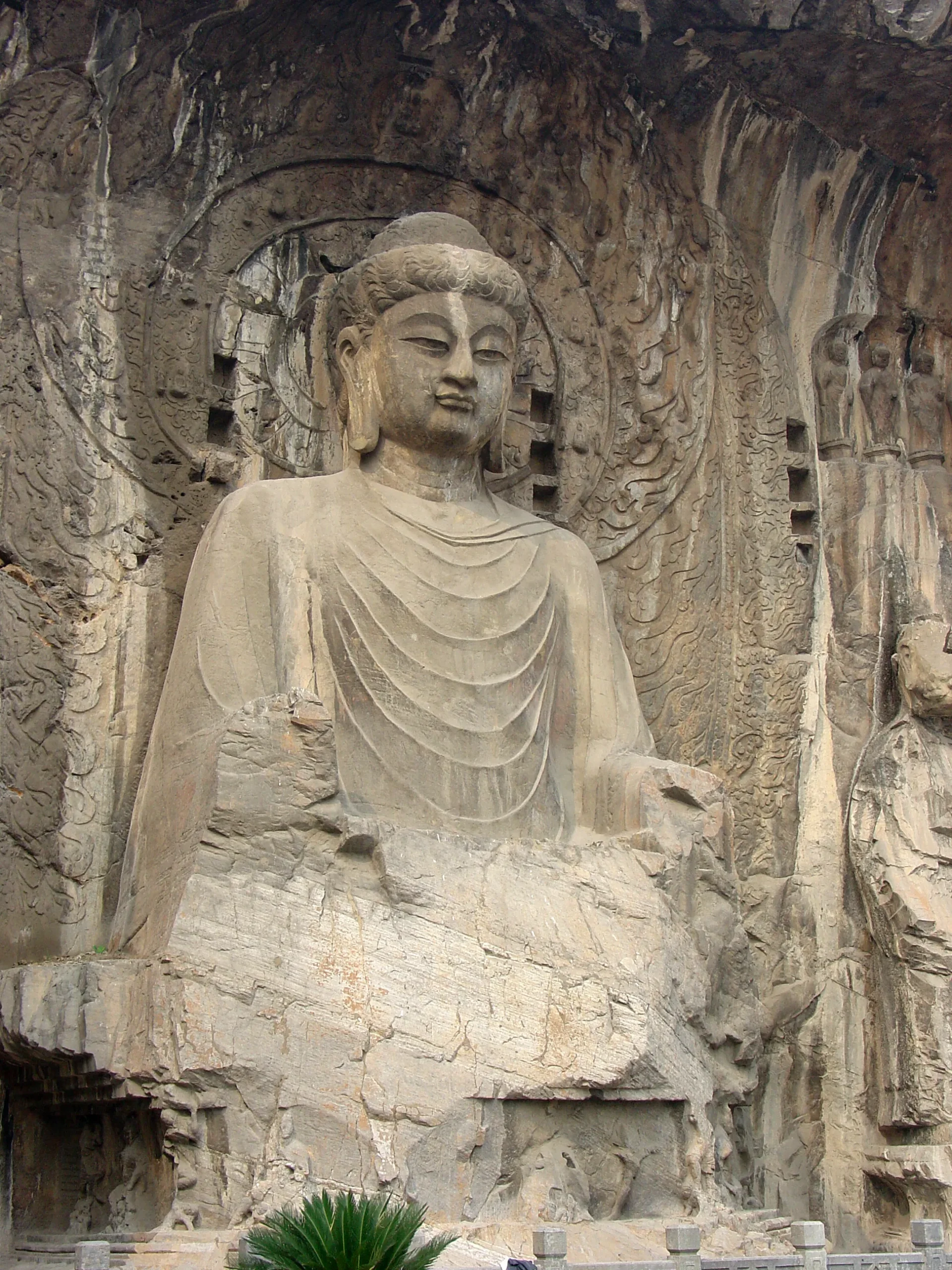
Nowhere is Vairocana’s historical stature in China more visible than at Fengxian Temple (奉先寺, Fèngxiān Sì) in the Longmen Grottoes (龙门石窟, Lóngmén Shíkū), carved into limestone cliffs south of Luoyang in Henan province. Commissioned under Tang Emperor Gaozong and Empress Wu Zetian in the early 670s—with an inscription recording major work completed around 675–676—the open-air niche is dominated by a seated stone Vairocana (inscribed as Lushena) standing approximately 17.14 meters (about 56 feet) tall.
Flanked by two monastic disciples (Kāśyapa and Ānanda), two crowned bodhisattvas, and armored guardians (including Heavenly Kings and vajra-bearing protectors), the colossal figure projects both calm majesty and imperial order. For more on the armored protectors who guard Buddhist sanctuaries alongside major Buddhas, see our guide to the Four Heavenly Kings in Chinese Buddhism.
Popular guides frequently claim that the Longmen Vairocana’s serene, rounded face was deliberately modeled after Empress Wu Zetian, who contributed personal funds to the project and later patronized Huayan Buddhism heavily. While Wu Zetian clearly embraced Buddhist imagery and universal-monarch ideology to support her authority, art historians note that the “portrait of Wu Zetian” story is a later tradition rather than a documented Tang court record. What is historically certain is that the statue marked a turning point in Tang sculpture, blending cosmic grandeur with soft, naturalistic drapery and compassionate expression.
Symbols and Iconography: How to Recognize Vairocana
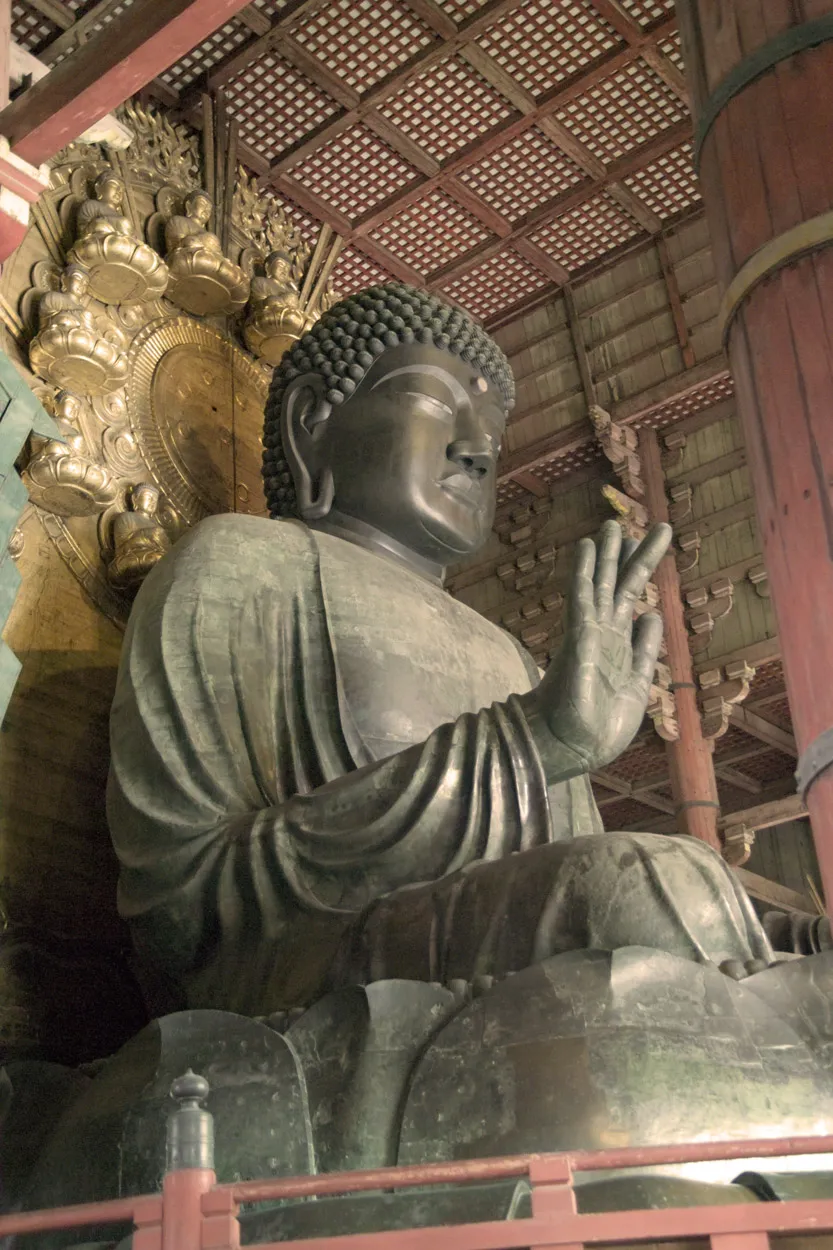
To an unfamiliar viewer, seated Buddha statues in Chinese temples can look nearly identical. Art historians and temple guides identify Vairocana through a combination of mudras (hand gestures), attire, throne details, and surrounding figures:
- Wisdom Fist Mudra (智拳印, Zhìquán Yìn): Especially common in Tang, Liao, and esoteric-influenced art (as seen in surviving gilt-bronze sculptures in museum collections such as The Metropolitan Museum of Art). One hand forms a fist wrapping around the extended index finger of the other hand, symbolizing the non-duality of the Buddha realm and sentient beings.
- Dharma Realm Meditation Mudra (法界定印, Fǎjiè Dìngyìn): Hands resting in the lap, palms upward, thumbs touching—associated with Womb Realm Vairocana and quiet cosmic contemplation.
- Teaching / Vairocana Mudra: Some Tang and later Chinese sculptures show Vairocana with hands raised in a teaching gesture, or with specific finger placements linked to Chinese ritual manuals.
- Crowned vs. Monastic Appearance: Unlike Shakyamuni, who is almost always shown in simple monastic robes without jewelry, Vairocana in esoteric and Liao–Song traditions frequently wears an ornate five-Buddha crown (五佛冠, Wǔfó Guān) and bodhisattva-style necklaces. In Huayan and early rock-cut traditions like Longmen, however, he often appears in simpler monastic drapery with the traditional cranial protuberance (uṣṇīṣa).
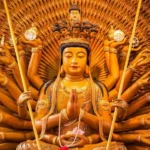
- The Thousand-Buddha Lotus Pedestal and Robe: Inspired by the Brahmajāla Sūtra and Avataṃsaka Sūtra, some Chinese sculptures and paintings of Vairocana depict tiny Shakyamuni Buddhas engraved across each petal of his lotus throne—or even across the folds of his robe—visually showing countless worlds contained within one cosmic Buddha.
Vairocana vs. Shakyamuni and Other Major Buddhas in China
Chinese monasteries often enshrine multiple Buddhas in the Main Hall (大雄宝殿, Dàxióng Bǎodiàn) or in dedicated pavilions such as a Pilu Hall (毗卢殿, Pílú Diàn). Understanding how Vairocana differs from the other Buddhas most commonly seen in China clarifies the layout of traditional temples:
| Buddha | Chinese Name | Primary Role in Chinese Buddhism | Typical Context / Visual Cue |
|---|---|---|---|
| Vairocana | 毗卢遮那佛 / 大日如来 | Cosmic Truth Body (Dharmakāya); universal source of awakening | Wisdom fist mudra, five-Buddha crown, or flanked by Wenshu and Puxian |
| Shakyamuni | 释迦牟尼佛 | Historical Buddha who taught in our world (Nirmāṇakāya) | Simple monastic robes; earth-touching or meditation mudra; central Main Hall figure |
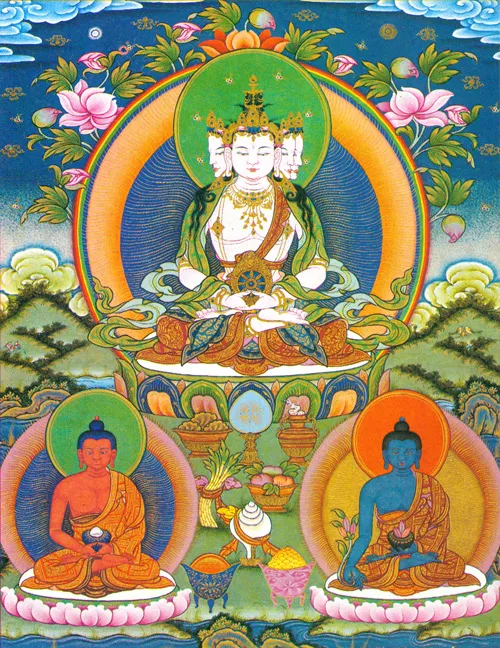
| Amitābha | 阿弥陀佛 | Buddha of Infinite Light and Life; presides over the Western Pure Land | Welcoming or meditation mudra; flanked by Guanyin and Mahāsthāmaprāpta |
| Bhaiṣajyaguru | 药师佛 | Medicine Buddha of the Eastern Pure Land; healing and vows | Often holds a medicine jar, pagoda, or myrobalan fruit |
| Maitreya | 弥勒佛 | Future Buddha; in China often fused in popular art with the monk Budai | Princely bodhisattva in early art, or the smiling, pot-bellied Laughing Buddha (Budai) in entrance halls |
How Vairocana Shaped Chinese Religious Culture
Unlike figures such as Guanyin (Avalokiteśvara) or Ksitigarbha (Dizang), who developed vast networks of folk legends, vernacular novels, and household miracle tales, Vairocana remained primarily a figure of monastic philosophy, ordination liturgy, imperial art, and esoteric ritual. He rarely appears as a folktale character in popular storytelling.
Even so, his influence on Chinese religious culture runs deep. Huayan philosophy—centered on Vairocana’s interconnected cosmos—shaped Chan (Zen) Buddhism and even influenced Song-dynasty Neo-Confucian metaphysics, which adapted Huayan ideas about the unity of principle and concrete things. Meanwhile, the Brahmajāla Sūtra‘s portrait of Vairocana framed how generations of Chinese monks, nuns, and laypeople understood the Bodhisattva Precepts. To see how Buddhist cosmology interacted more broadly with indigenous Chinese traditions, read our overview of Buddhist influence on Chinese mythology.
Frequently Asked Questions
Is Vairocana Buddha the same as Shakyamuni Buddha?
No, though Mahayana Buddhism considers them deeply connected. Shakyamuni (Siddhārtha Gautama) is the historical Buddha who lived and taught in ancient India (the Emanation Body, or Nirmāṇakāya). Vairocana is the cosmic Truth Body (Dharmakāya)—the universal principle of Buddhahood that manifests as Shakyamuni in our world.
What is the difference between Piluzhena, Lushena, and Dari Rulai?
All three are Chinese names for Vairocana. Piluzhena (毗卢遮那) and Lushena (卢舍那) are phonetic renderings of Sanskrit Vairocana and Locana; Chinese scholastic traditions often distinguish Piluzhena as the Truth Body and Lushena as the Reward Body. Dari Rulai (大日如来, “Great Sun Tathāgata”) translates the meaning of Mahāvairocana and is especially common in esoteric Buddhism.
Why is Vairocana sometimes called the Great Sun Buddha?
The Sanskrit name Vairocana relates to light and illumination, and Mahāvairocana was translated into Chinese as Dari (大日, “Great Sun”). Commentaries explain that just as sunlight nourishes the world, Vairocana’s wisdom illuminates all beings—except that his light never sets and cannot be blocked.
Was the giant Vairocana statue at Longmen Grottoes modeled after Empress Wu Zetian?
Empress Wu Zetian and Emperor Gaozong sponsored the colossal Fengxian Temple Vairocana in the 670s, and a popular legend claims its face was modeled after her. Art historians, however, find no contemporary Tang documentary proof for that claim; the statue’s calm, full features reflect broader high-Tang sculptural ideals rather than a confirmed imperial portrait.
Is Vairocana a Chinese god or a Buddhist figure?
Vairocana is a Mahayana and Esoteric Buddhist Buddha, not a Daoist deity or indigenous Chinese folk god. He belongs to Buddhist scripture, monastic ordination, Huayan philosophy, and mandala ritual, even though his temples and sculptures form a major part of China’s cultural heritage.
References and Further Reading
- Encyclopaedia Britannica, “Vairochana,” overview of Vairocana’s Sanskrit origins, East Asian Mahayana role, and esoteric transmission.
- Stanford Encyclopedia of Philosophy, “Huayan Buddhism,” scholarly analysis of the Avataṃsaka Sūtra, Huayan metaphysics, and Vairocana’s cosmic framework.
- The Metropolitan Museum of Art, “Seated Buddha Vairocana (Tang dynasty, early 8th century),” catalog entry documenting Tang-period Chinese bronze iconography of Vairocana.
- The Metropolitan Museum of Art, “Buddha Vairocana (Dari) (Liao dynasty, 11th century),” catalog entry examining the wisdom-fist mudra and mandala context in Chinese sculpture.
- Smarthistory (Dr. Jennifer N. McIntire), “Longmen caves, Luoyang,” art-historical overview of the Fengxian Temple Vairocana and Tang imperial patronage.
- UNESCO World Heritage Centre, “Longmen Grottoes,” official heritage documentation of the Longmen cave shrines and Northern Wei to Tang Buddhist stone carving.