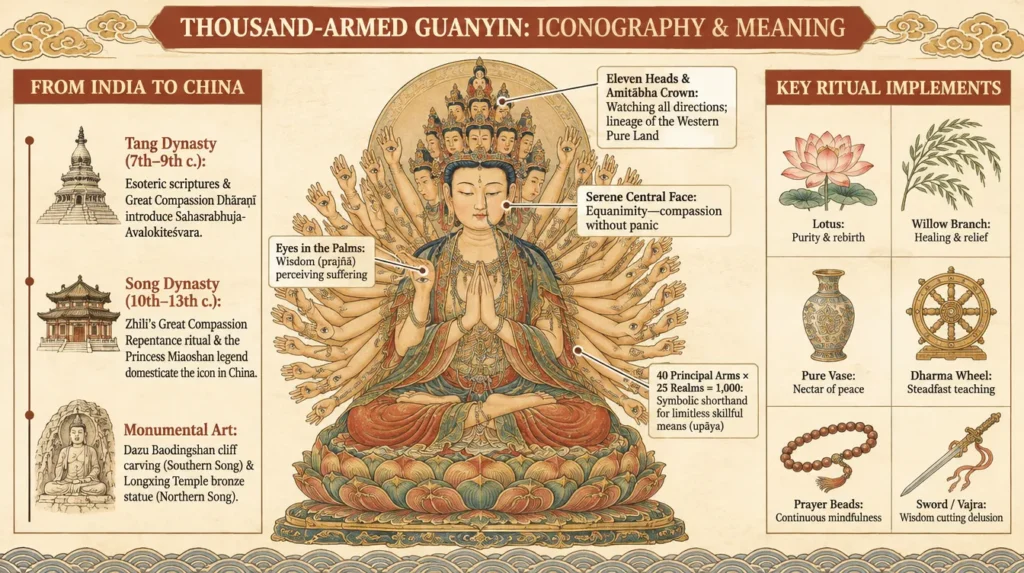
The Thousand-Armed Guanyin meaning centers on boundless, active compassion paired with all-seeing wisdom. Known in Chinese as Thousand-Armed, Thousand-Eyed Guanyin (千手千眼观音, Qiānshǒu Qiānyǎn Guānyīn) and in Sanskrit as Sahasrabhuja-Avalokiteśvara, this figure is an esoteric Buddhist manifestation of Guanyin, the bodhisattva of compassion—not a generic “goddess” in a fixed mythological pantheon. The thousand arms do not describe a literal physical anatomy. Instead, they express a core Mahāyāna Buddhist teaching: a bodhisattva perceives suffering everywhere (the eyes) and possesses limitless “skillful means” (upāya) to respond to every being’s specific need (the hands).
Because this iconography originated in Indian Esoteric Buddhism, flourished in Tang-dynasty scripture and ritual, and was later interwoven with Chinese folk narrative during the Song dynasty, understanding its full meaning requires looking at both its doctrinal symbolism and its cultural transformation in China.
Core Meaning: What the Thousand Arms and Thousand Eyes Represent
In Mahāyāna Buddhism, compassion (karuṇā) is never merely passive sympathy. A bodhisattva vows to remain engaged with the world to relieve suffering rather than withdrawing into solitary liberation. The Thousand-Armed form translates that vow into a direct visual language:
- The thousand arms signify limitless capacity to help. In classical Buddhist usage, “one thousand” (千, qiān) functions as a number of completeness and abundance rather than an exact headcount. Each hand represents a distinct method of protection, healing, teaching, or comfort tailored to the situation of the sufferer.
- The thousand eyes signify watchful awareness and wisdom. In canonical iconography, an open eye appears in the palm of each hand. Seeing and acting occur together: wisdom recognizes the root of suffering without distortion, and compassion reaches out immediately.
- The serene central face signifies equanimity. Surrounded by a dramatic fan of arms and implements, the main face remains calm and composed. This visual contrast teaches that effective compassion requires steadiness rather than panic or anger.
Classification note: English speakers often call Guanyin the “Goddess of Mercy,” especially when viewing feminine late-imperial statues. Doctrinally, however, Thousand-Armed Guanyin is a bodhisattva—an enlightened being within the tradition of Buddhist deities in China—and bodhisattvas are understood in Mahāyāna thought to transcend fixed gender, appearing in whatever form best helps living beings.
Why Most Statues Have 40 or 42 Arms Instead of 1,000
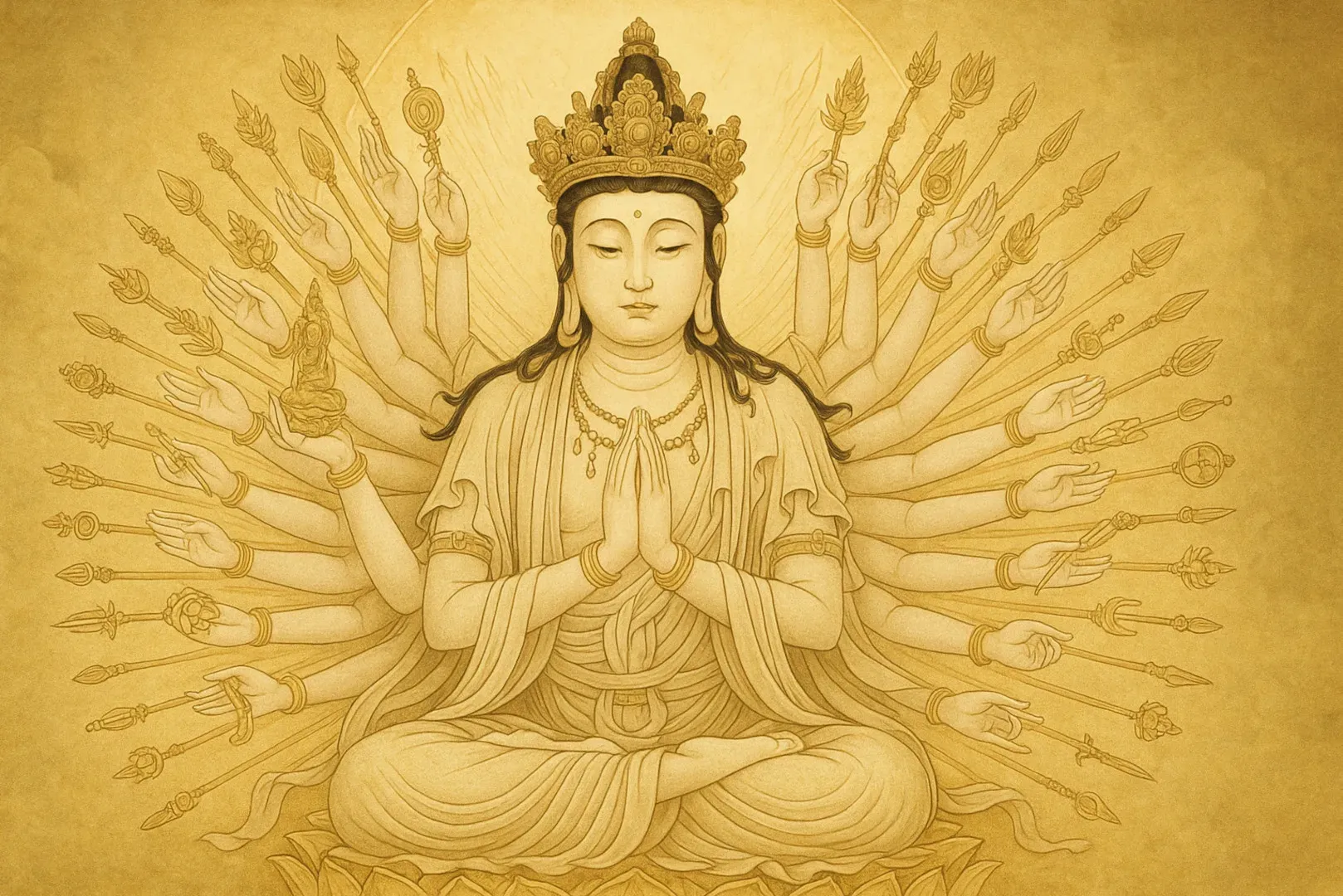
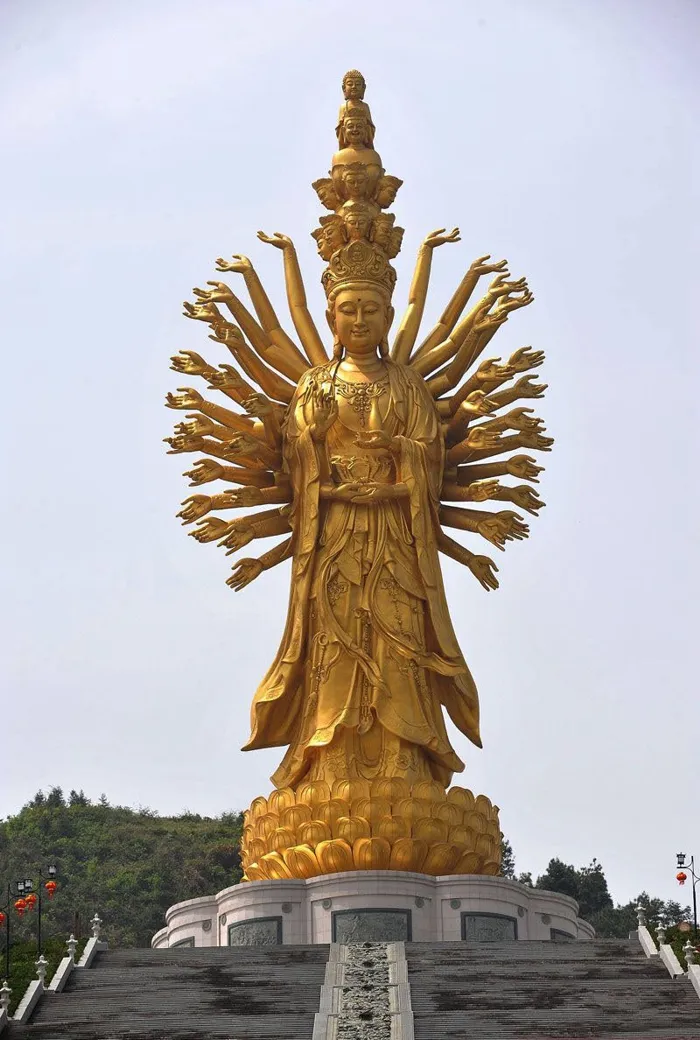
Visitors to Chinese temples and museums quickly notice that most Thousand-Armed Guanyin sculptures do not actually have one thousand separate carved arms. Sculpting a thousand fragile limbs in wood, bronze, or stone is structurally difficult, and Buddhist iconographic manuals established a standardized symbolic shorthand early on.
In the most widespread Chinese convention, the statue features 42 arms in total:
- Two central principal hands clasped at the chest in reverence (añjali mudrā) or resting in meditation, symbolizing the unity of compassion and wisdom.
- Forty radiating secondary arms holding specific ritual implements or forming symbolic hand gestures (mudrās).
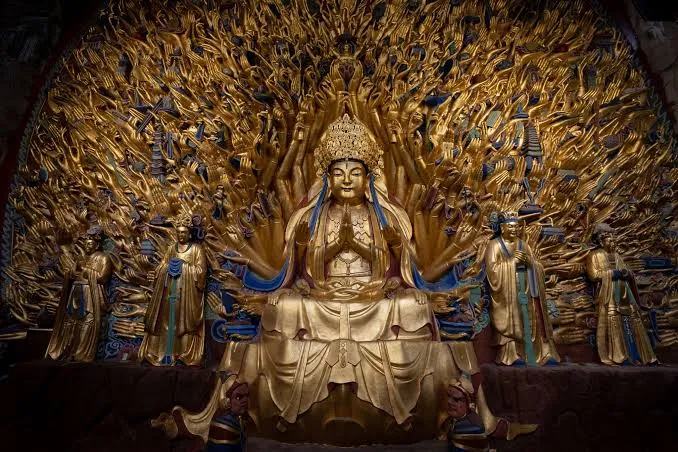
In Chinese Buddhist exegesis, each of the 40 radiating hands is said to govern and save beings across the 25 realms of existence (二十五有, èrshíwǔ yǒu) described in Buddhist cosmology. Multiplying 40 hands by 25 realms yields exactly 1,000 ($40 \times 25 = 1{,}000$), allowing a 42-arm image to carry the full theological weight of the thousand-armed vow. Variations also exist—some statues and hanging scrolls depict 18, 36, 44, or 48 arms—while rare monumental works, such as the cliffside carving at Baodingshan in Dazu, actually carve hundreds of gilded arms to create a literal halo of hands.
Reading the Iconography: Implements, Heads, and Crown
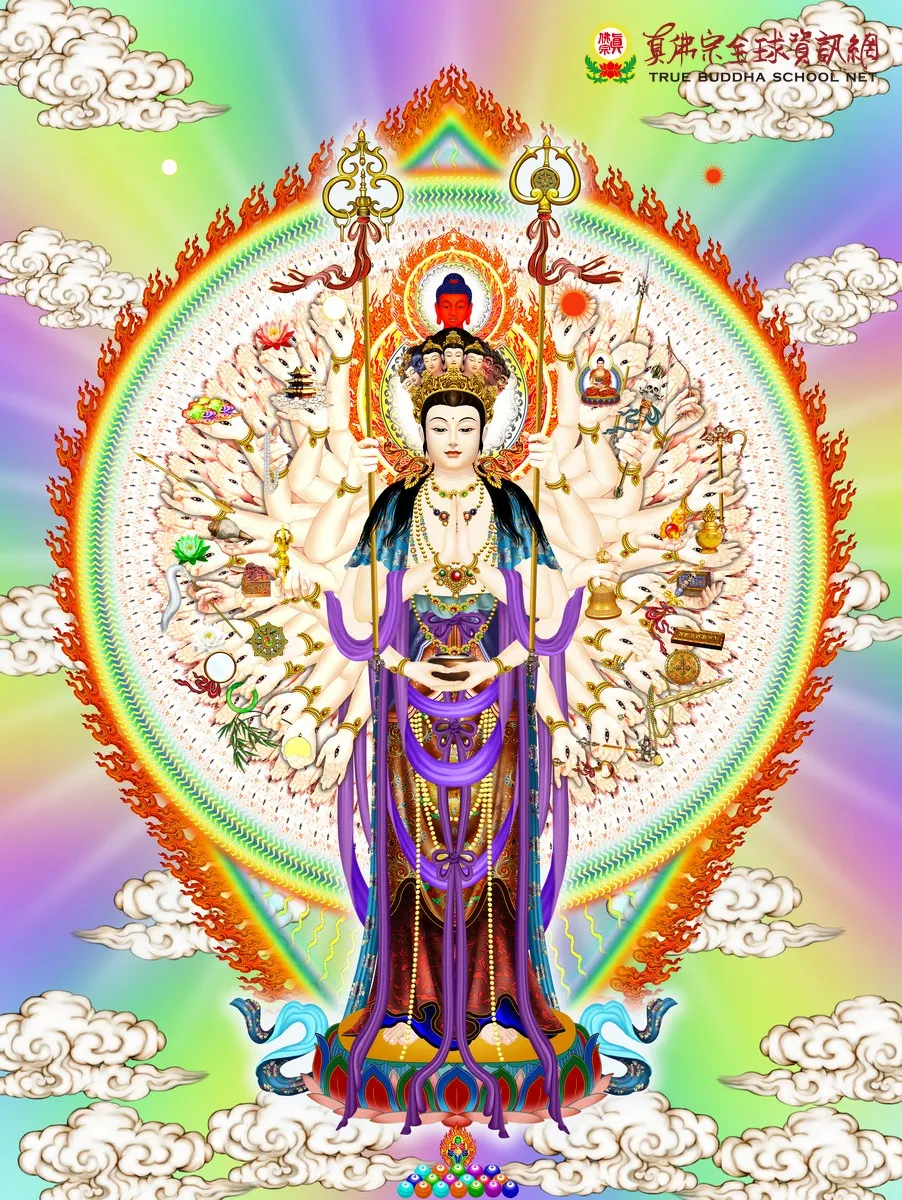
Every object placed in Thousand-Armed Guanyin’s hands corresponds to a specific vow or form of aid described in Tang-dynasty esoteric scriptures, particularly the Great Compassion Heart Dhāraṇī Sūtra (大悲心陀罗尼经, Dàbēixīn Tuóluóní Jīng). Rather than decorative props, these implements function as a visual catalog of spiritual and practical protection.
| Iconographic Element | Chinese Term (Pinyin) | Primary Symbolic Meaning |
|---|---|---|
| Lotus flower (white, blue, or red) | 莲花 (liánhuā) | Spiritual purity rising untainted from worldly suffering; merit and rebirth in a Pure Land. |
| Willow branch | 杨柳枝 (yángliǔzhī) | Healing, flexibility, and the power to dispel illness and misfortune; closely tied to Chinese Guanyin devotion. |
| Pure vase / nectar bottle | 净瓶 (jìngpíng) | The vessel holding sweet dew (amṛta), symbolizing purification, peace, and the quenching of spiritual thirst. |
| Dharma wheel | 法轮 (fǎlún) | The turning of Buddhist teaching, steadiness of practice, and perseverance on the path. |
| Prayer beads (mālā) | 念珠 (niànzhū) | Continuous mindfulness, recitation of the Buddha’s name, and unceasing compassionate vows. |
| Sun and moon discs | 日精、月精 (rìjīng, yuèjīng) | Illumination dispelling darkness, ignorance, and physical or spiritual blindness. |
| Sword, axe, or vajra | 宝剑、斧钺、金刚杵 | Decisive wisdom that cuts through delusion, fear, and demonic obstacles—never worldly violence. |
| Alms bowl | 宝钵 (bǎobō) | Sustenance, relief from hunger and physical distress, and the monastic path. |
| Wish-fulfilling jewel (cintāmaṇi) | 如意宝珠 (rúyì bǎozhū) | Abundance of spiritual and material necessities, relieving poverty and anxiety. |
| Multiple heads & Amitābha crown | 十一面、阿弥陀佛顶严 | Eleven (or more) faces looking in all directions to hear cries of distress, topped by Amitābha Buddha as Guanyin’s spiritual teacher. |
Many Thousand-Armed images also incorporate eleven heads arranged in tiers above the main face—a fusion with the Eleven-Headed Avalokiteśvara (Ekādaśamukha) tradition. These faces typically combine peaceful expressions, compassionate smiles, and a single wrathful face at the back or upper tier that confronts stubborn ignorance. At the very summit sits a miniature image of Amitābha Buddha (阿弥陀佛, Āmítuófó), identifying Guanyin as the chief attendant bodhisattva of the Western Pure Land.
Origins: From Indian Esoteric Buddhism to Tang and Song China
The Thousand-Armed form did not begin as an indigenous Chinese myth. It entered China through the translation of Indian Esoteric (Tantric) Buddhist scriptures during the Tang dynasty (618–907), part of the broader historical process examined in how Buddhism shaped Chinese mythology and in the transmission of Sanskrit names of Chinese Buddhist deities.
1. Tang-Dynasty Scriptures and the Great Compassion Dhāraṇī
The single most influential text behind the cult of Thousand-Armed Guanyin is the Sūtra of the Great Compassion Heart Dhāraṇī of the Thousand-Armed, Thousand-Eyed Bodhisattva Avalokiteśvara, traditionally attributed to the seventh-century translator Bhagavaddharma (伽梵达摩, Qiéfàndámó). In this scripture, Avalokiteśvara vows before the Buddha that if his body can assist all suffering beings, he wishes to sprout a thousand arms and a thousand eyes—and immediately manifests them.
The sūtra introduces the Great Compassion Dhāraṇī (大悲咒, Dàbēi Zhòu; Sanskrit Nīlakaṇṭha Dhāraṇī), which became one of the most widely chanted mantras across East Asian Mahāyāna Buddhism. From the Tang period onward, the epithet “Great Compassionate One” (大悲, Dàbēi) became closely associated with this multi-armed form of Guanyin.
2. Song-Dynasty Ritual Domestication
Although the multi-armed, multi-headed appearance initially looked unfamiliar to Chinese viewers accustomed to classical human-proportioned portraiture, it gained deep roots during the Song dynasty (960–1279). As historian of religion Chün-fang Yü has shown, two developments made Thousand-Armed Guanyin thoroughly at home in Chinese religious life:
- The Great Compassion Repentance ritual: The Tiantai master Siming Zhili (四明知礼, 960–1028) compiled a structured repentance liturgy centered on Thousand-Armed Guanyin and the Great Compassion Dhāraṇī, bringing an esoteric deity into mainstream monastic and lay devotional practice.
- The legend of Princess Miaoshan: Around 1100, a Chinese narrative emerged that gave Thousand-Armed Guanyin a Chinese biography, a female human life, and a deeply Confucian moral resonance.
The Legend of Princess Miaoshan: A Chinese Origin Story
In Chinese folk religion, precious scrolls (宝卷, bǎojuàn), and temple narratives, Thousand-Armed Guanyin is often explained through the story of Princess Miaoshan (妙善, Miàoshàn). This legend is not found in Indian Buddhist scripture; it took shape in Song-dynasty China around Xiangshan Monastery (香山寺, Fragrant Mountain) in Henan and spread nationwide.
In the best-known outline of the tale, Miaoshan is the youngest daughter of King Miaozhuang (妙庄王, Miàozhuāng Wáng). Devout from childhood, she refuses her father’s order to marry and insists on pursuing Buddhist cultivation. Enraged, the king subjects her to harsh labor and eventually orders her execution. In later retellings, her spirit travels through the underworld—where her recitation of scripture eases the suffering of condemned souls before Yanluo Wang—and she is restored to life on Fragrant Mountain.
Years later, King Miaozhuang falls gravely ill with an incurable disease. A wandering monk reveals that the only medicine able to save him must be compounded from the eyes and arms of someone entirely free of anger. Without hesitation, Miaoshan—now living as a hermit—offers her own eyes and arms to cure the very father who had persecuted her. When the recovered king journeys to Fragrant Mountain to thank his benefactor, he recognizes his mutilated daughter. In that moment of remorse and awakening, Miaoshan manifests as the Thousand-Armed, Thousand-Eyed Guanyin, radiating whole and luminous, and the royal family converts to Buddhism.
Historically, the Miaoshan story solved a major cultural tension. Critics had long accused Buddhist monasticism of violating Confucian filial piety by leaving one’s family and refusing marriage. By presenting Miaoshan’s self-sacrifice as the ultimate filial act, the legend harmonized Buddhist renunciation with Chinese family ethics—and gave a foreign-looking multi-armed esoteric icon a beloved Chinese identity.
Famous Historical Depictions of Thousand-Armed Guanyin in China
Some of China’s most celebrated surviving Buddhist artworks depict the Thousand-Armed form, illustrating how sculpture and painting evolved across dynasties:
- Baodingshan, Dazu Rock Carvings (Chongqing): Carved during the Southern Song dynasty (late 12th to mid-13th century) within the UNESCO World Heritage site of Dazu, this monumental gilded cliff relief is famous for departing from the 40-arm shorthand. Hundreds of carved, gilded arms fan outward across the rock wall like a peacock’s tail, each holding a distinct implement or bearing an eye in its palm.
- Dabei Pavilion, Longxing Temple (Zhengding, Hebei): Cast in bronze during the early Northern Song dynasty (971 CE), this towering statue stands over 21 meters tall and originally featured 42 arms. It remains one of the largest ancient bronze Buddhist sculptures in China and reflects imperial patronage of the Great Compassion cult.
- Dunhuang Caves (Gansu): Tang- and Five Dynasties-era silk paintings and cave murals from Mogao preserve some of the earliest Chinese visual programs of Thousand-Armed Avalokiteśvara, often surrounded by attendant guardians and cosmological diagrams derived from esoteric texts.
- Ming and Qing Wood and Gilded Bronzes: Later sculptures, including museum pieces in the Asian Art Museum of San Francisco and the Smithsonian’s National Museum of Asian Art, frequently blend Sino-Tibetan court aesthetics with softer, more feminine facial features familiar from late-imperial Guanyin devotion.
Cultural Meaning Today: Devotion, Art, and Everyday Symbolism
In contemporary Chinese culture, Thousand-Armed Guanyin occupies both sacred and cultural spaces. In Buddhist temples and home shrines, devotees chant the Great Compassion Dhāraṇī before Thousand-Armed images to cultivate patience, seek protection during illness or hardship, and dedicate merit to family members. Within Chinese Buddhist temple traditions, Thousand-Armed Guanyin is also widely venerated alongside other major bodhisattvas such as Ksitigarbha (Dizang) and protector figures like the Four Heavenly Kings.
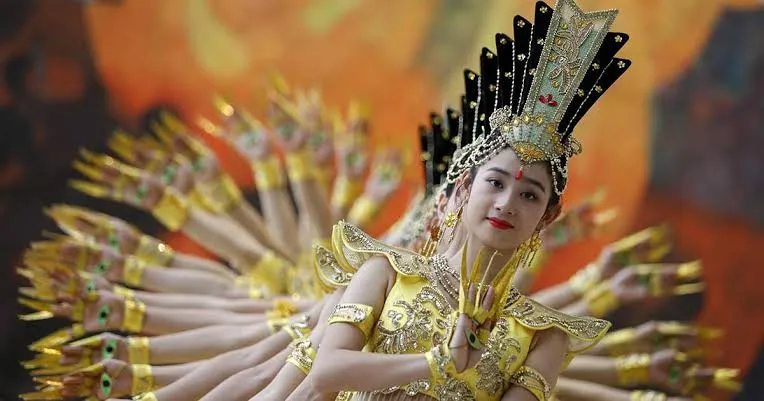
In folk zodiac devotion—a later popular religious layer distinct from early Buddhist scripture—Thousand-Armed Guanyin is traditionally paired as the patron protector (本命佛, běnmìngfó) for people born in the Year of the Rat. Meanwhile, in modern performing arts, the iconography reached global audiences through the celebrated Thousand-Hand Bodhisattva (千手观音) stage dance performed by hearing-impaired dancers of the China Disabled People’s Performing Art Troupe, which famously debuted at the 2005 CCTV Spring Festival Gala. By synchronizing twenty-one dancers in a single vertical line, the choreography translated an ancient Buddhist symbol of responsive compassion into a modern emblem of unity and perseverance.
Frequently Asked Questions
What is the main meaning of Thousand-Armed Guanyin?
Thousand-Armed Guanyin symbolizes boundless, responsive compassion guided by wisdom. The thousand eyes represent the ability to see every form of suffering in the world, while the thousand hands represent limitless skillful means to relieve it.
Why do most Thousand-Armed Guanyin statues only have 40 or 42 arms?
Carving one thousand separate arms is rarely practical. Standard Chinese iconography uses two central hands plus forty radiating arms; each of those forty arms is said to operate across the twenty-five realms of Buddhist cosmology (40 × 25 = 1,000), symbolizing the full thousand arms.
Is Thousand-Armed Guanyin male or female?
In Indian Mahāyāna Buddhism and early Tang-dynasty Chinese art, Avalokiteśvara (Guanyin) was depicted primarily in masculine or princely form. From the Song dynasty onward, feminine depictions became increasingly common in China—reinforced by the Princess Miaoshan legend—though Buddhist doctrine holds that a bodhisattva transcends fixed gender.
What is the connection between Thousand-Armed Guanyin and the Great Compassion Mantra?
The Great Compassion Dhāraṇī (Dàbēi Zhòu) is spoken by Thousand-Armed, Thousand-Eyed Avalokiteśvara in the Tang-dynasty Great Compassion Heart Dhāraṇī Sūtra. Chanting it became a cornerstone of Chinese Buddhist devotion and repentance practice linked directly to this manifestation.
Is Thousand-Armed Guanyin a goddess in Chinese mythology?
Although English sources frequently call Guanyin the “Goddess of Mercy” and popular Chinese religion often venerates Guanyin alongside Chinese gods, Thousand-Armed Guanyin is properly classified as a Buddhist bodhisattva—an enlightened being dedicated to liberating sentient beings from suffering.
References and Further Reading
- Yü, Chün-fang. Kuan-yin: The Chinese Transformation of Avalokiteśvara. New York: Columbia University Press, 2001. Bibliographic record via Architectura Sinica.
- Smithsonian’s National Museum of Asian Art. Thousand-armed Thousand-eyed Bodhisattva Avalokiteshvara (Guanyin), Object Record F1917.110.
- Asian Art Museum of San Francisco. Seated thousand-armed bodhisattva Avalokiteshvara (Guanyin), Ming dynasty or later, Object B60S584.
- Nara National Museum. Thousand-Armed Kannon (Sahasrabhūja), Collection Highlight and Iconographic Notes.
- UNESCO World Heritage Centre. Dazu Rock Carvings, World Heritage List (Baodingshan and Beishan Tantric Buddhist Carvings).
- Encyclopaedia Britannica. Avalokiteshvara, Buddhist Deity and Compassionate Bodhisattva.