
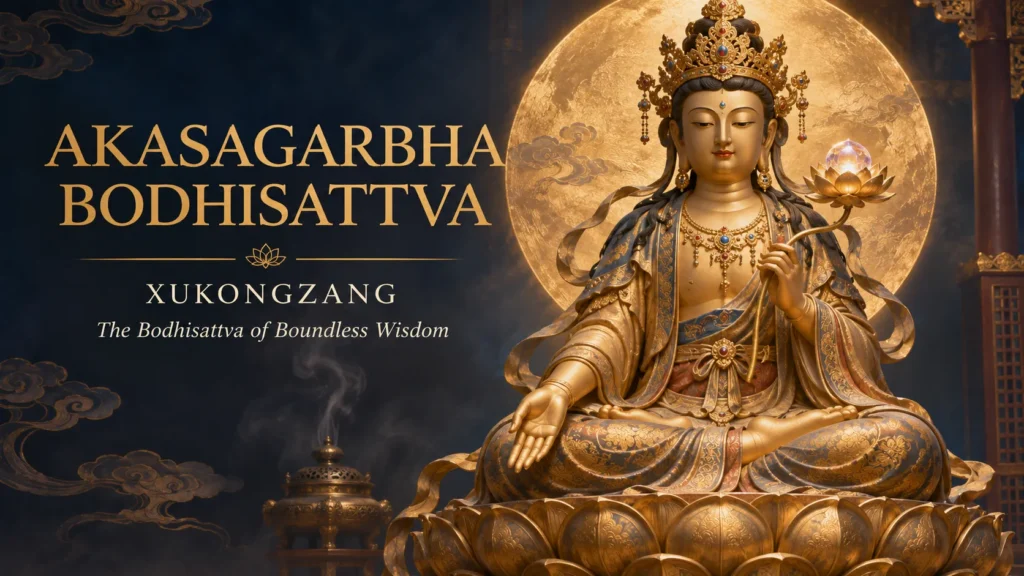
Akasagarbha Bodhisattva, known in China as Xukongzang Pusa (虚空藏菩萨, Xūkōngzàng Púsà), is a Mahayana Buddhist bodhisattva associated with boundless wisdom, spiritual merit, memory, and the purification of harmful karma. His Sanskrit name, Ākāśagarbha, evokes the vastness of space, suggesting a treasury of spiritual qualities that can never be exhausted.
Although less familiar to many Western readers than Guanyin or Manjushri, Akasagarbha occupies an important place in several Buddhist traditions. He appears in ancient scriptures, esoteric Buddhist rituals, religious paintings, and East Asian devotional practices. In contemporary popular religion, he is also known as the Buddhist protector associated with the Chinese zodiac signs of the Ox and Tiger.
Who is Akasagarbha Bodhisattva?
Akasagarbha is a Mahayana Buddhist bodhisattva representing wisdom and merit as limitless as space. In Chinese Buddhism, he is called Xukongzang. Devotees traditionally invoke him for spiritual understanding, memory, moral purification, and the cultivation of merit. He is distinct from Manjushri, Ksitigarbha, and other major bodhisattvas.
Akasagarbha Bodhisattva at a Glance
| Feature | Description |
|---|---|
| Chinese name | 虚空藏菩萨 (Xūkōngzàng Púsà) |
| Sanskrit name | Ākāśagarbha |
| Alternative spellings | Akasagarbha, Akashagarbha |
| Name meaning | Essence of Space or Treasury of Space |
| Classification | Mahayana Buddhist bodhisattva |
| Principal associations | Wisdom, merit, memory, and karmic purification |
| Common symbols | Wish-fulfilling jewel, lotus, jeweled crown, and ritual implements |
| Major scripture | Akasagarbha Bodhisattva Sutra (虚空藏菩萨经) |
| Japanese name | Kokūzō Bosatsu (虚空蔵菩薩) |
| Zodiac association | Ox and Tiger in popular East Asian traditions |
| Religious grouping | Eight Great Bodhisattvas in several Mahayana traditions |
What Does the Name Akasagarbha Mean?
The Sanskrit name Ākāśagarbha combines two elements. Ākāśa refers to space or the sky, while garbha can express meanings such as essence, womb, or that which contains something within itself.
Chinese Buddhist translators rendered the name as Xukongzang:
- Xu (虚): empty or insubstantial.
- Kong (空): space or emptiness.
- Zang (藏): a treasury, repository, or storehouse.
Together, these characters suggest a treasury as vast as empty space. English renderings vary because neither the Sanskrit nor the Chinese term has a single exact equivalent.
Space provides a powerful religious metaphor. It cannot easily be confined, divided, or exhausted. Akasagarbha’s wisdom and merit are understood through this same imagery: they are not limited resources reserved for a privileged few, but qualities cultivated for the benefit of living beings.
The name should not, however, be interpreted as referring to a god of outer space or a deity governing the stars and planets. Its significance is primarily philosophical and religious.
Origins of Akasagarbha in Buddhist Scriptures
Akasagarbha originated within the Indian Mahayana Buddhist tradition. His religious identity was subsequently developed through scriptural transmission, translation, ritual practice, and Buddhist art across Asia.
The Akasagarbha Bodhisattva Sutra
One of the most important Chinese scriptures associated with him is the Akasagarbha Bodhisattva Sutra (虚空藏菩萨经, Xukongzang Pusa Jing). The Chinese translation is attributed to Buddhayashas, a Buddhist translator active during the early fifth century. It is preserved in the Taisho Buddhist canon as text T0405.
The scripture presents Akasagarbha as an accomplished bodhisattva capable of assisting beings who have committed harmful actions and encountered obstacles on the Buddhist path.
Its religious concerns extend beyond intelligence or academic success. Repentance, ethical discipline, compassion, and spiritual recovery are central to the text.
A related version survives in the Tibetan Buddhist canon. An English translation is available through the 84000 Buddhist scripture translation project. The Chinese and Tibetan versions share important themes but differ in their arrangement and some of their content.
Other Chinese Buddhist Scriptures
The Chinese Buddhist canon also preserves additional works concerning Akasagarbha, including scriptures containing dharanis and ritual instructions. These materials reflect the development of distinct forms of devotion rather than a single unchanging system of worship.
By the Tang dynasty, Buddhist translation and ritual activity had created an extensive body of religious literature that helped shape esoteric traditions in China and elsewhere in East Asia.
What Does Akasagarbha Bodhisattva Represent?
The religious significance of Akasagarbha can be understood through several interconnected qualities.
1. Boundless Wisdom
Wisdom in Buddhism is more than the accumulation of information. It involves understanding the nature of existence, recognizing the causes of suffering, and developing insight that weakens ignorance and attachment.
Akasagarbha represents the inexhaustible potential of such understanding. His association with the vastness of space conveys the idea that spiritual insight cannot be measured in ordinary material terms.
2. Memory and Learning
Akasagarbha is especially associated with memory in East Asian esoteric Buddhism. Traditional practitioners have invoked him while studying Buddhist texts, memorizing religious teachings, and cultivating mental concentration.
In historical Buddhist communities, the ability to remember teachings had particular importance. Before printed books became widely available, oral instruction and accurate memorization were essential to transmitting religious knowledge.
Modern devotees may also connect Akasagarbha with examinations, education, and intellectual development. These are religious associations rather than scientifically established effects of devotional practice.
3. Spiritual Merit
The concept of merit, known as gongde (功德) in Chinese, refers to beneficial spiritual qualities generated through wholesome actions.
Acts of generosity, ethical conduct, religious study, and compassion are commonly understood as ways of cultivating merit. Akasagarbha symbolizes the abundance of these qualities and their potential to benefit others.
For this reason, his association with prosperity should not be reduced to the accumulation of money or material possessions.
4. Repentance and Karmic Purification
One of Akasagarbha’s most important scriptural functions is helping practitioners respond to the consequences of harmful conduct.
Buddhist teachings emphasize that intentional actions have consequences. The religious practices associated with Akasagarbha encourage people to acknowledge wrongdoing, cultivate remorse, and renew their commitment to ethical behavior.
This aspect of his identity is frequently overlooked in popular descriptions that present him only as a protector of students or a deity of wealth.
Symbols and Iconography of Akasagarbha
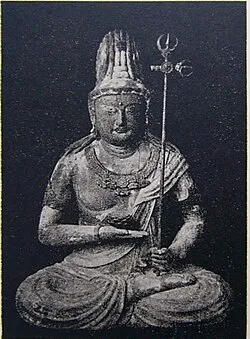
Akasagarbha appears in multiple forms throughout Buddhist art. His appearance depends on the region, historical period, scripture, and ritual tradition represented by a particular image.
| Symbol | Traditional significance |
|---|---|
| Wish-fulfilling jewel | Spiritual treasures, merit, and the fulfillment of beneficial aspirations. |
| Lotus flower or throne | Purity and spiritual development amid worldly existence. |
| Jeweled crown | Bodhisattva dignity and, in certain esoteric forms, a connection with the Five Buddhas. |
| Moon disc or circular halo | Spiritual illumination and a visual association with expansive space. |
| Sword | In some iconographic traditions, wisdom overcoming ignorance. |
| Open-handed gesture | Generosity, blessings, or the fulfillment of aspirations. |
The wish-fulfilling jewel, known in Sanskrit as cintamani, is a particularly significant attribute. It represents a form of spiritual wealth that can satisfy the needs of living beings.
However, no single object identifies Akasagarbha with complete certainty. Jewels, swords, crowns, and lotus flowers are also found in representations of other Buddhist figures. Inscriptions, accompanying figures, and the ritual context often provide more reliable evidence.
Akasagarbha in Chinese Buddhism
Chinese Buddhism encompasses numerous schools, devotional traditions, and regional practices. Akasagarbha’s position within this religious landscape is therefore not identical everywhere.
He is recognized as an important Mahayana bodhisattva, particularly in scriptures and practices involving merit, repentance, and esoteric ritual.
Nevertheless, his public devotional presence is generally less prominent than that of China’s Four Great Bodhisattvas: Guanyin, Manjushri, Samantabhadra, and Ksitigarbha.
Unlike these four figures, Akasagarbha is not conventionally associated with one of China’s Four Sacred Buddhist Mountains. He may instead appear in groups of bodhisattvas, specialized ritual images, or shrines connected with particular devotional traditions.
Although Chinese popular culture sometimes incorporates Buddhist figures into broader collections of protective gods, Akasagarbha is fundamentally a Buddhist bodhisattva rather than a deity originating in the Daoist celestial bureaucracy.
Is Akasagarbha One of the Eight Great Bodhisattvas?
Yes. Akasagarbha is included in a prominent grouping of eight bodhisattvas found in several Mahayana and Vajrayana Buddhist traditions.
| Bodhisattva | Chinese name | Common association |
|---|---|---|
| Avalokiteshvara | 观音 | Compassion |
| Manjushri | 文殊 | Transcendent wisdom |
| Samantabhadra | 普贤 | Practice and vows |
| Ksitigarbha | 地藏 | Great vows and deliverance from suffering |
| Maitreya | 弥勒 | The future Buddha |
| Vajrapani | 金刚手 | Spiritual power |
| Akasagarbha | 虚空藏 | Merit, wisdom, and purification |
| Sarvanivaranavishkambhin | 除盖障 | Removal of spiritual obstacles |
The Eight Great Bodhisattvas should not be confused with either China’s Four Great Bodhisattvas or the eight Buddhist figures associated with the twelve zodiac animals. These are distinct religious groupings with different historical and devotional purposes.
Akasagarbha as the Protector of the Ox and Tiger
Many people encounter Xukongzang through the East Asian tradition of zodiac guardian deities, commonly called benming fo (本命佛) in modern Chinese popular religion.
Within this system, Akasagarbha is associated with two zodiac animals:
- Ox (牛): traditionally associated with diligence, perseverance, and responsibility.
- Tiger (虎): traditionally associated with courage, independence, and strength.
People born in the Year of the Ox or Tiger may wear an Akasagarbha pendant, keep an image of the bodhisattva at home, or make offerings as an expression of devotion.
The system of zodiac guardians is particularly well documented in Japanese Buddhist culture and is also encountered in contemporary Chinese-speaking communities.
It is important to distinguish this tradition from the early scriptures concerning Akasagarbha. The association with particular birth years is not the foundation of his original Mahayana identity, nor does Buddhism universally require people to worship a guardian according to their zodiac sign.
Akasagarbha Bodhisattva Mantra and Devotional Practices
Mantras and dharanis associated with Akasagarbha appear in several Buddhist ritual traditions. Their wording, pronunciation, and intended use may differ between Sanskrit-derived, Chinese, Tibetan, and Japanese liturgical systems.
One historically important practice is known in Chinese as the Xukongzang Qiu Wen Chi Fa (虚空藏求闻持法), a ritual associated with retaining teachings and developing memory.
Religious practices connected with Akasagarbha may include:
- Reciting his name or established liturgical formulas.
- Making offerings before a devotional image.
- Reading and studying Buddhist scriptures.
- Practicing repentance and ethical reflection.
- Dedicating merit to other living beings.
Some esoteric practices are transmitted through specialized religious instruction. Their significance cannot always be understood by isolating a mantra from its ritual and doctrinal context.
Akasagarbha in Japanese Buddhism
In Japan, Akasagarbha is known as Kokūzō Bosatsu. His worship became especially significant in esoteric Buddhist traditions.
The Japanese ritual called Gumonjihō is closely associated with memory and the retention of Buddhist teachings. The practice was known in Japan before Kūkai established the systematic Shingon tradition in the early ninth century. Accounts of Kūkai’s religious training also connect him with this form of devotion.
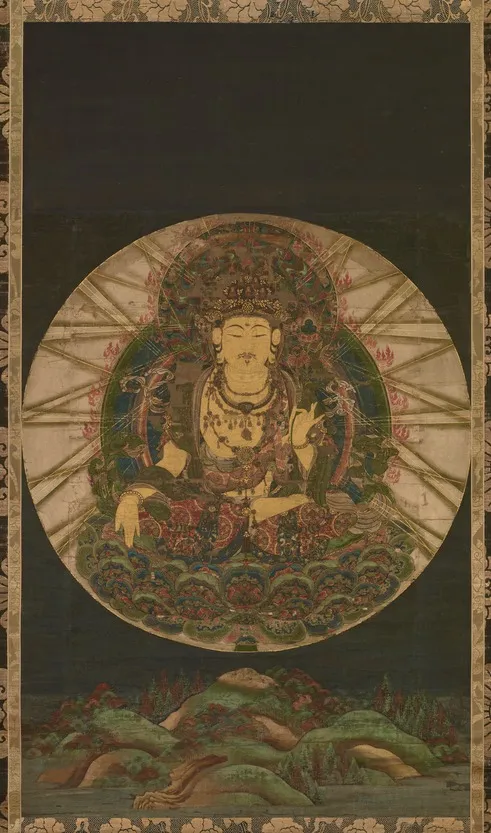
Historical Japanese paintings of Kokūzō often show the bodhisattva seated on a lotus within a lunar disc, wearing a jeweled crown and holding a sacred jewel.
Surviving works from the Heian and Kamakura periods demonstrate that different ritual purposes could produce distinct representations of the same bodhisattva.
Akasagarbha vs. Manjushri vs. Ksitigarbha
Akasagarbha is sometimes confused with other bodhisattvas because their religious qualities and artistic attributes overlap.
| Feature | Akasagarbha | Manjushri | Ksitigarbha |
|---|---|---|---|
| Chinese name | 虚空藏 | 文殊 | 地藏 |
| Primary association | Boundless merit, memory, and purification | Transcendent wisdom | Great vows and rescue of suffering beings |
| Common symbols | Jewel and jeweled crown | Sword and scripture | Ringed staff and jewel |
| Four Great Bodhisattvas of China | No | Yes | Yes |
Akasagarbha and Manjushri
Both bodhisattvas are associated with wisdom. Manjushri is particularly identified with prajna, the insight that penetrates ignorance and reveals the nature of reality. Akasagarbha has additional associations with the accumulation of merit, memory, and ethical purification.
Akasagarbha and Ksitigarbha
Their Sanskrit names share the element garbha, and their Chinese names both contain the character zang (藏). However, they are distinct religious figures.
Ksitigarbha, known in China as Dizang, is especially associated with vows to rescue suffering beings, including those in the Buddhist hell realms. Akasagarbha’s name instead evokes the vastness of space and the abundance of spiritual qualities.
Akasagarbha and Guanyin
Guanyin, the Bodhisattva of Compassion, is widely invoked by devotees seeking relief from suffering. Akasagarbha likewise acts compassionately, but his distinctive devotional traditions place greater emphasis on merit, spiritual understanding, and purification.
These associations are not rigid divisions of responsibility. Buddhist bodhisattvas may embody several virtues simultaneously, and their activities often overlap.
Frequently Asked Questions
Is Akasagarbha the same as Xukongzang?
Yes. Akasagarbha is a common Romanized spelling of the Sanskrit name Ākāśagarbha, while Xukongzang is the Chinese name for the same bodhisattva.
What is Akasagarbha Bodhisattva known for?
He is known for boundless wisdom, spiritual merit, memory, learning, and practices associated with the purification of harmful karma.
Is Akasagarbha a Buddha or a bodhisattva?
He is conventionally classified as a bodhisattva. Although some popular devotional expressions call him a guardian Buddha, this terminology should not obscure his traditional Mahayana identity.
Which zodiac signs are protected by Akasagarbha?
In the East Asian zodiac guardian tradition, Akasagarbha is associated with the Ox and Tiger. This is a particular devotional convention rather than a universal Buddhist doctrine.
Can students pray to Akasagarbha?
Yes. Some devotees invoke Akasagarbha when pursuing education, memorization, concentration, and religious study. Buddhist devotion traditionally accompanies personal effort, ethical conduct, and disciplined practice.
Is Akasagarbha the god of wealth?
Not in the ordinary sense. His association with spiritual treasures and accumulated merit has sometimes been extended to prosperity, but his religious identity is broader than that of a wealth deity.
Is Akasagarbha the same as Manjushri?
No. Although both are associated with wisdom, they are distinct bodhisattvas with different scriptural histories and devotional traditions.
Did Akasagarbha originate in Chinese mythology?
No. Akasagarbha originated in Mahayana Buddhism and became part of Chinese religious culture through the transmission and translation of Buddhist scriptures.
Conclusion
Akasagarbha Bodhisattva represents a distinctive understanding of spiritual abundance. His name evokes the immensity of space, while his scriptures and devotional traditions emphasize wisdom, ethical renewal, and the cultivation of merit.
His association with memory and learning remains particularly visible in East Asian esoteric Buddhism, while his role as the protector of the Ox and Tiger reflects later forms of popular devotion.
Understanding Xukongzang requires looking beyond zodiac symbolism and recognizing his place within the wider Mahayana tradition that developed from the teachings of Shakyamuni Buddha. His religious significance lies not simply in granting wishes, but in helping living beings cultivate the qualities necessary for spiritual progress.
References and Further Reading
- Taisho Tripitaka, Volume 13, No. 405. Akasagarbha Bodhisattva Sutra (虚空藏菩萨经). Chinese translation attributed to Buddhayashas.
- Sakya Pandita Translation Group. The Akasagarbha Sutra (Toh 260). 84000: Translating the Words of the Buddha.
- Tokyo National Museum. Kokuzo Bosatsu (Akasagarbha Bodhisattva), National Treasure, collection A-10498.
- Tokyo National Museum. Akasagarbha Bodhisattva, Kamakura period, collection A-989.
- Nara National Museum. Kokuzo (Akasagarbha), Important Cultural Property, collection 1108.
- Himalayan Art Resources. Akashagarbha Bodhisattva: Buddhist Iconography and the Eight Great Bodhisattvas.
- Buddha Tooth Relic Temple and Museum. Zodiac Protectors.
Related posts:
 Medicine Buddha in Chinese Buddhism: Yaoshi Fo Explained
 Five Dhyani Buddhas in Chinese Buddhism: Names, Symbols & Meaning
 Amitabha vs Shakyamuni Buddha: Key Differences
 Heng and Ha Generals in Chinese Temples: Origins & Meaning
 Shancai Tongzi (Sudhana): Guanyin’s Young Disciple
 Cundi Bodhisattva (Zhunti): Origins, Mantra & 18 Arms
