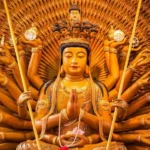
Walk into a Chinese Buddhist temple, and you may encounter several golden Buddha statues seated on lotus thrones. Their calm expressions, robes, and distinctive hairstyles can make them appear almost identical. Yet these images may represent very different figures within Buddhist tradition.
Two of the most important are Amitabha Buddha and Shakyamuni Buddha. Both are widely honored in Chinese Buddhism, but their origins, religious significance, and places within Buddhist cosmology are different. Understanding the distinction also helps explain why Chinese temples frequently enshrine more than one Buddha.
What is the difference between Amitabha and Shakyamuni Buddha? Shakyamuni is Siddhartha Gautama, the historical teacher whose teachings gave rise to Buddhism. Amitabha is the Buddha of Infinite Light described in Mahayana Buddhist scriptures, particularly those concerning the Western Pure Land. They are distinct Buddhas, although their roles are closely connected through Buddhist teachings about awakening and liberation.
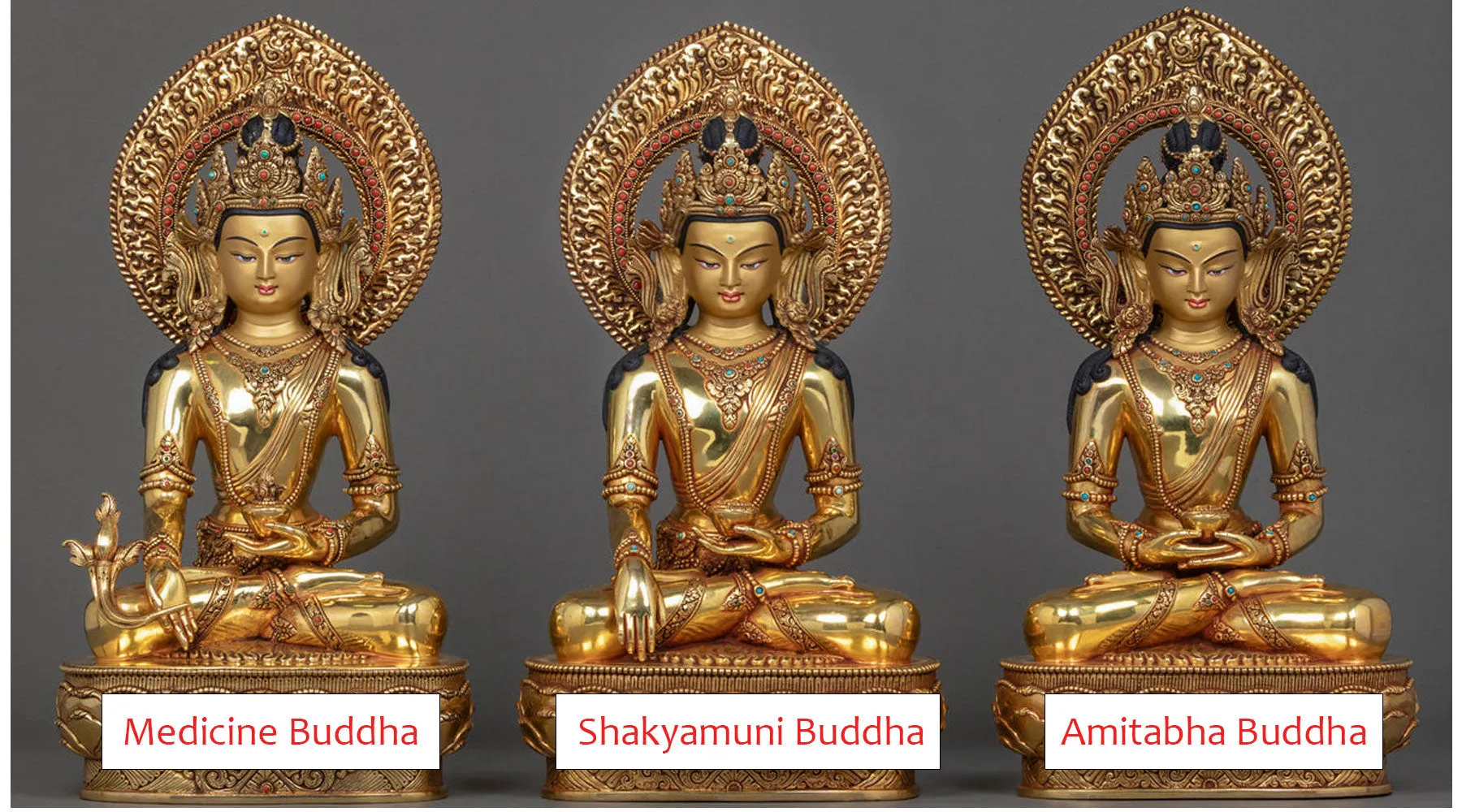
Amitabha vs Shakyamuni Buddha: Key Differences
The most important distinction concerns their identities. Shakyamuni belongs to the historical origins of Buddhism, while Amitabha occupies a central position in the cosmology and devotional teachings of Mahayana Buddhism.
| Feature | Amitabha Buddha | Shakyamuni Buddha |
|---|---|---|
| Chinese name | 阿弥陀佛 (Āmítuó Fó) | 释迦牟尼佛 (Shìjiāmóuní Fó) |
| Sanskrit name | Amitābha | Śākyamuni |
| Meaning | Infinite Light | Sage of the Shakya clan |
| Identity | Buddha described in Mahayana scriptures | The historical Buddha, Siddhartha Gautama |
| Associated world | Sukhavati, the Western Pure Land | The Saha world |
| Religious emphasis | Compassionate vows, Pure Land rebirth, and awakening | The Dharma, awakening, and liberation from suffering |
| Common artistic gestures | Meditation and welcoming gestures | Earth-touching, teaching, and meditation gestures |
| Common attendants | Guanyin and Mahasthamaprapta | Mahakasyapa and Ananda in many Chinese temples |
| Associated practice | Recollection or recitation of Amitabha’s name | Ethical conduct, meditation, and wisdom |
These associations are not exclusive. Pure Land practitioners also follow the teachings of Shakyamuni, and images of both Buddhas can express meditation, wisdom, and compassion.
Who Is Shakyamuni Buddha?
Shakyamuni Buddha is another name for Siddhartha Gautama, the historical religious teacher whose teachings formed the foundation of Buddhism. The title Shakyamuni means the sage of the Shakya clan.
He lived in ancient South Asia several centuries before the Common Era, although scholars continue to debate his precise dates. Buddhist tradition places his birth at Lumbini, in present-day Nepal, and his awakening at Bodh Gaya, in present-day India.
Traditional biographies describe how Siddhartha renounced his privileged life, pursued spiritual discipline, and eventually attained enlightenment beneath the Bodhi tree. He then devoted his life to teaching others how suffering arises and how liberation is possible.
The Teachings of Shakyamuni
Among the foundational teachings associated with Shakyamuni are:
- The Four Noble Truths: an explanation of suffering, its causes, its cessation, and the path leading to cessation.
- The Noble Eightfold Path: a framework for ethical conduct, mental cultivation, and wisdom.
- Impermanence: the understanding that conditioned phenomena are subject to change.
- Dependent origination: the principle that phenomena arise through causes and conditions.
- Nirvana: liberation from the forces that sustain suffering and cyclic existence.
Shakyamuni’s significance extends across Theravada, Mahayana, and Vajrayana traditions. In Chinese Buddhism, he remains the central historical teacher even within communities that emphasize devotion to Amitabha or other Buddhas and bodhisattvas.
For more about his statues, temple placement, and religious symbolism, see our guide to Shakyamuni Buddha in Chinese temples.
Who Is Amitabha Buddha?
Amitabha Buddha is known in Chinese as Amituo Fo (阿弥陀佛). His Sanskrit name means Infinite Light. He is also closely associated with the name Amitayus, meaning Infinite Life, particularly in East Asian Pure Land traditions.
Unlike Shakyamuni, Amitabha is not known through a historical human biography. His origins and religious significance are described in Mahayana Buddhist scriptures.
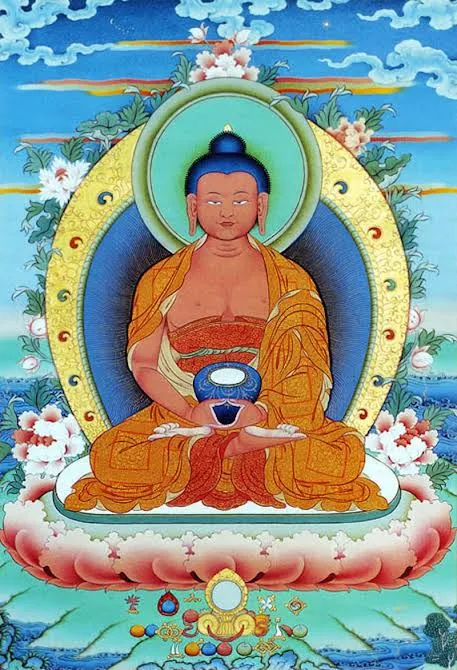
The Story of Dharmakara and His Vows
According to the Larger Sutra on Amitayus, Amitabha was formerly a religious practitioner named Dharmakara. Inspired by the Buddha Lokesvararaja, he undertook an extraordinary spiritual commitment to establish a Buddha-field where living beings could advance toward enlightenment.
An influential Chinese version of the sutra describes forty-eight vows. Other textual versions contain different enumerations, reflecting the transmission history of the scripture.
After fulfilling his commitments and attaining Buddhahood, Dharmakara became known as Amitabha or Amitayus. His Buddha-field is Sukhavati, the Western Pure Land.
What Is the Western Pure Land?
Sukhavati, known in Chinese as Jile Shijie (极乐世界), means the World of Ultimate Bliss. Pure Land scriptures describe it as a realm characterized by beauty, spiritual instruction, and favorable conditions for progress toward awakening.
Rebirth in this realm is not simply a reward for worldly virtue or an eternal existence in heaven. Its significance lies in the opportunity to continue Buddhist practice under conditions understood to be especially supportive of liberation.
Different Buddhist schools interpret the Pure Land in different ways. Some emphasize it as a realm of rebirth, while others also explore its relationship to the nature of mind.
What Is the Relationship Between Amitabha and Shakyamuni?
One of the clearest explanations of their relationship appears in the Amitabha Sutra, also known as the Smaller Sukhavativyuha Sutra.
In this scripture, Shakyamuni addresses his disciple Shariputra and describes Amitabha, the qualities of Sukhavati, and the spiritual significance of aspiring to rebirth there. Shakyamuni therefore acts as the teacher who introduces the Pure Land teaching within the narrative of the sutra.
Amitabha, in turn, is the Buddha whose vows and Buddha-field provide the foundation for Pure Land devotion.
The relationship is complementary rather than competitive. Shakyamuni teaches the Dharma in this world, while Amitabha represents a particular path toward awakening emphasized in Pure Land Buddhism.
This does not mean that Amitabha was historically a disciple of Shakyamuni, nor that one succeeded the other as the founder of Buddhism. Their relationship belongs primarily to the framework of Mahayana scripture and religious interpretation.
Why Are Both Buddhas Found in Chinese Temples?
Mahayana Buddhism recognizes numerous Buddhas associated with different world systems, teachings, and religious practices. Chinese Buddhist temples consequently may contain images of several Buddhas within the same hall.
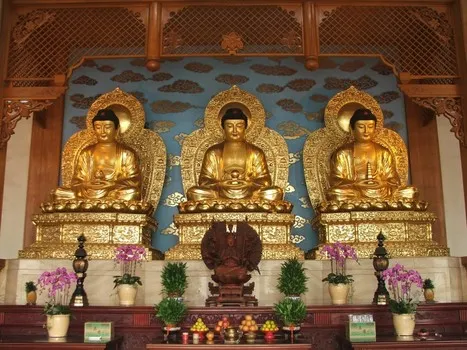
The Buddhas of the Three Directions
One widespread arrangement in Chinese Buddhism is the grouping known as the Three Buddhas of the Directions, sometimes called the Horizontal Three Buddhas (横三世佛).
- Shakyamuni Buddha: associated with the Saha world.
- Amitabha Buddha: associated with the Western Pure Land.
- Medicine Buddha: associated with the Eastern Pure Lapis Lazuli World.
Shakyamuni commonly occupies the central position in this arrangement. Amitabha and Medicine Buddha represent the western and eastern Buddha-fields respectively.
The grouping illustrates the Mahayana understanding that awakened Buddhas are not limited to a single world or historical period. However, not every three-Buddha shrine follows this arrangement.
The Three Buddhas of the Three Ages
Another familiar grouping represents the past, present, and future. One common version consists of Dipankara Buddha, Shakyamuni Buddha, and Maitreya, who is expected to become the Buddha of a future age in this world.
This temporal grouping should not be confused with the directional arrangement of Shakyamuni, Amitabha, and Medicine Buddha. Our guide to the Three Buddhas of the Three Ages explains the distinction in greater detail.
How to Identify Amitabha and Shakyamuni Buddha Statues
Both Buddhas may be represented with elongated earlobes, a cranial protuberance known as an ushnisha, a radiant halo, monastic robes, and a lotus pedestal. Their shared appearance reflects the artistic conventions used to represent enlightened Buddhas.
Identification therefore requires attention to the hands, accompanying figures, inscriptions, and broader religious context.
Shakyamuni Buddha’s Hand Gestures
One of the best-known representations of Shakyamuni shows him seated with his right hand reaching down toward the earth and his left hand resting in his lap.
This earth-touching gesture, called bhumisparsha mudra, recalls the traditional account of his awakening, when he called upon the earth to witness his spiritual achievement.
Other representations show him teaching, meditating, or raising a hand in reassurance. The earth-touching gesture is a valuable clue, but it is not an exclusive identifier in every Buddhist artistic tradition.
Amitabha Buddha’s Hand Gestures
Amitabha is frequently portrayed in a seated meditation posture, with both hands resting in his lap. He may also appear standing, extending a hand in a gesture of welcome.
Welcoming images are especially associated with Pure Land devotion and the religious belief that Amitabha receives practitioners who aspire to rebirth in Sukhavati.
Color Differences in Buddhist Paintings
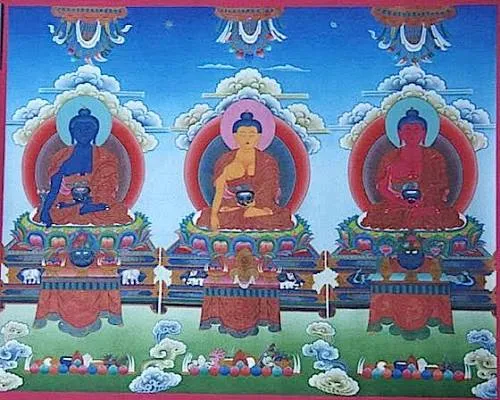
In Tibetan Buddhist iconography, Amitabha is often depicted with a red body, Shakyamuni with a golden body, and Medicine Buddha with a deep blue body.
These conventions can help identify figures in particular paintings, but they should not be applied universally. Chinese temples frequently contain gilded statues of all three Buddhas, making color alone an unreliable guide.
Amitabha and the Three Saints of the West
Amitabha also appears in a separate grouping known as the Three Saints of the West, or the Western Pure Land Triad.
In this arrangement, Amitabha occupies the central position and is accompanied by two bodhisattvas:
- Guanyin (Avalokiteshvara): associated with compassion and responsiveness to suffering.
- Dashizhi (Mahasthamaprapta): associated with spiritual strength, wisdom, and mindfulness.
This grouping is especially significant in Chinese Pure Land devotion. Unlike the Buddhas of the Three Directions, it contains one Buddha and two bodhisattvas.
Read our detailed introduction to the Three Saints of the West in Buddhism to learn how these figures are recognized in temple sculpture and religious paintings.
Why Do Chinese Buddhists Chant Amitabha’s Name?
One of the most familiar expressions in Chinese Buddhist communities is Namo Amituofo (南无阿弥陀佛), meaning homage to Amitabha Buddha.
The practice is commonly associated with nianfo (念佛), which encompasses remembering, contemplating, or reciting the name of a Buddha. In Chinese Pure Land Buddhism, it is particularly connected with Amitabha.
Practitioners may recite his name during daily religious practice, communal services, meditation, memorial ceremonies, and rites associated with death.
Pure Land traditions often emphasize faith, aspiration, and practice. Their interpretations of the relationship between personal spiritual cultivation and Amitabha’s compassionate vows vary.
Reciting Amitabha’s name does not necessarily mean that a practitioner rejects Shakyamuni. Within Chinese Buddhism, Pure Land devotion and other practices, including Chan meditation, have frequently existed alongside one another.
Frequently Asked Questions
Are Amitabha and Shakyamuni the same Buddha?
No. In conventional Buddhist teachings, they are distinct Buddhas. Shakyamuni is the historical Buddha associated with Siddhartha Gautama, while Amitabha is the Buddha of the Western Pure Land described in Mahayana scriptures.
Is Amitabha the same as Gautama Buddha?
No. Gautama Buddha is another name for Shakyamuni. Amitabha has a separate identity and is associated with the Pure Land known as Sukhavati.
Which Buddha came first, Amitabha or Shakyamuni?
Pure Land scriptures describe Amitabha as having attained Buddhahood many eons ago. Shakyamuni, by contrast, is associated with a historical human life in ancient South Asia. Their chronology cannot be compared directly as though both were historically documented individuals.
Did Shakyamuni teach about Amitabha Buddha?
Yes, according to Mahayana Pure Land scriptures. The Amitabha Sutra presents Shakyamuni describing Amitabha and his Western Pure Land to an assembly of disciples. This is a scriptural account, rather than independently verified evidence of a particular historical sermon.
Is Amitabha Buddha more powerful than Shakyamuni?
Buddhist teachings generally do not classify fully awakened Buddhas according to a simple hierarchy of supernatural power. Different traditions emphasize particular Buddhas according to their vows, teachings, and relationships with living beings.
Do Theravada Buddhists worship Amitabha?
Amitabha devotion is primarily associated with Mahayana and Vajrayana Buddhism. Theravada Buddhism does not generally incorporate Amitabha or the Pure Land scriptures into its traditional canonical and devotional framework.
Is Amitabha the Laughing Buddha?
No. The familiar Laughing Buddha is based on Budai, a Chinese monk traditionally associated with Maitreya. Amitabha, Shakyamuni, and Budai represent different figures.
Can you identify a Buddha by its hand gestures alone?
Not always. Many Buddhas share similar hand gestures, postures, and physical characteristics. Inscriptions, accompanying figures, ritual objects, and the dedication of the temple are often necessary for reliable identification.
Understanding Their Place in Chinese Buddhism
The distinction between Amitabha and Shakyamuni reveals an important feature of Chinese Buddhism: historical religious teachings, Mahayana cosmology, devotional practices, and artistic traditions coexist within a rich and interconnected religious culture.
Shakyamuni represents the historical origins of Buddhism and the teaching of the path beyond suffering. Amitabha embodies the Pure Land aspiration, grounded in compassionate vows and the possibility of advancing toward awakening under favorable conditions.
Rather than representing competing objects of worship, these two Buddhas express complementary dimensions of Buddhist religious life. Their presence together in Chinese temples reflects a tradition in which wisdom, compassion, faith, and spiritual cultivation can take many forms.
References and Further Reading
BDK America. The Three Pure Land Sutras. Translated from the Chinese by Hisao Inagaki, in collaboration with Harold Stewart. Revised edition, 2003. BDK English Tripitaka Series.
84000: Translating the Words of the Buddha. The Display of the Pure Land of Sukhavati. Toh 115. Translation of the Smaller Sukhavativyuha Sutra.
Internet Encyclopedia of Philosophy. Buddha. Academic overview of the historical Buddha and foundational Buddhist teachings.
Smithsonian National Museum of Asian Art. Diving Deeper into Buddhism: Western Paradise. Educational resource on Amitabha and Pure Land Buddhist art in China.
The Metropolitan Museum of Art. Chinese Buddhist Sculpture. Historical overview of Buddhist imagery and devotional traditions in China.
Los Angeles County Museum of Art. Buddha Shakyamuni or the Jina Buddha Amitabha. Collection record 34298. Discussion of overlapping iconographic characteristics.
Rubin Museum of Himalayan Art. Buddha Shakyamuni. Collection C2006.66.656. Discussion of the earth-touching gesture and Buddhist awakening imagery.