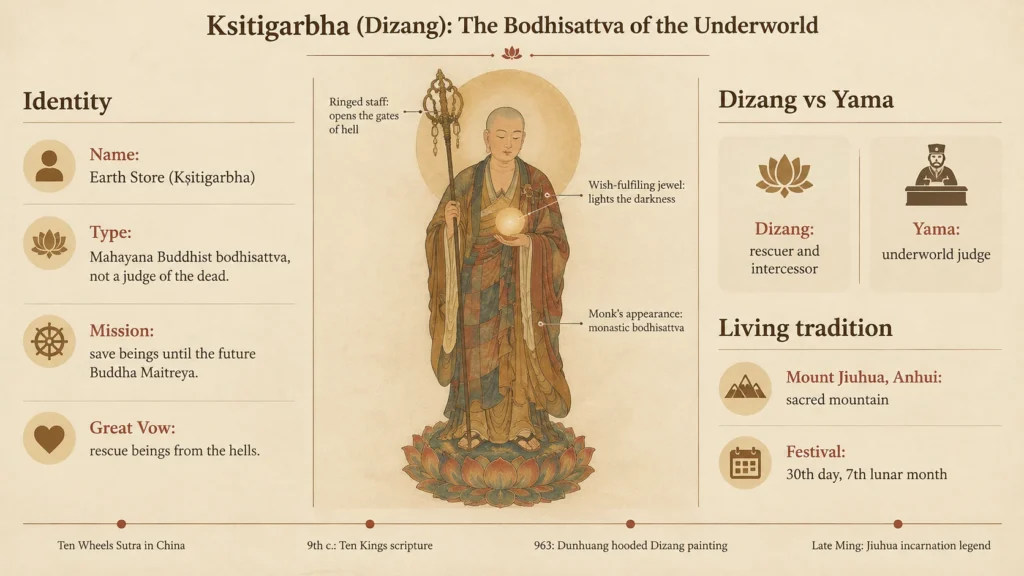
Ksitigarbha (Sanskrit Kṣitigarbha; Chinese 地藏, Dìzàng) is a Mahayana Buddhist bodhisattva best known for vowing to save beings suffering in the hell realms. In China he is usually called Dizang Wang Pusa (地藏王菩萨, Dìzàng Wáng Púsà), and he became one of the most important figures in Chinese funeral rites and devotion for the dead. English sources often call him “the bodhisattva of the underworld,” but that label needs a caveat: in Buddhist terms Dizang is not the judge of the dead. That role belongs to King Yama and the Ten Kings. Dizang is the rescuer who enters the hells to teach, relieve suffering, and lead beings toward better rebirths.
Short answer: Dizang is the Chinese form of Kṣitigarbha, the “Earth Store” bodhisattva. Buddhist scriptures describe him as entrusted with saving beings in the long age between the Buddha Shakyamuni and the future Buddha Maitreya. Chinese devotion emphasizes his great vow to rescue beings from hell, his compassion for the dead, and his ties to filial piety.
Ksitigarbha at a Glance
| Feature | Details |
|---|---|
| Chinese name | 地藏 (Dìzàng); popularly 地藏王菩萨 (Dìzàng Wáng Púsà) |
| Name meaning | “Earth Store” or “Earth Womb” |
| Classification | Mahayana Buddhist bodhisattva, not a Daoist or folk deity |
| Core role | Saving beings in all realms of rebirth, especially the hells |
| Signature vow | To keep rescuing suffering beings rather than seek his own final buddhahood first |
| Key scriptures | Ten Wheels Sutra, Divination Sutra (Zhancha jing), Sutra of the Past Vows of Dizang |
| Main attributes | Monk’s appearance, ringed staff (khakkhara), wish-fulfilling jewel |
| Sacred mountain | Mount Jiuhua (九华山, Jiǔhuá Shān), Anhui |
| Main festival | 30th day of the seventh lunar month |
Who Is Ksitigarbha?
A bodhisattva is a being committed to awakening for the sake of others. Mahayana Buddhism honors several great bodhisattvas, and in Chinese Buddhism Dizang is often grouped with Guanyin, the bodhisattva of compassion, Wenshu (Manjushri), and Puxian (Samantabhadra). Each is linked with a quality. Dizang’s is the great vow (大愿, dàyuàn), which is why he is sometimes called Dayuan Dizang, “Dizang of the Great Vow.”
What sets him apart is where his compassion is directed. Guanyin is invoked for help in this life, in danger, illness, and childbirth. Dizang’s sphere extends to the most hopeless places in Buddhist cosmology: the hells, the realm of hungry ghosts, and the anxious weeks after a death, when families hope to secure a good rebirth for a parent, spouse, or child.
Because he appears in Chinese underworld art next to Yama and the Ten Kings, he is sometimes folded into lists of Chinese gods. That popular overlap is real, but his identity remains Buddhist first. He is a bodhisattva, not a shen (神) appointed to a heavenly office.
The Name: Kṣitigarbha, Dizang, and “King”
The Sanskrit kṣiti means “earth,” and garbha can mean “womb,” “store,” or “inner treasury.” The name is usually rendered “Earth Store” or “Womb of the Earth.” Chinese translators chose 地藏, literally “earth” plus “store” or “treasury.” The image suggests a ground that holds hidden treasure and supports all living things, a fitting emblem for a bodhisattva who works in the lowest realms.
The word Wang (王, “king”) in Dizang Wang Pusa is an honorific. It does not mean Buddhist scripture appoints him monarch of the underworld, although popular religion often understands him as the senior authority there. Across East Asia the same figure appears as Jizō in Japan, Jijang in Korea, and Địa Tạng in Vietnam.
Origins and Early Sources
Kṣitigarbha appears in Indian Mahayana literature, but surviving evidence for a large independent cult in India is limited. His rise as a major devotional figure happened in Central Asia and especially China. Dunhuang banners and paintings show that he was widely venerated along the Silk Road by the late first millennium.
Three scriptures shaped the Chinese Dizang tradition:
- The Ten Wheels Sutra (十轮经, Shílún jīng). An early anonymous Chinese version circulated before Xuanzang produced a fuller translation in the seventh century. Here Dizang appears as a monk-bodhisattva whom the Buddha praises for aiding beings during the age without a living Buddha.
- The Divination Sutra (占察善恶业报经, Zhānchá shàn’è yèbào jīng), which teaches a divination practice for examining one’s karma and repenting. Scholars generally regard it as a text composed in China rather than translated from India.
- The Sutra of the Past Vows of Dizang Bodhisattva (地藏菩萨本愿经, Dìzàng Púsà Běnyuàn Jīng). It is traditionally credited to the Tang translator Śikṣānanda (652–710), but its date and origin are debated. This is the text most Chinese Buddhists know today, and it is still chanted for the dead.
The scholar Zhiru, in The Making of a Savior Bodhisattva, argues against the older view that Dizang was a minor Indian figure who was simply “sinicized” into an underworld god. Between roughly the sixth and tenth centuries, Chinese Buddhists understood him in many ways: as a model monk, a teacher of repentance, a savior in the hells, and a protector in the present life. His underworld role became dominant only gradually.
The Great Vow and the Past-Life Stories
The Sutra of the Past Vows explains Dizang’s commitment through stories of his earlier lives. Two are especially well known, and both involve a child trying to rescue a mother.
The Brahmin daughter
In one past life Dizang was a devout Brahmin girl whose mother had scorned the Buddhist teachings and died. Fearing that her mother had fallen into hell, she sold her family property to make offerings and prayed to a Buddha of that age. In a vision she reached the edge of the hells, where she learned that her mother had already been released through the merit of her offerings. Moved by what she saw there, she vowed to free all beings suffering in the hells.
The girl called Bright Eyes
In another life he was a young woman named Bright Eyes (光目, Guāngmù) whose mother had harmed many living creatures. Through offerings and a sincere vow, Bright Eyes learned that her mother would be reborn into better circumstances. She again pledged to work for the release of beings in the evil paths.
These stories help explain why Dizang devotion fit so naturally into Chinese culture. They present rescue from hell as an act of filial piety (孝, xiào), a value at the center of family life and ancestral rites.
The vow is often summed up in a widely quoted Chinese formulation: 地狱不空,誓不成佛 (Dìyù bù kōng, shì bù chéng fó), “Until the hells are empty, I vow not to become a Buddha.” This line is best treated as a popular summary of his vows rather than a word-for-word quotation from the oldest scriptures.
Is Dizang the King of the Underworld?
Not in a strict Buddhist sense. Chinese conceptions of the afterlife developed in layers, and Dizang’s place in them changed over time.
From about the ninth century, an apocryphal text called the Scripture on the Ten Kings (十王经, Shíwáng jīng) spread the idea that the dead pass before ten courts. The first seven hearings fall at weekly intervals after death, with later ones at the hundredth day, the first year, and the third year. Yanluo Wang (King Yama) is one of these judges. Stephen Teiser’s study of this scripture shows how it turned Buddhist ideas of karma into a bureaucratic purgatory that families could influence through offerings and rituals.
Dizang was soon attached to this system. A 2022 study of Tang sources in the journal Religions describes him as the savior of the Ten Kings framework: a compassionate figure seated beside Yama, able to intervene for the dead, but not the presiding judge. A late seventh-century account places him at the entrance to hell without authority over Yama’s verdicts. Later Tang texts give him a stronger supervisory role.
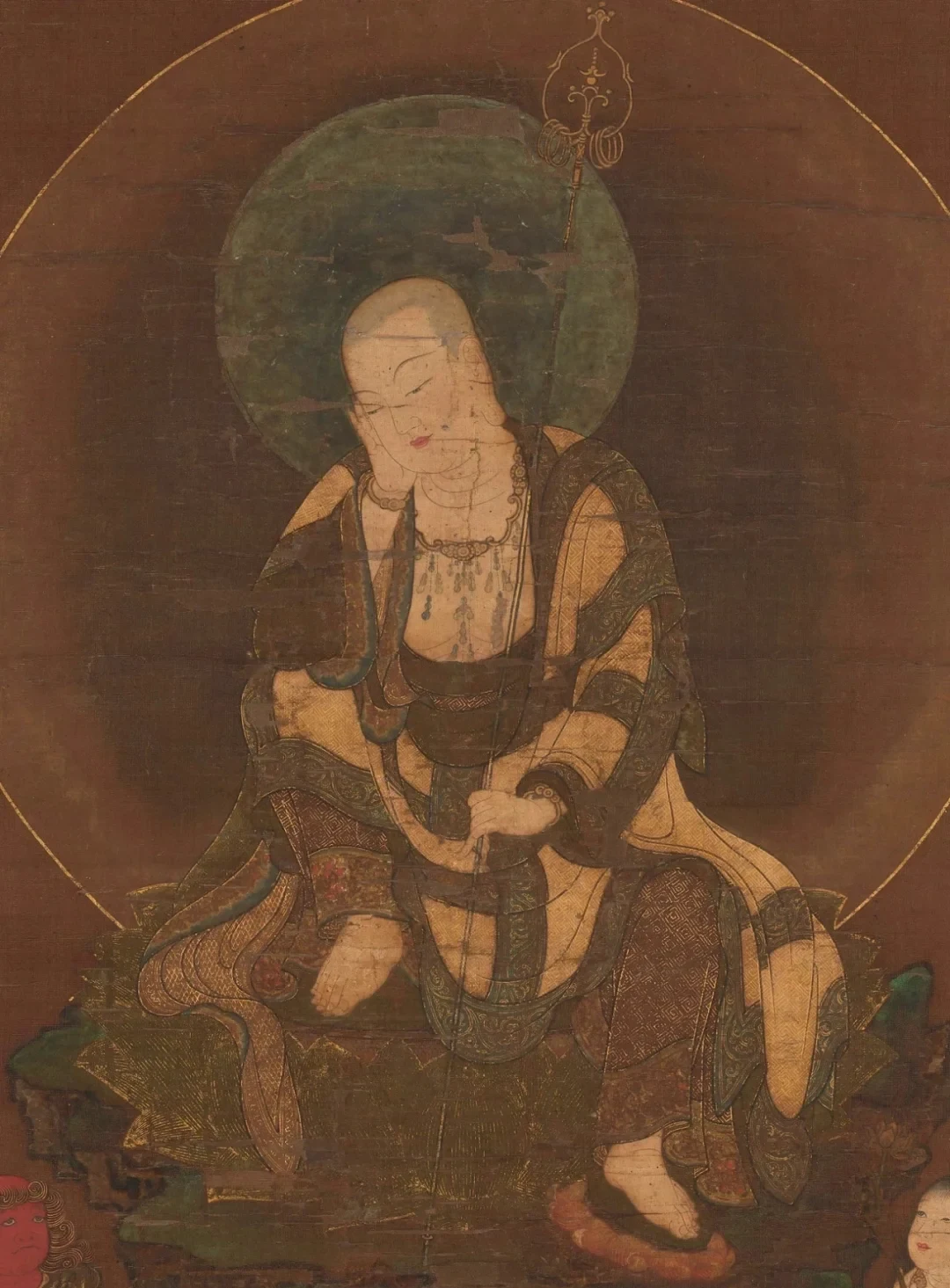
The art record follows the same arc. A silk painting from Dunhuang dated 963, now in the British Museum, shows a hooded Dizang as lord of the six paths of rebirth, with no Ten Kings present. In later paintings the Ten Kings gather around him, and by the late imperial period many temples and popular images treat him as the highest figure of the underworld. In practice, both understandings coexist: doctrinally a savior, popularly the head of the infernal administration.
| Dizang (Ksitigarbha) | Yanluo Wang (Yama) | |
|---|---|---|
| Type of figure | Bodhisattva | Underworld king and judge |
| Role in the afterlife | Rescues, teaches, and intercedes | Examines and judges the dead |
| Origin | Mahayana Buddhist scripture | Indian Yama, transformed in Chinese Buddhism and folk religion |
| Typical image | Calm monk with staff and jewel | Robed official, often stern, with court attendants |
| Why people turn to him | Hope for release and better rebirth | Fear of judgment and retribution |
Symbols and Iconography
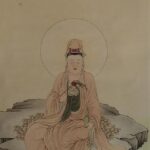
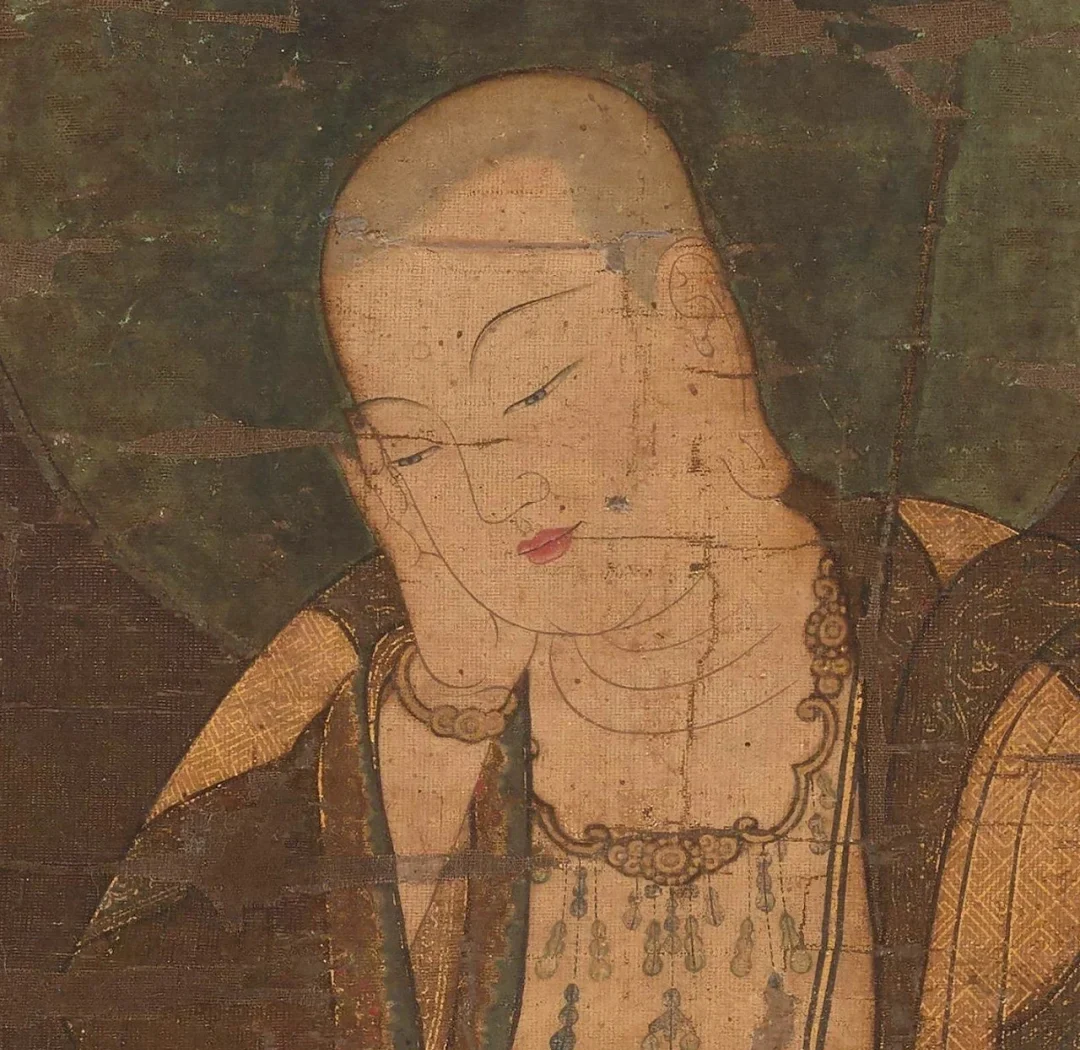
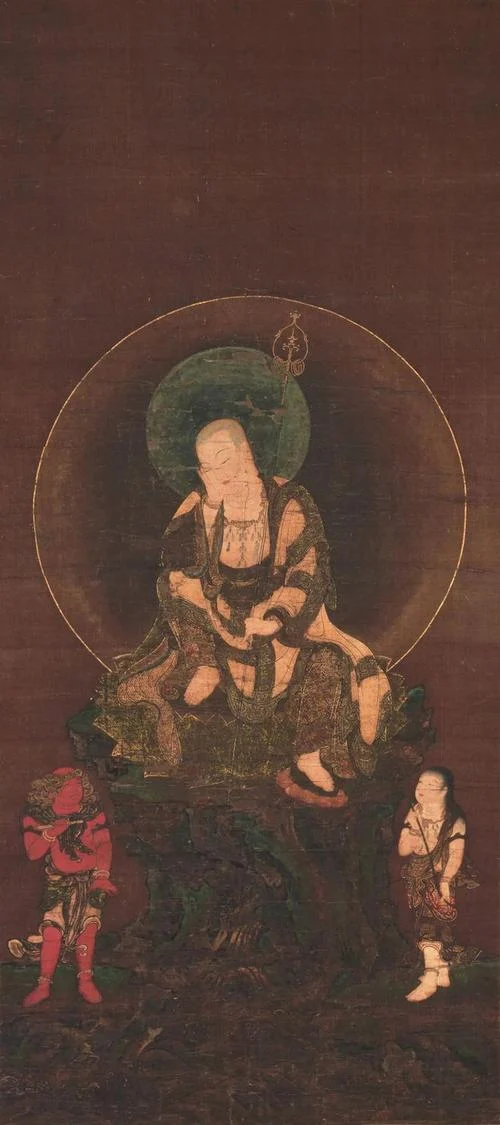
Most bodhisattvas in Chinese art wear jewels and princely robes. Dizang usually does not. He is most often shown as a Buddhist monk, which makes him easy to recognize in a temple hall.
- Shaved head or monk’s appearance. This reflects the Ten Wheels Sutra’s portrait of him as a monastic bodhisattva.
- Ringed staff (锡杖, xīzhàng; Sanskrit khakkhara). A monk’s walking staff with metal rings. In devotional interpretation it shakes open the gates of hell.
- Wish-fulfilling jewel (如意宝珠, rúyì bǎozhū; Sanskrit cintāmaṇi). It is said to light up the darkness of the hells and answer the needs of beings.
- Hood. Many Dunhuang paintings from the ninth and tenth centuries show a “hooded Dizang” draped in a head cloth, a form common in Central Asian and northwestern Chinese art.
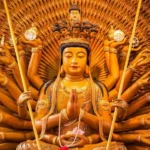
- Five-panelled crown. In many later Chinese images he wears a crown with five panels, the type also worn by monks who lead rituals for the dead.
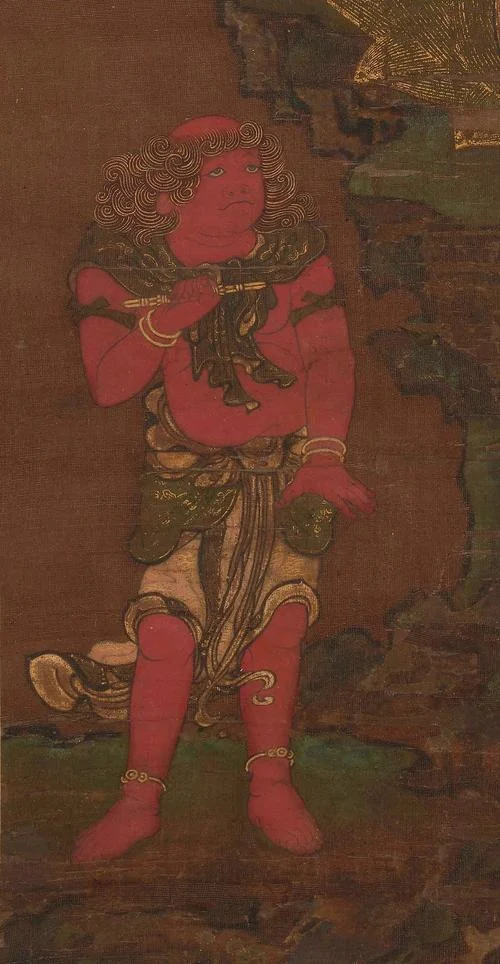
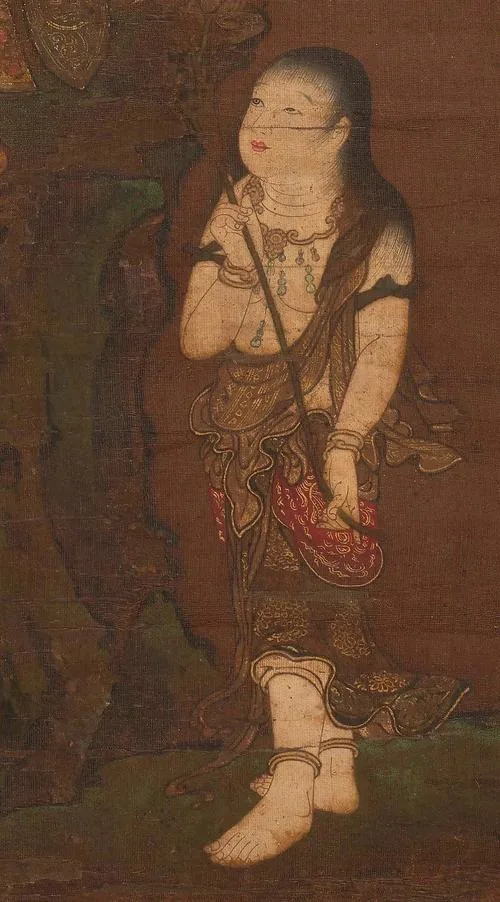
- Attendants. In many Chinese temples he stands between a young monk, Daoming (道明, Dàomíng), and an older layman, Elder Min (闵公, Mǐn Gōng). These two belong to the later Mount Jiuhua legends rather than the early scriptures.
- Diting (谛听, Dìtīng). A hybrid creature, sometimes shown as a white dog or a lion-like beast, which serves as his mount and is said to hear everything in the world.
Mount Jiuhua and the Monk Jin Dizang
Mount Jiuhua (九华山) in Anhui province is regarded as Dizang’s sacred mountain and is counted among China’s four great Buddhist mountains, alongside Wutai (Wenshu), Emei (Puxian), and Putuo (Guanyin).
Its link to Dizang comes through a historical monk from the Korean kingdom of Silla who practised on the mountain in the eighth century and was known as Jin Dizang (金地藏, Jīn Dìzàng). The earliest surviving account is a ninth-century record of Huacheng Temple by Fei Guanqing (费冠卿), a recluse who lived near the mountain. The Song-dynasty Biographies of Eminent Monks compiled by Zanning adds that the monk’s body remained intact after death and was enshrined.
The fuller legend took shape much later. Research by Nan Ouyang shows that local communities began identifying the monk as an earthly incarnation of the bodhisattva during the late Ming. Familiar details such as his princely status, the name Jin Qiaojue (金乔觉), and the story of Elder Min donating land to him do not appear in the earliest sources. So the historical Silla monk, the later legend, and the bodhisattva of the scriptures should be kept distinct.
Festivals and Living Devotion
In Chinese Buddhist communities, the 30th day of the seventh lunar month is celebrated as Dizang’s festival, often called his birthday or “holy day.” Pilgrims crowd Mount Jiuhua, and temples hold chanting services and offerings. In years when the month has only 29 days, many temples observe it on the 29th.
The date sits at the end of the seventh month, the season of the Ghost Festival. Its central Buddhist observance, Ullambana (盂兰盆, Yúlánpén) on the 15th, is linked to the story of Mulian (目连, Mùlián), the disciple who rescued his mother from suffering after death. The Mulian and Dizang traditions are separate, but they share the same theme: a devoted child, a suffering parent, and the power of Buddhist practice to bring release.
Dizang devotion is also part of ordinary funeral practice. Families often sponsor recitations of the Sutra of the Past Vows during the 49 days after a death, and many temples have a Dizang hall where memorial tablets for the dead are kept. Practices vary by region, monastery, and family custom.
Dizang in Chinese Literature
The sixteenth-century novel Journey to the West gives Dizang a memorable cameo. When two identical Monkey Kings appear and no one in Heaven can tell them apart, the pair end up in the underworld before Dizang. His creature Diting can perceive the truth but warns that exposing the impostor there would bring chaos, so the case is sent to the Buddha. The episode reflects how familiar Dizang and his underworld setting had become by the Ming. It is literary invention, not scripture. You can read more about the novel’s hero in our guide to Sun Wukong, the Monkey King.
Dizang Beyond China
The bodhisattva took distinct forms elsewhere in East Asia. In Japan, Jizō is a beloved roadside guardian and protector of children, including children who died young. Japanese tradition assigns the role of underworld judge to Enma, the Japanese Yama, rather than to Jizō. In Korea, Jijang is honored in Buddhist halls dedicated to the afterlife, often with the Ten Kings. These regional forms share the same scriptural root but should not be merged into a single image.
Common Misunderstandings
- “Dizang is a Chinese god.” He is a Buddhist bodhisattva. Popular religion often honors him alongside gods, but his identity and scriptures are Buddhist.
- “Dizang and Yama are the same.” Yama is a judge. Dizang is a rescuer who intervenes on behalf of the dead.
- “He rules hell.” This is a popular understanding that grew over centuries. Earlier sources present him as a savior working within or alongside the underworld courts.
- “The Silla prince Jin Qiaojue is historically documented.” A Silla monk on Mount Jiuhua is attested in Tang sources, but the princely name and many details are later legend.
For the broader story of how Buddhist figures reshaped Chinese religious culture, see our article on Buddhist influence on Chinese mythology.
Related Figures
- Guanyin, the bodhisattva of compassion, often paired with Dizang in temple halls and devotional texts.
- Yanluo Wang, the underworld king whose court Dizang is said to visit and influence.
- Budai and Maitreya, the future Buddha whose arrival marks the end of the age Dizang is entrusted with.
- The full directory of Buddhist deities in Chinese tradition.
Frequently Asked Questions
What does Ksitigarbha mean?
Kṣitigarbha is Sanskrit for “Earth Store” or “Womb of the Earth.” The Chinese name Dizang (地藏) translates the same idea, combining the characters for “earth” and “store” or “treasury.”
Is Dizang a god or a bodhisattva?
Dizang is a Mahayana Buddhist bodhisattva. In Chinese popular religion he is sometimes honored alongside gods and underworld officials, but his scriptures, vows, and monastic image are Buddhist.
What is Dizang’s famous vow?
He vowed to save beings suffering in the hells and the other painful realms. In Chinese the vow is often summarized as “Until the hells are empty, I vow not to become a Buddha,” a popular formulation of themes found in his sutras.
What is the difference between Dizang and Yanluo Wang?
Yanluo Wang (Yama) judges the dead in the underworld courts. Dizang is a compassionate bodhisattva who enters the hells to teach, relieve suffering, and help beings toward better rebirths.
When is Dizang’s festival?
Chinese Buddhist communities usually celebrate it on the 30th day of the seventh lunar month, or the 29th when the month is short. Mount Jiuhua in Anhui is the main pilgrimage center.
Why does Dizang hold a staff and a jewel?
The ringed staff marks him as a monk and, in devotional interpretation, opens the gates of hell. The wish-fulfilling jewel lights the darkness of the hells and answers the needs of suffering beings.
References and Further Reading
- Zhiru. The Making of a Savior Bodhisattva: Dizang in Medieval China. Honolulu: University of Hawai’i Press, 2007. University of Hawai’i Press
- Teiser, Stephen F. The Scripture on the Ten Kings and the Making of Purgatory in Medieval Chinese Buddhism. Honolulu: University of Hawai’i Press, 1994. University of Hawai’i Press
- Jiang, X. “Dizang and the Three Kings: Constructing Buddhist Hell by Imitating the Bureaucratic System in the Tang Dynasty.” Religions 13, no. 4 (2022): 317. doi.org/10.3390/rel13040317
- Ouyang, Nan. “Emplacing Dizang Bodhisattva on Mt. Jiuhua with Local Dramas during the Late Imperial and Republican Eras (1368–1949).” Journal of Chinese Buddhist Studies 33 (2020): 49–75. PDF
- British Museum. Painting of the Bodhisattva Kṣitigarbha (Dizang) from Dunhuang, dated 963, museum number 1919,0101,0.19. British Museum Collection
- Encyclopaedia Britannica. “Kshitigarbha.” Britannica
- Sūtra of the Great Vows of Kṣitigarbha Bodhisattva (地藏菩萨本愿经), Taishō no. 412. NTI Reader