
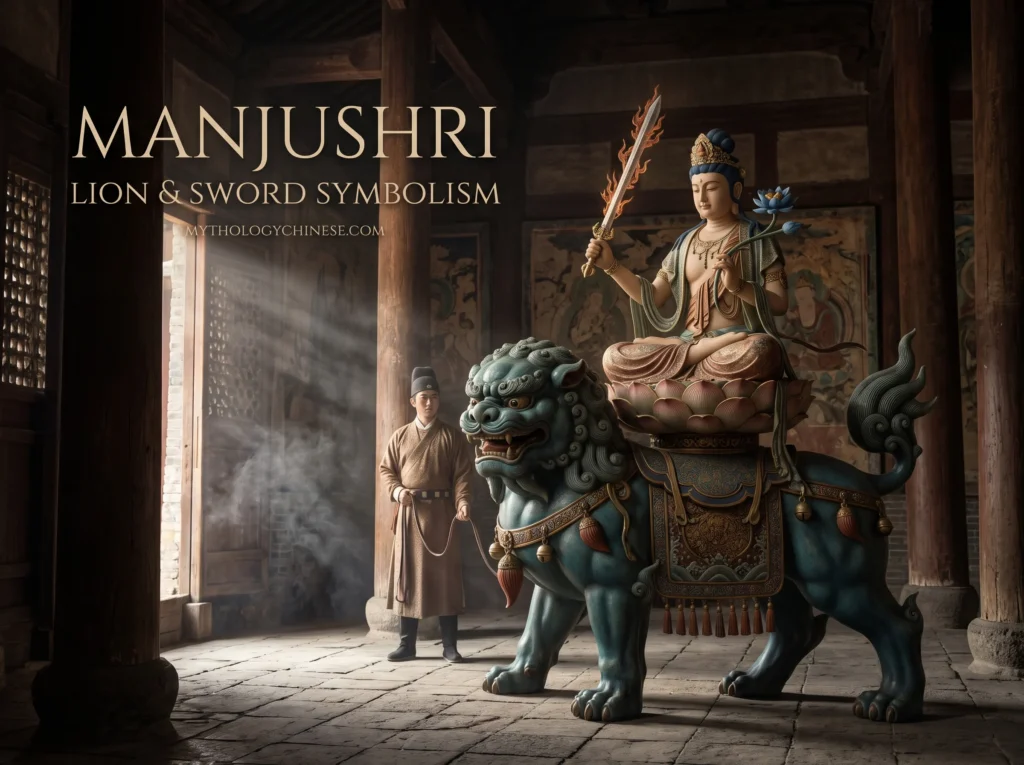
In Mahayana Buddhism, Manjushri—known in China as Wenshu (文殊, Wénshū) or Wenshu Pusa (文殊菩萨, Wénshū Púsà)—is the bodhisattva of transcendent wisdom, not a martial deity. The two emblems most closely linked to his iconography carry a unified philosophical message: the flaming sword represents incisive insight (prajñā) that severs ignorance, doubt, and attachment, while the lion symbolizes fearless Dharma proclamation and the mind’s unruly energy brought under disciplined control. Together, Manjushri lion and sword symbolism turns an apparently dramatic image into a visual teaching on clarity rather than violence. In Chinese temple art, however, Wenshu does not always hold a sword; depending on period and scriptural context, he frequently carries a ruyi scepter or a lotus supporting a scripture scroll instead.
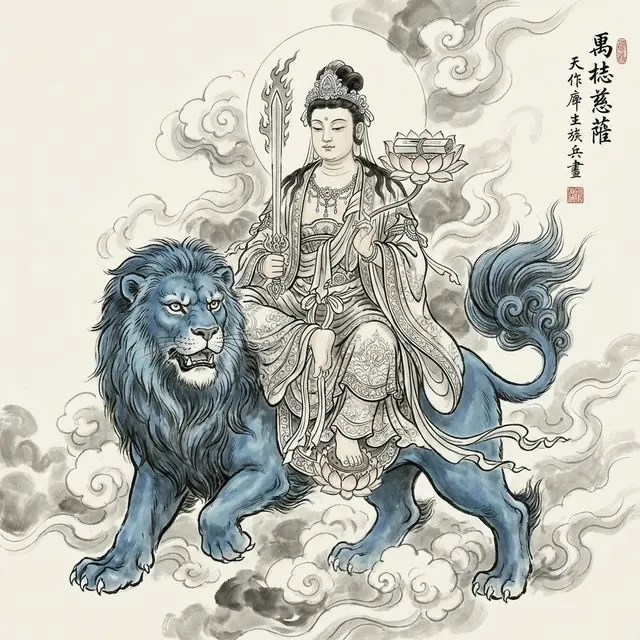
Quick Reference: Manjushri’s Core Symbols
Readers encountering Manjushri across Chinese temples, museum textiles, and Himalayan paintings often notice slight shifts in what he holds and how his mount appears. The table below summarizes his primary attributes and how they function together.
| Iconographic Element | Chinese / Sanskrit Term | Primary Symbolic Meaning | Common Visual Variations |
|---|---|---|---|
| Wisdom Sword | Zhìhuì Jiàn (智慧剑) / Khaḍga | Analytical insight (prajñā) cutting through ignorance, delusion, and mental confusion | Raised in the right hand, often wreathed in flames; sometimes hovering over a lotus shoulder-high |
| Lion Mount | Qīngshī (青狮) / Siṃha | Fearless wisdom, the “lion’s roar” of the Dharma, and taming the untamed mind | Blue-green or white-gold lion, standing or seated beneath a lotus saddle; often led by a groom in Dunhuang murals |
| Scripture on a Lotus | Bōrě Jīng (般若经) / Prajñāpāramitā Sūtra | Perfection of wisdom and the realization of emptiness (śūnyatā) | A palm-leaf book or Chinese scroll resting on a blue lotus (utpala) held in the left hand |
| Ruyi Scepter | Rúyì (如意) | Eloquent speech, auspiciousness, and philosophical authority in debate | Common in Chinese Tang–Ming paintings, Dunhuang murals, and Vimalakīrti Sūtra debate scenes |
| Youthful Form & Topknots | Rútóng Wénshū (孺童文殊) / Kumārabhūta | Wisdom that remains fresh, uncorrupted, and adaptable | Depicted as a princely youth, often with five hair topknots symbolizing the five wisdoms |
Who Is Manjushri (Wenshu) in Chinese Buddhism?
To read his emblems accurately, it helps to place Manjushri in his proper religious category. Within the broader landscape of Buddhist deities in China, Manjushri is a bodhisattva—an awakened being dedicated to liberating all sentient beings—rather than an indigenous Chinese god or a Daoist immortal. His Sanskrit name, Mañjuśrī, translates roughly as “Gentle Glory” or “Sweet Splendor,” rendered in Chinese through phonetic abbreviation as Wenshu (文殊) from Wénshūshīlì (文殊师利). For a closer look at how Sanskrit titles were adapted into Chinese temple usage, see our guide to the Sanskrit names of Chinese Buddhist deities.
In Chinese Buddhism, Wenshu is venerated as one of the Four Great Bodhisattvas (四大菩萨, Sì Dà Púsà), alongside Guanyin (Avalokiteśvara, compassion), Ksitigarbha (Dizang) (great vows), and Puxian (Samantabhadra, virtuous practice). Chinese tradition also anchors each of the four to a sacred pilgrimage mountain. Based on passages in the Avataṃsaka Sūtra (Huayan Sutra, 华严经) describing Manjushri dwelling on a “Clear and Cool Mountain” (Qingliangshan, 清凉山) in the northeast, Chinese Buddhists identified his earthly abode as Mount Wutai (五台山, Wǔtáishān) in Shanxi province. By the Tang dynasty (618–907 CE), Mount Wutai had become an international center of Manjushri devotion, drawing pilgrims from across East Asia and even India.
The Symbolism of Manjushri’s Flaming Sword
At first glance, a bodhisattva lifting a bare blade can look martial. In Buddhist iconography, however, Manjushri’s sword—often called the Sword of Wisdom (智慧剑, zhìhuì jiàn)—is never an instrument of physical harm or warfare. It represents a specific quality of mind: penetrating, non-dual clarity that severs illusion at its root.
Cutting Through Ignorance (Avidyā)
Buddhism identifies fundamental ignorance (avidyā, 无明, wúmíng)—misunderstanding the impermanent, interdependent nature of reality—as the root cause of suffering. A dull tool cannot untangle deeply ingrained mental habits, so Buddhist texts and artists use the metaphor of a sharp, double-edged blade. In museum examples such as the 14th-century hanging scroll of Five-Topknot Manjushri at the Metropolitan Museum of Art and the Qing-dynasty silk appliqué of Manjushri from China, the raised sword signifies decisive discernment: it cuts through self-deception, conceptual confusion, and clinging.
Why the Sword Is Often Surrounded by Flames
In both Sino-Tibetan art and many East Asian sculptures, flames lick along the blade or tip of Manjushri’s sword. Fire carries a dual meaning here:
- Illumination: Just as a lamp dispels darkness in a closed room, wisdom instantly reveals what ignorance obscures.
- Transformation: Flames burn away mental afflictions (kleśas, 烦恼, fánnǎo) such as greed, anger, and pride, leaving clarity behind rather than merely suppressing them.
The Necessary Counterweight: Sword and Scripture
Manjushri’s sword is rarely interpreted in isolation. In his classic two-armed form, while his right hand lifts the sword, his left hand holds the stem of a blue lotus (utpala) supporting a copy of the Prajñāpāramitā Sūtra (Perfection of Wisdom Sutra). The pairing is deliberate. The sword represents active, analytical insight that cuts away error; the book represents the contemplative wisdom that sees reality as it is—empty of fixed, independent selfhood (śūnyatā). Without the grounding of the scripture and compassion, sharpness alone could turn into mere intellectual pride.
Key Iconographic Distinction: Unlike martial guardian figures such as the Four Heavenly Kings or temple door generals, Manjushri wears the serene expression and flowing robes of a youthful prince (kumārabhūta). The contrast between his calm face and raised blade underscores that wisdom conquers confusion without anger.
The Symbolism of Manjushri’s Lion Mount
Lions are not native to China. They entered Chinese visual culture during the Han dynasty through diplomatic gifts and Silk Road contact, and Buddhist art played a decisive role in reshaping how Chinese viewers understood the animal. While architectural stone lions later guarded palaces and bridges—a distinct tradition explored in our guide to Chinese guardian lions—the lion beneath Manjushri draws directly on Indian and Mahayana Buddhist metaphor.
The “Lion’s Roar” (Siṃhanāda) of Fearless Wisdom
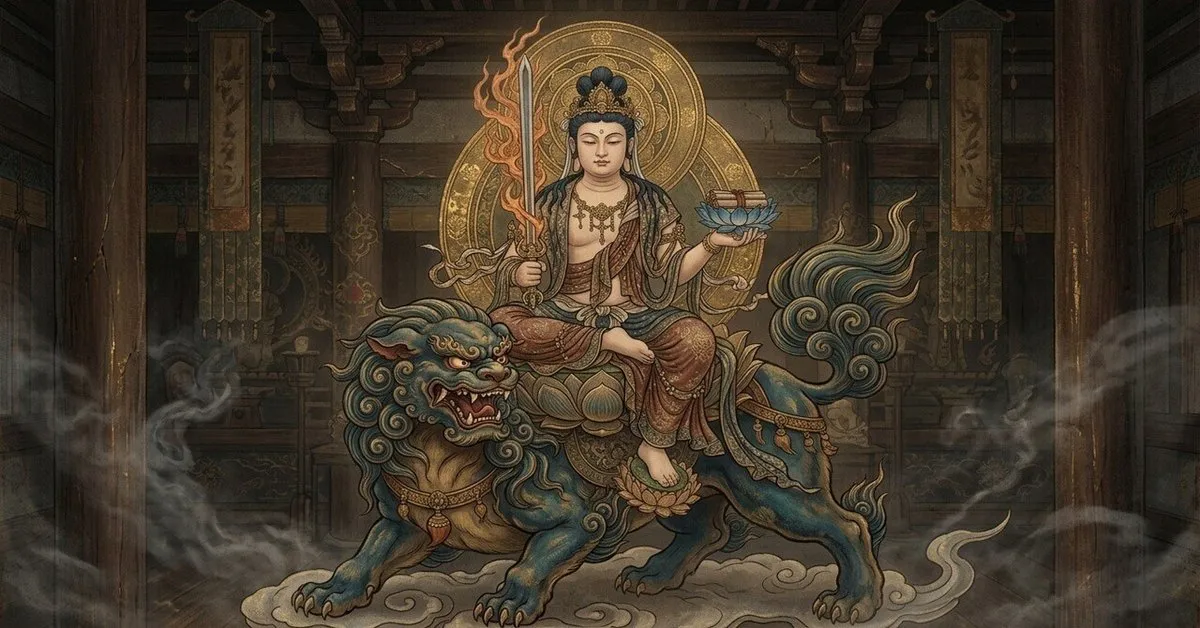
Early Buddhist scriptures frequently compare the Buddha’s teaching to a lion’s roar (siṃhanāda, 狮子吼, shīzǐ hǒu). Just as the roar of the king of beasts silences lesser animals in the forest, fearless truth silences sophistry, doubt, and misguided views. When Manjushri rides a lion—often depicted with an open mouth and muscular stride—the beast visually announces the unstoppable authority of wisdom. It is confidence rooted in clarity, not intimidation.
Taming the Untamed Mind
A second, equally influential interpretation focuses on the relationship between rider and mount. A wild lion is fierce, proud, and difficult to restrain—much like an untrained mind driven by ego, impulse, and anxiety. By sitting calmly in lotus posture on a floral saddle atop the lion’s back, Manjushri demonstrates mastery over those raw energies. Wisdom does not destroy vitality or courage; it tames and redirects them into service of the Dharma.
Why Is Manjushri’s Lion Often Blue or Green in China?
In Chinese Buddhist temples and murals—including famous Tang-period works at the Mogao Grottoes in Dunhuang and the Jin-dynasty Wenshu Hall of Foguang Temple at Mount Wutai—Manjushri’s mount is commonly called the Green-Blue Lion (青狮, qīngshī). In classical Chinese color vocabulary, qīng (青) spans green, blue-green, and deep slate blue. Visually, the cool blue-green coat distinguishes this sacred Dharma beast from an ordinary zoological animal and pairs harmoniously with the white six-tusked elephant ridden by his counterpart, Samantabhadra (Puxian).
How Sword and Lion Work Together in Temple Layouts
To see Manjushri’s symbolism in full context, look at how Chinese monasteries arrange their main halls. In the classic Huayan Triad (华严三圣, Huáyán Sānshèng) or the Shakyamuni Triad, Wenshu does not stand alone. He sits to the left of the central Buddha—either Vairocana or Shakyamuni Buddha in Chinese temples—while Puxian (Samantabhadra) sits to the right on a white six-tusked elephant.
This symmetry teaches a core Mahayana balance:
- Wenshu on the Lion (Wisdom): Sharp, agile, and incisive—representing the intellectual and meditative breakthrough that sees truth clearly.
- Puxian on the Elephant (Practice): Steady, patient, and heavy-footed—representing the long-term ethical conduct and compassionate vows that put wisdom into action.
Without Puxian’s elephant-like steadiness, wisdom stays abstract; without Wenshu’s lion-like boldness and sword-like clarity, effort risks losing direction.
Chinese Art Variations: Why Wenshu Sometimes Holds a Ruyi Instead of a Sword
Visitors to historic Chinese sites are sometimes surprised to find statues or murals of Wenshu riding a lion with no sword in sight. This is not an error—it reflects the long evolution of Chinese Buddhist iconography across different textual traditions.
The Ruyi Scepter and the Vimalakīrti Sūtra
From the Six Dynasties through the Tang and Song periods, one of the most celebrated scenes in Chinese Buddhist art was the philosophical debate between Manjushri and the wise layperson Vimalakīrti, drawn from the Vimalakīrti Sūtra (维摩诘经). In Chinese court and scholar-official culture, debaters and lecturers held a curved ruyi scepter (如意, “as you wish”) as a pointer and badge of eloquence. Consequently, in Dunhuang murals—such as Middle Tang Cave 159—and in many Ming- and Qing-era blanc de Chine porcelain figures, Wenshu rides his lion while holding a ruyi scepter rather than a sword.
Esoteric Buddhism and Qing Imperial Patronage
The familiar image of Manjushri raising a flaming sword above his head gained renewed prominence in China through Esoteric (Vajrayana) traditions during the Tang, Yuan, Ming, and especially Qing dynasties. Manchu rulers of the Qing court—most famously Emperor Qianlong (r. 1735–1796)—cultivated a close political and religious link with Tibetan Buddhism and Mount Wutai, commissioning monumental paintings, bronzes, and textiles depicting Manjushri on a blue lion with his raised sword and lotus-borne book. Today, both the sword-bearing form and the ruyi-holding form coexist across Chinese monasteries.
Later Literary Echoes: From Buddhist Bodhisattva to Ming Novels
As Buddhism shaped Chinese mythology and vernacular storytelling, Manjushri’s lion and identity crossed into popular fiction—a layer that should be kept distinct from canonical Buddhist doctrine.
In the 16th-century Ming novel Journey to the West (西游记), Wenshu’s blue-green lion escapes to the mortal world (appearing in episodes such as the Wuji Kingdom and Lion-Camel Ridge), where it acts as a formidable demon king until the bodhisattva himself arrives to reclaim his mount. In the Ming fantasy novel Investiture of the Gods (封神演义, Fengshen Yanyi), the figure is creatively reimagined as a Daoist immortal named Wenshu Guangfa Tianzun (文殊广法天尊), who subdues a lion spirit that later becomes his mount. While entertaining and widely known in Chinese pop culture, these narratives are later literary inventions rather than historical Buddhist scripture.
Frequently Asked Questions
Why does Manjushri hold a sword if Buddhism teaches non-violence?
Manjushri’s sword is entirely metaphorical. It represents transcendent wisdom (prajñā) cutting through ignorance, delusion, and ego-clinging—never physical violence against living beings. His calm, youthful expression reinforces that the blade symbolizes mental clarity rather than aggression.
What does Manjushri’s blue or green lion symbolize?
The lion symbolizes fearless wisdom, the “lion’s roar” of the Dharma that silences confusion, and disciplined mastery over the wild, untamed mind. In Chinese Buddhist art, its blue-green color (qīngshī) marks it as a sacred Dharma mount rather than an ordinary animal.
Why do some Chinese statues of Wenshu show a ruyi scepter instead of a sword?
In Chinese Buddhist art inspired by the Vimalakīrti Sūtra and classical Chinese scholarly debate, the curved ruyi scepter served as an emblem of eloquence and philosophical authority. Both the sword and the ruyi are authentic traditional attributes of Wenshu in China.
What is the book resting on the lotus in Manjushri’s left hand?
The manuscript is the Prajñāpāramitā Sūtra (Perfection of Wisdom Sutra), a foundational Mahayana text teaching the emptiness (śūnyatā) and interdependence of all phenomena. It balances the sword by pairing incisive analysis with deep contemplative wisdom.
Is Manjushri’s lion the same as Chinese stone guardian lions (Foo Dogs)?
They share a historical root in the Silk Road arrival of lion imagery and Buddhist influence, but they serve different roles. Stone guardian lions stand in male-and-female pairs at building entrances for architectural protection, whereas Manjushri’s lion is a specific Dharma mount symbolizing wisdom and self-mastery.
References and Further Reading
- The Metropolitan Museum of Art. Manjushri, the Bodhisattva of Transcendent Wisdom (Qing dynasty, 17th–18th century silk appliqué, China).
- The Metropolitan Museum of Art. The Bodhisattva Monju (Manjushri) with Five Topknots (14th century, Nanbokuchō period).
- Encyclopædia Britannica. Mañjuśrī.
- e-Museum, National Institutes for Cultural Heritage (Japan). Monju (Skt. Mañjuśrī).
- Religions (MDPI, 2024). The Neglected Dress—Re-Evaluating the Iconography of the True Visage Mañjuśrī at Mount Wutai.
Related posts:
 Vairocana Buddha in Chinese Buddhism: Meaning, Art & Role
 Amitabha vs Shakyamuni Buddha: Key Differences
 Heng and Ha Generals in Chinese Temples: Origins & Meaning
 Shancai Tongzi (Sudhana): Guanyin’s Young Disciple
 Cundi Bodhisattva (Zhunti): Origins, Mantra & 18 Arms
 Akasagarbha Bodhisattva (Xukongzang): Meaning & Symbols
