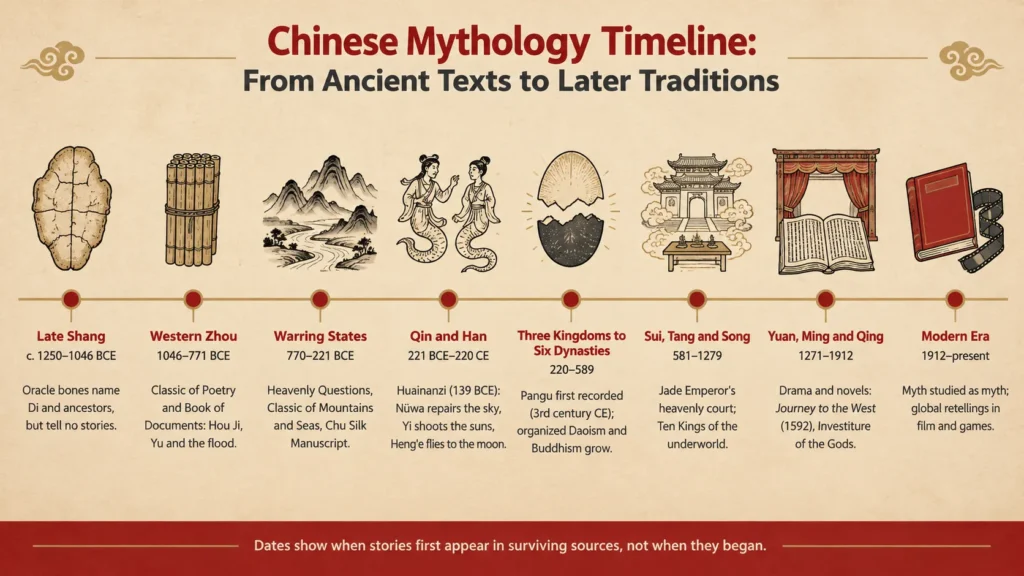
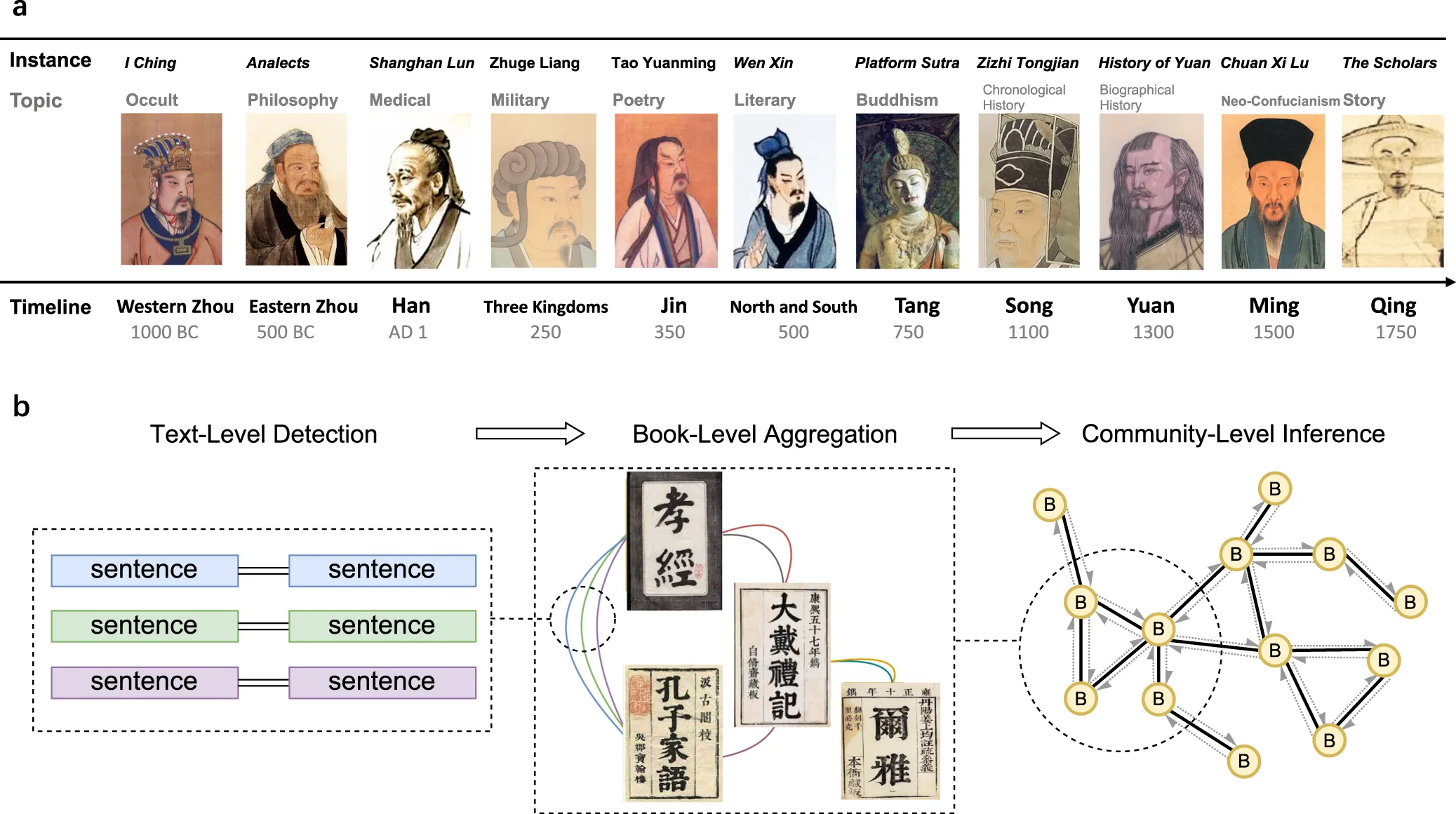
A Chinese mythology timeline is really a timeline of sources. No single ancient book sets out Chinese myths from beginning to end, and no fixed canon was accepted by every dynasty, region or religious tradition. Gods, heroes and origin stories surface instead in different kinds of evidence: Shang divination inscriptions, Zhou poems and documents, Warring States riddles and geographies, Han compendia, Daoist and Buddhist scriptures, Ming novels and modern retellings. Some of the best-known stories are also among the last to be written down. Pangu, usually placed at the very start of creation, does not appear in any surviving text until the third century CE. This guide follows the record period by period and shows what each layer added.
Short answer: The earliest written evidence comes from Shang oracle bones (c. 1250–1046 BCE), which name gods and ancestors but tell no stories. Narrative fragments appear in Zhou and Warring States texts, fuller versions in Han works such as the Huainanzi (139 BCE), and major figures like Pangu, the Jade Emperor and Sun Wukong much later, between the third and sixteenth centuries CE.
Chinese Mythology Timeline at a Glance
The table below lists when material first enters the surviving record. It does not claim to show when a belief or story began, which is usually impossible to know.
| Period | Approx. dates | Key sources | What enters the record |
|---|---|---|---|
| Late Shang | c. 1250–1046 BCE | Oracle-bone inscriptions | Di, royal ancestors, powers of wind, rain, rivers and mountains; no narrative myths |
| Western Zhou | 1046–771 BCE | Shijing, early Shangshu chapters, bronze inscriptions | Tian (Heaven), Hou Ji’s miraculous birth, Yu and the flood |
| Eastern Zhou and Warring States | 770–221 BCE | “Tianwen,” early layers of the Shanhaijing, Zhuangzi, Chu Silk Manuscript | Fragments about creation, Nüwa, Yi, Xiwangmu, Kunlun and hybrid creatures |
| Qin and Han | 221 BCE–220 CE | Huainanzi, Shiji, Fengsu tongyi, tomb art | Fuller narratives; legendary rulers turned into history; the Xiwangmu cult |
| Three Kingdoms to Six Dynasties | 220–589 CE | Xu Zheng’s writings, tales of the strange, Daoist scriptures, Buddhist translations | Pangu; organized Daoism and the deified Laozi; Buddhist cosmology |
| Sui, Tang and Song | 581–1279 | Tang tales, Buddhist scriptures composed in China, story compilations, state ritual | The Jade Emperor’s heavenly court; the Ten Kings of the underworld; new regional cults |
| Yuan, Ming and Qing | 1271–1912 | Drama, Journey to the West, Investiture of the Gods, Liaozhai zhiyi | The literary versions of gods, immortals and monsters that shape most modern images |
| Modern era | 1912–present | Critical scholarship, myth anthologies, film, television, games | Myth studied as myth; new national and global retellings |
How to Read This Timeline
Three points keep the dates from being misleading.
- “Earliest surviving” is not “original.” Much early writing was lost, and many stories circulated orally for generations before anyone recorded them. A myth first attested in the Han may be older than the Han.
- Later is not fake. A tradition recorded in the Tang or Ming is still a real part of Chinese religious and cultural history. It simply should not be presented as the oldest form.
- Versions coexist. New layers rarely erased old ones. A Han reader, a medieval Daoist priest and a Ming theatergoer could each know a different Nüwa or Xiwangmu, and all three versions survived side by side.
Late Shang (c. 1250–1046 BCE): Gods Without Stories
The oldest Chinese writing that survives in quantity is the corpus of oracle-bone inscriptions from the late Shang capital near modern Anyang. Shang kings had diviners crack ox scapulae and turtle plastrons with heat, then read the cracks as answers to questions about harvests, weather, warfare, illness and sacrifice. The questions and results were often carved onto the bones afterward.
These inscriptions name a high power called Di (帝, Dì), sometimes Shangdi (上帝, Shàngdì), who could send rain, wind or disaster. Royal ancestors acted as intermediaries, and spirits connected with rivers, mountains and the winds of the four directions received offerings. What the bones do not contain is narrative. They record what the king asked and what he offered, not how the world began or what the gods did in story form. For that reason, the Shang sit at the start of the timeline as the beginning of a religious world rather than of written mythology.
Western Zhou (1046–771 BCE): Heaven, Ancestors and Founding Heroes
The Zhou conquest brought Tian (天, Tiān), Heaven, to the center of royal ideology. Zhou rulers justified their power through Heaven’s mandate, and that idea runs through bronze inscriptions and the oldest layers of the classics.
Two collections preserve the first recognizable myths:
- Shijing (诗经, Shījīng), the Classic of Poetry. The ode “Sheng min” (生民) tells how Jiang Yuan conceived after stepping in the footprint of the high god, gave birth to Hou Ji, the Zhou ancestor associated with millet farming, and abandoned the child, who was protected by animals and survived. It is a founding legend told in ritual song, not a free-standing cosmic myth.
- Shangshu (尚书, Shàngshū), the Book of Documents. Its older chapters, along with the Shijing and later the Mengzi, refer to Yu and the great flood. These references became the backbone of the Gun and Yu flood myth. The dating of individual Shangshu chapters is debated, and some chapters were written or reworked much later.
Zhou sources present these figures as ancestors and model rulers. That framing matters for everything that follows, because it pulled many mythic figures toward history at a very early stage.
Eastern Zhou and Warring States (770–221 BCE): Fragments, Questions and Strange Geographies
The Warring States period is the first in which a wide range of mythic material appears in writing. It still does not appear as a single collection. Most of it survives as allusions, lists and arguments inside texts written for other purposes.
“Tianwen,” the Heavenly Questions
“Tianwen” (天问, Tiānwèn), preserved in the Chuci (楚辞, Chǔcí) anthology and traditionally attributed to Qu Yuan, is a poem of about 172 questions. It asks how Heaven and Earth took shape, who shaped Nüwa’s body, why Yi shot down suns and how Gun and Yu dealt with the flood. Because it asks rather than tells, it shows that these stories were known in the southern state of Chu while leaving their details unclear. It is one of the most important witnesses to early Chinese mythology for exactly that reason.
The Shanhaijing
The Shanhaijing (山海经, Shānhǎi jīng), the Classic of Mountains and Seas, describes mountains, rivers, peoples, spirits and creatures region by region. It was compiled in stages from roughly the Warring States period into the Han. Here Xiwangmu, the Queen Mother of the West, appears as a fearsome figure with a leopard’s tail and tiger’s teeth, very different from the elegant immortal queen of later art. The book also locates sacred mountains such as Kunlun and lists hybrid beings that later became staples of Chinese creature lore.
Philosophers and an excavated manuscript
Philosophical texts used mythic figures as teaching tools. The Zhuangzi (庄子) tells of Hundun (混沌, Hùndùn), a faceless emperor of the center who dies when his friends bore seven openings into him, a parable about lost wholeness that echoes older chaos imagery.
Archaeology adds the Chu Silk Manuscript, a text on silk from a tomb near Changsha dated to about 300 BCE. It describes a dark early world in which a figure called Bao Xi, usually identified with Fuxi, and his wife have four children who set the cosmos in motion and mark out the seasons. This is one of the oldest surviving creation accounts in Chinese, and it predates the Pangu story by roughly five centuries.
The story of Heng’e (姮娥, Héng’é), later called Chang’e, is also older than the Han in some form. Fragments of a divination text known as the Guicang (归藏) allude to her flight to the moon.
Qin and Han (221 BCE–220 CE): Narratives Take Shape, Myth Becomes History
The Han produced the first texts in which many familiar myths can be read as continuous stories. It also produced the most influential effort to turn mythic figures into historical rulers.
The Huainanzi (139 BCE)
Liu An, King of Huainan, presented the Huainanzi (淮南子, Huáinánzǐ) to Emperor Wu in 139 BCE. This large compendium of cosmology, statecraft and lore contains several of the best-known versions of early myths:
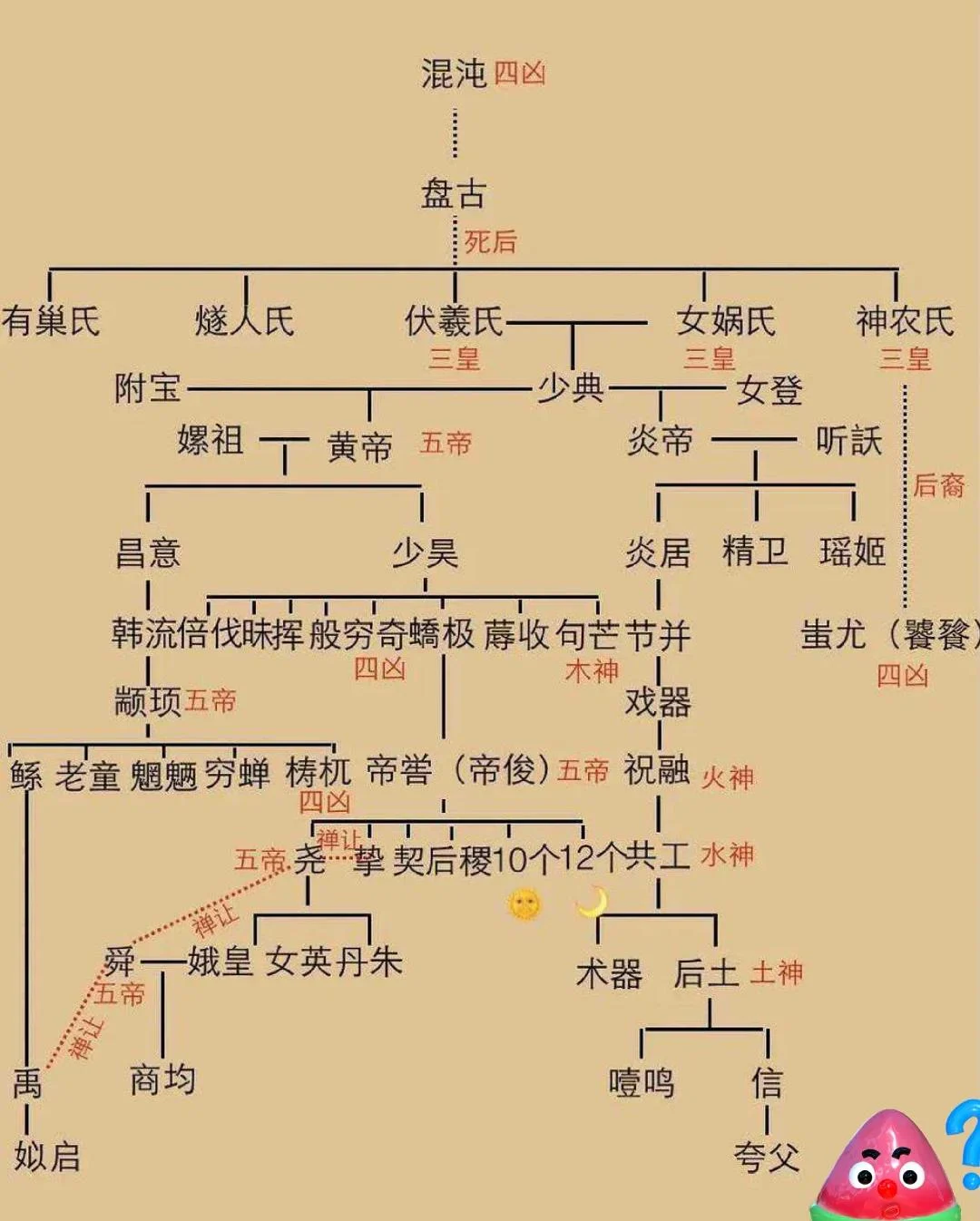
- Nüwa (女娲, Nǚwā) repairs a collapsing sky by smelting stones of five colors and propping up the four corners with the legs of a giant turtle.
- The archer Yi shoots down suns when ten of them burn in the sky together, and subdues destructive beasts.
- Yi obtains an elixir of immortality from Xiwangmu, and Heng’e takes it and flees to the moon. This is an early form of the Chang’e moon story. Her name was later written Chang’e (嫦娥, Cháng’é), commonly explained as avoidance of a character in the personal name of Emperor Wen of Han.
The Shiji and the historicizing of myth
Sima Qian’s Shiji (史记, Shǐjì), completed around the early first century BCE, opens with the Five Emperors, beginning with the Yellow Emperor (黄帝, Huángdì). Sima Qian admitted that many accounts of these rulers were unreliable, yet his annals gave them dates, genealogies and policies. Scholars call this process euhemerization: gods and culture heroes reshaped into ancient kings. It explains why Chinese sources often present mythic figures as sober historical founders rather than as gods.
New stories, new cults, new images
Ying Shao’s Fengsu tongyi (风俗通义, Fēngsú tōngyì), from the late second century CE, contains the story of Nüwa making people from yellow earth. It survives mainly through quotations in later encyclopedias.
Han religion also produced mass devotion. In 3 BCE, crowds from the eastern plains passed tokens hand to hand and traveled toward the capital in a movement centered on Xiwangmu, whom they associated with protection and immortality. In tombs, carved and painted images show Fuxi and Nüwa with serpentine lower bodies, often intertwined, a pairing that is much clearer in Han art than in earlier texts.
Three Kingdoms to Six Dynasties (220–589 CE): Pangu, Daoism and Buddhism
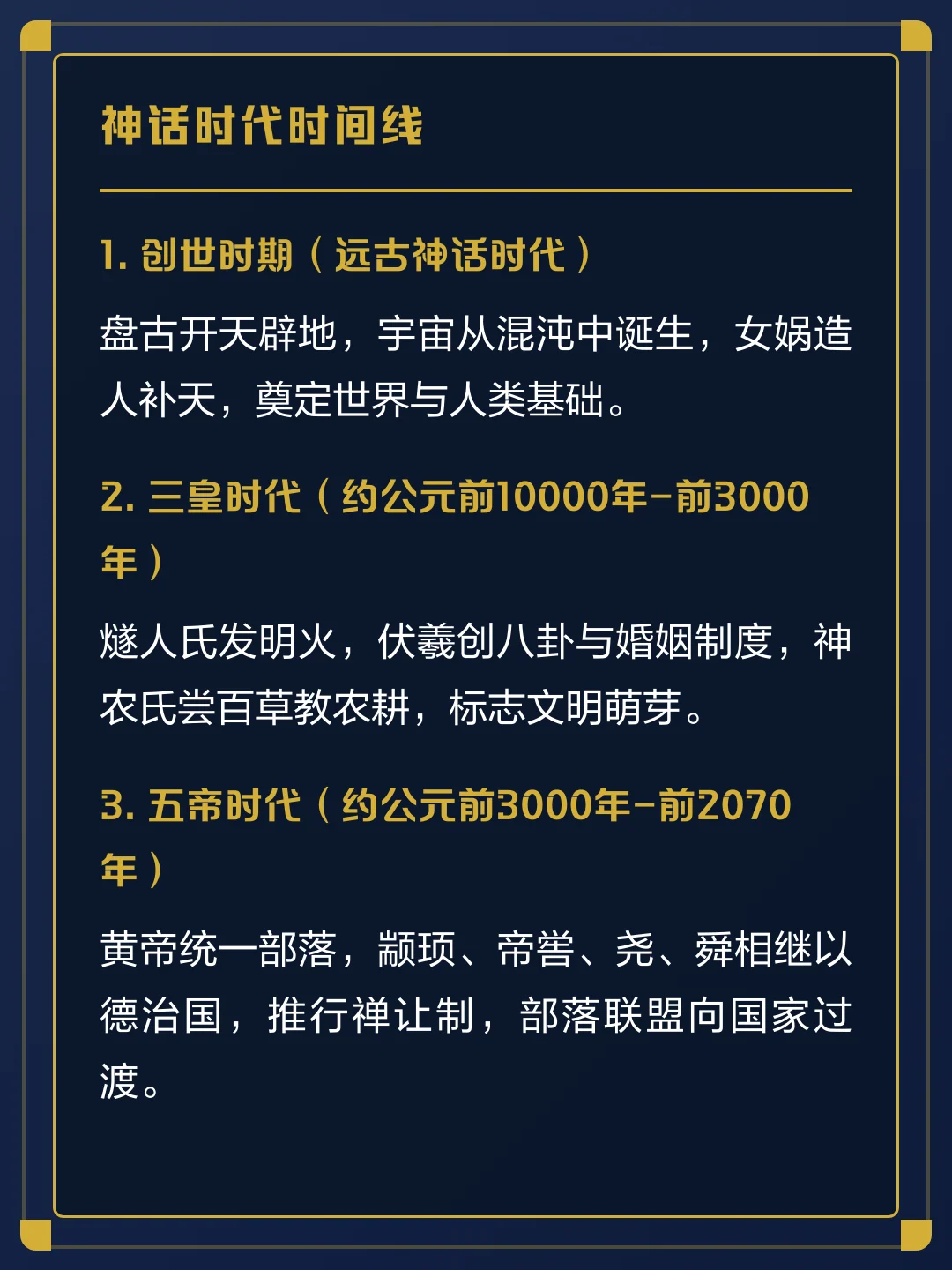
Pangu appears
The first surviving accounts of Pangu come from Xu Zheng, an official of the southern Wu kingdom in the third century CE. His Sanwu liji (三五历纪, Sānwǔ lìjì) describes Pangu growing between Heaven and Earth as they separate. A related text, the Wuyun linian ji (五运历年纪), tells how his body became the features of the world. Both originals are lost. Their passages survive only as quotations, for example in the Tang encyclopedia Yiwen leiju (艺文类聚, Yìwén lèijù), completed in 624.
Some scholars argue that the myth came from oral traditions in southern China and was recorded late, rather than invented late. Either way, Pangu’s position at the head of the Chinese creation story is a post-Han development.
Organized Daoism
Religious Daoism took institutional form in this period. The Way of the Celestial Masters (天师道, Tiānshī Dào) traced its founding to a revelation said to have been given to Zhang Daoling in 142 CE by Laozi in deified form as Taishang Laojun (太上老君, Tàishàng Lǎojūn). Later revealed scriptures expanded Daoist heavens, celestial officials and rituals. Daoist writers also absorbed older figures: Xiwangmu, Yu and others took on new roles inside a religious cosmology.
Buddhism and tales of the strange
Buddhism, which reached China around the first century CE, spread widely after the Han. It brought rebirth, karma, hells, bodhisattvas and an Indian cosmology that gradually merged with Chinese ideas. For an overview of that exchange, see Buddhist influence on Chinese mythology.
Writers also began collecting zhiguai (志怪, zhìguài), “records of the strange.” Gan Bao’s Soushen ji (搜神记, Sōushén jì), from the fourth century, preserved ghost stories, transformations and local cults that formal histories ignored.
Sui, Tang and Song (581–1279): Heavenly Bureaucracy and the Underworld
The Jade Emperor
The Jade Emperor (玉皇大帝, Yùhuáng Dàdì) has no role in early mythology. Belief in him took shape during the Tang, and by the tenth century poems and paintings show him presiding over a heavenly court. In 1017, Emperor Zhenzong of the Song established a state cult for him. In Daoist theology he remains below the Three Pure Ones, but in popular religion he became the familiar ruler of Heaven, governing gods through a bureaucracy modeled on the imperial civil service.
The Ten Kings of the underworld
By the ninth and tenth centuries, Buddhist scriptures composed in China described the dead passing through the courts of Ten Kings (十王, Shíwáng) for judgment. This system blended the Indian figure of Yama with Chinese legal and bureaucratic imagery, and it shaped later images of Yanluo Wang, Diyu and funeral ritual. Different texts continued to arrange the afterlife differently.
Tang tales, Song compilations and new cults
Tang writers produced literary tales (传奇, chuánqí) that gave lasting shape to stories of fate, romance and the supernatural. In 978 the Song court completed the Taiping guangji (太平广记), a compilation of earlier tales that preserved much material otherwise lost.
The same centuries saw cults grow around real people. Mazu, the sea goddess of the southeast coast, developed from devotion to a woman remembered as Lin Moniang, and Guanyin, the bodhisattva Avalokiteśvara, was increasingly portrayed in feminine form. Neither figure belongs to ancient mythology. Both are major parts of later Chinese religion.
Yuan, Ming and Qing (1271–1912): Drama and the Great Novels
For many modern readers, “Chinese mythology” means the gods and monsters of late imperial fiction and theater. These works collected earlier legends, combined Buddhist, Daoist and folk figures and gave them fixed personalities.
- Drama. Yuan and Ming plays helped settle the familiar membership of the Eight Immortals and popularized stories about immortals, judges and loyal heroes.
- Journey to the West (西游记, Xīyóu jì). Built on centuries of stories about the monk Xuanzang’s real seventh-century pilgrimage to India, the novel’s oldest dated full edition appeared in 1592. Its authorship is traditionally attributed to Wu Cheng’en. The novel created the Sun Wukong most people know, along with a comic, bureaucratic Heaven.
- Investiture of the Gods (封神演义, Fēngshén yǎnyì). This late Ming novel sets the fall of the Shang inside a war among immortals and ends with heroes being appointed to divine offices. It strongly influenced popular images of Nezha, Erlang Shen and many Daoist deities.
- Vernacular stories. Feng Menglong’s 1624 story collection fixed an influential version of the White Snake legend, which later opera versions changed again.
- Liaozhai zhiyi (聊斋志异). Pu Songling’s early Qing collection of fox spirits, ghosts and immortals revived the “records of the strange” tradition in polished literary form.
The Ming also printed the Daoist Canon in 1445, which preserved a vast body of liturgy and scripture. At the same time, the deification of historical people such as Guan Yu reached its height through state ritual and popular devotion.
A useful check: if a detail about a Chinese god appears mainly in Journey to the West or Investiture of the Gods, treat it as a late Ming literary version unless an earlier source confirms it.
Modern Era (1912–Present): Myth Studied as Myth
In the 1920s, the historian Gu Jiegang (顾颉刚, Gù Jiégāng) and the “Doubting Antiquity” movement challenged the traditional chronology of legendary rulers. In Gushi bian (古史辨), whose first volume appeared in 1926, he argued that ancient history had been built up in layers: the later a source, the further back its legendary figures were placed. Pangu is the classic example. He appears in writing after Fuxi, Nüwa and the Yellow Emperor, yet later chronologies put him first.
Chinese and Western scholars in the 1920s and 1930s also challenged the old claim that China “lacked” mythology, showing that myths had been fragmented and historicized rather than absent. Later twentieth-century scholars assembled scattered sources into readable myth anthologies, and archaeological finds such as manuscripts on silk and bamboo added material unknown to traditional commentators.
Retelling continues. Films, television series and games now reach global audiences, from the 2019 animated film Ne Zha to the 2024 game Black Myth: Wukong. These works usually draw on Ming novels more than on ancient texts, which makes the timeline above a practical tool for separating sources.
Where Famous Chinese Myths First Appear
| Myth or figure | Earliest surviving attestation | Later development |
|---|---|---|
| Hou Ji’s miraculous birth | Shijing, Western Zhou | Honored as Zhou ancestor and agricultural patron |
| Yu and the flood | Shangshu and Shijing, Zhou | Treated as history of the Xia founder; adopted in Daoist ritual |
| Xiwangmu | Shanhaijing, Warring States–Han | Han immortality cult; later the regal Queen Mother of Daoist and popular tradition |
| Nüwa repairs the sky | Named in “Tianwen”; told in the Huainanzi, 139 BCE | Paired with Fuxi in Han art; retold in later literature |
| Nüwa creates humans | Fengsu tongyi, late 2nd century CE | Became the best-known human origin story |
| Yi shoots the suns | Alluded to in “Tianwen”; told in the Huainanzi | Merged with the Chang’e story |
| Chang’e flies to the moon | Guicang fragments; Huainanzi | Tied to the Mid-Autumn Festival in much later custom |
| Pangu | Xu Zheng, 3rd century CE | Placed first in later chronologies of creation |
| Jade Emperor | Tang period | Song state cult from 1017; ruler of Heaven in popular religion and fiction |
| Ten Kings of the underworld | Buddhist scriptures composed in China, 9th–10th centuries | Standard image of underworld courts in later religion |
| Sun Wukong | A monkey pilgrim in Song–Yuan Xuanzang stories; Yuan–Ming drama | Journey to the West, 1592 edition; modern film and games |
For more stories organized by theme rather than by date, browse the Legends & Stories directory.
Frequently Asked Questions
What is the oldest text of Chinese mythology?
There is no single oldest myth book. Shang oracle-bone inscriptions are the oldest substantial writing and name gods and ancestors, but they contain no stories. The earliest narrative fragments appear in Zhou texts such as the Shijing and in Warring States works such as “Tianwen” and the Shanhaijing.
Why does Pangu come first in creation stories if he appears so late?
Later writers arranged legendary figures into one chronology and placed Pangu at the beginning because his story explains the origin of the cosmos. The earliest surviving Pangu texts date to the third century CE, centuries after Fuxi, Nüwa and the Yellow Emperor appear in writing.
Is the Shanhaijing an ancient book of Chinese gods?
It is an early source, compiled in stages from roughly the Warring States period into the Han, but it is a geography of mountains, seas, peoples, spirits and creatures rather than an organized book of gods. Many figures in it look very different from their later forms.
When did Daoism and Buddhism start shaping Chinese mythology?
Organized Daoism dates its founding revelation to 142 CE, and Buddhism reached China around the first century CE. Their strongest influence on popular mythology came later, through medieval scriptures, temple practice and Ming novels.
Are the stories in Journey to the West ancient Chinese myths?
No. The novel is a late Ming work, with its oldest dated full edition from 1592, built on earlier pilgrimage stories and drama. It uses older gods and religious ideas, but its plots and personalities are literary creations of the Song to Ming periods.
References and Further Reading
- Girardot, Norman J. “Chinese Religion: Mythic Themes.” Encyclopedia of Religion. Via Encyclopedia.com.
- Seidel, Anna. “Yuhuang.” Encyclopedia of Religion. Via Encyclopedia.com.
- Wu Xiaodong. “The Rhinoceros Totem and Pangu Myth: An Exploration of the Archetype of Pangu.” Oral Tradition 16, no. 2 (2001): 364–380. PDF.
- Teiser, Stephen F. The Scripture on the Ten Kings and the Making of Purgatory in Medieval Chinese Buddhism. University of Hawai’i Press. Publisher page.
- Encyclopaedia Britannica. “Daoism: Development of the Daoist Religion from the 2nd to the 6th Century.” Britannica.
- Encyclopaedia Britannica. “Journey to the West.” Britannica.
- Smarthistory. “Shang Dynasty, an Introduction.” Smarthistory.
- South China Morning Post, Post Magazine. Short read on the Queen Mother of the West movement of 3 BCE. SCMP.