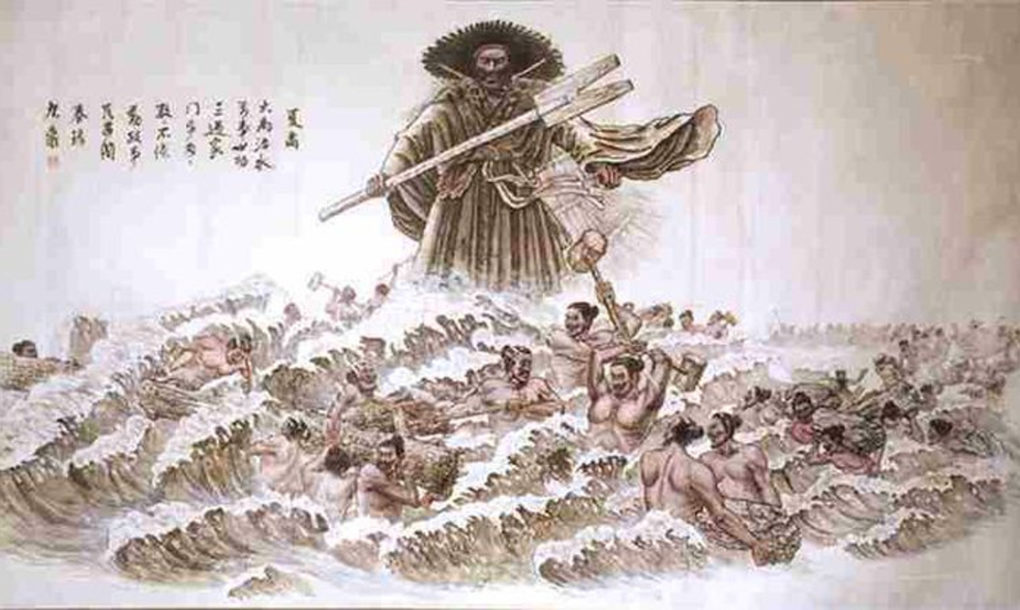
The Chinese flood myth of Gun and Yu—also written as Da Yu, meaning Yu the Great—is one of the foundational stories in Chinese mythology. It begins with a catastrophic ancient flood and follows two figures across two generations: Gun, who tried to stop the waters and failed, and Yu, who succeeded by understanding them.
For English-speaking readers, the name “Gun Yu” can be misleading. This is not one person but a linked mythic tradition involving a father and son. Gun is remembered as the tragic hero who attempted to block the flood through force and stolen power. Yu is the culture hero who completed the work through patience, observation, and a different method entirely.
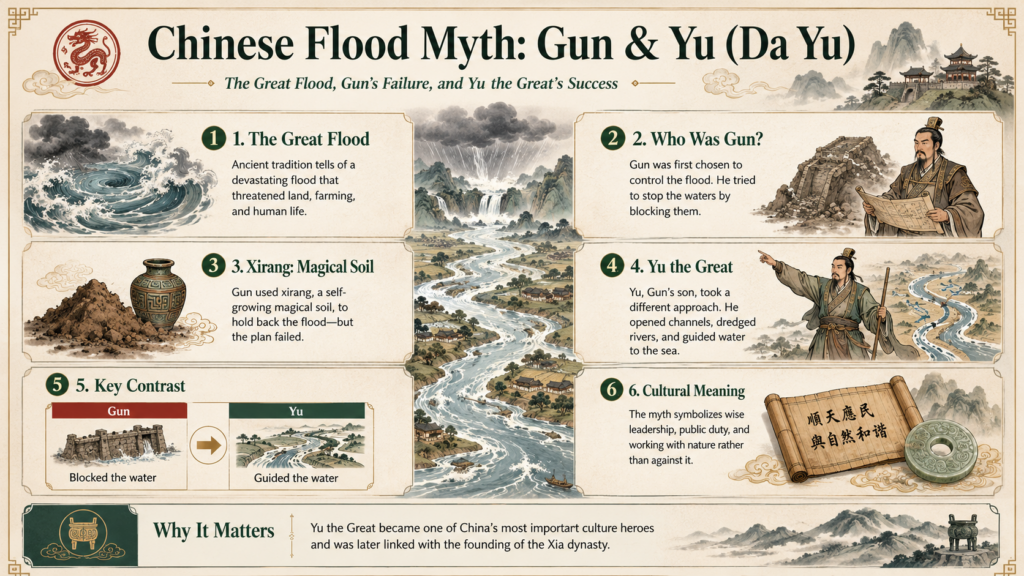
What makes this story worth knowing is that it is not really about water at all. It is about civilization—how human societies organize themselves in the face of environmental crisis, how leadership is tested, and how wisdom is ultimately more powerful than brute strength. In Chinese cultural memory, Yu the Great became the model of selfless public service. His father Gun, though remembered as a failure, gave the story its emotional depth. Together, they form one of the most meaningful contrasts in early Chinese tradition.
The Two Figures: Gun and Yu the Great
Who Was Gun?
Gun (鯀 in traditional Chinese, 鲧 in simplified) was appointed by the legendary sage ruler Yao to bring a catastrophic flood under control. In many versions of the myth, he tries to stop the rising waters by building barriers and embankments. In more mythological retellings, the pivotal element is xirang—a magical, self-growing soil. Gun steals this divine earth from the heavenly ruler and uses it to hold back the flood.
His plan fails. The waters do not recede, and Gun is punished. Depending on the source, he is executed by the fire deity Zhurong at a place called Yu Jiao or on Mount Yu. In the account preserved in the Classic of Mountains and Seas, something stranger happens: Gun’s body gives birth to Yu. This unusual origin marks Yu as a figure of extraordinary destiny—born from failure, punishment, and unfinished work.
Gun is not simply a villain. He is a desperate figure who took extreme action during a crisis, acted outside proper authority, and paid the price. His failure is both practical and moral, and without it, his son’s success has far less meaning.
Who Was Yu the Great?
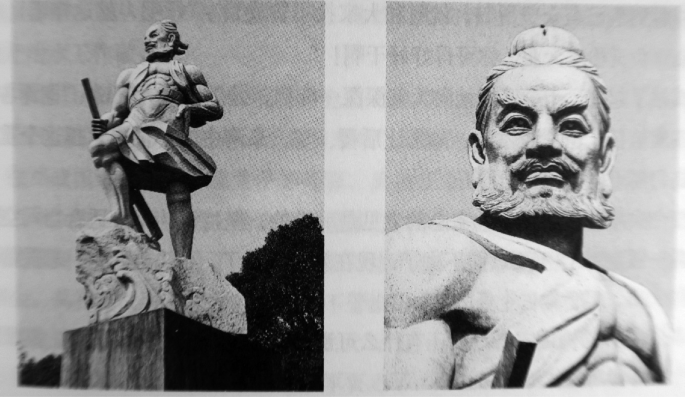
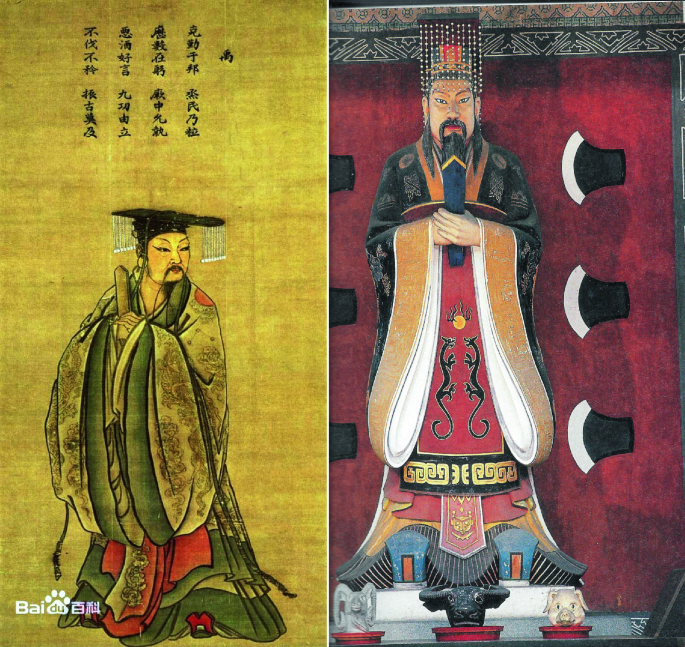
Yu the Great—Da Yu (大禹) in Chinese—is one of the most respected culture heroes in the entire tradition of Chinese mythology. He is not a warrior who defeats a monster in single combat. He is a civilizing hero: someone who studies mountains and rivers, organizes collective labor, travels the land season after season, and turns a flooded, chaotic landscape into a governed and livable world.
In later traditions, Yu is associated with the founding of the Xia dynasty, traditionally regarded as China’s first dynasty—though the historical status of the earliest Xia accounts remains complex and actively debated by scholars. For the purposes of mythology, what matters is his role: the man who succeeded where his father failed, and whose achievement defined what good leadership should look like.
The Chinese Flood Myth of Gun and Yu: The Story
The story begins during the age of the legendary sage rulers Yao and Shun, when floodwaters rise so high that settlements are destroyed, fields are ruined, and ordinary life becomes impossible. The land is overwhelmed.
Gun is selected to address the disaster. In some versions he raises embankments. In mythological versions, he steals xirang from the heavenly ruler and uses its self-expanding properties to hold the waters back. For years he labors. The flood does not stop.
Because Gun fails, he is punished and killed. His body, in the tradition recorded in the Classic of Mountains and Seas, gives birth to Yu—a mythic birth that marks Yu as someone whose very existence is tied to the burden his father could not complete.
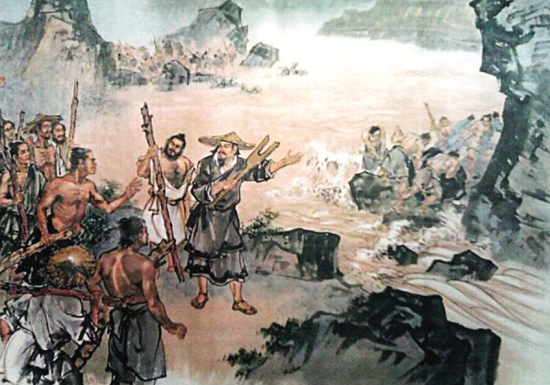
Yu does not simply repeat Gun’s approach. He studies the terrain: mountains, rivers, marshes, natural channels. He works not to stop water but to guide it. He dredges riverbeds, opens passages, and directs the flood toward the sea. His method is shaped by attention rather than force.
Yu’s labor lasts many years. One of the most famous images in the entire story is this: he passes his own home three times during those years but does not go inside, because the work is not yet done. This became one of the most enduring symbols of public duty in Chinese cultural memory—not an abandonment of family, but a measure of how seriously a leader must take responsibility toward the people.
Eventually, the waters are brought under control. Agriculture can continue. Communities are restored. Yu becomes a model ruler, remembered not for conquest but for service.
Historical and Cultural Background
The Great Flood in Chinese Tradition
Flood stories appear across many cultures, but the Chinese myth of Gun and Yu has a distinctive emphasis. Most flood myths concern survival: a chosen person or family escapes in a boat while the world is destroyed and later renewed. The Chinese story asks a different question entirely: not how do we survive the flood? but how do we manage it?
This distinction matters. The Gun-Yu tradition is deeply connected with ancient concerns about rivers, agriculture, settlement, land use, and political authority. Civilization is imagined as something built through the careful regulation of water and earth. The ability to manage floods was not just a technical achievement in early Chinese thought—it was a sign of legitimate rule.
Yao, Shun, and the World of Sage Rulers
The flood myth is set in the age of Yao and Shun, two legendary kings at the center of early Chinese political imagination. They are remembered as rulers who chose capable successors on the basis of merit rather than bloodline, and who placed the welfare of the people above personal advantage. Yu belongs to this moral world. His success is never presented as personal glory. It is a public achievement that restores order and makes ordinary life possible again.
The story connects natural order with political order. To govern well is not simply to issue commands—it is to understand the conditions of the people’s lives: rivers, soil, food, labor, the shape of the land.
The Nine Provinces and the Ordering of the World
One of the less-discussed but culturally important dimensions of Yu’s story is his role in organizing the land itself. In texts such as the Tribute of Yu (Yugong), Yu surveys mountains, traces rivers, and defines territories—laying out what later tradition described as the Nine Provinces. In this sense, Yu is not only a flood-control hero. He is a geographer and world-orderer. His myth explains how a chaotic, flooded landscape becomes a structured human world.
This is why Yu’s story remained so meaningful across Chinese history. He does not merely defeat the flood. He transforms the world.
Xirang: The Magical Soil at the Heart of Gun’s Story
One of the most distinctive elements in the myth is xirang—often translated as “self-growing soil,” “swelling earth,” or “living earth.” Gun steals it from the heavenly ruler in order to block the floodwaters, and it is genuinely extraordinary material: earth that expands to fill space, that could in theory hold back a rising tide.
Why does it fail?
On a practical level, the myth suggests something that engineers would recognize: floodwaters are dynamic. They accumulate, overflow, and find new paths. Blocking them without directing them can make things worse, not better.
On a deeper level, Gun’s theft raises a moral question. He acts without proper authority. His approach may be energetic and even courageous, but it violates the cosmic and political order from which legitimate action flows. The myth does not reduce the problem to engineering. It also asks whether power is used rightly—with wisdom, authorization, and a clear understanding of consequences.
Xirang therefore carries dual symbolism: it represents possibility, but also the danger of acting outside the right relationship between a ruler and the powers that sustain the world.
Why Gun Failed and Yu Succeeded
Gun’s Method: Blocking
Gun’s approach is essentially one of resistance. He treats the flood as an enemy to be stopped. In symbolic terms—and to some degree in practical terms—this is the method of the embankment: pile up earth, hold the water back.
It fails because water does not simply disappear when blocked. It finds new paths, builds pressure, and eventually breaks through. The myth gives this a moral dimension as well: Gun’s failure is not only technical. In some accounts, he acts without authorization or in defiance of proper process. Both strands—the practical and the ethical—contribute to his downfall.
Yu’s Method: Guiding
Yu’s approach is the opposite. He observes the landscape, identifies natural channels, opens waterways, and lets water move where it wants to go—toward the sea. He does not conquer the flood; he works with it.
This contrast became one of the reasons the story lasted. It presents wisdom not as brute strength but as the ability to read patterns and adapt accordingly. Yu succeeds because he listens to the world before he acts on it. Later readers—philosophers, administrators, engineers, rulers—found in this contrast a lesson applicable far beyond flood management.
Symbolism in the Chinese Flood Myth
Water as Chaos and Life
Water in this myth is not a simple evil to be destroyed. It is necessary—for life, agriculture, transportation, and fertility. The flood represents water out of balance, not water as enemy. The goal is restoration, not annihilation. This gives the story a more nuanced quality than a simple battle between good and evil.
Earth as Order and Settlement
Earth—especially as represented by xirang—stands for stability, agriculture, and human order. Gun wants to impose that stability on chaos, but his method is incomplete. Yu’s success comes when earth and water are brought into proper relationship: rivers have channels, marshes have boundaries, mountains and rivers are known and mapped.
Yu as the Ideal Public Servant
Yu’s refusal to enter his home during years of labor became the myth’s most cited moral image. The point is not that family was unimportant. The point is that extraordinary crisis demands extraordinary commitment to public duty—and that a true leader gives his body and time to the people before himself.
Gun as the Tragic Predecessor
Gun is often remembered negatively, but the myth needs him. He represents failed effort, the limits of force without wisdom, and the burden that one generation leaves to the next. His failure is not wasted. Without it, Yu’s success is merely technical. With it, the story becomes about inheritance, correction, and completion.
Cultural Meaning: Why This Myth Matters
The Chinese flood myth of Gun and Yu matters because it links mythology to ideas that became central to Chinese civilization itself.
It connects flood control with legitimate rulership—a leader proves himself not through personal power but through collective benefit. It connects geography with culture—Yu’s journey across mountains and rivers transforms unknown space into a governed world. It connects morality with practical ability—Yu’s virtue is not abstract; it is demonstrated through work that solves a real public problem.
And it connects myth with memory. Whether or not the story preserves traces of actual ancient floods, it became the cultural explanation for how order emerged from environmental crisis—and what kind of leader makes that possible.
Is the Gun-Yu Flood Myth Historical?
This requires a careful answer.
The story of Gun and Yu belongs to mythology and early cultural memory. The texts that preserve it were written, edited, and transmitted long after the events they describe, and the earliest layers are impossible to date with confidence. The myth should not be treated as a straightforward historical account.
At the same time, ancient China experienced major river systems, seasonal flooding, and long-standing challenges of water management. It is entirely reasonable to understand the myth as reflecting those real concerns, even if no specific historical flood can be confirmed as its origin.
Modern scholars have debated whether geological or archaeological evidence can be connected to the Great Flood tradition. Some researchers have proposed links between major ancient flood events and the Yu legend; others argue the evidence is insufficient or that the geographic setting needs to be reconsidered. The debate continues.
For readers of Chinese mythology, the safest framing is this: the Gun-Yu flood myth is a mythological and cultural tradition that may preserve memories of ancient environmental challenges, but it should not be treated as confirmed history.
Common Misunderstandings
Gun Yu is not one person. In most searches, “Gun Yu” can read as a single name. In Chinese mythology, they are two separate figures—father and son—with different roles, different methods, and different fates.
Yu did not simply build bigger dams. His success is most closely associated with dredging, channeling, and guiding water toward the sea. The key insight is not that he blocked the flood more effectively than his father, but that he used an entirely different approach.
Gun was not purely evil. He is punished in the myth, but he is also a tragic figure—someone who attempted to solve a genuine crisis through the wrong method or without proper authority. The myth gives him emotional depth, not just moral failure.
Xirang is not ordinary soil. It is a mythic substance with divine associations. Its meaning is symbolic as well as supernatural, representing the desire to create stability against chaos.
The Chinese flood myth is not the same as Noah’s Ark. The biblical flood story centers on divine punishment, survival at sea, and the rebirth of humanity. The Gun-Yu myth centers on long-term flood management, social organization, and the transformation of a flooded world into a livable one. The structural and thematic concerns are quite different.
The story is not proven history. The Gun-Yu tradition is culturally significant, but its historical interpretation remains actively debated. It is best understood as mythology with possible environmental memory at its roots.
Why This Story Still Matters
The story of Gun and Yu remains relevant because it speaks to problems that are still recognizable: floods, climate disruption, public works, leadership under pressure, and the relationship between human societies and the natural world.
Yu’s achievement is not a miracle. It requires time, labor, sustained observation, and coordination with other people. This makes the myth unusually practical in its values. It teaches that crisis management depends not only on courage, but on method—and that method comes from genuine understanding of what you are dealing with.
The story also matters because it offers Chinese mythology a distinctive kind of hero. Yu is not famous for conquest or personal glory. He is famous for making life possible for others. His greatness is defined by service.
Gun matters too, because he shows what happens when urgency substitutes for wisdom, and when power is exercised without proper grounding. His story is not merely a cautionary tale. It is a necessary part of the contrast that gives Yu’s success its full meaning.
Together, Gun and Yu express something close to a foundational Chinese mythic principle: civilization is created when people learn to live with the forces of the natural world, not simply against them.
Gun and Yu in the Wider World of Chinese Mythology
The flood myth connects with many of the larger themes of Chinese mythology: ancient sage rulers, divine authority, sacred geography, culture heroes, and the ordering of the world.
Some later versions of Yu’s story include supernatural helpers—dragons, turtles, spirit figures—who assist him in his work. These details vary significantly by source and historical period, and they show how Yu’s image expanded and accumulated new associations over time.
In certain later religious and folk traditions, Yu received forms of reverence connected with water protection and community welfare—though this varied by region and period. For readers new to Chinese mythology, it is best to understand him first as a mythological culture hero: a figure who brings order, structure, and safety to the human world through sustained effort rather than divine power alone.
Yu also fits into a broader pattern in Chinese mythology, where the world is shaped not only by gods from above but by beings who measure, repair, organize, and civilize from within. He belongs beside figures like Nüwa, who repairs the sky after catastrophe, and other heroes whose greatness lies in what they build or restore rather than what they defeat.
FAQ
Who are Gun and Yu in Chinese mythology? Gun and Yu are father and son in the Chinese Great Flood myth. Gun is appointed to control the flood but fails; his son Yu, known as Yu the Great or Da Yu, continues the work and succeeds.
What does Da Yu mean? Da Yu means “Yu the Great.” The character 大 (dà) means “great,” and 禹 (Yǔ) is his name. The title reflects his revered status as both a flood-control hero and an ideal ruler.
What is the Chinese flood myth of Gun and Yu about? At its core, it is about a catastrophic ancient flood, Gun’s failed attempt to stop it, and Yu the Great’s successful effort to control the waters through dredging, channeling, and guiding rivers toward the sea. More broadly, it is a story about civilization, leadership, and wisdom.
Is Gun the same as Yu the Great? No. Gun is Yu’s father. They are distinct figures with different roles, different methods, and different outcomes.
What is xirang? Xirang is a mythic, self-growing soil that Gun steals from the heavenly ruler in order to block the floodwaters. His method fails. The image is both magical and symbolic—representing the attempt to create stability against natural chaos.
Why did Gun fail? Gun fails because he tries to block the flood rather than guide it. In some versions, he also acts without proper divine authorization. His failure has both practical and moral dimensions.
Why did Yu succeed? Yu succeeds because he studies the landscape, opens channels, dredges riverbeds, and directs the water toward the sea. His method works with the natural movement of water rather than trying to suppress it.
Is Yu the Great considered a god? Yu is primarily a mythological culture hero and sage ruler. In some later folk and religious traditions, he received reverence associated with water and community protection, but his core identity in Chinese mythology is that of the great flood controller—a human figure transformed by extraordinary effort.
Did the Chinese Great Flood really happen? The myth may reflect ancient experiences with major flooding, but scholars continue to debate whether it can be connected to a specific historical event. It is best treated as mythology with possible historical memory embedded in it, not as confirmed history.
How is the Chinese flood myth different from other flood myths? Many flood myths center on divine punishment and survival in a vessel. The Gun-Yu myth centers on flood management: public labor, landscape transformation, and the creation of social order from environmental chaos.
Conclusion
The Chinese flood myth of Gun and Yu—Da Yu, the Great—is one of the most important stories in Chinese mythology, and one of the most revealing. It tells how a devastating flood threatened the ancient world, how Gun failed by relying on force and acting outside proper authority, and how Yu the Great succeeded through patience, observation, and disciplined labor guided by genuine understanding.
For readers new to Chinese mythology, the most important thing to hold onto is this: the story is not really about water. It is about civilization. The flood represents nature out of balance. Yu’s work represents the sustained human effort to understand that imbalance and restore order—not by dominating the world, but by learning to work within it.
Gun and Yu together form a powerful mythological pairing: failed resistance and successful guidance, desperate action and wise adaptation, inherited burden and completed duty. That is why Yu the Great became one of the most honored figures in Chinese cultural memory, and why the flood myth he belongs to remains essential reading for anyone who wants to understand what Chinese mythology says about leadership, society, and the long work of civilization.