Legendary Consort · First Sericulturist · Silkworm Goddess
Leizu: The Chinese Silk Goddess, Her Story, Symbols and Worship
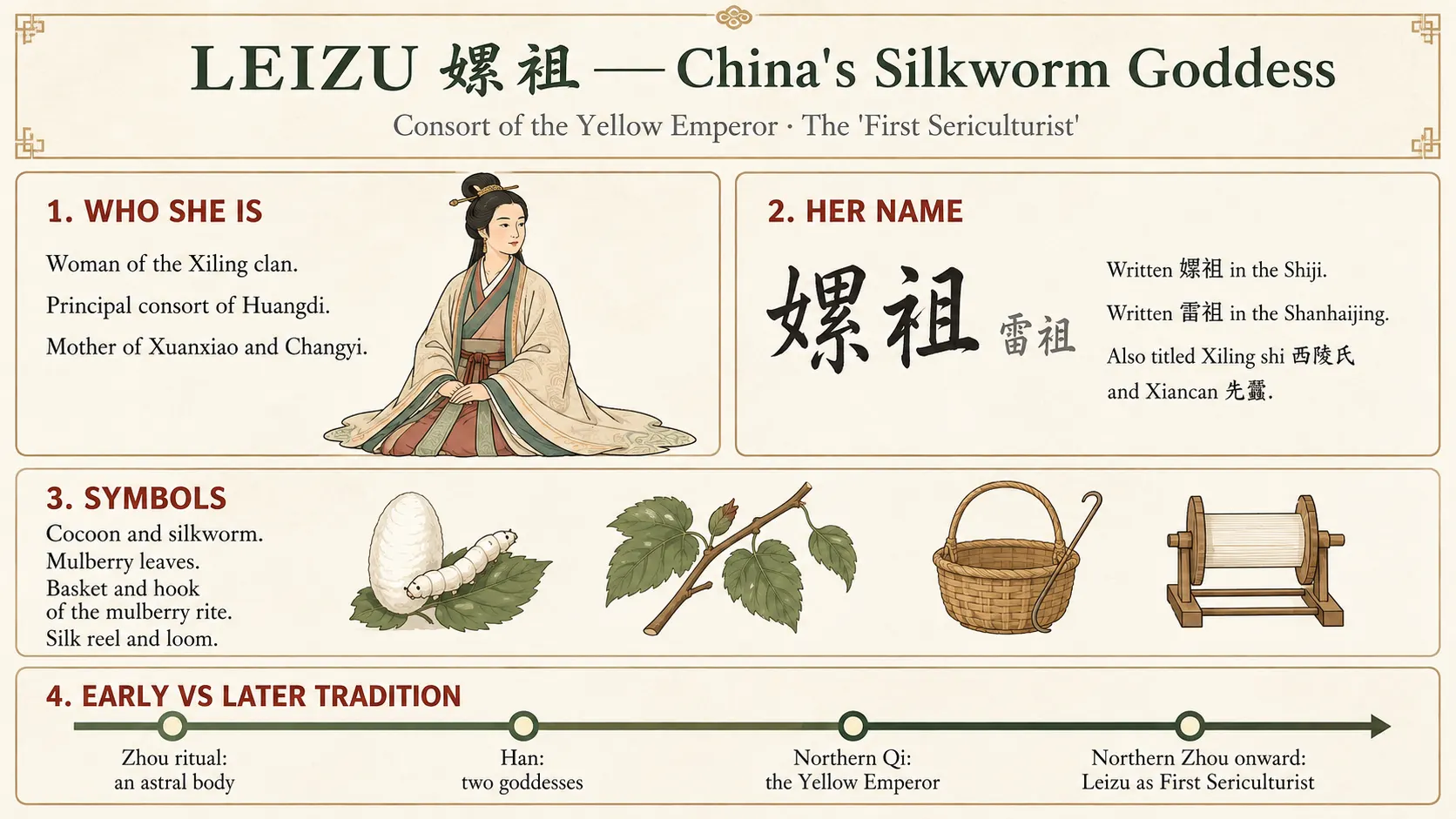
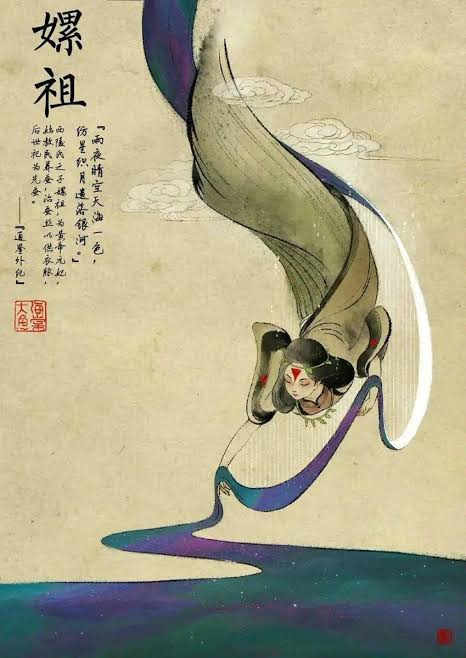
Leizu (嫘祖, Léizǔ) is the legendary woman of the Xiling clan whom Chinese tradition remembers as the principal consort of the Yellow Emperor and, from the early medieval period onward, as the goddess who taught people to raise silkworms and reel silk. She belongs to China’s legendary antiquity rather than to documented history. Her cult grew out of the imperial sericulture ritual and out of village silk-farming religion, not out of Daoism or Buddhism. She is also called Xiling shi (西陵氏, Xīlíngshì) and Xiancan (先蠶, Xiāncán), “the First Sericulturist.”
| Quick fact | Leizu |
|---|---|
| English name | Leizu; sometimes Lei-tsu or Lady Xiling in older books |
| Chinese | 嫘祖 (simplified 嫘祖); written 雷祖 in the Shanhaijing |
| Pinyin | Léizǔ |
| Other names and titles | Xiling shi 西陵氏, Xiancan 先蠶 (“First Sericulturist”), Canshen 蠶神 (“Silkworm Deity”), Silkworm Mother |
| Main identity | Consort of Huangdi; later the patron deity of sericulture |
| Earliest surviving mentions | Shiji and Shanhaijing, where she appears only as a consort and ancestress |
| Religious category | State ritual cult and folk religion; not originally a Daoist or Buddhist figure |
| Historical status | Legendary. No evidence identifies her as a documented individual |
Who Is Leizu in Chinese Mythology?
Ask who is Leizu in Chinese mythology and you will usually get a single tidy answer: she discovered silk when a cocoon fell into her tea. That answer is popular, memorable and very late. The figure behind it is more interesting.
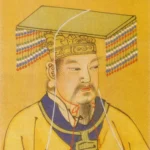
In the oldest surviving texts, Leizu is a genealogical figure. She marks the point where the line of the Yellow Emperor, Huangdi, continues into the following generations of legendary rulers. Sima Qian’s Shiji (Records of the Grand Historian) reports that Huangdi lived at Xuanyuan hill, married a woman of Xiling called Leizu, made her his principal consort, and had two sons by her: Xuanxiao (also called Qingyang) and Changyi. Changyi’s son Gaoyang later took the throne as Emperor Zhuanxu.
What the passage does not say is just as important. It says nothing about silkworms, mulberry groves, reeling or weaving. The silk attribution belongs to a much later layer of tradition, and one of the most useful things an English reader can learn about Leizu is how those two layers came apart and were later fused.
Leizu Meaning: The Name and Its Variants
The Leizu meaning that circulates online — “thunder ancestor,” from 雷 léi, “thunder” — comes from a real textual detail, but it is a misreading of what that detail shows.
The Shanhaijing (Classic of Mountains and Seas), in the “Classic of Regions Within the Seas,” states that Huangdi’s wife was 雷祖 (Léizǔ), who bore Changyi. Here her name is written with the character for thunder. The Shiji writes it 嫘祖, with a “silk” element on the left. Other early citations use 纍祖. In other words, an ancient name was recorded with several homophonous characters, and the graph that eventually won carries a silk radical. That does not prove she was originally a thunder deity, and it does not prove she was originally a silk deity either. It shows a name older than any settled spelling for it.
| Name or title | Chinese | Meaning and context |
|---|---|---|
| Leizu | 嫘祖 Léizǔ | The standard form, used in the Shiji and in almost all later writing |
| Leizu | 雷祖 Léizǔ | The Shanhaijing spelling, with the character for thunder |
| Xiling shi | 西陵氏 Xīlíngshì | “The woman of Xiling,” her clan or place designation |
| Xiancan | 先蠶 Xiāncán | “First Sericulturist,” the title of the deity honoured in the imperial silkworm rite |
| Canshen | 蠶神 Cánshén | General term for the silkworm deity, applied to several different figures |
| Silkworm Mother | 蠶母 / 蠶奶奶 | Affectionate popular forms used in silk-producing regions |
The Leizu Story: How the Silk Legend Took Shape
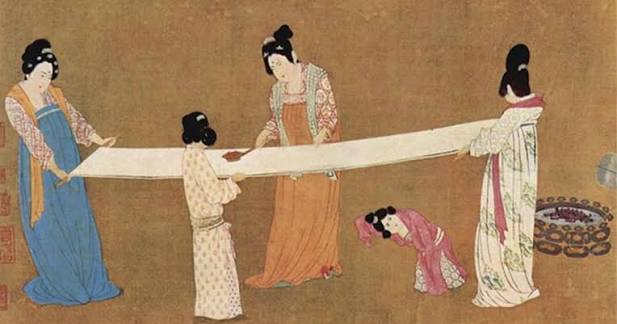
The familiar Leizu story runs like this. While sitting under a mulberry tree, or drinking tea in the palace garden, Leizu notices a cocoon. She teases loose a filament, winds it around her finger, and finds it unwinds into a single continuous thread. She persuades Huangdi to give her a grove of mulberry trees, learns to rear the worms, and invents the silk reel and the loom.
Retellings of this narrative are pleasant and worth knowing, but they should be labelled correctly. The cocoon-in-the-teacup detail is a modern popular version, not an ancient one, and the earliest surviving texts about Leizu contain no version of it at all. The Shanhaijing chapter that names her is in fact full of “first inventor” claims — one figure first made boats, another first made carts, another first made bows and arrows — and silk is not among the things it credits to her.
The earliest surviving sources present Leizu as a consort and ancestress. Later sources present her as the inventor of sericulture. Both are traditions about her; only the second is a story about silk.
By the Song dynasty, historical compilations state the sericulture claim plainly: the woman of Xiling, consort of Huangdi, first taught the people to rear silkworms and to work silk into clothing, and later generations sacrificed to her as the goddess of sericulture. That formulation is the direct ancestor of nearly every English retelling in circulation today. The German sinologist Dieter Kuhn traced this development in detail in a 1984 study of the “First Sericulturist,” and his conclusion is the one to keep in mind: the identity of that deity was not fixed in antiquity but assigned, changed and reassigned over centuries.
When Did Leizu Become the Silk Goddess?
The imperial state maintained a spring ritual in which the empress led court women in picking mulberry leaves and offering sacrifice to the Xiancan, the First Sericulturist — a female counterpart to the emperor’s ploughing rite for the god of agriculture, a role broadly comparable to that of Hou Ji on the farming side. The Tang encyclopaedia Tongdian preserves a dynasty-by-dynasty record of who that deity actually was, and it is not a single name.
| Period | Who received the “First Sericulturist” sacrifice |
|---|---|
| Zhou ritual system | Tiansi 天駟, an astral body associated with horses — not a human figure at all |
| Han | Two goddesses: 苑窳婦人 (Lady Yuanyu) and 寓氏公主 (Princess Yushi) |
| Northern Qi (550–577) | Huangdi Xuanyuan shi — the Yellow Emperor himself, not his consort |
| Northern Zhou (557–581) | The deity Xiling shi — that is, Leizu |
| Sui and Tang | The rite continues at a dedicated altar; Tang empresses perform it |
| Qing | An Altar of the First Sericulturist built in Beijing under the Qianlong reign, still standing in Beihai Park |
Two things follow. First, Leizu’s identification as the silk goddess is datable, and it is medieval rather than ancient. Second, it was an official decision inside a ritual system, later reinforced by Song historiography and by folk practice — which is why the association became so durable that most readers now assume it was always there.
Leizu Symbols and Powers
Leizu has no fixed weapon, mount or supernatural power set. Anyone offering a list of “Leizu symbols and powers” in the manner of a game character is inventing. Her attributes are occupational and material, and they are consistent across the traditions that actually depict her.
| Attribute | What it signifies | Caution |
|---|---|---|
| Silkworm and cocoon | Her central emblem; the source of the thread | The cocoon’s life cycle also carried meanings of death and rebirth in folk belief |
| Mulberry branch and leaves | The feed plant, and the labour of the rearing season | Mulberry symbolism in Chinese texts is broader than Leizu alone |
| Basket and hook | The tools carried in the empress’s mulberry-picking rite | These belong to the state ritual, not to a personal iconography |
| Reel and loom | The technologies later credited to her | Attributed by later sources; not stated in early texts |
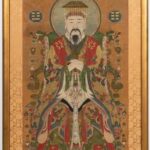
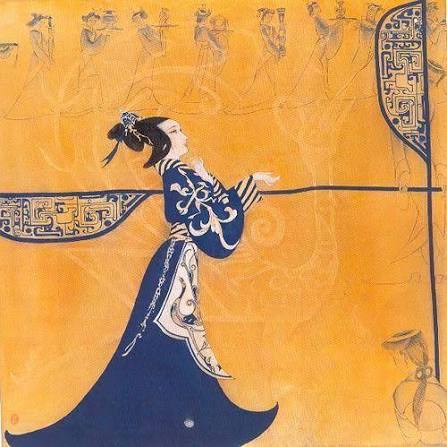
| Court robes | She is normally shown as a dignified consort, not as a warrior or immortal | Costume details vary widely by period and region |
What Does Leizu Represent?
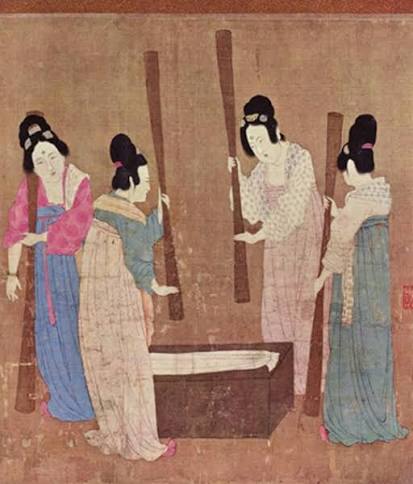
Asking what does Leizu represent is really asking what silk represented, because she absorbed the meaning of the industry she came to stand for.
- Women’s productive labour. Sericulture was organised around the household division in which men farmed and women wove. A female inventor made narrative sense of an economy that depended on women’s work.
- Civilised clothing. In the culture-hero framework, Leizu supplies garments as other figures supply grain, writing or fire.
- Imperial legitimacy. The empress’s silkworm rite mirrored the emperor’s ploughing rite; honouring Leizu was a statement about the ruling house’s relationship to the productive order.
- Ancestry. Through her sons she anchors the genealogy running from Huangdi to Zhuanxu and beyond.
- Modern cultural heritage. Sericulture and silk craftsmanship in China were inscribed on UNESCO’s Representative List of the Intangible Cultural Heritage of Humanity in 2009, and the silkworm goddess belongs to that living tradition.
Leizu Worship in Chinese Culture
Leizu worship in Chinese culture operated on two levels that rarely met.
The court cult
At the top was the Xiancan sacrifice described above: a dated, regulated ceremony with its own altar, prescribed robes, ranked participants and a fixed number of mulberry branches each rank was allowed to cut. This was state ritual, and its object could be reassigned by decree.
Village religion
At village level, the silkworm deity was a working goddess whose favour decided whether a family’s rearing season succeeded. UNESCO’s documentation of Chinese sericulture records that near the start of the lunar year silk farmers invite artisans into their homes to perform the story of the Goddess of the Silkworm, to ward off misfortune and secure a good harvest, and that in April women silk farmers wear flowers of silk or paper and make offerings at a Silkworm Flower festival. In these settings the deity is addressed by warm, local names rather than by the formal title Xiancan, and she is not always Leizu.
Regional claims
Several places in China identify themselves as Leizu’s birthplace or as the site of her principal temple, with Yanting in Sichuan and locations in Henan among the best known. These are competing local traditions supported by local temples and modern commemorations. They should not be read as settled historical geography.
Is Leizu a Chinese God, a Taoist Deity, or a Legendary Ancestor?
The search term “Leizu Chinese god” is common, and the honest answer needs a distinction. Leizu is venerated as a deity — that much is straightforward. But her cult is rooted in state agrarian ritual and in folk religion, not in Daoist scripture. She was not originally part of the Daoist celestial bureaucracy in the way that figures such as Xiwangmu came to be, and she is not a Buddhist figure.
Images of Leizu can appear in temples with Daoist affiliations, because Chinese popular religion is not organised into sealed compartments. That does not make her a Taoist deity in any doctrinal sense. Calling her a legendary ancestress who became a patron deity of an industry is more accurate than any single religious label. For readers mapping the wider landscape, our guide to Chinese gods and goddesses sets out how these categories differ.
Common Misconceptions About Leizu
Leizu is not a thunder god. The Shanhaijing spelling 雷祖 has led some English sources to link her with Leigong (雷公), the thunder deity. They are unrelated figures with unrelated cults.
Leizu is not the Horse-Headed Maiden. Chinese folk religion also honours a very different silkworm goddess, Matouniang (馬頭娘), whose story is told in the fourth-century Soushenji: a girl promises herself to a horse that rescues her father, the horse is killed, its hide wraps her, and she becomes a silkworm in a mulberry tree. This grim transformation tale, associated especially with Sichuan and the lower Yangtze silk districts, was often conflated with Leizu in later practice, but it is a separate tradition with a separate logic.
Leizu did not invent silk. Biomolecular analysis published in PLOS ONE in 2016 identified silk fibroin in soil from tombs at the Neolithic site of Jiahu in Henan, dated to roughly 8,500 years ago, and Yangshao-period sites in the same province have yielded actual silk fabrics several thousand years old. Silk in China long predates any date traditional chronology assigns to Huangdi’s court. Leizu is a story China told about the origin of silk, not the origin itself.
She is not a historical empress. A later Chinese tradition holds that she died while travelling and was therefore also honoured as a deity of roads and journeys. Like her birthplace, this is a late accretion, not an early textual claim.
Frequently Asked Questions
Who is Leizu in Chinese mythology?
Leizu (嫘祖) is the legendary woman of the Xiling clan named in the Shiji as the principal consort of the Yellow Emperor and the mother of Xuanxiao and Changyi. From the sixth century onward she was also identified as the First Sericulturist, the deity who taught people to raise silkworms and produce silk.
Did Leizu really discover silk?
No. Archaeological and biomolecular evidence places silk use in China thousands of years before the traditional dates given for Huangdi’s court. The discovery narrative is a cultural origin story, and its most familiar details — the cocoon in the teacup, the gift of a mulberry grove — are late popular retellings rather than ancient testimony.
Is Leizu a Taoist goddess?
Not in origin. Her cult grew out of the imperial sericulture ritual and out of village silk-farming religion. She may be encountered in temples of various affiliations, since Chinese popular religion is fluid, but she is not a scriptural Daoist deity and has no Buddhist identity.
Was Leizu always the goddess of silkworms?
No, and this is one of the clearer cases of change in Chinese religious history. The Tongdian records that the First Sericulturist sacrifice was directed at an astral body under Zhou ritual, at two goddesses under the Han, at the Yellow Emperor himself under the Northern Qi, and only under the Northern Zhou at the Xiling deity — Leizu.
What is the difference between Leizu and Matouniang?
Both are silkworm deities, but they come from different traditions. Leizu is a consort of the Yellow Emperor honoured in official ritual; Matouniang, the Horse-Headed Maiden, comes from a folk transformation tale in which a girl becomes a silkworm after being wrapped in a horse’s hide. Later popular religion often blended them.
How is Leizu remembered today?
Through local temples and commemorations at sites claiming her as their own, through the surviving Altar of the First Sericulturist in Beijing, and through living silk-farming customs such as the Silkworm Flower festival and household performances of the silkworm goddess story, documented as part of China’s UNESCO-listed sericulture heritage.
References and Further Reading
- Sima Qian, Shiji, “Annals of the Five Emperors” — Chinese Text Project — The passage naming Leizu as the woman of Xiling and consort of Huangdi, and listing her two sons; it makes no mention of silk.
- Shanhaijing, “Classic of Regions Within the Seas” — Chinese Text Project — Records her name as 雷祖 and attributes a series of “first inventions” to other figures, but not sericulture to her.
- Du You, Tongdian, “First Sericulturist” (先蠶) — Chinese Text Project — The dynasty-by-dynasty record showing that the object of the imperial silkworm sacrifice changed repeatedly before settling on the Xiling deity.
- Dieter Kuhn, “Tracing a Chinese Legend: In Search of the Identity of the ‘First Sericulturalist'”, T’oung Pao 70 (1984) — Brill — The standard scholarly study of how the sericulture attribution attached itself to Leizu.
- Gong et al., “Biomolecular Evidence of Silk from 8,500 Years Ago”, PLOS ONE (2016) — Peer-reviewed evidence of silk fibroin at the Neolithic site of Jiahu, used here to date silk far earlier than the legend allows.
- Sericulture and silk craftsmanship of China — UNESCO Intangible Cultural Heritage — Documents living silkworm-goddess customs, including household performances of her story and the Silkworm Flower festival.