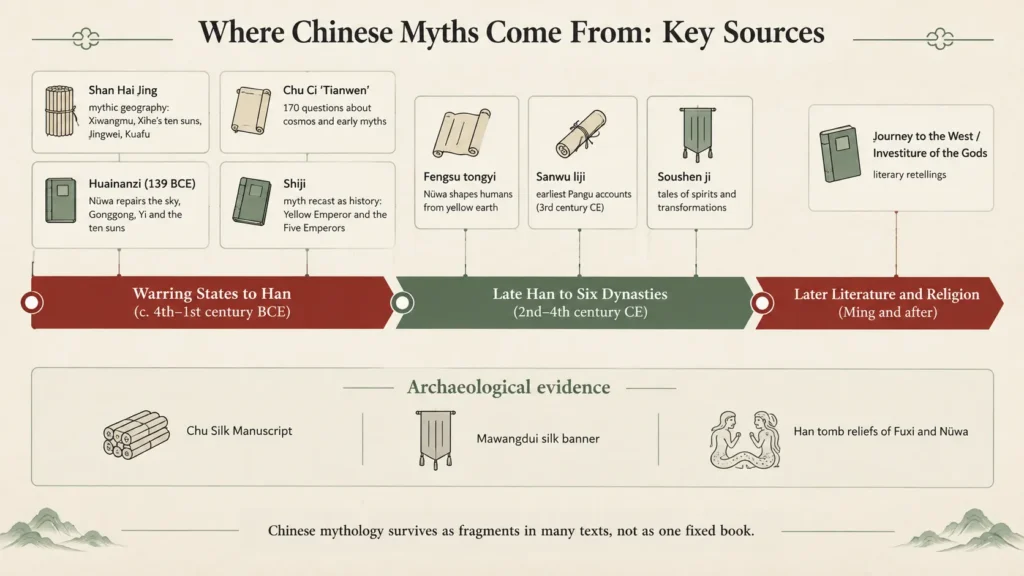
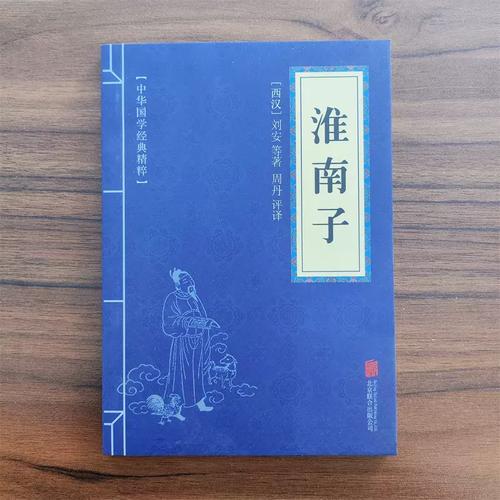
Chinese mythology has no single sacred book. Its sources are scattered passages in early texts that were written for other purposes, such as geography, philosophy, poetry, history, and ritual. The three most important early sources are the Shan Hai Jing (山海经, Shānhǎi jīng), a guide to strange mountains, peoples, gods, and creatures compiled in layers between roughly the fourth and first centuries BCE; the Huainanzi (淮南子, Huáinánzǐ), a philosophical compendium presented to the Han court in 139 BCE; and the Chu Ci (楚辞, Chǔcí), especially the poem “Tianwen.” Histories, early medieval anecdote collections, and tomb art fill many gaps. Some famous stories, including Pangu’s creation of the world, appear in writing much later than most readers expect.
Short answer: The best-known stories of Chinese myths and legends are reconstructed from fragments. The Shan Hai Jing preserves the widest range of gods and creatures, the Huainanzi preserves the fullest early versions of several major narratives, and the “Tianwen” shows which myths were already known by the Warring States period. Later texts often supply details that modern retellings treat as original.
Why Chinese Myths Survive in Fragments
Ancient Greece left epics and handbooks that organized myths into connected cycles. Early China did not produce an equivalent. No surviving early author set out to collect “the myths of China” as a body of stories. Instead, mythic material survives in passing references inside texts with other goals.
A philosopher might cite Nüwa to make a point about good government. A poet might ask a question about the flood without telling the story. A historian might turn ancient gods into human rulers and present them as early kings. As a result, most myths reach us as short episodes, often with conflicting details, spread across several centuries of writing.
This has two consequences for readers. First, the “complete” versions found in modern books are usually assembled from several sources. Second, the date of a text matters. A story first recorded in the third century CE may be old, but it cannot be assumed to be older than the Han dynasty without supporting evidence.
The Main Sources at a Glance
| Source | Approximate date | Type of text | Myths it is known for |
|---|---|---|---|
| Shan Hai Jing (山海经) | Layers compiled c. 4th–1st century BCE | Mythic geography and bestiary | Xiwangmu, Xihe and the ten suns, Jingwei, Kuafu, Gun’s swelling soil, the nine-tailed fox |
| Chu Ci (楚辞), esp. “Tianwen” (天问) | Warring States core; anthology edited in the Han | Poetry and ritual songs | Questions on creation, Nüwa, Gun and Yu, Yi and the suns |
| Huainanzi (淮南子) | Presented 139 BCE | Philosophy and statecraft | Nüwa repairs the sky, Gonggong and Mount Buzhou, Yi and the ten suns, the elixir and the moon |
| Shangshu (尚书), Guoyu (国语) | Zhou to Warring States, layered | Historical and ritual records | Cutting off communication between Heaven and Earth; Xi and He as officials |
| Shiji (史记) | Completed c. 90 BCE | History | Huangdi and the Five Emperors as early rulers |
| Mu Tianzi zhuan (穆天子传) | Recovered from a tomb in the late 3rd century CE | Travel narrative | King Mu’s meeting with Xiwangmu |
| Sanwu liji (三五历纪) | 3rd century CE, survives in quotations | Cosmological history | Pangu growing between Heaven and Earth |
| Fengsu tongyi (风俗通义) | Late 2nd century CE, survives in quotations | Customs and folklore | Nüwa shaping humans from yellow earth |
| Soushen ji (搜神记) | 4th century CE | Anecdotes of the strange | Spirits, transformations, local legends |
Shan Hai Jing: The Classic of Mountains and Seas
What kind of book it is
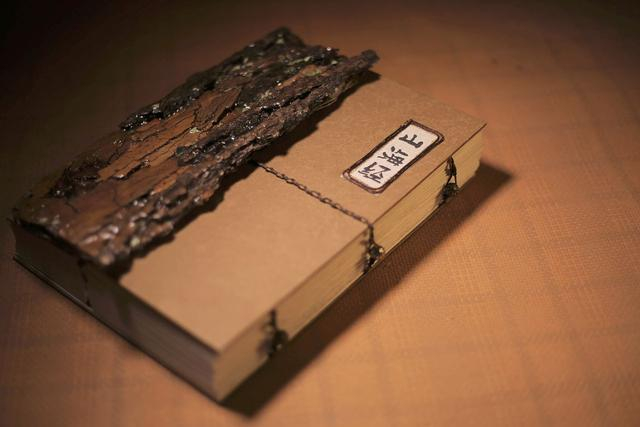
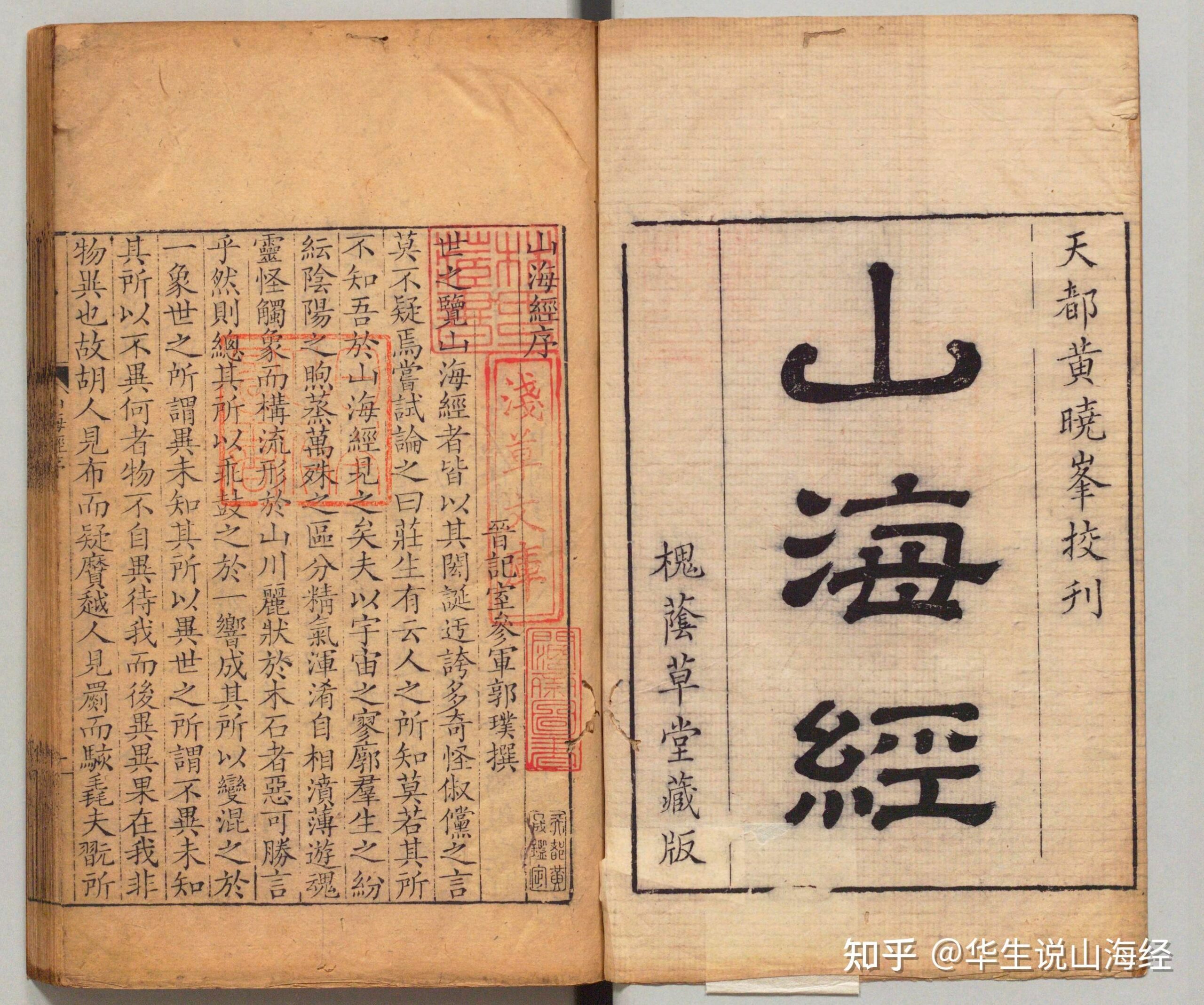
The Shan Hai Jing, usually translated as Classic of Mountains and Seas, reads like a survey of the world. The received text has 18 sections. The first part moves mountain by mountain through five regions, noting rivers, minerals, plants, animals, and the spirits that receive sacrifices there. Later sections describe lands “beyond the seas” and the “Great Wilderness,” which are full of unusual peoples and divine beings.
Tradition credited the work to Yu the Great and his helper Boyi. Modern scholars treat it as an anonymous compilation built up over several centuries, with the mountain sections generally regarded as the oldest. The Han scholar Liu Xin edited the text for the imperial library, and Guo Pu (郭璞, 276–324) wrote the commentary that shaped how later readers understood it. The book may once have accompanied pictures, but the earliest surviving illustrations come from late imperial woodblock editions.
Myths it preserves
The Shan Hai Jing does not tell long stories. Its value lies in brief, early descriptions of figures who later became famous:
- Xiwangmu appears as a fierce being with a leopard’s tail and tiger’s teeth, linked to calamity and punishment. This is very different from the gracious goddess of later Daoist and popular tradition. See how the Queen Mother of the West changed over time.
- Xihe is named as the wife of Di Jun and mother of ten suns, whom she bathes. A separate passage places the ten suns in the Fusang tree at the eastern edge of the world.
- Jingwei, a bird, is said to be the drowned daughter of the Flame Emperor. She carries twigs and stones to fill the Eastern Sea. Her human name is written 女娃 (Nǚwá), which is a different name from the creator goddess 女娲 (Nǚwā), although the two are easy to confuse in pinyin.
- Kuafu races the sun, dies of thirst after drinking the Yellow River and the Wei dry, and his staff becomes a forest.
- Gun steals the Lord’s “swelling soil” (息壤, xīrǎng) to stop a flood without permission, is executed, and Yu is born from his body. This passage is one of the key sources for the Gun and Yu flood myth.
- A nine-tailed fox lives on Qingqiu Mountain. The text treats it as a dangerous creature whose flesh protects against poison, an early stage of the nine-tailed fox tradition.
How to read it
The Shan Hai Jing is neither a reliable map nor pure fantasy. It mixes observed local knowledge, ritual instructions, omens, medicine, and hearsay about distant places. Many of its creatures are described by appearance and effect, such as “eating it cures deafness” or “when it appears, there will be drought.” For readers interested in Chinese mythical creatures, it is the single most important early catalog, but its entries should be read as brief records, not as fully developed legends.
Huainanzi: Myths Inside a Philosophy of Government
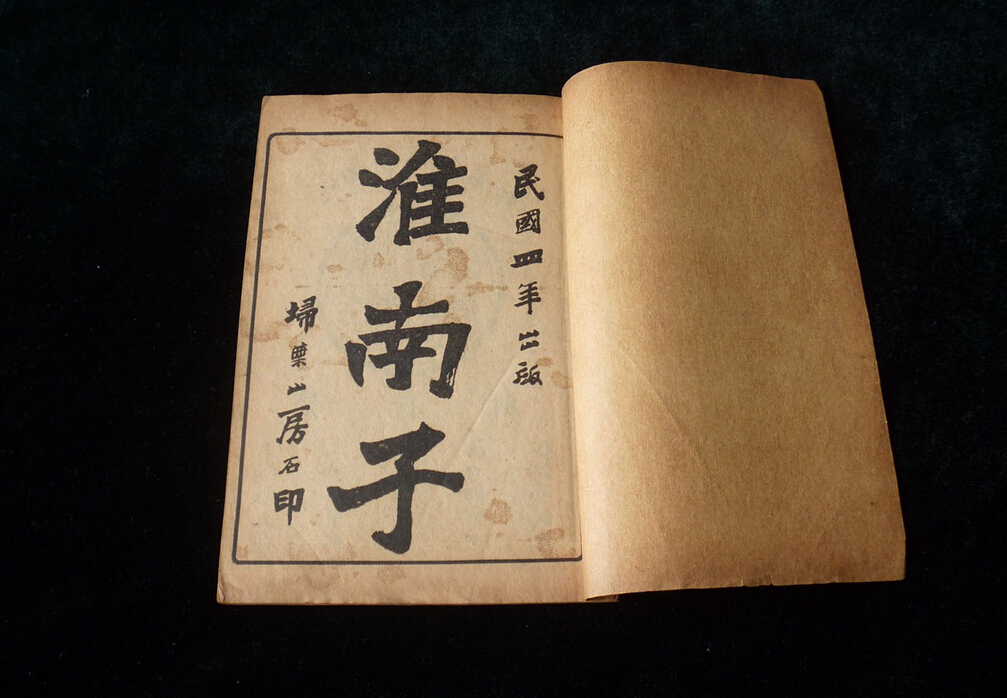
The Huainanzi was compiled at the court of Liu An (刘安), King of Huainan, and presented to Emperor Wu of Han in 139 BCE. Its 21 chapters cover cosmology, astronomy, geography, government, military affairs, and the conduct of a sage ruler. Myths appear because the authors used them as evidence in arguments about how the cosmos and the state work.
Several of the best-known Chinese myths have their fullest early versions here:
- Gonggong and Mount Buzhou (chapter 3, “Celestial Patterns”). Gonggong fights Zhuanxu for rulership and strikes Mount Buzhou, breaking a pillar of Heaven. The sky tilts toward the northwest and the earth sinks toward the southeast, which explains why the heavenly bodies move west and rivers flow east.
- Nüwa repairs the sky (chapter 6, “Surveying Obscurities”). When the four pillars collapse and the land splits, Nüwa melts five-colored stones to patch Heaven and sets up the legs of a giant turtle as new pillars. Read more about Nüwa’s roles in early myth.
- The elixir and the moon (also chapter 6). Yi obtains the drug of immortality from Xiwangmu, and Heng’e (姮娥) steals it and flees to the moon. Heng’e is the earlier written form of the name later known as Chang’e. The story of Chang’e and the moon grew from this short notice.
- Yi and the ten suns (chapter 8, “The Basic Warp”). In the time of Yao, ten suns rise together and scorch the crops, and monsters threaten the people. Yao sends the archer Yi to shoot at the suns and kill the beasts.
Two cautions apply. The Huainanzi does not connect Gonggong’s collision directly with Nüwa’s repair work. That link appears in later writers, such as the Tang historian Sima Zhen. In the same way, the familiar detail that Yi shot down nine suns and spared one belongs to commentary and later retellings, not to the core passage. The Huainanzi also frames these episodes politically. Nüwa’s repair of the world illustrates order restored in a sage age, and Yi’s victories precede Yao’s recognition as ruler.
Chu Ci and the “Heavenly Questions”
The Chu Ci, or Songs of Chu, is an anthology of poetry associated with the southern state of Chu and with the poet Qu Yuan (屈原). The anthology was edited in the Han, and Wang Yi’s second-century commentary became the standard guide to it.
Its most important poem for mythology is “Tianwen” (天问, Tiānwèn), the “Heavenly Questions.” It consists of roughly 170 questions about the shape of the cosmos, the sun and moon, the flood, early rulers, and dynastic history. It asks, for example, who shaped Nüwa’s body, how Gun failed and Yu succeeded, and why Yi shot at the suns. Because the poem only asks, its myths appear as allusions. Its importance is that it proves these stories were already circulating in the Warring States period, even when it gives no details.
Other Chu Ci pieces add color. “Lisao” sends the poet on a celestial journey in which Xihe drives the sun’s chariot and Kunlun appears as a sacred mountain. The “Nine Songs” (九歌) are ritual hymns addressed to deities of the sky, clouds, rivers, and mountains, and they preserve a southern religious atmosphere absent from northern classics.
Histories and Ritual Classics: Myth Turned into History
A distinctive feature of Chinese sources is the tendency to present mythic figures as historical rulers or officials. Scholars often call this historicization or euhemerization.
The Shangshu (尚书, Book of Documents) describes Xi and He as astronomer officials appointed by Yao to regulate the calendar. The Shan Hai Jing, by contrast, presents Xihe as the mother of the suns. The same text also mentions an order to “cut off communication between Heaven and Earth” (绝地天通). The Guoyu (国语) later explains this as a reform that separated human and divine affairs and assigned ritual contact with spirits to specialists.
Sima Qian’s Shiji (史记), completed around 90 BCE, opens with the Five Emperors and presents the Yellow Emperor as the first ruler in a historical sequence. Sima Qian also noted that many accounts of Huangdi in his time were unreliable, and he selected what he considered credible. His choices turned a cluster of divine and cultural traditions into a royal genealogy that shaped Chinese historical thinking for two thousand years.
The Mu Tianzi zhuan (穆天子传), recovered from a Warring States tomb in the late third century CE, describes King Mu of Zhou traveling west and exchanging poems with Xiwangmu. Here the fearsome figure of the Shan Hai Jing has become a dignified host.
Later Sources: Where Some “Ancient” Myths First Appear
Several stories that feel ancient are first recorded after the Han dynasty. They may draw on older oral traditions, but the written evidence is later.
- Pangu. The earliest surviving accounts are attributed to Xu Zheng (徐整), a third-century CE writer of the Wu state. His Sanwu liji describes Pangu growing in a chaotic, egg-like cosmos as Heaven and Earth separate. A related text describes his body becoming the features of the world. Both survive mainly as quotations in later encyclopedias. See the Pangu creation myth for the versions in detail.
- Nüwa making humans from clay. This episode is attributed to the Fengsu tongyi of Ying Shao (应劭) in the late second century CE. It survives through quotation in the Song-dynasty encyclopedia Taiping yulan (太平御览).
- Liezi. The received Liezi (列子) contains versions of Gonggong, Nüwa’s repair work, and Kuafu. Its date is disputed, and many scholars think the received text was compiled around the third or fourth century CE.
- Soushen ji. Gan Bao’s (干宝) fourth-century collection belongs to the genre of zhiguai (志怪), “records of the strange.” It preserves tales of spirits, transformations, and local cults that fed later folklore.
For an overview of how these layers fit together, see the guide to Chinese creation myths.
Archaeology: Silk, Tombs, and Stone
Material evidence sometimes confirms that mythic imagery existed earlier than the surviving texts, or shows versions that texts do not record.
- The Chu Silk Manuscript, found near Changsha in 1942 and dating to the Warring States period, contains a cosmological account that names Baoxi (雹戏), a figure widely identified with Fuxi.
- The Mawangdui silk banner from a Western Han tomb in Changsha (early second century BCE) depicts a sun with a black bird and a crescent moon with a toad and a hare, imagery linked to solar and lunar myths.
- Han tomb reliefs often show Fuxi and Nüwa as human figures with intertwined serpent tails, holding a compass and a carpenter’s square. This visual pairing is much more prominent in art than in early narrative texts.
Shang-dynasty oracle bones are the earliest Chinese writing, but they record divinations and sacrifices to ancestors and powers rather than myths in narrative form.
Literature, Religion, and Modern Anthologies
From the medieval period onward, Daoist scriptures, Buddhist texts, temple traditions, drama, and vernacular fiction created new layers of sacred story. Many popular images of Chinese gods come from these later layers rather than from the classical fragments.
Ming novels are the clearest example. Journey to the West (西游记) gave the world the Sun Wukong most readers know, and Investiture of the Gods (封神演义) organized a huge cast of deities through a fictional war. These works borrowed from earlier religion and folklore, but their plots and hierarchies are literary creations. Buddhism also reshaped ideas of the afterlife and divine compassion, as explained in the article on Buddhist influence on Chinese mythology.
In the twentieth century, scholars began collecting mythic fragments into systematic anthologies. Yuan Ke (袁珂) was especially influential in Chinese, and Anne Birrell’s work brought many source passages into English. These collections are valuable, but readers should remember that a smooth modern retelling may combine sources written many centuries apart.
How to Read Chinese Mythology Sources Carefully
- Ask when the source was written. A Han text and a Song encyclopedia quoting a lost third-century book carry different weight.
- Ask why the myth is there. A philosopher, a poet, and a historian use the same figure for different purposes.
- Expect variants. Nüwa, Xiwangmu, and Yi have changing identities, relationships, and roles across texts.
- Separate early sources from literary retellings. A detail from a Ming novel is not evidence for Warring States belief.
- Check the Chinese characters. Similar pinyin can hide different names, as with 女娃 and 女娲.
Frequently Asked Questions
What is the oldest source of Chinese mythology?
No single text holds that title. The earliest written references to connected mythic stories come from Warring States sources such as the “Tianwen” and the older layers of the Shan Hai Jing. Shang oracle bones are older, but they record rituals and divinations, not narratives.
Is the Shan Hai Jing a real geography book?
Partly. It is organized like a geography and includes real mountains, rivers, minerals, and plants, but it also describes divine beings, strange peoples, and creatures with magical effects. It is best read as a blend of local knowledge, ritual information, and mythic imagination.
Where does the Pangu myth first appear?
The earliest surviving accounts are attributed to the third-century CE writer Xu Zheng and are preserved mainly as quotations in later encyclopedias. Pangu is therefore attested later than figures such as Nüwa, Xihe, or Xiwangmu.
Is there a Chinese equivalent of Greek mythology handbooks?
Not from the early period. No surviving early author compiled Chinese myths into a single organized collection. Modern anthologies serve that function, but they assemble material from texts written across many centuries.
Which English translations are good starting points?
Anne Birrell’s translation of The Classic of Mountains and Seas, Richard Strassberg’s A Chinese Bestiary, the Columbia translation of the Huainanzi by John Major and colleagues, and David Hawkes’s The Songs of the South cover the core early texts. Birrell’s Chinese Mythology: An Introduction gathers passages from many sources.
References and Further Reading
- Anne Birrell, trans., The Classic of Mountains and Seas. Penguin Classics. Penguin Random House
- Richard E. Strassberg, ed. and trans., A Chinese Bestiary: Strange Creatures from the Guideways Through Mountains and Seas. University of California Press. University of California Press
- John S. Major, Sarah A. Queen, Andrew Seth Meyer, and Harold D. Roth, trans., The Huainanzi: A Guide to the Theory and Practice of Government in Early Han China. Columbia University Press, 2010. Princeton Alumni Weekly listing
- Anne M. Birrell, Chinese Mythology: An Introduction. Johns Hopkins University Press, 1993. Johns Hopkins University Press
- Huainanzi, Chinese text. Chinese Text Project
- “Tianwen,” Chu Ci, Chinese text. Chinese Text Project