The Chinese mythology creation story is not a single, unified account. It is a family of interconnected myths — shaped over centuries through oral tradition, classical texts, folk religion, and regional storytelling — that together describe how the cosmos came to be ordered, how human beings arrived in the world, and how that world was saved when order collapsed.
For many English-speaking readers, the question begins simply: Who created the world in Chinese mythology? The most famous answer is Pangu (盘古, Pángǔ), the primordial giant who broke open a cosmic egg and separated heaven from earth. But the fuller answer also includes Nüwa (女娲, Nǚwā), the creator goddess who shaped humanity from yellow earth and later mended the fractured sky. And behind both figures stands a broader mythological imagination rooted in transformation, balance, and cosmic responsibility.
This guide walks through the key stories, their cultural meaning, and why they still resonate today — in plain, accessible terms for anyone new to Chinese mythology.
What Is the Chinese Mythology Creation Story?
The phrase “Chinese mythology creation story” typically refers to a cluster of myths describing the beginning of the cosmos, the separation of heaven and earth, and the origin of human beings. Unlike some other world traditions that center on a single authoritative creation account, Chinese mythology preserves multiple overlapping stories, each developed in different periods, regions, and contexts.
Three recurring themes help make sense of them:
The world begins in chaos. Before sky, earth, mountains, rivers, and people, there is an undivided, formless condition — often imagined as a vast dark mass, or as a cosmic egg.
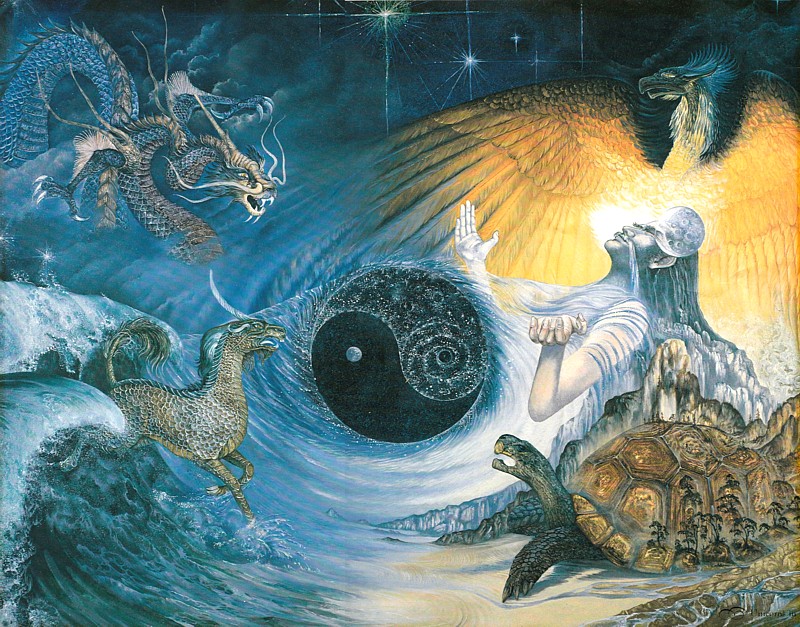
Order emerges through separation. Heaven rises and earth settles. This separation is often described through the language of yin and yang — the complementary forces that Chinese thought uses to explain balance, change, and relationship throughout the cosmos.
Humanity is created and protected within that order. Nüwa shapes people from earth and gives them life. Later, she repairs the sky when the world is threatened with collapse.
Because these myths developed across many dynasties, textual traditions, and folk cultures, there is no single “official” version. The creation story is better understood as a set of related answers to overlapping questions — how the universe became structured, where people came from, and how cosmic balance is preserved.
Historical and Cultural Background
Chinese creation myths grew from a long tradition of oral storytelling, ritual culture, cosmological speculation, and literary writing. Some stories were preserved in classical texts; others traveled through folk religion, drama, paintings, and popular storytelling. They were not fixed in one moment or by one author.
One thing that distinguishes many Chinese creation myths from certain Western counterparts is the emphasis on transformation rather than creation from nothing. In much of Chinese mythological thinking, the universe doesn’t simply appear at a divine command. It unfolds — chaos gradually becomes ordered, one state gives way to another, and the cosmos takes shape through a process of separation, growth, and change.
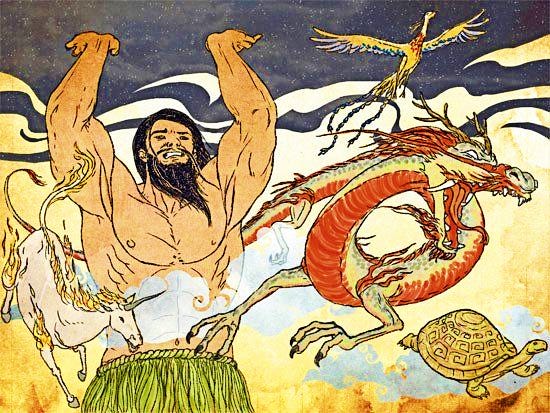
This matters because Chinese mythology is deeply concerned with relationships:
- Heaven and earth, and the space between them
- Yin and yang as complementary, not opposing, forces
- Humans and the natural world they belong to
- Order and chaos, each capable of becoming the other
- Disaster and the responsibility to restore what has been broken
Creation, in this framework, is not just about the first moment of existence. It is also about how the world becomes livable — and how it stays that way.
Key Terms and Figures
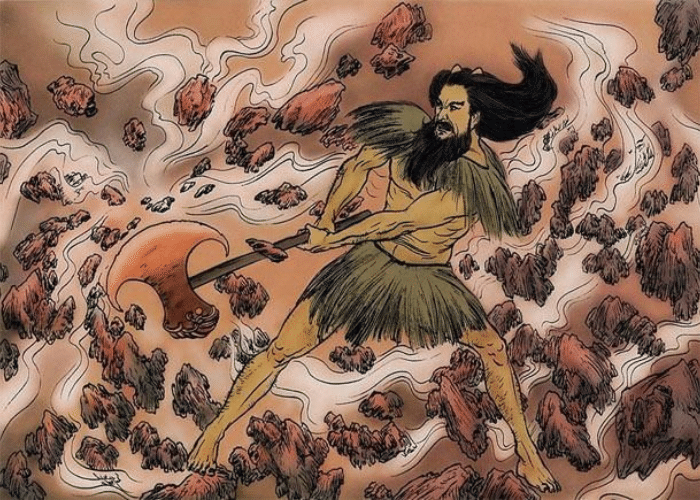
Pangu (盘古, Pángǔ) — the primordial giant associated with the cosmic egg, the separation of heaven from earth, and the transformation of his body into the natural world.
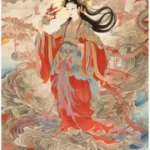
Nüwa (女娲, Nǚwā) — a creator figure, often described with a human head and serpent-like body, who shapes humanity from yellow earth and later repairs the sky.
Fuxi (伏羲, Fúxī) — frequently paired with Nüwa, and associated in many stories with early civilization, marriage customs, divination, and cultural order.
Yin and Yang (阴阳, yīn yáng) — complementary forces or qualities used to explain balance, change, and relationship. In creation stories, the separation of clear and heavy, light and dark, rising and settling elements reflects this framework.
Heaven and Earth (天地, tiāndì) — in Chinese thought, “heaven and earth” means the ordered, structured cosmos. Creation stories often describe how this order emerges from an earlier chaotic state.
The Story of Pangu: Cosmic Egg, Cosmic Body
The best-known version of the Chinese mythology creation story begins before form exists.
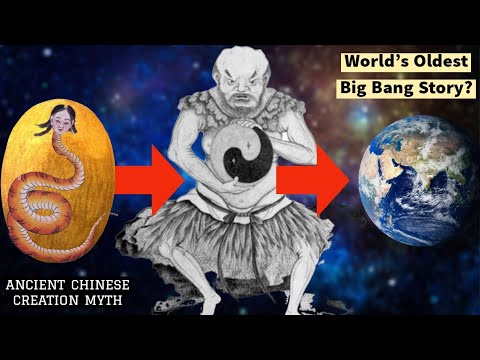
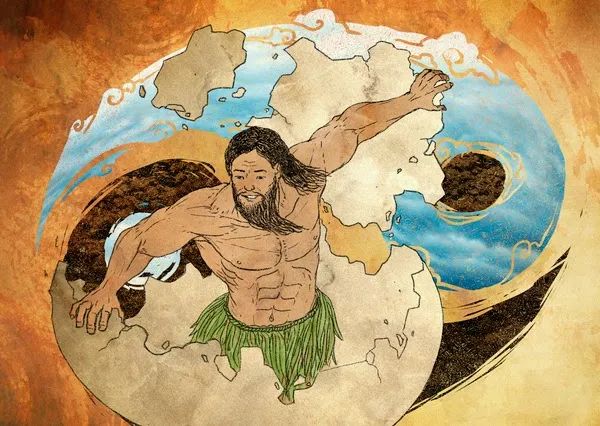
In the beginning, heaven and earth are not yet separate. Everything exists inside a vast, dark, undivided mass — described in many versions as a cosmic egg. Inside it, Pangu grows and sleeps for an immense span of time.
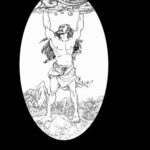
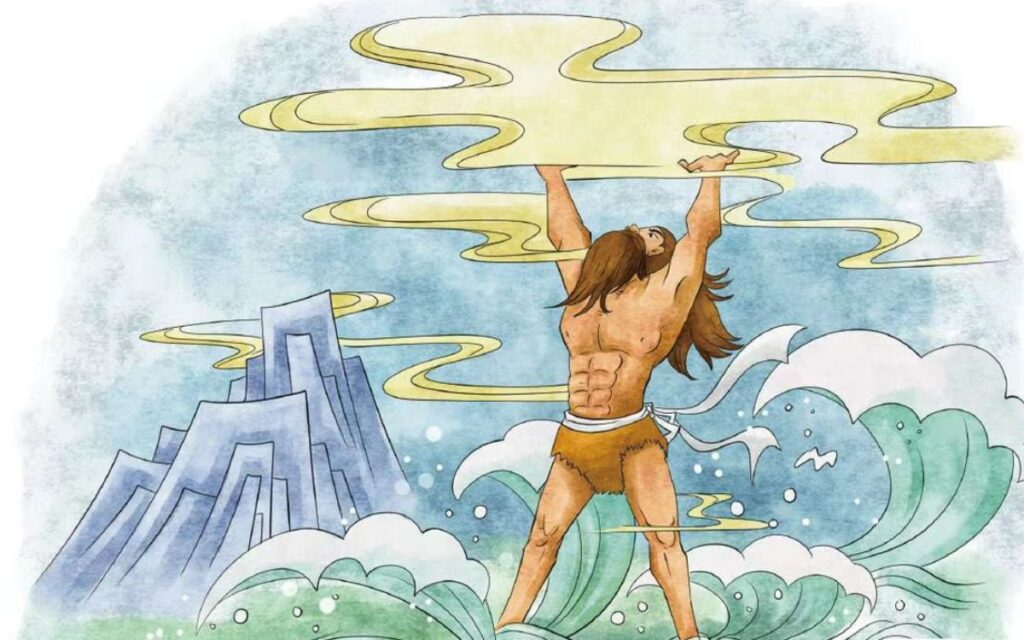
When Pangu finally awakens, he breaks the egg open. The lighter, clearer elements rise and become heaven. The heavier, denser elements sink and become earth. Pangu stands between them, holding sky and ground apart with his own body so they cannot collapse back into chaos.
In many versions, Pangu continues to grow each day. As he grows, heaven rises higher and earth becomes thicker, the two realms stabilizing over thousands of years.
Eventually, Pangu dies. But in one of Chinese mythology’s most striking images, his death is not an ending:
- His breath becomes wind and clouds
- His voice becomes thunder
- His eyes become the sun and moon
- His blood becomes rivers
- His body becomes mountains and land
- His hair becomes plants, trees, and stars
- His bones and teeth become minerals, stones, and precious substances
- His sweat becomes rain
Pangu does not build the universe from the outside. He becomes it. The mountains, rivers, sky, and weather are all extensions of his transformed body.
What the Pangu Story Means
The Pangu myth carries several ideas worth noticing.
Chaos must become order. The universe begins in an undivided state where nothing has its proper place. Pangu’s role is separation and structure — heaven must rise, earth must settle, and only then can life be possible.
Creation is transformation, not manufacture. The cosmos is not assembled from raw materials. It grows, separates, and changes from one form into another. This reflects a broader Chinese tendency to think of the world as dynamic and relational rather than static.
The body mirrors the cosmos. Pangu’s transformation into mountains, rivers, wind, and rain resonates with later Chinese ideas connecting the human body with the natural world — both understood as living systems with their own inner patterns and balances.
The Story of Nüwa: Shaping Humanity
If Pangu explains the structure of the cosmos, Nüwa explains where human beings come from.
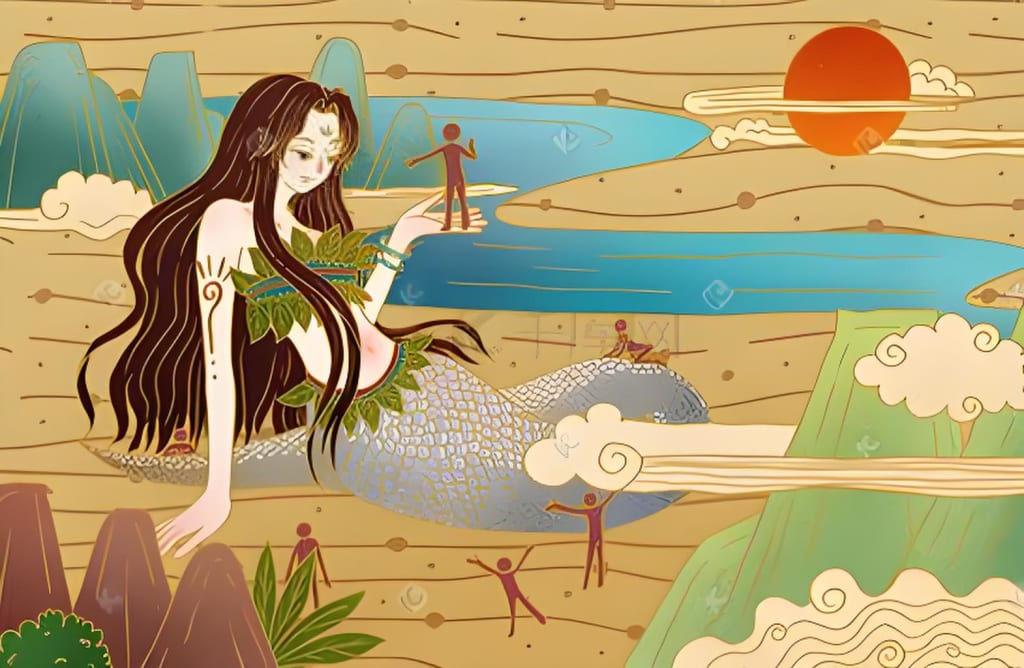
In one of the most popular versions, Nüwa finds herself in the newly formed world. The mountains, rivers, plants, and animals exist, but the world still feels incomplete. She kneels beside a river and begins shaping figures from yellow earth — giving them form, and then life. These become the first human beings.
Some versions say Nüwa carefully molds the first people by hand, one by one. Later, faced with the enormity of the task, she dips a cord into mud and flicks drops of clay across the land. These drops also come alive as humans.
This detail has sometimes been interpreted as a mythic explanation for social difference — hand-shaped figures representing nobles, cord-flicked ones representing commoners. Modern readers should approach that reading with caution; like many ancient myths, it reflects the social imagination of its time rather than any moral framework we need to carry forward.
The central image is clear: human beings are made from the earth. They are shaped by an ancestral or divine figure, but they remain inseparably tied to soil and land.
Nüwa as Protector
Nüwa’s role extends well beyond the act of creation. She is also the protector of humanity and the preserver of cosmic order.
Her most common visual form — human head, serpent-like body — may look strange to modern eyes, but in Chinese mythological imagery it marks her as a being of ancient and deep power. Serpentine forms in this tradition often suggest fertility, earth connection, transformation, and primal life force. They carry no suggestion of the evil associations such imagery sometimes has in other cultural contexts.
In many artistic depictions, Nüwa appears alongside Fuxi. He may hold a carpenter’s square; she may hold a compass. Together, these tools symbolize measurement and structure — not just the biological origin of humanity, but the beginning of culture itself: marriage customs, social norms, tools, and ordered life.
Nüwa Repairs the Sky: Creation as Restoration
One of Nüwa’s most important stories is not about original creation, but about saving the world after catastrophe.
In this myth, the pillars that support heaven are damaged. The sky cracks. The earth breaks apart. Floods rise, fires spread, and wild beasts prey on the human world. Everything that makes life possible is under threat.
Nüwa responds. She melts five-colored stones and uses them to patch the broken sky. She cuts the legs from a great tortoise and uses them to support the four corners of heaven. She works to drive back the chaos and restore balance.
This myth — often called Nüwa Mends the Sky or Nüwa Repairs Heaven — is as important as the creation story itself. It shows that cosmic order is not permanent. It can be broken. And when it is, repair requires wisdom, effort, and moral responsibility.
In this sense, Nüwa is not only a creator. She is a restorer. The act of maintaining the world matters as much as the act of making it.
How Pangu and Nüwa Fit Together
Pangu and Nüwa are often presented together in modern summaries of the Chinese mythology creation story, but they do not always appear in the same ancient texts or traditions. Their stories developed through different layers of myth, literature, and folklore and were not necessarily meant to be read as a unified sequence.
That said, for a beginner’s understanding, they complement each other in a clear way:
- Pangu separates heaven and earth, stabilizes the cosmos, and becomes the natural world through his death.
- Nüwa creates human beings from earth and gives them life.
- Nüwa later repairs the sky and restores the cosmos when disaster breaks it apart.
Three questions, three answers: How did the universe become ordered? Where did humans come from? How was the world saved when order failed?
This is why the Chinese creation story is better understood as a set of connected mythic explanations than as one continuous narrative.
The Role of Fuxi
Fuxi is not usually described as a creator of the physical cosmos, but he is an important figure in the broader creation tradition. He represents the beginning of civilization — not the making of the world, but the making of human culture within it.
In different stories and periods, Fuxi is associated with the Eight Trigrams used in divination, the invention of writing, fishing and hunting practices, music, and the establishment of marriage customs. These associations vary by source, but they all point toward the same idea: Fuxi helps transform early humanity into an organized society.
If Pangu explains the world and Nüwa explains human life, Fuxi explains why humans began to build culture — the tools, rituals, and social patterns that made civilization possible.
Symbolism in the Chinese Creation Story
The cosmic egg represents the undivided beginning — all things existing in potential, nothing yet separated or structured. Pangu’s awakening and the breaking of the egg is the first act of cosmic order.
Heaven and earth as separate realms is one of the central images in Chinese cosmology. Heaven is associated with height, clarity, and active movement; earth with depth, density, and receptive support. Their separation creates the space where life can unfold.
Yellow earth or clay connects Nüwa’s creation of humanity to soil, land, and the physical world. Yellow carries deep cultural resonance in Chinese tradition — associated with the Yellow River region, centrality, and earth in the system of Five Phases.
Five-colored stones used by Nüwa to repair the sky are understood symbolically in many readings. They may evoke the Five Phases — wood, fire, earth, metal, and water — suggesting that restoring the cosmos requires the full complement of natural forces.
The tortoise is an ancient symbol of endurance and stability. Nüwa’s use of tortoise legs as pillars of heaven suggests that cosmic structure, once broken, must be rebuilt on a foundation of something ancient and sure.
Serpent bodies on Nüwa and Fuxi do not indicate danger or deception in Chinese mythology. They mark these figures as belonging to an older, deeper stratum of the mythic world — connected to earth, water, fertility, and transformation.
Cultural Meaning
The Chinese mythology creation story reflects values that run throughout Chinese cultural and philosophical tradition.
Harmony is not guaranteed; it must be maintained. Many creation myths focus on the initial moment of making. The Nüwa stories emphasize equally the ongoing work of preservation. The world can fall apart, and restoring it requires active, wise response.
Humans belong to nature, not above it. People are made from earth; the world is made from Pangu’s body. Neither humanity nor the cosmos is treated as essentially separate from the other. They share substance and pattern.
Order has moral weight. Nüwa repairs the sky not because she must, but because the human world is threatened. Her action models a kind of cosmic moral responsibility — the obligation to protect life and restore what has been broken.
Creation and civilization are linked. Nüwa creates biological life; Fuxi helps build cultural life. Together, they suggest that a fully human existence requires both origins — physical and social, natural and ordered.
Common Misunderstandings
“Chinese mythology has one creation story.” There is no single canonical account. The myths of Pangu, Nüwa, Fuxi, and other cosmological figures developed across different traditions and time periods. Modern summaries often combine them for clarity, but the original sources are considerably more varied.
“Pangu is the only creator.” Pangu explains the formation of the cosmos, but Nüwa is the primary creator of humanity, and Fuxi plays a significant role in civilization myths. Chinese mythology has multiple creation-related figures, each with a distinct domain.
“Nüwa created the entire universe.” Nüwa is most closely associated with creating human beings and repairing the sky. She is not generally described as the creator of the cosmos in the way Pangu is in the creation tradition.
“Nüwa’s serpent body is monstrous.” This misreads the symbolism. In Chinese mythological tradition, serpentine forms carry associations of ancient power, fertility, and earth connection — not the evil or threatening qualities such imagery sometimes holds in other cultural contexts.
“The Pangu story is the oldest Chinese creation account.” Pangu is the most famous, but the written versions we have today are relatively late compared to some early Chinese cosmological ideas. The tradition developed over time, and Pangu’s prominence in modern retellings does not necessarily reflect the oldest layers of the tradition.
“These myths represent Taoist or Buddhist doctrine.” Chinese mythology overlaps with Taoism, Buddhism, folk religion, and other traditions, but the creation myths should not be read as straightforward statements of any one religious system. They are cultural stories with many layers of interpretation.
Is the Chinese Creation Story Taoist?
This is a common question, and the honest answer is: it depends on which version, from which period, and how we define “Taoist.”
Pangu is connected with Daoist-inflected creation thinking in some later traditions, and the language of yin and yang fits naturally with broader Chinese cosmological ideas. But the stories of Pangu and Nüwa also belong to folklore, classical literature, popular religion, and regional oral tradition that doesn’t map neatly onto any single category.
It is most accurate to say these stories exist within the wide world of Chinese mythology and have been interpreted through different lenses over time — Taoist, Buddhist, Confucian, and broadly folkloric. No single tradition owns them.
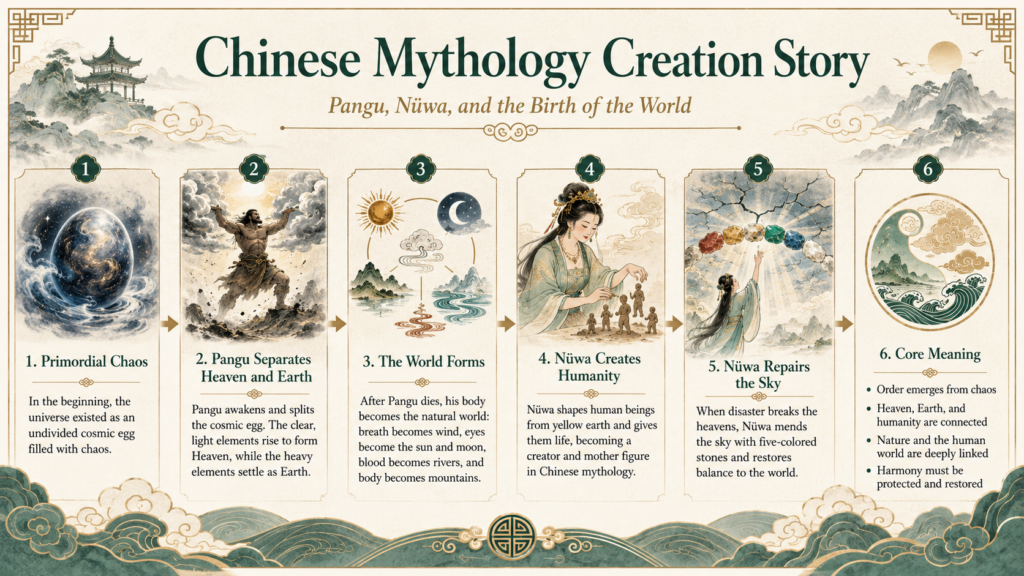
A Simple Sequence to Remember
This is a teaching framework, not a single ancient scripture, but it helps beginners follow the key events:
- Chaos exists before the ordered world — heaven and earth are not yet separate
- Pangu awakens inside the cosmic egg and breaks it open
- Clear elements rise as heaven; heavy elements settle as earth; Pangu holds them apart
- Pangu dies and becomes the world — his body transforms into mountains, rivers, sky, and weather
- Nüwa shapes human beings from yellow earth and gives them life
- The sky breaks and disaster threatens the human world
- Nüwa repairs heaven with five-colored stones, restores balance, and protects human life
Why This Creation Story Still Matters
The Chinese mythology creation story endures not because it is dramatic — though it is — but because it expresses something durable about how ancient Chinese civilization imagined its place in the universe.
Pangu’s transformation into the natural world suggests that the mountains, rivers, and sky are not merely a backdrop to human life. They are, in some sense, made of the same substance. Nüwa’s mending of the sky suggests that the world’s order is not automatic — it requires care, wisdom, and responsible action.
These ideas continue to circulate through Chinese art, children’s literature, animation, temple culture, and popular storytelling. They are not merely relics. They are part of a living tradition through which Chinese culture has long asked: What kind of world do we live in, and what do we owe it?
For English-speaking readers, these stories open a door into a mythological tradition that is rich, layered, and worth taking seriously — one that goes far beyond dragons and emperors, into the deepest questions of existence, order, and belonging.
FAQ
Who created the world in Chinese mythology? The most famous cosmic creator is Pangu, who separates heaven from earth and whose body becomes the natural world. But Chinese mythology does not center on one fixed creation account — multiple figures and stories address different aspects of cosmic and human origins.
Who created humans in Chinese mythology? Nüwa is the most famous creator of human beings. In many versions, she shapes people from yellow earth or clay and gives them life.
What is the cosmic egg in Chinese mythology? The cosmic egg represents the chaotic, undivided state before heaven and earth separate. Pangu grows inside it and, upon awakening, breaks it open to bring order to the cosmos.
Did Pangu create humans? In some versions, tiny creatures associated with Pangu’s transformed body eventually become human beings. But the more widely known human-creation story belongs to Nüwa.
What does Nüwa repairing the sky mean? It represents the restoration of cosmic order after catastrophe. Nüwa is not only a creator but a protector — her action models the idea that maintaining balance is as important as the original act of creation.
Are Pangu and Nüwa worshipped as gods? They appear in mythology, folk tradition, and sometimes in religious contexts, but their specific roles vary by region, period, and tradition. Pangu is generally treated as a primordial creation figure; Nüwa is often revered as a mother goddess or ancestral creator in popular and folk religion.
Is the Chinese creation story part of Taoism? Some interpretations connect the myths — especially Pangu’s — with Taoist cosmological thinking. But these stories also belong to broader Chinese folklore, literature, and popular religion. They have been read through many different lenses over the centuries.
Why is Nüwa shown with a snake body? In Chinese mythological symbolism, serpentine forms carry associations of ancient power, fertility, earth connection, and primal life. Nüwa’s form marks her as a being of deep mythic authority — not a monstrous figure.
What do the five-colored stones symbolize? They are often linked with the Five Phases — wood, fire, earth, metal, and water — suggesting that repairing the sky requires the full balance of natural forces. They represent completeness and cosmic restoration.
Is this story suitable for children? Yes — many simplified versions are shared with children, especially the stories of Pangu separating heaven and earth, and Nüwa mending the sky. For adult readers, the myths also carry deeper philosophical and cultural meaning.
Conclusion
The Chinese mythology creation story is, at its core, a set of answers to questions that matter across cultures: How did the cosmos become ordered? Where do human beings come from? What happens when the world falls apart?
Pangu separates heaven from earth and gives his body to the world — becoming the mountains, rivers, wind, and rain. Nüwa shapes people from yellow earth, gives them life, and later repairs the broken sky. Together, these figures present a worldview in which creation is not a single moment but a continuing process of transformation, care, and balance.
For anyone beginning to explore Chinese mythology, Pangu and Nüwa are the best starting point. They are not simply origin stories. They are images of how ancient Chinese imagination understood the relationship between the cosmos and the human beings who live inside it — fragile, connected, and worth protecting.