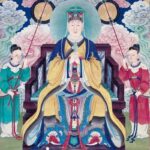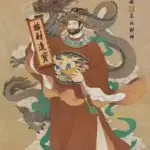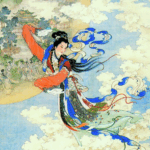
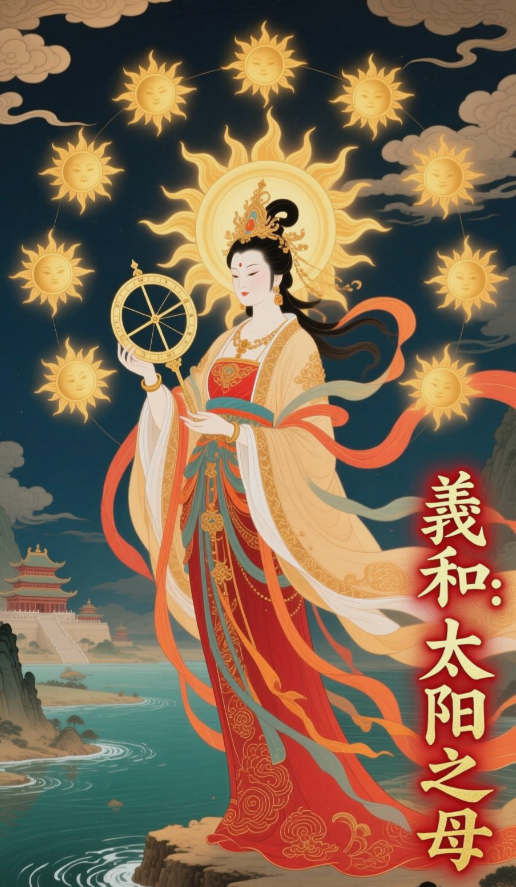
In Chinese mythology, Xihe 羲和 is one of the most fascinating solar figures: a mother of suns, a divine charioteer, and later a symbol of time, calendar-making, and cosmic order.
She is best known as the mother of the ten suns, the wife of the ancient deity Di Jun 帝俊, and the goddess who is closely connected with the daily movement of the sun across the sky. In some traditions, her story also overlaps with the famous myth of Hou Yi 后羿, the archer who shot down nine suns when their unbearable heat nearly destroyed the world.
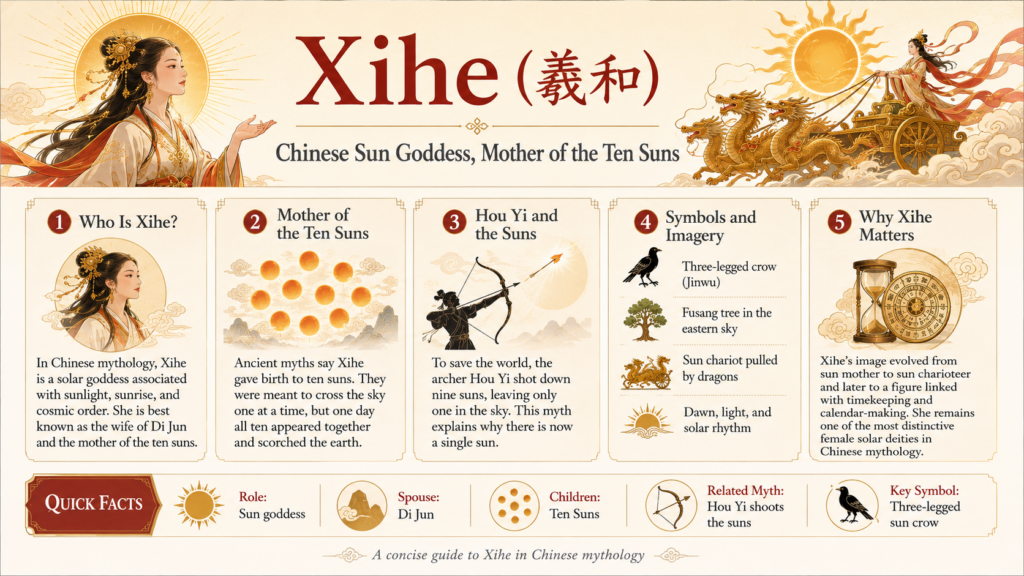
What makes Xihe especially interesting is that she is not a simple “sun goddess” in only one sense. Across ancient texts and later interpretations, she appears as a sun mother, a sun driver, a calendar deity, and even, in some scholarly readings, a figure connected with both the sun and the moon.
Who Is Xihe 羲和 in Chinese Mythology?
Xihe 羲和 is an ancient Chinese solar goddess associated with sunlight, sunrise, and the movement of the sun. In early mythology, she is described as the wife of Di Jun, an ancient celestial emperor, and the mother of ten suns.
Her name is often interpreted in relation to light and harmony. The character 羲 xī is sometimes connected with 曦, meaning sunlight or the glow of the sun. The character 和 hé can mean harmony, but some interpretations also connect it with movement or rotation. In this reading, Xihe’s name may suggest something like “rotating sunlight” or “circling solar radiance.”
This meaning fits her mythological role very well. Xihe is not only linked to the sun as an object in the sky; she is connected with the sun’s rhythm, its journey, and its return each day.
Xihe 羲和 as the Mother of the Ten Suns
One of the oldest and most important images of Xihe comes from the myth of the ten suns.
According to ancient Chinese mythology, Xihe gave birth to ten suns. These suns were often imagined as living in the far east, near the Fusang 扶桑 tree, a mythical tree associated with sunrise. Each sun would take its turn crossing the sky, so that only one sun appeared each day.
This arrangement kept the world in balance. One sun brought warmth, light, and life. But ten suns together would be catastrophic.
That is exactly what happens in the famous myth.
One day, the ten suns appear in the sky at the same time. Their combined heat burns the earth, dries rivers, scorches crops, and makes life almost impossible. To save the world, the heroic archer Hou Yi shoots down nine of the suns, leaving only one to continue its daily journey.
This myth explains why there is only one sun in the sky today. It also shows how ancient Chinese mythology often treated cosmic order as something fragile. Too much light, like too much darkness, could destroy the world.
Xihe 羲和 and the Three-Legged Sun Crow
The ten suns are also closely connected with the image of the three-legged crow, known as Jinwu 金乌.
In Chinese solar mythology, the sun is sometimes imagined as a golden crow with three legs. These birds are not just ordinary creatures; they are symbols of solar power. Each crow represents a sun, and together they form one of the most memorable images in Chinese myth: ten fiery sun-birds rising from the east.
In some versions, Xihe is the mother of these solar crows. In others, the suns themselves are divine beings or celestial bodies. Either way, the three-legged crow became one of the most enduring symbols of the sun in Chinese culture.
This image is powerful because it makes the sun feel alive. The sun is not merely a glowing object. It flies, moves, rises, rests, and returns.
Xihe 羲和 as the Sun Charioteer
Xihe’s role later developed from sun mother into sun charioteer.
In this version of the myth, she drives the sun across the sky in a divine carriage. Some texts describe the sun as riding in a chariot pulled by dragons. Xihe guides this solar vehicle from east to west, controlling the pace of the day.
This image appears in classical literature, including references in the Chu Ci 楚辞 tradition. The poet speaks of commanding Xihe to slow down, as if she controls the sun’s movement toward the western mountain where the day ends.
This makes Xihe more than a mother figure. She becomes the goddess of solar motion itself.
She drives the day forward.
She measures time through movement.
She keeps the heavens from falling into disorder.
For ancient people watching sunrise and sunset, this image would have been deeply meaningful. The sun’s journey was not automatic or mechanical. It was guided by divine rhythm.
Xihe 羲和 and the Fusang Tree
The Fusang tree is another important part of Xihe’s solar mythology.
In ancient Chinese cosmology, the sun was believed to rise from the far eastern world. The Fusang tree stood in this eastern region, often imagined near a sacred valley or water source where the suns rested or bathed before beginning their journey.
Some traditions say Xihe bathed the suns in a place called Gan Yuan 甘渊 or Tanggu 汤谷 / 旸谷, a mythical valley associated with sunrise.
The image is beautiful: before the sun rises, it is washed, renewed, and prepared for its daily path across the sky. Xihe, as the mother of the suns, is part of this sacred morning ritual.
This gives her myth a gentle, almost domestic quality. She is cosmic, but also maternal. She does not only command the sun; she cares for it.
Xihe 羲和 as a Goddess of Time and Calendar
One of the most important later developments in Xihe’s image is her connection with timekeeping.
Because Xihe was associated with the sun’s daily movement, she naturally became linked with the measurement of time. In ancient agricultural society, the sun was essential for understanding seasons, planting, harvesting, ritual timing, and daily life.
Texts connected with early Chinese tradition describe figures named Xihe as being responsible for observing the heavens, studying the sun, moon, stars, and seasons, and helping establish a proper calendar.
In this sense, Xihe is not only a mythic goddess. She also represents one of the most practical forms of ancient knowledge: knowing when to plant, when to harvest, when to perform rituals, and how to live in harmony with celestial cycles.
This is one reason her image feels so layered. She belongs to mythology, but she also touches astronomy, agriculture, ritual, and governance.
Is Xihe 羲和 the Same as Changxi 常羲?
Xihe is often discussed together with Changxi 常羲, another ancient goddess associated with celestial birth.
In some traditions, Changxi is the wife of Di Jun and the mother of the twelve moons, while Xihe is the mother of the ten suns. This creates a neat cosmic pairing:
Xihe gives birth to the suns.
Changxi gives birth to the moons.
However, some scholars have suggested that Xihe and Changxi may have originally been related forms of the same figure, or that their names reflect connected traditions. In this interpretation, Xihe may have once been a broader deity of both sun and moon, later divided into separate solar and lunar roles.
This idea is not the only interpretation, but it is useful because it shows how ancient myths change over time. A goddess may begin as one figure, then split into several roles as stories develop across regions, texts, and ritual traditions.
Xihe 羲和, Di Jun, and the Solar Family
Xihe’s husband, Di Jun 帝俊, is an important but mysterious figure in ancient Chinese mythology. He appears as a high celestial deity and is associated with several divine family lines.
In the solar myth, Di Jun and Xihe are the parents of the ten suns. In lunar mythology, Di Jun is also connected with Changxi, the mother of the twelve moons.
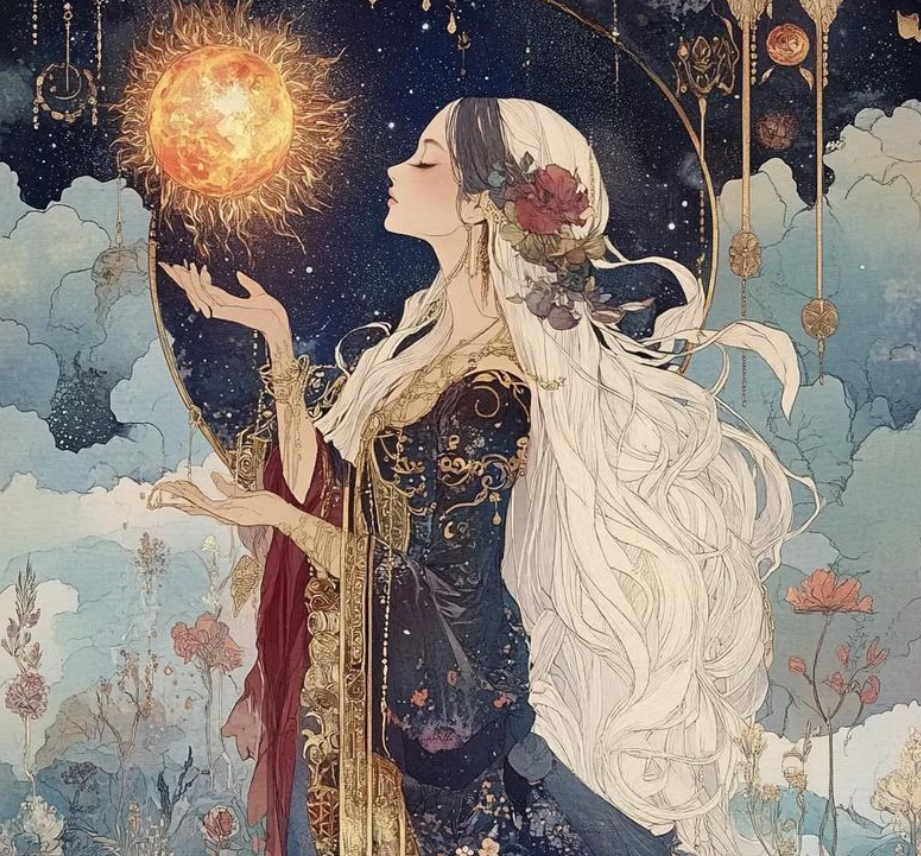
This makes Di Jun’s divine household a kind of cosmic family: suns, moons, light, time, and celestial cycles all belong to the same mythological world.
The family structure is important. Ancient myths often explained the universe through kinship. The sun was not just a physical body; it had a mother. The moons had a mother. The heavens had rulers, drivers, and caretakers.
Through this lens, Xihe becomes one of the great maternal powers of the cosmos.
Xihe 羲和 and Ancient Chinese Sun Worship
Xihe’s mythology is closely connected with ancient Chinese sun worship.
In some regional traditions, especially those linked with Rizhao 日照 in Shandong, Xihe is remembered as a solar deity associated with sunrise, solar rituals, and local legends of the sun. The name Rizhao itself means something like “sunshine” or “sun illumination,” and the region has long been connected in cultural memory with eastern sunrise imagery.
Local traditions mention places such as Tanggu 汤谷, Yanggu 旸谷, and Yuyi 嵎夷 as locations connected with the rising sun. These places are often interpreted through mythology, geography, and regional heritage.
Whether read as myth, ritual memory, or cultural geography, the connection is clear: Xihe belongs to a very old layer of Chinese solar imagination.
She represents the east.
She represents dawn.
She represents the first light over the world.
Xihe 羲和 in Literature and Later Culture
Over time, Xihe moved from myth into poetry, symbolism, and literary imagination.
Classical poets used her name as a poetic image for the sun, the passing of time, or the urgency of daylight. Phrases involving Xihe could suggest the sun’s chariot, the whip that drives the sun, or the unstoppable movement of the day.
This literary transformation is important. It shows that Xihe did not remain only a character in ancient myth. She became a symbol.
Writers could invoke her name to speak about time passing too quickly, the beauty of dawn, the movement of the heavens, or the desire to pause the sun before sunset.
In this way, Xihe became part of the poetic vocabulary of Chinese civilization.
Why Xihe 羲和 Still Matters
Xihe matters because she preserves several ancient ideas at once.
She is a mother goddess, giving birth to the ten suns.
She is a solar goddess, connected with light, heat, and dawn.
She is a charioteer, guiding the sun across the sky.
She is a timekeeper, linked with calendars and celestial order.
She is also a literary symbol, appearing in later poetry as an image of sunlight and passing time.
For readers today, Xihe offers a beautiful glimpse into how ancient Chinese culture imagined the sun. The sun was not just a star. It was a living force, a child, a bird, a chariot, a rhythm, and a divine presence.
And behind that force stood Xihe: the goddess who gave birth to light and guided it across the world.
FAQ About Xihe 羲和
Who is Xihe 羲和?
Xihe 羲和 is an ancient Chinese solar goddess. She is best known as the mother of the ten suns and the wife of Di Jun. In later traditions, she is also described as the divine driver of the sun’s chariot.
What is Xihe the goddess of?
Xihe is mainly associated with the sun, sunlight, sunrise, solar movement, and timekeeping. She is often called a Chinese sun goddess or solar mother goddess.
What are the ten suns in Chinese mythology?
The ten suns are Xihe’s children in ancient Chinese mythology. They were supposed to appear one at a time, but when all ten rose together, their heat nearly destroyed the earth.
What happened to the ten suns?
According to the famous myth, the archer Hou Yi shot down nine of the ten suns to save the world from burning. One sun was left in the sky, which explains why only one sun appears today.
What is the three-legged crow in Xihe’s myth?
The three-legged crow, or Jinwu, is a solar symbol in Chinese mythology. The suns are sometimes represented as three-legged golden crows living in or near the sun.
Is Xihe the same as Changxi?
Some traditions treat Xihe and Changxi as separate goddesses: Xihe is the mother of the suns, while Changxi is the mother of the moons. Some scholars, however, have suggested that the two figures may be related or may have developed from connected mythological traditions.
What is Xihe’s relationship with Di Jun?
Xihe is described as the wife of Di Jun, an ancient celestial emperor. Together, they are said to have produced the ten suns.
Why is Xihe important in Chinese mythology?
Xihe is important because she connects solar worship, motherhood, celestial movement, calendar-making, and poetic symbolism. She is one of the most distinctive female solar figures in Chinese mythology.