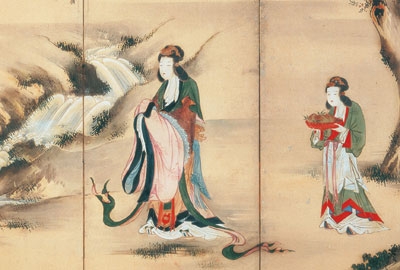
XiWangmu, also known as Xiwangmu or the Queen Mother of the West, is one of the most fascinating goddesses in Chinese mythology. She is ancient, powerful, mysterious, and surprisingly complex. In early texts, she appears as a wild, almost fearsome figure connected with mountains, disasters, and heavenly punishment. In later traditions, she becomes a majestic Daoist goddess, ruler of female immortals, keeper of the Peaches of Immortality, and host of the famous Peach Banquet.
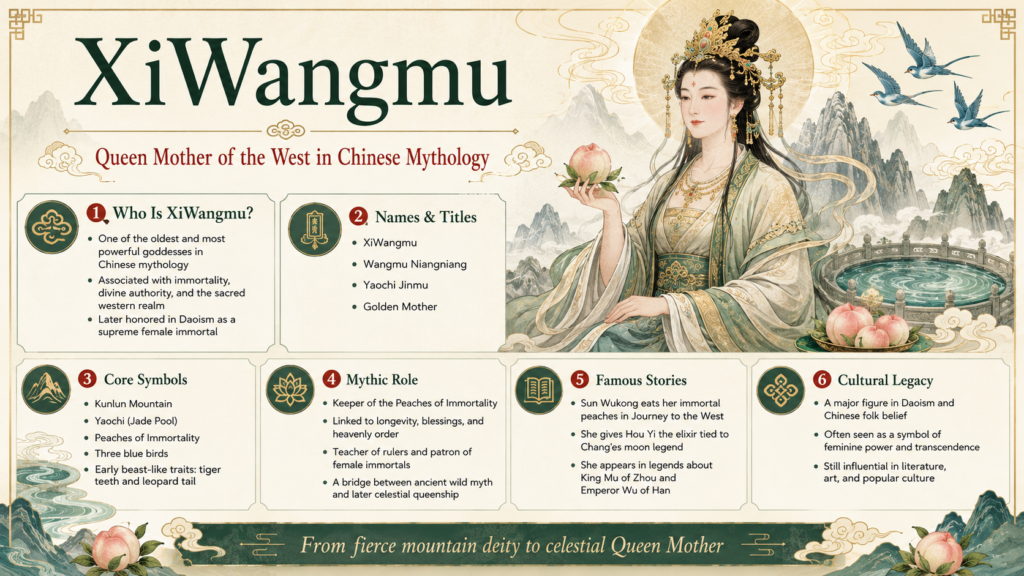
What makes XiWangmu especially interesting is that her image did not stay fixed. Across centuries, she changed from a beast-like mountain deity into a graceful divine queen. Her story reflects not only mythology, but also Chinese ideas about immortality, rulership, femininity, the western frontier, and the connection between heaven and earth.
Who Is XiWangmu?
XiWangmu is best known in English as the Queen Mother of the West. Her Chinese name is 西王母. The character xi means “west,” wang can mean “king” or a high royal title, and mu means “mother.” So the name is usually understood as “Queen Mother of the West.”
She is also known by many other titles, including Wangmu Niangniang, Yaochi Jinmu, Golden Mother, and Jinmu Yuanjun. These names point to her elevated status in later Daoist and folk religious traditions.
In Chinese mythology, XiWangmu is often associated with:
- The western paradise or sacred western mountains
- Kunlun Mountain and Yaochi, the Jade Pool
- The Peaches of Immortality
- Female immortals and Daoist transcendence
- Heavenly authority and divine blessing
- Longevity, fertility, and protection
She is not simply a gentle mother goddess. Her older image is much wilder, darker, and more untamed.
XiWangmu in Early Chinese Texts
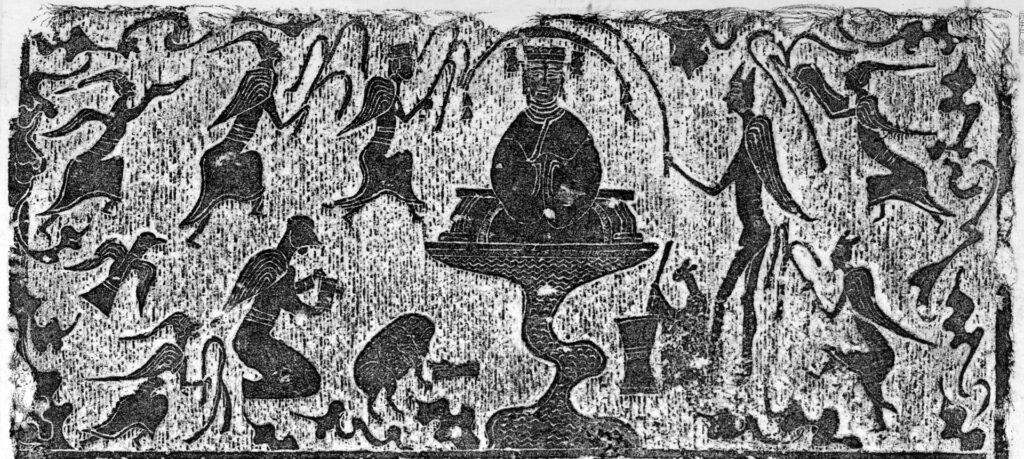
One of the earliest and most important sources for XiWangmu is the Shan Hai Jing, or Classic of Mountains and Seas. In this ancient text, she is not described as the elegant queen many people imagine today. Instead, she appears as a strange and powerful being living in the western mountains.
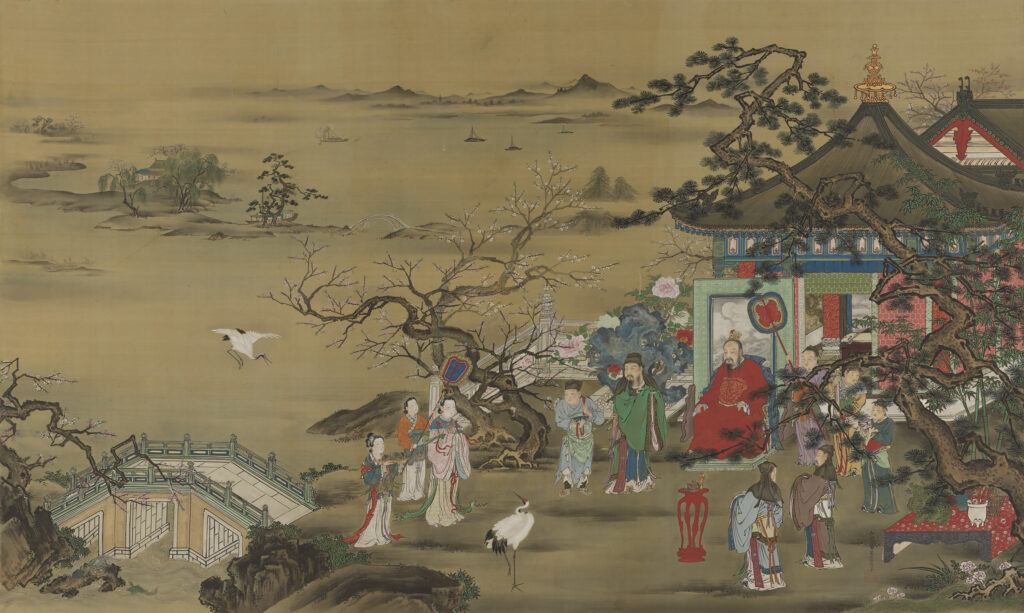
The early description gives her a partly human, partly animal form. She is said to have tiger’s teeth, a leopard’s tail, wild hair, and a head ornament. This image feels closer to a mountain spirit or primal deity than to the refined goddess of later literature.
In these early traditions, XiWangmu was linked with dangerous forces: calamity, disease, floods, punishment, and heavenly disasters. She was not yet the peaceful Queen Mother hosting immortals in a celestial palace. She was a figure of awe — something divine, but not necessarily comforting.
This is one reason XiWangmu stands out among Chinese mythological figures. Her story preserves traces of very old beliefs, where gods were not always beautiful or benevolent. They could be fierce, ambiguous, and closely tied to nature’s power.
How XiWangmu Became the Queen Mother of the West
Over time, XiWangmu’s image changed dramatically. By the Han dynasty and especially through later periods such as the Wei, Jin, Southern and Northern Dynasties, and Tang dynasty, she became more humanized and more divine in the familiar sense.
Instead of a wild mountain being, she came to be imagined as a majestic goddess living in a sacred western realm. Her home was often placed at Kunlun Mountain, one of the most important mythical mountains in Chinese imagination. There, she ruled over a paradise-like domain with Yaochi, the Jade Pool, and gardens filled with immortal peaches.
This transformation did not erase her older power. Rather, it refined it. XiWangmu still controlled life, death, longevity, and divine order, but she became less monstrous and more royal. She was now a heavenly queen, a Daoist master, and a symbol of immortality.
XiWangmu and the Peaches of Immortality
Among all the myths connected with XiWangmu, the Peaches of Immortality are probably the most famous.
In later Chinese tradition, XiWangmu tends a divine peach garden. These peaches are not ordinary fruit. They ripen only once every few thousand years and grant immortality to those who eat them. Because of this, they became one of the most recognizable symbols of Chinese longevity culture.
The famous Peach Banquet, or Pantao Hui, is held when the peaches ripen. Immortals and gods gather to celebrate XiWangmu and share in the promise of long life. This image appears often in Chinese literature, opera, painting, temple art, and folk storytelling.
The peach itself became a major symbol in Chinese culture. Even today, peaches are associated with birthdays, blessings, and longevity.
XiWangmu in Journey to the West
XiWangmu also appears in connection with Journey to the West, one of China’s most famous novels.
In the story, Sun Wukong, the Monkey King, is assigned to guard the heavenly peach garden. This sounds like an important position, but for the rebellious Monkey King, it becomes another chance to defy heaven. Instead of protecting the peaches, he eats them.
This act is one of the reasons Sun Wukong causes such chaos in the heavenly court. The episode also shows how important XiWangmu’s peaches are. They are not just magical fruit; they belong to the cosmic order of heaven.
For modern readers, this story is often one of the easiest ways to remember XiWangmu. She is the goddess behind the immortal peach garden that Sun Wukong famously raids.
XiWangmu, Hou Yi, and Chang’e
XiWangmu is also connected with the myth of Hou Yi and Chang’e, one of the best-known stories behind the Mid-Autumn Festival.
According to the legend, there were once ten suns in the sky. Their heat scorched the earth, making life unbearable. The heroic archer Hou Yi shot down nine of the suns, leaving only one to light the world. As a reward, XiWangmu gave him an elixir of immortality.
But before Hou Yi could drink it, Chang’e took the elixir and became immortal. She then flew to the moon, where she remains in Chinese legend as the Moon Goddess.
This story gives XiWangmu another important role: she is the giver of immortality. She does not merely possess divine power; she can grant it, test it, and withhold it.
XiWangmu and Chinese Emperors
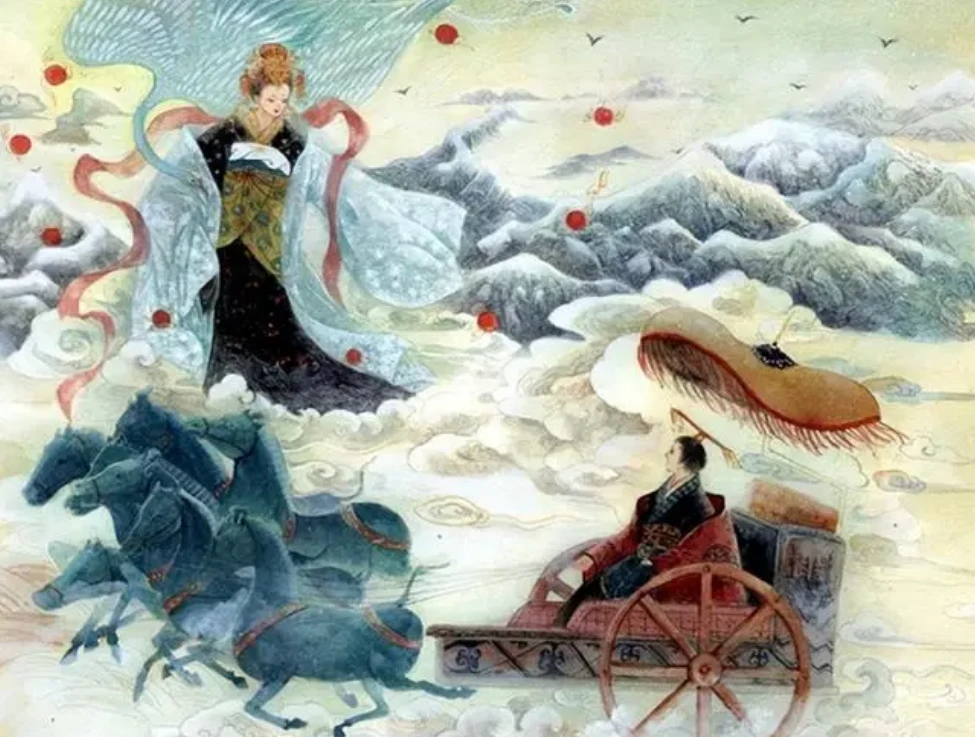
In many legends, XiWangmu is linked with Chinese rulers. She is said to have appeared to or interacted with legendary and historical emperors, including Emperor Shun, King Mu of Zhou, and Emperor Wu of Han.
These meetings are important because they connect XiWangmu with the idea of divine legitimacy. In ancient China, emperors ruled under the Mandate of Heaven. A meeting with XiWangmu could symbolize heavenly approval, spiritual instruction, or access to the secrets of immortality.
In these stories, XiWangmu often appears almost like a Daoist master. She teaches rulers, offers sacred objects, or tests their worthiness. The emperors may desire immortality, but they usually fail to fully achieve it. This pattern reflects a common theme in Chinese mythology: immortality is not simply something a ruler can demand. It requires spiritual discipline, humility, and alignment with the Dao.
XiWangmu and Kunlun Mountain
XiWangmu is strongly associated with Kunlun Mountain, a mythical and geographic symbol of the far west.
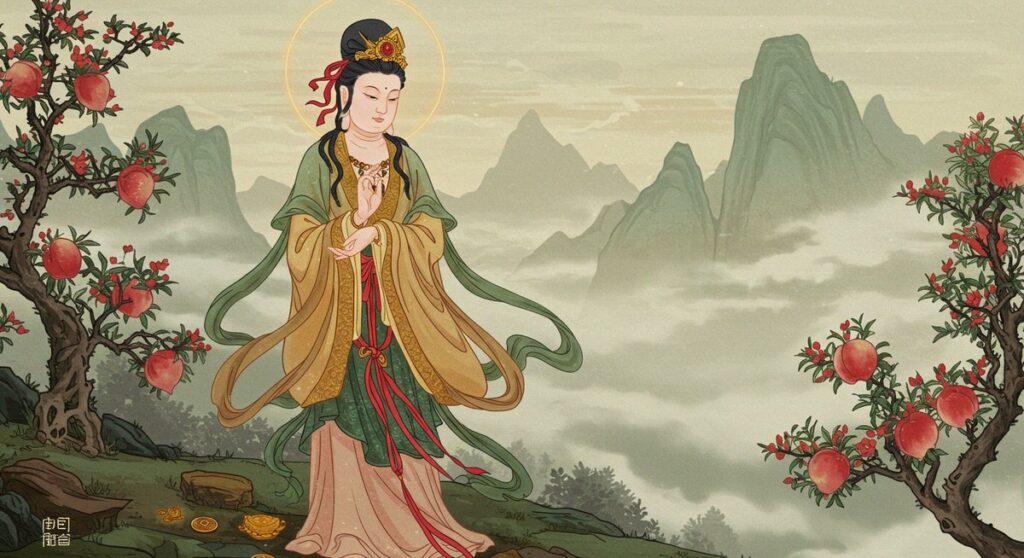
In Chinese imagination, Kunlun is not just a mountain range. It is a cosmic place — a bridge between the human world and the divine. Many traditions describe XiWangmu as living there in a palace or sacred cave, surrounded by immortals, divine birds, and supernatural beings.
Some later discussions also connect XiWangmu with real western regions such as Qinghai, Gansu, and areas around the ancient routes linking central China with the western frontier. These interpretations suggest that the myth may preserve memories of ancient western tribes, sacred sites, or cultural exchanges between early Chinese states and frontier peoples.
Whether read as mythology, religious geography, or cultural memory, XiWangmu’s western location matters. She represents the mysterious west: distant, powerful, sacred, and full of the promise of immortality.
XiWangmu in Daoism
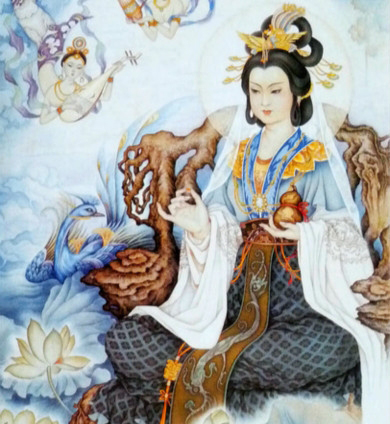
After Daoism developed as a religious system, XiWangmu became one of its most important female divinities. In Daoist tradition, she is often regarded as the supreme goddess of female immortals.
She is sometimes paired with Dongwanggong, the King Father of the East. Together, they represent cosmic balance: west and east, yin and yang, female and male, immortality and divine order.
In some Daoist texts, female immortals must first pay respect to XiWangmu before entering higher heavenly realms. This gives her a role as a divine administrator of immortality. She is not only worshiped as a goddess of blessing, but also imagined as a ruler within the celestial hierarchy.
Her Daoist titles, such as Yaochi Jinmu and Jinmu Yuanjun, emphasize her dignity, cosmic authority, and spiritual purity.
XiWangmu as a Female Power Figure
One reason XiWangmu remains so compelling is that she is one of the strongest female figures in Chinese mythology.
She is not defined only by marriage, beauty, or motherhood. She commands immortals, controls sacred peaches, grants or denies longevity, interacts with emperors, and stands at the center of major myths. Her older wild form also gives her a sense of independence that feels unusual and powerful.
In modern readings, XiWangmu is sometimes seen as a mythological feminist icon. That does not mean ancient texts described her in modern political terms. Rather, it means she represents a type of female divinity who is autonomous, commanding, and difficult to domesticate.
She is motherly, but not soft. Beautiful, but not passive. Benevolent in later tradition, but never weak.
XiWangmu in Folk Belief and Popular Culture
In Chinese folk religion, XiWangmu is widely known as Wangmu Niangniang. She is worshiped for blessings, longevity, fertility, health, and protection. Her birthday and festivals vary by tradition, but she is often connected with celebrations of immortality and the Peach Banquet.
She also appears frequently in literature, drama, temple art, murals, and storytelling. From Journey to the West to local operas and Daoist rituals, XiWangmu has remained part of Chinese cultural imagination for centuries.
In modern popular culture, she has appeared in novels, games, and fantasy settings inspired by Chinese mythology. Her image is especially useful for writers and artists because she combines several dramatic elements: ancient mystery, divine authority, immortality, mountain mythology, and feminine power.
Why XiWangmu Still Matters
XiWangmu is not just another goddess in Chinese mythology. She is a layered figure whose story stretches across ancient texts, Daoist religion, imperial legends, folk belief, and modern culture.
Her transformation from a fierce mountain deity into the Queen Mother of the West tells us something important about mythology itself. Myths are not frozen. They evolve as cultures change. A terrifying goddess can become a divine queen. A mountain spirit can become the ruler of immortals. A symbol of danger can become a source of blessing.
That is why XiWangmu remains so memorable. She carries the wildness of ancient myth, the elegance of Daoist heaven, and the deep human longing for longevity, wisdom, and a world beyond ordinary life.
FAQ About XiWangmu
Who is XiWangmu?
XiWangmu is a major goddess in Chinese mythology, commonly known as the Queen Mother of the West. She is associated with Kunlun Mountain, the Peaches of Immortality, Daoist immortals, longevity, and divine authority.
What does the name XiWangmu mean?
XiWangmu means “Queen Mother of the West.” The name can also be interpreted in older or alternative ways, such as “Western Grandmother” or “Spirit Mother of the West.”
Is XiWangmu the same as Wangmu Niangniang?
Yes. Wangmu Niangniang is a popular Chinese title for XiWangmu. In folk belief, she is often worshiped under this name.
What are the Peaches of Immortality?
The Peaches of Immortality are divine fruits in XiWangmu’s heavenly garden. They ripen only after a very long period and are believed to grant immortality or extreme longevity.
Where does XiWangmu live?
XiWangmu is traditionally said to live in the western paradise, often associated with Kunlun Mountain and Yaochi, the Jade Pool.
What is XiWangmu’s role in Daoism?
In Daoism, XiWangmu is one of the highest female deities and is often regarded as the ruler of female immortals. She is connected with yin energy, longevity, cosmic balance, and spiritual transcendence.
How is XiWangmu connected to Sun Wukong?
In Journey to the West, Sun Wukong is assigned to guard the immortal peach garden associated with XiWangmu. Instead, he eats the peaches, causing chaos in heaven.
How is XiWangmu connected to Chang’e?
In the myth of Hou Yi and Chang’e, XiWangmu gives Hou Yi the elixir of immortality. Chang’e later drinks it and flies to the moon, becoming the Moon Goddess.
Why is XiWangmu important in Chinese mythology?
XiWangmu is important because she combines many major themes in Chinese mythology: immortality, divine rulership, female power, mountain worship, Daoist spirituality, and the connection between heaven and earth.