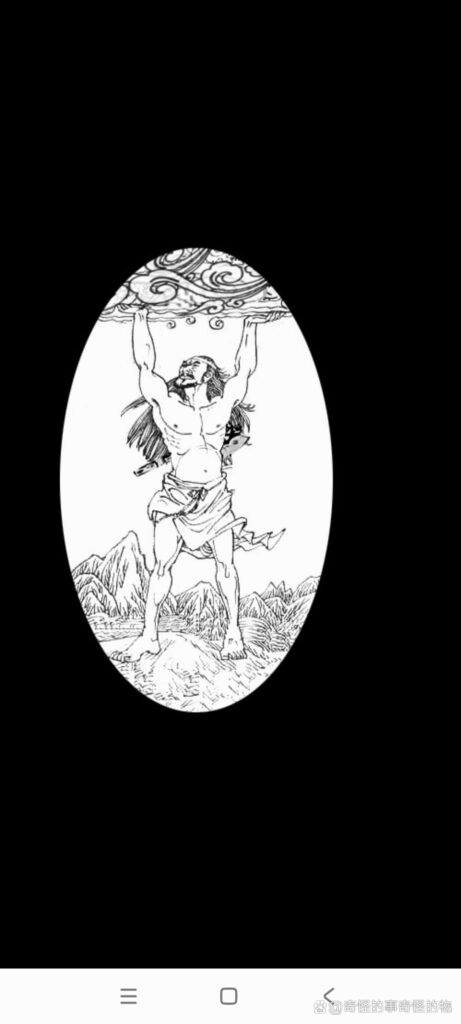
In Chinese mythology, Pangu is the great primordial being who appears at the very beginning of the universe. Before mountains, rivers, sunlight, seasons, or human life, there was only chaos — a dark, formless state often imagined as a vast cosmic egg. From inside that egg, Pangu awakened, broke through the shell, and began the work of separating heaven from earth.
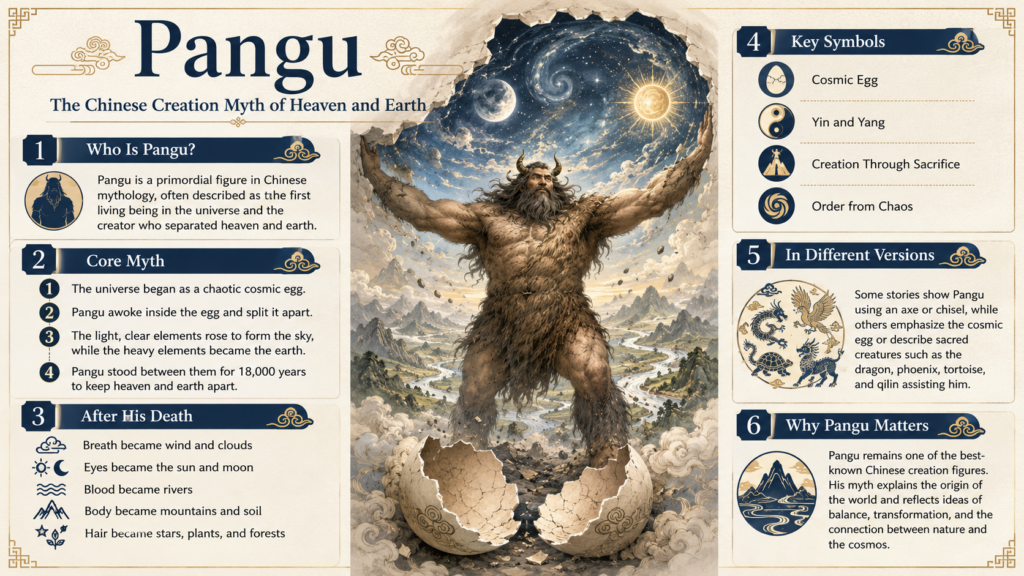
His story is one of the most memorable creation myths in Chinese tradition because it does not simply describe how the world was made. It imagines the universe as something born through effort, balance, sacrifice, and transformation. Britannica describes Pan Gu as a central figure in Chinese Daoist creation legends, associated with chaos, the separation of heaven and earth, and the shaping of the natural world.
Who Is Pangu in Chinese Mythology?
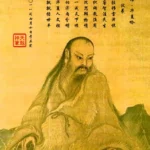
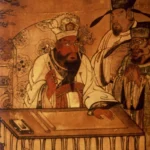
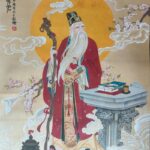
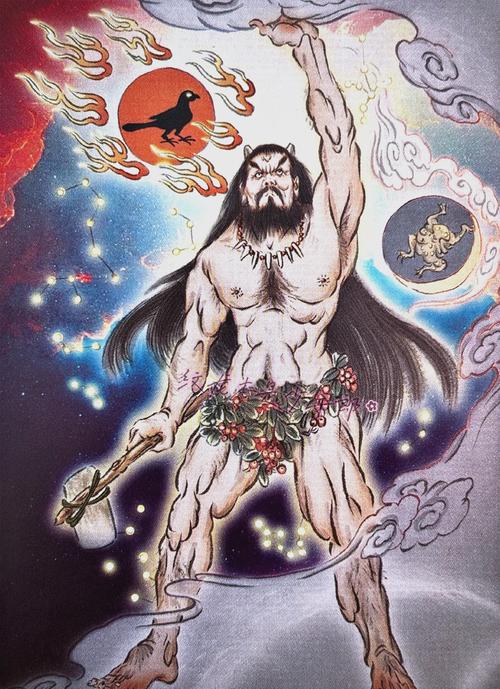
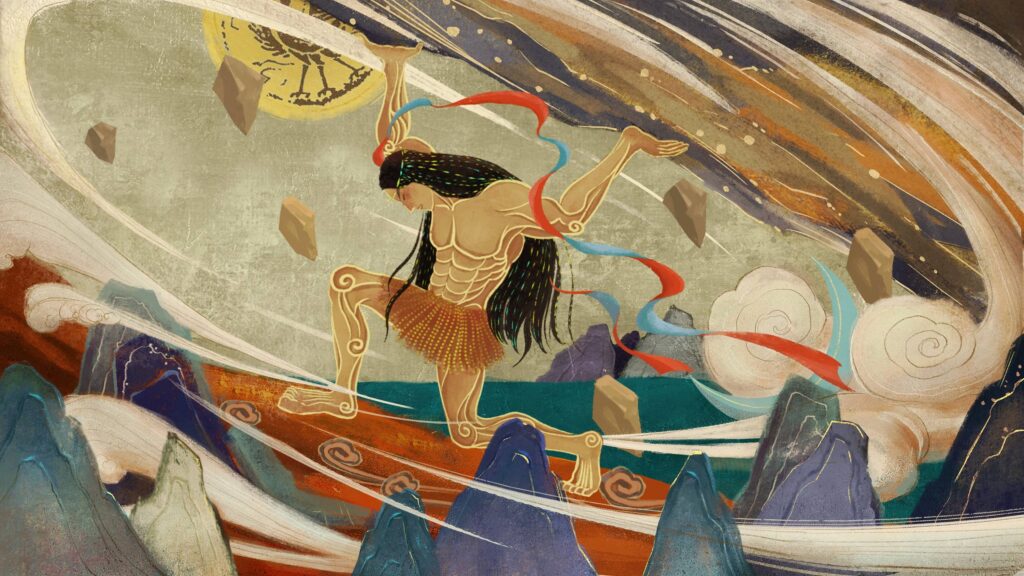
Pangu, also written as Pan Gu or P’an-ku, is often described as the first living being in the universe. In many versions of the myth, he is a giant with a hairy body, horns, and immense strength. Some artistic traditions show him holding a hammer and chisel, while others show him with the sun and moon, symbolizing his connection to cosmic creation.
Although Pangu is sometimes called the “first man,” he is not quite the same as a human ancestor in the ordinary sense. He is more like a cosmic being — part creator, part giant, part embodiment of the universe itself. His role is to bring order out of chaos and give shape to the world.
The Meaning of Pangu’s Name
The name Pangu is usually explained through the Chinese characters 盤古. The character pán can suggest coiling or curling, while gǔ means ancient. This fits the myth beautifully: before creation, Pangu sleeps curled inside the cosmic egg, surrounded by all the raw matter and forces of the universe.
In older romanization systems, his name may appear as P’an-ku. That is why readers may see several spellings — Pangu, Pan Gu, and P’an-ku — all referring to the same mythological figure.
Pangu and the Cosmic Egg
The most famous version of the Pangu myth begins with a universe that has not yet taken form. There is no sky, no earth, no day or night. Everything exists inside a dark, chaotic egg.
For 18,000 years, Pangu sleeps inside this cosmic egg. During that time, the forces of yin and yang gradually come into balance. When Pangu finally awakens, he stretches, breaks the egg apart, and releases the universe from its closed, chaotic state. In one common telling, the lighter and purer parts rise upward to become the sky, while the heavier and denser parts sink downward to become the earth.
This image is simple, but powerful. The world is not created from nothing. It is shaped from a hidden potential already waiting inside chaos.
How Pangu Separated Heaven and Earth
After the cosmic egg breaks, Pangu faces a problem: heaven and earth may collapse back into one another. To prevent the return of chaos, he stands between them.
In many versions, Pangu pushes the sky upward while standing firmly on the earth. Every day, the sky rises higher, the earth grows thicker, and Pangu himself grows taller. This continues for another 18,000 years until heaven and earth are finally stable and permanently separated. World History Encyclopedia summarizes this part of the myth as Pangu cutting through darkness, separating yin from yang, and pushing earth and sky apart.
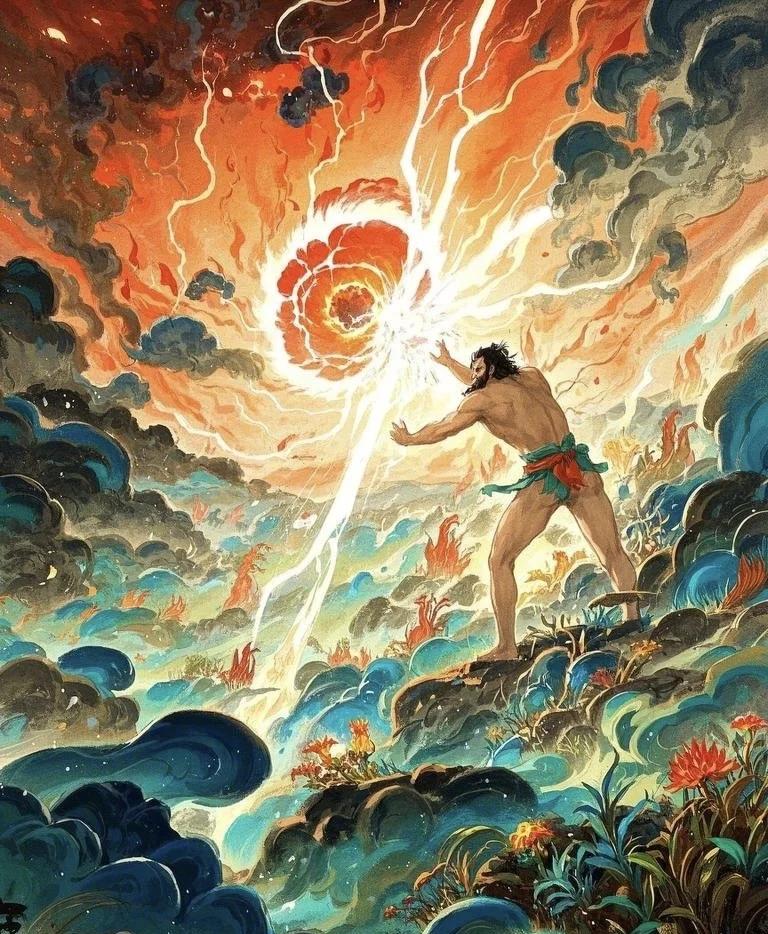
This part of the story gives Pangu his most famous identity: the being who “opened up heaven and earth.” He does not create through speech alone. He creates through endurance.
Pangu’s Body Becomes the World
The most poetic part of the myth comes after Pangu dies. His death is not an ending, but a transformation. His body becomes the landscape, weather, and living structure of the world.
In different versions, his breath becomes wind and clouds. His voice becomes thunder. His left eye becomes the sun, and his right eye becomes the moon. His blood turns into rivers and seas, his flesh becomes fertile soil, his bones become rocks and minerals, and his hair becomes stars, forests, or plants.
This gives the myth a deeply organic feeling. The world is not a machine assembled from separate parts. It is a living inheritance from Pangu’s body. Mountains, rivers, rain, sunlight, and soil all carry traces of the first being.
Why Yin and Yang Matter in the Pangu Myth
The Pangu myth is closely tied to the idea of yin and yang, the paired forces that help explain balance in Chinese thought. In the story, creation begins when these opposite forces separate and find their proper places.
Yin is often associated with heaviness, darkness, earth, and depth. Yang is associated with lightness, brightness, sky, and upward movement. When Pangu divides them, the universe becomes ordered. The myth therefore presents creation as a process of balance, not simply domination.
This is one reason the story still feels meaningful. Pangu does not destroy chaos entirely. He transforms it into a structured world where opposites can exist together.
Different Versions of the Pangu Myth
Like many ancient myths, the story of Pangu has more than one version. Some accounts emphasize the cosmic egg. Others focus on Pangu using an axe, hammer, or chisel to shape the world. Some versions say he was helped by sacred creatures such as the dragon, phoenix, tortoise, and qilin.
There are also different explanations of how human beings appeared. In some tellings, humans come later through the goddess Nüwa, who shapes people from clay. In other versions, human life emerges from tiny creatures on Pangu’s body after his death. Encyclopedia.com notes both types of traditions, showing how flexible and layered the myth became over time.
Rather than seeing these differences as contradictions, it is better to see them as signs of a living tradition. Myths change as they travel through regions, communities, temples, books, and oral storytelling.
Pangu and Nüwa: Creation of the World and Creation of Humanity
Pangu and Nüwa are often discussed together because they answer two different questions.
Pangu explains how the universe becomes a world: heaven and earth separate, mountains rise, rivers flow, and the sky gains sun, moon, and stars. Nüwa, by contrast, is usually associated with the creation or repair of human life. In many stories, she shapes humans from clay and later repairs the broken sky.
Together, they form a broad mythic sequence: Pangu creates the world’s structure, and Nüwa brings humanity into that world.
What the Pangu Myth Tells Us
The story of Pangu is not just a fantasy about a giant in a cosmic egg. It reflects several ideas that run deeply through Chinese mythology:
Creation begins in chaos, but chaos contains potential.
Order requires separation, balance, and patience.
The natural world is sacred because it is connected to a primordial being.
Life comes through transformation, not only birth.
Pangu’s story also explains why creation myths are so enduring. They give shape to questions that are too large for ordinary language: Where did the sky come from? Why are earth and heaven separate? Why do rivers flow, mountains stand, and stars shine?
The myth does not answer these questions scientifically. It answers them imaginatively — and that is exactly why it has survived.
Conclusion
Pangu remains one of the most striking figures in Chinese mythology. Born from the cosmic egg, he separates heaven and earth, holds them apart for thousands of years, and finally gives his body to the world. His myth is grand, strange, and deeply symbolic.
At its heart, the story of Pangu is about the movement from chaos to order. The world begins as darkness, but through balance and sacrifice, it becomes a place of sky, earth, rivers, mountains, sun, moon, and life.
That is why Pangu is more than a creator figure. He is the world before the world — and the world after it begins.
FAQ
Who is Pangu?
Pangu is a primordial creator figure in Chinese mythology. He is best known for emerging from a cosmic egg, separating heaven and earth, and helping shape the natural world.
What is the Pangu creation myth?
The Pangu creation myth says that the universe began as a chaotic cosmic egg. Pangu slept inside it for 18,000 years, then broke it open. The lighter parts became the sky, while the heavier parts became the earth.
What happened after Pangu died?
After Pangu died, his body transformed into parts of the world. His eyes became the sun and moon, his blood became rivers, his breath became wind and clouds, and his flesh became the soil.
Is Pangu a god or a giant?
Pangu can be understood as both a mythological giant and a creator figure. In many traditions, he is not a god in the same sense as later deities, but a primordial being who existed before the formed world.
What is the meaning of Pangu?
The name Pangu is commonly associated with the characters 盤古. It suggests something ancient and curled or coiled, matching the image of Pangu sleeping inside the cosmic egg before creation.
What is the difference between Pangu and Nüwa?
Pangu is mainly connected with the creation of the universe and the separation of heaven and earth. Nüwa is more often linked with the creation of humans and the repair of the sky in later myths.