
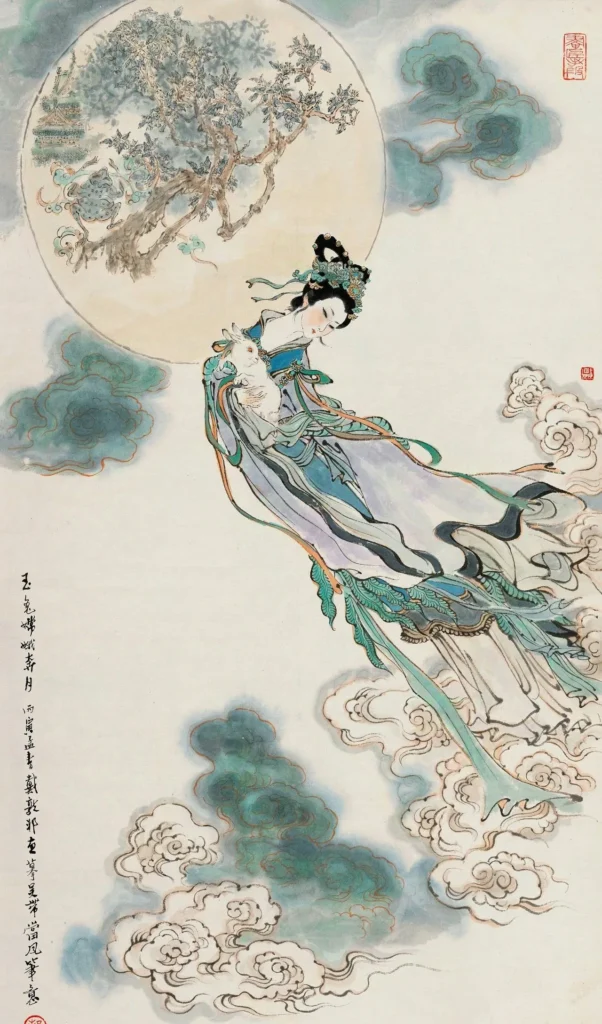
If you have ever looked up at the full moon during Mid-Autumn Festival and wondered why people speak of a goddess living there, you are already close to one of the most beloved stories in Chinese mythology. The Chang’e moon story full is not just a tale about flying to the moon. It is a story about love, separation, sacrifice, immortality, and the quiet sadness that often lives inside beauty.
Like many old legends, it exists in more than one version. Some are romantic, some are tragic, and some are morally complex. But together, they help explain why Chang’e remains such an enduring figure in Chinese culture, especially during the season of mooncakes, lanterns, and family reunions.
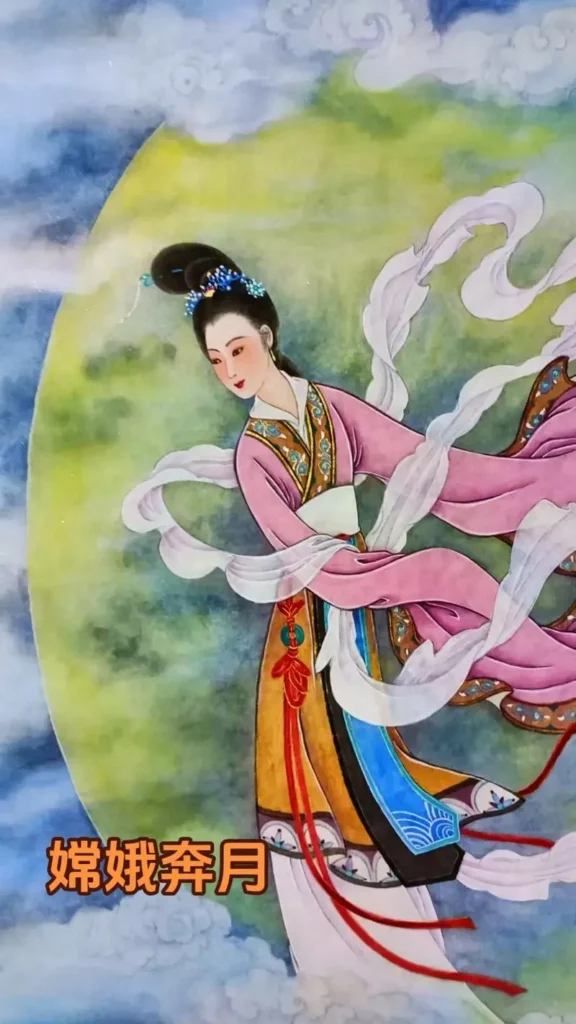
Chang’e Moon Story Full: How the Legend Begins
Long ago, the heavens were watched over by ten suns. Rather than appearing one at a time, as they were meant to, the ten suns rose together and scorched the earth. Rivers dried up, crops failed, and people suffered terribly under the unbearable heat.
To save the world, the great archer Hou Yi was given a divine bow and arrows. He was meant to warn the suns and restore order. But when he saw the suffering below, he acted with force instead of restraint. One by one, he shot down nine of the ten suns, leaving only one to light the world.
This heroic act saved humanity, but it also changed his fate.
In many retellings, Hou Yi’s bold decision angered the heavenly ruler. As punishment, Hou Yi and his wife Chang’e were stripped of their divine status and sent to live in the mortal world. That fall from heaven is important to the story. It turns the legend from a simple heroic myth into something more human: a marriage tested by loss, regret, and the passing of time.
Who Are Chang’e and Hou Yi?
Chang’e is usually portrayed as beautiful, gentle, and otherworldly, but that is only part of her image. In Chinese literary and folk tradition, she is also a figure of longing. She is admired not only for her grace, but also for the loneliness that follows her.
Hou Yi, meanwhile, is remembered as the heroic archer who saved the world. He is powerful, decisive, and deeply human in many later retellings. He is not always flawless. In some versions, his actions lead directly to the couple’s exile. In others, the emotional distance between husband and wife becomes part of the tragedy.
That is one reason this myth has lasted so long. It is not a flat fairy tale. It carries both grandeur and sorrow.
The Elixir of Immortality and the Turning Point
After being cast down to earth, Hou Yi and Chang’e had to live as mortals. Time, aging, and death were now real. In many versions of the story, Hou Yi eventually obtained an elixir of immortality from the Queen Mother of the West.
This potion became the turning point of the legend.
Rather than taking it immediately, Hou Yi brought it home. Depending on the version, the couple either planned to share it or kept it hidden for later. But the elixir did not remain safe for long.
One of the most famous retellings introduces Hou Yi’s apprentice, often named Feng Meng or Pang Meng. He learns of the elixir and tries to steal it while Hou Yi is away. With no other way to protect it, Chang’e swallows the potion herself.
And that is the moment the story enters mythic memory forever.
Why Did Chang’e Fly to the Moon?
This is where the legend branches into several classic interpretations.
1. Chang’e swallowed the elixir to protect it
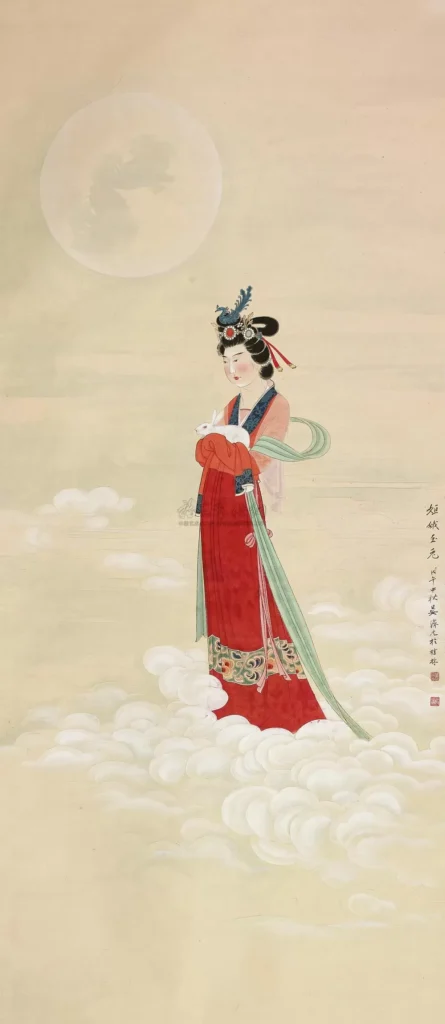
This is the version many readers know best today. Chang’e is not selfish here. She acts in an emergency. Faced with the threat of the elixir falling into the wrong hands, she chooses to consume it herself.
As the potion takes effect, her body becomes weightless and she rises into the sky. Because she does not want to go too far from Hou Yi, she chooses the moon, the nearest heavenly place to earth.
This version gives Chang’e a noble, tragic dignity. She does not leave because she wants power. She leaves because circumstances force her hand.
2. Chang’e stole the elixir herself
An older and harsher tradition presents Chang’e differently. In this telling, she secretly takes the elixir and ascends alone. Some early texts even describe her transformation into a toad on the moon, a reminder that ancient mythology was often stranger and less polished than later popular versions.
This version carries a moral warning. The moon is still beautiful, but Chang’e’s place there is touched by punishment and regret.
3. Chang’e flew to the moon out of heartbreak or separation
Some interpretations focus less on theft and more on emotional rupture. In these versions, the story becomes one of sorrow, distance, and irreversible change. Chang’e’s ascent is less about ambition than about broken trust, pain, or destiny.
This reading feels especially powerful in later poetry, where Chang’e is often imagined as a lonely figure in the cold Moon Palace, forever gazing toward the human world below.
Life in the Moon Palace
After ascending, Chang’e is said to live in Guanghan Palace, often translated as the Moon Palace or the Palace of Vast Cold. It is one of the most haunting settings in Chinese myth: bright, silent, beautiful, and empty.
She is not always alone there. Popular tradition often places the Jade Rabbit beside her, endlessly pounding herbs or medicine. Together, they form one of the most recognizable moon images in Chinese culture.
But even with the Jade Rabbit nearby, Chang’e’s image remains one of solitude. She is immortal, yet separated. She is elevated, yet lonely. That emotional contradiction is part of what makes her unforgettable.
Hou Yi’s Grief and the Origin of Mid-Autumn Worship
When Hou Yi returned and learned what had happened, he was devastated. He looked up at the moon and seemed to see Chang’e’s figure there. In some versions, he laid out her favorite foods beneath the moonlight in the hope that she might feel his love across the distance.
People began to imitate this act, offering fruit and cakes to the moon and praying for peace, beauty, and reunion.
Over time, this became tied to the Mid-Autumn Festival.
That is why the Chang’e moon story full is so closely connected with the holiday. The festival is not only about harvest and moon-viewing. It is also about emotional longing. The full moon symbolizes reunion, yet the legend at its heart reminds us that reunion is precious precisely because separation exists.
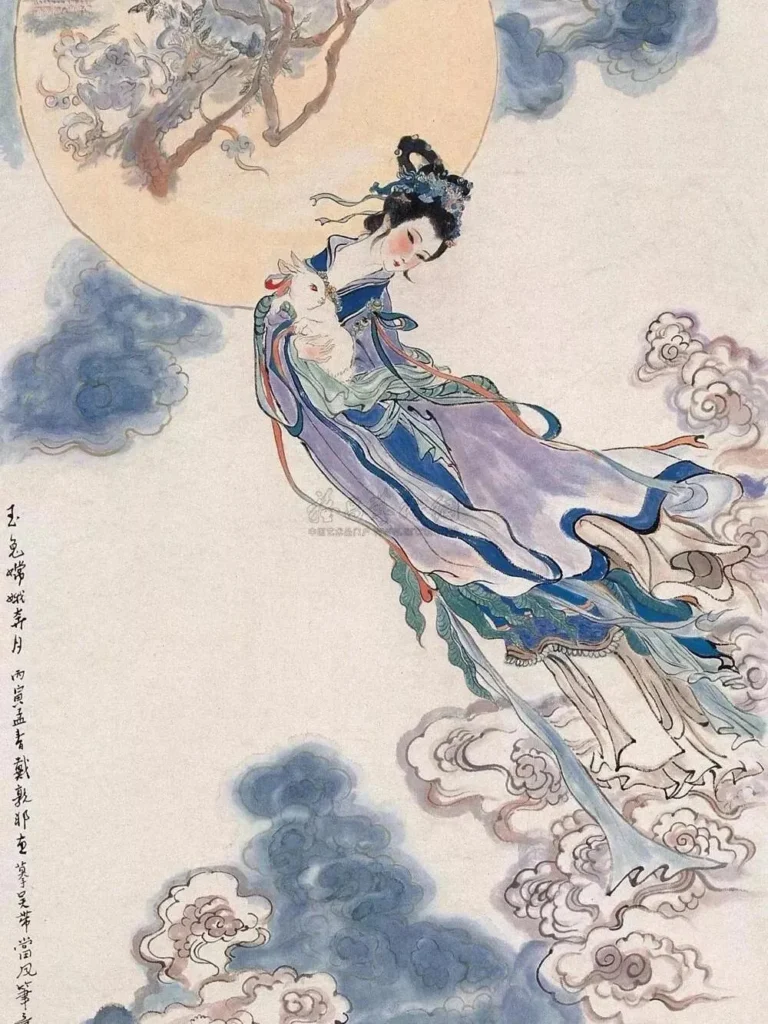
Why Chang’e Became a Symbol of the Mid-Autumn Festival
The moon was already important in ancient Chinese ritual life before the legend fully took shape. But Chang’e gave the moon a face, a personality, and an emotional story.
Through her, the moon came to represent more than light in the sky:
- fullness became a symbol of reunion
- distance became a symbol of longing
- moonlight became a symbol of memory
- the Moon Palace became a symbol of beauty touched by loneliness
That emotional layering is why Chang’e remains central to Mid-Autumn imagery even today. When families gather to admire the moon, eat mooncakes, and think of loved ones far away, the old legend still feels close.
The Cultural Meaning of the Chang’e Legend
The lasting power of Chang’e’s story comes from the way it holds several meanings at once.
First, it is a love story, though not a simple one. It speaks of devotion, separation, and the ache of unfinished companionship.
Second, it reflects humanity’s age-old fascination with immortality. The elixir is not just a magical object. It represents a dream people have chased in many cultures: to escape time, aging, and death.
Third, it expresses one of the deepest values in Chinese culture: reunion. Chang’e’s loneliness on the moon makes earthly togetherness feel even more precious.
And finally, it shows how myths evolve. Early sources are rougher, stranger, and sometimes morally sharper. Later retellings soften Chang’e into a more sympathetic figure. That shift tells us something about changing cultural taste, emotional ideals, and the desire to see beauty joined with goodness.
Why the Story Still Matters Today
Even in the modern age, Chang’e has never really faded. She appears in poems, paintings, festival decorations, television dramas, children’s books, and even in the naming of China’s lunar exploration program.
That ongoing presence says a great deal. The world may change, but people still respond to stories about distance, memory, and hope. Chang’e is not only a moon goddess from the past. She is also a symbol of how myths continue to speak to modern life.
When we look at the moon, we do not just see an object in the night sky. We see meaning. We see longing. We see the idea that beauty can carry sorrow, and that separation can deepen the desire for reunion.
That may be the real reason the Chang’e legend has survived for so many centuries.
Final Thoughts on the Chang’e Moon Story Full
So what is the Chang’e moon story full? It is not just one fixed tale. It is a living legend shaped by myth, literature, ritual, and imagination across generations.
At its heart, though, the story remains the same: a heroic archer, a precious elixir, a sudden ascent, a moonlit separation, and a festival that turns longing into remembrance.
Perhaps that is why the story still feels so moving. The moon is full, yet someone is missing. The night is beautiful, yet touched by sadness. And somewhere in that quiet brightness, Chang’e still endures as one of the most unforgettable figures in Chinese mythology.
FAQ
What is the full story of Chang’e?
The full story of Chang’e usually begins with Hou Yi shooting down nine of the ten suns to save the earth. After he and Chang’e are forced to live as mortals, Hou Yi obtains an elixir of immortality. In the most popular version, Chang’e swallows it to prevent it from being stolen and then rises to the moon, where she lives in the Moon Palace.
Why did Chang’e go to the moon?
In the best-known retelling, Chang’e went to the moon after swallowing the elixir of immortality to protect it from a thief. Other older versions say she took it herself or left because of emotional conflict, which is why the legend has several interpretations.
Is Chang’e a goddess or a mythological figure?
Chang’e is a mythological figure who is widely treated as a moon goddess in Chinese culture. Over time, she became one of the most important symbolic figures associated with the moon and the Mid-Autumn Festival.
How is Chang’e connected to the Mid-Autumn Festival?
Chang’e is connected to the Mid-Autumn Festival because her legend became closely tied to moon worship, moon-viewing, and the idea of reunion. Her story adds emotional meaning to the festival, especially themes of family, distance, and longing.
Who is Hou Yi in the Chang’e story?
Hou Yi is the heroic archer who shot down nine suns and saved the world. He is Chang’e’s husband and one of the central figures in the legend.
Why is the Jade Rabbit often shown with Chang’e?
The Jade Rabbit is a traditional companion of Chang’e on the moon. In folklore, it is often shown pounding herbs or medicine, adding another layer of symbolism to the Moon Palace.
2 thoughts on “Chang’e Moon Story Full”
Comments are closed.