
Introduction: Who Is He Xiangu?
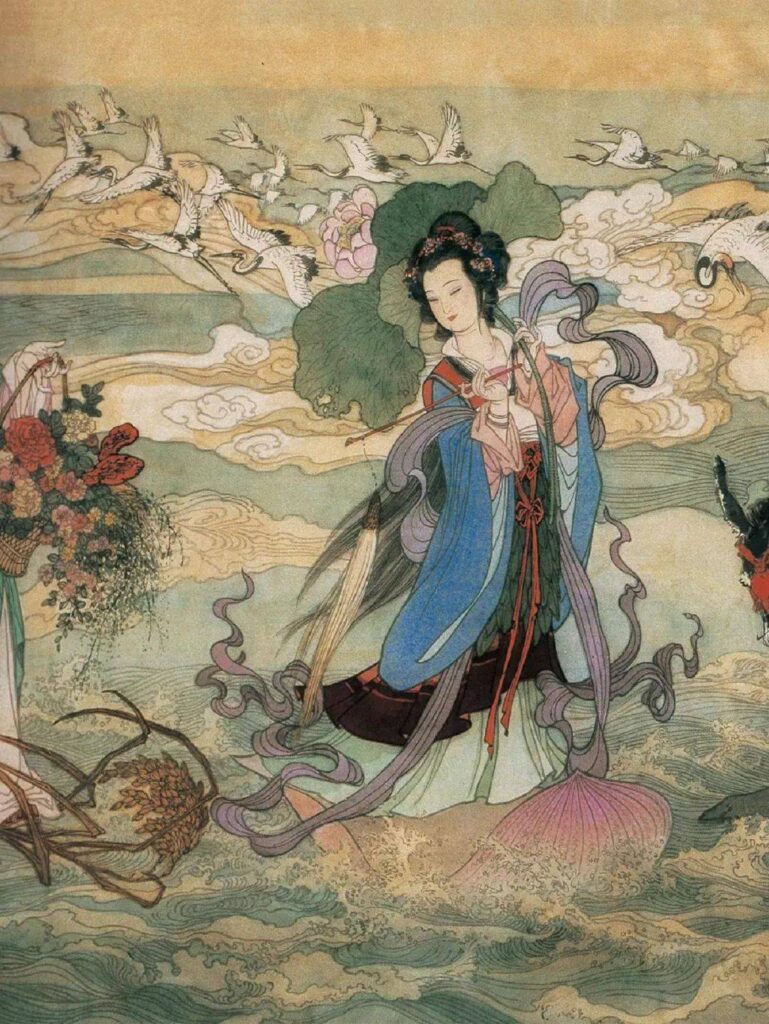
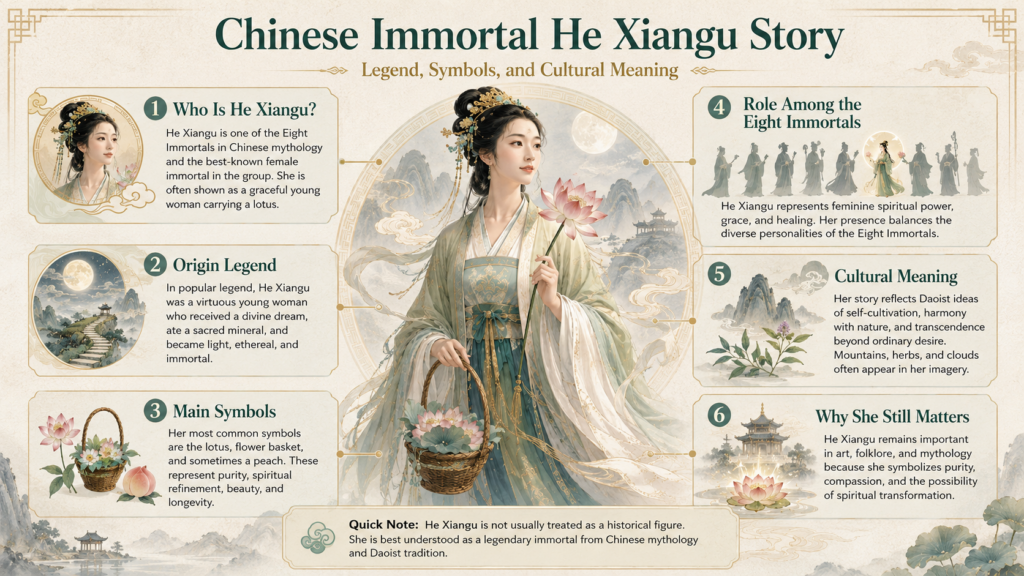
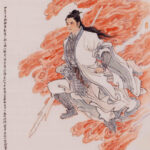
The Chinese immortal He Xiangu story belongs to one of the most beloved traditions in Chinese mythology: the legends of the Eight Immortals, known in Chinese as Baxian 八仙. He Xiangu 何仙姑 is usually described as the only clearly female member of this famous group of Daoist immortals. In art, she is often shown as a graceful young woman holding a lotus flower, a flower basket, a peach, or occasionally a reed-pipe instrument. The British Museum identifies her as one of the Eight Immortals and notes that she is usually represented with a lotus flower or flower basket, sometimes with a peach or sheng reed organ.
For English-speaking readers, He Xiangu can be understood as a mythological figure who stands at the meeting point of folklore, Daoist imagination, religious art, and moral storytelling. She is not simply a “goddess” in the same sense as a creator deity, nor is she a historical person whose biography can be verified in modern terms. Rather, she is a legendary immortal whose story teaches ideas about purity, self-cultivation, compassion, and spiritual transformation.
In many versions of the legend, He Xiangu begins life as an ordinary young woman. Through a mysterious dream, a sacred substance, or disciplined cultivation, she becomes an immortal and gains the ability to move lightly through mountains, gather healing herbs, and live beyond normal human limitations. Britannica summarizes one well-known version: as a teenage girl, she dreamed that mother-of-pearl or mica could confer immortality, ate it, became ethereal, and could float across the hills while gathering herbs.
Her story is simple on the surface, but culturally rich. It reflects long-standing Chinese ideas about immortality, virtue, the mountain as a sacred landscape, the lotus as a symbol of purity, and the possibility that spiritual attainment can be found outside political power, wealth, or formal status.
Chinese Immortal He Xiangu Story: The Main Legend
The most familiar version of the Chinese immortal He Xiangu story presents her as a young woman from the Tang dynasty period, though different traditions give different birthplaces and details. Some accounts associate her with Guangdong, while others connect her with Hunan. A Hong Kong cultural resource notes that legend places He Xiangu either in Zengcheng county, Guangdong, or Yongzhou county, Hunan, and describes her as attaining immortality as a young maiden.
In the common legend, He Xiangu is a filial and spiritually gifted girl. One night, she receives a dream or vision in which a divine figure tells her to eat yunmu 云母, often translated as mica or mother-of-pearl-like mineral substance. After consuming it, her body becomes light and refined. She no longer needs ordinary food in the same way, and she can move across mountains with extraordinary ease.
Instead of using this power for status or domination, He Xiangu gathers herbs and helps others. This detail is important. In Chinese immortal legends, supernatural ability is not always presented as spectacle. It often serves as a sign that the person has moved beyond ordinary desires and now participates in a higher moral or spiritual order.
In some tellings, He Xiangu disappears into the mountains, becoming fully immortal. In others, she remains near her family for a time, returning home in the evening after collecting herbs during the day. This version, also summarized by Britannica, emphasizes both her otherworldly ability and her continued human tenderness.
The story is not a single fixed biography. Like many Chinese myths, it exists in several regional and literary forms. The important pattern is consistent: He Xiangu begins as a virtuous human being, encounters a sign of immortality, undergoes transformation, and becomes one of the Eight Immortals.
Historical and Cultural Background
The Eight Immortals in Chinese Mythology
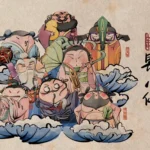
To understand He Xiangu, it helps to understand the Eight Immortals. The Baxian are a group of legendary Daoist immortals who became especially popular in Chinese literature, art, opera, temple culture, and decorative objects. Britannica describes the Baxian as a diverse group of Daoist holy figures who gained immortality and are often depicted together, even though they were not necessarily imagined as living at the same historical moment.
The Eight Immortals are not uniform in social class, age, gender, or personality. The group typically includes scholars, wanderers, eccentrics, officials, elderly figures, and He Xiangu as the female immortal. This diversity is one reason the Eight Immortals remained so popular. They represent the idea that transcendence is not limited to one type of person.
Their stories also express a very Chinese form of mythological balance. They are divine or semi-divine, yet often humorous, eccentric, and close to ordinary life. They travel, drink, argue, help people, test mortals, and appear in folk stories as much as in religious imagery.
Daoist Ideas of Immortality
The word “immortal” in this context translates the Chinese term xian 仙. A xian is not simply a person who “does not die” in a modern fantasy sense. In Daoist and folk imagination, a xian may be a transcendent being who has refined the body, spirit, and energy to live in harmony with the Dao 道, the underlying Way of the cosmos.
Mountains, herbs, minerals, peaches of longevity, cranes, clouds, and remote islands often appear in these stories. They suggest separation from ordinary worldly concerns and entrance into a more refined state of existence.
He Xiangu’s legend fits this pattern. She is linked with mountains, spiritual diet, healing plants, purity, and lightness of body. These motifs are not random; they belong to a wider Chinese symbolic world in which immortality is achieved through moral refinement, natural harmony, and spiritual discipline.
The Origin of He Xiangu
Different Birthplace Traditions
One reason He Xiangu’s story can feel confusing is that there is no single universally accepted origin account. Some traditions place her in Zengcheng, Guangdong. Others place her in Yongzhou, Hunan. The Hong Kong cultural source mentioned above records both traditions, showing that her legend developed across different regions rather than from one fixed historical biography.
This should not be treated as a contradiction that “disproves” the story. In mythology, regional variation is common. A popular figure may be adopted by different local communities, each preserving a version connected to its own geography, temple traditions, or storytelling heritage.
The Name “He Xiangu”
The name He Xiangu can be translated loosely as “Immortal Maiden He” or “Immortal Woman He.” He 何 is her family name. Xian 仙 means immortal or transcendent being. Gu 姑 can mean maiden, aunt, or woman depending on context, but in this case it contributes to the sense of a female immortal figure.
The name itself tells us how she is remembered: not primarily as a ruler, warrior, or cosmic creator, but as a woman who became immortal.
The Main Story Explained Step by Step
1. A Young Woman with Unusual Virtue
He Xiangu is usually introduced as a young woman of moral purity. Many versions emphasize her filial behavior, simplicity, or distance from worldly desires. This is typical of Chinese immortal legends, where spiritual transformation begins with ethical character.
Her gender also matters. In a group otherwise dominated by male or gender-ambiguous figures, He Xiangu’s presence gives the Eight Immortals a broader symbolic range. She often represents feminine refinement, purity, healing, and quiet spiritual power.
2. The Dream or Divine Instruction
A key moment in the story is her dream. A divine or mysterious being instructs her to consume a special substance, often identified as mica or mother-of-pearl. In Chinese traditions of immortality, minerals and rare substances were sometimes imagined as having transformative properties.
Modern readers should not interpret this as practical medical advice. It is a mythological motif, not a health recommendation. The point is symbolic: He Xiangu receives a sign from beyond ordinary life, accepts it, and begins a transformation.
3. The Transformation into an Immortal
After consuming the sacred substance, she becomes light, ethereal, and no longer bound by ordinary physical limits. She can move across hills or mountains with ease. In some versions, she does not need normal food. In others, she travels freely through natural landscapes.
This lightness is spiritually meaningful. It suggests freedom from heavy worldly attachments: greed, ambition, fear, and bodily limitation.
4. Gathering Herbs and Helping Others
One of the most beautiful details in the He Xiangu legend is that she gathers herbs. This connects her with healing, compassion, and nature. Her immortality is not described as selfish escape. She remains linked to human need and practical care.
For English-speaking readers, this makes He Xiangu different from many Western fantasy immortals. She is not defined by conquest, prophecy, or magical battle. Her power is quiet, healing, and morally restrained.
5. Joining the Eight Immortals
Eventually, He Xiangu is counted among the Eight Immortals. In paintings, porcelain, sculpture, temple images, and popular prints, she appears with the other seven figures. The National Palace Museum in Taiwan identifies Qing dynasty bamboo carvings of the Eight Immortals that include He Xiangu, showing her importance in later Chinese art and material culture.
As part of the Eight Immortals, she becomes more than a local heroine. She becomes a widely recognized symbol within Chinese mythology and Daoist-influenced folklore.
He Xiangu’s Role Among the Eight Immortals
He Xiangu is often described as the only female immortal among the Eight. This statement is generally true in the common modern understanding, although Lan Caihe is sometimes portrayed with gender ambiguity in earlier or variant traditions. For clarity, He Xiangu is the only consistently female figure in the standard Eight Immortals group.
Her role is not usually that of a leader. Lü Dongbin often receives more attention as a central or senior figure. Li Tieguai is associated with medicine and compassion for the suffering. Zhongli Quan is connected with transformation and longevity. He Xiangu, by contrast, is often remembered for purity, grace, and spiritual refinement.
She helps balance the group. The Eight Immortals are not merely eight powerful beings; they form a symbolic collection of human types. He Xiangu brings youth, femininity, moral clarity, and natural healing into that collection.
Symbols of He Xiangu
The Lotus Flower
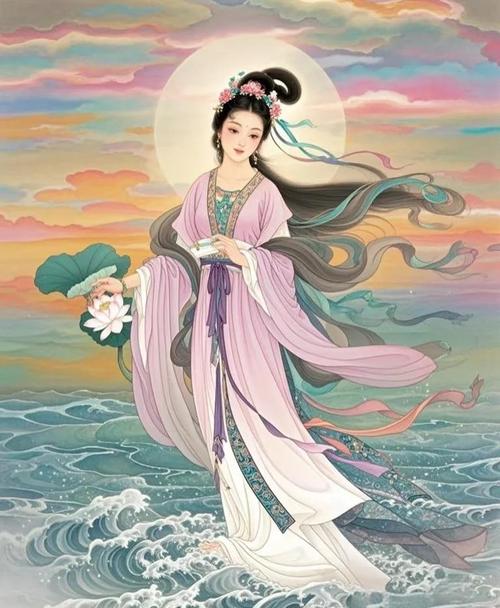
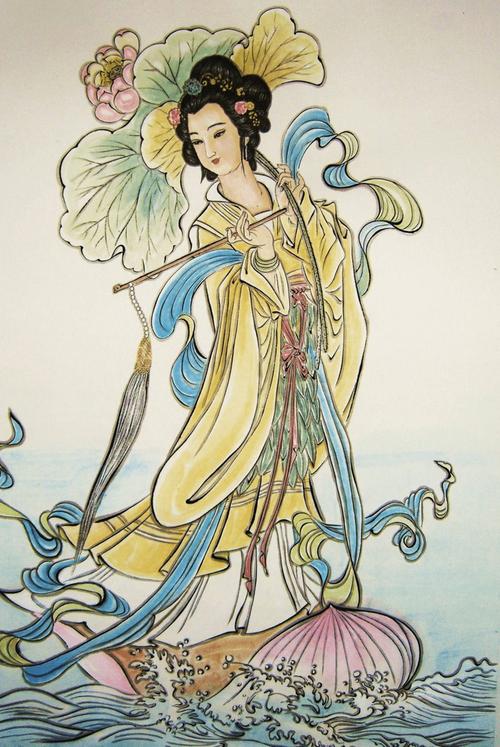
The lotus is He Xiangu’s most famous attribute. The British Museum notes that she usually carries a lotus flower or flower basket.
In Chinese culture, the lotus often symbolizes purity because it grows from mud yet produces a clean and beautiful blossom. This makes it a fitting symbol for spiritual cultivation. It suggests that a person may live in an imperfect world without being spiritually corrupted by it.
For He Xiangu, the lotus reinforces her identity as an immortal of purity and moral refinement. It also connects her with broader Buddhist and Daoist visual cultures, where lotus imagery often appears in relation to transcendence, spiritual awakening, and sacred presence.
The Flower Basket
In some images, He Xiangu carries a flower basket rather than a single lotus. The basket may suggest abundance, healing herbs, natural beauty, and the gathering of spiritual or medicinal gifts.
This image also softens her power. She does not carry a sword, thunderbolt, or weapon. Her emblem is natural, gentle, and restorative.
The Peach
Sometimes He Xiangu is shown with a peach. In Chinese symbolism, peaches often relate to longevity and immortality, especially through stories of the Queen Mother of the West, Xiwangmu, and her peaches of immortality. The British Museum also notes that He Xiangu may occasionally carry a peach.
When He Xiangu appears with a peach, the image emphasizes long life, spiritual nourishment, and the immortal realm.
The Sheng Reed Organ
Less commonly, she may be shown with a sheng, a Chinese reed-pipe instrument. This association is not as famous as the lotus, but it appears in art-historical descriptions. The sheng may connect her to harmony, ritual sound, and refined culture.
Symbolism and Cultural Meaning
Purity Without Escapism
He Xiangu’s purity should not be understood as weakness or passivity. In her legend, purity is a form of spiritual strength. She withdraws from ordinary desire, but she does not abandon compassion.
This is why the herb-gathering motif matters. She is transformed, yet still connected to care. Her story suggests that spiritual refinement should produce benefit, not indifference.
Feminine Spiritual Power
He Xiangu is important because she gives female form to the ideal of immortality. Chinese mythology includes many powerful female figures, including Xiwangmu, Nüwa, Chang’e, Guanyin in Buddhist devotion, and various local goddesses. He Xiangu belongs to this wider world of female sacred imagery, but her role is distinctive because she is embedded within the Eight Immortals.
She is not presented mainly through marriage, motherhood, or political authority. Her identity is spiritual attainment.
The Mountain and the Natural World
Mountains are central to Daoist imagination. They are places of retreat, transformation, hidden masters, medicinal plants, and contact with the immortal realm. He Xiangu’s movement through hills and mountains places her within this sacred geography.
Her story reflects an older Chinese idea: the natural world is not merely scenery. It can be a field of cultivation, revelation, and transformation.
He Xiangu in Chinese Art and Popular Culture
He Xiangu appears in temple imagery, paintings, porcelain, woodblock prints, bamboo carvings, and decorative arts. She is often immediately recognizable because of the lotus. The National Palace Museum’s Qing dynasty bamboo carving of He Xiangu shows how the figure was represented as part of an Eight Immortals set, demonstrating her presence in elite and decorative art traditions.
The Eight Immortals also appear in the famous story pattern known as “The Eight Immortals Crossing the Sea” 八仙过海. In this tale, each immortal uses his or her own magical object or power to cross the sea. The phrase later became a Chinese idiom meaning that each person displays their own special ability. A modern cultural article notes He Xiangu as the only female among the eight and associates her with a magic lotus.
This story helps explain why the Eight Immortals remain culturally familiar. They are not confined to religious texts. They appear in idioms, festivals, folk art, opera, novels, and everyday decorative motifs.
Common Misunderstandings
Misunderstanding 1: He Xiangu Is a Fictional “Fantasy Character” Only
He Xiangu is mythological, but calling her merely a fantasy character misses her cultural role. She belongs to a living tradition of folklore, Daoist symbolism, religious art, and popular storytelling. Her stories may not be historical biography, but they carry cultural meaning.
Misunderstanding 2: He Xiangu Was Definitely a Historical Person
At the same time, it is also misleading to present He Xiangu as a verified historical person. Different birthplace traditions and variant legends show that her figure developed through folklore and religious imagination. It is safer to describe her as a legendary immortal associated with possible historical settings, not as a documented historical individual.
Misunderstanding 3: She Is Simply a “Chinese Goddess”
The word “goddess” can be useful for beginners, but it is imprecise. He Xiangu is better understood as a female immortal or Daoist immortal. She is a sacred or semi-divine figure in Chinese mythological tradition, but her identity is different from that of a creator goddess or supreme deity.
Misunderstanding 4: The Lotus Means Only Beauty
The lotus is beautiful, but its symbolism is deeper. It suggests purity, spiritual refinement, and transcendence. In He Xiangu’s case, the lotus helps communicate her moral and spiritual identity.
Misunderstanding 5: Her Story Has One Official Version
Like many Chinese myths, He Xiangu’s story has multiple versions. Different regions, temples, books, and art traditions preserve different details. A serious mythology guide should recognize these variations rather than force them into one rigid narrative.
Why This Figure/Story Still Matters
He Xiangu still matters because her story speaks to several enduring human questions.
First, her legend asks what it means to live purely in an imperfect world. The lotus grows from mud but remains unstained. He Xiangu’s story gives that idea a human form.
Second, she represents spiritual attainment outside conventional power. She is not a king, general, or wealthy aristocrat. Her importance comes from virtue, transformation, and closeness to nature.
Third, she gives English-speaking readers a doorway into Chinese ideas of immortality. The xian is not the same as a superhero, angel, or vampire-like immortal. The xian is tied to cultivation, refinement, landscape, and harmony with the Dao.
Fourth, He Xiangu shows that Chinese mythology is not only about dragons, emperors, and cosmic battles. It also includes quiet figures of healing, moral beauty, and spiritual aspiration.
Finally, her image remains visually powerful. A young immortal holding a lotus is simple enough to recognize, yet rich enough to invite deeper interpretation.
He Xiangu and the Meaning of Immortality
In modern English, “immortality” usually means endless life. In Chinese mythology, immortality is more layered. It may include long life, spiritual transformation, freedom from ordinary decay, access to celestial realms, or harmony with cosmic principles.
He Xiangu’s immortality is not presented as technological life extension or physical invincibility. It is a change of being. Her body becomes light; her relationship to food changes; she moves through mountains; she gathers healing herbs; she eventually joins a group of transcendent beings.
This kind of immortality is moral and symbolic as much as physical. The story suggests that the person who lets go of ordinary cravings may become less heavy, less trapped, and more aligned with the natural and spiritual order.
He Xiangu Compared with Other Female Figures in Chinese Mythology
He Xiangu is sometimes grouped mentally with other famous female figures, but her role is distinct.
Chang’e, the moon goddess, is linked with the moon, separation, and the elixir of immortality.
Xiwangmu, the Queen Mother of the West, is a powerful goddess associated with immortality, sacred peaches, and divine authority.
Nüwa is a creator and world-repairing goddess.
Guanyin, in Chinese Buddhist devotion, is a bodhisattva of compassion.
He Xiangu is different because she is not primarily cosmic, royal, or salvific. She is a human-like figure who becomes immortal through transformation. This makes her especially approachable. Her story is less about ruling the cosmos and more about cultivating the self.
How to Understand He Xiangu Respectfully
For readers new to Chinese mythology, the best approach is to read He Xiangu on several levels at once.
As folklore, she is a memorable character in the Eight Immortals cycle.
As religious imagery, she reflects Daoist ideas of immortality and transcendence.
As cultural symbolism, she represents purity, healing, femininity, and moral cultivation.
As art history, she is an identifiable figure in Chinese visual tradition.
As literature, she belongs to a flexible story world where different versions can coexist.
This layered reading avoids two common mistakes: treating the story as literal history, or dismissing it as meaningless fiction.
FAQ
Who is He Xiangu?
He Xiangu is a female immortal in Chinese mythology and one of the Eight Immortals, or Baxian. She is usually shown holding a lotus flower and is associated with purity, healing, and spiritual cultivation.
What is the Chinese immortal He Xiangu story about?
The Chinese immortal He Xiangu story usually tells of a young woman who receives a dream or divine instruction, consumes a sacred mineral substance, becomes light and ethereal, gathers herbs, and eventually becomes one of the Eight Immortals.
Is He Xiangu the only female Eight Immortal?
In the standard modern understanding, He Xiangu is the only clearly female member of the Eight Immortals. Some traditions treat Lan Caihe as gender-ambiguous, but He Xiangu is the group’s consistently female figure.
What does He Xiangu’s lotus mean?
The lotus symbolizes purity, spiritual refinement, and transcendence. It grows from mud but blossoms cleanly, making it a powerful symbol for moral and spiritual cultivation.
Was He Xiangu a real historical person?
There is no secure historical evidence that He Xiangu was a documented historical person in the modern sense. Her story belongs mainly to mythology, folklore, Daoist tradition, and cultural memory.
Where was He Xiangu from?
Different traditions give different origins. Some associate her with Zengcheng in Guangdong, while others connect her with Yongzhou in Hunan. This regional variation is common in Chinese mythology.
What is He Xiangu’s role among the Eight Immortals?
He Xiangu brings feminine spiritual power, purity, healing symbolism, and balance to the Eight Immortals. She is often recognized by her lotus flower.
Is He Xiangu a Daoist deity?
She is best described as a Daoist immortal or mythological immortal associated with Daoist tradition. Calling her a deity is understandable in broad terms, but “female immortal” is more precise.
Conclusion
The Chinese immortal He Xiangu story is one of the most graceful and accessible legends in the Eight Immortals tradition. It tells of a young woman who moves from ordinary life into spiritual transformation, becoming light, pure, and connected with healing nature. Her lotus flower is not just a decorative object; it expresses the central meaning of her legend: purity emerging from the ordinary world.
He Xiangu’s importance lies not in dramatic conquest or divine power, but in quiet transformation. She represents a form of immortality rooted in virtue, natural harmony, compassion, and spiritual refinement. For English-speaking readers exploring Chinese mythology, she offers a valuable introduction to the deeper meaning of the xian: not merely an undying being, but a person transformed by the pursuit of the Dao.
1 thought on “Chinese Immortal He Xiangu Story”
Comments are closed.