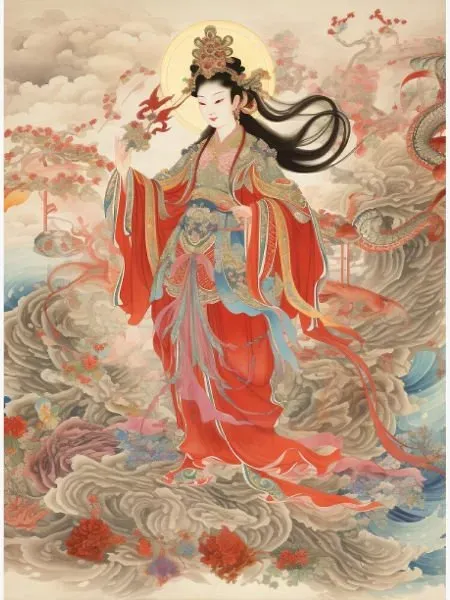
Jiutian Xuannu is one of the most fascinating goddesses in Chinese mythology. Her name is often translated as “Mysterious Lady of the Nine Heavens,” and that title already tells us a lot about her world: she belongs to the highest celestial realms, yet her stories often bring her down to earth, into moments of war, crisis, healing, and human transformation.
Unlike some deities who have one clearly defined role, Jiutian Xuannu is layered. She appears as a divine strategist, a Taoist goddess, a teacher of secret knowledge, a protector in times of danger, and in some traditions, a goddess connected with longevity, sexuality, fertility, alchemy, and cosmic wisdom.
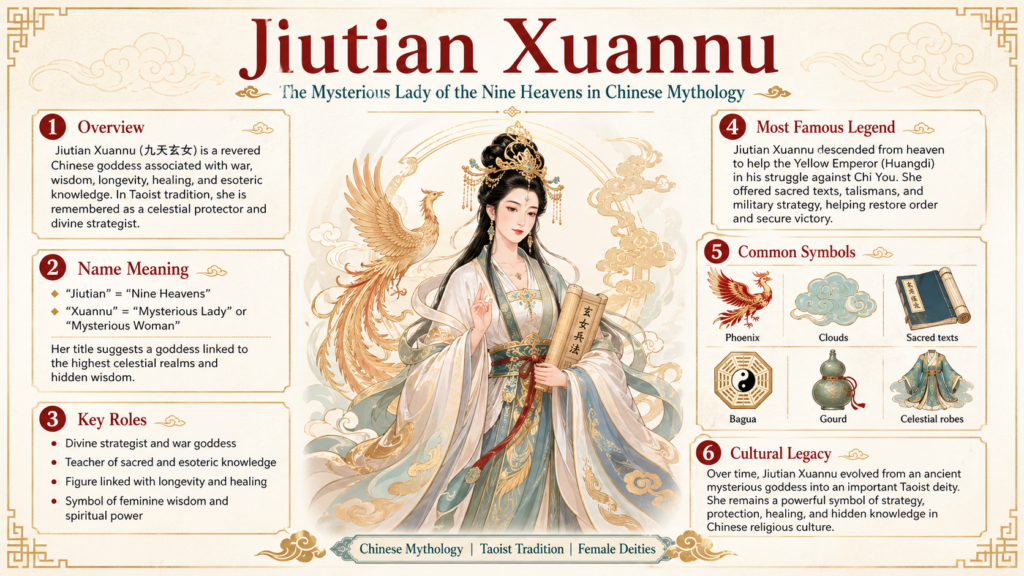
That complexity is exactly what makes her so memorable. Jiutian Xuannu is not simply a “war goddess” in the ordinary sense. She represents a deeper kind of power: the power of hidden knowledge, timing, strategy, spiritual cultivation, and the mysterious forces that connect heaven and the human world.
Who Is Jiutian Xuannu?
Jiutian Xuannu is a major female deity in Chinese mythology and Taoist tradition. She is best known as a celestial goddess who helps legendary heroes overcome impossible challenges, especially through military strategy and esoteric wisdom.
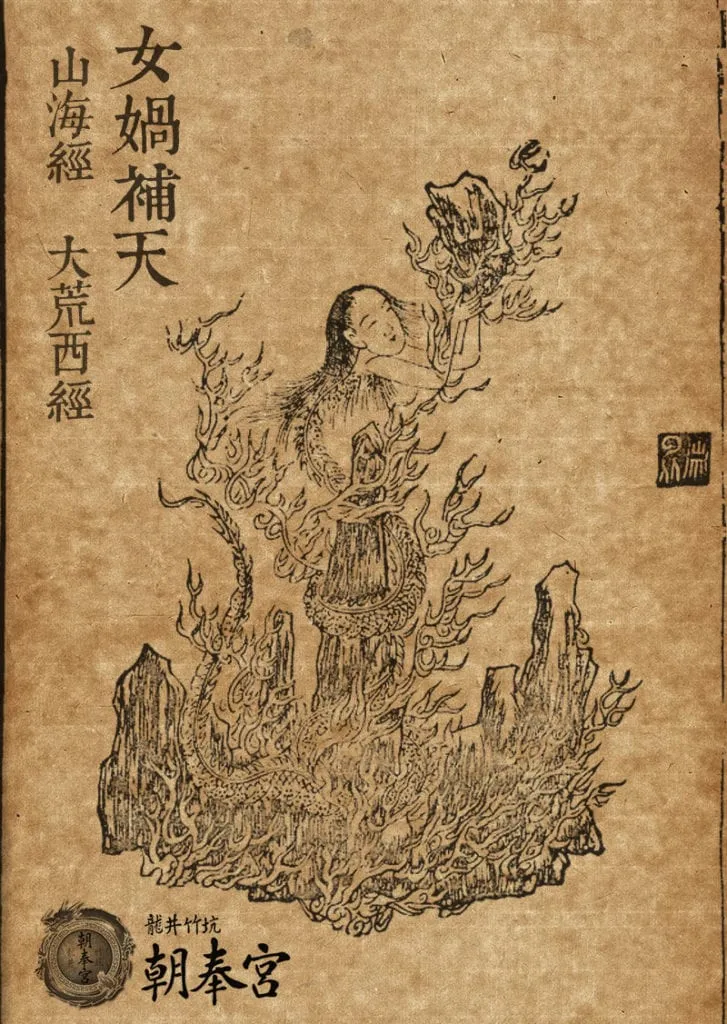
Her most famous myth involves the Yellow Emperor, or Huangdi, during his legendary conflict with Chi You. When Huangdi was struggling against Chi You’s supernatural powers, Jiutian Xuannu descended from heaven and gave him divine teachings, sacred talismans, military methods, and strategic knowledge. With her help, Huangdi was finally able to defeat his enemy.
This story made Jiutian Xuannu a powerful symbol of victory through intelligence rather than brute force. She does not win battles simply by swinging a weapon. She wins through knowledge, discipline, timing, and command of hidden cosmic principles.
What Does the Name Jiutian Xuannu Mean?
The name Jiutian Xuannu is made of two parts:
Jiutian means “Nine Heavens.” In ancient Chinese cosmology, the number nine often represents completeness, celestial authority, and the highest level of power. The Nine Heavens suggest a realm far above the ordinary world, where divine beings and cosmic forces operate.
Xuannu is usually translated as “Mysterious Woman,” “Dark Lady,” or “Mysterious Lady.” The word xuan carries a sense of depth, darkness, mystery, and hidden truth. It is not simply “dark” in a negative sense; it points to something profound and difficult to see clearly.
Together, Jiutian Xuannu means “Mysterious Lady of the Nine Heavens.” It is a fitting name for a goddess who holds secret knowledge and appears at decisive moments in myth.
Jiutian Xuannu and the Yellow Emperor
The most important legend of Jiutian Xuannu centers on her role as the divine helper of Huangdi, the Yellow Emperor.
In the myth, Huangdi faces the fearsome warlord Chi You, a powerful enemy associated with strange weapons, frightening physical traits, and control over storms and mist. Some versions say Chi You received help from wind and rain spirits, making the battlefield nearly impossible for Huangdi’s army to control.
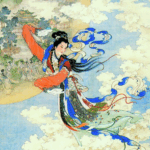
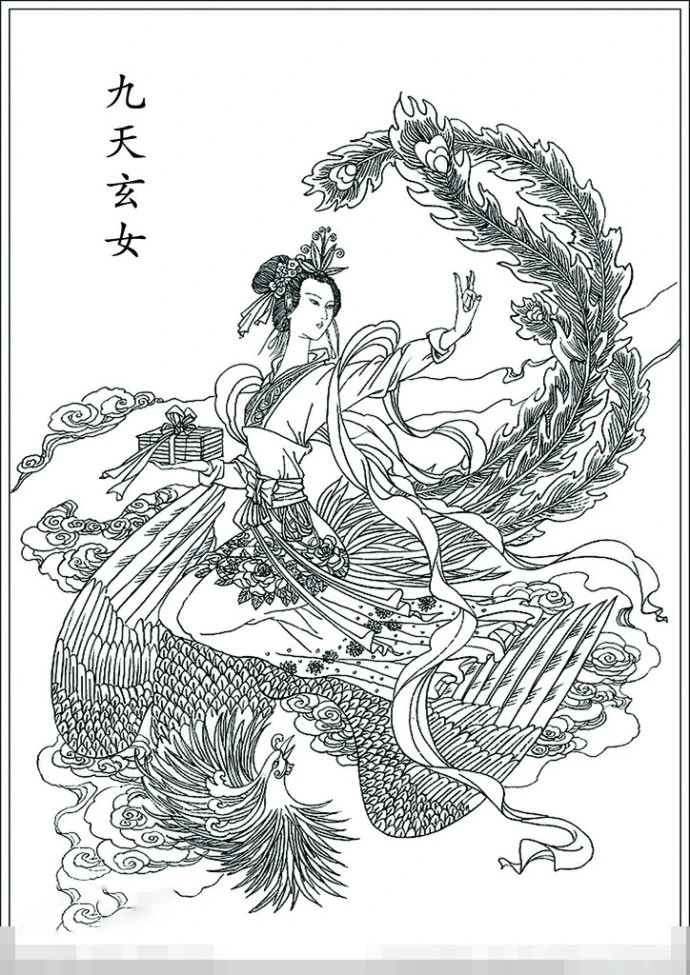
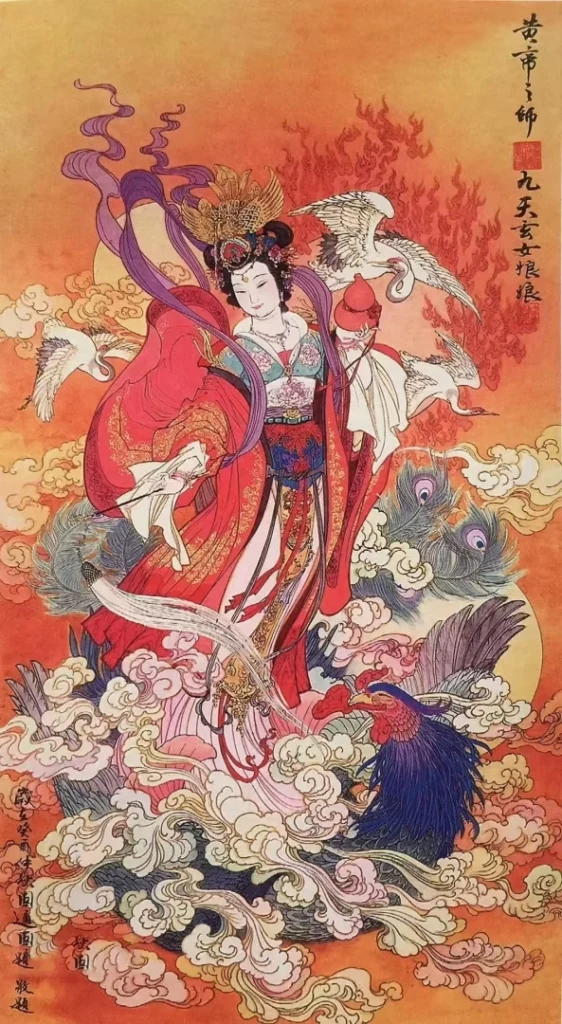
When Huangdi could not find a way to win, Jiutian Xuannu descended from the heavens. In later Taoist descriptions, she appears riding a red phoenix or descending through colorful clouds, dressed in brilliant celestial robes. She gives Huangdi sacred military texts, talismans, magical seals, and knowledge of cosmic strategy.
These gifts are not ordinary weapons. They represent a combination of military science, ritual power, Taoist cosmology, and divine timing. Through Jiutian Xuannu’s teachings, Huangdi learns how to overcome confusion, break through the enemy’s supernatural tricks, and restore order.
This is why Jiutian Xuannu is often remembered as a divine strategist. Her wisdom transforms a losing battle into a legendary victory.
A Goddess of War, But Not Only War
Calling Jiutian Xuannu a goddess of war is accurate, but it is also incomplete.
She is not a goddess of violence for its own sake. Her role is closer to that of a celestial adviser who teaches the proper use of power. In her myths, war is often tied to restoring order, defending the people, or helping a worthy ruler overcome chaos.
This makes her different from many martial figures. She is not just a battlefield deity; she is a teacher of strategy. Her power lies in knowing when to act, how to read the situation, and how to use hidden principles to change the outcome.
For this reason, Jiutian Xuannu became associated with:
- Military strategy
- Sacred talismans
- Taoist ritual knowledge
- Divination and cosmic calculation
- Protection in times of crisis
- Victory through wisdom
In some traditions, she is even honored as one of China’s most extraordinary female military figures—not because she ruled an army in the ordinary historical sense, but because myth presents her as the heavenly source of superior strategy.
Jiutian Xuannu in Taoism
Jiutian Xuannu became especially important within Taoist tradition. Taoism often emphasizes harmony with the cosmos, the cultivation of life energy, the pursuit of longevity, and the discovery of hidden principles beneath the surface of ordinary life.
These themes fit Jiutian Xuannu very well.
In Taoist texts and later religious imagination, she is not only a goddess who helps emperors win wars. She also becomes a keeper of secret arts. Her knowledge may include alchemy, talismans, internal cultivation, healing, breath practices, and methods for harmonizing yin and yang.
This Taoist dimension makes her much more than a mythological character. She becomes a symbol of esoteric wisdom—the kind of knowledge that is not casually available, but revealed only at the right moment to the right person.
Jiutian Xuannu and the Xuannü Jing
One of the more complex parts of Jiutian Xuannu’s tradition is her connection with sexuality and longevity.
In some ancient texts, especially those associated with sexual cultivation, Xuannu appears as a teacher of sexual wisdom. The Xuannü Jing, or Classic of the Mysterious Woman, is linked to this tradition. These teachings were not necessarily understood in a modern romantic sense. In early Chinese medical and Taoist contexts, sexuality could be discussed as part of health, vitality, reproduction, and the balance of life energy.
This side of Jiutian Xuannu made her a somewhat controversial figure in later history. Some periods tried to soften or remove the more sexual elements of her image, especially when religious writers wanted to present her primarily as a dignified celestial goddess or military strategist.
Still, this older layer is important. It shows that Jiutian Xuannu’s power was not limited to war. She was also connected with life itself: fertility, vitality, health, and the mysterious forces that sustain the body.
Jiutian Xuannu, Longevity, and Healing
Jiutian Xuannu is also associated with longevity and healing traditions. In Taoist and folk belief, she may be connected with alchemy, medicine, breath cultivation, and the preservation of life energy.
This is one reason she sometimes appears as a goddess of health and protection. In some folk traditions, people turn to her not only for victory or wisdom, but also for blessings related to healing, children, and family well-being.
Her connection with alchemy is especially meaningful. Chinese alchemy was not only about making elixirs. It was also about transformation—turning the ordinary into the refined, the mortal into the immortal, the chaotic into the balanced. Jiutian Xuannu, as a goddess of hidden knowledge, naturally became linked with this kind of transformation.
The Symbolism of the Mysterious Bird
Some traditions connect Jiutian Xuannu with the ancient image of the xuanniao, or “mysterious bird.” This is especially interesting because the mysterious bird appears in early Chinese cultural memory, including stories connected with the origins of the Shang dynasty.
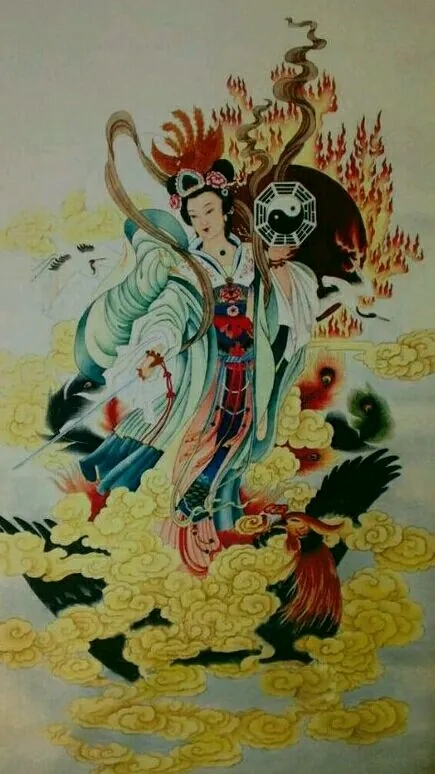
In the famous ancient tradition, a heavenly bird descends and becomes linked to the birth of Xie, an ancestral figure of the Shang people. Because of this, later religious and folk interpretations sometimes connect the mysterious bird with Jiutian Xuannu.
This bird symbolism gives her an older, more primal quality. Before she is imagined as a beautiful celestial woman in flowing robes, she may also be remembered through bird imagery: a being who descends from heaven, brings life, and connects human dynasties with divine origins.
That is why some images of Jiutian Xuannu include bird-like or phoenix-like elements, especially in headdresses or temple iconography.
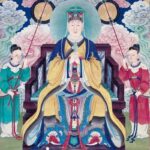
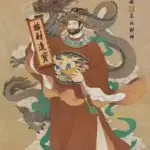
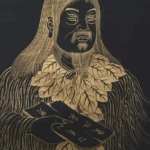
How Jiutian Xuannu Is Depicted in Art
In art and religious imagery, Jiutian Xuannu is usually shown as a graceful yet authoritative goddess.
She may wear elegant robes, often in white or richly colored celestial garments. Some descriptions emphasize her beauty, pale skin, refined features, and noble bearing. In literary works, she can appear with elaborate hair ornaments, dragon and phoenix motifs, jade objects, and garments decorated with gold thread.
Common visual symbols associated with Jiutian Xuannu include:
- A phoenix or bird imagery
- Flowing celestial robes
- A sword or military object
- A talisman or sacred text
- A bagua symbol
- A gourd, linked with medicine or alchemy
- Clouds, stars, and heavenly patterns
These symbols reflect her many identities: warrior, healer, Taoist teacher, strategist, and celestial protector.
Jiutian Xuannu in Folk Religion
In folk belief, Jiutian Xuannu can be honored as a protective and powerful goddess with many functions. In some regions, she is associated with childbirth, healing, family blessings, fortune, and protection from danger.
In Taiwan, her worship has developed distinctive local forms. She may be known by titles such as Jiutian Niangniang, Jiutian Shengmu, or Lianli Ma. Some traditions even describe multiple forms or ranks of the goddess, showing how her worship has adapted to local religious life.
This is one reason Jiutian Xuannu remains so interesting: she is not frozen in a single ancient text. Her image has changed over time. She has been a mysterious bird, a Taoist immortal, a heavenly strategist, a teacher of alchemy, a fertility-related goddess, and a general protector of human life.
Why Jiutian Xuannu Still Matters Today
Jiutian Xuannu remains meaningful because she represents a rare combination of feminine power, intelligence, mystery, and spiritual authority.
In many mythologies, female figures are often limited to motherhood, beauty, or romance. Jiutian Xuannu breaks that pattern. She is beautiful, but beauty is not her main power. Her deeper strength is wisdom. She teaches emperors. She changes the outcome of wars. She guards secret knowledge. She stands at the intersection of body, spirit, strategy, and cosmic order.
For modern readers, Jiutian Xuannu can be understood as a symbol of:
- Strategic intelligence
- Feminine authority
- Hidden wisdom
- Transformation
- Protection
- Balance between strength and insight
She is not easy to define, and that is part of her appeal. Jiutian Xuannu belongs to the Nine Heavens, but her stories speak to very human concerns: how to survive crisis, how to use power wisely, how to transform difficulty into victory, and how to find guidance when the path ahead is unclear.
Final Thoughts
Jiutian Xuannu is one of the most complex goddesses in Chinese mythology. She is a war goddess, but also a healer. She is a strategist, but also a mystical teacher. She is connected with ancient bird symbolism, Taoist secrets, longevity practices, fertility traditions, and celestial protection.
Her most famous story—helping the Yellow Emperor defeat Chi You—captures her essential character. When chaos overwhelms the human world, Jiutian Xuannu descends from the Nine Heavens with knowledge that changes everything.
That is why she continues to stand out among Chinese mythological figures. She is not merely powerful. She is mysterious, strategic, and wise.
FAQ About Jiutian Xuannu
Who is Jiutian Xuannu?
Jiutian Xuannu is a goddess in Chinese mythology and Taoist tradition. She is known as the “Mysterious Lady of the Nine Heavens” and is associated with war, strategy, wisdom, longevity, healing, and esoteric knowledge.
What does Jiutian Xuannu mean?
The name Jiutian Xuannu means “Mysterious Lady of the Nine Heavens.” “Jiutian” means “Nine Heavens,” while “Xuannu” means “Mysterious Woman” or “Mysterious Lady.”
What is Jiutian Xuannu famous for?
She is most famous for helping the Yellow Emperor, Huangdi, defeat Chi You. According to legend, she descended from heaven and taught Huangdi military strategy, sacred methods, and divine techniques that helped him win the battle.
Is Jiutian Xuannu a Taoist goddess?
Yes. Jiutian Xuannu became an important goddess in Taoist tradition. She is associated with sacred knowledge, talismans, alchemy, longevity practices, and cosmic wisdom.
Is Jiutian Xuannu a war goddess?
Yes, Jiutian Xuannu is often described as a war goddess or divine strategist. However, her role is not limited to warfare. She represents wisdom, timing, spiritual knowledge, and the intelligent use of power.
What symbols are associated with Jiutian Xuannu?
Common symbols include the phoenix, mysterious bird, celestial robes, sacred texts, talismans, swords, the bagua, gourds, clouds, and stars. These symbols reflect her roles as a strategist, healer, Taoist goddess, and heavenly protector.
What is the connection between Jiutian Xuannu and the Yellow Emperor?
Jiutian Xuannu is said to have helped the Yellow Emperor during his war against Chi You. She gave him divine military teachings and sacred objects, allowing him to defeat his powerful enemy.
Why is Jiutian Xuannu important in Chinese mythology?
Jiutian Xuannu is important because she combines several major themes in Chinese mythology: war, wisdom, Taoist secrets, longevity, fertility, healing, and celestial authority. She is one of the most powerful and multidimensional female deities in Chinese tradition.