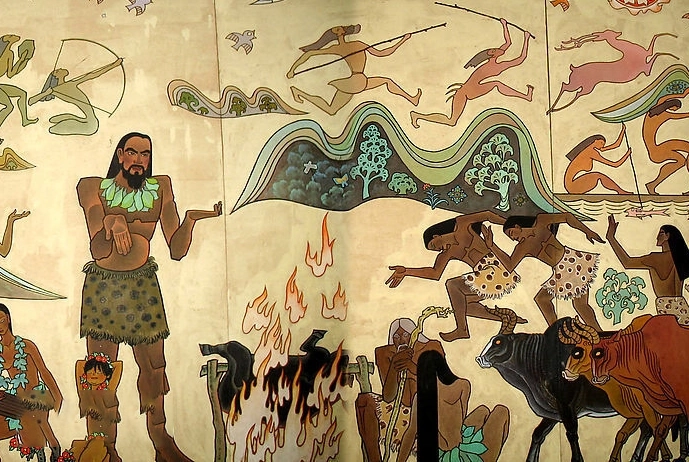
Fuxi in Chinese Mythology
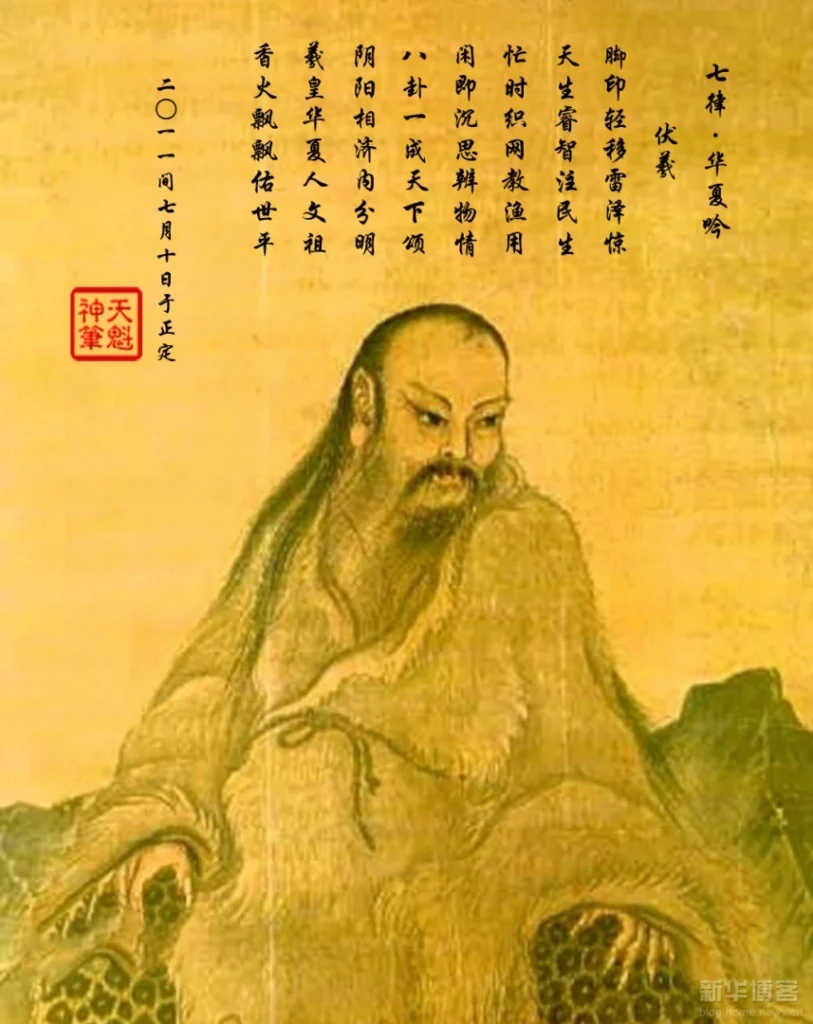
Fuxi, written 伏羲 and also spelled Fu Xi or Fu Hsi, is a legendary culture hero and ancestral sovereign in Chinese tradition. He is commonly counted among the Three Sovereigns and is traditionally credited with the Eight Trigrams and several early civilizing arts, although these attributions come from different texts and historical periods.
Fuxi at a Glance
| Chinese name | 伏羲 |
|---|---|
| Pinyin | Fúxī, approximately pronounced “foo-shee” |
| Alternative spellings | Fuxi, Fu Xi, Fu Hsi, Fu-hsi; older textual forms include Baoxi or Paoxi |
| Main roles | Culture hero, ancestral sovereign, legendary ruler and civilizing sage |
| Associated traditions | The Three Sovereigns, the Eight Trigrams, the Yijing tradition, ancestral worship and early Chinese cosmology |
| Common symbols | Bagua trigrams, fishing net, ruler or carpenter’s square, intertwined serpent tail |
| Related figures | Nuwa, Shennong, Pangu and Taihao |
| Historical or mythological status | A legendary and mythological figure, not a securely documented historical monarch |
Who Is Fuxi in Chinese Mythology?
Fuxi is remembered as a founder of human culture rather than simply as a supernatural being. Traditional narratives place him near the beginning of organized society, where he observes patterns in heaven, earth, animals and the human body and converts those observations into useful forms of knowledge.
His importance lies in the transition he represents: from unstructured survival to fishing, animal management, social customs, measurement and symbolic thought. This is why “culture hero” is often the most useful English description of Fuxi.
He can also appear as a divine ancestor, an ancient sovereign or a religious figure. These identities developed in different textual, ritual and artistic settings and should not be reduced to one rigid biography.
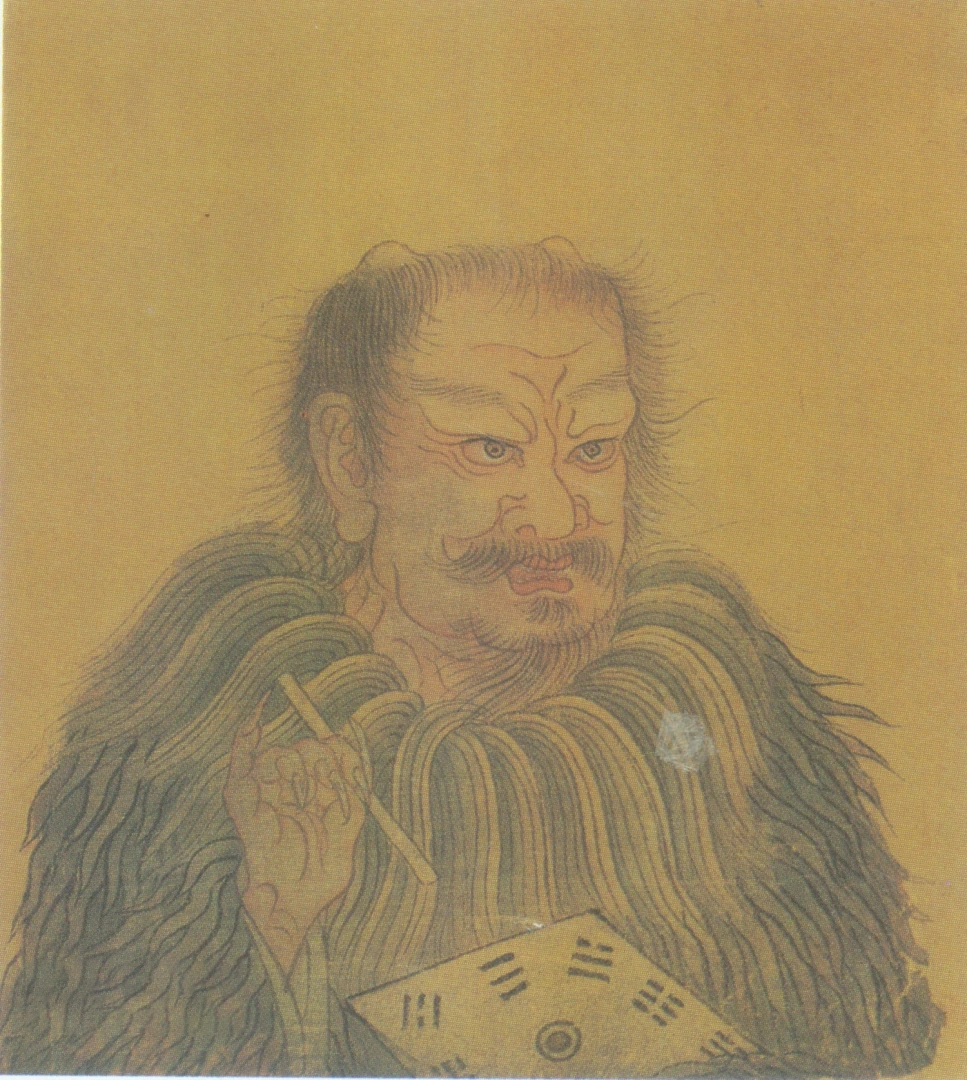
Fuxi Name, Chinese Characters and Pronunciation
Fuxi is written 伏羲 and pronounced Fúxī in modern Mandarin. “Fuxi” and “Fu Xi” are two ways of spacing the same pinyin name. “Fu Hsi” or “Fu-hsi” reflects the older Wade–Giles romanization and does not refer to a different figure.
Classical and later sources also preserve forms such as Baoxi or Paoxi, often written 包犧, 庖犧 or related variants. These name forms are evidence of a long and complicated textual history.
The individual character 伏 has ordinary meanings such as bending down, hiding or submitting, but the compound 伏羲 does not have a universally accepted literal translation. Claims that the name has one precise mystical meaning should therefore be treated cautiously.

Is Fuxi a God, Emperor or Culture Hero?
All three descriptions can be appropriate, but they refer to different ways of remembering him. In temples and religious art, Fuxi may be honored as a deity or sacred ancestor. In traditional histories, he appears as a primordial sovereign. In mythology studies, he is usually described as a culture hero because his defining acts establish knowledge, tools and social order.
Fuxi is sometimes called a creator figure, particularly when paired with Nuwa, but he should not be presented as the single creator god of all Chinese mythology. Chinese origin traditions are plural and include several different explanations of the cosmos, humanity and civilization.
Fuxi and the Three Sovereigns
Fuxi is commonly counted among the Three Sovereigns, or Sanhuang, a group of primordial rulers placed before the Five Emperors in traditional accounts of remote antiquity.
There was never only one universally accepted list. Fuxi may be grouped with Nuwa and Shennong, while other traditions include Suiren, the Yellow Emperor or different cosmic rulers. The variation reflects the fact that the category was assembled and reinterpreted by multiple authors and schools.
It is therefore accurate to say that Fuxi is “commonly one of the Three Sovereigns,” but misleading to present a single list as the uncontested version throughout Chinese history.
Fuxi and the Eight Trigrams
The strongest and most enduring association of Fuxi is with the bagua, or Eight Trigrams. Each trigram consists of three solid or broken lines. The eight forms are known as Qian, Kun, Zhen, Xun, Kan, Li, Gen and Dui and became important in the interpretive tradition surrounding the Yijing, or Book of Changes.
The received Great Commentary, also called the Xici, says that the ancient Baoxi observed patterns in heaven and earth, markings on birds and animals, and correspondences near and far. He then made the Eight Trigrams to communicate with spiritual powers and classify the conditions of the myriad things.
Did Fuxi Invent the Bagua?
According to traditional accounts, yes: Fuxi is the first sage who formulated the Eight Trigrams. From a modern historical perspective, however, this is a cultural attribution rather than proof that one identifiable individual invented the symbols.
The core divination text of the Zhouyi does not contain a biography of Fuxi. His authorship belongs to later explanations of how the trigrams originated. Stories about a dragon-horse emerging from a river, a mysterious diagram or markings on a tortoise belong to additional layers of legend and should not be merged into one original account.
The arrangement commonly called the “Fuxi Bagua” or “Earlier Heaven Bagua” is likewise a later diagrammatic tradition named after him. Its title expresses symbolic authority, not demonstrable personal authorship.
Civilizing Inventions Attributed to Fuxi
Lists of Fuxi’s inventions expanded over time. They should be presented as traditional attributions from different textual periods, not as a verified catalogue of one historical ruler’s achievements.
| Attributed achievement | How it should be understood |
|---|---|
| Fishing and hunting nets | The Great Commentary associates Baoxi with knotting cords into nets for hunting and fishing. The popular spider-web origin story is a later narrative elaboration, not part of that passage. |
| Animal domestication | Later civilizing traditions credit Fuxi with managing or raising animals, symbolizing a move from uncertain hunting toward organized subsistence. |
| Marriage customs | Some later texts and legends make him the founder of regulated unions, kinship or wedding rites. These accounts reflect later concerns about family and social order. |
| Music | Fuxi is linked with stringed instruments such as the qin or se, but other legendary rulers receive the same credit in competing traditions. |
| Writing or recordkeeping | Some accounts connect the trigrams with early signs or the replacement of knotted cords. This should not be confused with a proven invention of Chinese writing; Cangjie is more commonly named in script-origin legends. |
The common theme is more important than the length of the list. Fuxi embodies the idea that civilization begins when observation is converted into repeatable knowledge, shared rules and meaningful symbols.
Fuxi and Nuwa
Fuxi and Nuwa are among the best-known paired figures in Chinese myth and art. Depending on the source, they may be described as siblings, spouses, complementary deities or joint ancestors of humanity.
These relationships do not form a single doctrine shared by every Chinese tradition. Some early accounts treat the two figures separately, while later flood-survivor stories and regional traditions make them brother and sister who marry to renew the human population.
Nuwa is more directly associated with shaping human beings and repairing the damaged sky. Fuxi is more consistently associated with trigrams, social order and civilizing skills. Their roles overlap, but they should not be treated as interchangeable. Read the separate guide to Nuwa in Chinese mythology.
Why Fuxi and Nuwa Have Serpent-Like Bodies
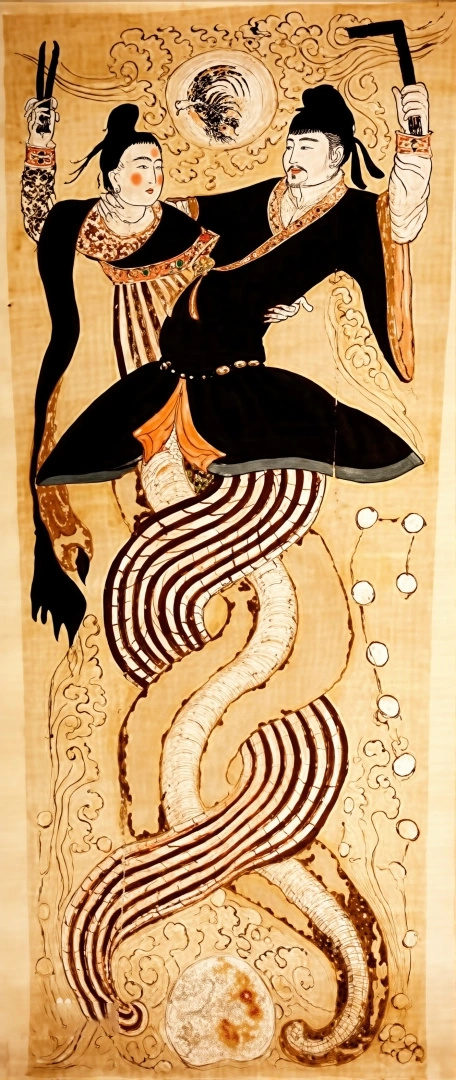
Han and later funerary images frequently show Fuxi and Nuwa with human upper bodies and long serpent- or dragon-like lower bodies. Their tails may be intertwined beneath celestial signs, stars, the sun and the moon.
This imagery should not be interpreted through the Western idea that a serpent automatically signifies temptation or evil. In its Chinese artistic contexts, the paired form is associated with primordial ancestry, reproduction, celestial order and the union of complementary powers.
In some tomb programs, the intertwined bodies can evoke the joining of yin and yang, the generation of life, protection of the deceased or participation in a heavenly realm. The precise meaning depends on the period, region and object rather than one universal explanation.
Meaning of the Compass and Carpenter’s Square in Their Art
Fuxi and Nuwa are often shown holding measuring tools: a carpenter’s square or ruler and a compass. Surviving works do not always assign the same tool to the same figure, so descriptions should follow the individual artwork rather than impose a fixed rule.
The compass creates circles, while the square establishes straight lines and right angles. In Chinese cosmological interpretation, they may evoke the traditional pairing of round heaven and square earth. They also symbolize measurement, standards, construction and the transformation of an unordered world into an intelligible one.
These meanings fit the pair’s broader identity as ancestors and makers of cultural order. They are not evidence that Fuxi and Nuwa were literal historical engineers.
Fuxi in Early Texts and Later Tradition
There is no single ancient book containing the complete modern biography of Fuxi. Instead, his identity was assembled in layers.
The Great Commentary to the Yijing provides the influential account of Baoxi observing the world, creating the trigrams and making nets. Late Zhou and Han intellectual traditions increasingly placed ancient sages into sequences of civilizational development. Han and later writers connected Fuxi with primordial sovereignty, cosmic classifications and the figure Taihao.
Medieval and later sources expanded his family relationships, miraculous origins, musical inventions, marriage rules, writing traditions and local birth or burial sites. Art, temple worship and regional folklore added further variations.
Fuxi Compared with Pangu and Nuwa
Fuxi, Pangu and Nuwa belong to different layers of Chinese origin mythology. Their stories can appear together in modern retellings, but they were not originally parts of one fixed narrative system.
Pangu
Pangu is usually associated with cosmogony: the separation of heaven and earth and the formation of the physical world. See the guide to Pangu and the cosmic egg.
Nuwa
Nuwa is especially associated with the creation of human beings and the repair of the broken sky, although her myths also have several versions.
Fuxi
Fuxi is primarily the organizer of human culture: trigrams, nets, social customs, measurement and the conversion of natural patterns into knowledge.
For the wider range of Chinese cosmogonic and human-origin traditions, see the overview of the Chinese mythology creation story.
Fuxi in Temples, Art and Modern Cultural Memory
Fuxi remains visible in temples, ancestral ceremonies, museum collections, local festivals and popular discussions of the Yijing. Tianshui in Gansu and Huaiyang in Henan are especially prominent centers of Fuxi-related cultural memory, although competing place traditions should not be treated as historical proof of his birthplace or tomb.
In modern culture, Fuxi may be presented as an ancestor of Chinese civilization, a sacred ruler, an inventor or an embodiment of observation and order. His classification also overlaps with broader collections of Chinese gods and, in some religious settings, Taoist deities.
His continuing significance comes less from establishing whether every invention literally belonged to one person than from the cultural idea he represents: humanity learning to recognize patterns and build a shared world from them.
Frequently Asked Questions
Who is Fuxi in Chinese mythology?
Fuxi is a legendary culture hero, ancestral sovereign and civilizing sage. He is commonly included among the Three Sovereigns and is traditionally connected with the Eight Trigrams, fishing nets and early social customs.
Are Fuxi, Fu Xi and Fu Hsi different people?
No. Fuxi and Fu Xi are different ways of spacing the modern pinyin spelling. Fu Hsi is the older Wade–Giles romanization of the same Chinese name, 伏羲.
What does Fuxi mean?
Fuxi is an ancient proper name without one securely established literal English translation. Translating the two characters separately does not necessarily explain the historical meaning of the complete name.
Did Fuxi invent the Eight Trigrams?
Traditional Yijing commentary attributes the creation of the Eight Trigrams to Fuxi or Baoxi. Modern scholarship treats this as a foundational cultural attribution, not verified evidence of a single historical inventor.
What did Fuxi invent?
Different traditions credit him with trigrams, fishing nets, hunting methods, animal domestication, marriage customs, music and forms of recordkeeping. These claims come from different periods and should not be presented as one uniform historical list.
Are Fuxi and Nuwa brother and sister?
They are siblings in some traditions and both siblings and spouses in certain later flood and ancestry myths. Other accounts pair them without providing the same family story, so no single relationship applies to every tradition.
Why are Fuxi and Nuwa shown with snake bodies?
Their intertwined serpent- or dragon-like bodies are usually connected with primordial ancestry, cosmic order, complementary forces and the generation of life. They should not automatically be interpreted as symbols of evil.
Is Fuxi a creator god?
Fuxi can participate in human-origin traditions, particularly with Nuwa, but he is not the only creator figure in Chinese mythology. His most consistent role is the creation of cultural order rather than the creation of the entire cosmos.
Was Fuxi a real historical emperor?
There is no secure historical evidence for a monarch with Fuxi’s legendary biography, dates and inventions. He is best understood as a mythological and culturally remembered ancestral sovereign.