What is a qilin in Chinese mythology? A qilin, written 麒麟 in Chinese and pronounced roughly “chee-lin,” is a legendary creature known for its gentle nature, auspicious meaning, and close connection with virtue and wise rule. In English, it is often called the “Chinese unicorn,” but that translation only tells part of the story.
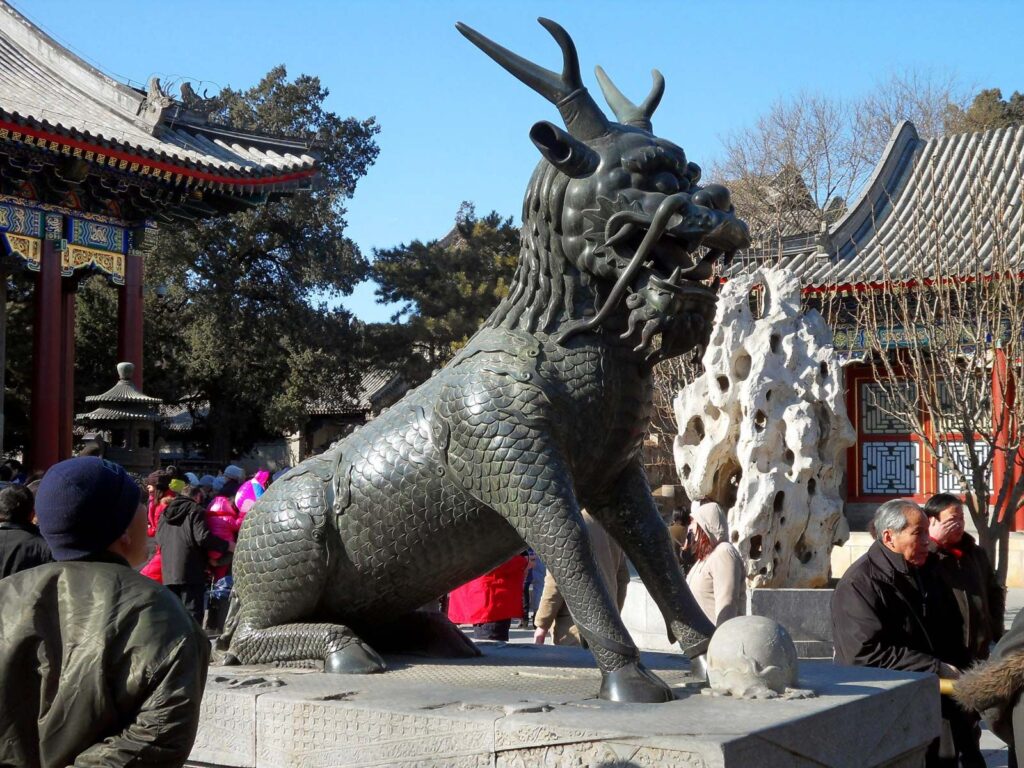
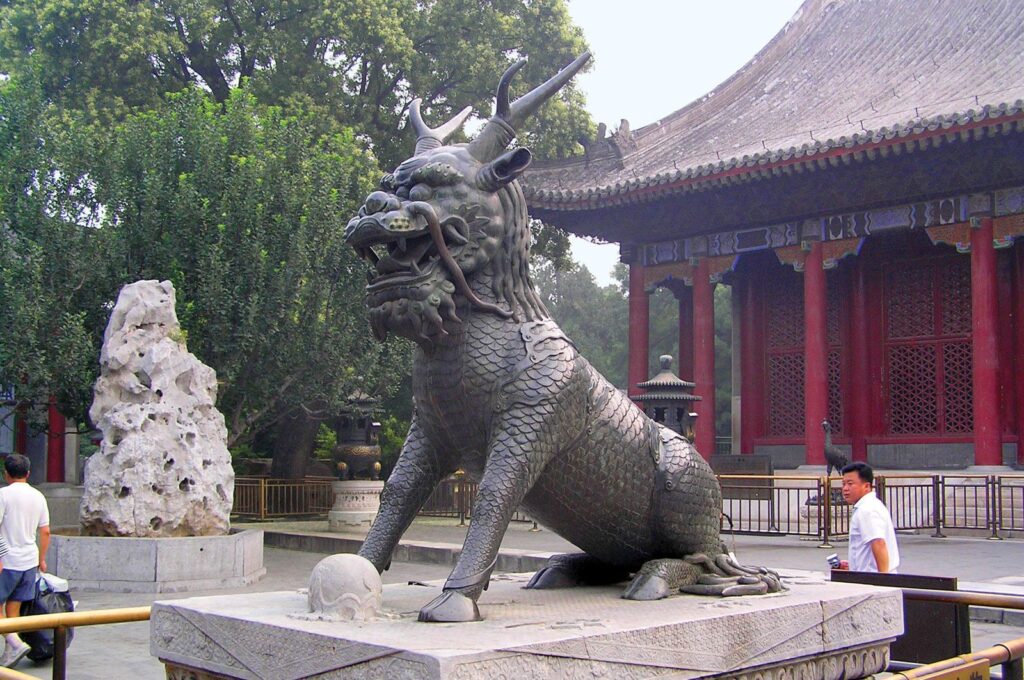
Unlike the Western unicorn, the qilin is not simply a white horse with a horn. Traditional descriptions present it as a composite creature with features that may recall a deer, ox, horse, dragon, or other animals. It can have a horn or horns, a scaled body, a flowing mane, hooves, and sometimes flame-like or cloud-like details in art. More important than its physical form, however, is its moral meaning.
In Chinese mythology and cultural symbolism, the qilin is usually a peaceful and benevolent creature. It is said to appear during the rule of a wise and humane ruler, or around the birth or death of a great sage. For this reason, the qilin is not a monster to be defeated. It is a sign of harmony, righteousness, good fortune, and exceptional virtue.
This guide explains the qilin’s meaning, origins, stories, symbolism, and cultural importance in a clear way for readers new to Chinese mythology.
What Is a Qilin in Chinese Mythology?
A qilin is an auspicious mythical creature in Chinese tradition. It belongs to the world of legendary beasts, but its role is very different from many creatures in fantasy or monster stories. The qilin is not usually portrayed as aggressive, evil, or chaotic. Instead, it represents moral goodness, peaceful power, and the presence of a just order.
The qilin is often grouped with other important Chinese mythical creatures such as the dragon, the phoenix-like fenghuang, and the tortoise. In classical thought, these creatures could symbolize cosmic harmony, good governance, and the ideal relationship between heaven, earth, rulers, and human society.
A simple definition would be:
The qilin is a gentle, auspicious Chinese mythical creature associated with virtue, wise leadership, peace, prosperity, and the birth or presence of great sages.
This definition is more accurate than simply calling it a unicorn. The unicorn comparison helps English readers imagine a horned sacred animal, but the qilin has its own Chinese cultural background, symbolic language, and visual tradition.
What Does the Qilin Look Like?
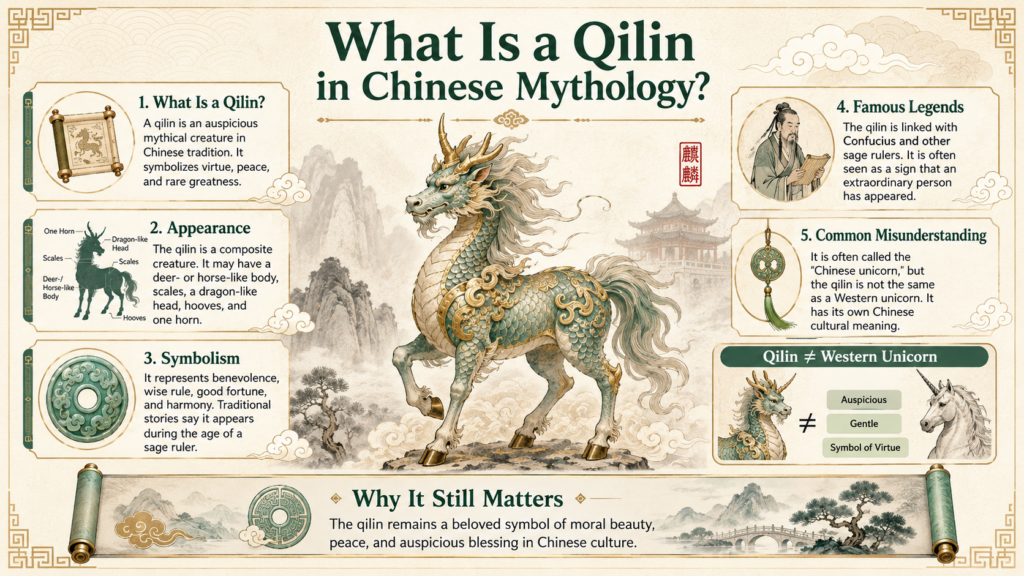
There is no single fixed appearance for the qilin. Like many Chinese mythical creatures, its image changed across time, regions, art forms, and religious or cultural contexts. Still, several common features appear again and again.
A qilin may be described or depicted with:
- The body of a deer, horse, ox, or other hoofed animal
- One horn or sometimes two horns
- Hooves
- A dragon-like head or facial features
- A mane or beard
- Scales or patterned skin
- An ox-like tail
- Flame-like, cloud-like, or jewel-like details
- A noble, calm, and alert posture
In some artworks, the qilin looks almost like a dragon-horse. In others, it appears closer to a deer or a mythical ox. In later Chinese art, especially when influenced by real exotic animals such as giraffes, the qilin could also be shown with a longer neck or more unusual proportions.
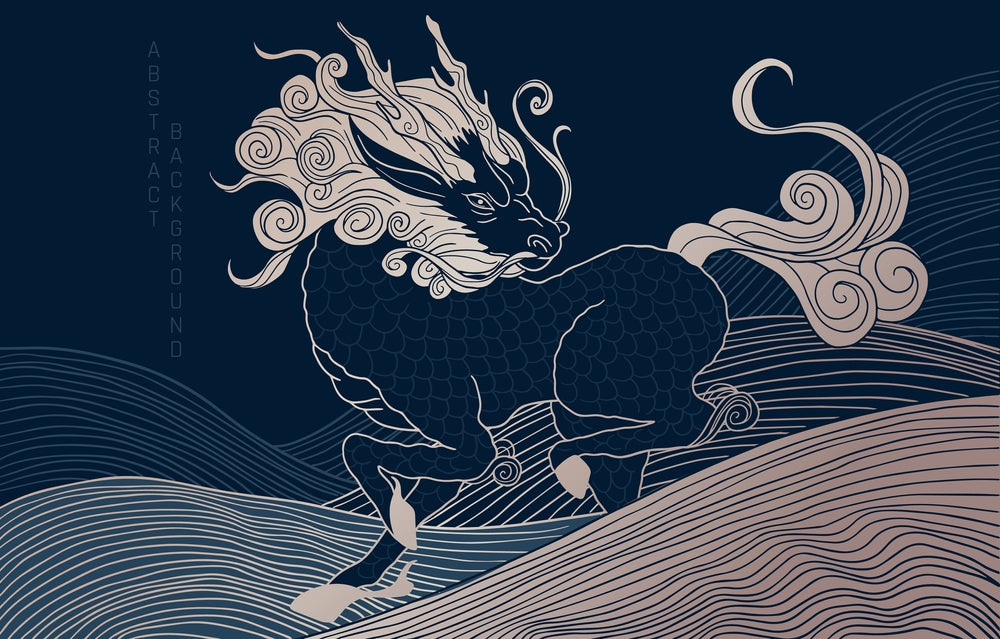
The important point is that the qilin is a composite creature. Its body brings together traits from several animals to express a meaning larger than any single natural species. Like the Chinese dragon, it is not meant to be understood as an ordinary animal. Its hybrid form signals that it belongs to the symbolic and mythological world.
Is the Qilin the Same as a Unicorn?
The qilin is often translated as “Chinese unicorn,” but this can be misleading.
There are similarities. Both the qilin and the Western unicorn can be associated with purity, rarity, and sacred or noble qualities. Both may be imagined as horned creatures. Both are difficult to encounter and carry symbolic meaning beyond their physical appearance.
However, the qilin is not simply the Chinese version of a European unicorn. The Western unicorn is often imagined as a white horse-like animal with a single spiraled horn. The qilin, by contrast, is usually a chimeric creature with a mixture of deer, ox, horse, dragon, and other features. It also belongs to a different cultural system of symbols.
The qilin’s meaning is especially tied to virtue, benevolent government, the birth of sages, peaceful rule, and auspicious signs. It is not mainly a creature of romantic purity or magical fantasy. It is a moral and cultural symbol.
So it is acceptable to say that the qilin is sometimes called the Chinese unicorn, but it is better to explain that the term is only an approximation.
Historical and Cultural Background
The qilin has deep roots in Chinese literary, ritual, and artistic traditions. It appears in classical texts, later legends, decorative arts, official symbols, folk prints, and popular celebrations. Over time, it became one of the most recognizable auspicious creatures in Chinese culture.
In older Chinese thought, extraordinary creatures often served as signs of harmony between the human world and the larger cosmic order. A peaceful realm, a virtuous ruler, or the arrival of a sage could be imagined as causing rare and auspicious beings to appear. The qilin fits this pattern very clearly.
This is why the qilin is often connected with rulership and morality. Its appearance is not random. It signals that something morally important is happening. A ruler may be wise. A child may grow into a great person. A period of peace may be beginning. A sage may be entering or leaving the world.
The qilin was also important in visual culture. It appears in sculpture, textiles, rank badges, ceramics, woodblock prints, and decorative objects. In these contexts, it could symbolize status, auspiciousness, noble birth, or protective blessing.
The Qilin and the Four Auspicious Creatures
In Chinese tradition, the qilin is sometimes discussed alongside other revered creatures, especially the dragon, the fenghuang, and the tortoise. These beings are not merely “animals” in the ordinary sense. They are symbolic creatures that represent ideals of order, virtue, longevity, transformation, and harmony.
The dragon is often associated with power, rain, imperial authority, and cosmic vitality. The fenghuang is associated with harmony, virtue, grace, and renewal. The tortoise is linked with longevity, divination, and stability. The qilin adds another important quality: gentle righteousness.
This grouping helps explain why the qilin is so respected. It is not a minor creature on the edge of mythology. It belongs to the highest level of Chinese auspicious symbolism. It represents the hope that power can be humane, that society can be ordered without cruelty, and that greatness should be guided by virtue.
Main Stories and Legends of the Qilin
The qilin is less famous for one single adventure than for a set of symbolic appearances. Unlike the Monkey King, Nezha, or the Dragon Kings, the qilin is not usually the hero of a long narrative cycle. Instead, its stories are short, meaningful, and often connected with omens.
The Qilin and the Yellow Emperor
One tradition says that a qilin appeared during the time of the Yellow Emperor, or Huangdi. The Yellow Emperor is one of the great legendary culture heroes of ancient China, associated with civilization, rule, invention, and ancestral origins.
In this context, the qilin’s appearance supports the idea that the ruler’s age was marked by virtue and cosmic approval. The creature acts as a sign that the ruler is not merely powerful, but benevolent and worthy.
Whether read as legend, political symbolism, or cultural memory, the message is clear: the qilin appears when rulership is aligned with moral order.
The Qilin and Emperor Yao
Another tradition connects the qilin with Emperor Yao, one of the legendary sage-kings. Yao is remembered in Chinese tradition as an ideal ruler, wise, humble, and concerned with the welfare of the people.
A qilin appearing in such a reign makes symbolic sense. It confirms the idea that the world responds to moral leadership. When government is humane and the ruler is virtuous, even rare and sacred creatures may appear.
This is one reason the qilin became a symbol of good governance. It does not simply mean “luck.” It suggests that luck follows virtue, and that peace depends on moral conduct.
The Qilin and Confucius
The qilin is especially famous for its connection with Confucius, the great Chinese teacher and thinker whose ideas deeply shaped Chinese culture.
In one well-known legend, a qilin appeared before the birth of Confucius. The creature was said to bring or reveal a message foretelling the child’s future greatness. In this story, the qilin becomes a herald of wisdom. It announces that a sage is about to enter the world.
Another tradition connects the qilin with the death of Confucius. A wounded qilin appears as a sorrowful omen, suggesting that an age of true sagehood is coming to an end.
These legends are important because they show the qilin’s emotional and moral range. It is not only a symbol of celebration. It can also mark loss, transition, and the passing of a rare moral presence.
The Qilin as a Symbol of Virtue
The qilin’s deepest meaning is virtue.
Many mythical creatures symbolize strength. Others symbolize danger, mystery, or supernatural power. The qilin is unusual because its power is restrained by gentleness. It may look impressive or even fierce in art, but its character is peaceful.
Traditional descriptions often emphasize that the qilin avoids harm. It does not trample living grass carelessly. It does not harm living creatures. Its gentleness is not weakness, but moral discipline.
This makes the qilin an ideal symbol for civilized power. It suggests that true greatness does not need cruelty. A ruler, scholar, official, or noble person should be strong, but not violent; dignified, but not arrogant; respected, but not feared for brutality.
In this sense, the qilin is one of the most refined moral symbols in Chinese mythology.
The Qilin as an Omen of Wise Rule
The qilin is often described as appearing during the reign of a sage ruler. This idea reflects an older worldview in which heaven, nature, and human society were interconnected. The ruler’s virtue could influence the harmony of the realm, and auspicious signs could reveal that harmony.
A qilin sighting therefore functioned as a powerful political and moral symbol. It suggested that the ruler had achieved a level of benevolence worthy of recognition by heaven and nature.
This is one reason the qilin appears in court culture and official art. It could express legitimacy, noble status, and the ideal of righteous authority. In imperial China, symbols mattered. A creature such as the qilin could communicate rank, virtue, and heavenly favor without needing a long written explanation.
At the same time, this symbolism should be read carefully. In real historical settings, claims about auspicious creatures could also serve political purposes. A court might interpret a rare animal or unusual event as a sign supporting the ruler. The qilin therefore sits at the intersection of mythology, art, politics, and cultural imagination.
The Qilin and the Giraffe in Ming China
One of the most fascinating historical episodes involving the qilin occurred in the Ming dynasty. In 1414, a giraffe was brought to the court of the Yongle Emperor. Because giraffes were unfamiliar in China at the time, court observers associated the animal with the legendary qilin.
This does not mean that the qilin “was really” a giraffe. Rather, it shows how mythological categories could shape the interpretation of foreign animals. The giraffe’s long neck, gentle manner, unusual body, and exotic presence made it possible for officials to identify it with the auspicious creature known from tradition.
The political meaning was also important. If a qilin appeared only under a sagacious ruler, then the arrival of a giraffe interpreted as a qilin could be used to praise the emperor and support his legitimacy.
This episode is a useful reminder that mythology is not separate from history. Myths, symbols, court politics, diplomacy, and art often interact in complex ways.
The Qilin in Chinese Art
The qilin appears in many forms of Chinese art. It can be found on textiles, ceramics, metalwork, paintings, sculptures, and decorative objects. Sometimes it stands alone as an auspicious creature. Sometimes it appears with clouds, flames, waves, precious objects, or other symbols of good fortune.
In official dress, the qilin could appear on rank badges. These badges were not merely decorative. They communicated the status and role of the wearer. The use of the qilin in such contexts shows that the creature was associated with dignity, authority, and elite symbolism.
In other settings, the qilin could be part of household or festival imagery. It was not limited to courtly culture. Like many Chinese auspicious symbols, it moved between elite art and popular visual culture.
The visual style of the qilin could vary widely. Some examples are elegant and restrained. Others are energetic, with flames or supernatural details. But the underlying message usually remains positive: blessing, virtue, protection, and auspicious presence.
Qilin Delivering a Son
One of the most popular folk motifs is “qilin delivering a son,” or qilin songzi in Chinese. In this image, the qilin is associated with the blessing of a gifted child, especially a son who will grow into a talented or honorable person.
This motif appears in New Year pictures and other popular prints. It reflects family hopes for children, continuity, success, and social honor. In traditional society, a child’s future achievement could bring pride and security to the family, so imagery of a qilin bringing a child carried strong emotional meaning.
For modern readers, it is important to understand this motif in its historical context. It reflects traditional family values, ideas of lineage, and hopes for future success. It does not mean the qilin is simply a fertility animal. Its deeper meaning remains connected to virtue, promise, and exceptional destiny.
Is the Qilin a Taoist or Buddhist Creature?
The qilin appears across Chinese culture rather than belonging only to one religious system. It can be found in Confucian moral symbolism, folk belief, court art, auspicious imagery, and broader Chinese mythology. It may also appear in contexts influenced by Taoist or Buddhist visual culture, but it should not be reduced to only one religious category.
Its strongest associations are often Confucian and cultural: sagehood, benevolent rule, virtue, and moral order. However, because Chinese religious and cultural traditions have often overlapped, the qilin can appear in many settings.
This makes the qilin different from a deity with a fixed temple cult or a single doctrinal identity. It is better understood as an auspicious mythological creature whose meanings were flexible, but consistently positive.
Symbolism and Cultural Meaning of the Qilin
The qilin carries several layers of meaning. These meanings often overlap.
Benevolence
The qilin is gentle and avoids harming life. This makes it a symbol of kindness and humane conduct.
Righteousness
The qilin is associated with moral correctness. It appears when virtue is present and when leadership is just.
Wise Rule
Because the qilin appears during the age of a sage ruler, it became a symbol of good governance and political legitimacy.
Peace
The qilin is not a creature of war or destruction. It represents harmony, calm strength, and social order.
Good Fortune
Like many auspicious Chinese creatures, the qilin can symbolize blessing, prosperity, and favorable destiny.
Noble Children
Through the motif of qilin delivering a son, the creature became associated with the birth of talented and virtuous children.
Rare Greatness
Because the qilin rarely appears, it symbolizes something exceptional. Its presence marks a person, event, or age as extraordinary.
Common Misunderstandings
Misunderstanding 1: The qilin is just a Chinese unicorn
Calling the qilin a Chinese unicorn is common, but incomplete. The qilin is a hybrid auspicious creature with its own Chinese symbolic tradition. It may have a horn, but it is not simply a horse with a horn.
Misunderstanding 2: The qilin is a dragon
The qilin may have dragon-like features, especially in art, but it is not the same as a dragon. The dragon is usually connected with power, rain, imperial authority, and cosmic energy. The qilin is more closely connected with virtue, peace, and benevolent rule.
Misunderstanding 3: The qilin is a monster
In many English fantasy settings, a strange creature is automatically treated as a monster. The qilin should not be read this way. It is usually benevolent and auspicious, not evil or destructive.
Misunderstanding 4: The qilin always looks the same
There is no single standard design. Qilin images vary across dynasties, regions, and art forms. Some look deer-like, some dragon-like, some horse-like, and some are influenced by giraffes.
Misunderstanding 5: The qilin belongs only to religion
The qilin appears in religious, moral, artistic, political, and folk contexts. It is not limited to one tradition such as Taoism or Buddhism.
Misunderstanding 6: The giraffe proves the qilin was based on a real animal
The Ming dynasty association between giraffes and qilin is historically interesting, but it does not prove that the qilin was originally just a giraffe. It shows how people used existing mythological symbols to interpret an unfamiliar animal.
Why This Figure Still Matters
The qilin still matters because it offers a different model of mythical power.
Many mythological creatures around the world represent danger, conquest, or supernatural violence. The qilin represents power under moral control. It is impressive but gentle, rare but protective, supernatural but ethical.
For readers interested in Chinese mythology, the qilin also opens a door into Chinese symbolic thinking. It shows how animals, rulers, sages, family hopes, and cosmic order could be connected through imagery. A single creature could speak to politics, morality, art, and everyday blessing.
The qilin also remains culturally recognizable in East Asia and beyond. Related forms appear in Japan as kirin, in Korea, Vietnam, and other regions influenced by Chinese culture. In modern popular culture, the name and image of the qilin continue to appear in games, fiction, branding, and art.
Understanding the qilin helps readers avoid flattening Chinese mythology into dragons alone. Chinese mythological creatures are diverse. Some are cosmic, some protective, some frightening, some humorous, and some deeply moral. The qilin belongs to the moral and auspicious side of that tradition.
Qilin Compared with Other Chinese Mythical Creatures
The qilin is often mentioned with the dragon, fenghuang, and tortoise. Comparing them helps clarify its meaning.
The dragon represents dynamic power, transformation, rain, water, and imperial authority. It is one of the most important symbols in Chinese culture.
The fenghuang, sometimes loosely called the Chinese phoenix, represents harmony, virtue, and graceful order. It is often associated with balance and auspicious rule.
The tortoise represents longevity, wisdom, divination, and stability. Its shell was important in ancient practices of reading signs and patterns.
The qilin represents benevolent virtue, peace, righteousness, and the arrival of sages.
Together, these creatures show that Chinese mythology often uses animals not only as characters, but as symbolic languages. Each creature expresses a different ideal.
How to Understand the Qilin as a Beginner
For beginners, the easiest way to understand the qilin is to remember three points.
First, the qilin is auspicious. Its appearance is a good sign, not a threat.
Second, the qilin is moral. It is linked to virtue, good rule, and the arrival of great people.
Third, the qilin is culturally flexible. It appears in classical texts, Confucian legends, imperial art, folk prints, and later popular culture.
If you remember only one sentence, remember this:
The qilin is a gentle and auspicious Chinese mythical creature that symbolizes virtue, peace, wise rule, and rare greatness.
FAQ
What is a qilin in Chinese mythology?
A qilin is a legendary Chinese creature associated with virtue, peace, good fortune, wise rule, and the birth or presence of sages. It is often called the Chinese unicorn, but it is more accurately understood as a unique auspicious creature in Chinese mythology.
Is a qilin good or evil?
The qilin is generally good. It is usually portrayed as gentle, benevolent, and morally pure. It is not a monster or a destructive beast.
Why is the qilin called the Chinese unicorn?
The qilin is sometimes called the Chinese unicorn because it may have one horn and is associated with purity and rarity. However, the comparison is imperfect because the qilin is often a hybrid creature with dragon-like, deer-like, ox-like, or horse-like traits.
What does the qilin symbolize?
The qilin symbolizes benevolence, righteousness, peace, good fortune, wise leadership, noble children, and rare greatness.
What does the qilin look like?
A qilin may have the body of a deer, horse, or ox, hooves, scales, a dragon-like head, a mane, one or two horns, and an ox-like tail. Its appearance varies widely in Chinese art.
Is the qilin related to Confucius?
Yes. In legend, a qilin appeared before the birth of Confucius and foretold his greatness. Another tradition connects a wounded qilin with the approaching death of Confucius.
Is the qilin the same as a dragon?
No. The qilin may have dragon-like features, but it is not a dragon. The dragon is more strongly linked with power, rain, and imperial authority, while the qilin is linked with virtue, peace, and wise rule.
What is qilin delivering a son?
“Qilin delivering a son” is a traditional auspicious motif in which the qilin is connected with the blessing of a gifted or noble child. It appears in folk prints and family-related imagery.
Did Chinese people think giraffes were qilin?
During the Ming dynasty, a giraffe brought to the Yongle Emperor’s court was associated with the qilin. This was an interpretation of an unfamiliar exotic animal through a Chinese mythological symbol, not proof that the qilin was originally just a giraffe.
Is the qilin still important today?
Yes. The qilin remains an important symbol in Chinese cultural memory, art, festivals, popular culture, and East Asian mythological traditions. It continues to represent auspiciousness, virtue, and peaceful strength.
Conclusion
The qilin is one of the most meaningful creatures in Chinese mythology. Although it is often introduced in English as the Chinese unicorn, it is far richer than that simple comparison suggests. The qilin is a hybrid, auspicious, and deeply moral creature associated with benevolence, righteousness, wise rule, noble children, and the arrival of sages.
Its stories are not usually dramatic battles or heroic adventures. Instead, the qilin appears as a sign. It marks moments when the world is believed to be in harmony, when a ruler is virtuous, or when a great person is about to appear.
For English-speaking readers, the qilin offers a valuable way to understand Chinese mythology beyond dragons and immortals. It shows that mythical creatures in Chinese culture are not only magical beings. They are also symbols of ethics, family hope, political legitimacy, and cosmic order.
To understand the qilin is to understand one of the gentlest forms of power in Chinese mythology: strength guided by virtue.