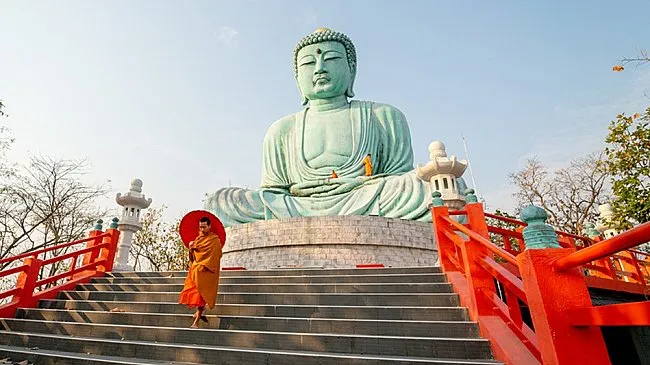
Amitabha Buddha (阿弥陀佛, Āmítuófó) is the central transcendent Buddha of Pure Land devotion in Chinese Buddhism. Known in Sanskrit as Amitābha (“Infinite Light”) and Amitāyus (“Infinite Life”), he presides over Sukhāvatī, the Western Pure Land (西方极乐世界, Xīfāng Jílè Shìjiè), a purified realm where beings can train toward awakening without the obstacles of ordinary existence. Rather than a mythological god or a deified Chinese ancestor, Amitabha is a Mahāyāna Buddha whose scriptural roots lie in ancient Indian Buddhism. Over nearly two millennia in China, however, devotion to Amitabha shaped temple worship, funerary rituals, visual art, and everyday speech, making Amituofo one of the most widely recognized sacred names in Chinese culture.
| Attribute | Details |
|---|---|
| Chinese Name | 阿弥陀佛 (Āmítuófó); also 无量光佛 (Wúliàngguāng Fó, Buddha of Infinite Light) and 无量寿佛 (Wúliàngshòu Fó, Buddha of Infinite Life) |
| Sanskrit Names | Amitābha (Infinite Light) and Amitāyus (Infinite Life) |
| Classification | Transcendent Mahāyāna Buddha (not a historical human founder and not a Daoist or folk deity) |
| Realm | Sukhāvatī, the Western Pure Land / Land of Utmost Bliss (西方极乐世界, Xīfāng Jílè Shìjiè) |
| Primary Attendants | Guanyin (Avalokiteśvara) and Dashizhi (Mahāsthāmaprāpta), forming the Three Sages of the West |
| Core Practice | Nianfo (念佛, niànfó): mindfulness and vocal recitation of Amitabha’s name, commonly “Namo Amituofo” (南无阿弥陀佛) |
| Foundational Texts | Infinite Life Sutra, Contemplation Sutra, and Amitabha Sutra (the Three Pure Land Sutras) |
Who Is Amitabha Buddha in Chinese Buddhism?
Within the broader landscape of Buddhist deities and sacred figures in China, Amitabha holds a distinct doctrinal status. English-language summaries sometimes casually group Buddhas with “Chinese gods,” but Chinese Buddhist tradition draws a clear line between worldly deities (shen or heavenly beings still bound to the cycle of rebirth) and a fully awakened Buddha who has transcended cyclic existence (saṃsāra).
Equally important is the distinction between Amitabha and Śākyamuni, the historical Buddha who lived in ancient India. In Mahāyāna cosmology, Śākyamuni is the Buddha of our present world (the Sahā world), while countless other Buddhas preside over buddha-fields across the cosmos. Amitabha is the Buddha of the western buddha-field, Sukhāvatī. In Chinese temple architecture, he frequently appears either as the central figure of a Pure Land hall or beside Śākyamuni and Bhaiṣajyaguru (Medicine Buddha, 药师佛, Yàoshī Fó) in the triad known as the Three Buddhas of the Three Directions.
| Buddha | Chinese Name | Role in Chinese Buddhism | Common Confusion |
|---|---|---|---|
| Amitabha | 阿弥陀佛 (Āmítuófó) | Transcendent Buddha of the Western Pure Land; focus of nianfo recitation and rebirth vows | Often mistaken by newcomers for the historical Buddha |
| Śākyamuni | 释迦牟尼佛 (Shìjiāmóuní Fó) | The historical Buddha (Siddhārtha Gautama) who taught the Dharma in our world, including the sutras about Amitabha | Sometimes confused visually with Amitabha when mudras are not checked |
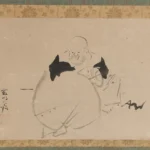
| Maitreya | 弥勒佛 (Mílè Fó) | The future Buddha currently dwelling in Tuṣita Heaven; popularly linked in China with the monk Budai (the Laughing Buddha) | Frequently misidentified as “the” Buddha or confused with Amitabha in popular Western media |
Names and Meanings: Amitābha, Amitāyus, and Amituofo
The Chinese name Āmítuófó (阿弥陀佛) is a phonetic rendering of the Sanskrit stem Amita (“immeasurable” or “infinite”) combined with Fo (佛, “Buddha”). As explored in our guide to the Sanskrit names of Chinese Buddhist deities, early Chinese translators used both phonetic transliteration and semantic translation depending on the scripture and context.
In Sanskrit texts, this Buddha carries two closely linked epithets:
- Amitābha (无量光, Wúliàngguāng, “Infinite Light”): signifies boundless wisdom and illuminating compassion that reaches across all directions without obstruction.
- Amitāyus (无量寿, Wúliàngshòu, “Infinite Life”): signifies immeasurable lifespan and enduring spiritual vitality, ensuring that beings reborn in his land have uninterrupted time to reach awakening.
Early Chinese translations, such as those attributed to Lokakṣema and Saṃghavarman, often favored semantic titles like Wúliàngshòu Fó. Later, Kumārajīva’s concise early fifth-century translation of the Amitabha Sutra popularized the phonetic form Āmítuófó, which proved rhythmically suited to daily chanting and became standard across China.
Scriptural Origins and the Forty-Eight Vows
Devotion to Amitabha did not originate as Chinese folklore; it entered China through Indian and Central Asian Mahāyāna scriptures translated from the second through fifth centuries CE. Three texts eventually became the canonical core of East Asian Pure Land Buddhism, known collectively as the Three Pure Land Sutras (净土三经, Jìngtǔ Sānjīng):
- The Infinite Life Sutra (Wúliàngshòu jīng, 无量寿经; Sanskrit: Larger Sukhāvatīvyūha Sūtra): Narrates Amitabha’s past life as the bodhisattva Dharmākara (法藏比丘, Fǎzàng Bǐqiū), who studied under the Buddha Lokeśvararāja and formulated forty-eight vows to establish a pure buddha-field.
- The Contemplation Sutra (Guān Wúliàngshòufó jīng, 观无量寿佛经): Presents sixteen progressive visualizations of Sukhāvatī, Amitabha, and his two attendant bodhisattvas, taught by Śākyamuni to Queen Vaidehī. It also outlines nine grades of rebirth, confirming that even beings with heavy karmic burdens can call upon Amitabha at death. (Modern scholars note that no Sanskrit original of this text survives and debate whether it was compiled in Central Asia or China from earlier Buddhist materials.)
- The Amitabha Sutra (Āmítuó jīng, 阿弥陀经; Sanskrit: Smaller Sukhāvatīvyūha Sūtra): Translated by Kumārajīva around 402 CE, this brief, poetic scripture describes the jeweled ponds, golden earth, and Dharma-proclaiming birds of the Western Pure Land and urges practitioners to hold fast to Amitabha’s name with an undistracted mind.
Among Dharmākara’s forty-eight vows in the Infinite Life Sutra, the Eighteenth Vow became the theological cornerstone of Chinese Pure Land Buddhism. In it, Dharmākara vows that he will not attain supreme buddhahood unless any sentient being across the ten directions who sincerely entrusts themselves to him, aspires to be born in his land, and calls his name even ten times is assured of rebirth there. Because the sutras teach that Dharmākara fulfilled his vows ten kalpas ago and now dwells as Amitabha, practitioners understand the promise of the Eighteenth Vow as already active.
The Western Pure Land and the Three Sages of the West
In Chinese Buddhism, Sukhāvatī is translated as Jílè Shìjiè (极乐世界, “World of Utmost Bliss”) or simply the Western Pure Land (西方净土, Xīfāng Jìngtǔ). Although English readers often compare it to a Western heaven, the doctrinal function of a pure land is fundamentally different. In Buddhist cosmology, even the highest heavens remain temporary states within cyclic rebirth; when good karma runs out, beings fall back into lower realms. By contrast, a pure land is an ideal training ground created by a Buddha’s vows and merit. Once reborn there—traditionally depicted as emerging miraculously from lotus blossoms in ponds of seven jewels—a practitioner is guaranteed non-retrogression and steady progress toward full nirvana.
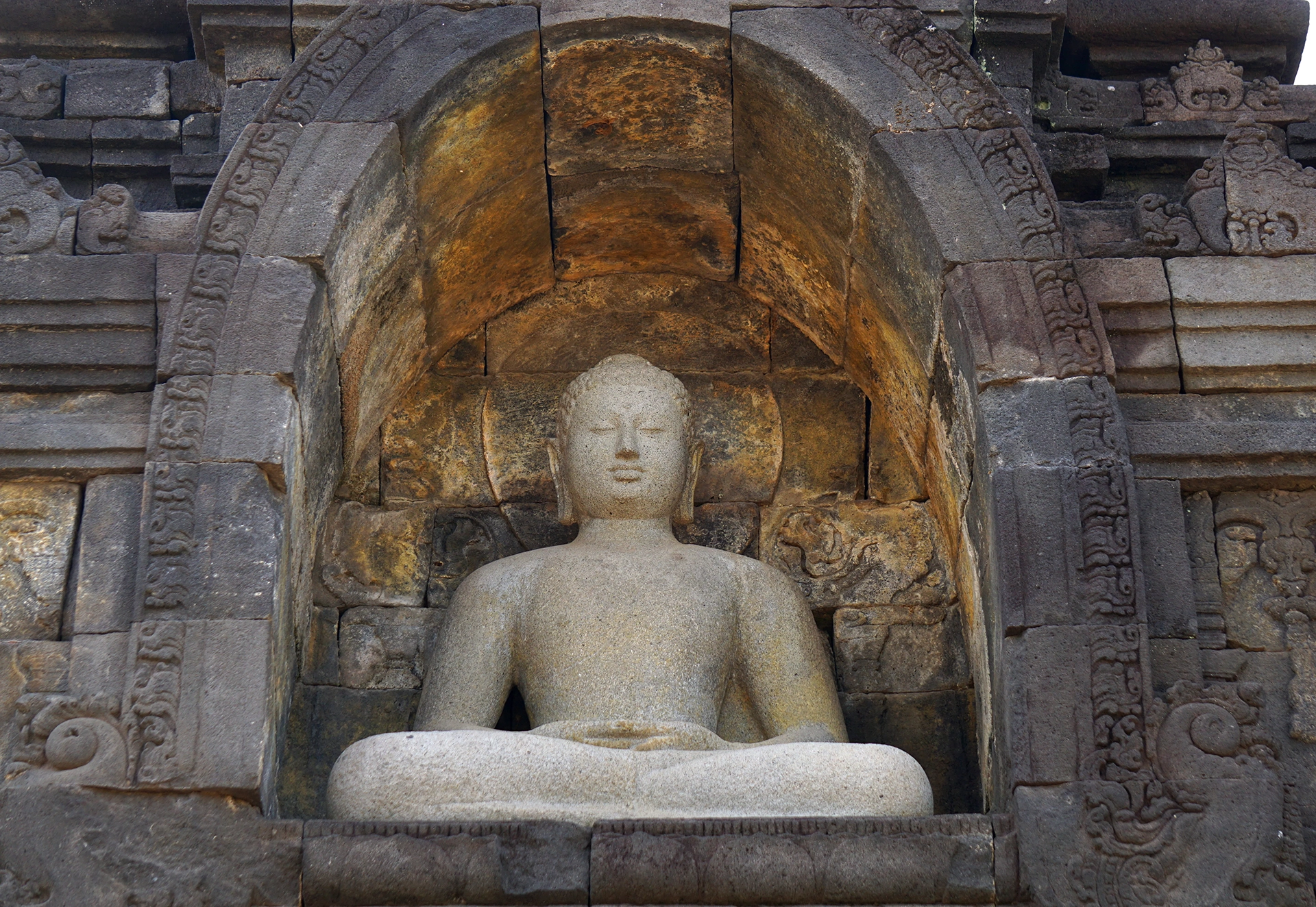
Amitabha rarely appears alone in major Pure Land tableaus. He is flanked by two great bodhisattvas, forming the Three Sages of the West (西方三圣, Xīfāng Sānshèng):
- Guanyin (观音, Guānyīn; Sanskrit: Avalokiteśvara) stands to Amitabha’s left, representing boundless compassion (dàbēi). In Chinese Buddhist art, Guanyin’s crown frequently bears a miniature image of Amitabha, marking their close spiritual lineage.
- Dashizhi (大势至, Dàshìzhì; Sanskrit: Mahāsthāmaprāpta) stands to Amitabha’s right, representing the power of awakened wisdom and steadfast spiritual energy. His crown is traditionally marked with a jeweled vase.
How Amitabha Devotion Developed in Chinese Buddhism
Amitabha’s rise in China was not sudden, nor was it limited to a single sect. Instead, Pure Land thought evolved from elite meditative assemblies into a universal devotional framework embedded across nearly all Chinese Buddhist schools.
Early Vows and Mount Lu (Fourth–Fifth Centuries)
One of the earliest documented Chinese communities devoted to Amitabha formed under the scholar-monk Lushan Huiyuan (庐山慧远, 334–416 CE). In 402 CE on Mount Lu in present-day Jiangxi, Huiyuan gathered more than a hundred monks and lay literati before an image of Amitabha to vow mutual support for rebirth in the Western Pure Land. Historically, Huiyuan’s practice centered on meditative visualization (samādhi) rather than simple vocal chanting, though later Chinese tradition honored him retrospectively as the First Patriarch of Pure Land Buddhism.
Systematization and Oral Recitation (Sixth–Seventh Centuries)
During the Northern Dynasties and Tang period, three thinkers transformed Pure Land practice into an accessible path for ordinary householders as well as monastics:
- Tanluan (昙鸾, c. 476–542) distinguished between the “difficult path” of self-power (zìlì) and the “easy path” relying on Amitabha’s compassionate vow power, or “other-power” (tālì).
- Daochuo (道绰, 562–645) argued that in an age of declining Dharma (mòfǎ), reliance on Amitabha’s Pure Land was the most realistic doorway to liberation.
- Shandao (善导, 613–681) systematized Chinese Pure Land orthodoxy in his influential commentary on the Contemplation Sutra. Shandao explicitly interpreted the scriptural call to mindfulness of Amitabha as vocal recitation of his name, emphasizing that ordinary people—not only advanced sages—could attain rebirth through sincere faith and recitation.
Integration with Chan and Late Imperial Buddhism
Unlike in Japan, where Pure Land later split into independent denominations such as Jōdo-shū and Jōdo Shinshū, Chinese Pure Land Buddhism remained largely woven into the shared life of mainstream monasteries. From the Song and Ming dynasties onward, influential masters promoted the dual cultivation of Chan meditation and Pure Land recitation (禅净双修, Chán–Jìng shuāngxiū), famously summarized by the Ming master Ouyi Zhixu and earlier thinkers who saw mindful recitation of Amitabha’s name and direct insight into the nature of mind as mutually reinforcing rather than opposed.
Iconography and Buddhist Art in China
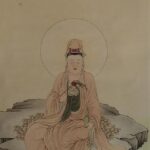
Visual depictions of Amitabha in China reflect centuries of artistic adaptation, from stone cave carvings to silk banners and gilded temple halls. One of the earliest surviving Chinese inscriptions invoking Amitabha’s Pure Land appears on the Liu Song dynasty pedestal of Gao Xiong (fifth century CE), now in the Princeton University Art Museum. By the Northern Qi dynasty (550–577), monumental reliefs such as the famous Western Paradise panel from Cave 2 at Southern Xiangtangshan (now at the Smithsonian’s National Museum of Asian Art) already portrayed Amitabha presiding over a jewel-like lotus pond where newly reborn beings emerge from blooming flowers.
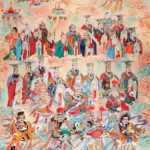
During the Tang dynasty (618–907), Pure Land murals reached extraordinary scale at sites like the Mogao Caves in Dunhuang. These large “transformation tableaux” (biànxiàng, 变相) translated the vivid descriptions of the Contemplation Sutra and Amitabha Sutra into palatial Chinese wooden architecture, bridges, celestial musicians, and lotus pools.
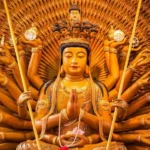
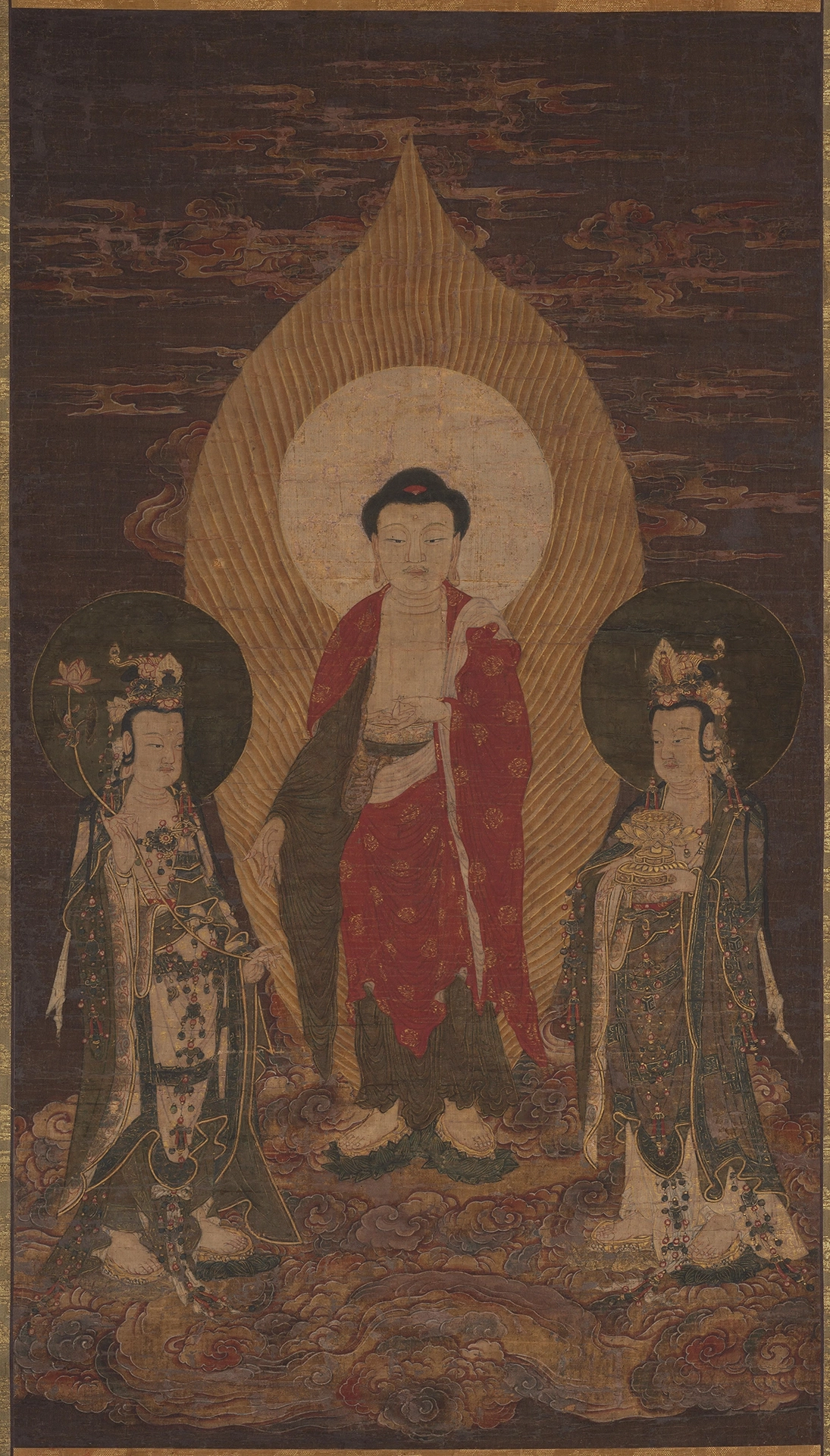
When identifying Amitabha in Chinese Buddhist sculpture and painting, several iconographic details are especially informative:
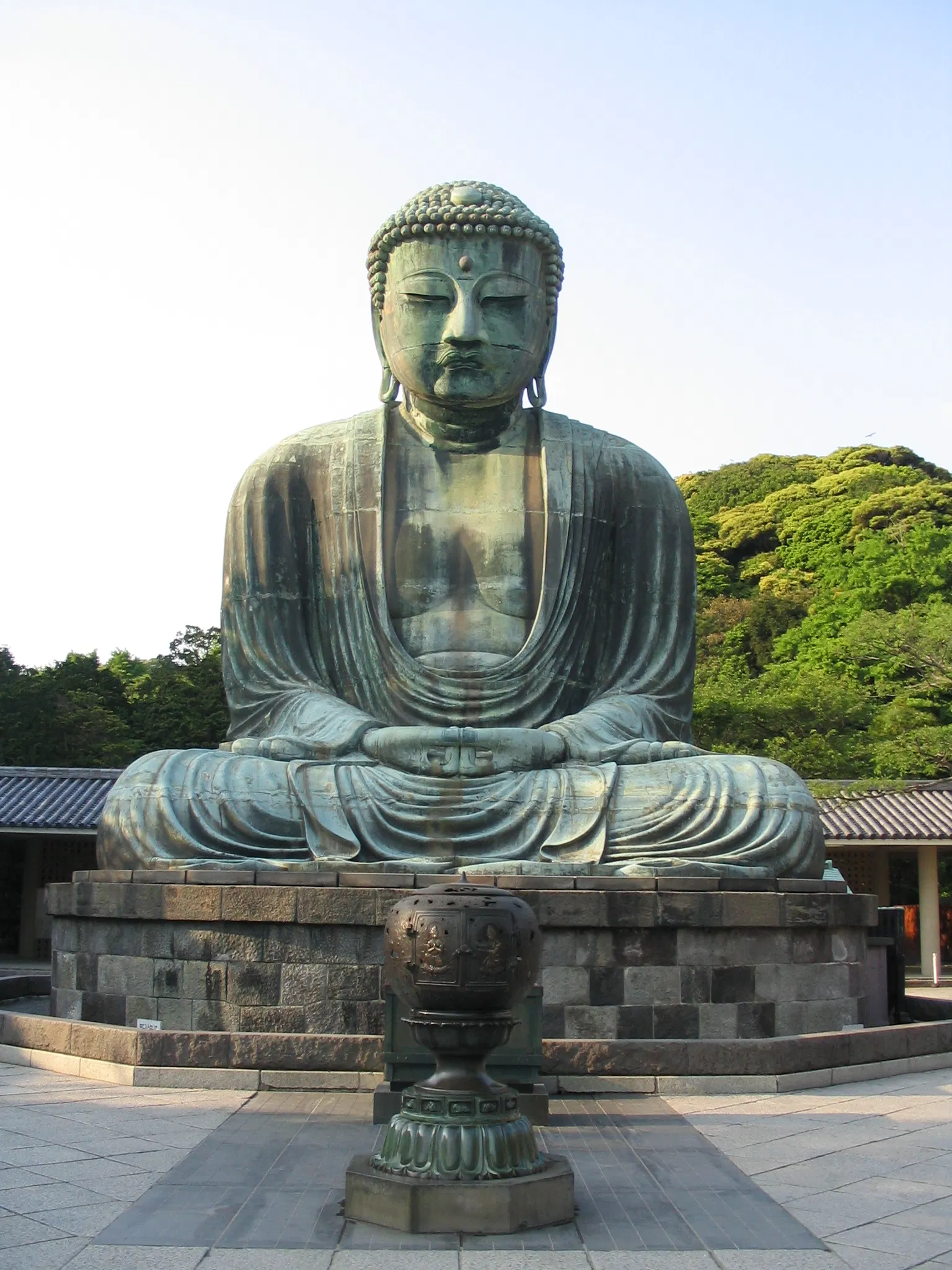
- Hand gestures (mudras): Seated images often show the meditation mudra (dhyāna mudrā), with both hands resting in the lap and thumbs touching, or a variation with the thumbs and index fingers forming circles. Standing images frequently display the welcoming gesture (jiēyǐn shǒuyìn, 接引手印), with one hand raised in reassurance and the other lowered toward the viewer to receive beings into the Pure Land.
- Lotus seat and halo: Amitabha is seated or standing on a lotus pedestal, symbolizing purity untouched by worldly defilement, often framed by a radiant aureole evoking “Infinite Light.”
- Standing welcoming form: In late imperial Chinese art, standing statues of Amitabha with an outstretched left hand—sometimes holding a miniature lotus pedestal—became closely associated with deathbed guidance.
Nianfo Practice, Funerary Rites, and Everyday Chinese Culture
The defining practice associated with Amitabha in Chinese Buddhism is nianfo (念佛, literally “mindfulness of the Buddha”), most commonly performed by reciting the six-character phrase Namo Amituofo (南无阿弥陀佛, “Homage to Amitabha Buddha”). Practitioners may recite aloud in communal chanting halls, quietly while counting prayer beads (niànzhū), or silently in daily life.
Amitabha’s presence also extends deeply into Chinese approaches to death, mourning, and the afterlife. As Buddhism interacted with indigenous Chinese traditions—a broader historical process examined in our guide to Buddhist influence on Chinese mythology—Pure Land rebirth came to sit alongside vivid beliefs about the ten courts of the underworld (Dìyù) overseen by figures such as Yanluo Wang and assisted by Ksitigarbha (Dizang Bodhisattva). In Chinese Buddhist deathbed care (zhùniàn, 助念), family members and monastics gather to chant Amitabha’s name calmly around a dying person so that the mind remains focused on the Western Pure Land rather than fear or attachment.
Why “Amituofo” Is Used in Everyday Speech: Beyond formal temple liturgy, Chinese Buddhists—and many non-monastic speakers influenced by Buddhist custom—say “Amituofo” as a greeting, a word of thanks, a wish for peace, or a quiet expression of compassion when hearing of misfortune. Popular martial arts novels and films often feature monks saying the phrase, which reflects a real, centuries-old monastic habit of keeping Amitabha’s name on the lips throughout the day.
Frequently Asked Questions
Is Amitabha Buddha the same as the historical Buddha?
No. The historical Buddha is Śākyamuni (Siddhārtha Gautama), who lived and taught in ancient India. Amitabha is a transcendent Mahāyāna Buddha who presides over Sukhāvatī, the Western Pure Land. According to Pure Land scriptures, it was Śākyamuni who first taught people in our world about Amitabha and his vows.
Is Amitabha Buddha considered a Chinese god?
In Buddhist doctrine, no. Amitabha is a fully awakened Buddha who has transcended the cycle of rebirth, whereas gods (shen or heavenly deities) remain beings within cyclic existence. Although Western readers sometimes browse Amitabha alongside Chinese deities in general encyclopedias, Chinese Buddhism maintains his distinct identity as a Buddha.
What does “Namo Amituofo” mean?
“Namo” (南无) comes from the Sanskrit namas, meaning homage, reverence, or taking refuge. “Amituofo” (阿弥陀佛) is the Chinese rendering of Amitabha Buddha. Saying “Namo Amituofo” expresses refuge in Amitabha’s wisdom, compassion, and vow to welcome beings into the Western Pure Land.
Is the Western Pure Land the same as heaven?
Not in Buddhist cosmology. Heavens are temporary realms of pleasant rebirth that eventually end when positive karma is exhausted. The Western Pure Land (Sukhāvatī) is a buddha-field designed as an ideal environment for spiritual practice, where beings progress irreversibly toward full awakening and nirvana.
Who are the two figures standing next to Amitabha Buddha?
In Chinese Buddhist art, Amitabha is commonly flanked by Guanyin (Avalokiteśvara, the bodhisattva of compassion) on his left and Dashizhi (Mahāsthāmaprāpta, the bodhisattva of wisdom’s strength) on his right. Together, the three are known as the Three Sages of the West (Xīfāng Sānshèng).
References and Further Reading
- Inagaki, Hisao, trans., with Harold Stewart. The Three Pure Land Sutras. BDK English Tripiṭaka Series. Berkeley: Numata Center for Buddhist Translation and Research, 2003. BDK America.
- Encyclopædia Britannica. “Amitabha.” Britannica.com.
- Encyclopædia Britannica. “Pure Land Buddhism.” Britannica.com.
- Smithsonian National Museum of Asian Art (Freer Gallery of Art). Western Paradise of the Buddha Amitabha (Northern Qi dynasty, 550–577, Southern Xiangtangshan Cave 2, Object F1921.2). Smithsonian Institution.
- The Metropolitan Museum of Art. “Chinese Buddhist Sculpture.” Heilbrunn Timeline of Art History. MetMuseum.org.
- Princeton University Art Museum. Amitabha Buddha Pedestal of Gao Xiong (Liu Song dynasty, 420–479 CE, Object 57511). Princeton University Art Museum.