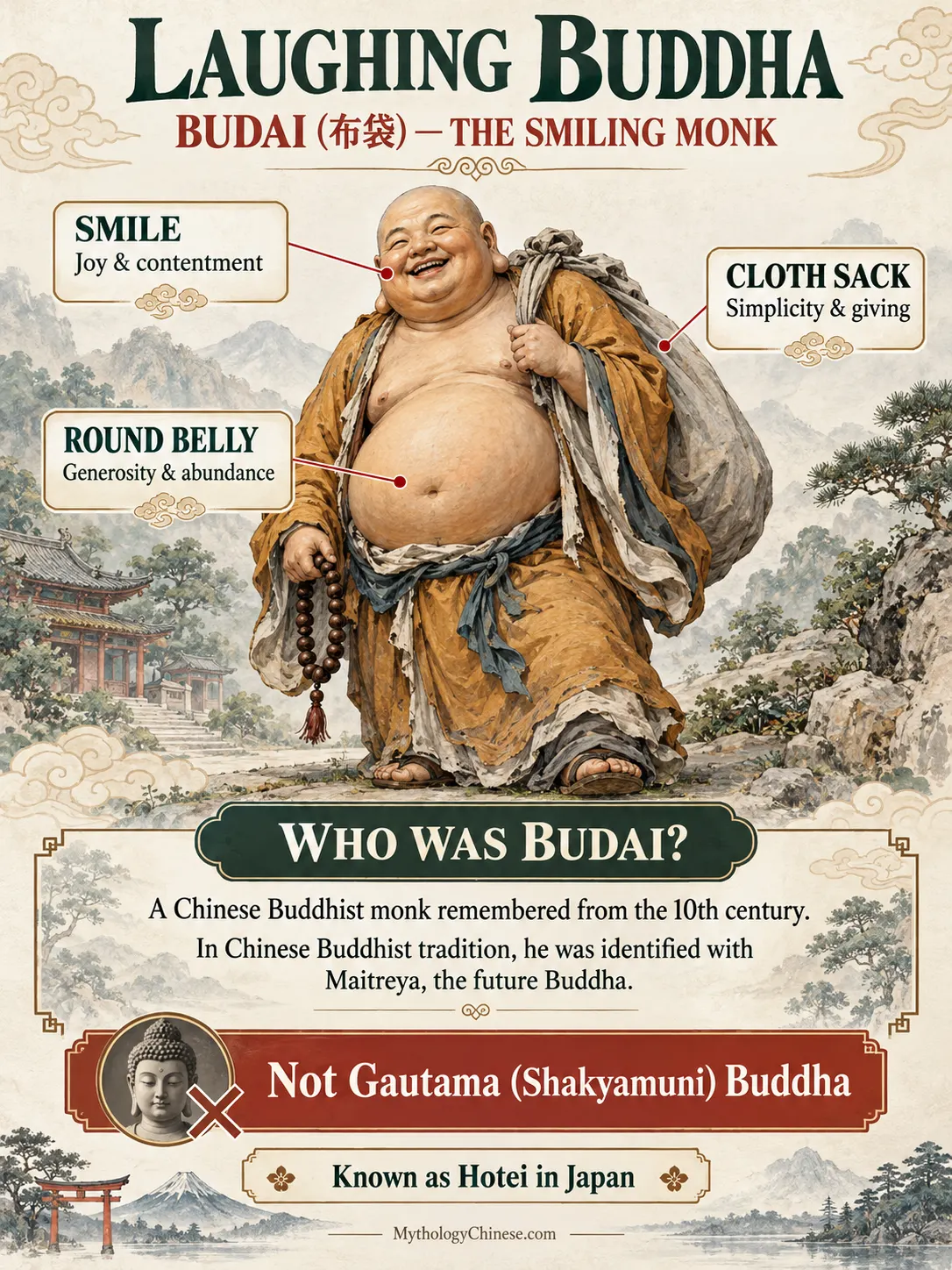
The Laughing Buddha, known in Chinese as Budai (布袋, Bùdài), is one of the most recognizable figures in East Asian Buddhist art. With his bald head, wide smile, round belly, and loose robes, he appears in temples, homes, gardens, and shops around the world.
But the Laughing Buddha is not Siddhartha Gautama, the historical founder of Buddhism.
Budai was a Chinese Buddhist monk who lived around the tenth century. Over time, stories of his unusual behavior, kindness, and cheerful disposition led people to identify him with Maitreya (弥勒, Mílè), the future Buddha. His image eventually became a symbol of happiness, contentment, generosity, and good fortune.
Understanding Budai means looking beyond the familiar smiling statue to the historical monk, Buddhist traditions, and Chinese folklore that shaped his identity.
Who Was the Laughing Buddha?
The Laughing Buddha is traditionally identified with a Chinese monk named Qici (契此, Qìcǐ), who lived around the late ninth and early tenth centuries.
He is associated with the Fenghua area of present-day Ningbo, Zhejiang Province, in eastern China.
Accounts describe him as an unconventional wandering monk who traveled between communities, carrying a cloth sack containing his belongings. Instead of presenting himself as a solemn religious teacher, he became known for his approachable manner, unusual sayings, and apparent indifference to wealth or social status.
His nickname, Budai, literally means “cloth sack” or “cloth bag.”
The sack became such a distinctive part of his identity that it replaced his personal name in popular memory.
Stories tell of Budai sharing what he carried with children and ordinary people. Other accounts describe him answering questions with unexpected gestures or puzzling remarks.
These details belong to a mixture of Buddhist biography and religious storytelling. Although Budai is generally treated as a historical monk, the surviving accounts do not allow every episode of his life to be verified.
His reputation continued to grow long after his death, eventually making him far more famous than most monks of his time.
How Did Budai Become the Laughing Buddha?
Budai’s transformation from wandering monk to celebrated Buddhist figure developed over several centuries.
One important early source is the Song Gaoseng Zhuan (宋高僧传, Biographies of Eminent Monks Compiled in the Song Dynasty), completed in the tenth century. It preserves an account of Qici as an eccentric monk and associates him with Maitreya.
The later Jingde Chuandeng Lu (景德传灯录, Jingde Record of the Transmission of the Lamp), compiled in the early eleventh century, includes additional stories and dialogues associated with the Chan Buddhist tradition.
These writings helped establish Budai as more than an ordinary religious wanderer.
A particularly influential tradition connects him with a verse declaring that Maitreya is truly present, although people fail to recognize him. In Buddhist interpretation, this became evidence that the seemingly ordinary monk was actually a manifestation of the future Buddha.
As his reputation spread, artists increasingly portrayed him as a cheerful, large-bellied monk whose very appearance suggested ease and happiness.
The familiar Laughing Buddha image was therefore not simply a portrait of one man. It developed through religious devotion, storytelling, and centuries of artistic interpretation.
Is Budai the Same as Maitreya Buddha?
In many Chinese Buddhist traditions, Budai is regarded as a manifestation of Maitreya, but the two figures have different historical and religious origins.
Maitreya originated in Indian Buddhism long before Budai lived.
In Buddhist cosmology, Maitreya is the bodhisattva destined to become the next teaching Buddha after the era of Shakyamuni Buddha. He is associated with the future renewal of Buddhist teachings.
Early Buddhist images of Maitreya often depict a dignified bodhisattva adorned with ornaments or a serene Buddha seated in a formal posture.
These representations look very different from the Laughing Buddha.
In China, however, the identification of Budai with Maitreya gradually gave the future Buddha a distinctive local appearance: an approachable monk with a welcoming smile and an uncovered belly.
That association became especially influential in Chinese Buddhist temples.
This does not mean that Maitreya was originally imagined as a laughing, overweight monk. Rather, Budai’s appearance became one important Chinese representation of Maitreya.
The distinction illustrates how Buddhist religious figures could acquire new identities and visual forms as Buddhism developed in China.
What Does the Laughing Buddha Symbolize?
The meaning of Budai’s image comes from several recognizable features, each shaped by Buddhist and folk traditions.
His Laughing Face: Happiness and Contentment
Budai’s most familiar feature is his broad, joyful smile.
In popular interpretation, his laughter represents happiness, optimism, and the ability to remain content without being controlled by worldly anxieties.
This image is closely connected with stories describing a monk who possessed little yet appeared satisfied with his life.
His smile also makes him unusually approachable among religious figures. Rather than conveying spiritual authority through an imposing expression, Budai seems to welcome people into his presence.
The lesson most commonly drawn from his appearance is that happiness need not depend on possessions or status.
His Large Belly: Generosity and Abundance
Why does the Laughing Buddha have such a big belly?
In Chinese popular symbolism, Budai’s rounded stomach is associated with abundance, generosity, tolerance, and an expansive spirit.
It can suggest someone who has room for other people’s faults and approaches life without constant resentment.
His belly also became linked with prosperity and fertility in popular culture.
However, these meanings are cultural and religious interpretations of his image. They are not evidence that physical size indicates spiritual attainment or material success.
His Cloth Sack: Simplicity and Giving
The cloth sack is Budai’s defining attribute.
In early descriptions, it identifies him as a wandering monk who carries his belongings rather than accumulating valuable possessions.
Later stories sometimes portray the sack as holding food, gifts, or seemingly inexhaustible treasures that he shares with others.
This creates an interesting contrast: Budai appears poor, yet his generosity makes him a figure of abundance.
In some religious interpretations, the sack can also evoke the burdens people carry and the possibility of putting them down.
Such readings should be understood as symbolic interpretations, not as a single fixed meaning established by all Buddhist traditions.
Children, Prayer Beads, and Other Objects
Budai is often pictured surrounded by children, emphasizing his friendliness, generosity, and associations with happiness and fertility.
Some statues show him holding Buddhist prayer beads, which connect his familiar appearance to religious practice.
Other versions include a fan, a staff, or objects associated with prosperity.
Not every attribute appears in every depiction. The meaning of a particular statue depends partly on when and where it was made.
Was the Laughing Buddha Always Depicted Laughing?
Surprisingly, no.
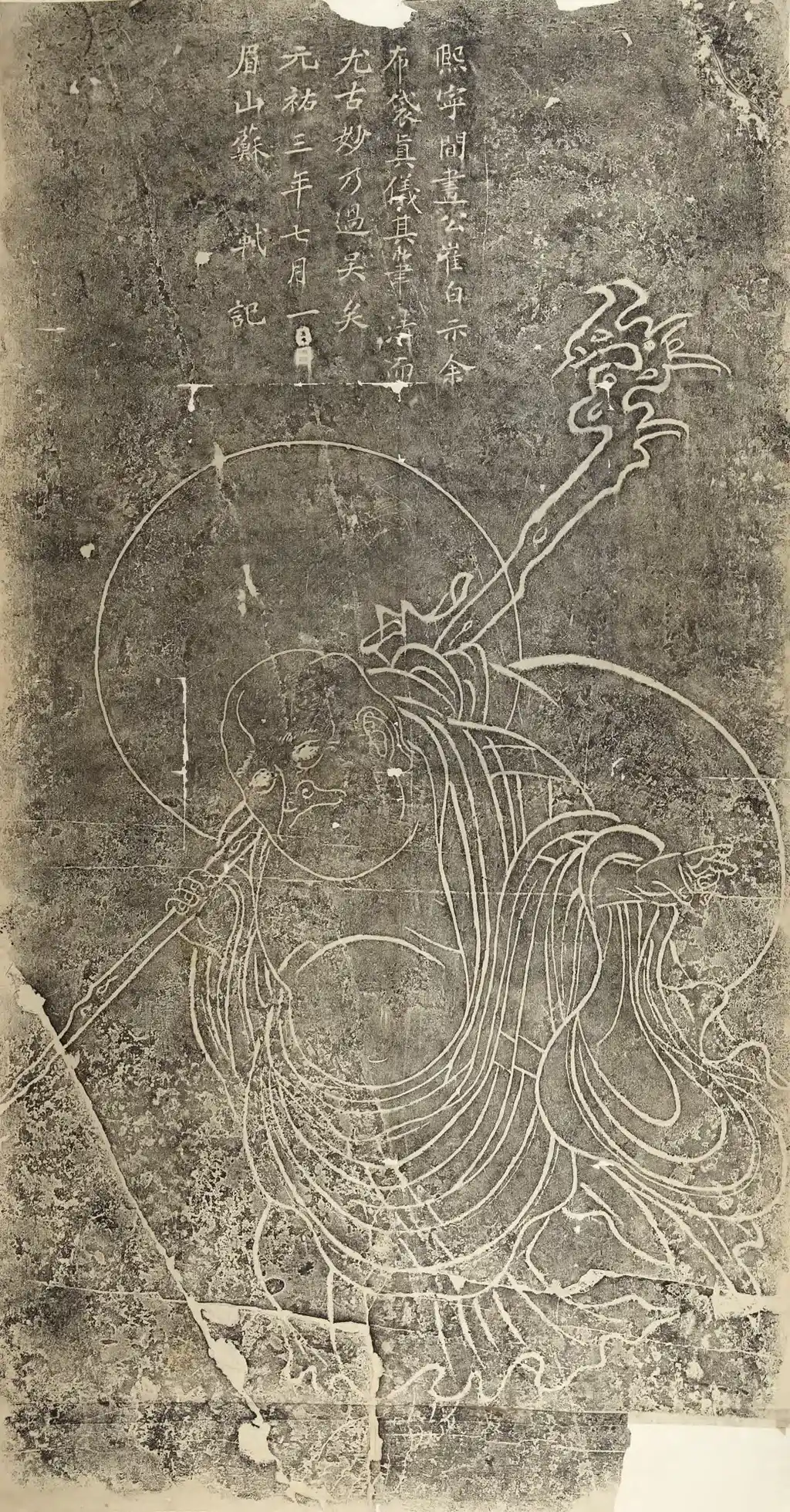
Although modern images emphasize Budai’s smile, early surviving depictions show that his appearance was not always standardized.
The Princeton University Art Museum preserves a rubbing of a stone image dated to 1088. It depicts Budai carrying his sack and staff, but his expression appears more like a grimace than the broad laughter familiar today.
This is an important clue to how his visual identity developed.
The sack, loose clothing, and rounded body were established features, while the emphasis on constant laughter became more prominent in later representations.
By the Ming and Qing dynasties, Budai’s smiling appearance had become especially recognizable in porcelain, wood, jade, and other artistic media.
The Laughing Buddha known today is thus the product of a long artistic tradition, not a single unchanging ancient image.
Is the Laughing Buddha the Same as Gautama Buddha?
No. Budai and Gautama Buddha are different figures.
Gautama Buddha, also known as Shakyamuni or Siddhartha Gautama, was the historical teacher at the origin of Buddhism in ancient India.
Budai was a Chinese monk who lived many centuries later.
Their representations also tend to differ.
| Feature | Laughing Buddha (Budai) | Gautama Buddha (Shakyamuni) |
|---|---|---|
| Historical setting | Tenth-century China | Ancient India |
| Identity | Monk later identified with Maitreya | Historical Buddha |
| Common appearance | Bald, smiling, large belly | Serene expression, formal robes |
| Typical attributes | Cloth sack, staff, sometimes prayer beads | Buddhist hand gestures and marks of Buddhahood |
| Main associations | Contentment, generosity, good fortune | Awakening, Buddhist teachings, liberation |
These are common artistic conventions rather than absolute rules. Buddhist images vary greatly across regions and periods.
The confusion often comes from the popular English name “Laughing Buddha.”
In a Chinese religious context, however, Budai’s association with Maitreya gives the title a specific meaning. It does not make him another name for Shakyamuni.
Why Is the Laughing Buddha Found in Chinese Temples?
In many traditional Chinese Buddhist temples, visitors encounter a smiling Budai-form Maitreya near the entrance, often in the Hall of the Heavenly Kings (天王殿, Tiānwáng Diàn).
The Four Heavenly Kings, who protect the Buddhist teaching, may stand on either side of the hall.
Budai’s welcoming expression contrasts with the commanding appearance of these guardians.
Together, they form a striking introduction to the temple: protection and discipline stand alongside warmth and generosity.
The arrangement also shows the importance of Budai’s identification with Maitreya in Chinese Buddhism.
A visitor may see him labeled simply as Maitreya Buddha, even though his appearance derives from the traditions surrounding the Chinese monk.
Not all Buddhist traditions represent Maitreya in this way, and temple arrangements differ between regions.
The Legend of Budai’s Cloth Sack
One well-known Chan Buddhist story describes someone asking Budai about the meaning of the Buddhist teaching.
Instead of offering a long explanation, Budai puts down his sack.
When asked what comes next, he picks it up and continues walking.
The story is often interpreted as a lesson about letting go of attachment without abandoning ordinary life.
Putting down the sack suggests releasing burdens. Picking it up again suggests returning to everyday responsibilities without becoming trapped by them.
The anecdote survives as part of Budai’s religious storytelling tradition, including later artistic treatments. It should not be read as a modern eyewitness account of an established historical event.
Like many Chan stories, its power comes from a simple action that can be understood in more than one way.
Budai in Japan: Why Is He Called Hotei?
Budai’s popularity did not remain confined to China.
His image spread to other East Asian Buddhist cultures, including Japan, where he became known as Hotei (布袋).
Hotei retains the recognizable features of the Chinese monk: his sack, rounded stomach, and cheerful appearance.
In Japan, however, he also developed a distinct place in popular religion as one of the Seven Lucky Gods, known as the Shichifukujin (七福神).
These figures are associated with blessings, fortune, and different aspects of a prosperous life.
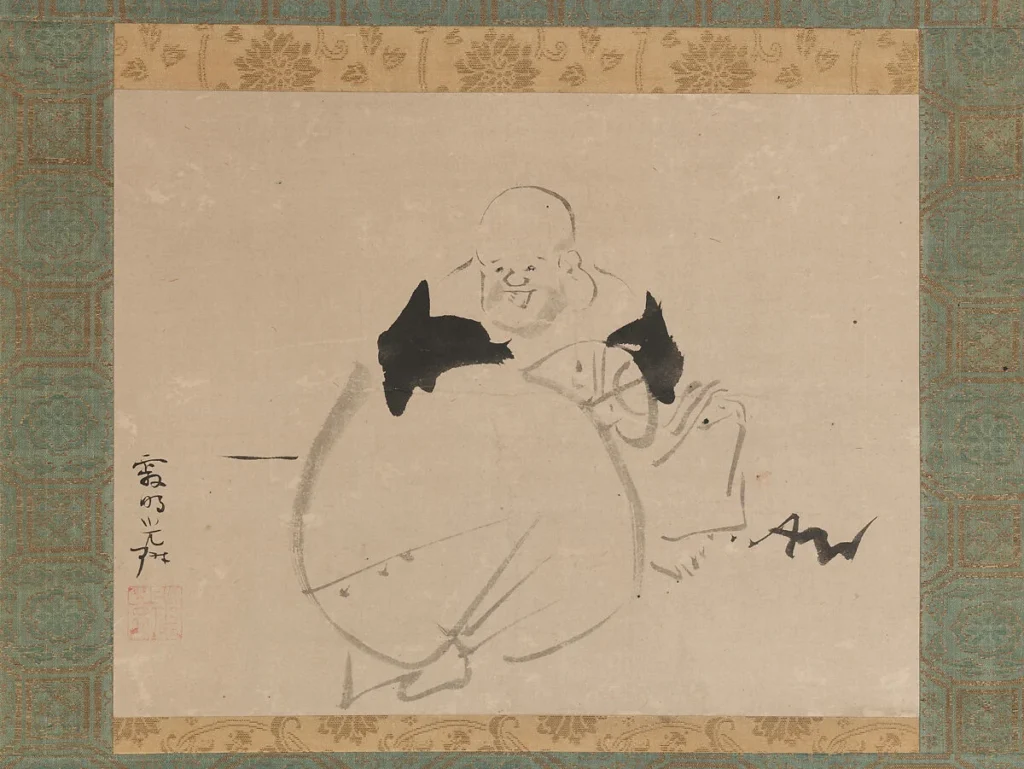
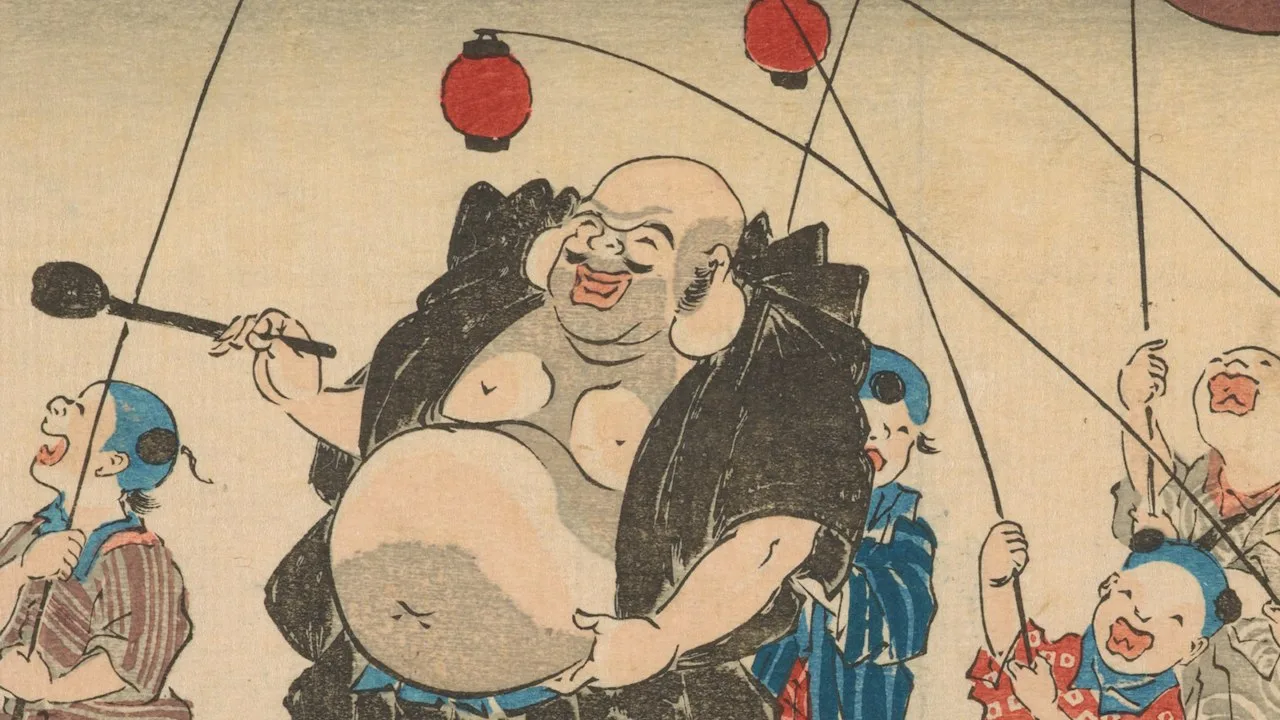
Japanese artists frequently portrayed Hotei in humorous or affectionate scenes, sometimes with children playing around him or interacting with his enormous bag.
He also became an important subject in Zen painting, where an ordinary-looking monk could suggest spiritual freedom without formal grandeur.
Budai and Hotei therefore refer to the same underlying figure, but their roles and cultural associations are not completely identical.
Does Rubbing the Laughing Buddha’s Belly Bring Good Luck?
One familiar custom is to rub a Laughing Buddha statue’s belly in the hope of receiving good fortune.
This belief is part of popular cultural practice rather than a fundamental requirement of Buddhist doctrine.
In folk interpretations, the rounded belly represents abundance and generosity. Touching it can become a symbolic gesture expressing a wish for prosperity or happiness.
However, there is no historical basis for claiming that every Buddhist tradition teaches that rubbing Budai’s stomach automatically brings wealth.
A Buddha statue may be an object of religious devotion, an expression of cultural identity, a work of art, or an auspicious household decoration, depending on its setting.
These functions sometimes overlap, but they should not be treated as identical.
How the Laughing Buddha Became Famous Around the World
Budai’s international popularity developed through several different cultural routes.
Within East Asia, his image circulated through Buddhist temples, painting, sculpture, and folk traditions.
Japanese interpretations, especially those associated with Zen and Hotei, helped introduce his appearance to a wider international audience.
Chinese decorative arts provided another important pathway.
During the eighteenth century, European collectors developed a strong interest in Chinese porcelain. Among the many objects that reached European collections were small ceramic figures of Budai.
White porcelain sculptures produced in Dehua, Fujian Province, became especially recognizable examples.
Over time, the Laughing Buddha appeared far beyond its original religious settings.
Today, Budai may be encountered in a Buddhist temple, an art museum, a family home, a restaurant, or a garden.
His global familiarity has sometimes obscured his Chinese origins. Yet the history behind the smiling figure remains a remarkable example of how a local Buddhist monk became an enduring cultural symbol.
Budai’s Place in Chinese Buddhism and Folklore
Budai occupies an unusual position between historical biography, Buddhist devotion, and popular folklore.
His life is associated with a real period and place in Chinese history. His later identity as a manifestation of Maitreya belongs to Buddhist religious interpretation. The stories about magical generosity and unusual behavior belong to the traditions that grew around his memory.
His associations with wealth, happiness, and luck developed through popular belief and artistic representation.
All these layers help explain his continuing importance.
They also make Budai a useful example of the wider Buddhist influence on Chinese mythology, where imported Buddhist ideas took on new cultural forms.
Another Chinese monk whose historical reputation became intertwined with stories of unconventional behavior and compassion is Ji Gong. Although the two figures belong to different periods and traditions, both show how an unusual religious personality could become a beloved subject of folklore.
Budai’s lasting appeal is not simply that he laughs. It is that his stories imagine someone who can live with very little, share with others, and remain content.
Frequently Asked Questions
Was the Laughing Buddha a real person?
Budai is traditionally identified with Qici, a Chinese monk who lived around the tenth century. Early Buddhist biographical sources preserve accounts of him, although many familiar stories contain legendary elements that cannot be independently verified.
What does Budai mean in Chinese?
Budai (布袋, Bùdài) means “cloth sack” or “cloth bag.” The nickname refers to the bag the monk carried while wandering.
Is the Laughing Buddha a god?
Budai was originally remembered as a Buddhist monk. In Chinese Buddhist tradition, he became associated with Maitreya, the future Buddha. In popular culture, he is also treated as an auspicious figure associated with happiness and good fortune. Describing him simply as a god can obscure these distinctions.
Is the Laughing Buddha Buddhist or Taoist?
Budai is primarily rooted in Chinese Buddhist tradition, particularly through his identification with Maitreya and his association with Chan Buddhism. His image also appears in broader folk-religious culture, where Buddhist and other popular beliefs often overlap.
Why does the Laughing Buddha have a big stomach?
His large belly is commonly interpreted as a symbol of abundance, generosity, contentment, and tolerance. These meanings developed through Chinese Buddhist and folk artistic traditions.
Is Budai the same as Maitreya?
Budai is identified as a manifestation of Maitreya in many Chinese Buddhist traditions. Maitreya, however, is a much older Buddhist figure originating in Indian religious traditions.
Is Hotei the same as Budai?
Yes. Hotei is the Japanese name for the figure known in Chinese as Budai. In Japanese culture, Hotei is also one of the Seven Lucky Gods.
Why is the Laughing Buddha considered lucky?
Budai became associated with generosity, abundance, happiness, and prosperity through religious storytelling and folk tradition. These associations explain why his image is widely used as a symbol of good fortune.
References and Further Reading
- The Metropolitan Museum of Art — Buddhist Monk Budai. A Qing-dynasty porcelain figure with museum commentary on Budai’s historical and religious identity.
- University of Tennessee — Who Is the Laughing Buddha?. An explanation by Buddhist studies scholar Megan Bryson of Budai’s origins and global cultural development.
- Princeton University Art Museum — Budai with Staff and Bag. An important early image documenting the development of Budai’s appearance.
- The Walters Art Museum — The Chinese Monk Budai. A 1209 rubbing with a traditional story about Budai and his cloth sack.
- The Metropolitan Museum of Art — Hotei. An Edo-period Japanese painting illustrating Budai’s transformation into Hotei.