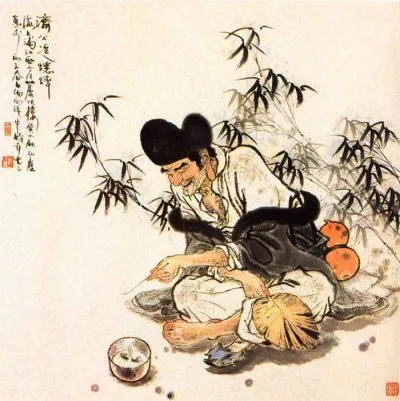
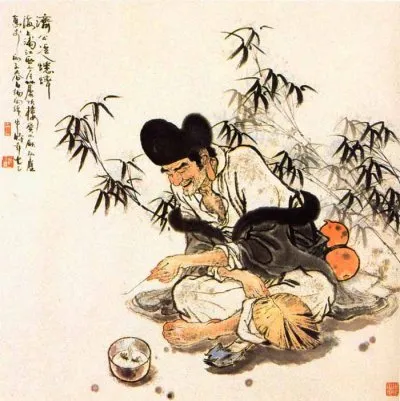
Ji Gong is one of the most unforgettable figures in Chinese legend: a Buddhist monk in torn robes, often pictured with a worn fan in one hand and a wine gourd in the other. He looks nothing like the calm, polished image many people expect from a holy man. In fact, that is exactly why people remember him.
Known as the “Crazy Monk,” Ji Gong lived during the Southern Song Dynasty and became famous for his eccentric behavior, sharp wit, compassion for ordinary people, and legendary ability to help the poor and punish injustice. He drank wine, ate meat, laughed at rigid rules, and often appeared completely unpredictable. Yet beneath that messy exterior was a figure deeply connected with Buddhist wisdom, folk religion, and the Chinese idea that true virtue is found in the heart—not in appearances.
Today, Ji Gong remains popular in Chinese culture, especially in folklore, temple worship, dramas, opera, television series, and stories passed down through generations.
Who Was Ji Gong?
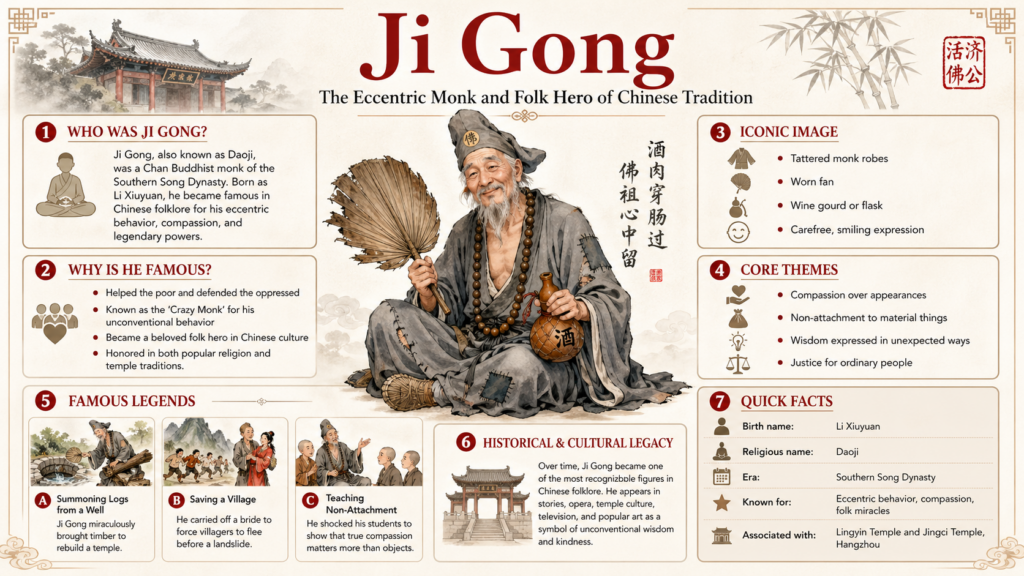
Ji Gong was born Li Xiuyuan, though he later became known by his Buddhist name, Daoji. He is also called Master Ji, Ji Gong Huo Fo, the Mad Monk, the Drunk Monk, or simply the Crazy Monk.
He was a Chan Buddhist monk associated with the Southern Song Dynasty. Many traditions place his life between the 12th and early 13th centuries, and his stories are especially connected with Hangzhou, Lingyin Temple, and Jingci Temple.
Unlike many monks of his time, Ji Gong did not present himself as solemn or perfectly disciplined. His robes were often dirty and torn. He wandered from place to place. He drank alcohol and ate meat, both of which shocked more conventional Buddhist clergy. But in folk memory, these habits did not make him a villain. Instead, they made him a strange, humorous, deeply human figure whose wisdom could not be measured by outward discipline alone.
This tension is the heart of Ji Gong’s legend: he looked like a rule-breaker, but acted with compassion.
The Meaning of Ji Gong’s Name
The name Ji Gong is usually written as 濟公 in traditional Chinese or 济公 in simplified Chinese.
The character “Ji” can mean to help, aid, or relieve suffering. “Gong” is a respectful term that can suggest an honored or important person. In that sense, the name fits him beautifully: Ji Gong is remembered as someone who helped people, especially those with no power, no wealth, and no one else to defend them.
His Buddhist name, Daoji, also appears often in historical and religious discussions. Some traditions call him Hu Yin, meaning “Recluse from the Lake,” and Elder Fang Yuan, meaning “Squared Circle.” These names reflect the unusual, paradoxical quality of his character: he belonged to the religious world, but never fit neatly inside it.
The Life of Ji Gong
According to legend, Ji Gong was born into a wealthy family as Li Xiuyuan. His father, Li Maochun, is often described as a retired military strategist or advisor. Before his birth, his parents were said to have struggled to have children. In one popular story, they visited temples and prayed for a child. While they were making offerings in a hall dedicated to the arhats, a statue connected with the Arhat Taming Dragon fell from the altar. Later, his mother became pregnant, and the event was interpreted as a sign that the child was linked to this arhat.
Ji Gong’s early life was comfortable, but everything changed when his parents died while he was still young. Around the age of 18, he entered monastic life at Lingyin Temple in Hangzhou and became a monk under the guidance of a respected teacher.
At first, he seemed to follow the path of religious training. But over time, his behavior became more and more difficult for the other monks to accept. He drank wine, ate meat, wore ragged clothes, and wandered outside the strict boundaries of monastic life. Other monks saw him as undisciplined and embarrassing.
His teacher, however, recognized something deeper in him. One famous line attributed to his teacher asks, in essence: if the gate of Buddhism is so vast, why should this crazy monk not be forgiven?
After his teacher passed away, Ji Gong eventually left or was pushed out of formal monastery life. He spent much of his remaining life wandering, helping people, healing the sick, challenging injustice, and using unconventional methods to teach moral lessons.
Why Was Ji Gong Called the Crazy Monk?
Ji Gong was called the Crazy Monk because he behaved in ways that seemed outrageous for a Buddhist monk.
He drank alcohol.
He ate meat.
He joked, teased, and mocked hypocrisy.
He appeared dirty, drunk, and disorderly.
He ignored appearances and social expectations.
But his “madness” was not meaningless chaos. In many stories, Ji Gong uses absurd behavior to reveal a deeper truth. He does not simply break rules for pleasure; he breaks the illusion that holiness always looks clean, quiet, and respectable.
This is why Ji Gong is sometimes compared to unconventional holy figures in Buddhist traditions, including wandering adepts who used shocking behavior to cut through attachment and false appearances. There is no clear evidence that Ji Gong formally practiced tantra, but his legends often carry a similar message: wisdom is not always polite, and compassion does not always arrive in the form people expect.
To ordinary people, Ji Gong looked crazy. To those who understood him, he was free.
Ji Gong’s Appearance and Symbols
Ji Gong is easy to recognize in Chinese art, statues, and temple images. He is usually shown with:
- Tattered monk robes
- A carefree or laughing expression
- A worn-out fan
- A wine gourd or flask
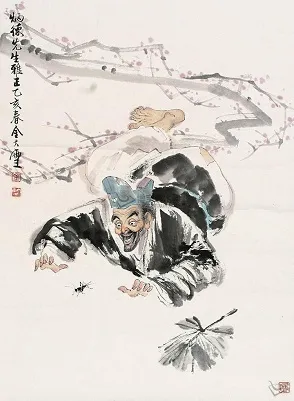
- Sometimes a shoe, cricket, or other unusual object
His fan is often seen as a symbol of releasing negative energy and bringing in fresh, positive energy. The gourd or flask represents non-attachment and the temporary nature of the material world. People might assume the flask contained wine, but some stories say Ji Gong could change the liquid inside into water, vinegar, or something else entirely.
This fits one of his main lessons: do not judge by appearances.
Ji Gong’s ragged look is part of his teaching. He does not want people to confuse spiritual value with clean clothing, status, or formal respectability. What matters is the true heart.
Ji Gong and the Lesson of Not Judging by Appearances
One of the most famous lessons in Ji Gong’s stories is that appearances can mislead us.
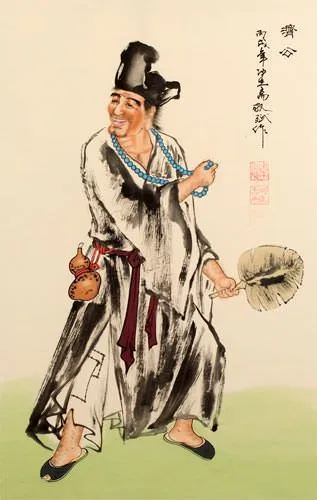
He looked poor, drunken, and wild, but he helped people. Some officials, monks, and wealthy figures looked respectable, but behaved selfishly or cruelly. Ji Gong’s stories often reverse expectations in this way.
He cared less about whether someone looked virtuous and more about whether they had kindness, honesty, and compassion. This is why he became so beloved among ordinary people. He saw through social masks. He helped those who were ignored. He embarrassed those who abused their power.
In a way, Ji Gong is a reminder that wisdom is not always dressed in silk, and goodness is not always found in official places.
Famous Stories of Ji Gong
Many Ji Gong legends are preserved in folk tales, plays, poems, novels, temple stories, and popular entertainment. These stories are often funny, dramatic, and morally sharp. They present him as a strange but compassionate figure who uses unusual methods to save people.
Ji Gong and the Buddha Statue
One winter night, Ji Gong and his students were freezing. To keep warm, Ji Gong took apart a wooden altar and used it as firewood. His students were horrified. How could he burn something sacred?
Then Ji Gong took a wooden Buddha statue and cut it apart as well. A student cried out that he was cutting the Buddha.
Ji Gong replied that the statue was not the Buddha himself. It was only wood.
The point of the story is not disrespect. Ji Gong was teaching that spiritual practice should not become attachment to objects. A statue may be sacred as a symbol, but compassion is deeper than wood. The true Buddha is not limited to a carved image. What matters most is the heart, intention, and living wisdom.
This story captures Ji Gong’s style perfectly. He does something shocking, then reveals a lesson that people remember for life.
Ji Gong Summons Logs from a Well
Another famous story takes place at Jingci Temple, where Ji Gong was said to serve for a time. After a fire destroyed the temple’s main prayer hall, the monks needed large quantities of wood for rebuilding. The problem was that good timber was far away and difficult to obtain.
Instead of searching for merchants or making plans, Ji Gong reportedly slept for three days, seemingly drunk and useless. When he finally woke, he shouted that the wood had arrived and told the monks to take it from the well.
To everyone’s amazement, large logs began appearing from the well one after another. The monks pulled them out and stacked them until they had enough. In some versions, one final log remained half-submerged after a monk shouted that the supply was sufficient.
This story became associated with the idea of a miraculous well, sometimes called the Divine Teleportation Well or Shenmu Well. Whether read as folklore, miracle tale, or religious symbolism, it presents Ji Gong as a figure whose power appears only when truly needed.
Ji Gong Abducts the Bride to Save a Village
Perhaps the most dramatic Ji Gong story tells of a village threatened by a landslide.
One day, Ji Gong sensed that a mountain peak was about to collapse onto a nearby village. He warned the villagers to run, but they laughed at him. To them, he was only the crazy monk again, shouting nonsense.
Seeing that no one believed him, Ji Gong noticed a wedding procession. He suddenly grabbed the bride, threw her over his shoulder, and ran out of the village. Naturally, the groom, relatives, guests, and villagers chased after him.
As soon as they had all run beyond the village gate, the mountain collapsed. Rocks crashed down, houses were destroyed, and the village was buried. But the people survived because they had chased Ji Gong out of danger.
In some versions, Ji Gong also saves a little girl left behind by stopping a giant boulder with his palm. This story is linked with Hangzhou’s famous Flying Peak, where visitors are said to be able to see a handprint in the rock.
The story is strange, funny, and heroic at once. Ji Gong breaks social rules in the most outrageous way possible, but his action saves lives.
Ji Gong Saves a Suicidal Old Man
Another moving story shows Ji Gong’s compassion through humor.
Ji Gong once came upon an old man preparing to hang himself. Instead of giving a direct lecture, Ji Gong pretended that he also wanted to die. He told a ridiculous story about losing money meant for a monastery and claimed he was too ashamed to go back.
The old man became curious and began talking to him. Ji Gong teased him, joked with him, and slowly pulled him away from despair. The old man eventually opened his heart and shared the grief that had driven him to suicide. In some versions, Ji Gong later helps him find his lost daughter, giving the story a happy ending.
This tale shows another side of Ji Gong. He does not always save people with supernatural power. Sometimes he saves them by interrupting their despair, making them laugh, and giving them a reason to keep speaking.
Was Ji Gong a Buddhist Figure or a Taoist Deity?
Ji Gong is difficult to place neatly into one religious category.
Historically, he is remembered as a Buddhist monk, especially connected with Chan Buddhism. But after his death, he also became a folk hero and was worshipped in Chinese folk religion and Taoist temple culture. In Taiwan and parts of southern China, Ji Gong appears in temple festivals, spirit-medium traditions, and popular religious practice.
This blend is not unusual in Chinese religion. Many figures move across Buddhist, Taoist, and folk religious worlds. Ji Gong’s identity is especially fluid because he was both a monk and a folk hero, both a religious figure and a protector of ordinary people.
In some temples, people may describe him as Buddhist. In others, he may be treated as part of Taoist or folk religious worship. His popularity comes partly from this flexibility. Ji Gong belongs to the people as much as to any formal religious institution.
Ji Gong in Chinese Culture
Ji Gong has remained popular because his stories are entertaining, memorable, and emotionally satisfying. He appears in novels, operas, television dramas, paintings, temple statues, and folk performances.
He is often portrayed as a magical helper of the poor, a protector against injustice, and a playful figure who exposes hypocrisy. Some compare him to a Chinese Robin Hood: a wandering hero who uses wit, spiritual power, and moral courage to defend those who cannot defend themselves.
In Taiwan, Ji Gong is especially visible in folk religious settings, including festivals, temple rituals, and spirit-medium traditions. His image—messy, smiling, holding a fan and gourd—is instantly recognizable.
Part of his charm is that he feels approachable. He is not distant, cold, or impossibly perfect. He laughs. He drinks. He looks like someone who has walked through the dust of real life. Yet he is also wise, compassionate, and fearless.
The Deeper Meaning of Ji Gong’s Eccentric Behavior
Ji Gong’s stories are not simply about a monk behaving badly. They ask a deeper question: what does true holiness look like?
Is it clean robes?
Perfect manners?
Strict rules?
Public respect?
Or is it compassion, courage, and freedom from attachment?
Ji Gong challenges the easy answer. His behavior often looks improper, but his actions reveal kindness. He may appear drunk, but he sees clearly. He may look poor, but he gives generously. He may be mocked as crazy, but he understands danger before anyone else does.
That is why his legends still work today. They remind us that wisdom can be uncomfortable. Sometimes the person who helps us most is not the person who looks respectable, but the person who dares to act when everyone else is trapped by fear, pride, or convention.
Why Ji Gong Still Matters Today
Ji Gong remains relevant because his stories speak to a very human problem: we judge too quickly.
We judge people by clothes, status, manners, religion, wealth, or reputation. Ji Gong’s life turns that habit upside down. He asks us to look deeper. Does a person have compassion? Do they help others? Do they speak up against injustice? Do they act from the heart?
His legends also offer a refreshing kind of spirituality. Ji Gong is not presented as fragile, distant, or overly polished. He is rough-edged, funny, unpredictable, and alive. For many people, that makes him more relatable than a perfect saint.
In the end, Ji Gong is remembered not because he followed every rule, but because he helped people. His madness was a mask. His compassion was the truth.
FAQ About Ji Gong
Who is Ji Gong?
Ji Gong was a legendary Chinese Buddhist monk, folk hero, and religious figure from the Southern Song Dynasty. He is remembered for his eccentric behavior, compassion for the poor, supernatural powers, and playful wisdom.
Was Ji Gong a real person?
Ji Gong is generally believed to be based on a real monk named Li Xiuyuan, also known as Daoji. Over time, his life became surrounded by legends, miracle stories, and folk religious traditions.
Why is Ji Gong called the Crazy Monk?
Ji Gong was called the Crazy Monk because he behaved in ways that seemed shocking for a Buddhist monk. He wore ragged robes, drank wine, ate meat, joked openly, and ignored many formal expectations. However, his actions often carried deep moral or spiritual meaning.
What does Ji Gong symbolize?
Ji Gong symbolizes compassion, non-attachment, unconventional wisdom, and the idea that true goodness is not always visible on the surface. He teaches people not to judge others by appearance alone.
Is Ji Gong Buddhist or Taoist?
Ji Gong began as a Buddhist monk in Chinese tradition, but after his death he also became part of Chinese folk religion and Taoist temple culture. Today, he is honored in different ways depending on the region and religious setting.
What are Ji Gong’s most famous stories?
Some of the most famous Ji Gong stories include summoning logs from a well, saving a village by abducting a bride, cutting a wooden Buddha statue to teach non-attachment, and saving a suicidal old man through humor and compassion.
What does Ji Gong usually hold in statues?
Ji Gong is often shown holding a fan and a wine gourd or flask. These objects are part of his iconic image and are often interpreted as symbols of transformation, non-attachment, and his unconventional teaching style.
Why is Ji Gong popular in Chinese culture?
Ji Gong is popular because he is funny, compassionate, rebellious, and deeply human. His stories combine humor, miracles, moral lessons, and social justice, making him one of the most memorable figures in Chinese folklore.