The Medicine Buddha, known in Chinese as Yaoshi Fo (药师佛, Yàoshī Fó), is a Buddha associated with healing, compassion, and relief from suffering in Mahayana Buddhism. His Sanskrit name is Bhaiṣajyaguru, meaning “Medicine Teacher” or “Medicine Master.” In Chinese Buddhism, devotees turn to him not only in times of illness but also when facing fear, poverty, or uncertainty.
He is not a historical Chinese physician who became a god. He is a Buddha described in Buddhist scripture, whose promises concern the well-being and spiritual liberation of all living beings. His best-known teaching is the series of Twelve Great Vows recorded in the Medicine Buddha Sutra.
Medicine Buddha at a Glance
- Chinese name
- 药师佛 / 藥師佛 (Yàoshī Fó); 药师琉璃光如来 (Yàoshī Liúlíguāng Rúlái)
- Sanskrit name
- Bhaiṣajyaguru
- Tradition
- Mahayana Buddhism; especially prominent in East Asian Buddhist traditions
- Associated realm
- Eastern Pure Land of Lapis Lazuli Radiance
- Core scripture
- Sutra of the Original Vows and Merits of the Medicine Master Lapis Lazuli Light Tathagata (Taishō 450)
- Key themes
- Healing, compassion, the Twelve Great Vows, material well-being and awakening
Who Is Medicine Buddha in Chinese Buddhism?
In Chinese temples, Medicine Buddha is commonly called Yaoshi Fo. A more expansive title, Yaoshi Liuliguang Rulai (药师琉璃光如来), describes him as the Medicine Master Tathagata of Lapis Lazuli Light. The title refers both to his compassionate role and to the luminous quality of the pure land over which he presides.
His presence in China grew through the translation, recitation and interpretation of Buddhist sutras. Chinese Buddhist communities incorporated devotion to him into ceremonies for the sick, prayers for protection and practices intended to cultivate compassion and merit. Such practices belong to Buddhist religious life, rather than to a separate cult of a Chinese folk god.
The name “Medicine Buddha” can be misleading if it suggests that his importance is limited to physical health. In Buddhist teaching, suffering also involves ignorance, harmful actions, distress and the conditions that prevent people from pursuing spiritual practice. His vows respond to all of these concerns.
The Medicine Buddha Sutra and Its Chinese Translations
The principal scripture in Chinese devotion to Medicine Buddha is the Yaoshi Liuliguang Rulai Benyuan Gongde Jing (药师琉璃光如来本愿功德经), usually called the Medicine Buddha Sutra. One especially influential Chinese translation was completed by the monk Xuanzang (玄奘) in the seventh century, traditionally dated to 650 CE. This version is catalogued as Taishō no. 450 (T450).
In the sutra, Śākyamuni Buddha tells the bodhisattva Mañjuśrī about Bhaiṣajyaguru, his eastern Buddha-land and the twelve vows he made while following the bodhisattva path. The narrative thus presents Medicine Buddha through a teaching spoken by Śākyamuni, rather than as another name for the historical Buddha.
There is no single surviving Chinese text that exhausts the tradition. Another influential translation by Yijing (义净), catalogued as T451, presents a broader teaching concerning seven Medicine Buddhas. Discussions of his vows, attendants and rituals should therefore specify which scripture or tradition they describe.
What Are the Twelve Great Vows of Medicine Buddha?
The Twelve Great Vows are the heart of Medicine Buddha devotion. According to Xuanzang’s version of the sutra, Bhaiṣajyaguru made these aspirations before attaining Buddhahood. They address spiritual awakening, physical suffering and the everyday hardships that make a dignified life difficult.
The following are concise summaries, not direct quotations from the scripture:
- Radiant illumination: May his light illuminate immeasurable worlds, and may living beings gain the qualities associated with Buddhahood.
- Purity like lapis lazuli: May his body be clear, flawless and luminous, dispelling darkness and guiding beings.
- Freedom from material deprivation: May living beings have what they need and not suffer through scarcity.
- Guidance toward awakening: May those on mistaken paths be guided toward the Buddhist path, and may practitioners progress toward the Mahayana ideal.
- Restoration of ethical conduct: May people who have broken precepts find a way back to purity and avoid harmful rebirths.
- Relief from bodily afflictions: May those experiencing illness and impairments be freed from suffering, in the terms used by the ancient scripture.
- Care for the sick and abandoned: May people without physicians, medicine, family or shelter find relief and the means to live.
- Release from gendered suffering: The ancient text speaks of women distressed by their circumstances being able to be reborn male; this reflects historical ideas about gender and is interpreted differently today.
- Freedom from delusion: May living beings escape destructive influences and develop right understanding.
- Release from persecution: May those facing imprisonment, punishment and fear be freed from distress.
- Food for the hungry: May the hungry receive nourishment before being introduced to the spiritual nourishment of the Dharma.
- Clothing and protection: May those lacking clothing and basic comfort be provided for and relieved of exposure and hardship.
These vows are remarkable for placing food, clothing, safety and care alongside spiritual liberation. The Buddha’s compassion is presented as something that concerns the conditions of ordinary life, not just distant enlightenment.
Why Is Medicine Buddha Blue? The Meaning of Lapis Lazuli
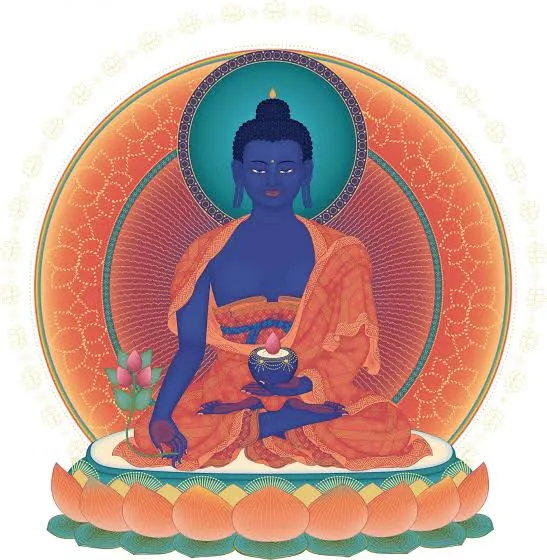
Medicine Buddha is famous for his deep-blue appearance, especially in Tibetan and modern Buddhist art. That color relates to the Sanskrit term vaiḍūrya, a precious, luminous substance commonly rendered in English as “lapis lazuli” or “beryl.” In the sutra, his body is described through the imagery of exceptional clarity and radiance.
The blue color suggests purity, light and the transformation of suffering. It also connects Medicine Buddha to his Eastern Pure Land, often called the Pure Land of Lapis Lazuli Radiance. This is a Buddha-field described in religious cosmology, not a physical location that can be identified on a map.
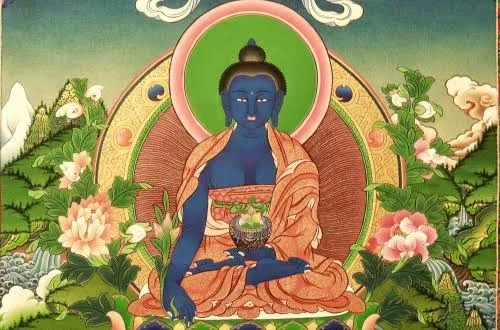
Is Medicine Buddha Always Shown in Blue?
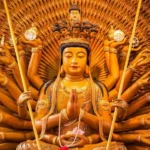
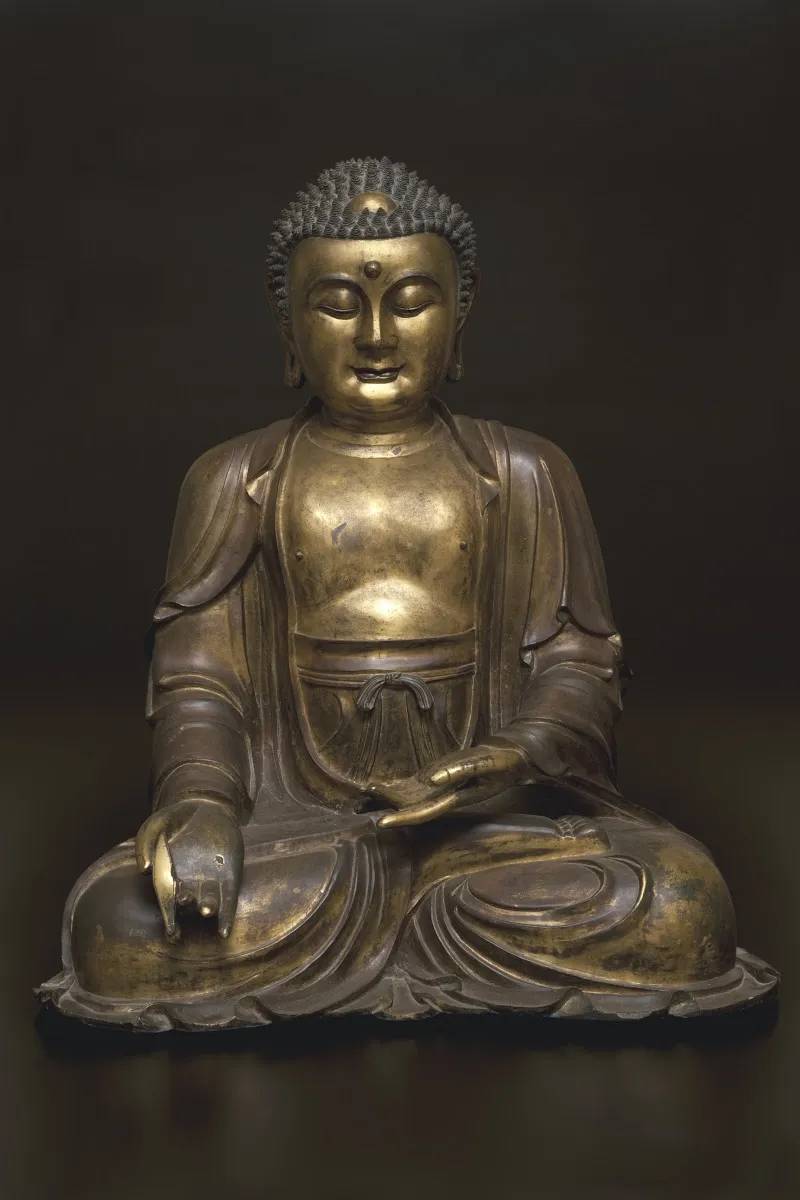
No. In Chinese Buddhist sculpture and painting, Medicine Buddha may also appear with a golden or natural-colored body. Artistic conventions vary across regions and centuries. A golden Buddha statue is not automatically Medicine Buddha, just as every blue Buddha image should not be identified without checking its attributes and context.
His appearance is best understood through a combination of evidence: inscriptions, the vessel or other objects he holds, nearby figures and the shrine or artwork in which he appears.
How to Recognize Medicine Buddha in Chinese Buddhist Art
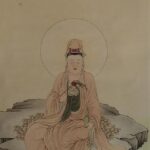
Many images portray Medicine Buddha seated in monastic robes. Depending on the tradition, he may hold a medicine bowl or jar in his left hand. Other portrayals show him with a medicinal plant or fruit, often identified as myrobalan. A hand extended toward the viewer may express generosity or the granting of aid.
These details are useful clues, not rigid rules. Paintings and sculptures produced for different communities do not always use the same attributes. In Chinese art, the identity of a Buddha may also depend on his companions and the arrangement of an entire altar.
Sunlight, Moonlight and the Twelve Yaksha Generals
Medicine Buddha is sometimes portrayed in a triad with two bodhisattvas: Sunlight Bodhisattva (Riguang Pusa, 日光菩萨; Sanskrit Sūryaprabha) and Moonlight Bodhisattva (Yueguang Pusa, 月光菩萨; Sanskrit Candraprabha). Together, the three figures are commonly known as the Three Sages of the East (东方三圣).
The Sunlight and Moonlight bodhisattvas are not interchangeable with the attendants of every other Buddha. Their appearance beside Medicine Buddha helps identify the eastern triad in temples and painted assemblies.
The Medicine Buddha Sutra also describes Twelve Great Yaksha Generals who pledge to protect those who uphold its teaching. In Buddhist religious imagery, these often appear as armored guardians. Their role is protective; they are not twelve additional Buddhas. They should also not be confused with the Four Heavenly Kings, another group of Buddhist guardians.
Medicine Buddha’s Eastern Pure Land vs. Amitabha’s Western Pure Land
Because both are associated with pure lands, Medicine Buddha and Amitabha Buddha are sometimes confused. Their scriptures and devotional traditions are connected to the broader Mahayana understanding of Buddha-fields, but they are distinct figures.
| Feature | Medicine Buddha (Yaoshi Fo) | Amitabha Buddha (Amituo Fo) |
|---|---|---|
| Associated direction | East | West |
| Pure Land | Lapis Lazuli Radiance | Sukhāvatī, the Land of Ultimate Bliss |
| Prominent devotional focus | Healing, relief of suffering, well-being and awakening | Rebirth in the Western Pure Land and progress toward liberation |
| Common attendants in Chinese art | Sunlight and Moonlight bodhisattvas | Guanyin and Mahāsthāmaprāpta (Dashizhi) |
In some Chinese Buddhist settings, Śākyamuni Buddha, Medicine Buddha and Amitabha Buddha are honored together. Such a grouping does not mean that they are three names for the same figure. For more context on Chinese renderings of Buddhist names, see our guide to Sanskrit names of Chinese Buddhist deities.
How Do Chinese Buddhists Honor Medicine Buddha?
Devotion to Medicine Buddha may include reading or chanting the Medicine Buddha Sutra, reciting his name, making offerings, lighting lamps and dedicating the merit of practice to others. Temples may conduct ceremonies for people facing illness or other difficulties. The form of these practices varies by community and ritual tradition.
A common form of homage is “Namo Yaoshi Liuliguang Rulai” (南无药师琉璃光如来), meaning an expression of reverence to Medicine Master Lapis Lazuli Light Tathagata. Shorter forms such as “Namo Yaoshi Fo” are also used. Sanskrit mantras belong to related ritual traditions, but should not be confused with the Buddha’s Chinese name or with the complete sutra.
For practitioners, chanting and prayer can be expressions of faith, hope, compassion and concern for others. They should not be presented as substitutes for medical diagnosis, appropriate treatment or professional care.
Medicine Buddha in Chinese History and Temple Art
Medicine Buddha devotion developed in China through transmitted scriptures, ceremonies and visual culture. Tang-period Buddhist art already included imagery linked to the Medicine Buddha Sutra. Later paintings and sculptures show how his worship continued in Chinese monastic settings.
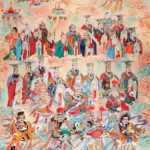
One especially important surviving example is a monumental Yuan-dynasty mural of the Buddha of Medicine, dated to about 1319 and originally from the Lower Guangsheng Temple in Shanxi. Now in the Metropolitan Museum of Art, the painting includes a central Buddha, Sunlight and Moonlight bodhisattvas, and other members of the celestial assembly. Its historical provenance helps scholars distinguish securely identified Medicine Buddha imagery from more generic representations of a seated Buddha. The museum provides a catalogue record of this mural.
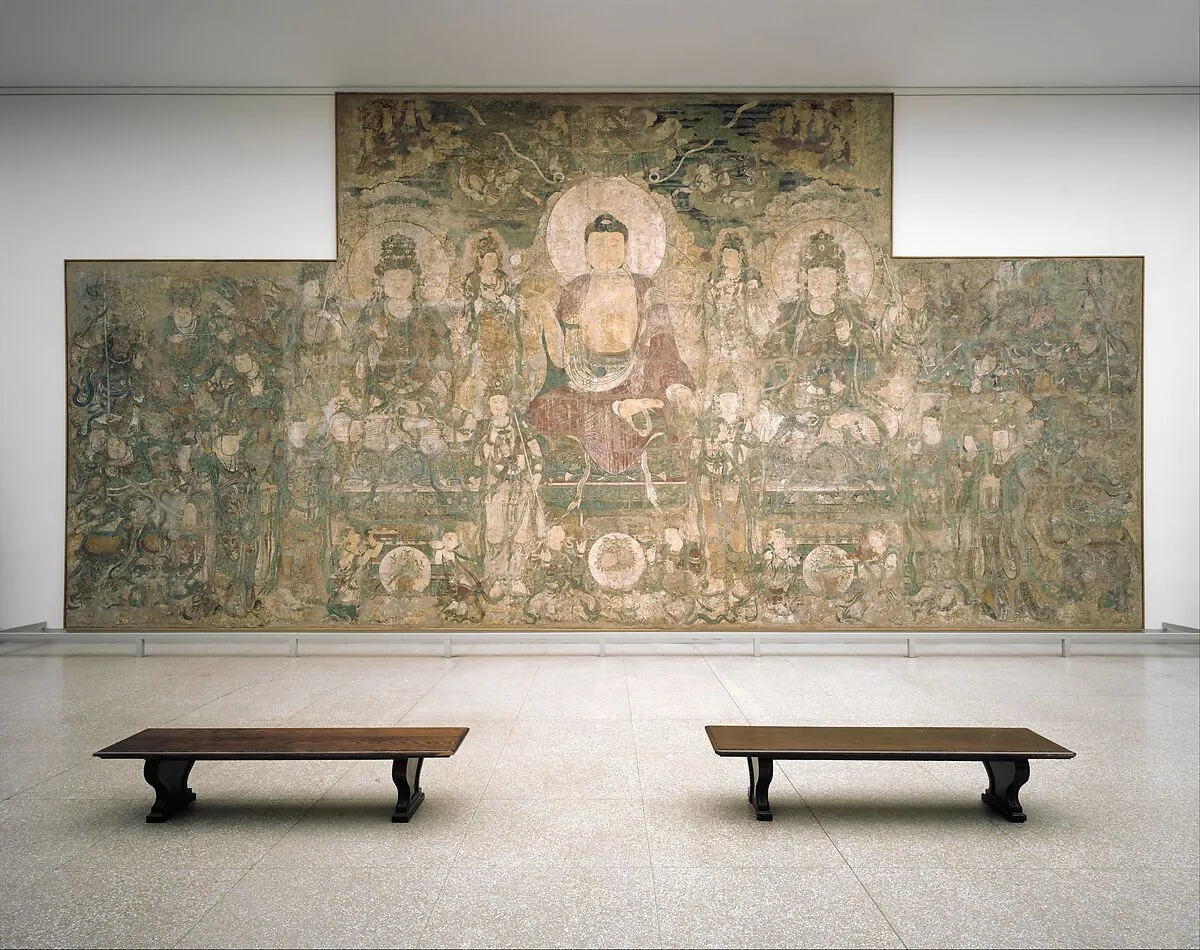
Material evidence is important because scripture and later popular custom do not always tell the same story. A translated sutra can document the ideals of a religious tradition, while the age and setting of an artwork help establish when and where those ideals took visible form. For a broader introduction, visit our Buddhist Deities collection.
Why Medicine Buddha Still Matters
The enduring appeal of Yaoshi Fo comes from the unusual breadth of his compassion. His vows concern a person with no doctor, someone without food or clothing, a prisoner living in fear, and a practitioner struggling to follow an ethical path. Health appears within a larger vision of human vulnerability.
For believers, Medicine Buddha offers a focus for prayer and an ideal of compassionate action. For readers studying Chinese religion, he shows how an Indian Mahayana Buddhist figure became an important presence in Chinese temples, images and everyday devotional life. Understanding the distinction between those religious meanings and their historical record makes his story richer, not less significant.
Frequently Asked Questions
Is Medicine Buddha a Chinese god?
No. Yaoshi Fo is a Buddha within Mahayana Buddhism, not originally a Chinese folk god. His worship became influential in Chinese Buddhist religious culture.
Is Medicine Buddha the same as Gautama Buddha?
No. Gautama, or Śākyamuni, is the historical Buddha. The Medicine Buddha Sutra presents Śākyamuni teaching about another Buddha, Bhaiṣajyaguru.
What are the Twelve Great Vows?
They are twelve aspirations attributed to Medicine Buddha before his awakening. They address enlightenment and ethical conduct as well as illness, hunger, material deprivation and fear.
Why is Medicine Buddha blue in paintings?
The color evokes the radiant gem imagery associated with his body and eastern pure land. However, golden and other non-blue representations also exist, particularly in Chinese Buddhist art.
Which direction is associated with Medicine Buddha?
East. His pure land is the Eastern Land of Lapis Lazuli Radiance, distinct from Amitabha Buddha’s Western Pure Land.
Can Medicine Buddha prayers cure illness?
Buddhist devotees may pray to Medicine Buddha for healing and relief from suffering. Those are religious beliefs and practices; they do not establish that prayer can cure medical conditions or replace professional treatment.
References and Further Reading
- Yaoshi Liuliguang Rulai Benyuan Gongde Jing (药师琉璃光如来本愿功德经), attributed to Xuanzang’s Chinese translation, Taishō Tripiṭaka T450.
- Yaoshi Liuliguang Qifo Benyuan Gongde Jing (药师琉璃光七佛本愿功德经), attributed to Yijing’s Chinese translation, Taishō Tripiṭaka T451.
- Fo Guang Shan International Translation Center, The Medicine Buddha Sutra, English and Chinese edition.
- The Metropolitan Museum of Art, Buddha of Medicine Bhaishajyaguru (Yaoshi fo), Yuan dynasty, ca. 1319, accession 65.29.2.
- Smithsonian National Museum of Asian Art, materials on Medicine Buddha (Bhaiṣajyaguru) and Buddhist iconography.