Few figures in Chinese cultural memory walk the line between history and myth quite like Bao Zheng. He was a real government official of the Northern Song dynasty, remembered in his own time for honesty and impartial judgment. But over the centuries that followed, storytellers, opera performers, novelists, and worshippers transformed him into something larger: Judge Bao, the fearless defender of truth, the official who could not be bribed, threatened, or deceived.
For many Chinese audiences, this is the Chinese god of justice Bao Zheng myth in its fullest sense — not the story of a god from ancient heaven, but the story of how a historical man became a moral ideal and, in some religious traditions, a divine one.
This article traces that transformation from the historical Bao Zheng of the Song court to the legendary Judge Bao of opera and fiction, and finally to his place in Chinese popular religion and mythological imagination.
What Does “Chinese God of Justice” Actually Mean for Bao Zheng?
Before going further, it’s worth pausing on the title itself.
In Chinese, Bao Zheng is most often called Bao Gong (包公), meaning “Lord Bao,” a respectful honorific. His more poetic name is Bao Qingtian (包青天), which translates roughly as “Clear-Sky Bao.” The phrase “clear sky” evokes brightness, moral transparency, and the clearing away of clouds — in other words, a world made fair again by the right judge.
He is not a creator god, a nature deity, or a figure from ancient cosmological mythology in the same category as the Jade Emperor, Guanyin, or the Dragon Kings. His divine status — where it exists — developed through a long process of folklore, drama, and popular worship rather than classical religious scripture.
In practice, the Bao Zheng tradition operates across three overlapping layers:
- The historical layer: a real Song dynasty official known for integrity
- The literary and theatrical layer: the legendary Judge Bao of court-case fiction and opera
- The religious and mythological layer: a justice deity and, in some traditions, a judge of the dead
Understanding these layers separately — and how they interact — is the key to understanding why the Bao Zheng myth has lasted as long as it has.
The Historical Bao Zheng: Who Was He?
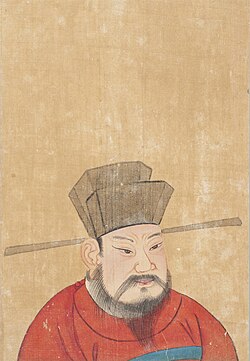
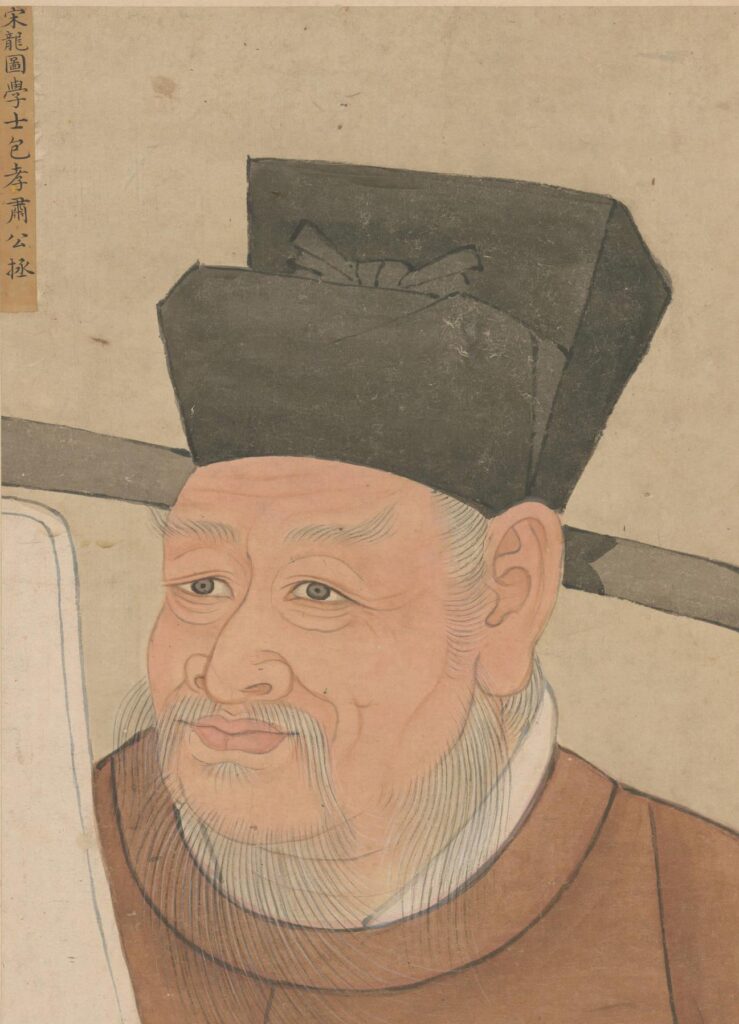
Bao Zheng (包拯) lived from 999 to 1062 CE during the Northern Song dynasty, a period marked by elaborate civil administration, the examination system, and strong Confucian ideals of governance. He served under Emperor Renzong and held a range of official posts, including positions connected with legal judgment and the administration of the capital region Kaifeng.
In historical memory, several qualities defined him.
Integrity. He was remembered as an official who refused bribes and resisted personal favoritism — an embodiment of the Confucian ideal of the qingguan (清官), or “upright official.” In a political culture where corruption and patronage networks were commonplace, this reputation was remarkable.
Impartiality. Historical and semi-historical accounts emphasize that Bao judged according to principle rather than according to the rank, wealth, or family connections of those before him.
Courage. He was said to have confronted powerful officials and aristocrats on matters of law and ethics. How much of this is strictly historical and how much is later embellishment is difficult to determine, but the theme became central to everything that followed.
Care for common people. Bao’s reputation is not only about punishing criminals. It is also about giving ordinary people — those without rank or connections — a place to be heard. This gave his image a strongly populist quality that made him attractive to later storytellers.
These qualities were genuinely unusual enough to be remembered. But the Bao Zheng of history is a much quieter figure than the one who would emerge through centuries of storytelling.
From Official to Legend: How Judge Bao Was Born
The transformation from historical Bao Zheng to legendary Judge Bao did not happen suddenly. It built gradually through oral tradition, theatrical performance, printed fiction, local worship, and eventually television — each medium adding new dimensions to the figure.
Court-Case Fiction and the Gong’an Tradition
One of the most important literary forces behind the Bao Zheng legend was gong’an (公案) fiction — court-case or case-record stories built around a magistrate or judge who investigates crimes, exposes hidden truth, and delivers moral judgment.
Judge Bao became the defining figure of this tradition. In these tales, injustice is usually established at the outset: a murder is concealed, a poor person is falsely accused, a corrupt local official is exploiting his position. The drama lies not in mystery for its own sake but in a deeper question — can justice overcome power, money, and fear?
Unlike later Western detective fiction, gong’an stories are rarely about outsmarting a clever criminal. They are about whether moral order can be restored in a world that often resists it. Bao Zheng — fearless, incorruptible, and sharp — became the ideal vehicle for that theme.
Opera and the Black-Faced Judge
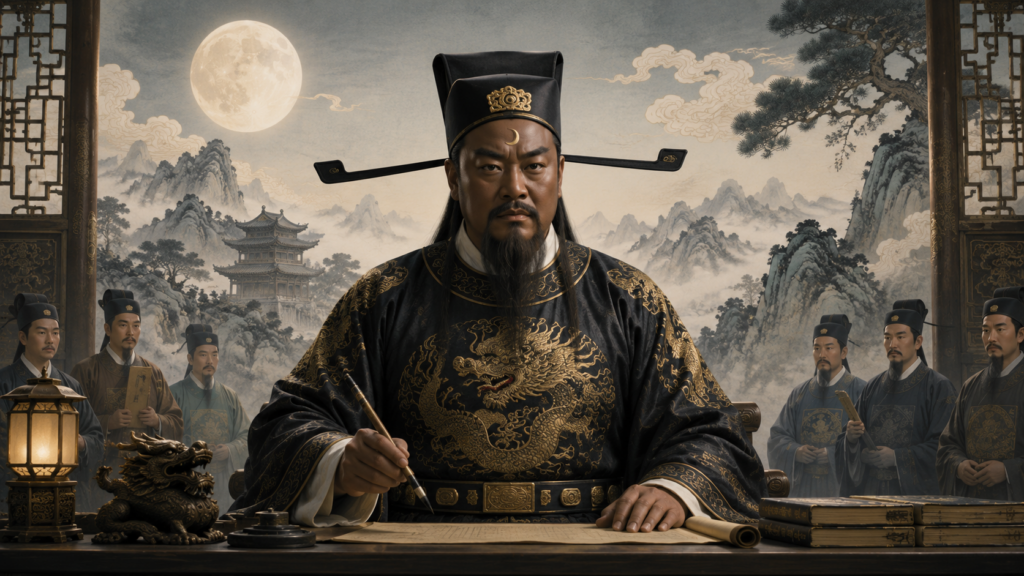
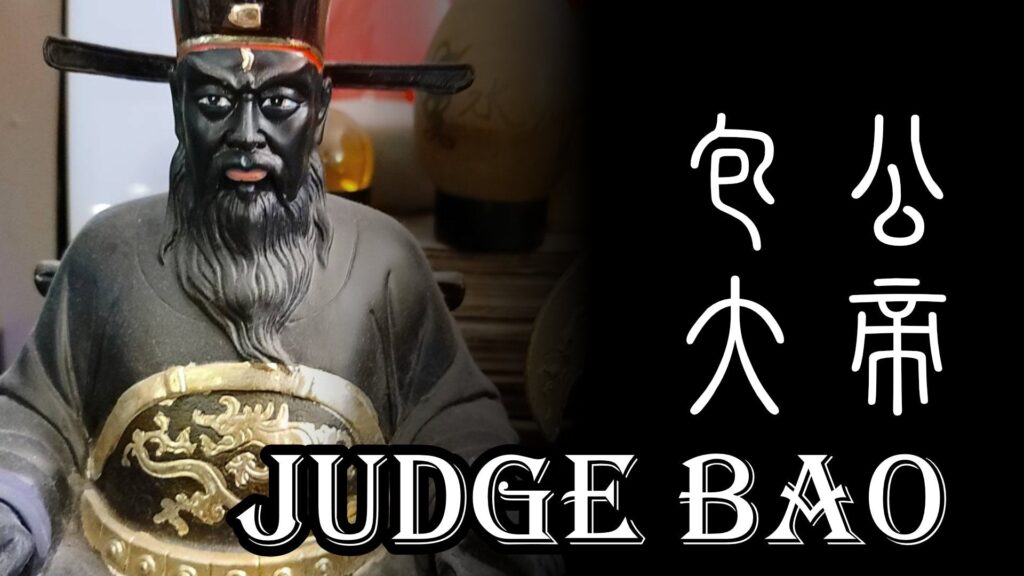
Chinese opera gave Judge Bao his most iconic visual form. On stage, he is invariably shown with a dark or black-painted face and a crescent moon mark on his forehead. Neither feature is historical evidence of what the real Bao Zheng looked like. Both are theatrical conventions loaded with symbolic meaning.
In Chinese opera face painting, colors and patterns communicate a character’s moral nature to the audience at a glance. Bao’s black face came to signify sternness, incorruptibility, and absolute seriousness — a face that cannot be softened by flattery or frightened by rank. The crescent moon suggests clarity of perception, a kind of supernatural insight that pierces through deception.
For many people across Chinese cultural history, this operatic image has been more familiar and more powerful than anything from the historical record.
Novels, Illustrated Fiction, and Television
Judge Bao also found his way into narrative fiction, perhaps most famously through story cycles connected with The Three Heroes and Five Gallants (三侠五义), which placed Bao’s courtroom authority alongside martial heroes and dramatic adventure. These works helped establish him as a figure whose jurisdiction extended well beyond any single case.
In the modern era, television dramas — particularly Taiwanese and mainland Chinese productions — brought Judge Bao to new generations across the Chinese-speaking world. The stern judge in his official hat, presiding over a courtroom where truth is finally spoken, became one of the most recognizable images in Chinese popular culture.
The Bao Zheng Myth: Themes, Stories, and Symbols
There is no single canonical “Bao Zheng myth” in the way there is one fixed story of, say, Nuwa shaping humans from clay. The Bao Zheng tradition is better understood as a cycle of stories built around one central moral proposition: true justice must be fearless, impartial, and morally clear.
Most Judge Bao stories follow a recognizable pattern. An injustice occurs — a false accusation, a concealed crime, a powerful person exploiting their position. The ordinary legal system fails, either through corruption, cowardice, or complicity. The case reaches Bao. He listens, investigates, and uses a combination of sharp reasoning and sometimes psychological cunning to expose the truth. The guilty are punished regardless of rank. Moral order is restored.
The power of this pattern lies in what it insists is possible.
Famous Stories Associated with Judge Bao
The Case of Chen Shimei. One of the most famous stories in the Judge Bao cycle involves a man who abandons his first wife after rising to official success and marrying into a higher-status family. When his abandoned wife arrives to seek justice, Chen Shimei attempts to deny or suppress his past. In the legend, Bao refuses to shield him simply because of his connections to the imperial household. The case became especially famous in opera because it combines social ambition, family betrayal, gender injustice, and the judge’s absolute obligation to truth — regardless of who the defendant is.
The Civet Cat Exchanged for the Crown Prince. This highly fictionalized story involves palace intrigue at the imperial level: a newborn prince is secretly swapped for a civet cat, and a grave injustice is buried for years within the highest reaches of power. In legend, Bao is the one who eventually uncovers it. The story pushes his role beyond local magistrate into something more extraordinary — a judge whose reach extends even into the protected inner world of the palace.
The Wronged Dead. Several stories in the Bao cycle involve ghosts or spirits who appear to reveal crimes that living witnesses cannot or will not speak about. A wronged woman’s spirit, a murdered man who cannot rest — Bao is the judge willing to hear them. This theme carried important cultural weight: in Chinese belief, injustice disturbs both the living and the dead, and a truly righteous judge must be able to address both.
Symbols of Bao Zheng
Bao Zheng’s image is rich in visual shorthand that has become culturally embedded.
The black face. In opera symbolism, it does not refer to skin color. It represents moral sternness, absolute honesty, and a kind of severity that cannot be worn down.
The crescent moon. Positioned on his forehead, it suggests clarity of judgment, the ability to perceive what others cannot, and perhaps a connection with the realm of night and hidden things.
The judge’s hat. With its characteristic stiff horizontal extensions, it marks him as an official — not a wandering outsider, but the ideal inside the system. His authority comes from the state, but his character is his own.
The execution blades. In many dramatic versions, Bao possesses special blades for executing criminals of different social ranks — one for commoners, one for officials, one for members of the imperial family. Whether read literally or symbolically, the message is clear: accountability is not a privilege of rank. It applies to everyone.
The courtroom. In Bao’s stories, the courtroom itself becomes a near-sacred space — the one place where the powerless can speak freely and where hidden truth can finally surface.
Bao Zheng and the Underworld
One of the most distinctly mythological dimensions of the Bao Zheng tradition is his association with the afterlife.
In Chinese religious imagination — drawing from a blend of folk belief, Buddhism, and Taoist cosmology — the afterlife is frequently described in bureaucratic terms. The dead pass through courts, face judgment, have their deeds recorded in celestial registers, and receive punishments or rewards before possible rebirth. The presiding figure of this system is often Yanluo Wang (阎罗王), known in English as King Yama, the lord of the underworld.
In some literary and religious traditions, Bao Zheng is imagined as a judge within this underworld system. In others, he is identified with Yanluo Wang himself, or treated as his earthly counterpart — the judge above ground who mirrors the judge below. This identification is not uniform across all traditions and should not be presented as official religious doctrine. It is, rather, a natural extension of popular imagination: if Bao was the fairest judge among the living, who better to judge the dead?
This association gives the Bao Zheng myth a cosmic dimension that goes beyond law and government. Justice, in his legend, is not merely a human institution. It is a moral principle woven into the structure of the universe itself. Crimes hidden in life may still be judged after death.
Is Bao Zheng a Taoist Deity?
This question comes up regularly, and the honest answer is: it depends on the tradition and the context.
Bao Zheng is sometimes discussed alongside Taoist deities and underworld officials, and some temples worship him within frameworks influenced by Taoist ritual. However, he is more accurately described as a deified historical figure in Chinese popular religion rather than a major Taoist deity from classical scripture. The distinction matters.
Chinese popular religion has a long tradition of elevating historical or semi-historical figures to divine or semi-divine status after death. Guan Yu, the Han dynasty general who became a god of war and righteousness, is one well-known example. Mazu, a woman from Fujian who became a goddess of the sea, is another. Bao Gong belongs to a similar category: a figure whose historical identity became religiously meaningful over time, absorbed into the broader moral and cosmological imagination of Chinese popular belief.
His connections to Taoism, Buddhism, folk religion, and Confucian ethics are real but intertwined in ways that resist clean categorization. For English-speaking readers, the most accurate framing is probably this: Bao Zheng is a justice deity of popular religion, with roots in real history and branches reaching into multiple religious and cultural traditions.
Common Misunderstandings
Bao Zheng was always a god. He was not. He was first a historical official. His divine or semi-divine status developed slowly through folklore, drama, and popular worship, not from ancient scripture.
Every Judge Bao story is historical fact. Many famous stories in the cycle are fictionalized or largely legendary. They preserve moral and cultural values, but they should not be read as historical record.
His black face is what he really looked like. The black face is a theatrical convention, not a historical portrait. It is a symbol of moral sternness and incorruptibility in the opera tradition.
Bao Zheng belongs only to Taoism. His legend draws on folk religion, Confucian morality, Buddhist underworld cosmology, opera symbolism, and literary tradition. He cannot be reduced to a single religious category.
Judge Bao stories are primarily detective stories. They involve crime, evidence, and courtroom procedure, but their deeper concern is moral rather than procedural. The real question in these stories is always whether justice can overcome power and corruption — not simply who committed the crime.
Why the Bao Zheng Myth Still Matters
Bao Zheng endures because his legend addresses something that never becomes irrelevant: what happens when power is unjust, and who, if anyone, can correct it?
His stories imagine a world where the answer is not “no one.” A judge exists who cannot be bought. A court exists where ordinary people can finally speak. The guilty — even the powerful guilty — are held accountable. This is a fantasy in the literal sense, but it is a fantasy that has served real cultural work for centuries, giving people a language for what justice ought to look like.
For English-speaking readers exploring Chinese mythology, Bao Zheng is also a valuable entry point into traditions that can seem unfamiliar. His legend shows that Chinese mythological culture is not only concerned with dragons, immortals, and cosmic creation. It is equally interested in social ethics, legal idealism, historical memory, and the relationship between earthly and cosmic moral order.
He stands, as he has for nearly a thousand years, at the intersection of history and myth — real enough to have lived and served, legendary enough to have become a courtroom hero, and sacred enough in some traditions to sit in judgment of the dead.
FAQ
Who is Bao Zheng in Chinese mythology? Bao Zheng — also known as Bao Gong, Judge Bao, or Bao Qingtian — was a historical Northern Song dynasty official who became, over centuries, a legendary symbol of justice in Chinese folklore, opera, fiction, and popular religion.
Is Bao Zheng really a Chinese god of justice? Not in the sense of an ancient deity from classical mythology. But in the sense of popular religion and cultural imagination, he has been worshipped as a justice deity in some traditions. Calling him a Chinese god of justice is reasonable as long as his historical origins are kept in view.
What does Bao Qingtian mean? The name means something like “Clear-Sky Bao.” It suggests fairness, brightness, and the clearing away of injustice — a world made morally transparent by the right judge.
Why does Bao Zheng have a black face? This comes from Chinese opera symbolism, not historical record. In the opera tradition, a black-painted face represents sternness, incorruptibility, and absolute moral seriousness.
What does the crescent moon on Bao Zheng’s forehead mean? The crescent moon is a symbolic marking associated with clarity of insight and supernatural perception — the ability to see what others cannot, or will not.
Is Bao Zheng connected to King Yama? In some literary, dramatic, and religious traditions, Bao Zheng is associated with or identified as Yanluo Wang (King Yama), the judge of the dead. This is part of his later mythological development and varies by region and tradition.
What are Judge Bao stories really about? Most Judge Bao stories center on crimes, false accusations, corruption, and the restoration of moral order. Their deeper theme is whether justice can prevail against wealth, power, and fear.
Is Bao Zheng the same as Guan Yu? No. Both are historical figures who became deified in popular religion, but they represent different ideals. Guan Yu is associated with loyalty, martial virtue, and protection. Bao Zheng is associated with justice, legal judgment, and the accountability of power.
Where does Bao Zheng fit on a Chinese mythology website? He fits well under Chinese Gods, Legends and Stories, and — with appropriate framing — under Folk Religion or Underworld Deities, given his associations with judgment after death.
Conclusion
The Chinese god of justice Bao Zheng myth is not the story of a god from ancient heaven. It is something more unusual and, in its own way, more interesting: the story of how a real human being became a moral legend.
Historically, Bao Zheng was an upright Song dynasty official in an era that valued exactly such men. In folklore, he became Judge Bao — the judge who could not be bought, the official who would face down nobles, the voice of the powerless against the powerful. In opera, he became the black-faced judge with the crescent moon, instantly recognizable to generations of audiences. In popular religion, he became, for some traditions, a divine judge whose reach extended from the living into the world of the dead.
What connects all these versions is a single, persistent hope: that justice is real, that it is stronger than rank and money, and that somewhere — in a courtroom, in a story, or in the moral structure of the universe itself — the truth will finally come out.