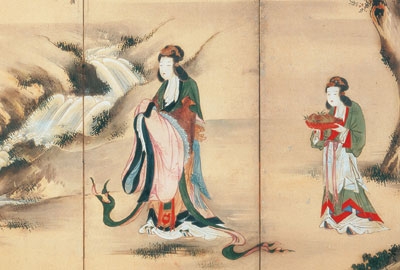
Xiwangmu (西王母, Xīwángmǔ), the Queen Mother of the West, is one of the oldest goddesses in Chinese tradition and one of the few whose image can be traced across more than a thousand years of texts and art. In the Classic of Mountains and Seas she has a leopard’s tail and tiger’s teeth. In Han dynasty tombs she presides over a western paradise of deathlessness. In medieval Daoism she rules the female immortals, and in popular religion, as Wangmu Niangniang, she hosts the Peach Banquet that Sun Wukong ruins in Journey to the West. These are not chapters of one fixed story. They are layers from different periods, sources, and religious settings.
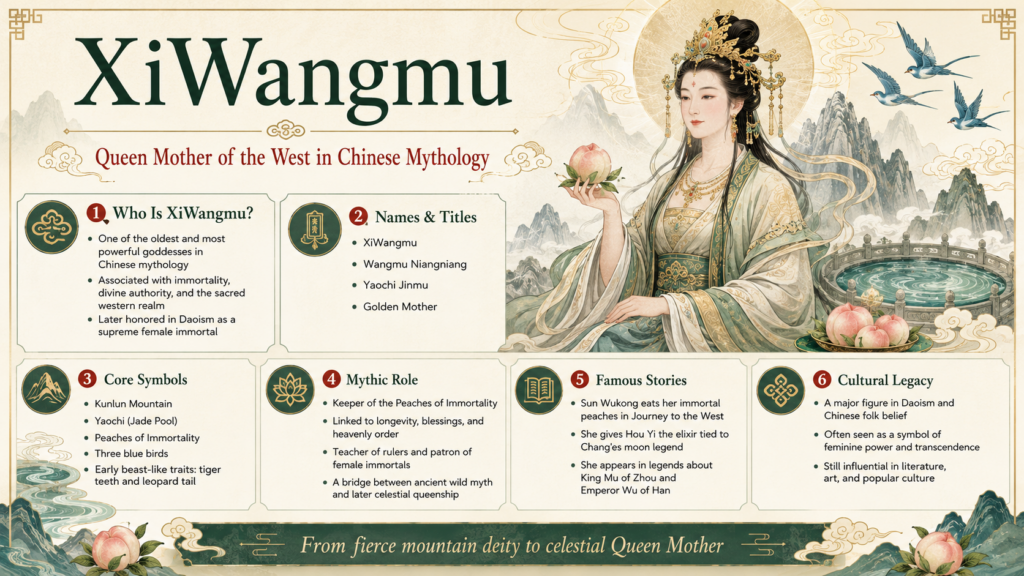
Quick answer: Xiwangmu is a Chinese goddess associated with the far west, Mount Kunlun, the Jade Pool, and the power to grant or withhold immortality. Early sources describe a fierce, partly animal figure; Han art turned her into an enthroned deity of paradise; Daoist writers made her the supreme goddess of female transcendents; and folk tradition remembers her as keeper of the Peaches of Immortality.
| Item | Details |
|---|---|
| Chinese name | 西王母 (Xīwángmǔ) |
| Other names | Hsi Wang Mu (Wade-Giles); Wangmu Niangniang (王母娘娘); Yaochi Jinmu (瑤池金母); Jinmu Yuanjun (金母元君) |
| Home | Mount Kunlun (崑崙) and the Jade Pool (瑤池, Yáochí) in the far west |
| Associated with | Immortality, the elixir of deathlessness, peaches, the sheng headdress, female transcendents |
| Key early sources | Shanhaijing, Zhuangzi, Mu Tianzi zhuan, Huainanzi, Hanshu |
| Traditions | Early mythology, Han funerary religion, religious Daoism, popular religion, literature |
Who Is Xiwangmu?
Xiwangmu is best understood as a deity of the western margins of the world: the place where the sun sets, where the sacred mountain Kunlun rises, and where the boundary between mortal and immortal life could be crossed. Across her long history she has been a dangerous mountain power, a hostess to visiting kings, a savior figure in a popular Han cult, a ruler in the Daoist heavens, and a household-name goddess of birthdays and longevity.
She belongs in the broad category of Chinese gods and goddesses because no single tradition owns her. Daoism absorbed her, but she was already worshipped before organized Daoism existed, and popular religion and fiction later reshaped her again.
Name and Meaning
The name combines xi 西 (“west”), wang 王, and mu 母 (“mother”). “Queen Mother of the West” is the standard English rendering, but it is an approximation. In early Chinese usage, wangmu could refer to a paternal grandmother, and the early dictionary Erya also uses Xiwangmu as the name of a remote western region. The philosopher Paul R. Goldin has argued that “Spirit-Mother of the West” captures the early sense better. Most English writers keep “Queen Mother” because it is established.
Other forms you will meet include:
- Hsi Wang Mu – the older Wade-Giles spelling, common in English books before the 1980s.
- Wangmu Niangniang (王母娘娘) – “Lady Queen Mother,” her everyday name in popular religion, opera, and storytelling.
- Yaochi Jinmu (瑤池金母) – “Golden Mother of the Jade Pool.”
- Jinmu Yuanjun (金母元君) – “Golden Mother, Primordial Sovereign,” a Daoist title. “Golden” here also carries the sense of “metal,” the phase associated with the west.
Some scholars have connected her with a “Western Mother” (西母) who appears in a Shang dynasty oracle-bone divination alongside an “Eastern Mother.” The evidence is a single inscription separated from the literary sources by many centuries, so the link remains a possibility rather than an established origin.
Xiwangmu in Early Sources
Pre-Han writings do not agree on who Xiwangmu was. The scholar Riccardo Fracasso grouped them into three main portraits: a Daoist being who had attained the Dao, a foreign ruler visited by a Zhou king, and a feline demon of the mountains.
The Classic of Mountains and Seas
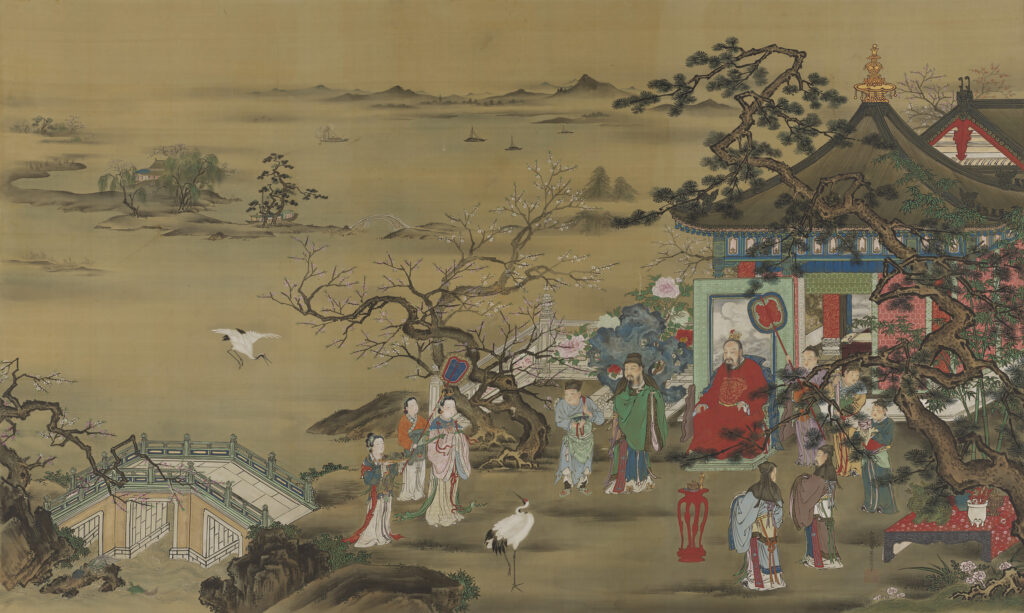
The Shanhaijing (山海經), compiled over several centuries from the Warring States into the Han, mentions her three times. In the “Western Mountains” chapter she lives on Jade Mountain. She looks human but has a leopard’s tail and tiger’s teeth, is skilled at a piercing whistle or howl, and wears a sheng ornament over unkempt hair. The same passage says she oversees “the calamities of Heaven and the five destructions” (司天之厲及五殘), a line commentators read either as plagues and punishments or as baleful stars.
Two later chapters add details. One places her north of the Kunlun ruins, leaning on a stool while three green birds fetch her food. Another sets her on the Hill of Kunlun, living in a cave, again with tiger teeth, a leopard tail, and the sheng. Fracasso notes that these are the only early passages that give her monstrous features. The sheng survived; the claws and teeth did not.
Zhuangzi
The Zhuangzi (莊子), in its chapter on the “Great and Venerable Teacher,” lists Xiwangmu among those who obtained the Dao. She sits on Shaoguang, and no one knows her beginning or end. Michael Loewe considered this possibly the earliest reference to her, and it already links her with timelessness.
The Tale of King Mu, Son of Heaven
The Mu Tianzi zhuan (穆天子傳) was recovered from a Warring States tomb in Ji commandery (modern Henan) around 279–281 CE. It describes King Mu of Zhou traveling west by chariot and being entertained by Xiwangmu at the Jade Pool. The two exchange songs; she asks whether he will come again, and he promises to return in three years. Here she is a dignified ruler of a distant land, not a beast. How much of the text reflects genuine Western Zhou material is still debated. Edward Shaughnessy has pointed to names in it that also appear in King Mu-era bronze inscriptions.
Huainanzi: The Elixir
The Huainanzi (淮南子), presented to the Han court in 139 BCE, gives the clearest early link between Xiwangmu and immortality. It says the archer Yi asked her for the drug of deathlessness, and Heng’e stole it and fled to the moon. This is the root of the familiar story of Hou Yi and the story of Chang’e, though later retellings add motives, dialogue, and moral judgments that the brief Han line does not contain.
The Han Dynasty: Cult, Tomb Art, and Bronze Mirrors
The Han period (206 BCE–220 CE) is when Xiwangmu became a major object of worship. In 3 BCE, during a drought, the Hanshu records a mass movement in which people passed tokens of the Queen Mother from hand to hand, traveled across commanderies toward the capital, and held gatherings in her honor. It is often described as the earliest recorded large-scale religious movement in China. The account comes from a hostile court historian, so it says more about official anxiety than about what participants believed.
Her image also spread through tomb art. A Western Han mural in the tomb of Bu Qianqiu at Luoyang shows a figure wearing the sheng, which scholars identify as Xiwangmu. Eastern Han shrine reliefs in Shandong and pictorial bricks and coffins in Sichuan show her enthroned, often on a dragon-and-tiger seat, surrounded by a recognizable court:
- a hare pounding the elixir of immortality;
- a toad and a three-legged crow, linked with the moon and sun;
- a nine-tailed fox, an auspicious creature;
- feathered immortals and worshippers.
Art historians disagree about what these scenes mean. Wu Hung reads her as a cosmic figure who took over the role once held by Fuxi and Nüwa; Jean James emphasizes her role as a helper who protects the souls of the dead. Both readings agree that she had become the central deity of Han funerary imagery.
Pairing with Dongwanggong
Xiwangmu originally had no fixed partner. During the Eastern Han, artists and believers created a male counterpart, Dongwanggong (東王公), the King Father of the East, to balance her as east balances west and yang balances yin. Many Eastern Han bronze mirrors show the two seated on opposite sides of the central knob, sometimes identified by inscription and joined by the Azure Dragon, the White Tiger, or chariots. A later legend said the pair met once a year. Dongwanggong never gained an independent cult comparable to hers.
Emperor Wu and the Peaches of Immortality
The famous story of Xiwangmu descending to visit Emperor Wu of Han (r. 141–87 BCE) comes from texts written long after his reign. The most elaborate, the Han Wudi neizhuan (漢武帝內傳), was traditionally credited to the Han historian Ban Gu, but it is a Six Dynasties work; Britannica dates it to the late sixth century. In it, the goddess arrives at night on the seventh day of the seventh month, shares divine peaches, and instructs the emperor, who ultimately fails to become immortal.
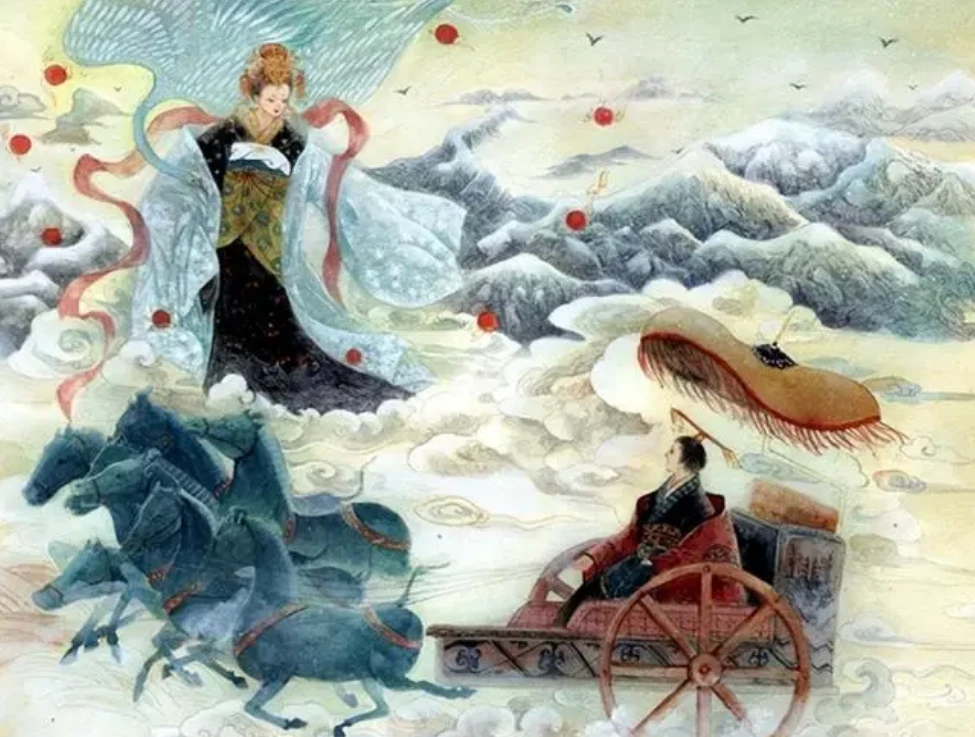
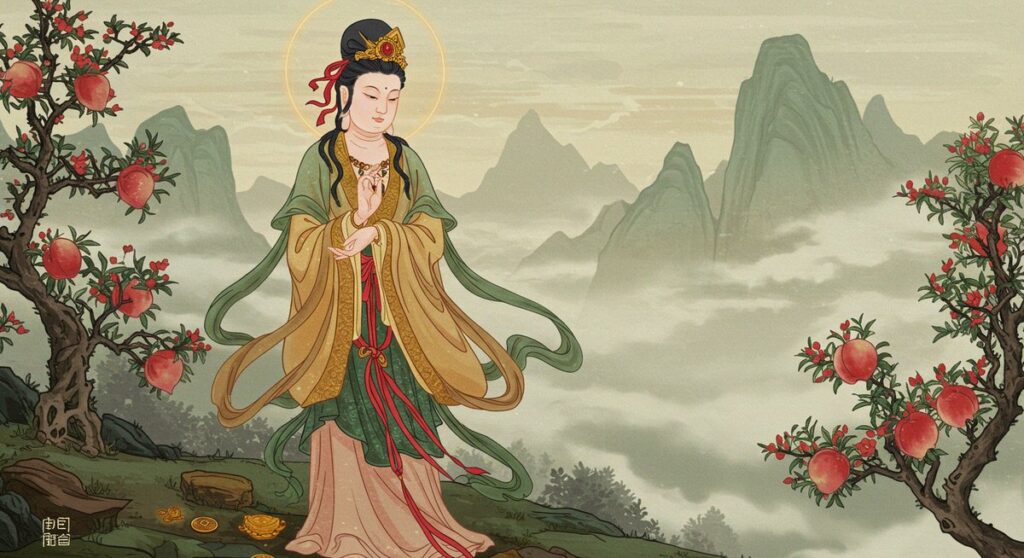
Earlier anecdote collections, including Zhang Hua’s third-century Bowuzhi, already have her giving peaches to Emperor Wu and explaining that the trees fruit only once every three thousand years. These stories turned the peach into her signature gift. In later centuries the peach became a standard birthday and longevity motif in painting, ceramics, and festival food.
Xiwangmu in Medieval Daoism
From the fourth century onward, Daoist scriptures of the Shangqing (Highest Clarity) movement placed Xiwangmu high in the celestial order as a revealer of sacred texts and teacher of adepts. Tang dynasty poets wrote about her constantly, and the Daoist master Du Guangting (850–933) included a formal biography of her, under the title Golden Mother, Primordial Sovereign, in his collection of lives of female transcendents, the Yongcheng jixian lu (墉城集仙錄).
In this setting she governs all female immortals, and women Daoists of the Tang were understood as her dependents. Du Guangting’s collection also presents Jiutian Xuannü as her disciple. Suzanne Cahill’s study of medieval sources shows how she became, in effect, the greatest goddess of Daoism, a model of the path described in Daoist ideas of becoming immortal.
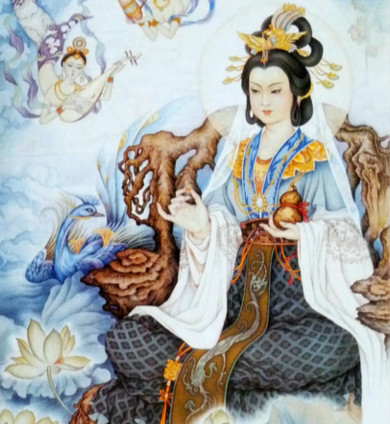
Her exact rank depends on the text. Daoist hierarchies differ between schools and periods, and no single chart places her permanently above or below other deities. For how these rankings work, see the Taoist gods hierarchy.
Kunlun, the Jade Pool, and the “Real” West
Kunlun in early Chinese texts is a cosmic mountain, a link between Heaven and Earth, surrounded by barriers such as the Weak River that only the worthy could cross. Xiwangmu’s palace and the Jade Pool sit within this mythic geography, not on a surveyed map.
Some nineteenth- and twentieth-century scholars read Xiwangmu as the name of a western tribe or its ruler, and modern local traditions in parts of Gansu and Qinghai claim sites connected with her. These identifications are speculative. The early texts treat her as a goddess or a ruler of a semi-legendary land, and no archaeological evidence ties the myth to a specific people or place.
Wangmu Niangniang in Popular Religion and Literature
In popular religion she is Wangmu Niangniang, approached for longevity, children, health, and family blessings. Popular tradition often treats her as the wife of the Jade Emperor. That pairing is a late folk arrangement, not a rule in Daoist scripture, and festival dates for her vary by temple and region.
The novel Journey to the West (published 1592) fixed her best-known modern scene. In chapter five, Sun Wukong is made keeper of the heavenly Peach Garden, where 3,600 trees ripen every 3,000, 6,000, or 9,000 years. He eats the best peaches, then wrecks the Peach Banquet (蟠桃會, Pántáo Huì) she is preparing for the gods. In the novel she is a court hostess rather than a cosmic power, which is a good example of literature reshaping an older deity.
Unlike many goddesses, Xiwangmu is not defined in the earliest sources by a husband or son. Her consorts were added later, and medieval writers present her as a teacher and ruler in her own right.
How Her Image Changed
| Period | Main sources | How she appears |
|---|---|---|
| Warring States–early Han | Shanhaijing, Zhuangzi, Mu Tianzi zhuan | Feline mountain power; being who attained the Dao; ruler who hosts King Mu |
| Western Han | Huainanzi, Hanshu, tomb murals | Holder of the elixir; focus of a popular cult in 3 BCE |
| Eastern Han | Shrine reliefs, bricks, bronze mirrors | Enthroned goddess of paradise, paired with Dongwanggong |
| Six Dynasties–Tang | Han Wudi neizhuan, Shangqing scriptures, Tang poetry, Du Guangting | Daoist sovereign of female transcendents; giver of peaches |
| Ming and later | Journey to the West, opera, temple cults | Wangmu Niangniang, hostess of the Peach Banquet |
Related Figures
- Dongwanggong – her Eastern Han male counterpart.
- Hou Yi and Chang’e – the archer and the woman who took the elixir.
- Jiutian Xuannü – presented as her disciple in Daoist hagiography.
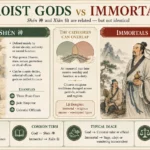
- The female immortals of the Taoist Deities tradition, whom she governs in medieval sources. For the distinction between deities and transcendents, see Taoist gods vs immortals.
Frequently Asked Questions
Who is Xiwangmu?
Xiwangmu is the Queen Mother of the West, a Chinese goddess linked with Mount Kunlun, the Jade Pool, and immortality. Her image changed from a fierce mountain being in early texts to a Daoist sovereign and a popular goddess of longevity.
Is Hsi Wang Mu the same as Xiwangmu?
Yes. Hsi Wang Mu is the older Wade-Giles spelling of the same name, 西王母. Xiwangmu is the standard Hanyu Pinyin form.
Is Xiwangmu the Jade Emperor’s wife?
In popular religion and modern retellings she is often treated as his consort. This is a late folk pairing. Her older counterpart was Dongwanggong, and Daoist scriptures do not consistently marry her to the Jade Emperor.
Did Xiwangmu give Hou Yi the elixir of immortality?
Yes. The Huainanzi (139 BCE) says Yi obtained the drug of deathlessness from her and Heng’e (Chang’e) stole it and flew to the moon. Fuller versions of the story come from later sources.
Why is Xiwangmu associated with peaches?
Post-Han tales about her visit to Emperor Wu have her offering peaches that fruit once every three thousand years. Journey to the West later made her Peach Garden and Peach Banquet famous.
Is Xiwangmu a Daoist goddess?
She became one of Daoism’s most important goddesses, but she was worshipped before organized Daoism existed. She also belongs to Han funerary religion, popular religion, and literature.
References and Further Reading
- Cahill, Suzanne E. Transcendence and Divine Passion: The Queen Mother of the West in Medieval China. Stanford University Press, 1993. WorldCat record
- Du Guangting. Divine Traces of the Daoist Sisterhood: Records of the Assembled Transcendents of the Fortified Walled City. Translated by Suzanne E. Cahill. Three Pines Press, 2006. Publisher page
- Birrell, Anne, trans. The Classic of Mountains and Seas. Penguin Classics, 2000. Publisher page
- Loewe, Michael. “Xi Wang Mu.” Encyclopedia of Religion. See also his Ways to Paradise: The Chinese Quest for Immortality (London, 1979). Encyclopedia.com
- Fracasso, Riccardo. “Holy Mothers of Ancient China: A New Approach to the Hsi-wang-mu Problem.” T’oung Pao 74 (1988): 1–46.
- James, Jean M. “An Iconographic Study of Xiwangmu during the Han Dynasty.” Artibus Asiae 55, no. 1/2 (1995): 17–41.
- Goldin, Paul R. “On the Meaning of the Name Xi wangmu, Spirit-Mother of the West.” Journal of the American Oriental Society 122, no. 1 (2002): 83–85.
- Thaithosaeng, Pattira, and Suradej Intagorn. “Assessing Scholarly Debates on the Significance of the Deity Xiwangmu in Han Dynasty Tomb Art.” Journal of Letters 50, no. 2 (2021): 41–65. Article page
- Shaughnessy, Edward L. “The Mu Tianzi Zhuan and King Mu Bronzes.” Bulletin of the Jao Tsung-I Academy of Sinology 1 (2014): 55–75. Article page
- Espesset, Grégoire. “Latter Han Religious Mass Movements and the Early Daoist Church.” HAL open archive
- “Intimate Life of Emperor Wu of Han (Han Wudi neizhuan).” Encyclopaedia Britannica. Britannica
- Cleveland Museum of Art. “Mirror with Deities, Chariot, and the White Tiger” (Eastern Han, 100–200 CE). Collection record
- Harvard Art Museums. Shenshou mirror with Xiwangmu and Dongwanggong, Eastern Han (1949.59). Collection record