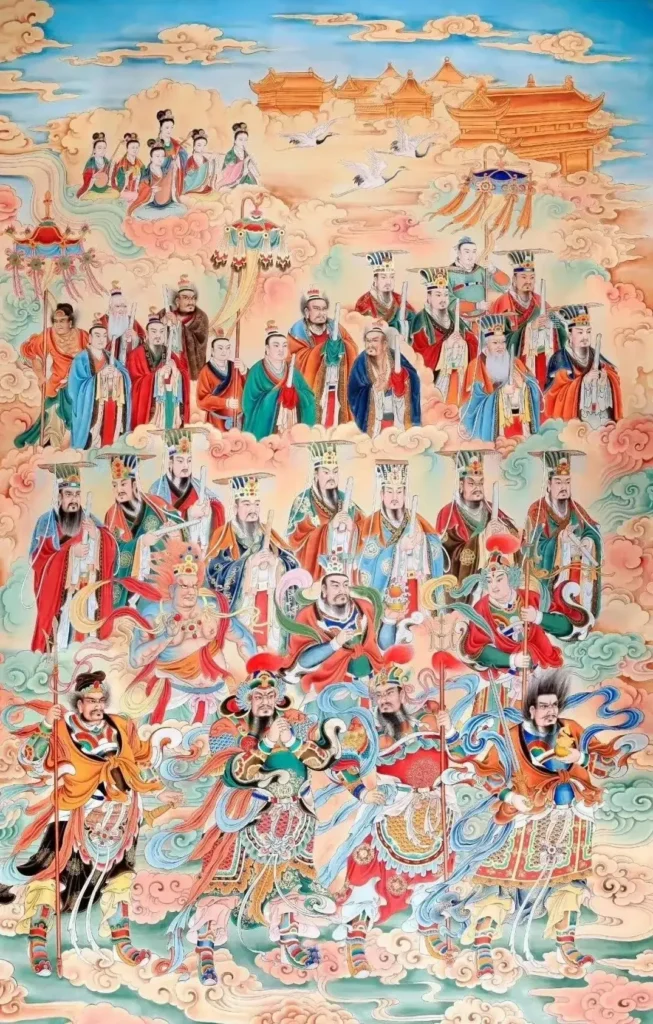
Most major Chinese Buddhist deities began as Indian figures with Sanskrit names. When their scriptures were translated into Chinese, translators either imitated the sound of a name (Amitābha became Amituo, Maitreya became Mile) or translated its meaning (Kṣitigarbha, “Earth Store,” became Dizang). The Sanskrit name tells you where a figure came from, but not always what it became in China. Avalokiteśvara developed into the largely female Guanyin, the Indian war god Skanda became the monastery guardian Weituo, and Yama, the Indian lord of the dead, became one judge among ten. A few of the most familiar figures in Chinese temples, including Budai and Ji Gong, have no Sanskrit original at all.
Short answer: Guanyin = Avalokiteśvara; Dizang = Kṣitigarbha; Wenshu = Mañjuśrī; Puxian = Samantabhadra; Mile = Maitreya; Amituo Fo = Amitābha; Yaoshi Fo = Bhaiṣajyaguru; Weituo = Skanda; Yanluo Wang = Yama; the Four Heavenly Kings = the Lokapālas. Budai, Ji Gong, and Guan Yu in his role as monastery guardian are Chinese figures with no Sanskrit counterpart.
Quick Reference: Chinese Names and Their Sanskrit Originals
The table pairs each figure’s usual Chinese name with its Sanskrit source and notes whether Chinese translators carried over the sound or the meaning.
| Chinese name | Sanskrit name | How the name was rendered | Main role in Chinese Buddhism |
|---|---|---|---|
| Shijiamouni Fo (释迦牟尼佛) | Śākyamuni | Sound | The historical Buddha |
| Amituo Fo (阿弥陀佛) | Amitābha / Amitāyus | Sound; also translated as “Infinite Light” and “Infinite Life” | Buddha of the Western Pure Land |
| Yaoshi Fo (药师佛) | Bhaiṣajyaguru | Meaning (“Medicine Master”) | Healing and protection of life |
| Piluzhena Fo (毗卢遮那佛) | Vairocana | Sound | Cosmic Buddha of Huayan and esoteric Buddhism |
| Mile (弥勒) | Maitreya | Sound | Future Buddha; popularly shown as Budai |
| Guanyin (观音) | Avalokiteśvara (early variant Avalokitasvara) | Meaning | Bodhisattva of compassion; usually female in later Chinese art |
| Wenshu (文殊) | Mañjuśrī | Sound, shortened | Bodhisattva of wisdom |
| Puxian (普贤) | Samantabhadra | Meaning (“Universal Worthy”) | Bodhisattva of practice and vows |
| Dizang (地藏) | Kṣitigarbha | Meaning (“Earth Store”) | Rescuer of beings in hell and helper of the dead |
| Dashizhi (大势至) | Mahāsthāmaprāpta | Meaning | Attendant of Amitābha |
| Four Heavenly Kings (四大天王) | Lokapālas | Meaning | Guardians of the four directions |
| Weituo (韦驮) | Skanda | Sound, through variant transcriptions | Protector of monks and monasteries |
| Yanluo Wang (阎罗王) | Yama (Yamarāja) | Sound | Judge of the dead in the Ten Kings system |
| Luohan (罗汉) | Arhat | Sound, shortened | Enlightened disciples, usually in sets of 16 or 18 |
| Guizimu (鬼子母) | Hārītī | Meaning | Converted demoness who protects children |
| Qielan (伽蓝) | saṃghārāma (“monastery”) | Sound | Monastery guardian, a role often given to Guan Yu |
How Sanskrit Names Became Chinese Names
Translators working from Sanskrit and Central Asian texts had two basic options. They could transliterate, choosing characters for their sound rather than their meaning. That is why Śākyamuni appears as Shijiamouni (释迦牟尼, Shìjiāmóuní) and Vairocana as Piluzhena (毗卢遮那, Pílúzhēnà). These characters mean nothing as a phrase; they are a phonetic spelling.
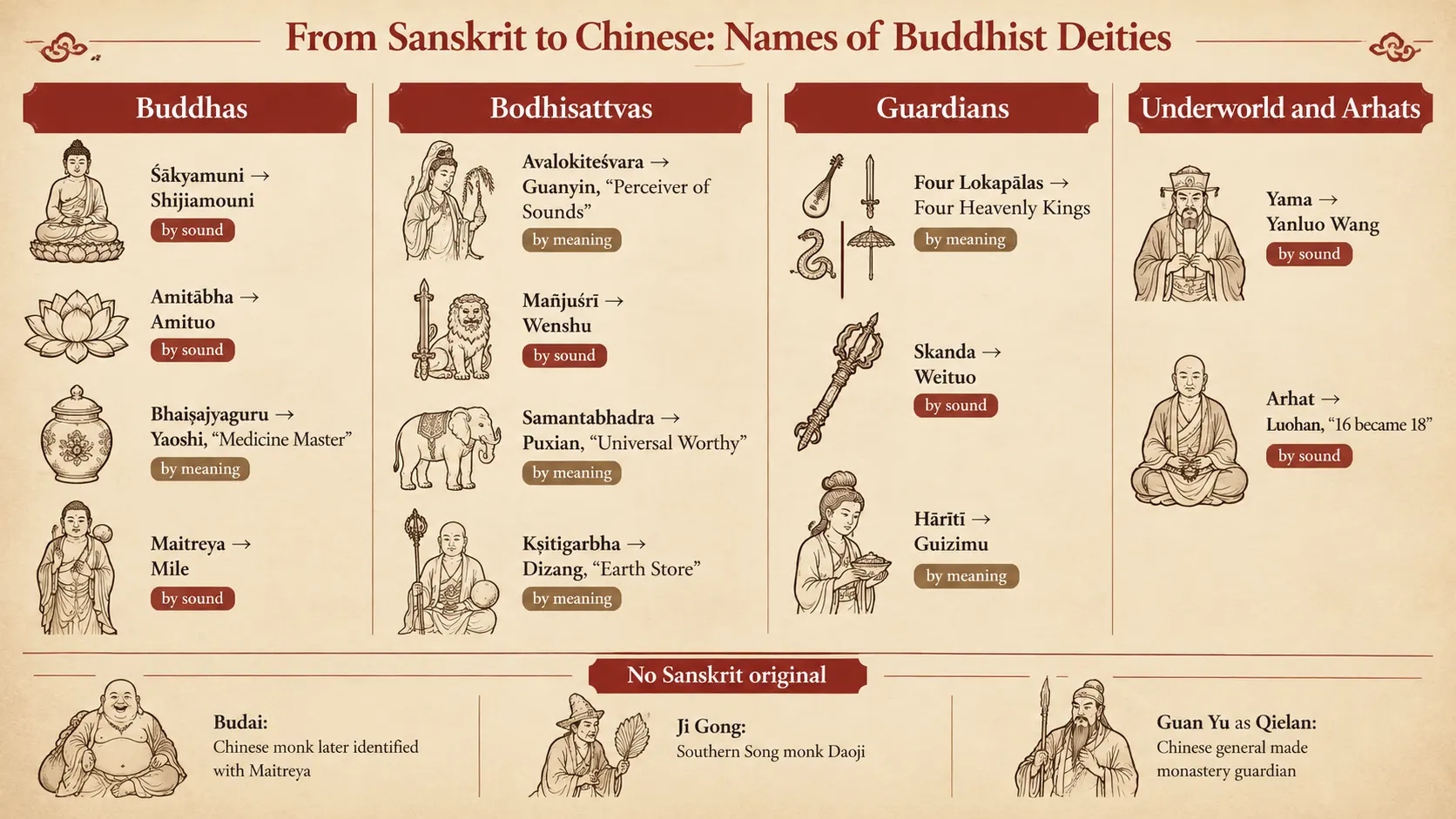
Or they could translate. Kṣitigarbha combines Sanskrit words for “earth” and “womb” or “storehouse,” so the bodhisattva became Dizang (地藏, Dìzàng), “Earth Store.” Samantabhadra, “universally good,” became Puxian (普贤, Pǔxián), and Bhaiṣajyaguru, “medicine teacher,” became Yaoshi (药师, Yàoshī).
Long transliterations were usually shortened in everyday speech. Bodhisattva was written 菩提萨埵 (pútísàduǒ) and became pusa (菩萨); arhat became aluohan and then luohan; buddha became fotuo and then simply fo (佛). Mañjuśrī went from Wenshushili (文殊师利) to Wenshu. Some figures carry both kinds of name: Amitābha is Amituo by sound, but also Wuliangguang (无量光, “Infinite Light”) by meaning, while his alternative name Amitāyus is rendered Wuliangshou (无量寿, “Infinite Life”).
Different translators also made different choices, so one figure can have several Chinese names. The clearest case is Guanyin, discussed below. Matching names is only the first step, though. Scriptures composed in China, temple layouts, local cults, and vernacular literature reshaped many figures long after the name arrived, a process covered more broadly in our guide to Buddhist influence on Chinese mythology.
Buddhas
Shijiamouni Fo: Śākyamuni
Śākyamuni means “sage of the Śākya clan,” a title for the historical Buddha. Chinese simply transliterated it. In many Chinese main halls he sits at the center, often flanked by Yaoshi Fo and Amituo Fo in a common three-Buddha arrangement.
Amituo Fo: Amitābha
Amitābha presides over the Western Pure Land, a realm into which Pure Land Buddhists hope to be reborn. The Chinese form is Amituo Fo (阿弥陀佛, Ēmítuó Fó; also read Āmítuó). Reciting his name became one of the most widespread practices in Chinese Buddhism, and “Amituofo” is still used as a greeting and blessing in Chinese Buddhist communities. With Guanyin and Dashizhi he forms the Three Sages of the West (西方三圣, Xīfāng Sānshèng).
Yaoshi Fo: Bhaiṣajyaguru
The “Medicine Master” Buddha is associated with healing and the extension of life. Here Chinese chose a meaning translation, so the name is self-explanatory to Chinese readers in a way that Amituo is not.
Piluzhena Fo: Vairocana
Vairocana is the cosmic or universal Buddha of the Huayan tradition and of esoteric Buddhism. Esoteric texts also call him Dari Rulai (大日如来, Dàrì Rúlái), “Great Sun Tathāgata,” a meaning-based name. The colossal Vairocana at Fengxian Temple in the Longmen Grottoes is the best-known Chinese image of him.
Mile: Maitreya
Maitreya is the Buddha expected to come in the future. Chinese uses the transliteration Mile (弥勒, Mílè) and, less often, the meaning translation Cishi (慈氏, Císhì), “the Benevolent One.” Early Chinese images show Maitreya as a seated bodhisattva or a crowned Buddha-to-be. The fat, laughing figure now placed at the entrance of many Chinese temples is a different matter: he is Budai, a tenth-century Chinese monk later believed to be an incarnation of Maitreya. Our article on the Laughing Buddha, Budai, and Maitreya traces how that identification formed.
Bodhisattvas
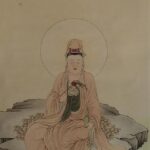
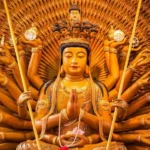
Guanyin: Avalokiteśvara
Guanyin (观音, Guānyīn) is a shortened form of Guanshiyin (观世音, Guānshìyīn), “the one who perceives the sounds of the world.” This was the name used in Kumārajīva’s influential translation of the Lotus Sutra in the early fifth century. In the seventh century Xuanzang (玄奘, Xuánzàng) preferred Guanzizai (观自在, Guānzìzài), “the one who observes freely,” which reflects the Sanskrit form Avalokiteśvara, interpreted as “the lord who looks down.”
Why “sound,” then? Early Sanskrit fragments preserve a variant name, Avalokitasvara, which contains svara, “sound.” Many scholars think this older form lies behind the Chinese rendering, which means Guanyin was not a mistranslation but a faithful one.

The larger change came later. Chinese images made before the Song dynasty (960–1279) show Guanyin as male. During the Song, mixed and female forms appear, and the female image eventually became dominant, helped by Chinese legends such as that of Princess Miaoshan (妙善). Putuo Shan (普陀山) off the Zhejiang coast became Guanyin’s chief pilgrimage center. Despite the common English label “goddess of mercy,” Guanyin is a bodhisattva, and the Lotus Sutra itself describes the bodhisattva appearing in whatever form, male or female, best helps those in need. See our profile of Guanyin for the full history.
Wenshu: Mañjuśrī
Mañjuśrī, the bodhisattva of wisdom, usually holds a sword that cuts through ignorance and rides a lion. Chinese tradition placed his earthly seat at Wutai Shan (五台山) in Shanxi, which drew pilgrims from across East Asia.
Puxian: Samantabhadra
Samantabhadra represents practice and the fulfillment of vows. He rides a white elephant, often shown with six tusks. His Chinese center is Emei Shan (峨眉山) in Sichuan.
Dizang: Kṣitigarbha
Kṣitigarbha vowed to keep working until the beings in hell are saved. Unlike most bodhisattvas, who wear princely jewelry, he appears as a shaven-headed monk holding a ringed staff, used to open the gates of hell, and a wish-fulfilling jewel that lights the darkness. In China he became closely tied to funerals and care for the dead, and popular religion sometimes treats him as the overseer of the underworld. His mountain is Jiuhua Shan (九华山) in Anhui, where tradition regards a Silla-born monk known in Chinese as Jin Qiaojue (金乔觉) as a manifestation of Dizang.
Wutai, Emei, Putuo, and Jiuhua came to be known together as the four famous Buddhist mountains of China. None of them is in India, and that is the point: over centuries, Chinese Buddhism gave Indian bodhisattvas Chinese homes.

Dashizhi: Mahāsthāmaprāpta
Mahāsthāmaprāpta, “one who has attained great strength,” became Dashizhi (大势至, Dàshìzhì). He is rarely worshipped alone in China and appears mainly as Amitābha’s second attendant, opposite Guanyin.
Guardians and Devas
The Four Heavenly Kings: The Lokapālas
The Four Heavenly Kings (四大天王, Sì Dà Tiānwáng) are Indian guardians of the four directions. Their Chinese names are meaning translations, or traditional interpretations, of their Sanskrit names. In Chinese temples they stand in the Hall of the Heavenly Kings (天王殿, Tiānwáng Diàn), the first hall a visitor enters.
| Direction | Chinese name | Sanskrit name | Meaning of the Chinese name | Typical attribute in Chinese temples |
|---|---|---|---|---|
| East | Chiguo Tianwang (持国天王) | Dhṛtarāṣṭra | “Upholder of the Realm” | Pipa (lute) |
| South | Zengzhang Tianwang (增长天王) | Virūḍhaka | “Growth” | Sword |
| West | Guangmu Tianwang (广目天王) | Virūpākṣa | “Broad-Eyed” | Snake or dragon |
| North | Duowen Tianwang (多闻天王) | Vaiśravaṇa | “Hearing Much” | Umbrella or parasol; sometimes a pagoda |
The attributes are themselves partly Chinese. Indian and Himalayan art gives the kings different emblems, such as a banner and a mongoose for Vaiśravaṇa. A well-known popular reading links the four Chinese attributes to the phrase feng tiao yu shun (风调雨顺), “favorable winds and timely rain,” but this is a folk interpretation rather than a scriptural one.
Vaiśravaṇa, also transliterated as Pishamen (毗沙门, Píshāmén), had the most eventful Chinese career. He developed a cult of his own as a protector of armies and cities, and Ming fiction recast the pagoda-holding Heavenly King as Li Jing (李靖), father of Nezha. Nezha himself has Indian roots: the scholar Meir Shahar traces him to Nalakūbara, a figure from Indian epic and Buddhist literature linked to Vaiśravaṇa’s family.

Weituo: Skanda
Skanda, also called Kumāra or Kārttikeya, was an Indian war god, usually shown as a youth riding a peacock. Chinese texts render his name in several transcriptions, and Weituo (韦驮, Wéituó) became the standard temple name. Chinese tradition even treated “Wei” as a surname and called him General Wei (韦将军, Wéi Jiāngjūn).
His Chinese role owes most to the monk Daoxuan (道宣, 596–667), founder of the Vinaya school, who recorded visions of General Wei as a protector of monks and the Dharma. Later Buddhist accounts largely repeat Daoxuan’s description. The earliest surviving Chinese image of Weituo is in the East Hall of Foguang Temple (佛光寺), dated 857, and by the Song dynasty his place in the Hall of the Heavenly Kings, facing inward toward the main hall, had become standard. He is now a young general in Chinese armor holding a vajra staff, which looks nothing like the peacock-riding Skanda of India.
The Twenty-Four Devas
Many Chinese temples display a set of protective devas (诸天, zhūtiān), Indian gods absorbed into Buddhism as guardians of the Dharma. Several are recognizable by name:
- Dafantian (大梵天): Brahmā, treated in Buddhism as a protector rather than a creator.
- Dishitian (帝释天): Śakra, the Buddhist form of Indra.
- Guizimu (鬼子母): Hārītī, a child-devouring demoness who, after her conversion, became a protector of children.
- Molizhi Tian (摩利支天): Marīcī, a goddess of light. Daoist and popular devotion identified her with Doumu, the Dipper Mother.
During the Song, Liao, and Jin periods, many temples expanded the set to twenty-four by adding figures including the Kinnara King and three deities from Chinese religion: Emperor Ziwei (紫微大帝), the Emperor of the Eastern Peak (东岳大帝), and a thunder god comparable to Lei Gong. The list shows the exchange running in both directions: Chinese gods could also enter a Buddhist roster.
Yama and the Chinese Underworld
Yanluo Wang (阎罗王, Yánluó Wáng) is a transliteration of Yama, or Yamarāja (“King Yama”), the Indian lord of the dead; a fuller Chinese form is Yanmoluo Wang (阎摩罗王). In India Yama ruled the realm of the dead. In medieval China he became part of a larger bureaucracy of Ten Kings (十王, Shíwáng), who judge the dead in sequence. Stephen Teiser’s study of the Scripture on the Ten Kings shows how this system took shape among Chinese Buddhists of the ninth and tenth centuries.
Later popular tradition says Yanluo was originally the first judge but was moved to the fifth court for being too lenient. The courts mix Buddhist ideas of karma and rebirth with Chinese legal and bureaucratic imagery, and descriptions vary between texts. Our profile of Yanluo Wang explains how the Indian god became a Chinese magistrate.
Arhats: How Sixteen Became Eighteen Luohan
An arhat is a disciple who has attained liberation. In 654 Xuanzang translated a record attributed to the arhat Nandimitra that lists sixteen arhats who remain in the world to protect the Dharma, and this text made their names known in China. The monk-painter Guanxiu (贯休) painted an influential set of the sixteen in 891.
Between the late Tang and the Five Dynasties, Chinese sets grew to eighteen, while Japan generally kept sixteen. The identity of the two added figures varies between lists. Popular sets often include a Dragon-Taming Luohan and a Tiger-Taming Luohan, figures whose names have no Sanskrit counterpart.
Chinese Figures With No Sanskrit Name
Some of the most visible figures in Chinese Buddhist temples were never Indian:
- Budai (布袋, Bùdài): A wandering monk named Qici (契此) who lived in Mingzhou, in the area of present-day Fenghua, Zhejiang. Later tradition identified him as an incarnation of Maitreya, which is how a Chinese monk came to stand in for the future Buddha.
- Ji Gong (济公, Jìgōng): The eccentric Southern Song monk Daoji, whose legend grew through storytelling and fiction. See our article on Ji Gong.
- Qielan as Guan Yu: Qielan (伽蓝, Qiélán) comes from Sanskrit saṃghārāma, “monastery,” and Qielan deities are monastery guardians. Buddhist scriptures say nothing about Guan Yu in this role. A legend linked to the Tiantai founder Zhiyi (智顗) at Jade Spring Mountain (玉泉山) in Hubei describes the spirit of Guan Yu vowing to protect Buddhism, and Guan Yu became the usual Qielan figure, often paired with Weituo. The name is Sanskrit; the deity is a deified Chinese general. Read more about Guan Yu’s deification.
Common Mix-Ups When Matching Names
- “Guanyin is the Chinese goddess of mercy.” The English label is common, but Guanyin is a bodhisattva, and the female form developed in China.
- “The Laughing Buddha is Maitreya as he looked in India.” The laughing image is Budai, a Chinese monk. Indian and early Chinese Maitreya images look entirely different.
- “Weituo is simply Skanda.” The name traces back to Skanda, but the Chinese guardian’s role, armor, and placement come from Chinese monastic tradition.
- “Yanluo Wang is the same as the Indian Yama.” The name is the same; the Chinese courtroom setting and the Ten Kings system are Chinese developments.
- Old spellings. Older English books use Wade-Giles forms such as Kuan-yin, Ti-tsang, Mi-lo, and Wei-t’o. These are the same figures as Guanyin, Dizang, Mile, and Weituo.
- “Every Chinese Buddhist figure has a Sanskrit name.” Budai, Ji Gong, Miaoshan, and Guan Yu as Qielan show otherwise.
Frequently Asked Questions
What is Guanyin’s Sanskrit name?
Guanyin is the Chinese name for Avalokiteśvara. Early Sanskrit fragments also preserve the form Avalokitasvara, “the one who perceives sound,” which matches the Chinese Guanshiyin, “perceiver of the world’s sounds.”
Is the Laughing Buddha the same as Maitreya?
Not originally. The Laughing Buddha is Budai, a tenth-century Chinese monk. Later tradition identified him as an incarnation of Maitreya, so Chinese temples often use his image to represent the future Buddha.
Why do some Chinese Buddhist names sound Indian while others do not?
Translators either transliterated a name by sound, as with Amituo and Mile, or translated its meaning, as with Dizang (“Earth Store”) and Puxian (“Universal Worthy”). Some figures have both kinds of name.
What is Dizang’s Sanskrit name?
Dizang is Kṣitigarbha, the bodhisattva who vowed to save beings in hell. In Japan the same bodhisattva is known as Jizō.
Who is Weituo in Sanskrit?
Weituo derives from Skanda, an Indian war god. In China he became a young armored general who protects monks and monasteries, a role shaped largely by the Tang monk Daoxuan.
Does Guan Yu have a Sanskrit name?
No. Guan Yu was a Chinese general of the Three Kingdoms period. In Buddhist temples he serves as Qielan, a monastery guardian; only the title Qielan comes from Sanskrit.
References and Further Reading
- Encyclopaedia Britannica. “Avalokiteshvara.” https://www.britannica.com/topic/Avalokiteshvara
- Encyclopaedia Britannica. “Kshitigarbha.” https://www.britannica.com/topic/Kshitigarbha
- Encyclopaedia Britannica. “Lokapala.” https://www.britannica.com/topic/lokapala
- Encyclopaedia Britannica. “Shiwang.” https://www.britannica.com/topic/Shiwang
- Zhu, Tianshu. “Weituo Statue in Temple Space: Worshipping Weituo as a Patron Deity of the Chinese Saṅgha.” Religions 15, no. 10 (2024): 1195. https://doi.org/10.3390/rel15101195
- Teiser, Stephen F. The Scripture on the Ten Kings and the Making of Purgatory in Medieval Chinese Buddhism. University of Hawai’i Press. https://uhpress.hawaii.edu/title/the-scripture-on-the-ten-kings-and-the-making-of-purgatory-in-medieval-chinese-buddhism/
- Shahar, Meir. Oedipal God: The Chinese Nezha and His Indian Origins. University of Hawai’i Press, 2015. https://ubcpress.ca/oedipal-god
- JAANUS: Japanese Architecture and Art Net Users System. “Hotei” (Budai). https://projects.mcah.columbia.edu/jaanus/node/3894