
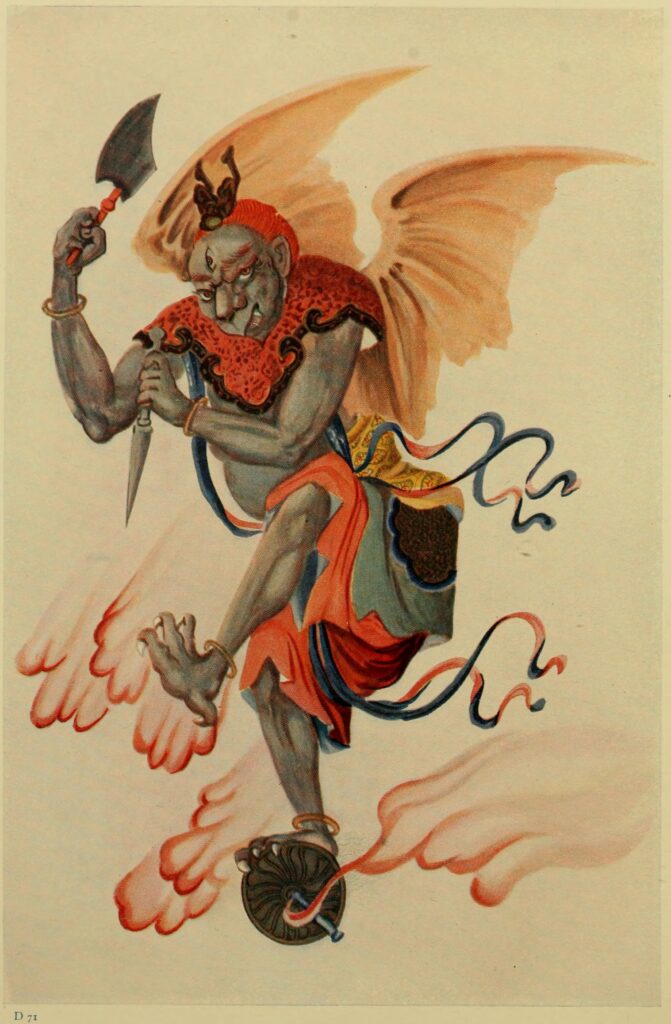
In Chinese mythology, Lei Gong is not simply the god who makes thunder roll across the sky. He is also a divine enforcer, a frightening figure who punishes evil, exposes injustice, and reminds humans that Heaven is watching.
Known as 雷公 in Chinese, Lei Gong is often translated as the Duke of Thunder or Lord of Thunder. He appears in myths as a strange and powerful deity with wings, claws, drums, and a hammer or chisel used to strike down wrongdoers. His image can feel almost wild at first glance, but behind that fearsome appearance is a deeper idea: thunder is not random noise. In traditional belief, it can be a warning, a judgment, or even the voice of Heaven.
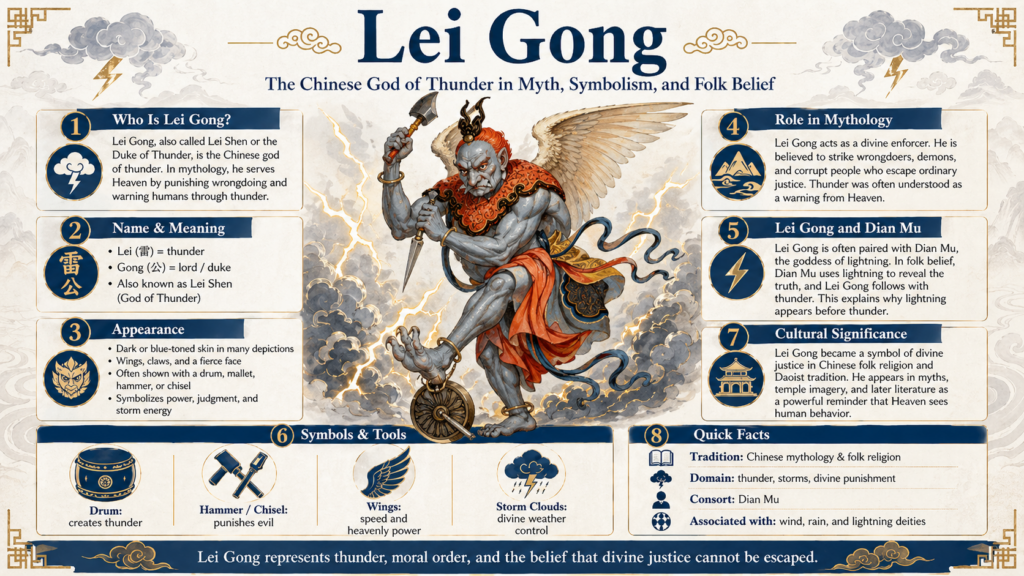
Who Is Lei Gong?
Lei Gong is the Chinese god of thunder. His name comes from two Chinese characters: lei (雷), meaning “thunder,” and gong (公), a title often translated as “lord,” “duke,” or a person of authority.
He is also known as Lei Shen (雷神), meaning “God of Thunder,” and sometimes appears in older romanization as Lei Kung.
In myth, Lei Gong serves under the authority of the Jade Emperor, the supreme ruler of Heaven in many Chinese religious traditions. His duty is to watch the human world and punish people who commit serious wrongs, especially those who escape ordinary human justice.
That is why Lei Gong is more than a storm god. He is a symbol of divine law.
What Does Lei Gong Look Like?
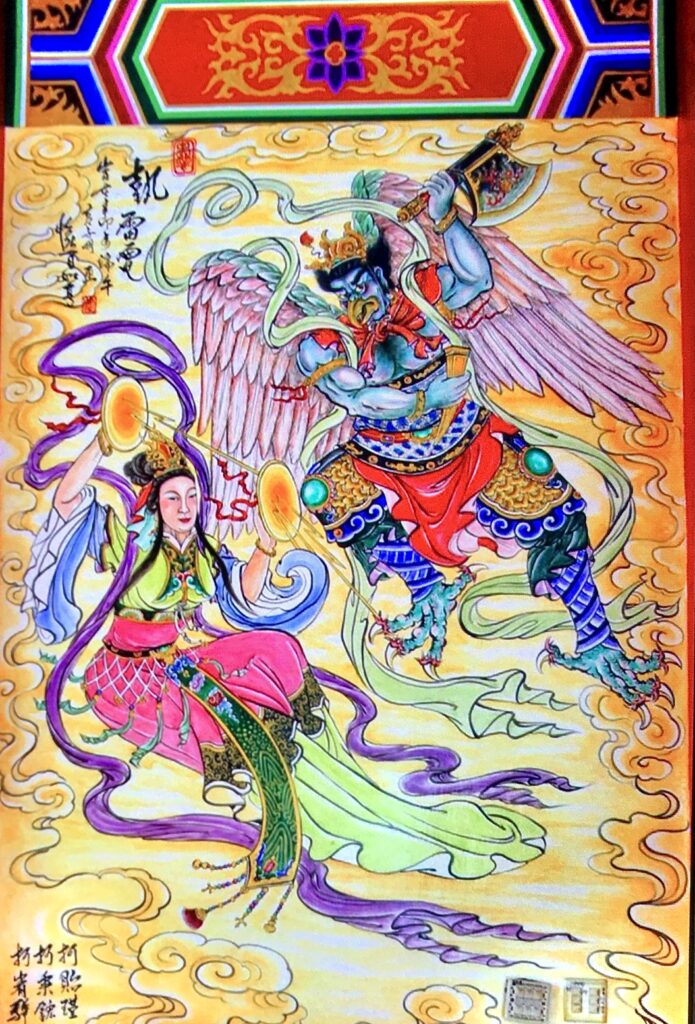
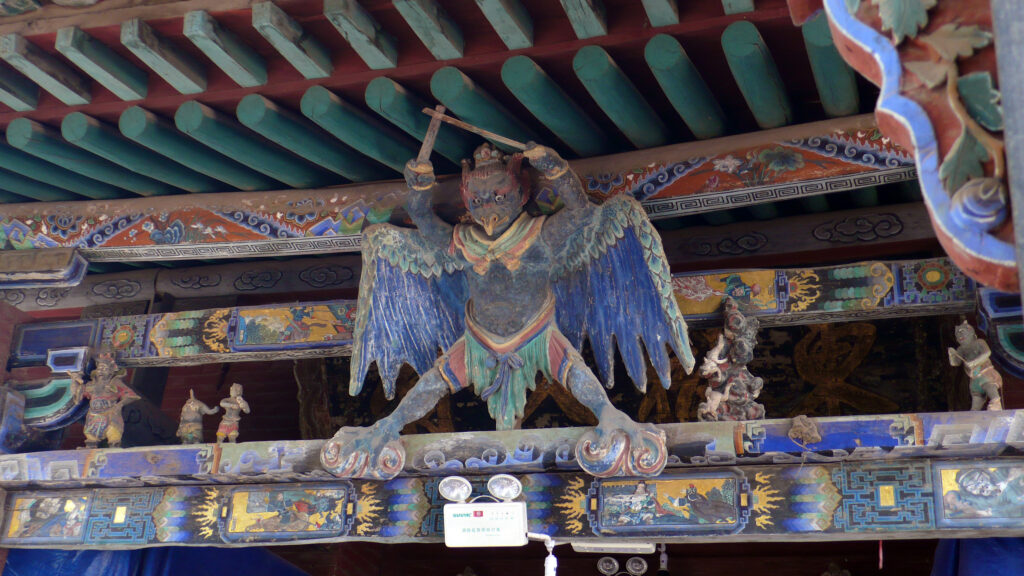
Lei Gong’s appearance is one of the most memorable in Chinese mythology.
He is often described as having:
- Dark blue or reddish skin
- A fierce, bird-like or monkey-like face
- Sharp claws like an eagle
- Wings on his back
- A nearly naked body, usually wearing only a loincloth
- A drum, hammer, mallet, chisel, or wedge
- Sometimes a third eye or several drums around his body
In some traditions, he has a dragon-like face and wings. In others, he looks more like a strong warrior with monstrous features. These changes reflect the long history of Lei Gong’s image, which evolved across ancient texts, folk religion, Daoist ritual, temple art, and popular storytelling.
The most important part of his image is his equipment. His drum creates the sound of thunder, while his hammer, mallet, or chisel is used to punish demons and immoral humans.
Lei Gong and Dian Mu: Thunder and Lightning Together
Lei Gong is commonly paired with Dian Mu (電母), the goddess of lightning. She is also known as the Mother of Lightning or Lightning Lady.
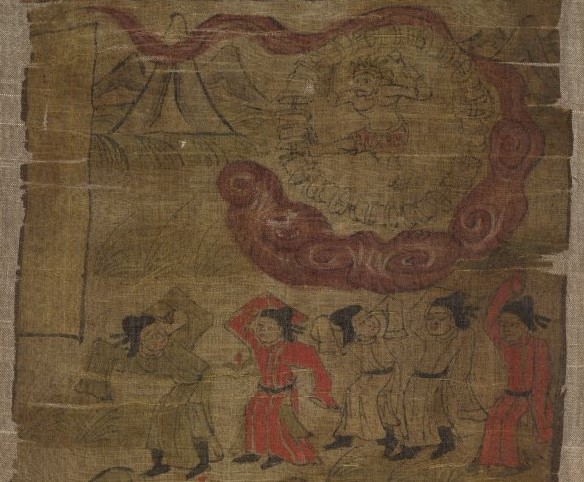
In folk belief, Dian Mu holds shining mirrors that flash across the sky. These mirrors are said to illuminate the human world, revealing good and evil before Lei Gong delivers thunderous punishment.
This pairing also explains a natural observation: lightning comes before thunder. In mythological language, Dian Mu first shines her mirrors to expose the truth, and Lei Gong follows with thunder.
Together, Lei Gong and Dian Mu represent more than weather. They express a moral order: lightning reveals, thunder judges.
The Origin Story of Lei Gong
One of the strangest stories about Lei Gong begins with King Wen of Zhou.
According to legend, King Wen was hunting in the forest with his unusual nine-eared dog. Suddenly, the dog began digging furiously at the ground. Beneath the leaves, it uncovered a mysterious egg.
When King Wen picked up the egg, it cracked open. From inside emerged not a baby, but a fully formed boy. This child had dark blue skin, a beak, claws, and wings. One of his palms bore the character lei (雷), meaning “thunder,” while the other bore zhou (州), meaning “state.”
King Wen, who had no children, understood this strange being as a gift from Heaven. He adopted the child, who would become Lei Gong.
In later stories, Lei Gong rises to important positions and eventually gains immortality after eating a stolen Peach of Immortality that had been misplaced by a fox demon. This mix of royal adoption, strange birth, and heavenly destiny gives Lei Gong a mythic identity that is both divine and uncanny.
Lei Gong’s Hammer and Divine Punishment
One of Lei Gong’s most famous roles is punishing evil.
A well-known story tells of the Jade Emperor looking down from Heaven and seeing two robbers mistreating a blind salesman. He sent Lei Gong to handle the injustice.
Lei Gong first beat his drum loudly, warning the robbers to stop. But they ignored the warning. So Lei Gong struck them down with his hammer.
To the villagers, the sudden deaths were terrifying. But the lesson was clear: thunder was not merely a sound in the sky. It could be Heaven’s warning against greed, cruelty, and corruption.
This is why Lei Gong is often connected with sayings and beliefs about divine punishment. In Chinese culture, expressions like “struck by thunder” or “five thunders strike the head” carry a strong moral meaning. They suggest that serious wrongdoing may eventually meet a force beyond human law.
Lei Gong in Daoism and Folk Religion
Lei Gong appears in both folk belief and Daoist tradition. In Daoist ritual systems, thunder deities became especially important in practices related to thunder magic and rainmaking.
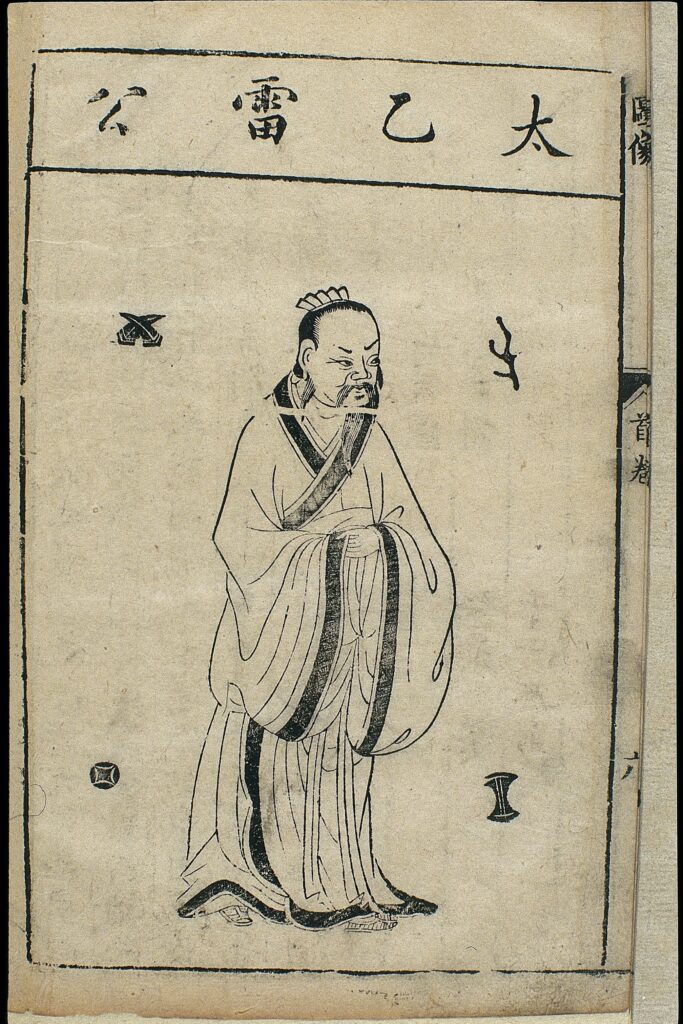
In larger temples and Daoist settings, Lei Gong may appear alongside Dian Mu, Fengbo the wind god, and Yushi the rain master. Together, these deities form part of a wider celestial system that governs storms, rain, wind, thunder, and lightning.
Lei Gong was also invoked in rituals seeking rain or protection. However, temples dedicated only to Lei Gong are relatively rare. He is often worshiped as part of a larger pantheon rather than as a standalone household deity.
His birthday is traditionally associated with the 24th day of the sixth lunar month, though worship practices vary by region and tradition.
Lei Gong, Fengbo, Yushi, and the Ministry of Storms
Lei Gong does not work alone in the mythological world.
He is often connected with other weather deities, including:
Dian Mu — goddess of lightning and Lei Gong’s wife
Fengbo — god of wind
Yushi — rain master
Yunzhongzi — a cloud-generating assistant in some traditions
Together, these figures help explain the drama of a storm. The wind rises, clouds gather, lightning flashes, rain falls, and thunder roars. In mythology, each part of the storm has a divine personality behind it.
This gives Chinese storm mythology a structured, almost bureaucratic feeling. Weather is not chaotic; it belongs to Heaven’s administration.
How Lei Gong’s Image Changed Over Time
Lei Gong’s image did not stay the same throughout Chinese history.
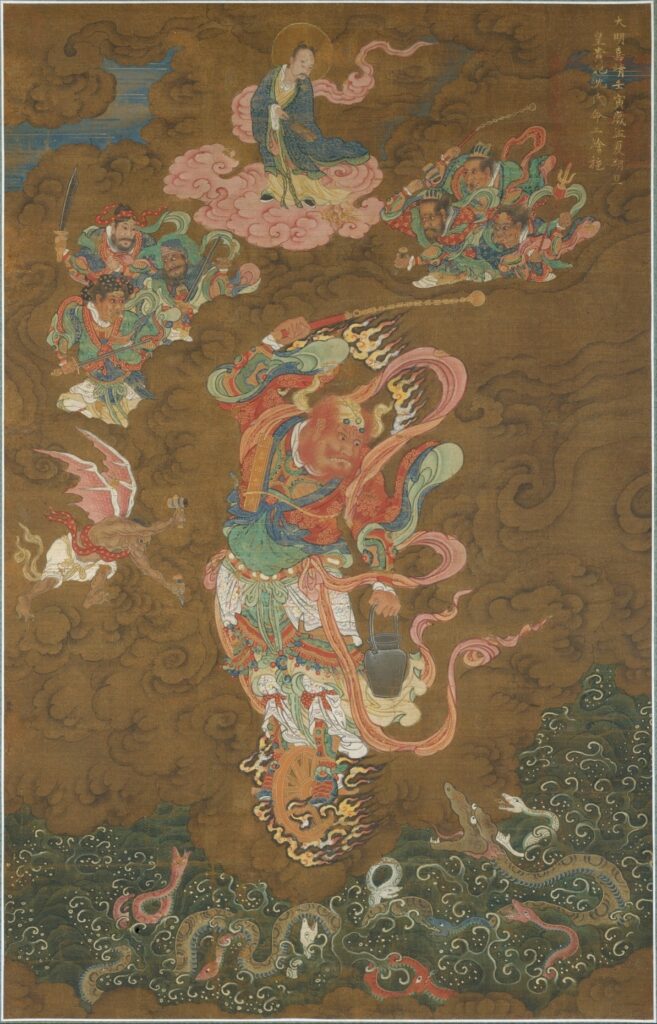
In early texts, thunder spirits could appear in animal-like or dragon-like forms. Some descriptions present thunder beings as having a dragon body and human head, or as strange one-legged creatures connected to thunderous sounds.
Later, Lei Gong became more human-like, often described as a strong warrior or muscular divine official. Over time, his image developed into the familiar form: bare-chested, winged, clawed, fierce-faced, and surrounded by drums.
By the Ming and Qing periods, this image had become more standardized in popular art and temple sculpture. His sharp mouth, wings, claws, and thunder tools became key visual markers.
This evolution shows how Chinese mythology often grows through layers: ancient nature spirits, classical literature, folk worship, Daoist ritual, and later artistic imagination all shape the same deity.
Lei Gong and the Meaning of Thunder
To understand Lei Gong, it helps to think about how thunder felt in the ancient world.
Thunder was loud, sudden, frightening, and impossible to ignore. It came from the sky, shook homes, split trees, and sometimes killed people. Long before modern meteorology explained lightning and thunder scientifically, people naturally connected storms with divine power.
Lei Gong gave thunder a moral voice.
When thunder sounded, it could be heard as a warning: behave honestly, respect Heaven, and do not assume hidden wrongdoing will stay hidden forever.
That is why Lei Gong’s myths often feel severe. He is not usually gentle or playful. He represents the part of the divine world that is sharp, corrective, and impossible to bargain with.
Lei Gong in Literature and Popular Culture
Lei Gong also appears in Chinese literature, especially in traditions connected with Fengshen Yanyi — The Investiture of the Gods. The character Leizhenzi shares several features with Lei Gong, including wings, thunder associations, and a strange origin story.
In modern pop culture, Lei Gong’s influence continues in comics, fantasy stories, games, and reinterpretations of Chinese myth. Characters inspired by thunder gods, winged warriors, divine judges, or storm masters often borrow from the same symbolic world.
Even when Lei Gong is not named directly, his image remains recognizable: the terrifying thunder deity who punishes evil from the sky.
Why Lei Gong Still Matters
Lei Gong is fascinating because he connects weather, morality, religion, and storytelling.
On the surface, he is the Chinese god of thunder. But deeper down, he represents a belief that the universe has a moral structure. Wrongdoing may escape human courts, but it cannot escape Heaven.
His frightening face and thunderous weapons are not only meant to scare people. They also express a hope: that injustice will not last forever.
In that sense, Lei Gong is not just a storm god. He is a mythological answer to a very human question:
Who judges the wrongs that no one else sees?
FAQ About Lei Gong
Who is Lei Gong?
Lei Gong is the Chinese god of thunder. He is also known as the Duke of Thunder, Lei Shen, or Lei Kung. In mythology, he creates thunder and punishes wrongdoers on behalf of Heaven.
What does Lei Gong look like?
Lei Gong is usually shown as a fearsome deity with wings, claws, a bird-like or monkey-like face, and a powerful body. He often carries a drum, hammer, mallet, wedge, or chisel used to create thunder and punish evil.
Is Lei Gong the same as Lei Shen?
Yes, Lei Gong and Lei Shen both refer to the Chinese thunder god. Lei Gong means something like “Lord of Thunder,” while Lei Shen means “God of Thunder.”
Who is Lei Gong’s wife?
Lei Gong’s wife is Dian Mu, the goddess of lightning. She is often shown holding mirrors that create flashes of lightning and reveal the truth before Lei Gong strikes with thunder.
Why does Dian Mu come before Lei Gong in myths?
Dian Mu’s lightning appears before Lei Gong’s thunder. In folk explanation, she first shines her mirrors to illuminate the world and identify evil, then Lei Gong follows with thunderous punishment.
What does Lei Gong symbolize?
Lei Gong symbolizes thunder, divine justice, punishment, moral warning, and the authority of Heaven. His myths often teach that hidden wrongdoing may still be seen and judged by higher powers.
Is Lei Gong worshiped today?
Lei Gong is still known in Chinese folk religion and Daoist tradition, though temples dedicated only to him are not very common. He is more often honored as part of a wider group of thunder, lightning, wind, and rain deities.
Does Lei Gong appear in Chinese literature?
Yes. Lei Gong and thunder-god imagery appear in Chinese mythology and literature. Related figures, such as Leizhenzi in The Investiture of the Gods, share many traits with Lei Gong.
1 thought on “Lei Gong”
Comments are closed.