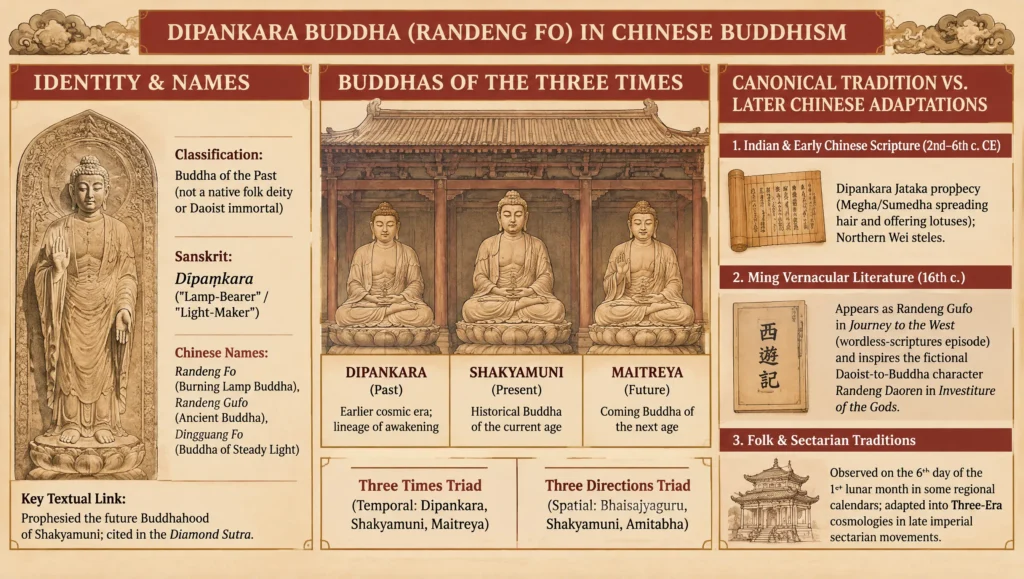
Dipankara Buddha (Sanskrit: Dīpaṃkara), known in Chinese as Randeng Fo (燃灯佛, Rándēng Fó, “Burning Lamp Buddha”) or Randeng Gufo (燃灯古佛, Rándēng Gǔfó, “Ancient Buddha of the Burning Lamp”), is one of the most important Buddhas of the past in Buddhist scripture and Chinese religious art. Within the framework of Buddhist deities in China, Dipankara is neither a native Chinese god nor a Daoist immortal: he is a fully awakened Buddha from an earlier cosmic era who is remembered above all for prophesying the future enlightenment of Shakyamuni (释迦牟尼, Shìjiāmóuní), the historical Buddha.
In Chinese Buddhism, Dipankara occupies a prominent place in temple cosmology as the past Buddha in the triad known as the Buddhas of the Three Times (竖三世佛, Shù Sānshì Fó), alongside Shakyamuni of the present and Maitreya of the future. Over the centuries, his name and imagery also crossed from canonical scripture and Northern Wei stone carvings into late imperial vernacular fiction—most famously Journey to the West and Investiture of the Gods—where literary adaptations gave him roles quite different from those in monastic Buddhism.
Who Is Dipankara Buddha?
Across Theravada, Mahayana, and Vajrayana traditions, Buddhism teaches that Shakyamuni was not the only Buddha to appear in the world. Countless Buddhas awakened in earlier cosmic cycles (kalpas), and others will appear in ages yet to come. Dipankara is among the most celebrated of those predecessors. In standard Indian and Chinese Buddhist accounts, he lived eons before Shakyamuni, attained complete enlightenment, taught the Dharma, and entered final nirvana long before the present age.
What separates Dipankara from dozens of other named past Buddhas is his direct link to Shakyamuni’s bodhisattva career. When Shakyamuni was still a spiritual seeker in a former life, he encountered Dipankara, made an act of extraordinary devotion, and received a definite prediction (Sanskrit: vyākaraṇa; Chinese: 授记, shòujì) that he would one day become a fully awakened Buddha. That moment became a foundational narrative across Buddhist literature, art, and philosophy.
Classification Note: English-language summaries sometimes list Dipankara among “Chinese gods.” In religious terms, Dipankara is a Buddha (佛, Fó)—an awakened being who has transcended the cycle of rebirth—rather than a celestial official, folk deity, or Daoist immortal. Understanding this distinction helps separate canonical Chinese Buddhism from later literary and folk retellings.
Name and Meaning in Sanskrit and Chinese
The Sanskrit name Dīpaṃkara combines dīpa (“lamp” or “light”) and kara (“maker,” “bearer,” or “causer”), meaning “Lamp-Bearer,” “Light-Maker,” or “Illuminator.” As Buddhist texts were translated from Indic and Central Asian languages into Classical Chinese between the second and sixth centuries CE, translators rendered the name through both meaning-based translations and phonetic transcriptions—a pattern seen across many Sanskrit names of Chinese Buddhist figures.
| Chinese Name | Pinyin | Literal Meaning / Type | Primary Context |
|---|---|---|---|
| 燃灯佛 / 然灯佛 | Rándēng Fó | Burning Lamp Buddha (semantic translation) | Standard Chinese Buddhist name; 然 is the older classical variant of 燃 |
| 燃灯古佛 | Rándēng Gǔfó | Ancient Buddha of the Burning Lamp | Temple devotion, Journey to the West, and popular Chinese usage |
| 定光佛 / 定光如来 | Dìngguāng Fó / Dìngguāng Rúlái | Buddha of Steady Light / Tathagata of Fixed Light | Early Chinese translations, Northern Wei–Tang texts, and traditional lunar calendars |
| 普光佛 | Pǔguāng Fó | Buddha of Universal Light | Appears in texts such as the Sutra of Past and Present Causes and Effects |
| 提和竭罗 / 提洹竭 | Tíhéjiéluó / Tíhuánjié | Phonetic transliteration of Dīpaṃkara | Early Chinese Buddhist canonical translations |
Early Chinese Buddhist texts explain the “light” motif through his birth narrative. In the Sutra of Past and Present Causes and Effects (过去现在因果经, Guòqù Xiànzài Yīnguǒ Jīng), translated in the fifth century by Guṇabhadra, brilliant illumination filled the world at the moment of his birth, making the sun, moon, and lamps unnecessary—hence his association with steady, universal, or burning light. In Buddhist symbolism, that light represents wisdom dispelling ignorance rather than a literal solar deity.
Origins and Key Scriptural Stories
The Prophecy to the Future Shakyamuni
The best-known story involving Dipankara is the Dipankara Jātaka, preserved across multiple Indic and Chinese textual traditions, including the Pali Buddhavaṃsa, the Sanskrit Mahāvastu and Divyāvadāna, and Chinese canonical biographies of the Buddha. Details vary by text—the young ascetic is called Sumedha in Pali sources and Megha (or Sumati) in Sanskrit and Chinese Mahayana versions—but the core episode remains consistent.
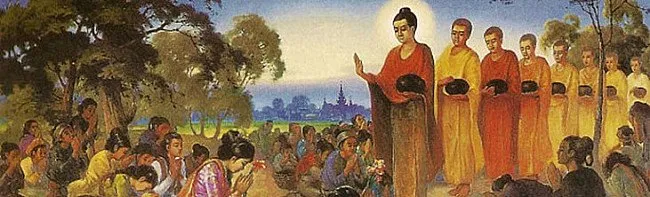
Hearing that Dipankara Buddha was about to enter the city, the young ascetic wished to offer flowers in homage. Because the local ruler had reserved all available blossoms, he obtained five (or seven) lotus flowers from a young woman on the condition that they remain spiritually connected in future lifetimes. When Dipankara arrived, the ascetic tossed the lotuses into the air, where they miraculously floated in a canopy above the Buddha’s head. Seeing a muddy stretch of road ahead, the ascetic then prostrated himself and spread his long hair over the mud so that Dipankara could walk across without soiling his feet.
Recognizing the depth of this vow, Dipankara declared that in a distant future age, the ascetic would attain supreme enlightenment as Shakyamuni Buddha. This scene became one of the most widely carved narrative subjects in Gandharan art and later traveled along the Silk Road into Central Asia and China, appearing on sixth-century funerary monuments, cave temple murals, and Buddhist steles.
Dipankara in the Diamond Sutra
Within Chinese Buddhism specifically, Dipankara’s philosophical prominence owes much to the Vajracchedikā Prajñāpāramitā Sūtra—the Diamond Sutra (金刚经, Jīngāng Jīng), translated by Kumārajīva around 401 CE and deeply influential in Chan (Zen) Buddhism. In two well-known dialogues with his disciple Subhūti (Chapters 10 and 17 in the traditional Chinese chapter division), Shakyamuni asks whether he actually “attained” any fixed doctrine or independent thing called supreme enlightenment when he was in the presence of Dipankara Buddha.
Subhūti answers no. Shakyamuni confirms that if there were some graspable, self-existent object called enlightenment to be acquired, Dipankara would never have given him the prophecy of future Buddhahood. Because of the Diamond Sutra’s central role in Chinese monastic study and lay recitation, generations of Chinese Buddhists encountered Dipankara not only as a narrative figure from the distant past, but as a key reference point for the Mahayana teaching of non-attachment and emptiness (śūnyatā).
Dipankara’s Role in Chinese Buddhist Cosmology
In Chinese temple architecture and liturgical imagery, Dipankara is most frequently encountered as part of the Buddhas of the Three Times (竖三世佛, Shù Sānshì Fó, literally “Vertical Three-Period Buddhas,” referring to the sequence of time):
- Dipankara (Randeng Fo): The Buddha of the Past, representing the unbroken lineage of awakening that preceded the current era.
- Shakyamuni (Shijiamouni Fo): The Buddha of the Present, seated in the center as the historical teacher of the current world age.
- Maitreya (Mile Fo): The Buddha of the Future, who awaits his time to descend and renew the Dharma—later widely known in China through the popular Budai and Maitreya tradition.
Visitors to Chinese monasteries sometimes confuse this temporal triad with a second three-Buddha arrangement known as the Buddhas of the Three Directions (横三世佛, Héng Sānshì Fó), which depicts Shakyamuni in the center flanked by Bhaisajyaguru (Medicine Buddha, 药师佛) of the East and Amitabha (阿弥陀佛) of the West. Both triads appear in Main Halls (大雄宝殿, Dàxióng Bǎodiàn) across China, but only the temporal triad features Dipankara.
| Temple Triad | Chinese Term | Axis / Theme | Three Buddhas |
|---|---|---|---|
| Buddhas of the Three Times | 竖三世佛 (Shù Sānshì Fó) | Time (Past, Present, Future) | Dipankara (Past), Shakyamuni (Present), Maitreya (Future) |
| Buddhas of the Three Directions | 横三世佛 (Héng Sānshì Fó) | Space (East, Center, West) | Bhaisajyaguru (East), Shakyamuni (Center), Amitabha (West) |
Symbols, Art, and Iconography in China
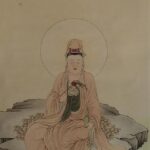
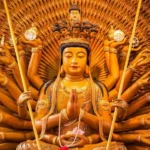
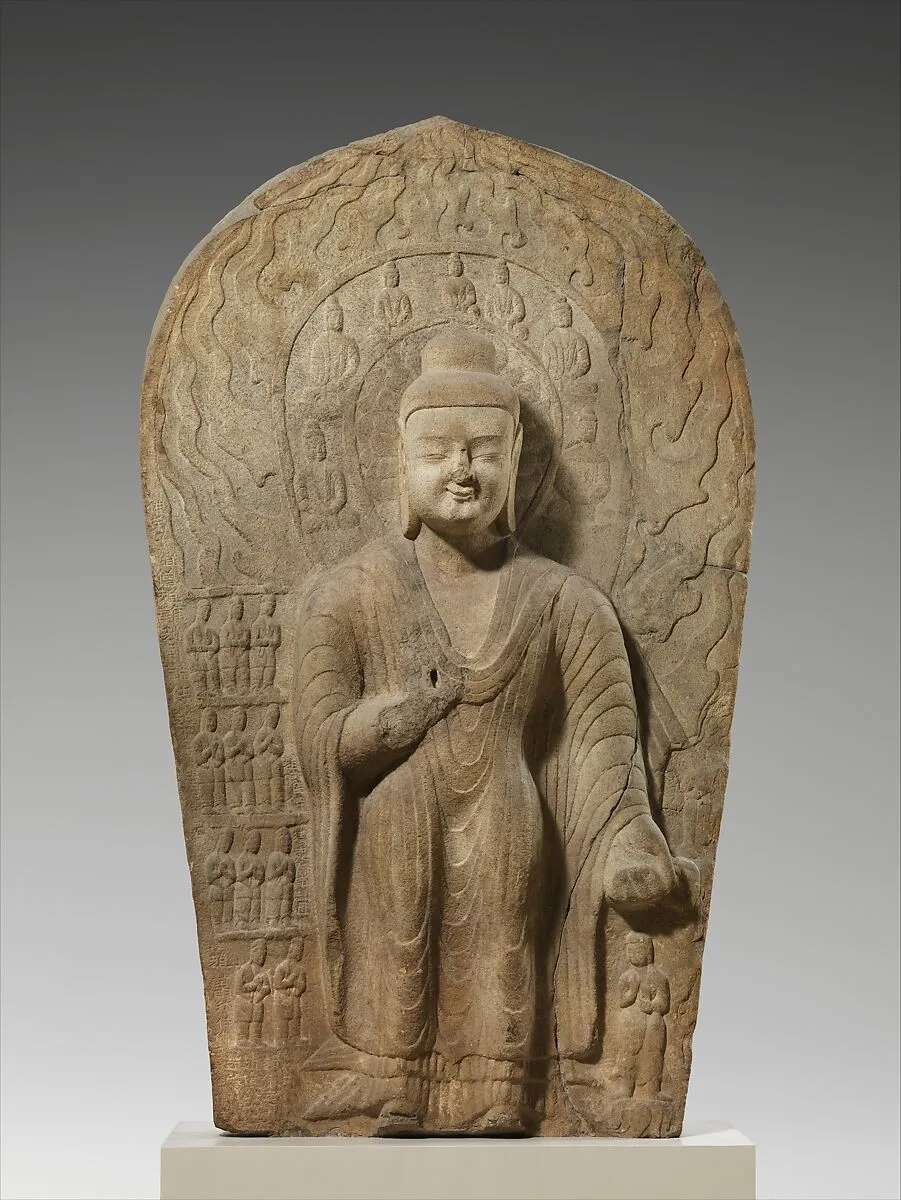
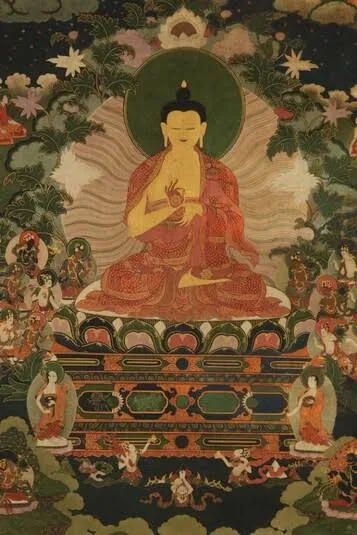
In Chinese Buddhist art, Dipankara is depicted with the standard physical marks of a Buddha rather than holding a literal oil lamp—a common misconception among modern readers encountering his translated name for the first time. Like other Buddhas, he wears monastic robes and displays the uṣṇīṣa (cranial protuberance signifying wisdom), elongated earlobes, and a serene meditative expression.
One of the most important surviving early Chinese sculptures of Dipankara is a monumental sandstone stele from the Northern Wei dynasty, dated by inscription to 495 CE, now in the collection of The Metropolitan Museum of Art. The inscription on the reverse explicitly identifies the large standing Buddha on the front as Dipankara (Randengfo), while a cross-ankled figure on the back—consistent with fifth-century Yungang cave sculpture—likely represents Maitreya, pairing the Buddha of the past with the Buddha of the future.
Key visual features associated with Dipankara in Chinese and broader Asian Buddhist art include:
- Posture: Appears both standing (especially in early northern Chinese steles and Gandharan narrative reliefs) and seated in lotus posture (common in later Ming and Qing Three-Times temple triads).
- Hand gestures (mudrās): Frequently shown with the right hand raised in the abhaya mudrā (gesture of fearlessness and reassurance) and the left hand lowered in the varada mudrā (gesture of generosity or granting boons), though seated temple images vary by period and workshop.
- Narrative reliefs: In early Silk Road and northern Chinese stone carvings, Dipankara can be identified through the surrounding narrative: the kneeling ascetic spreading his hair on the ground and floating lotus blossoms around the Buddha’s halo.
- Placement in triads: When displayed with Shakyamuni and Maitreya, Dipankara normally sits or stands to Shakyamuni’s side (traditionally on the viewer’s left in many Chinese temple layouts), visually anchoring the past.
Because standalone Buddha statues without inscriptions can look nearly identical across different Buddhas, art historians rely heavily on dedicatory inscriptions, accompanying narrative scenes, and triad pairings to confirm an image’s identity as Dipankara.
How Dipankara Changed in Chinese Literature and Folk Religion
As Buddhism interacted with Chinese literary culture and popular religion—a broader historical process examined in Buddhist influence on Chinese mythology—Dipankara acquired vivid secondary personas outside monastic scripture. Keeping these layers distinct is essential for accuracy.
Randeng Gufo in Journey to the West
In the sixteenth-century Ming novel Journey to the West (西游记, Xīyóujì), Dipankara appears near the climax (Chapter 98) as Randeng Gufo (燃灯古佛, Ancient Buddha of the Burning Lamp). When the pilgrim Xuanzang and his companions—including Sun Wukong—receive blank, wordless scriptures from Ananda and Kashyapa at Spirit Mountain, Randeng Gufo realizes that the pilgrims from the East will not recognize the value of wordless texts and dispatches the White-Robed Venerable (白雄尊者) to scatter the scrolls so the mistake is exposed. The scene is a witty literary invention, not a canonical sutra episode, yet it cemented Randeng Gufo’s image in Chinese popular memory as a senior, watchful elder of the Buddhist assembly.
Randeng Daoren in Investiture of the Gods
An even more dramatic literary transformation appears in the Ming-dynasty gods-and-demons novel Investiture of the Gods (封神演义, Fēngshén Yǎnyì). The novel introduces Randeng Daoren (燃灯道人, “Burning Lamp Daoist”), a senior Daoist master of Mount Lingjiu who serves as vice-leader of the Chan sect (阐教) under Yuanshi Tianzun, battles the rival Jie sect, and later converts to Buddhism to become the Ancient Buddha of the Burning Lamp.
Scholars of Chinese literature note that the author deliberately drew on the Buddhist figure of Dipankara—alongside other Buddhist names—to construct a fictional narrative explaining the relationship between Daoist immortals and Buddhist Buddhas during the Shang–Zhou transition. Randeng Daoren is a Ming-era literary creation and should not be mistaken for a historical Daoist origin of Dipankara Buddha.
Folk Calendars and Sectarian Cosmologies
In late imperial and modern Chinese popular religion, especially in parts of southern China, Taiwan, and overseas Chinese communities, Dipankara’s birthday is sometimes marked on the sixth day of the first lunar month under the older title Dingguang Fo Shengdan (定光佛圣诞). Separately, in several Ming–Qing and modern Chinese new religious movements—most notably Yiguandao (一贯道)—the Buddhist triad of the Three Times was adapted into a three-era cosmological framework in which Dipankara presides over the first (“Green Yang”) epoch, Shakyamuni over the second (“Red Yang”), and Maitreya over the coming third (“White Yang”) epoch. That cosmological scheme belongs to sectarian Chinese folk religion rather than mainstream monastic Buddhism.
Related Figures in Chinese Buddhism
Readers exploring Dipankara’s place in Chinese temples often encounter several closely connected Buddhist figures:
- Maitreya (弥勒, Mílè): Dipankara’s counterpart at the opposite end of the Three Times triad, representing the future Buddha.
- Guanyin (观音, Guānyīn): The bodhisattva of compassion, widely venerated in Chinese temples and households.
- Ksitigarbha / Dizang (地藏, Dìzàng): The bodhisattva associated with vows to save beings in the underworld realms.
- Four Heavenly Kings (四大天王, Sìdà Tiānwáng): The directional guardian deities stationed at the entrance hall of Chinese monasteries, protecting the Dharma taught by Buddhas past and present.
Frequently Asked Questions
What is Dipankara Buddha’s name in Chinese?
Dipankara is most commonly called Randeng Fo (燃灯佛, Rándēng Fó, “Burning Lamp Buddha”) or Randeng Gufo (燃灯古佛, “Ancient Buddha of the Burning Lamp”). Older Chinese scriptures and traditional calendars also call him Dingguang Fo (定光佛, “Buddha of Steady Light”).
Why is Dipankara important in Buddhism?
Dipankara is revered as a major Buddha of the distant past who prophesied that a devoted young ascetic—Shakyamuni in a former life—would one day attain complete enlightenment and become the historical Buddha. In Chinese Buddhism, he is also prominently cited in the Diamond Sutra and worshipped as the past Buddha in the Buddhas of the Three Times triad.
Is Dipankara Buddha the same as Randeng Daoren?
No, not in historical or canonical terms. Randeng Daoren (“Burning Lamp Daoist”) is a fictional character in the sixteenth-century Ming novel Investiture of the Gods (Fengshen Yanyi) who was modeled on Dipankara Buddha and written as a Daoist master who later enters Buddhism. Canonical Buddhism knows Dipankara solely as a Buddha from Indian Buddhist tradition.
Does Dipankara Buddha hold a lamp in Chinese Buddhist art?
Rarely. Although his Sanskrit and Chinese names mean “Lamp-Bearer” or “Burning Lamp,” traditional Chinese sculptures and temple icons portray him with standard Buddha features—monastic robes, cranial protuberance (uṣṇīṣa), and hand gestures such as the abhaya mudrā—rather than carrying a physical lamp.
How can you recognize Dipankara in a Chinese Buddhist temple?
In temples that enshrine the Buddhas of the Three Times (Shù Sānshì Fó), Dipankara appears alongside Shakyamuni (center) and Maitreya. Outside of inscribed plaques or triad groupings, individual Buddha statues look very similar, so temple labels or dedicatory inscriptions are usually needed to confirm his identity.
References and Further Reading
- The Metropolitan Museum of Art. Buddha Dipankara (Randengfo), Northern Wei dynasty, dated 495 CE (Object 65.29.3). Asian Art Collection, New York.
- The Metropolitan Museum of Art. Dipankara Jataka (The Story of the Ascetic Megha and the Buddha Dipankara). Gandharan Relief Collection, New York.
- Leidy, Denise Patry. Chinese Buddhist Sculpture. Heilbrunn Timeline of Art History, The Metropolitan Museum of Art, 2010.
- Xu, Jin. A Journey across Many Realms: The Shi Jun Sarcophagus. Columbia University Department of Art History, 2021.
- Nikaido, Yoshihiro. Some Buddhist Characters in Fengshen Yanyi. Kansai University Academic Repository.
- University of California, San Diego Library Digital Collections. Baoding Monastery, Dazu (referencing the Encyclopedia of Chinese Buddhism).