
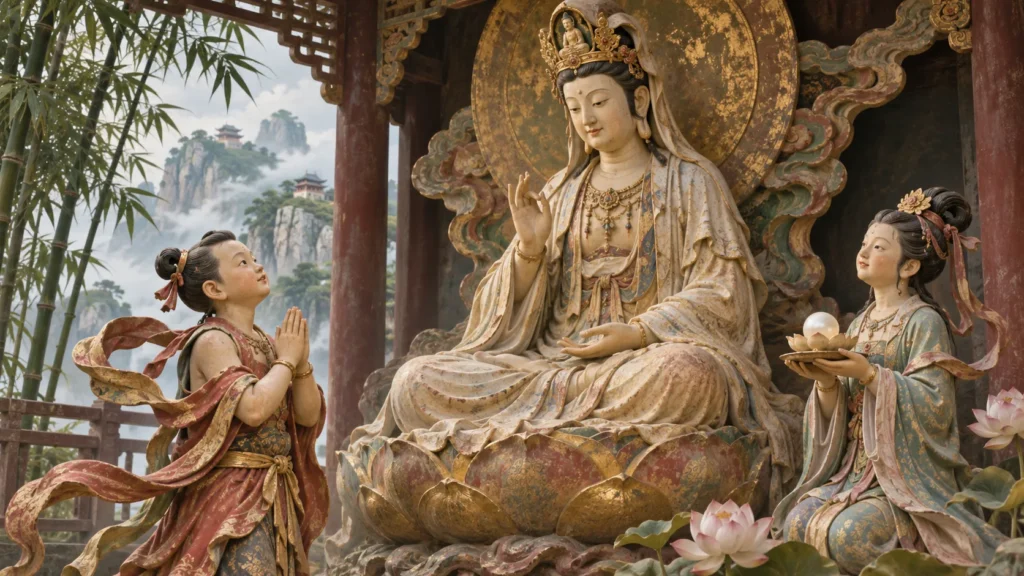
In many Chinese Buddhist temples, a youthful figure stands beside Guanyin with his palms pressed together, looking toward the bodhisattva with an expression of devotion. This figure is often Shancai Tongzi (善财童子), known in Sanskrit as Sudhana, one of the most recognizable young pilgrims in Mahayana Buddhist tradition.
Although Chinese popular culture frequently associates Shancai with Red Boy from Journey to the West, his Buddhist origins belong to a much older religious narrative. His story concerns the pursuit of wisdom, the cultivation of compassion, and the willingness to learn from spiritual teachers.
Who is Shancai Tongzi?
Shancai Tongzi, or Sudhana, is a young Buddhist pilgrim whose search for enlightenment is described in the Flower Garland Sutra. During his traditional pilgrimage to fifty-three spiritual teachers, he encounters Avalokiteshvara, known in China as Guanyin. In Chinese Buddhist art, he frequently appears alongside Dragon Girl as one of Guanyin’s two youthful attendants.
Who Is Shancai Tongzi (Sudhana)?
Sudhana is the central pilgrim of the Gandavyuha Sutra, an extensive concluding section of the Avatamsaka Sutra, also known as the Flower Garland Sutra. This scripture holds particular importance in the Chinese Huayan Buddhist tradition.
Rather than portraying him as a powerful deity with authority over a particular part of the universe, the scripture presents Sudhana as a young seeker who wishes to understand how a bodhisattva develops wisdom and works for the benefit of living beings.
| Chinese name | 善财童子 / 善財童子 |
|---|---|
| Pinyin | Shàncái Tóngzǐ |
| Sanskrit name | Sudhana (Sudhanakumāra) |
| English name | Child of Good Wealth, Child of Wealth |
| Religious tradition | Mahayana Buddhism |
| Principal scripture | Avatamsaka Sutra, Gandavyuha section |
| Primary role | Young pilgrim and spiritual seeker |
| Associated bodhisattva | Guanyin (Avalokiteshvara) |
| Common companion in art | Longnu (Dragon Girl) |
| Symbolism | Devotion, humility, wisdom and spiritual cultivation |
| Literary association | Red Boy in Journey to the West |
What Does the Name Shancai Tongzi Mean?
The Sanskrit name Sudhana is commonly understood as good wealth or excellent riches. Its Chinese rendering, Shancai Tongzi, preserves this association through three elements:
- Shan (善): goodness, virtue or wholesomeness.
- Cai (财): wealth, riches or treasure.
- Tongzi (童子): a boy, youth or young attendant.
In the scriptural account, extraordinary treasures appear in connection with Sudhana’s arrival into the world. Yet the direction of his life is not determined by the accumulation of material possessions. Instead, he becomes devoted to the search for Buddhist understanding.
The contrast between his auspicious wealth and his spiritual aspirations is central to interpreting his name. Within the context of his pilgrimage, wisdom, virtue and compassion represent forms of richness that cannot be measured in money.
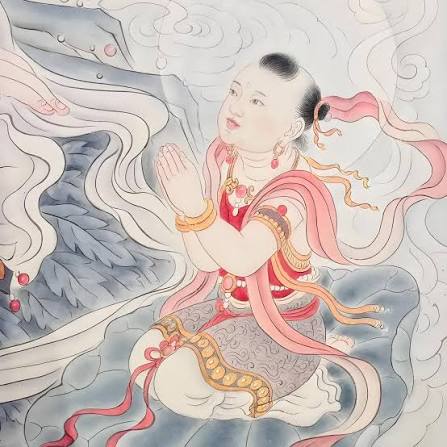
The Story of Sudhana in the Flower Garland Sutra
Sudhana’s story begins with his encounter with Manjushri, the bodhisattva associated with wisdom. Inspired by Buddhist teachings, the young seeker develops the aspiration to attain awakening for the benefit of all living beings.
Manjushri encourages him to seek guidance from other spiritual friends and teachers. This leads to an extraordinary pilgrimage traditionally described in China as the fifty-three visits of Shancai, or Shancai Wushisan Can (善财五十三参).
Sudhana’s Pilgrimage to 53 Spiritual Teachers
One of the distinctive features of Sudhana’s pilgrimage is the diversity of the people from whom he learns. His teachers include religious practitioners, laypeople, women, men, celestial beings and bodhisattvas. Spiritual understanding is not presented as something available only through a single social position or religious occupation.
Each encounter introduces another dimension of the bodhisattva path. Having received instruction, Sudhana continues onward, recognizing that his understanding can still deepen.
Among the most important bodhisattvas associated with his journey are:
The bodhisattva of wisdom who inspires Sudhana to begin his spiritual quest.
The bodhisattva whose teachings emphasize great compassion and the relief of suffering.
The future Buddha, associated in the narrative with a profound visionary experience near the conclusion of Sudhana’s pilgrimage.
The bodhisattva associated with the vast aspirations, vows and practices that bring Sudhana’s journey to its culmination.
These encounters illustrate the relationship between wisdom, compassion, spiritual aspiration and practical conduct. They also explain why Sudhana became an enduring model of Buddhist learning.
The Indian and Chinese names of these figures are discussed in our guide to the Sanskrit names of Chinese Buddhist deities.
How Is Sudhana Related to Guanyin?
During his pilgrimage, Sudhana visits Avalokiteshvara at Mount Potalaka, a sacred dwelling associated with the bodhisattva of compassion. In the Chinese Buddhist tradition, Avalokiteshvara is best known as Guanyin, the Bodhisattva of Compassion.
In the Gandavyuha narrative, Guanyin is one of Sudhana’s spiritual teachers. Their encounter concerns the practice of compassion and the bodhisattva’s commitment to helping living beings overcome suffering and fear.
This meeting is important because it demonstrates that spiritual awakening involves more than acquiring knowledge. The bodhisattva must also develop a compassionate response to the difficulties experienced by others.
Over time, Chinese Buddhist art developed a particularly close visual association between Sudhana and Guanyin. The young pilgrim is often represented standing or kneeling near the bodhisattva, transforming an episode in a much larger scriptural journey into a recognizable devotional image.
Mount Potalaka and Mount Putuo
The sacred mountain of Potalaka also became important in the development of Guanyin devotion in China. Chinese religious geography associated this dwelling with Mount Putuo, an island in Zhejiang Province that became a major center of Buddhist pilgrimage.
Paintings and sculptures of Guanyin in rocky landscapes, bamboo groves or settings surrounded by water may therefore evoke the sacred environment in which Sudhana encounters the bodhisattva.
This Chinese localization of Potalaka should be distinguished from the geographical setting of the earlier Indian Buddhist narrative.
Shancai Tongzi and Longnu: Guanyin’s Two Attendants
In Chinese Buddhist temples, Guanyin is frequently accompanied by two youthful attendants: Shancai Tongzi and Longnu (龙女), whose name means Dragon Girl.
Together, they form a distinctive devotional grouping found in temple sculptures, paintings and household religious images. Their youthful appearances contrast with the more imposing central figure of Guanyin.
| Feature | Shancai Tongzi | Longnu |
|---|---|---|
| English name | Sudhana | Dragon Girl |
| Chinese name | 善财童子 | 龙女 |
| Scriptural association | Flower Garland Sutra | Lotus Sutra and dragon-princess traditions |
| Typical appearance | Young boy with joined palms | Young girl, sometimes holding a jewel |
| Common interpretation | Spiritual seeking and devotion | Spiritual potential and devotion |
| Role in Chinese Buddhist art | Attendant of Guanyin | Attendant of Guanyin |
The Dragon King’s daughter described in the Lotus Sutra is associated with a remarkable account of attaining buddhahood. Later Chinese devotional traditions also developed stories about Dragon Girl becoming Guanyin’s attendant. These narratives should not be treated as a single continuous episode from the Flower Garland Sutra.
The familiar arrangement of Guanyin with Shancai and Longnu reflects the development of Chinese Buddhist iconography, bringing figures with different scriptural and narrative backgrounds into a shared devotional setting.
Is Shancai Tongzi the Same as Red Boy?
The answer depends on whether the question concerns Buddhist scripture or Chinese classical literature.
In the Flower Garland Sutra, Sudhana is a sincere young pilgrim who seeks Buddhist teachings. He is not introduced as a demon child, the son of the Bull Demon King or an opponent of the Monkey King.
In the Ming-dynasty novel Journey to the West, however, Shancai Tongzi becomes associated with a very different character: Red Boy, known in Chinese as Hong Hai’er (红孩儿).
Red Boy in Journey to the West
Red Boy is the son of the Bull Demon King and Princess Iron Fan in the novel. He possesses powerful supernatural abilities, including the famous True Fire of Samadhi, and becomes a dangerous obstacle to Tang Sanzang and his companions.
Unable to resolve the confrontation alone, Sun Wukong seeks assistance from Guanyin. In Chapter 42, Guanyin subdues Red Boy and brings him under Buddhist discipline, giving him the name Shancai Tongzi.
The episode gives the character a new role within Guanyin’s religious world. A hostile supernatural being becomes a disciple expected to follow Buddhist precepts.
Sudhana vs. Red Boy
| Feature | Buddhist Sudhana | Red Boy |
|---|---|---|
| Primary source | Flower Garland Sutra | Journey to the West |
| Original identity | Young spiritual seeker | Demon child in a literary narrative |
| Family background | Associated with a wealthy merchant household | Son of the Bull Demon King and Princess Iron Fan |
| Relationship with Guanyin | Visits the bodhisattva to receive spiritual instruction | Is subdued and accepted under Buddhist discipline |
| Central theme | The pursuit of awakening | The transformation and restraint of destructive power |
| Tradition | Mahayana Buddhist scripture | Chinese classical literature |
Important distinction: Red Boy becomes Shancai Tongzi within the narrative of Journey to the West. The earlier Buddhist account of Sudhana does not describe him as Red Boy. The novel draws on an existing Buddhist figure rather than providing his original scriptural biography.
How to Identify Shancai Tongzi in Chinese Temples
Sudhana is often recognizable by his youthful appearance and reverent posture. Sculptures frequently depict him with joined palms, a gesture known in Sanskrit as anjali mudra, expressing respect, devotion or greeting.
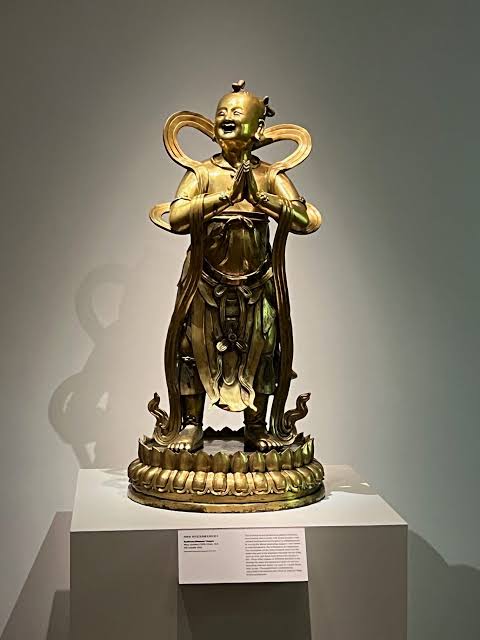
Common features of Shancai Tongzi sculptures and paintings include:
- A youthful male appearance.
- Palms joined together in a devotional gesture.
- Standing or kneeling postures near Guanyin.
- Traditional garments, jewelry and flowing decorative ribbons.
- Hair arranged in distinctive youthful knots or tufts.
- An upward or inward gaze directed toward the central bodhisattva.
- A corresponding female attendant representing Dragon Girl.
These features vary across historical periods and artistic traditions. A youthful figure with joined palms is not automatically Sudhana, especially when separated from its original religious setting. Inscriptions, accompanying figures and the overall composition provide additional identification clues.
Historical examples also demonstrate that this iconography is not simply a modern result of the popularity of Journey to the West. The Smart Museum of Art at the University of Chicago preserves a fourteenth-century bronze devotional group depicting Guanyin with Shancai and Longnu, predating the standard late-Ming printed novel.
The Metropolitan Museum of Art also documents a large gilt copper-alloy statue of Sudhana dated to 1641, illustrating the importance of this figure in late imperial Chinese Buddhist sculpture.
What Does Shancai Tongzi Symbolize?
Although his name contains a reference to wealth, Sudhana’s enduring religious significance lies primarily in the development of spiritual qualities.
Humility and the Willingness to Learn
Throughout his pilgrimage, Sudhana approaches his teachers with respect. His progress depends on his willingness to recognize the limitations of his current understanding and learn from others.
Compassion and Spiritual Wisdom
His encounter with Guanyin highlights the importance of compassion, while his relationship with Manjushri reflects the pursuit of wisdom. The two qualities complement one another within the bodhisattva path.
Perseverance in Spiritual Practice
The many stages of Sudhana’s journey suggest that spiritual development requires sustained commitment. Each encounter contributes something to his understanding, but no single early lesson exhausts the meaning of the path.
Spiritual Wealth Beyond Material Possessions
The association of Sudhana with auspicious treasures provides a contrast between material prosperity and the qualities cultivated through Buddhist practice. In this sense, his name can serve as a reminder that genuine richness includes wisdom, generosity and virtue.
Is Shancai Tongzi a Chinese God of Wealth?
Despite the literal meaning of his name, Shancai Tongzi is not primarily the Chinese God of Wealth.
The figures collectively known as Caishen (财神) occupy a different place in Chinese religious culture. They are popularly associated with prosperity, business success and financial fortune.
Sudhana, by contrast, is best understood through his Buddhist pilgrimage and his association with Guanyin. Popular devotional interpretations may connect his auspicious name with blessings or prosperity, but this does not replace his original role as a spiritual seeker.
Is Shancai Tongzi Buddhist or Taoist?
Shancai Tongzi originates in Mahayana Buddhism, rather than Taoist scripture or an indigenous Chinese creation myth.
Nevertheless, the boundaries between religious traditions in Chinese popular culture have often been flexible. Guanyin and her attendants may appear in religious environments that incorporate Buddhist, Taoist and local devotional practices.
The presence of Shancai in such a setting does not change his scriptural origin. His cultural development is an example of how Indian Buddhist narratives were adapted into Chinese art, literature and religious life.
For a broader introduction to related figures, see our guide to Buddhist deities and bodhisattvas in Chinese mythology.
Frequently Asked Questions
Who is the little boy standing beside Guanyin?
He is often Shancai Tongzi, also known as Sudhana. In Chinese Buddhist art, Sudhana commonly appears as a youthful attendant of Guanyin with his hands joined in reverence.
What is the Sanskrit name of Shancai Tongzi?
His Sanskrit name is Sudhana, also known as Sudhanakumara. The name is commonly interpreted as referring to good or excellent wealth.
Why did Sudhana visit 53 teachers?
Sudhana sought guidance on the bodhisattva path and the attainment of awakening. His pilgrimage brought him into contact with spiritual teachers from diverse backgrounds, each offering another perspective on Buddhist practice.
Was Sudhana originally a demon?
No. In the Flower Garland Sutra, Sudhana is a young Buddhist seeker. His identification with a demon child belongs to the later literary narrative of Red Boy in Journey to the West.
Did Guanyin turn Red Boy into Shancai Tongzi?
Yes, within Journey to the West. In Chapter 42, Guanyin subdues Red Boy and gives him the name Shancai Tongzi after bringing him under Buddhist discipline.
Are Shancai Tongzi and Dragon Girl siblings?
No. They are commonly depicted together as Guanyin’s attendants, but their association in Buddhist art does not mean they are biological siblings.
Is Shancai Tongzi a wealth deity?
Not primarily. Although his name refers to wealth, his principal significance in Buddhism is his pursuit of wisdom and enlightenment. He should not be confused with Caishen, the Chinese God of Wealth.
Is Sudhana a Buddha?
Sudhana is primarily known as a young pilgrim pursuing the bodhisattva path. He is not usually represented or worshipped as a historical Buddha.
Conclusion
Shancai Tongzi occupies a distinctive place in Chinese Buddhist culture because his story emphasizes the process of learning rather than the possession of supernatural power. His encounters with spiritual teachers, including Guanyin, illustrate how wisdom and compassion develop through sustained practice.
His later association with Red Boy demonstrates how Chinese classical literature could reinterpret established Buddhist figures. While the two narratives share the name Shancai Tongzi, they present different accounts of how a youthful figure enters Guanyin’s religious world.
Understanding this distinction allows us to appreciate Sudhana both as an important figure in Mahayana scripture and as a familiar presence in Chinese temples, devotional art and popular storytelling.
References
- Avatamsaka Sutra (Flower Garland Sutra), Gandavyuha section, known in Chinese as the Chapter on Entering the Dharma Realm (入法界品).
- 84000: Translating the Words of the Buddha. The Stem Array (Gandavyuha), Toh 44-45. English translation of the Tibetan canonical text.
- The Lotus Sutra (Saddharmapundarika Sutra), Chapter 12, Devadatta.
- Wu Cheng’en (traditionally attributed). Journey to the West, Chapters 40-42. Ming dynasty.
- The Metropolitan Museum of Art. Pilgrim Sudhana (Shancai tongzi). Ming dynasty, late 15th to early 17th century. Object 42.25.6.
- The Metropolitan Museum of Art. Sudhana (Shancai Tongzi). China, 1641.
- Smart Museum of Art, University of Chicago. Guanyin and Her Two Attendants, Longnu and Shancai. Mid- to late 14th century. Object 2001.2.
- Herbert F. Johnson Museum of Art, Cornell University. Guanyin and Shancai in a Bamboo Grove. Late 16th century. Object 2002.012.003.
- Yu, Anthony C., translator. The Journey to the West, Revised Edition, Volume 2. University of Chicago Press, 2012.
Related posts:
 Vairocana Buddha in Chinese Buddhism: Meaning, Art & Role
 Amitabha vs Shakyamuni Buddha: Key Differences
 Heng and Ha Generals in Chinese Temples: Origins & Meaning
 Cundi Bodhisattva (Zhunti): Origins, Mantra & 18 Arms
 Akasagarbha Bodhisattva (Xukongzang): Meaning & Symbols
 Manjushri Lion and Sword Symbolism in Chinese Buddhism
