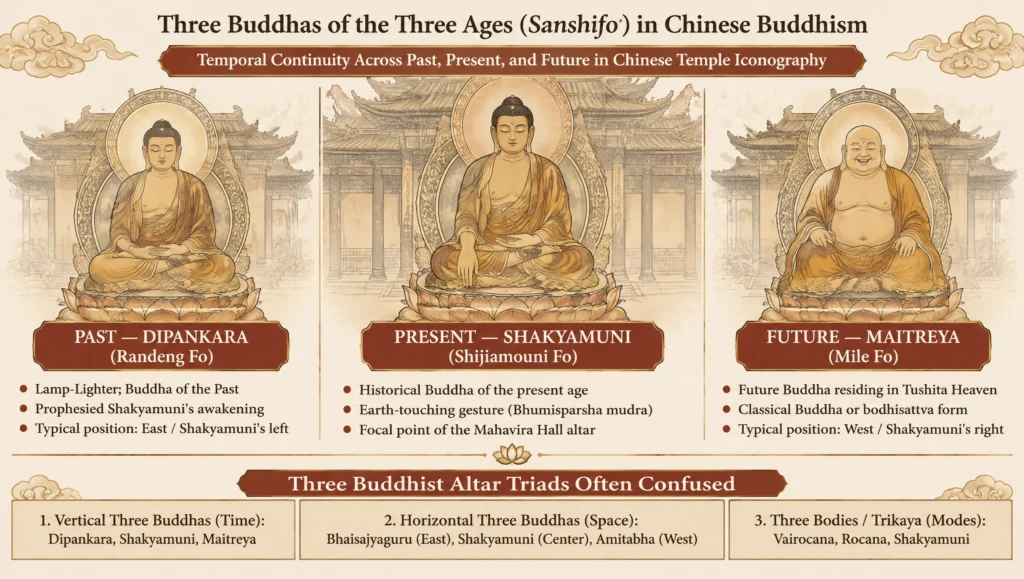
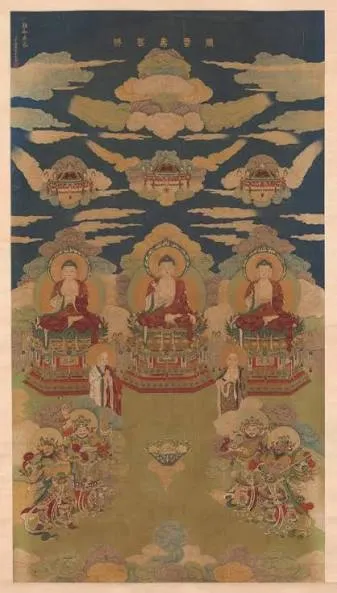
The Three Buddhas of the Three Ages (三世佛, Sānshìfó) are a central Buddhist triad in Chinese temple art and Mahāyāna cosmology, representing the continuity of awakened teaching across past, present, and future time. In their temporal form—known in Chinese as the Vertical Three Buddhas (竖三世佛, Shù Sānshìfó)—the group consists of Dīpaṃkara (燃灯佛, Rándēng Fó, Buddha of the Past), Śākyamuni (释迦牟尼佛, Shìjiāmóuní Fó, Buddha of the Present), and Maitreya (弥勒佛, Mílè Fó, Buddha of the Future).
Although English-language readers sometimes encounter this triad while researching Chinese mythology, the Three Buddhas belong to Buddhist sacred figures in China rather than to indigenous myths or a single universal pantheon. They are enlightened Buddhas—not gods in the Western polytheistic sense—and in Chinese monastic architecture the same phrase, Sānshìfó, can also refer to a spatial triad of Buddhas presiding over three cosmic realms.
Quick Distinction: When visiting a Chinese monastery’s main hall, three large seated Buddhas on the central altar do not always depict the same trio. Depending on the temple’s lineage and period, the statues may represent the Vertical Three Buddhas (time: past, present, future), the Horizontal Three Buddhas (space: east, center, west), or the Three Bodies of the Buddha (Trikāya).
What “Three Ages” Means in Chinese Buddhism
In Chinese, sānshì (三世) translates the Sanskrit term trikāla—the “three times” or “three periods” of past, present, and future. Early Buddhist traditions already taught that the historical Buddha, Śākyamuni, was neither the first awakened teacher in cosmic history nor the last. Instead, Buddhas appear sequentially across vast eons (kalpas) whenever the Dharma—the liberating teaching—fades from human memory and needs to be rediscovered and taught anew.
As Mahāyāna Buddhism developed in India and took root in China from the Han dynasty onward, this concept expanded in two complementary directions:
- Temporal continuity (Vertical / 竖, shù): One Buddha follows another along the vertical axis of time—past, present, and future—reassuring practitioners that awakening is not confined to a single historical moment.
- Spatial expanse (Horizontal / 横, héng): Multiple Buddhas exist simultaneously across the horizontal expanse of the cosmos, each presiding over a distinct world-system or Pure Land.
Because the Chinese character shì (世) carries both meanings—”age/era” and “world/realm”—Chinese Buddhist tradition uses Sānshìfó (三世佛) for both triads, adding shù (vertical/temporal) or héng (horizontal/spatial) when precision is needed. This layered vocabulary is one reason the influence of Buddhism on Chinese religious culture produced such rich, regionally varied temple programs.
Who Are the Three Buddhas of the Three Ages?
In the standard Chinese temporal triad (Shù Sānshìfó), each Buddha anchors a distinct epoch of Buddhist sacred history. Śākyamuni occupies the center as the teacher of the present world age, flanked by Dīpaṃkara and Maitreya.
| Buddha | Chinese & Pinyin | Age / Role | Typical Altar Position | Key Traditional Association |
|---|---|---|---|---|
| Dīpaṃkara | 燃灯佛 (Rándēng Fó) / 定光佛 (Dìngguāng Fó) | Buddha of the Past | Left side of Śākyamuni (or East) | “Lamp-Lighter”; predicted Śākyamuni’s future Buddhahood in a former life |
| Śākyamuni | 释迦牟尼佛 (Shìjiāmóuní Fó) | Buddha of the Present | Center | Historical founder of Buddhism; teacher of the present Sahā world |
| Maitreya | 弥勒佛 (Mílè Fó) | Buddha of the Future | Right side of Śākyamuni (or West) | Currently a bodhisattva in Tuṣita Heaven; destined to renew the Dharma |
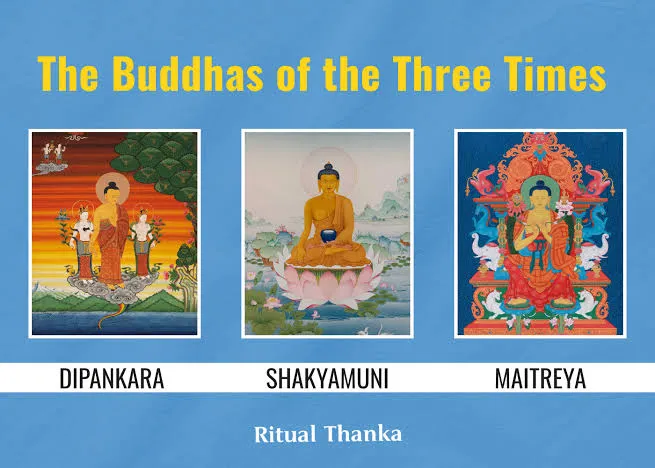
1. Dīpaṃkara (燃灯佛, Rándēng Fó) — Buddha of the Past
Dīpaṃkara, whose Sanskrit name means “Lamp-Lighter” or “Maker of Light,” is the most prominent representative of the Buddhas of the Past in Chinese Buddhism. In Chinese translations he is rendered as Rándēng Fó (燃灯佛, “Lamp-Lighting Buddha”) or Dìngguāng Fó (定光佛, “Buddha of Fixed Light”).
His enduring fame rests on a foundational Jātaka narrative preserved across both early and Mahāyāna texts. Countless eons ago, a young ascetic named Sumedha (known in some Chinese versions as Rútōng or Shànhuì) encountered Dīpaṃkara walking along a muddy road. After offering lotus blossoms, Sumedha lay down in the mud and spread his hair so the Buddha could step across without soiling his feet. Recognizing the depth of Sumedha’s vow, Dīpaṃkara uttered a formal prophecy (vyākaraṇa) that in a future age the ascetic would become the Buddha Śākyamuni.
In Chinese Buddhist art, Dīpaṃkara became an important devotional figure by the Northern Wei dynasty (386–534 CE). A monumental sandstone stele dated 495 CE in the Metropolitan Museum of Art bears an inscription identifying its central standing figure as Dīpaṃkara, testifying to his early prominence alongside Maitreya in northern China.
Important Literary Distinction: Readers of the Ming-dynasty novel Investiture of the Gods (封神演义, Fēngshén Yǎnyì) sometimes confuse Dīpaṃkara with Randeng Daoren (燃灯道人, “Lamp-Lighting Daoist”), a fictional Daoist sage who later enters the Western Buddhist fold in the novel. That character is a 16th-century literary invention blending popular Daoist and Buddhist motifs; he should not be mistaken for the canonical Buddhist Buddha of the Past.
2. Śākyamuni (释迦牟尼佛, Shìjiāmóuní Fó) — Buddha of the Present
Seated at the center of the triad is Śākyamuni (“Sage of the Śākya clan”), the historical Buddha born as Siddhārtha Gautama in ancient northern India (modern-day southern Nepal). Because his teachings govern the current cosmic era—the Sahā world of endurance—Śākyamuni forms the focal point of the Three Ages.
In Chinese temple iconography, Śākyamuni is most commonly shown seated in the lotus posture with his right hand reaching downward toward his knee or the earth. This gesture, the bhūmisparśa mudrā (“earth-touching gesture”), recalls the decisive moment beneath the Bodhi Tree when Śākyamuni called the earth to witness his accumulated merit against the armies of Māra and attained awakening. On altars where he is depicted teaching, he may also display the vitarka (exposition) or dharmacakra (turning the wheel of the Dharma) gesture, or hold a begging bowl in meditation.
3. Maitreya (弥勒佛, Mílè Fó) — Buddha of the Future
Maitreya, whose name derives from the Sanskrit maitrī (“loving-kindness” or “friendliness”), is the Buddha of the Future recognized across virtually all Buddhist traditions. According to Buddhist cosmology, Maitreya currently resides as a bodhisattva in Tuṣita Heaven (兜率天, Dōushuàitiān). In the distant future, after Śākyamuni’s teachings have completely disappeared from the human world, Maitreya will descend to Earth, attain supreme enlightenment beneath the Dragon-Flower Tree (龙华树, Lónghuáshù), and preach three great assemblies of the Dharma.
In China, Maitreya is one of the most visually diverse figures in Buddhist art. Early cave sculptures at Yungang and Longmen, as well as a celebrated gilt-bronze Northern Wei statue dated 486 CE at the Metropolitan Museum of Art, portray Maitreya as a slender, serene Buddha or a crowned bodhisattva seated with ankles crossed or in the “pendant-legged” posture (both feet resting on the ground, signaling readiness to descend into the world).
From the Song dynasty onward, Chinese popular devotion also linked Maitreya with the eccentric 10th-century Chan monk Budai—giving rise to the smiling, pot-bellied Laughing Buddha (Budai) enshrined near monastery entrances. In a formal Three Buddhas of the Three Ages triad inside the main hall, however, Maitreya is almost always depicted in classical Buddha or princely bodhisattva form rather than as the round-bellied monk.
Vertical vs. Horizontal Three Buddhas (and the Three Bodies)
One of the most common points of confusion for visitors to Chinese temples—and readers of English guides—is that three seated Buddhas on a main altar can represent three different doctrinal groupings. Recognizing which triad stands before you clarifies the temple’s theological emphasis.
| Triad Name | Chinese Term | Core Concept | Three Buddhas | How to Recognize Them |
|---|---|---|---|---|
| Vertical Three Buddhas (Three Ages) | 竖三世佛 (Shù Sānshìfó) | Time: Past, Present, Future | Dīpaṃkara (Past), Śākyamuni (Present), Maitreya (Future) | Often distinguished by mudrās (e.g., earth-touching, fearlessness, teaching); sometimes Kāśyapa replaces Dīpaṃkara |
| Horizontal Three Buddhas (Three Worlds) | 横三世佛 (Héng Sānshìfó) | Space: East, Center, West | Bhaiṣajyaguru (East), Śākyamuni (Center), Amitābha (West) | Bhaiṣajyaguru holds a medicine jar or pagoda; Amitābha holds a lotus pedestal or displays meditation/welcoming mudrā |
| Three Bodies of the Buddha (Trikāya) | 三身佛 (Sānshēnfó) | Modes of Buddhahood | Vairocana (Dharmakāya), Rocana (Sambhogakāya), Śākyamuni (Nirmāṇakāya) | Vairocana at center (often crowned or making wisdom-fist mudrā), flanked by Rocana and Śākyamuni |
In late imperial China, the Horizontal Three Buddhas (Héng Sānshìfó) became the single most widespread altar arrangement in the Mahāvīra Hall (大雄宝殿, Dàxióng Bǎodiàn) of Han Chinese monasteries, reflecting the immense popularity of Pure Land devotion to Amitābha (阿弥陀佛, Āmítuó Fó) and healing prayers to Bhaiṣajyaguru (药师佛, Yàoshī Fó). Meanwhile, the Vertical Three Buddhas remained prominent in older monastic lineages, cave temples, and imperial Gelug-influenced complexes such as Beijing’s Yonghe Temple (雍和宫, Yōnghégōng).
The Three Bodies triad (Sānshēnfó) expresses a more philosophical Mahāyāna doctrine—the Trikāya—in which Vairocana (毗卢遮那佛, Pílúzhēnà Fó) embodies ultimate reality (Dharmakāya), Rocana (卢舍那佛, Lúshěnà Fó) embodies the bliss body of attainment (Sambhogakāya), and Śākyamuni embodies the manifested historical teacher (Nirmāṇakāya). Readers interested in how these Sanskrit titles entered Chinese can explore our guide to the Sanskrit names of Chinese Buddhist deities.
Alternative Past Buddhas: Why Kāśyapa Sometimes Replaces Dīpaṃkara
Although Dīpaṃkara is the most familiar Buddha of the Past in Chinese temple triads, he is not the only one. Buddhist scriptures also list the “Seven Buddhas of the Past” (过去七佛, Guòqù Qīfó), a lineage culminating in Śākyamuni. In that sequence, the immediate predecessor before Śākyamuni is Kāśyapa Buddha (迦叶佛, Jiāyè Fó)—not to be confused with Śākyamuni’s elder disciple Mahākāśyapa.
Consequently, certain Chinese temples and Tibetan-influenced monasteries enshrine Kāśyapa, Śākyamuni, and Maitreya as the Three Buddhas of the Three Ages. Both versions are doctrinally sound: Dīpaṃkara emphasizes the original vow and prophecy that launched Śākyamuni’s bodhisattva path, whereas Kāśyapa emphasizes the immediate historical link in the chain of awakened teachers.
How to Identify the Three Buddhas in Temple Art
Unlike Daoist deities or popular folk gods who frequently carry distinctive weapons, scrolls, or court tablets, seated Buddhas share a standardized set of physical marks (lakṣaṇas): a cranial protuberance (uṣṇīṣa), elongated earlobes, tightly curled hair, and simple monastic robes. Because their faces and robes look nearly identical at a glance, art historians and devotees rely on three primary clues to tell them apart.
1. Hand Gestures (Mudrās)
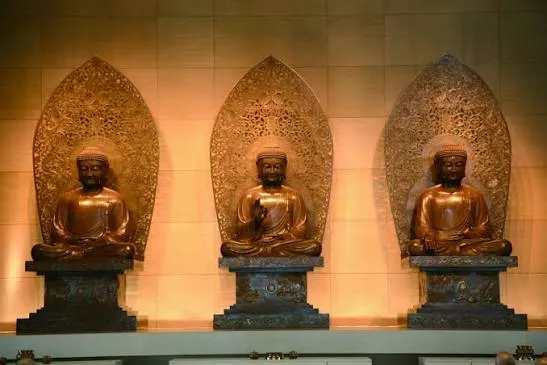
A clear historical example survives at Beijing’s 15th-century Zhihua Temple (智化寺, Zhìhuàsì), where three Ming-dynasty wooden sculptures in the Zhihua Hall represent the Buddhas of the Three Ages. All three wear identical diagonal monastic robes, yet each is differentiated by his hands:
- Śākyamuni (Center): Right hand reaching downward in the earth-touching gesture (bhūmisparśa mudrā).
- Flanking Buddha (Left): Right hand raised with palm outward in the gesture of fearlessness (abhaya mudrā).
- Flanking Buddha (Right): Both hands held before the chest in the teaching gesture of turning the wheel of the Dharma (dharmacakra mudrā).
Exact mudrā assignments for Dīpaṃkara and Maitreya can vary by region, dynasty, and monastic school, so gesture is always read alongside altar position and inscriptions.
2. Spatial Position on the Altar
In traditional Chinese temple orientation, the main hall typically faces south. Śākyamuni sits at the center facing south, while the Buddha of the Past (Dīpaṃkara) is usually placed to the east (viewer’s right, or the Buddha’s left—historically the position of honor in Chinese ritual) and the Buddha of the Future (Maitreya) to the west (viewer’s left, or the Buddha’s right). At Beijing’s Yonghe Temple, for instance, the main hall enshrines Śākyamuni in the center, Dīpaṃkara to the east, and Maitreya to the west.
3. Handheld Objects and Attendants
If the flanking Buddhas hold recognizable objects—such as a small medicine jar or miniature pagoda on one side and a lotus blossom or pedestal on the other—you are almost certainly looking at the Horizontal Three Buddhas (Bhaiṣajyaguru and Amitābha) rather than the Three Ages. Flanking bodhisattvas also offer decisive clues: Guanyin (Avalokiteśvara) and Mahāsthāmaprāpta attend Amitābha, while Mañjuśrī and Samantabhadra commonly attend Śākyamuni or Vairocana.
Role in Chinese Temple Layout and Devotion
Within a classic Chinese Buddhist monastery layout, visitors do not encounter the Three Buddhas immediately upon entering. First, they pass through the Mountain Gate and the Hall of the Four Heavenly Kings, where Maitreya typically appears in his accessible, welcoming Budai form facing outward toward guests. Only after crossing the courtyard into the principal Mahāvīra Hall (Dàxióng Bǎodiàn) do worshippers stand before the solemn, towering Three Buddhas.
This architectural progression mirrors a spiritual movement from everyday protection and hospitality toward the timeless core of Buddhist doctrine. Bowing and offering incense before the Three Buddhas of the Three Ages affirms faith not merely in one historical founder, but in an unbroken lineage of awakening stretching from the remote past into the distant future.
It is also worth noting how Chinese religious culture handles sacred triads across different traditions. While Chinese Buddhism venerates the Three Buddhas of the Three Ages, religious Daoism honors the Three Pure Ones (三清, Sānqīng) as supreme personifications of the Dao. Though both triads occupy central temple altars and share the number three, they arise from completely distinct theological frameworks and are not counterparts of one another.
Frequently Asked Questions
Who are the Three Buddhas of the Three Ages?
In Chinese Buddhism, the Three Buddhas of the Three Ages (Sānshìfó, 三世佛) are Dīpaṃkara (Buddha of the Past), Śākyamuni (Buddha of the Present), and Maitreya (Buddha of the Future). In some temple lineages, Kāśyapa Buddha appears as the Buddha of the Past instead of Dīpaṃkara.
What is the difference between the Vertical and Horizontal Three Buddhas?
The Vertical Three Buddhas (Shù Sānshìfó) represent time—past (Dīpaṃkara), present (Śākyamuni), and future (Maitreya). The Horizontal Three Buddhas (Héng Sānshìfó) represent space—the eastern realm (Bhaiṣajyaguru, Medicine Buddha), the central Sahā world (Śākyamuni), and the western Pure Land (Amitābha).
Why does Maitreya look different in the Three Buddhas triad than as the Laughing Buddha?
The smiling, pot-bellied Laughing Buddha is modeled on Budai, a 10th-century Chinese monk revered in folk and Chan tradition as an emanation of Maitreya, and is usually placed in the front entrance hall. Inside the main hall, Maitreya as the Future Buddha of the Three Ages is depicted in classical Indian-derived Buddha or crowned bodhisattva iconography.
Are the Three Buddhas of the Three Ages considered gods in Chinese mythology?
No. In Buddhist doctrine, Buddhas are fully awakened beings who have transcended the cycle of rebirth, rather than creator deities or mythological gods. While popular Chinese culture sometimes groups Buddhist figures alongside Daoist and folk deities, temples and scriptures maintain their distinct Buddhist identity.
How can you tell which Buddha is which on a Chinese temple altar?
Start with the center statue, which is almost always Śākyamuni (often with his right hand touching the earth). Next, check for handheld emblems: a medicine jar and lotus indicate the Horizontal Three Buddhas (Bhaiṣajyaguru and Amitābha), whereas matching monastic robes distinguished primarily by hand gestures (mudrās) typically indicate the Three Buddhas of the Three Ages.
References and Further Reading
- University of Chicago, Center for the Art of East Asia. Sculptures of Zhihua Temple (documentation of the 15th-century Buddhas of the Three Ages sculptures and their mudrās).
- The Metropolitan Museum of Art. Buddha Dipankara (Randengfo), Northern Wei dynasty, dated 495 (Accession No. 65.29.3).
- The Metropolitan Museum of Art. Buddha Maitreya (Mile), Northern Wei dynasty, dated 486 (Accession No. 26.123).
- Leidy, Denise Patry. Chinese Buddhist Sculpture. Heilbrunn Timeline of Art History, The Metropolitan Museum of Art.
- Encyclopaedia Britannica. Maitreya (Future Buddha).
- Encyclopaedia Britannica. Trikaya (Three Bodies of the Buddha).
- Encyclopaedia Britannica. Amitabha (Buddhism).