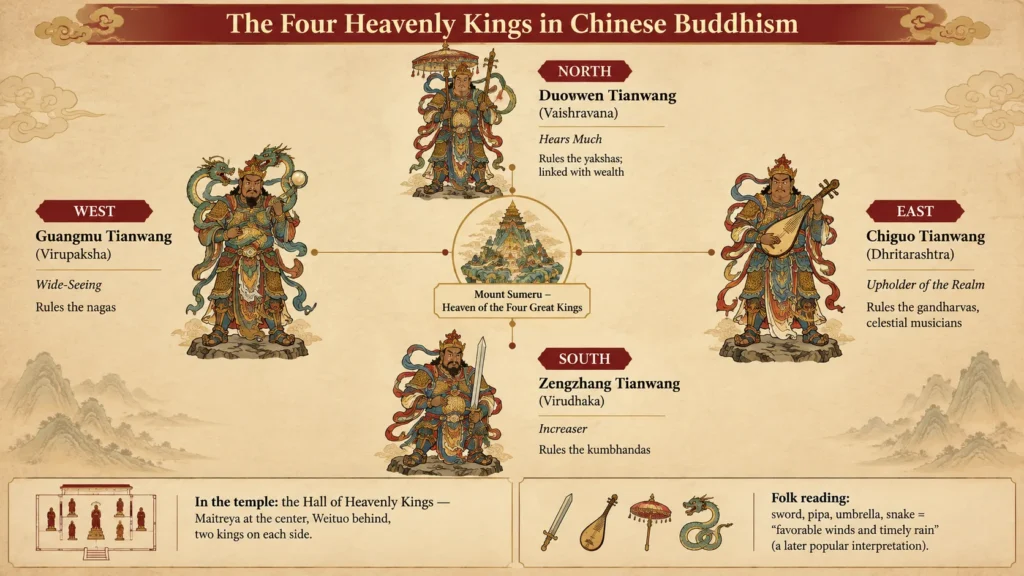
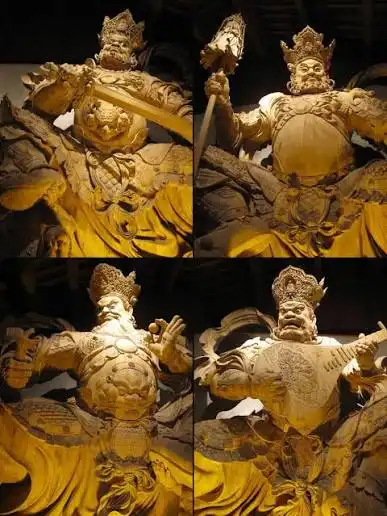
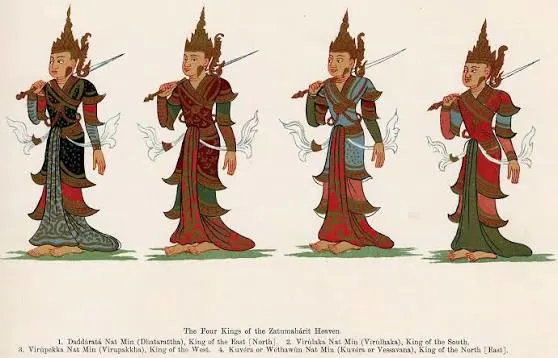
The Four Heavenly Kings (四大天王, Sì Dà Tiānwáng) are Buddhist guardian deities who protect the four directions of the world and the Buddhist teaching. In Chinese Buddhism they are Chíguó of the east, Zēngzhǎng of the south, Guǎngmù of the west, and Duōwén of the north: Chinese forms of the Indian lokapālas Dhṛtarāṣṭra, Virūḍhaka, Virūpākṣa, and Vaiśravaṇa. Most visitors meet them as four towering armored statues in the Hall of Heavenly Kings near a monastery’s entrance, holding a pipa, a sword, a snake or dragon, and an umbrella.
They are devas (天, tiān), heavenly beings who serve the Dharma. They are not buddhas or bodhisattvas, and their popular role as patrons of good weather owes much to Ming-period fiction and folk custom rather than to Buddhist scripture.
| Chinese name | Sanskrit name | Direction | Name meaning | Commands | Usual attribute in Chinese temples |
|---|---|---|---|---|---|
| Chíguó Tiānwáng (持国天王) | Dhṛtarāṣṭra | East | “Upholder of the Realm” | Gandharvas (乾闼婆), celestial musicians | Pipa (琵琶, lute) |
| Zēngzhǎng Tiānwáng (增长天王) | Virūḍhaka | South | “Increaser” or “He Who Causes Growth” | Kumbhāṇḍas (鸠槃荼) | Sword |
| Guǎngmù Tiānwáng (广目天王) | Virūpākṣa | West | “Broad-Eyed” or “Wide-Seeing” | Nāgas, translated in Chinese as long (龙) | Snake or dragon, sometimes with a pearl |
| Duōwén Tiānwáng (多闻天王) | Vaiśravaṇa | North | “Hears Much” or “Well-Learned” | Yakṣas (夜叉) | Umbrella (宝伞); in some images a pagoda |
Attributes and face colors are not fixed. They differ between Indian, Tibetan, Chinese, and Japanese art, and even between Chinese temples.
Who Are the Four Heavenly Kings?
In Sanskrit sources the four are called lokapālas, “protectors of the world.” Chinese texts often call them the World-Protecting Four Heavenly Kings (护世四天王, Hùshì Sì Tiānwáng). The word tiānwáng literally means “heavenly king,” and here tiān translates the Sanskrit deva, a god-like being who is still part of the cycle of rebirth.
Buddhist cosmology places them in the Heaven of the Four Great Kings (四天王天, Sì Tiānwáng Tiān; Sanskrit Cāturmahārājika), on the slopes of Mount Sumeru (须弥山, Xūmí Shān), the central mountain of the Buddhist world. This is the lowest of the six heavens of the desire realm. Each king guards one side of the mountain and commands a class of non-human beings.
Their main religious role is protective. They guard the Buddhist teaching, the monastic community, and practitioners who uphold the Dharma. In Chinese monastic liturgy they are also counted among the Twenty, or later Twenty-Four, Devas (二十诸天 / 二十四诸天), a group of Dharma protectors honored in ritual. That makes them important, but secondary: they serve the Buddha rather than standing at the center of devotion as Guanyin or Amitābha do.
The Four Kings, One by One
Chíguó Tiānwáng (持国天王), Guardian of the East
Chíguó’s Chinese name means “Upholder of the Realm,” a close rendering of Dhṛtarāṣṭra. He rules the gandharvas, the musicians of the heavens, which explains his usual attribute in China: a pipa held across the body. Later Chinese explanations sometimes add that he protects through harmony, “tuning” the world as a musician tunes strings.
Zēngzhǎng Tiānwáng (增长天王), Guardian of the South
Zēngzhǎng means “Increase” or “Growth,” following Virūḍhaka. He commands the kumbhāṇḍas, a class of grotesque spirits. In Chinese temples he usually grips a sword, the most obviously martial of the four attributes.
Guǎngmù Tiānwáng (广目天王), Guardian of the West
The Sanskrit name Virūpākṣa is usually explained as “of unusual eyes.” Chinese translators chose Guǎngmù, “Broad-Eyed” or “Wide-Seeing,” which suits a guardian who watches over the world. He rules the nāgas, serpent beings that Chinese translators rendered as long (龙), the same word used for the Chinese dragon. For that reason he often holds a snake or a small dragon, sometimes with a pearl.
Duōwén Tiānwáng (多闻天王), Guardian of the North
Duōwén means “Hears Much,” traditionally explained as a king who constantly hears the Dharma. He is Vaiśravaṇa, also known as Kubera, the only figure shared by the Hindu and Buddhist lists of directional guardians. He commands the yakṣas and is linked with wealth. Chinese temple statues usually give him an umbrella, while many other images show him holding a pagoda or stupa, and some include a mongoose or rat that spits jewels.
Of the four, Vaiśravaṇa is the one who developed a significant independent cult. The other three are rarely worshipped on their own.
Origins: From Indian Lokapālas to Chinese Guardians
Early Buddhist texts
The four kings appear in some of the earliest Buddhist literature. In the Pāli Āṭānāṭiya Sutta (Dīgha Nikāya 32), they visit the Buddha with a protective recitation meant to keep monks, nuns, and lay followers safe from hostile spirits. The same text assigns each king his direction and his retinue: gandharvas in the east, kumbhāṇḍas in the south, nāgas in the west, and yakṣas in the north.
Biographies of the Buddha also give them a role at key moments. In one well-known episode they offer the newly awakened Buddha four alms bowls, which merge into one.
The Golden Light Sutra and protection of the state
The four kings gained special prominence in East Asia through the Golden Light Sutra (金光明经, Jīnguāngmíng Jīng; Sanskrit Suvarṇaprabhāsa). Chapters devoted to them describe the kings pledging to protect anyone who teaches the sutra and to shield the ruler and people of a land where it is honored. Chinese translations by Dharmakṣema in the early fifth century and by Yijing in 703 made this idea widely available, and it fed a strand of “state-protecting” Buddhism across China, Korea, and Japan.
Vaiśravaṇa in Tang and Dunhuang art
By the Tang dynasty (618–907), Vaiśravaṇa had become an object of devotion in his own right, especially as a protector associated with the northwest frontier. A ninth-century painting from Dunhuang, now in the British Museum, shows him crossing water with an armed retinue, holding a halberd while a stupa floats nearby on a cloud. Later tradition also attached a legend to the esoteric master Amoghavajra (不空, Bùkōng, 705–774), crediting his rituals with summoning Vaiśravaṇa’s help against an attack on a frontier garrison. The story is better read as evidence of the cult’s popularity than as a record of a battle.
“Heavenly king” tomb guardians
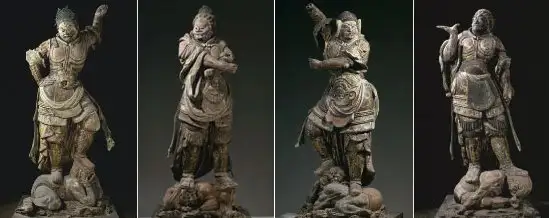
Tang tombs often included ceramic guardians of the so-called “heavenly king” type (天王俑, tiānwáng yǒng): armored warriors trampling a demon, sometimes with gilding and painted detail. These figures borrowed the visual language of the lokapālas, but most were not meant to depict one of the four specific kings. They show how thoroughly the armored guardian image had entered Chinese material culture by the eighth century.
For the wider story of how Indian Buddhist figures reshaped Chinese religious imagination, see Buddhist influence on Chinese mythology.
The Hall of Heavenly Kings (天王殿)
The place most people encounter the four kings today is the Hall of Heavenly Kings (天王殿, Tiānwáng Diàn). In a typical Chinese Buddhist monastery, it is the first major hall after the mountain gate (山门, shānmén), standing before the main Buddha hall.
The layout is consistent across many temples, though not universal:
- Center, facing the entrance: Maitreya (弥勒, Mílè), usually in the form of the cheerful, round-bellied monk Budai, often called the Laughing Buddha in English.
- Behind Maitreya, facing the main hall: Weituo (韦驮, Wéituó), an armored Dharma protector usually identified with Skanda.
- Along the side walls: the Four Heavenly Kings, two on each side, often several meters tall.
Lingyin Temple in Hangzhou is a well-known example: its Hall of Heavenly Kings places a Budai-style Maitreya at the center, the four kings along the sides, and a Weituo statue that the temple dates to the Southern Song dynasty at the back.
The arrangement carries a message. A visitor passes a smiling, welcoming figure and a ring of fierce protectors before reaching the Buddha. The kings’ frightening faces are not hostile to worshippers; they are aimed at the forces that would harm the teaching. A similar threshold logic appears in Chinese household religion with door gods and at building entrances with guardian lions, though those belong to different traditions.
Wind, Tuning, Rain and Order: The “Fēngtiáo Yǔshùn” Reading
Chinese visitors often explain the four attributes with a popular wordplay on the blessing 风调雨顺 (fēngtiáo yǔshùn), “favorable winds and timely rain,” a traditional wish for good harvests and national peace:
- Sword: its edge, fēng (锋), sounds like fēng (风), wind.
- Pipa: an instrument must be tuned, tiáo (调).
- Umbrella: keeps off yǔ (雨), rain.
- Snake or dragon: stands for shùn (顺), things going smoothly and in order.
This reading is a late popular interpretation, not a scriptural one. The attributes come from the kings’ older Indian roles: the pipa from the gandharva musicians, the serpent from the nāgas, and the umbrella or banner from royal and protective symbolism. The weather association was reinforced by Ming fiction, discussed below, and by temple culture in an agrarian society where rain mattered greatly.
The Heavenly Kings in Chinese Literature and Folk Religion
The Mo brothers of Investiture of the Gods
The Ming novel Investiture of the Gods (封神演义, Fēngshén Yǎnyì) gave the four kings an entirely new backstory. It turns them into four brothers of the Mo family (魔家四将), generals of the Shang dynasty who defend Jiameng Pass (佳梦关) with magical weapons: a sword, a jade pipa, an umbrella, and a marten-like creature (花狐貂). After their deaths, the novel’s final canonization in chapter 99 installs them as the Four Heavenly Kings, entrusted with favorable wind and rain.
These personal names, battles, and family ties do not appear in Buddhist scripture. The novel grafted Chinese narrative onto Buddhist guardians, and its version became influential in opera, folk retellings, and modern popular culture.
Journey to the West and the celestial court
In Journey to the West (西游记, Xīyóu Jì), the Four Heavenly Kings appear as guardians of the heavenly court and among the forces sent against Sun Wukong. There they serve within a bureaucratic heaven headed by the Jade Emperor, a setting that blends Buddhist, Daoist, and imperial imagery. That literary placement should not be read back into Buddhist doctrine, where the kings serve Śakra and, above all, the Buddha.
Li Jing, the Pagoda-Bearing Heavenly King
Vaiśravaṇa’s legacy also survives in a different figure: Li Jing (李靖), the Pagoda-Bearing Heavenly King (托塔李天王) and father of Nezha. Scholars generally trace Li Jing’s pagoda and his title of “heavenly king” to Vaiśravaṇa iconography, which was later fused with the name of a Tang general and with Chinese family drama. He is a separate literary and folk figure, not one of the four kings in temple halls.
Common Misconceptions
- “They are Daoist gods.” The Four Heavenly Kings are Buddhist protectors. They entered folk and Daoist-influenced settings largely through literature and popular religion, but their origin and primary role are Buddhist.
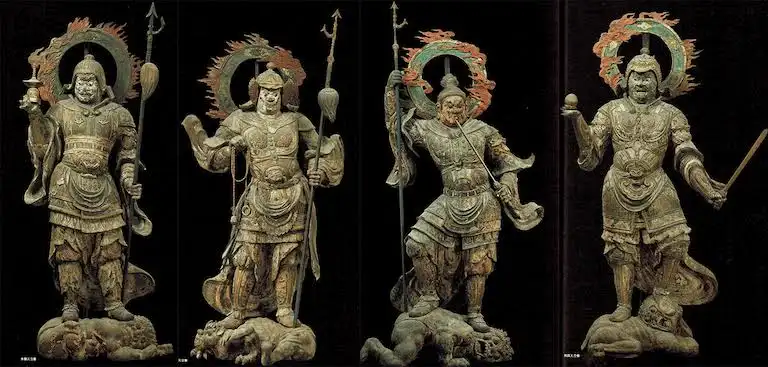
- “They are demons because they look fierce.” Their scowls and armor are protective. Many images show them standing on demons, not acting as them.
- “They are bodhisattvas.” They are devas, powerful heavenly beings within the cycle of rebirth, who serve as Dharma protectors.
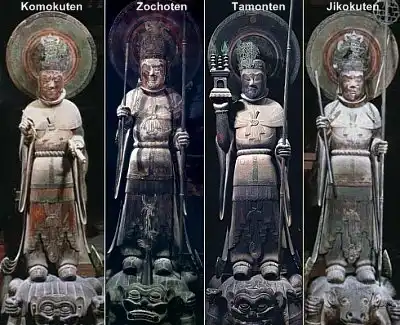
- “Chinese and Japanese versions are identical.” The Japanese Shitennō are the same Indian figures, but their attributes often differ. In Japan, Tamonten (Vaiśravaṇa) commonly holds a stupa and spear, and Kōmokuten (Virūpākṣa) often holds a brush and scroll rather than a snake.
- “Each king has one fixed color and object.” Color schemes and attributes vary by period, region, and workshop. The pipa, sword, snake, and umbrella set is a common Chinese temple convention, not a universal rule.
Related Figures and Further Reading on MythologyChinese
- Browse the Buddhist Deities directory for other bodhisattvas and protectors.
- Read about Guanyin, the bodhisattva of compassion, often enshrined in the same monasteries.
- See how Nezha and his father Li Jing connect to Vaiśravaṇa imagery.
- Explore how Buddhism changed Chinese mythology.
Frequently Asked Questions
What are the names of the Four Heavenly Kings in Chinese?
They are Chíguó Tiānwáng (持国天王) of the east, Zēngzhǎng Tiānwáng (增长天王) of the south, Guǎngmù Tiānwáng (广目天王) of the west, and Duōwén Tiānwáng (多闻天王) of the north. Together they are called 四大天王 (Sì Dà Tiānwáng).
Are the Four Heavenly Kings gods or bodhisattvas?
They are devas (heavenly beings) who act as Dharma protectors. In Buddhist terms they are not bodhisattvas or buddhas, and they remain within the cycle of rebirth, even though they are powerful and widely honored.
Why do they hold a pipa, sword, snake and umbrella?
The objects trace back to their older roles: the eastern king rules celestial musicians, the western king rules serpent-like nāgas, and the others carry martial or royal emblems. A popular Chinese interpretation links the four objects to the blessing 风调雨顺, “favorable winds and timely rain,” but this is a later folk reading.
Which of the Four Heavenly Kings is the most important?
No single ranking applies in every tradition. Historically, Duōwén (Vaiśravaṇa), guardian of the north, received the most independent worship and was linked with protection and wealth, especially from the Tang dynasty onward.
Are the Heavenly Kings in Journey to the West and Investiture of the Gods the same as the Buddhist ones?
They share the titles but not the full identity. Investiture of the Gods invents the Mo brothers as their human backstory, and Journey to the West places them in a celestial bureaucracy under the Jade Emperor. Neither version reflects Buddhist scripture.
Where can you see the Four Heavenly Kings in China?
Most Chinese Buddhist monasteries display them in the Hall of Heavenly Kings (天王殿), usually the first hall after the main gate. Lingyin Temple in Hangzhou is one well-known example.
References and Further Reading
- Encyclopaedia Britannica. “Lokapāla.” britannica.com
- Piyadassi Thera, trans. “Āṭānāṭiya Sutta: Discourse on Āṭānāṭiya” (Dīgha Nikāya 32). Access to Insight. accesstoinsight.org
- Peter Alan Roberts, trans. The Sūtra of the Sublime Golden Light (Toh 555, the version translated from Yijing’s Chinese text), chapters 11–12 on the Four Mahārājas. 84000: Translating the Words of the Buddha. 84000.co
- The British Museum. Painting of Vaiśravaṇa, Guardian of the North, Dunhuang, 9th century (1919,0101,0.45). britishmuseum.org
- Harvard Art Museums. Guardian warrior of the “Heavenly King” (Lokapala) type, Tang dynasty, 8th century. harvardartmuseums.org
- Lingyin Temple. “Temple Halls.” en.lingyinsi.org
- Buddhistdoor Global. “Protected on All Four Sides: The Propagation of Guardian King Iconography.” buddhistdoor.net