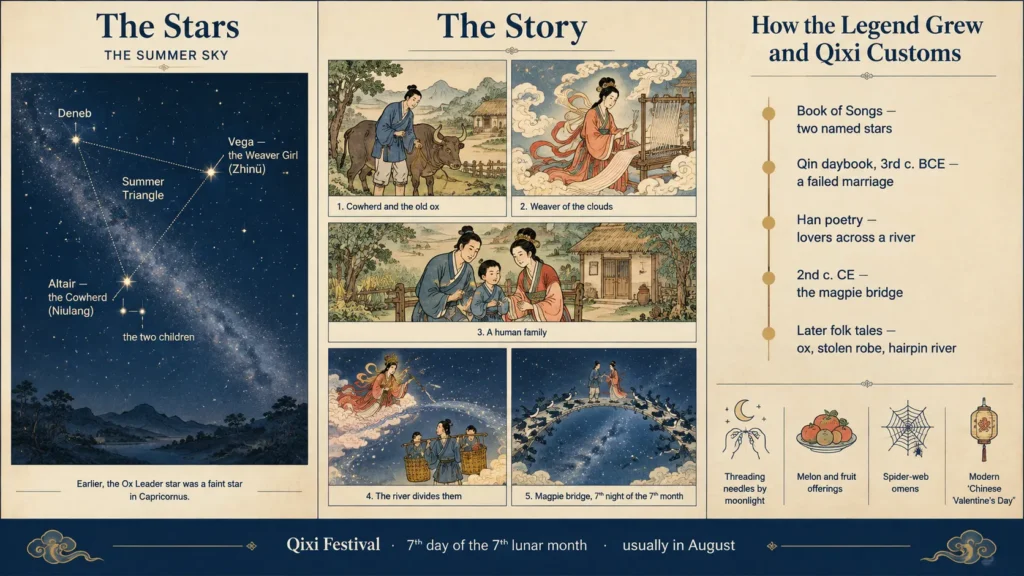
The Cowherd and the Weaver Girl (牛郎织女, Niúláng Zhīnǚ) is the Chinese legend of a cowherd and a celestial weaver who marry, are separated by Heaven, and are allowed to meet only once a year, on the seventh night of the seventh lunar month, when magpies form a bridge across the Milky Way. That night is Qixi (七夕, Qīxī), the Double Seventh Festival.
The legend began in the sky. The Weaver Girl is the star Vega, and the Cowherd is now identified with Altair, on the far side of the “Heavenly River.” The romance most readers know today took shape slowly, over roughly two thousand years of poetry, anecdote, and oral storytelling. Qixi itself was for centuries a women’s festival for “begging for skill” before it became widely marketed as Chinese Valentine’s Day.
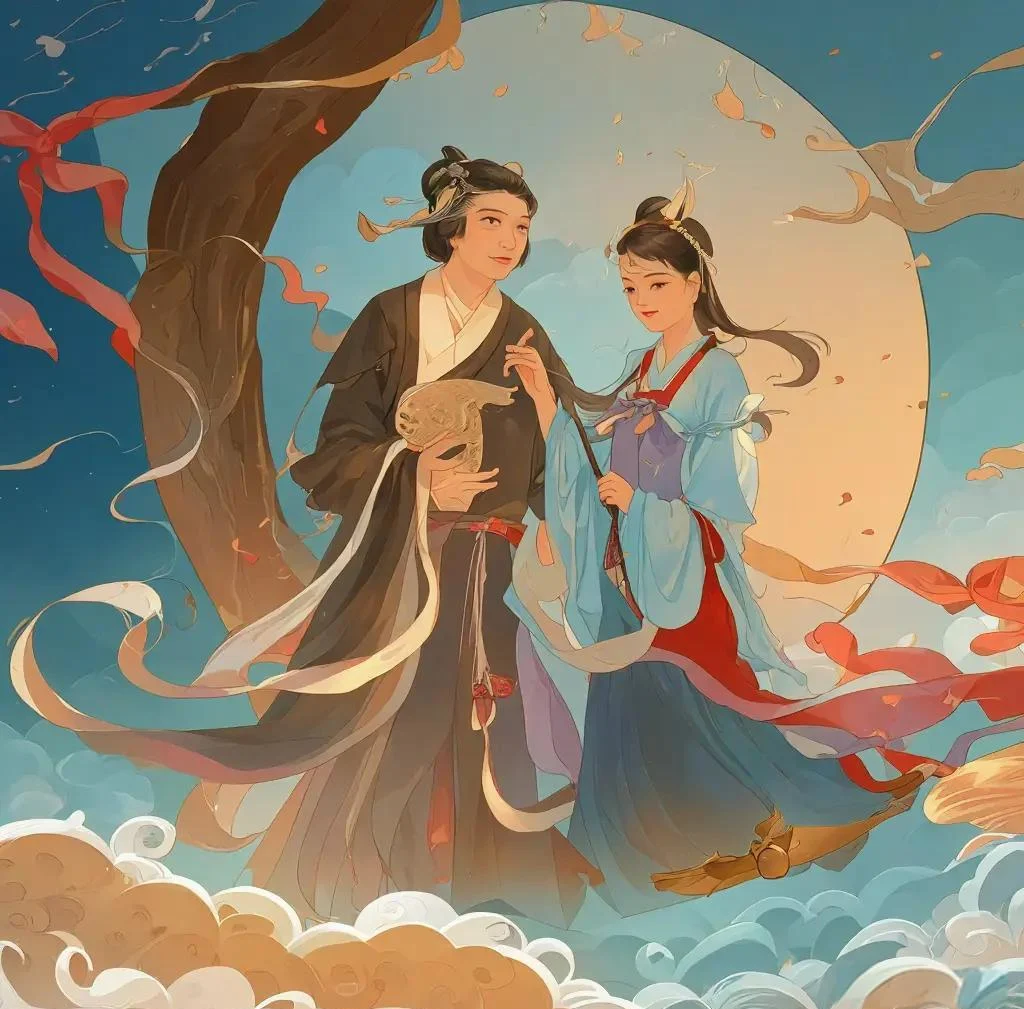
Quick answer: In the best-known version, Niulang, a poor cowherd, marries Zhinü, a weaver from Heaven. After her heavenly family takes her back, the Queen Mother draws a river across the sky to keep them apart. Moved by their devotion, magpies form a bridge once a year so the couple can meet on Qixi, the seventh day of the seventh lunar month.
| Feature | Details |
|---|---|
| Chinese name | 牛郎织女 (Niúláng Zhīnǚ); the stars were earlier called 牵牛 (Qiānniú, “Ox Leader”) and 织女 (Zhīnǚ, “Weaving Woman”) |
| Main characters | Niulang the cowherd, Zhinü the weaver, a wise old ox, the couple’s two children, a heavenly ruler or the Queen Mother |
| Stars | Zhinü = Vega (in Lyra); Niulang = Altair (in Aquila); the river = the Milky Way |
| Festival | Qixi, also called the Qiqiao Festival (乞巧节, “begging for skill”) |
| Date | 7th day of the 7th month in the Chinese lunar calendar, usually August in the Gregorian calendar |
| Classification | Star lore that developed into a folk legend; counted among China’s “Four Great Folktales” |
The Cowherd and the Weaver Girl Story
The version below is the one most often told in modern China, in picture books, school readers, and television adaptations. It is a late folk version, not the oldest form of the story, and details change from region to region.
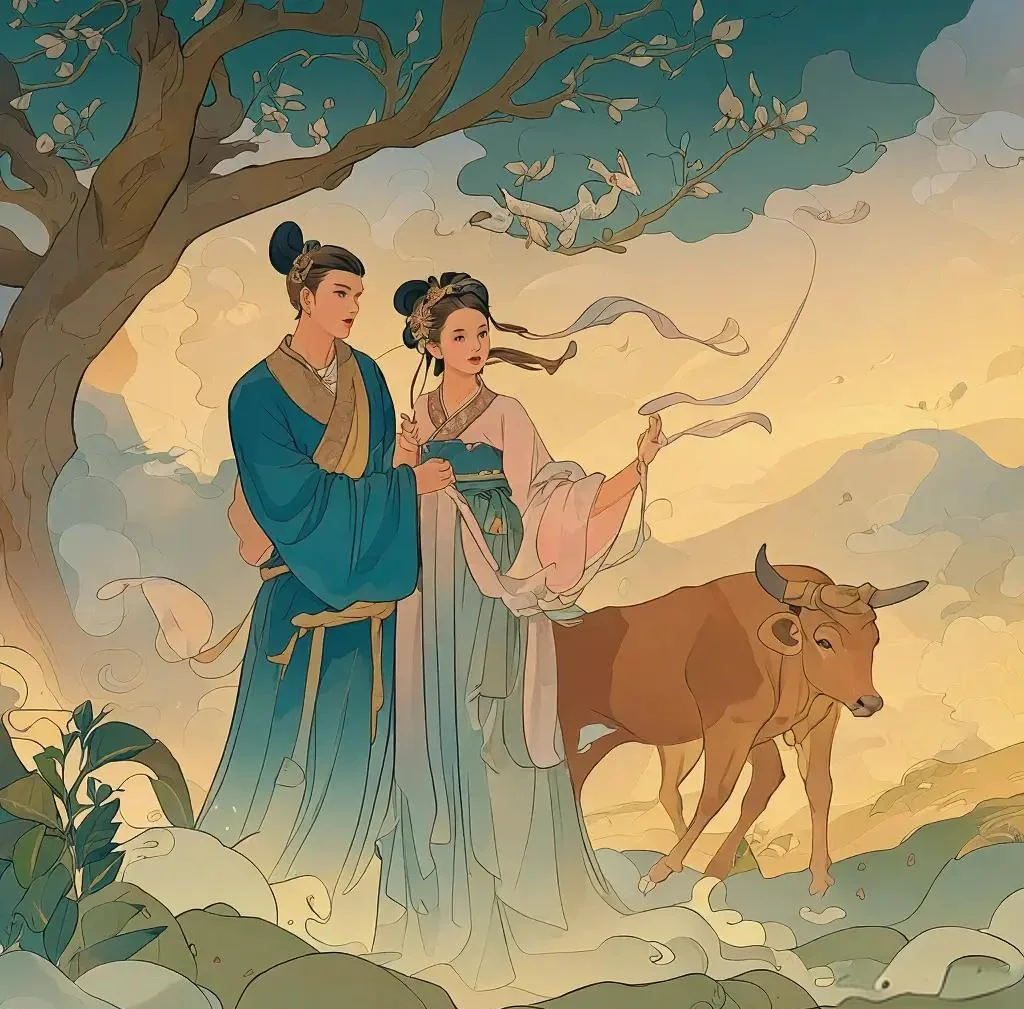
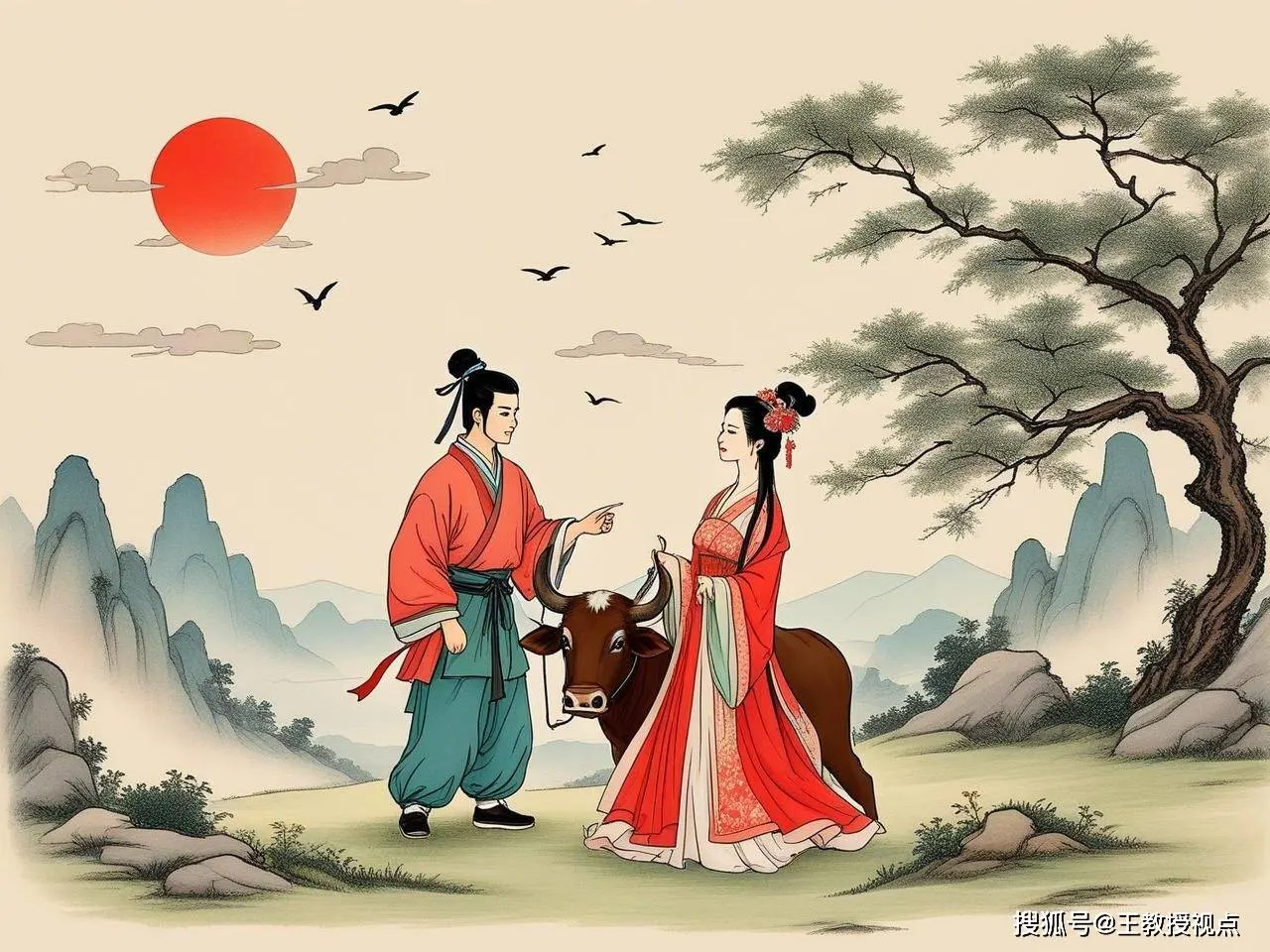
- The cowherd and the ox. Niulang is an orphan who lives with his older brother and a harsh sister-in-law. When the household is divided, he receives almost nothing except an old ox. The ox turns out to be able to speak, and in many tellings it was once a star or celestial being sent down to earth.
- The weaver from Heaven. Zhinü weaves the clouds and the colored light of the sky. She and other heavenly maidens come down to bathe in a lake. Following the ox’s advice, Niulang takes her robe, so she cannot fly home. In gentler retellings, she chooses to stay because she has fallen in love with him.
- A human life. The couple marry. He farms and she weaves, and they have a son and a daughter.
- Heaven intervenes. Her absence is discovered. In many modern versions the Queen Mother of Heaven, Wangmu Niangniang, comes to take her back; other versions give that role to the Jade Emperor or simply to the Heavenly Emperor.
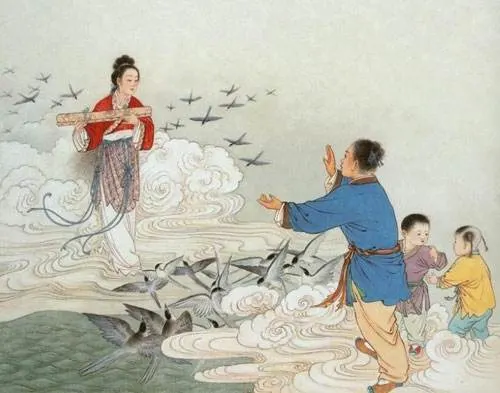
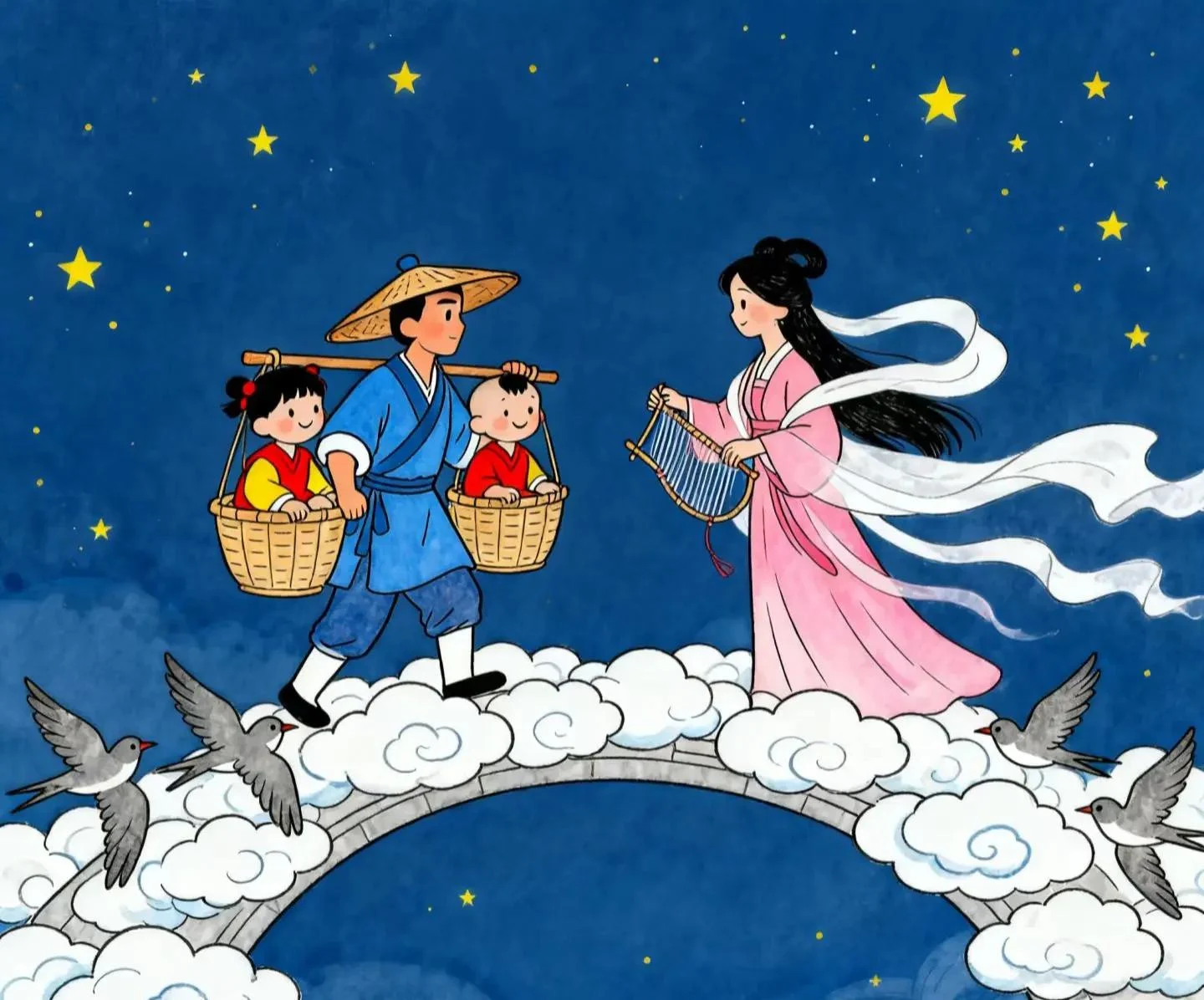
- The chase across the sky. Before dying, the old ox tells Niulang to keep its hide. Wearing it, he flies after his wife, carrying the two children in baskets hung from a shoulder pole.
- The river. Just as he is about to reach her, the Queen Mother draws a line across the sky with her hairpin. It becomes a wide, rushing river of stars, the Milky Way, and the family cannot cross.
- The magpie bridge. Their grief moves the magpies (or Heaven relents). Once a year, on the seventh night of the seventh month, flocks of magpies fly up and link their bodies into a bridge, the queqiao (鹊桥, quèqiáo), so the couple can meet.
Folk storytellers add small explanations to the ending. Rain on Qixi is said to be the lovers’ tears. Magpies look ruffled in late summer because their heads were trampled by the reunited couple. In northern China, people say that if you sit quietly under a grape trellis on Qixi night, you may overhear the couple talking.
Main Characters
| Character | Role in the story | Notes on versions |
|---|---|---|
| Niulang 牛郎 (the Cowherd) | A poor, hardworking young man who marries the weaver | Usually a mortal in modern folk versions; in early literary versions he is himself a celestial figure living west of the river |
| Zhinü 织女 (the Weaver Girl) | A heavenly weaver of clouds and brocade | Called the daughter or granddaughter of the Heavenly Emperor in early texts; often the granddaughter of the Jade Emperor and Queen Mother in modern ones |
| The old ox | Helper and advisor who makes the marriage possible | A later folk addition; its hide lets Niulang reach Heaven |
| The Queen Mother (Wangmu Niangniang 王母娘娘) | Separates the couple by creating the Milky Way | A popular later form of the ancient goddess Xiwangmu, the Queen Mother of the West |
| The Heavenly Emperor / Jade Emperor | Head of the heavenly household and the authority behind the separation | Early sources speak of Tiandi 天帝; later popular versions often name the Jade Emperor |
| The magpies | Form the bridge for the annual reunion | Attested from the Eastern Han onward; the magpie was already a bird of good news in Chinese culture |
From Star Names to Love Story: How the Legend Developed
The story did not appear fully formed. Its pieces can be traced through a series of texts, each adding something new.
Stars in the Book of Songs
The earliest mention is in the Book of Songs (诗经, Shījīng), in the poem “Da Dong” (大东) among the Minor Odes. The poet complains about a sky full of useless names: the Weaving Woman star moves across the sky all day yet never completes a pattern, and the Ox Leader star shines brightly yet pulls no cart. Here the two are simply stars with work-related names. There is no couple and no romance.
A failed marriage in a Qin divination manual
The first clear hint of a marriage comes from bamboo slips excavated in 1975 at Shuihudi in Yunmeng, Hubei, buried in the Qin period. A “daybook” (日书, rìshū) for choosing lucky days warns that a certain day is bad for taking a wife, because on that day the Ox Leader married the Weaving Woman and the marriage did not last. By the late third century BCE, then, the two stars already had a known marriage story, and it was an unhappy one.
Separated lovers in Han poetry
One of the Nineteen Old Poems (古诗十九首), anonymous verses of the Eastern Han dynasty, turns the stars into grieving lovers. The Weaver works her loom but cannot finish her cloth, weeping as she gazes across a narrow, clear river at someone she cannot speak to. This poem set the emotional tone that later Qixi literature would keep.
The magpie bridge
The bridge of magpies is credited to Ying Shao’s Fengsu tongyi (风俗通义), a late second-century work on customs. The relevant line survives only as a quotation in later Tang compilations: on Qixi the Weaver must cross the river, and magpies are made to serve as her bridge. From this point the annual crossing becomes part of the story.
The Heavenly Emperor’s punishment
A fuller plot appears in the Xiaoshuo (小说) of Yin Yun (殷芸), compiled under the Liang dynasty in the sixth century. East of the Heavenly River lives the Weaver, child of the Heavenly Emperor, who weaves cloud brocade without rest. Pitying her loneliness, the Emperor lets her marry the Ox Leader west of the river. After the wedding she stops weaving. Angered, he orders her back east and allows the couple to meet once a year.
This older version differs from the modern one in important ways. Both partners are celestial. The marriage is arranged by Heaven, not won by a stolen robe. And the cause of the separation is neglected work, not a forbidden match between a goddess and a mortal.
Swan maidens, Dong Yong, and the folk version
Several other story traditions fed into the modern plot. Gan Bao’s fourth-century Soushen ji (搜神记) includes a tale of bird-women in feather robes, one of whom is trapped on earth when a man hides her robe; scholars of Chinese folktales note its overlap with the Cowherd story. The same collection tells of the filial son Dong Yong (董永), who is helped by a weaver from Heaven sent to repay his debts. Over the centuries, the robe-stealing episode, the mortal hero, the helpful ox, and the Queen Mother’s hairpin were woven together into the story told today. In the twentieth century, folklorists grouped it with the legends of Meng Jiangnü, the White Snake, and the Butterfly Lovers as China’s “Four Great Folktales.”
| Period | Source | What it adds |
|---|---|---|
| Early 1st millennium BCE | Book of Songs, “Da Dong” | Weaving Woman and Ox Leader as named stars |
| Late 3rd century BCE | Shuihudi Qin daybook | A marriage between the two stars that fails |
| Eastern Han (25–220 CE) | Nineteen Old Poems | Lovers longing across a river |
| Late 2nd century CE | Ying Shao, Fengsu tongyi (quoted later) | Magpies form a bridge on Qixi |
| 6th century CE | Yin Yun, Xiaoshuo | Arranged marriage, neglect of weaving, yearly meeting |
| Late imperial and modern | Oral tradition, opera, prints | Mortal cowherd, stolen robe, talking ox, hairpin river, two children |
The Stars Behind the Legend
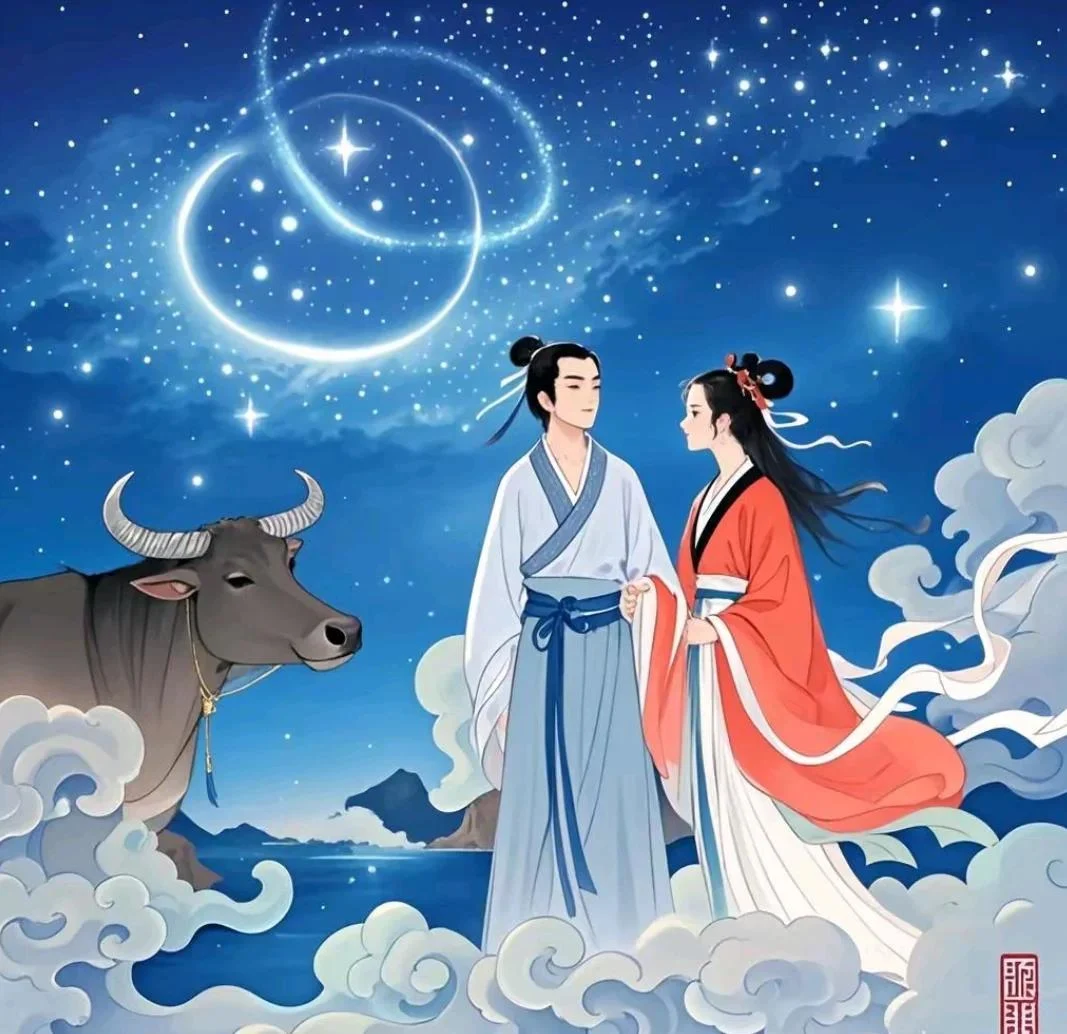
On a clear August evening in the Northern Hemisphere, Vega and Altair stand high in the sky on opposite sides of the Milky Way. Vega, the brightest star of the Chinese Zhinü asterism, sits on the west bank. Altair, the brightest star of the asterism Hegu (河鼓, “River Drum”), sits on the east. Together with Deneb they form the bright pattern Western stargazers call the Summer Triangle.
The Cowherd’s star has moved over time. The original Ox Leader (Qianniu) was a faint star in the Niu lunar mansion, in today’s Capricornus. Popular tradition later shifted the Cowherd to brilliant Altair, a far better visual match for Vega. The two fainter stars on either side of Altair are often described as the children he carries on his shoulder pole.
The legend still shapes how China names things in space. In 2018 China launched a relay satellite named Queqiao, “Magpie Bridge,” to link the Chang’e-4 lander on the far side of the Moon with Earth. The moon goddess Chang’e and the Cowherd legend meet, quite literally, in orbit.
What Is the Qixi Festival?
Qixi falls on the seventh day of the seventh lunar month, usually in August. Its names reflect its history: Qixi (“Seventh Night”), Qiqiao Jie (乞巧节, “Festival of Begging for Skill”), and in some regions the Girls’ Festival. In Cantonese-speaking areas it is also known as the birthday of the Seventh Sister (七姐诞).
For most of its history, Qixi centered on the Weaver Girl as a patron of women’s handiwork rather than on romance. The Xijing zaji (西京杂记), a collection of anecdotes about the Western Han court compiled several centuries later, describes palace women threading seven-eyed needles on the seventh of the seventh month. By the sixth century, Zong Lin’s Jingchu suishi ji (荆楚岁时记), a calendar of customs in the middle Yangtze region, calls the night the meeting of the Cowherd and Weaver and describes women threading needles and setting out melons and fruit in the courtyard to beg for skill.
Traditional Qixi customs
- Threading needles by moonlight. Women and girls raced to thread needles with several eyes. Success was a sign the Weaver Girl had granted them skill.
- Spider omens. According to the Jingchu suishi ji, a small spider spinning a web over the melon offerings was taken as a favorable sign. In later periods, some women kept a spider in a box overnight and judged their luck by the web it spun.
- Floating needles. In Ming and Qing north China, girls set a bowl of water in the sun and floated a needle on its surface, reading the shape of the needle’s shadow as a sign of cleverness or clumsiness.
- Offerings to the Weaver Girl. Households set tables with fruit, flowers, cosmetics, and needlework. In Guangdong, groups of young women prepared elaborate displays for the “Seven Sisters.”
- Sunning books and clothes. Midsummer was a time to air books and garments. A famous anecdote in the fifth-century Shishuo xinyu describes a scholar lying in the sun on the seventh day of the seventh month and explaining that he was “airing the books” inside his belly.
- Star worship for scholars. In some regions, students honored Kuixing (魁星), a star deity of examination success closely associated with Wenchang Wang, on Qixi.
Regional traditions
Qixi has strong local forms. In Tainan, Taiwan, the day is linked to the Qiniangma (七娘妈), seven goddesses who protect children. In the local version of the legend, the Weaver Girl’s six sisters cared for her children after she was taken back to Heaven. Families mark a child’s sixteenth year on Qixi with a coming-of-age ceremony, zuo shiliusui (做十六岁), thanking these goddesses for watching over the child.
The legend and festival also traveled abroad. Japan’s Tanabata, Korea’s Chilseok, and Vietnam’s Thất Tịch all derive from the Chinese Double Seventh, each with its own customs, such as Japan’s wish-strips hung on bamboo.
Love and the “Chinese Valentine’s Day” label
Romance was never absent from Qixi. Poets wrote about the lovers for centuries, and Qin Guan’s Song-dynasty lyric to the tune “Immortals at the Magpie Bridge” (鹊桥仙) ends with the idea that a love meant to last does not need to be together every morning and evening. Still, the label “Chinese Valentine’s Day” is modern. Since the late twentieth century, gift-giving, dinners, and marketing campaigns have pushed the romantic side to the front, while the older skill-seeking customs have faded in many cities. In 2006 Qixi was included in the first batch of China’s national list of intangible cultural heritage, which has encouraged renewed interest in its traditional practices.
Couples who visit temples on Qixi often pray to Yue Lao, the matchmaking god of the red thread, though he belongs to a separate tradition from the Cowherd and Weaver Girl.
What the Legend Means
Readers have taken several lessons from the story, and they depend partly on which version is told.
- Work and household order. A cowherd and a weaver represent the two halves of the traditional farm household, men in the fields and women at the loom (男耕女织). The early versions are almost a warning: when the Weaver stopped working, Heaven’s order broke down.
- Faithful love under separation. The later versions celebrate constancy. The lovers cannot change Heaven’s ruling, but they never stop waiting for each other. This made the story a favorite subject for poems about absent spouses, soldiers, and travelers.
- Heaven versus ordinary people. In the folk version, a poor farmer marries a goddess and builds a happy family until a powerful authority tears it apart. Many listeners sympathize with the couple against the heavenly court.
Modern readers also question parts of the story, especially the robe-stealing episode, which traps the Weaver on earth without her consent. Some recent retellings change the scene so she stays by choice. These debates show that the legend is still alive and still being reshaped.
Common Misunderstandings
- “The modern story is ancient.” The stars are ancient, and the separated-lovers theme dates back to the Han dynasty. The talking ox, stolen robe, and hairpin river are much later folk developments.
- “The Queen Mother is always the villain.” Early versions blame the Heavenly Emperor, and the reason is neglected duty. The Queen Mother’s role grew in later popular retellings.
- “The Weaver Girl is the Seventh Fairy.” The Seventh Fairy (七仙女) who marries Dong Yong in the opera A Match Made in Heaven (天仙配) belongs to a related but separate story. The two are often blended in popular media.
- “Qixi has always been a lovers’ day.” For most of its history Qixi was mainly a women’s festival of craft, prayer, and divination.
- “Altair has always been the Cowherd.” The original Ox Leader was a fainter star in Capricornus.
Related Legends and Figures
The Cowherd and the Weaver Girl sits within a wider web of Chinese stories about love, Heaven, and the night sky. The story of Chang’e and the Moon plays a similar role for the Mid-Autumn Festival. The Legend of the White Snake is another of the Four Great Folktales about a love between a human and a supernatural being. For more myths and folk narratives, browse the Legends & Stories collection.
Frequently Asked Questions
What is the Cowherd and the Weaver Girl story about?
It tells of Niulang, a cowherd, and Zhinü, a weaver from Heaven, who marry and have children before Heaven separates them with the Milky Way. They are allowed to meet once a year on the seventh night of the seventh lunar month, crossing a bridge formed by magpies.
Is the Cowherd and Weaver Girl a true story?
No. It is a legend that grew out of names given to two stars, Vega and Altair. Over many centuries, poets and storytellers turned those star names into a love story with human characters, a talking ox, and a magpie bridge.
Who separated the Cowherd and the Weaver Girl?
It depends on the version. Early texts say the Heavenly Emperor separated them after the Weaver neglected her weaving. Most modern folk versions say the Queen Mother of Heaven drew the Milky Way with her hairpin, sometimes acting with the Jade Emperor.
Why do magpies form the bridge?
The magpie bridge appears in a line attributed to the late-second-century writer Ying Shao. Magpies were already associated with joy and good news in Chinese culture, and their gathering became the image of the yearly reunion.
When is the Qixi Festival?
Qixi falls on the seventh day of the seventh month of the Chinese lunar calendar, so its Gregorian date changes each year. It usually lands in August; in 2027 it falls on August 8.
Is Qixi the same as Japan’s Tanabata?
Tanabata comes from the Chinese Qixi and uses the same characters, 七夕, but it developed its own customs in Japan. Many Japanese celebrations now follow the Gregorian date of July 7, while others keep a date closer to the lunar calendar.
References and Further Reading
- Ellen Johnston Laing, “The Meeting of the Herd Boy and the Weaving Maid in Chinese Popular Prints,” Orientations.
- China Intangible Cultural Heritage Network, “Qixi Festival (七夕节), National Intangible Cultural Heritage Item X-4.”
- Mao Zengwen, “古卷诗词中的七夕 (Qixi in Classical Poetry and Texts),” Chinese Social Sciences Net, August 19, 2026.
- British Library, Asian and African Studies Blog, “‘Tanabata (七夕) Star Festival’: Is It 7 July or 2 August 2014? (2).”
- Larry Lebofsky, “What Do the Summer Sky, a Japanese Festival, and a Chinese Lunar Mission Have in Common?,” Vatican Observatory, 2019.
- Xiuyan Fu, “The Charm of Intertextuality: A New Insight into Four Folktales,” in Chinese Narratologies, Springer, 2021.
- Xi’an Jiaotong-Liverpool University, “From Stars to Roses: The Forgotten Origins of Chinese Valentine’s Day,” 2024.
- “Tainan to Host Chihsi Arts Festival,” Taipei Times, August 3, 2007.