Chinese Dragon Meaning and Symbolism
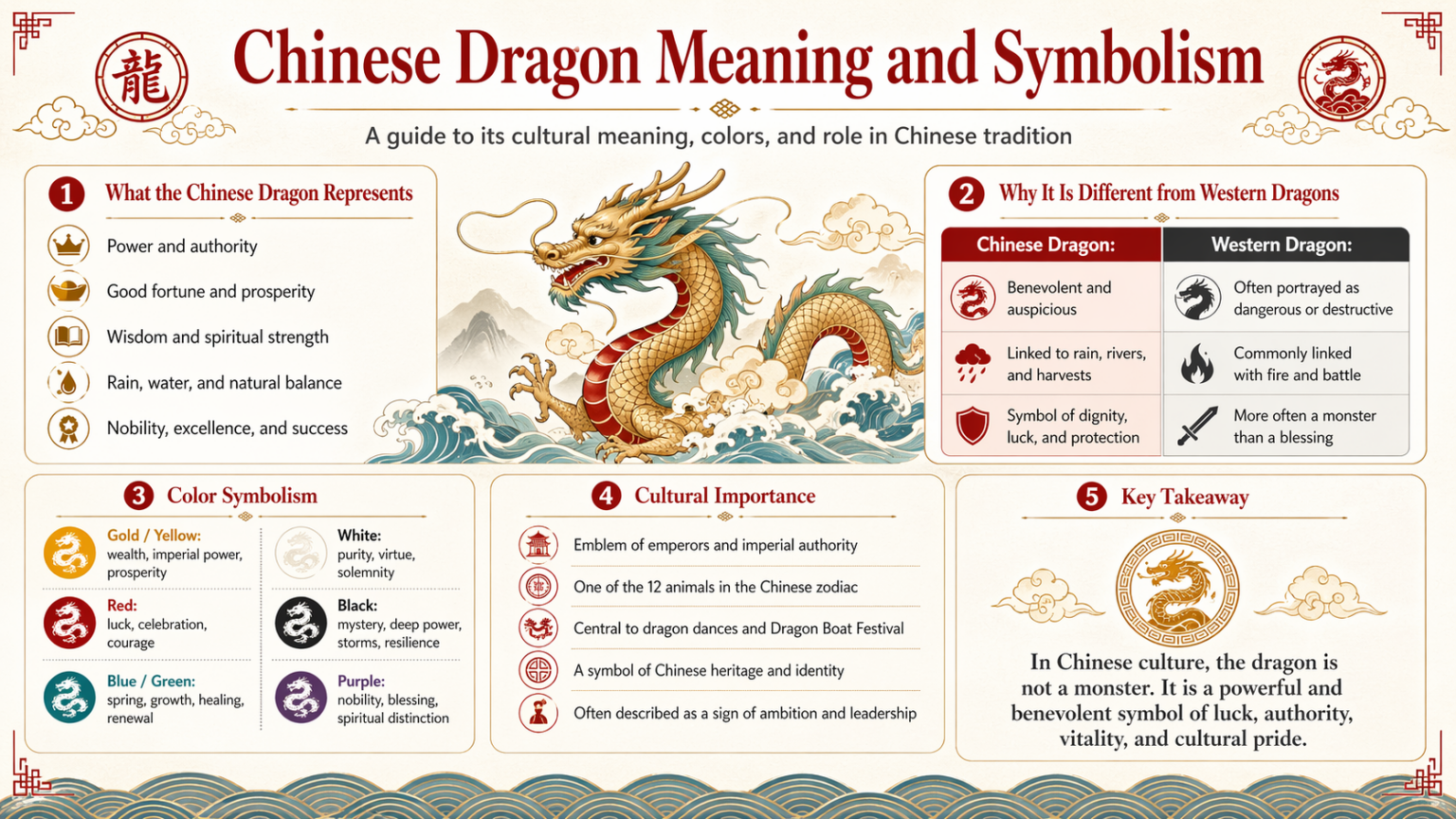
The Chinese dragon, or long 龍/龙, commonly symbolizes power, vitality, rain, water, good fortune, imperial authority and cultural identity. Its meaning depends on context: a dragon in an ancient ritual object, an imperial robe, a rainmaking tradition, a zodiac chart and a modern festival does not necessarily carry exactly the same symbolism.
Chinese dragon meaning and symbolism is best understood as a family of related ideas rather than one fixed definition. Across periods, the dragon could represent life-giving water, legitimate rule, cosmic energy, an auspicious wish, a local deity or cultural belonging.
| Symbolic meaning | Historical or cultural context | Typical visual setting | Important qualification |
|---|---|---|---|
| Power and authority | Court culture, especially in later imperial China | Robes, thrones, palace stairs and imperial ceramics | Rules varied by dynasty, rank, object and occasion. |
| Rain, water and fertility | Agrarian religion, rainmaking and water cults | Clouds, waves, rivers, wells and temples | Dragons could bring rain but could also represent floods and dangerous waters. |
| Vitality and transformation | Cosmology, Daoist art and literary metaphor | Coiling bodies, mist, ascent and changing forms | “Cosmic energy” is contextual, not the meaning of every dragon image. |
| Good fortune and protection | Festivals and auspicious decorative arts | Dragon dances, textiles and architecture | Auspiciousness depends on the object, audience and ritual setting. |
| Imperial identity | Yuan, Ming and Qing court systems, with earlier precedents | Five-clawed dragons and privileged court colors | Five claws were not a timeless rule for all Chinese history. |
| Cultural identity | Modern national and diasporic discourse | Public celebrations, music and media | “Descendants of the Dragon” has a complex modern history. |
What Is a Chinese Dragon?
A Chinese dragon is a legendary, composite creature known in Mandarin as lóng. “Loong” is also used by some English speakers who want to preserve the Chinese sound and distinguish the figure from European dragon traditions. It remains an optional modern spelling; “Chinese dragon” is still the most widely understood English term.
Dragon-like images in China are extremely old. Neolithic jade carvings associated with the Hongshan culture include coiled creatures now called “pig-dragons.” Later bronzes, tomb art, paintings, ceramics and textiles display many other forms. These archaeological objects show that dragon imagery developed over a long period, but they do not prove that one unchanged national symbol existed from the Neolithic era to the present.
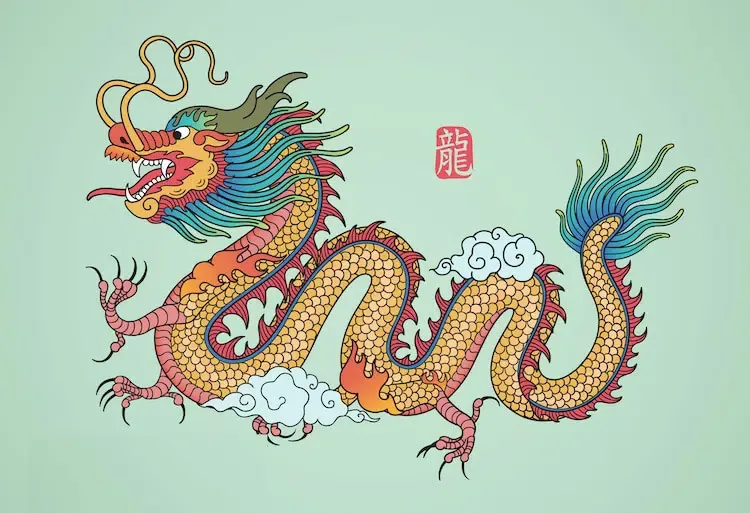
The familiar later dragon usually has a long body, scales, claws, horns, whiskers and an expressive head, often among clouds, waves or mist. Claims that every Chinese dragon combines exactly nine animals reflect later descriptive traditions, not a universal rule.
Chinese Dragon Meaning in Simple Terms
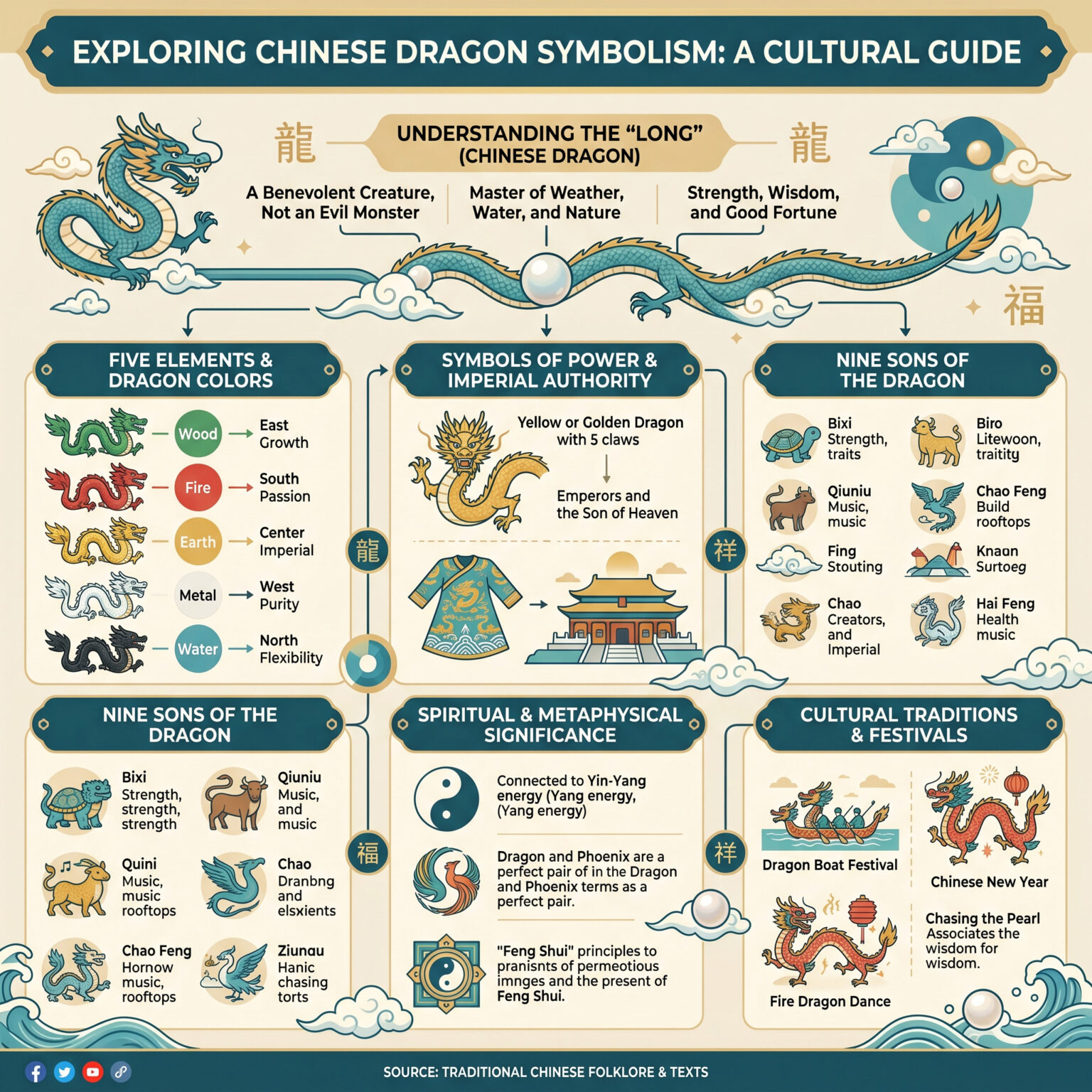
In simple terms, the Chinese dragon represents powerful life in motion. It can connect heaven with earth, clouds with rain, rivers with fields and political authority with cosmic order. Because water could sustain crops or destroy settlements, dragon power was not merely pleasant or harmless. It was respected as beneficial when properly ordered and dangerous when uncontrolled.
Power, Authority and Imperial Rule
The dragon became one of the most important images of rulership in imperial China. Emperors were compared with dragons, and dragon motifs appeared on ceremonial garments, throne rooms, architectural carvings and court objects. By linking the ruler with a creature associated with clouds, rain and heaven, court imagery presented political authority as part of a larger cosmic order.
The association was not identical in every dynasty. Museum collections show court robes in several colors and arrangements. In the Qing dynasty, bright yellow and specific emblems could be restricted to the emperor, while other imperial garments varied by rank and occasion.
Rain, Water and Agricultural Fertility
The dragon’s relationship with water is one of the most persistent themes in Chinese religion and art. Dragons appear in seas, rivers, lakes, wells, clouds and underwater palaces. Rainmaking rituals could call upon dragon powers during drought, while local communities worshipped water deities for reliable rainfall, safe navigation or protection from flooding.
Timely rain supported crops; too little brought famine, and too much could destroy fields and homes. The dragon therefore symbolized environmental forces that communities depended upon but could not fully control.
For a focused account of named water gods and the rulers of the Four Seas, see the Dragon King guide.
Vitality, Transformation and Cosmic Energy
The Chinese dragon’s twisting body and ability to move through water, clouds and sky made it a compelling image of transformation. In Daoist art, dragons could embody qi, the active energy through which the world changes. The Metropolitan Museum’s discussion of the painting Beneficent Rain describes dragons as embodiments of cosmic energy capable of producing clouds and rain.
This symbolism is visible in the dragon’s posture. It rarely appears stiff. It coils, ascends, turns and disappears into mist, suggesting change, seasonal movement and forces that cannot be contained by a rigid form. Literary images such as the carp passing the Dragon Gate also use transformation into a dragon as a metaphor for achievement and dramatic change in status.
Good Fortune, Protection and Success
Dragons frequently appear within the broad vocabulary of auspicious Chinese art. On textiles, ceramics, festival decorations and public architecture, they may express wishes for prosperity, favorable conditions, protection, longevity or success. Their exact meaning often comes from nearby motifs: bats may evoke blessings, waves emphasize water, the character shou signals longevity, and court emblems indicate rank.
Modern red or gold festival dragons are commonly read as celebratory and fortunate. That interpretation is reasonable in a New Year parade or commercial opening, but it should not be projected automatically onto every ancient object of the same color.
Wisdom, Nobility and Cultural Identity
The dragon can suggest exceptional ability, dignity and unrealized potential. Zhuge Liang’s traditional epithet “Crouching Dragon” evokes concealed talent. The carp that becomes a dragon after crossing the Dragon Gate represents advancement through effort, examination success and social transformation.
As a cultural emblem, the dragon appears in modern art, tourism, media and diaspora celebrations. It can express pride and continuity, but no single creature represents every Chinese community in exactly the same way. Readers can compare the dragon with the auspicious qilin and the wider directory of Chinese mythical creatures .
Chinese Dragon Appearance and Attributes
The best-known Chinese dragon is elongated and usually wingless, although it can fly. Common attributes include horns, a mane or whiskers, scales, four legs, sharp claws and large eyes. It may hold or pursue a pearl, emerge from waves, coil through clouds or face another dragon.
These features became increasingly standardized in later painting, court textiles and decorative art, but earlier objects can look very different. A Neolithic coiled jade, a Han tomb creature, a Tang dragon, a Yuan ceramic dragon and a Qing robe dragon should not be treated as interchangeable illustrations of one fixed anatomy.
Chinese Dragon vs Western Dragon
Chinese and Western dragon traditions developed through different languages, religions, genres and artistic histories. The following comparison describes broad tendencies rather than universal rules.
Common Chinese patterns
- Long, flexible and often wingless
- Closely associated with rain and water
- Frequently auspicious or authoritative
- Appears in ritual, court and festival art
Common European patterns
- Often winged and fire-breathing
- May guard treasure or threaten a community
- Frequently opposed by saints or heroes
- Also appears in heraldic and protective roles
European traditions include protective, heraldic and morally ambiguous dragons, while Chinese stories include violent, unruly or defeated dragons. The clearest comparison is not “good East versus evil West,” but different clusters of imagery and narrative roles.
Chinese Dragon Colors and Their Contexts
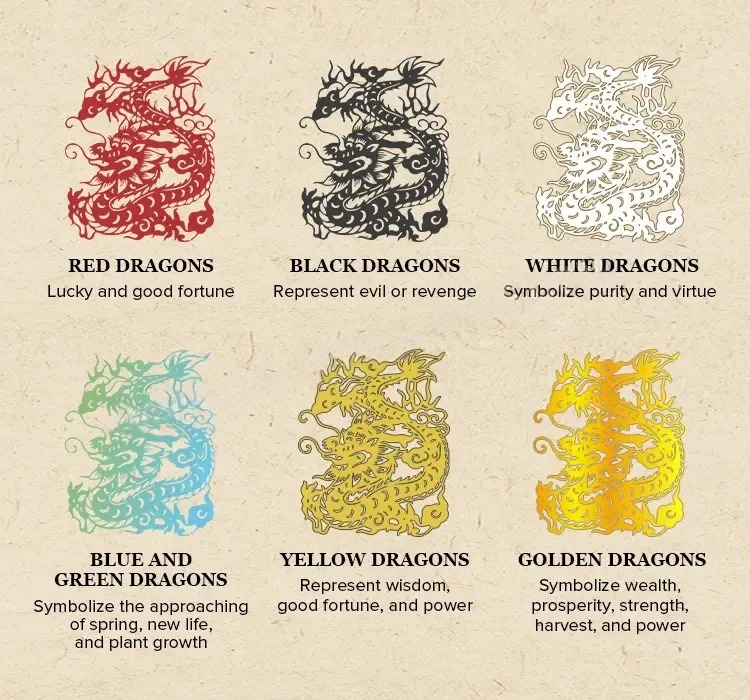
There is no reliable universal chart in which every dragon color always has one meaning. Color must be read through the work’s date, material, religious system, rank rules and modern use.
Dragon Claws and Imperial Rank
The popular rule “five claws for the emperor, four for nobles and three for commoners” compresses a complicated history into a slogan. Claw number became an important sign of rank in particular Yuan, Ming and Qing court systems, but regulations changed, exceptions existed, gifts could confer privileges, and surviving objects do not always match simplified charts.
For Qing dress, five-clawed dragons are strongly associated with the emperor and high imperial ranks, while four-clawed mang motifs appeared on other ranked garments. Yet background color, dragon orientation, the Twelve Symbols, robe construction and occasion also mattered. Claws alone cannot securely identify every owner or date.
The Dragon and the Flaming Pearl
Dragons chasing or confronting a flaming pearl form one of the most recognizable motifs in Chinese art. The pearl is shown as a luminous disk surrounded by flame-like scrolls. Scholars and museum catalogues have offered several interpretations: a precious jewel, a celestial light, a Buddhist wish-granting jewel, wisdom, thunder or the concentrated value that completes an auspicious composition.
No single explanation fits every work. A pearl on a Buddhist object may invite a different reading from a pearl on a court robe or ceramic dish. It is safer to describe the motif first and interpret it through its date and setting.
Dragon Kings and Water Deities
Dragon Kings are divine rulers associated with seas and other bodies of water. The Four Dragon Kings of the seas became prominent figures in religion and literature, while local Dragon Kings could be attached to rivers, wells, springs or regions. Worshippers petitioned them for rain, calm water and protection, but stories also portray them as officials with tempers, families and competing obligations.
This topic belongs within the broader worlds of Chinese gods and local religion. It should not imply that every decorative dragon is a portrait of a Dragon King.
Chinese Zodiac Dragon Meaning
The Dragon is the fifth animal in the twelve-year zodiac cycle and the only one normally regarded as mythical. Popular astrology associates Dragon years with confidence, vigor, ambition and charisma. Such descriptions are conventional beliefs, not scientific personality assessments.
The zodiac Dragon is only one part of Chinese dragon culture. A person’s zodiac sign does not explain the symbolism of an imperial robe, a rainmaking painting or a temple dragon.
“Descendants of the Dragon”
“Descendants of the Dragon” is a powerful modern expression of shared Chinese cultural identity, but its history should not be reduced to one ancient origin story. Earlier myths linked rulers, ancestors and regional groups with dragons, while twentieth-century archaeology and nationalism encouraged new attempts to treat the dragon as a unifying ancestral emblem.
The phrase gained enormous visibility through Hou Dejian’s 1978 song “Descendants of the Dragon,” which circulated in Taiwan, mainland China and overseas communities. Its later use reflects modern debates about nation, ethnicity and diaspora as well as older mythic material. It is better understood as a layered cultural statement than as literal evidence that all Chinese people historically claimed one dragon ancestor.
Dragon Symbolism in Festivals, Art and Architecture
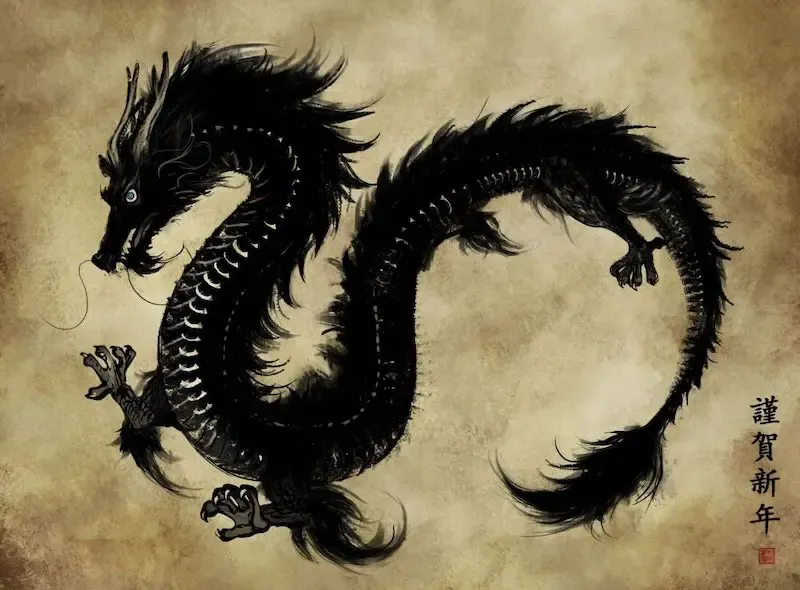
Dragon dances use a long articulated body carried by coordinated performers. In Lunar New Year and other celebrations, the moving dragon can express collective energy, skill, prosperity and hopes for favorable conditions. The performance is a living communal art, not simply a reenactment of one ancient myth.
Dragon boats connect the creature with water, speed and communal ritual. The Dragon Boat Festival also contains regional traditions, seasonal customs and narratives associated with figures such as Qu Yuan; its meaning cannot be explained by dragon symbolism alone.
In architecture and visual art, dragons appear on roof ridges, columns, stairways, screens, ceramics, lacquer, metalwork and textiles. A palace dragon may proclaim authority; a temple dragon may evoke sacred protection or water power; a household object may carry an auspicious wish. To explore stories in which dragons, deities and heroes interact, visit Chinese legends and stories .
FAQ
What does the Chinese dragon symbolize?
It commonly symbolizes power, rain, water, vitality, good fortune, imperial authority, success and cultural identity. The intended meaning depends on the historical and visual context.
Are Chinese dragons always good?
No. They are often auspicious or beneficial, especially as bringers of rain, but Chinese myths also include angry, dangerous, punished and destructive dragons.
What is the red Chinese dragon meaning?
In modern festive contexts, red often emphasizes celebration, happiness, vitality and good fortune. It is not a timeless rule for every red dragon in older art.
What is the gold Chinese dragon meaning?
Gold may suggest splendor, wealth and auspicious prosperity. Gold thread also appears in elite court textiles, where rank depends on the complete garment rather than color alone.
Does a five-clawed dragon always represent the emperor?
No. Five claws are strongly connected with imperial privilege in particular later court systems, especially Yuan, Ming and Qing contexts, but rules and exceptions changed. The whole object must be studied.
What does loong mean?
“Loong” is an English spelling based on the Chinese pronunciation of lóng. Some writers use it to distinguish the Chinese creature from Western dragons, but it has not universally replaced “dragon.”
Is the zodiac Dragon the same as a Dragon King?
No. The zodiac Dragon is a calendrical sign. Dragon Kings are religious and mythological water deities with their own stories, cults and identities.
Selected Museum and Scholarly References
- The Metropolitan Museum of Art: Daoism and Daoist Art
- The Metropolitan Museum Journal: The Dragon and the Pearl
- The Metropolitan Museum of Art: Qing Festival Robe
- British Museum: Chinese Ceramics, Room 95
- British Museum: Hongshan Coiled “Pig-Dragon”
- Daniela Zhang-Cziráková: Descendants of the Dragon and Chinese National Identity