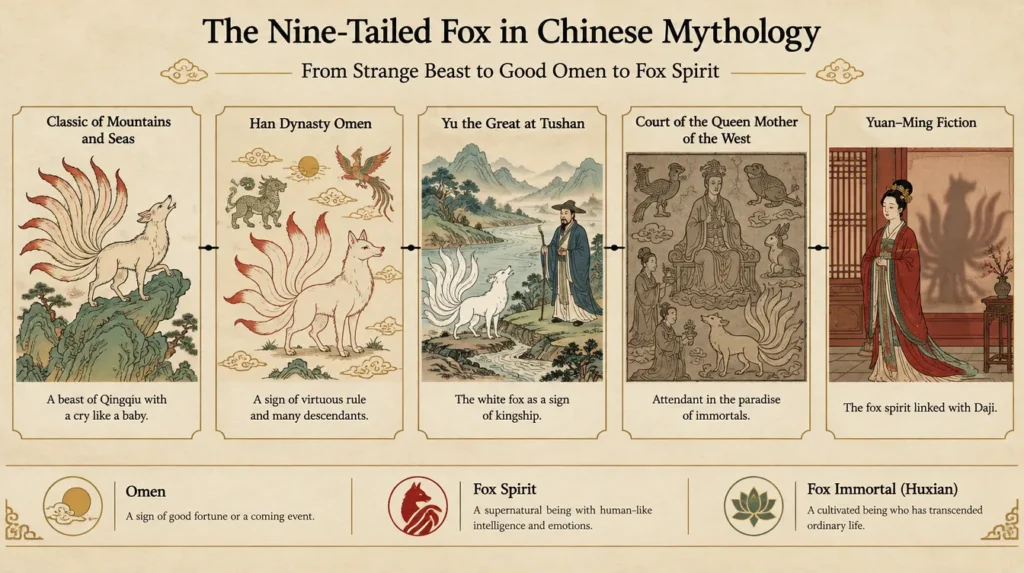
The nine-tailed fox (九尾狐, jiǔwěihú) is one of the oldest named creatures in Chinese mythology. It first appears in the Classic of Mountains and Seas as a strange beast of Qingqiu Mountain that can eat people. During the Han dynasty it became an auspicious omen tied to virtuous rule, abundant descendants, the marriage of Yu the Great, and the court of the Queen Mother of the West. Only later, from the Tang and Song periods onward, did writers merge it with the seductive fox spirit (狐狸精, húlijīng) and with Daji, the consort blamed for the fall of the Shang. The nine-tailed fox is therefore neither simply good nor simply evil. Its meaning depends on which text, and which century, you are reading.
Short answer: In Chinese tradition, the nine-tailed fox is a mythical fox from Qingqiu (青丘, Qīngqiū). The earliest text presents it as dangerous but useful; Han sources treat it as a sign of good government and many heirs; Yuan and Ming fiction turned it into the shape-shifting fox that possesses Daji. The fox-spirit stories and fox cults of late imperial China are related to it but form a broader tradition.
What Is the Nine-Tailed Fox?
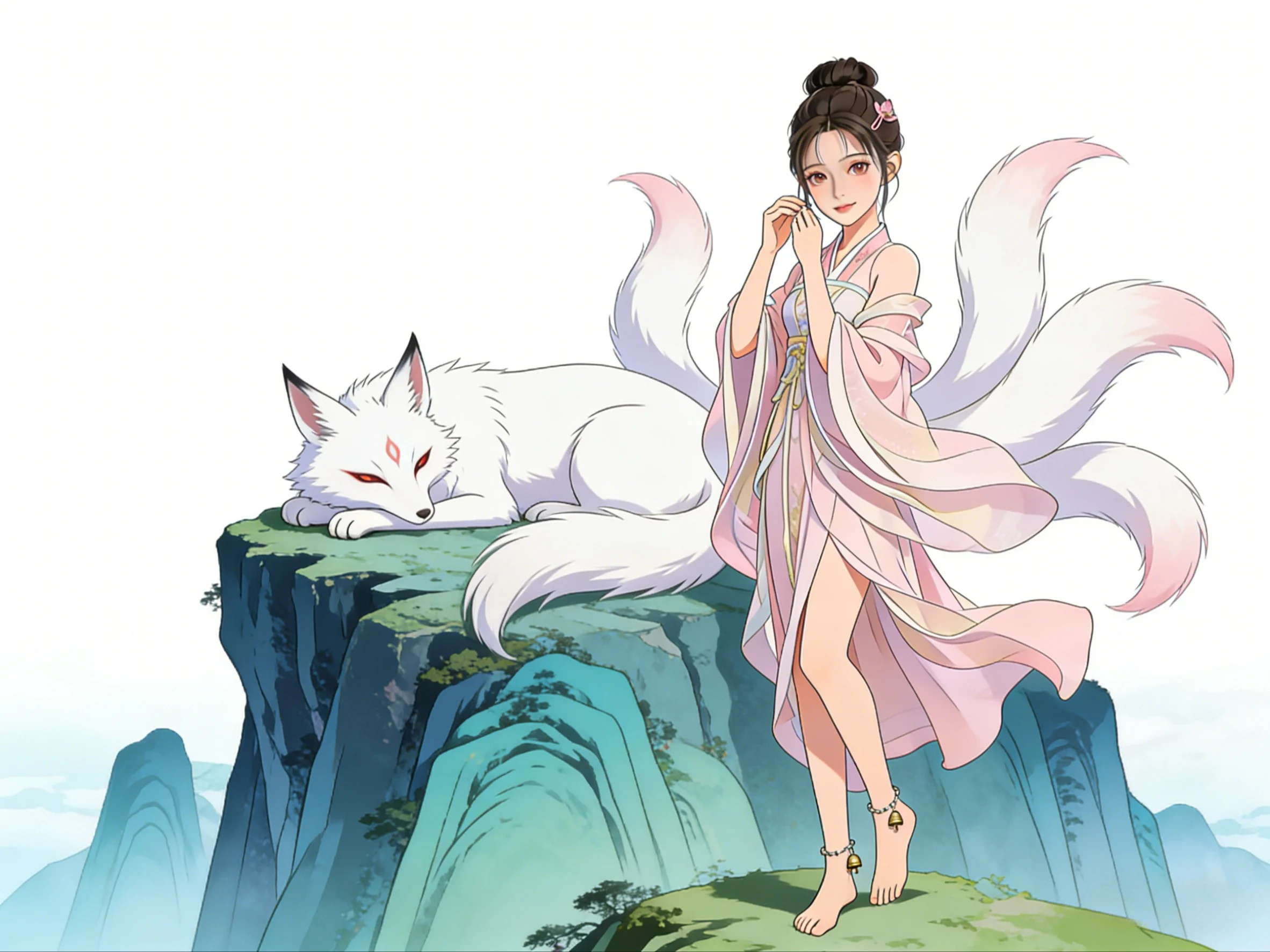
The name is literal: jiǔ means nine, wěi means tail, and hú means fox. In early Chinese texts the nine-tailed fox is a creature and an omen animal, not a deity. It has no fixed personality, no temple cult of its own, and no single story. Different authors used it for different purposes, which is why its reputation changed so dramatically.
It helps to separate three related terms that English sources often blur:
- Jiuweihu (九尾狐): the specific nine-tailed fox of the Classic of Mountains and Seas, Han omen lists, and later Daji legends.
- Huli jing (狐狸精): a general term for a fox spirit, usually a fox that has gained the power to take human form. Most fox spirits in Chinese stories are not described as having nine tails.
- Huxian (狐仙, húxiān): a “fox immortal,” a fox spirit treated as a being that could be worshipped, consulted, or appeased, especially in northern Chinese popular religion.
The nine-tailed fox sits within the wider family of Chinese mythical creatures, alongside omen animals such as the qilin and the fenghuang.
The Nine-Tailed Fox at a Glance
| Period | Key source | How the nine-tailed fox appears |
|---|---|---|
| Warring States to Han (text compiled in stages) | Classic of Mountains and Seas (山海经, Shānhǎi Jīng) | A beast of Qingqiu with a baby-like cry; it can eat people, yet eating its flesh protects against gu (蛊) sorcery |
| Eastern Han | Bai Hu Tong (白虎通); Wu Yue Chunqiu (吴越春秋) | An omen of virtuous rule and many descendants; a sign of Yu the Great’s kingship |
| Han tomb art | Stone reliefs and molded bricks | An attendant of Xiwangmu, with the three-legged bird, the toad, and the hare |
| Jin dynasty | Guo Pu’s commentary; the Xuanzhong Ji attributed to him | Appears in times of peace; separately, old foxes learn to take human form |
| Tang to Song | Poetry, anecdotes, official histories | Fox seduction is linked with ruinous consorts; the fox’s omen status fades |
| Yuan to Ming | Wuwang Fa Zhou Pinghua; Investiture of the Gods | A fox spirit that takes over Daji’s body |
| Late imperial to modern | Strange-tale collections; northern fox cults; modern media | Fox spirits as lovers, tricksters, and worshipped huxian; the nine-tailed fox as a seductive villain |
The Earliest Source: Qingqiu in the Classic of Mountains and Seas
The Classic of Mountains and Seas is not a storybook. It is a catalog of mountains, rivers, peoples, plants, creatures, and omens, assembled over several centuries. The nine-tailed fox appears in three places, all tied to the name Qingqiu, meaning “Green Hill.”
The fullest entry is in the Classic of the Southern Mountains (南山经). East of Mount Ji lies Qingqiu Mountain, rich in jade on its sunny slope. There, the text says, lives a beast shaped like a fox with nine tails. Its cry sounds like a crying infant, it can eat people, and whoever eats it will not be harmed by gu. Gu refers to a feared form of venom-based sorcery or harmful bewitchment, and commentators have read the phrase in slightly different ways. Two shorter entries, in the sections on the regions beyond the seas and the Great Wilderness in the east, mention a land of Qingqiu whose foxes have four legs and nine tails.
Two points stand out. First, the creature is already double-edged: dangerous to meet, protective once eaten. Second, the text gives no story, no human form, and no seduction. Attempts to identify Qingqiu with a specific modern region exist, but there is no settled answer.
A Han Dynasty Good Omen
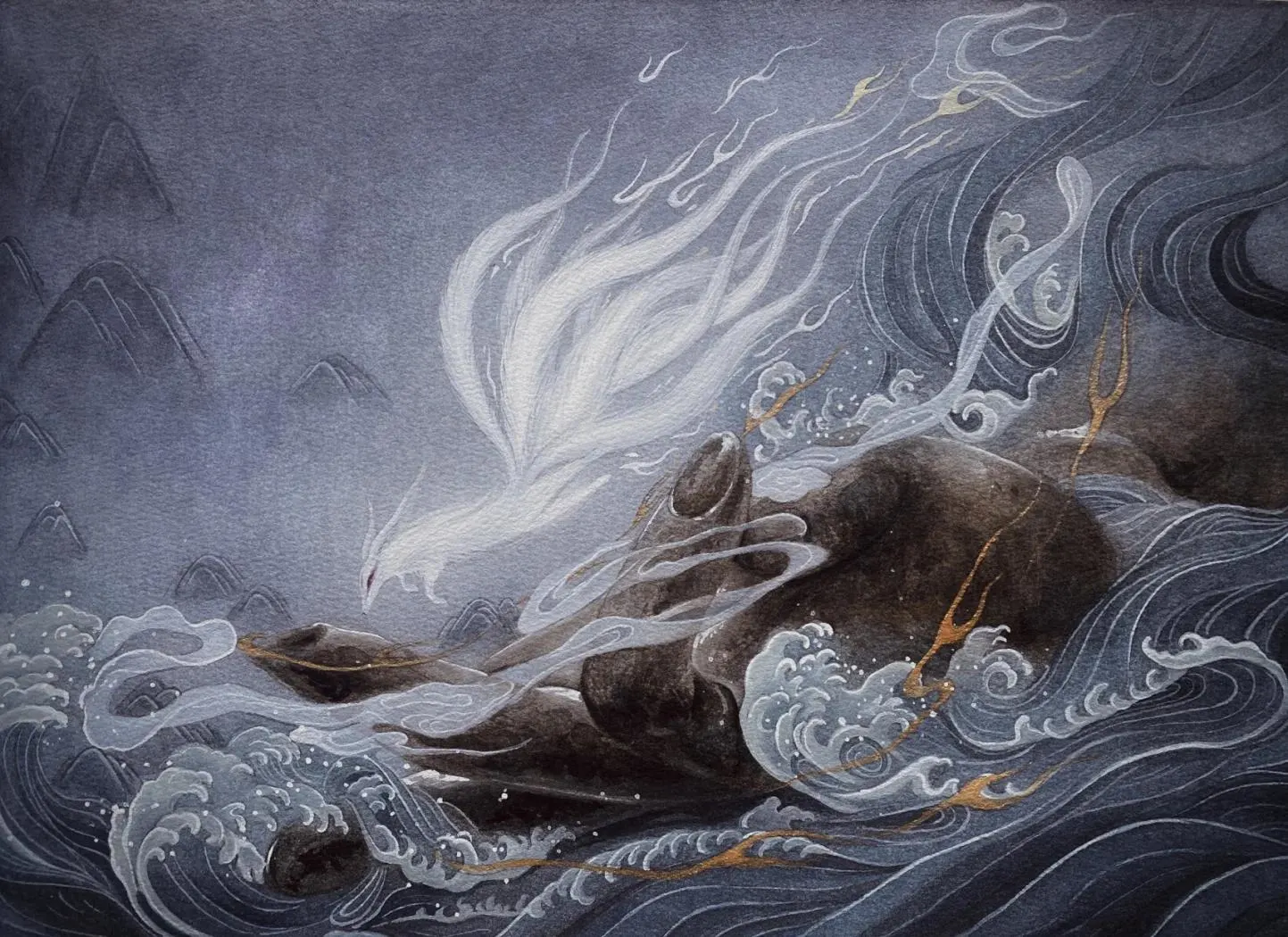
Han political thought held that Heaven responded to the ruler’s conduct. Floods and eclipses could signal displeasure; rare animals and plants could signal approval. Within this system, the nine-tailed fox became a recognized auspicious sign.
An Omen of Virtuous Rule
The Bai Hu Tong (白虎通, Báihǔ Tōng), which records the conclusions of a court conference held in 79 CE and is traditionally credited to Ban Gu, lists the omens that appear when a ruler’s virtue reaches the birds and beasts. The phoenix soars, the qilin arrives, the white tiger comes, and the fox appears with nine tails. The fenghuang and the qilin are its companions in this list, which shows the company the nine-tailed fox kept in Han thought.
The same text explains the symbolism. A fox is said to die with its head turned toward the hill of its den (狐死首丘), so it “does not forget its origins.” The nine tails mean that the ruler’s nine consorts are in their proper places and that descendants multiply. In other words, the creature signaled moral memory, an orderly royal household, and a secure line of heirs.
In the early fourth century, the scholar Guo Pu (郭璞, Guō Pú) added a commentary to the Classic of Mountains and Seas stating that the nine-tailed fox appears as an auspicious sign in times of great peace. By then, the omen reading had become the standard way to interpret the old Qingqiu entry.
Yu the Great and the White Fox of Tushan
The best-known nine-tailed fox story involves Yu the Great (大禹, Dà Yǔ), the hero of the Gun and Yu flood myth. In the version preserved in the Eastern Han Wu Yue Chunqiu (吴越春秋, Wúyuè Chūnqiū) by Zhao Ye, Yu reaches the age of thirty without marrying. Arriving at Tushan (涂山, Túshān), he says that if he is to marry, there will be a sign. A white fox with nine tails then comes to him. Yu interprets the white color as matching his robes and the nine tails as proof that he will be king. The people of Tushan sing a song about the white fox, and Yu marries a Tushan woman, named Nüjiao (女娇, Nǚjiāo) in this source.
This episode is often retold as “Yu married a fox spirit,” but the text does not say that. It presents the fox as an omen that approves the marriage. The story also survives only in Han and later sources. A similar passage quoted in later encyclopedias is attributed to the Lüshi Chunqiu, but it does not appear in the received text, and some modern scholars connect the white-fox detail to Han omen theory rather than to older Yu traditions.
Beside the Queen Mother of the West
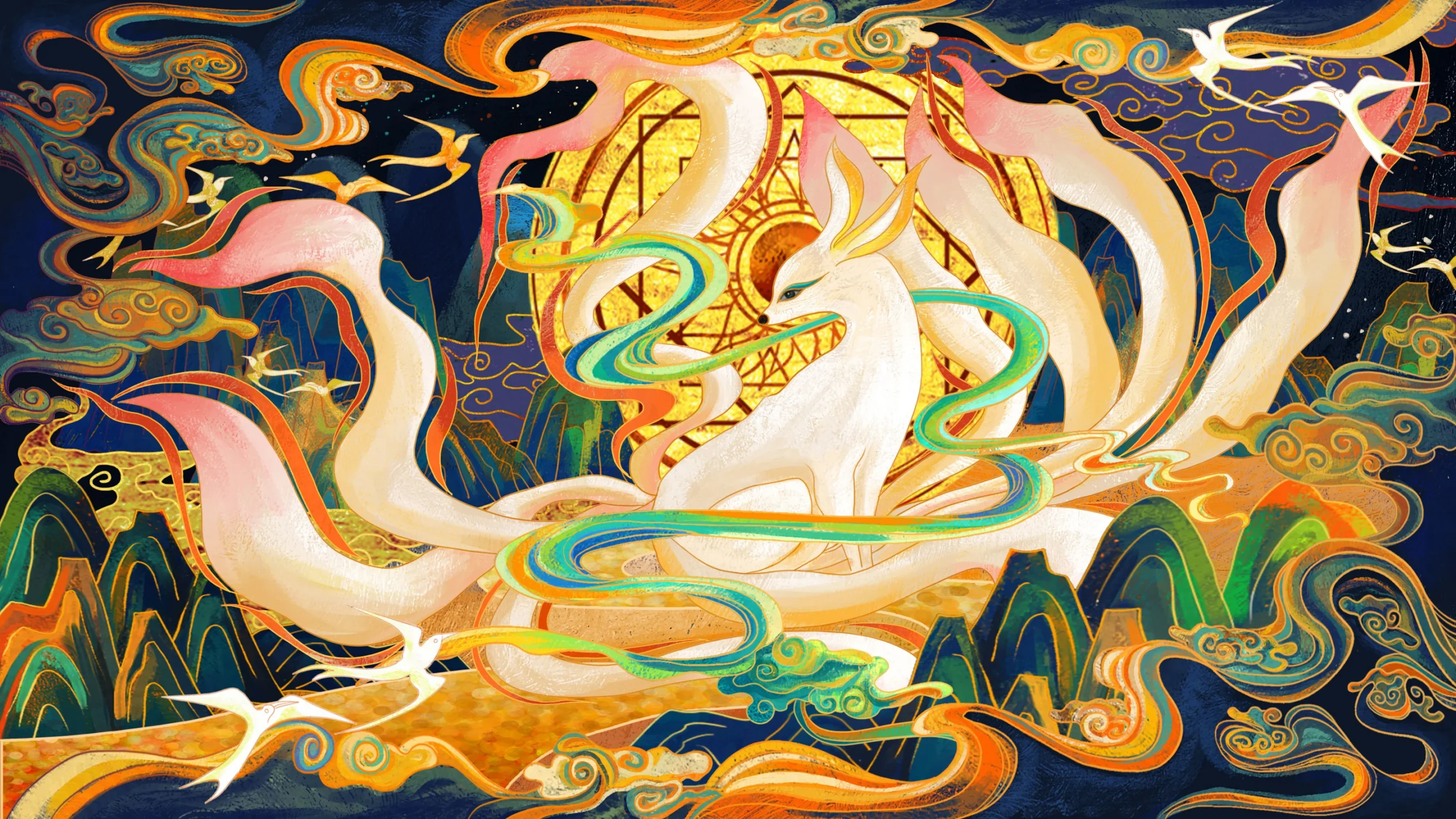
In Han funerary art, the nine-tailed fox often appears in the paradise of Xiwangmu, the Queen Mother of the West. An Eastern Han tomb brick catalogued by the Metropolitan Museum of Art shows Xiwangmu enthroned with a three-legged bird, a toad, a hare, and a nine-tailed fox as her attendants. In this setting, the fox belongs to a vision of immortality and blessing for the deceased, not to any story of seduction.
From Auspicious Beast to Fox Spirit
The nine-tailed fox did not turn villainous overnight. Its later image came from the slow merging of two separate traditions: the Han omen animal and a much broader body of belief about ordinary foxes that grew old and learned to transform.
Old Foxes and the Power to Transform
By the fourth century, writers described foxes as long-lived animals that gained power with age. The alchemist Ge Hong wrote in the Baopuzi that foxes could live eight hundred years and, after five hundred, become skilled at taking human form. The Xuanzhong Ji (玄中记), traditionally attributed to Guo Pu, gives a more detailed sequence. At fifty years a fox can change into a woman; at one hundred it can become a beautiful woman, a spirit medium, or a man who seduces women, and it can know events a thousand li away. At a thousand years it communicates with Heaven and becomes a Heavenly Fox (天狐, tiānhú).
None of these passages mentions nine tails. They describe foxes in general. Yet they supplied the shape-shifting, seduction, and accumulated power that later authors would attach to the nine-tailed fox.
Tang Fox Worship and Suspicion
In the Tang dynasty, fox belief was both widespread and ambivalent. Zhang Zhuo’s Chaoye Qianzai reports that many households sacrificed to fox spirits and quotes a saying: “Without fox demons, there is no village” (无狐魅,不成村). Tang fiction could portray foxes sympathetically, as in “The Story of Miss Ren” (任氏传, Rènshì Zhuàn), whose fox heroine is loyal to her human lover.
At the same time, the nine-tailed fox gradually dropped out of the omen records of official history, and fox seduction became a political metaphor. Bai Juyi’s poem “Old Tomb Fox” (古冢狐) warns against beautiful women who ruin men and states, and it invokes Daji and Bao Si, two consorts traditionally blamed for the downfall of dynasties.
How Daji Became the Nine-Tailed Fox
The historical Daji (妲己, Dájǐ) was the favored consort of King Zhou (纣王), the last Shang ruler. Han historians such as Sima Qian already blamed her influence for his misrule, but early records do not describe her as a fox.
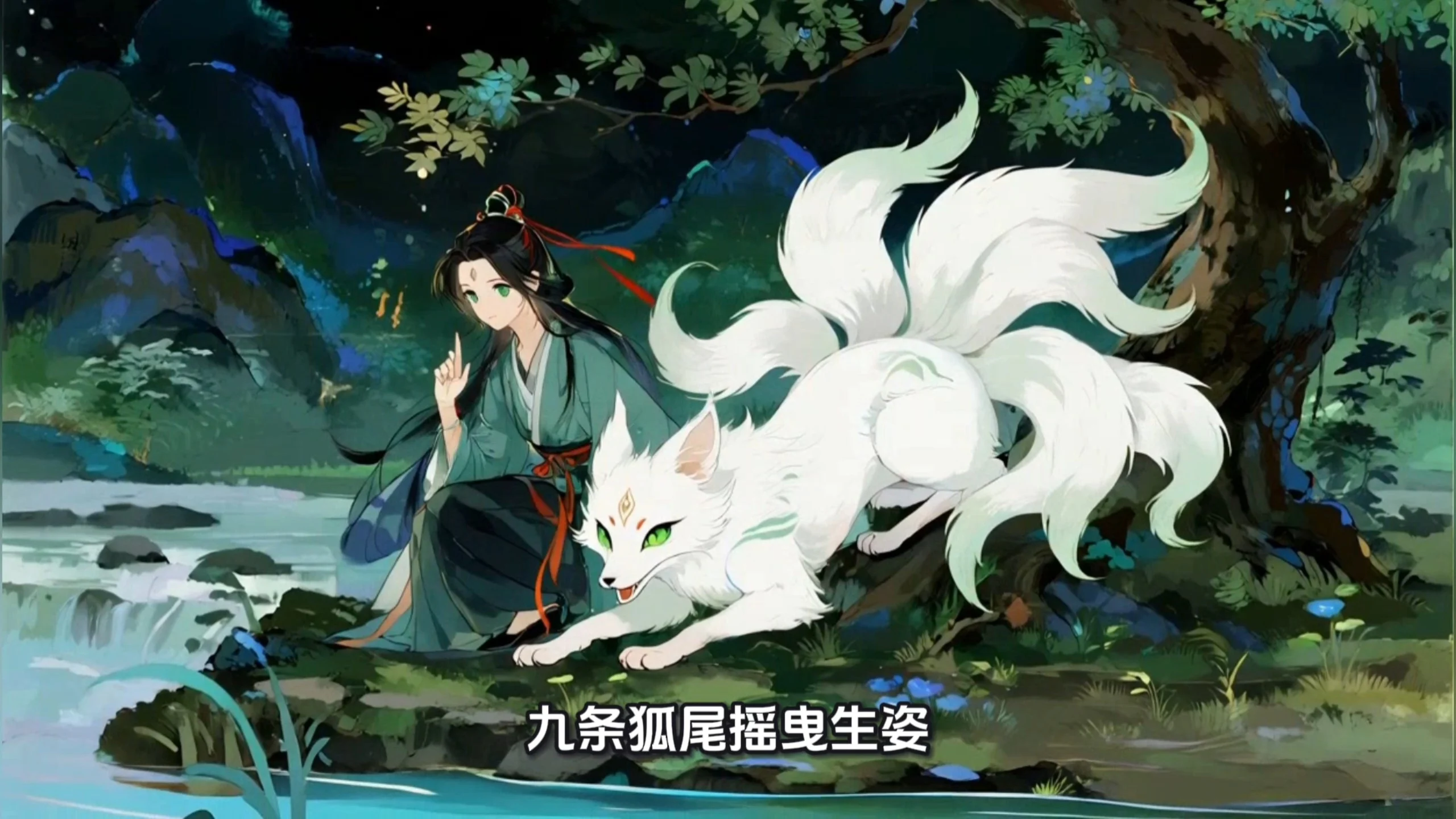
The connection grew in stages. A study of Chinese and Japanese textual evidence by Cao Zhexiang argues that by the Song period, some texts already treated the nine-tailed fox and Daji as the same being. The early fourteenth-century Wuwang Fa Zhou Pinghua (武王伐纣平话), a Yuan-dynasty storyteller’s narrative, makes it explicit: a nine-tailed, golden-haired fox draws the souls out of the sleeping Daji on her journey to court and occupies her body.
The Ming novel Investiture of the Gods (封神演义, Fēngshén Yǎnyì) gave this plot its most influential form. Nüwa, offended by a disrespectful poem King Zhou writes in her temple, summons three demon spirits to bring down the Shang. One of them, a thousand-year fox spirit, takes over Daji’s body. The novel itself emphasizes the fox’s age rather than its tail count; the nine-tailed label comes from the earlier pinghua tradition and was reinforced by later opera, prints, film, and television.
Fox Spirits in Late Imperial Religion and Literature
From the late sixteenth century, a shamanistic fox cult flourished in northern China. Historian Xiaofei Kang shows that fox spirits were honored in household and community shrines and spoke through spirit mediums, even though officials and clergy regarded the cult as illicit. In this setting the fox could bring wealth, healing, or fertility, or it could cause possession and illness that required exorcism.
Ming and Qing writers filled their collections of strange tales with foxes. Pu Songling’s Liaozhai Zhiyi (聊斋志异, Strange Tales from a Chinese Studio) and Ji Yun’s notebooks include fox wives, fox scholars, tricksters, and dangerous seducers. Rania Huntington describes these foxes as “middle creatures,” morally ambiguous beings that cross the boundaries between animal and human, male and female, and mortal and transcendent.
Most of these late imperial foxes are simply foxes that have cultivated power. They are not labeled nine-tailed. Readers who know the story of the White Snake legend will recognize the same broader pattern: an animal spirit in human form whose love, danger, and legitimacy are debated in the story itself.
What the Nine Tails Symbolized
The symbolism shifted with the context. The most important meanings, roughly in historical order, are:
- Strangeness and protection: in the Classic of Mountains and Seas, a dangerous beast whose flesh guards against gu.
- Abundant descendants: in the Bai Hu Tong, nine tails mean a well-ordered household and many heirs.
- Remembering one’s roots: the belief that a dying fox turns its head toward its home hill.
- Heaven’s approval: a sign of peace and legitimate kingship, as in the Yu story.
- Paradise and immortality: a member of Xiwangmu’s court in Han tomb art.
- Seduction and political ruin: from the Tang onward, and above all through the Daji legend.
The number nine also mattered. As the highest single digit, it often signals fullness or abundance in Chinese usage, which suits both the Han reading of many descendants and the later image of a fox at the peak of its power.
Chinese, Japanese, and Korean Nine-Tailed Foxes
The Chinese nine-tailed fox spread across East Asia, where it developed separate local forms. Modern pop culture often blends them, so a brief comparison is useful.
| Tradition | Name | Typical image | Key difference |
|---|---|---|---|
| China | Jiuweihu (九尾狐) | Strange beast, then good omen, then Daji’s fox spirit | Long auspicious history before its villain image |
| Japan | Kyūbi no kitsune (九尾の狐) | Shape-shifting fox, famously linked with Tamamo-no-Mae | Later Japanese retellings connect Tamamo-no-Mae to the same fox said to have possessed Daji; kitsune also have separate roles as messengers of Inari |
| Korea | Kumiho (구미호) | Dangerous fox woman in folktales | Usually portrayed as malevolent, often seeking to become human |
Common Misconceptions
- “The nine-tailed fox was always evil.” For much of early Chinese history it was an omen of good rule and fertility.
- “Every Chinese fox spirit has nine tails.” Most fox spirits in Chinese tales have no specified tail count. The nine-tailed fox is one famous type within a much larger fox tradition.
- “Daji was a fox in ancient records.” Early histories blame Daji’s influence on King Zhou but do not make her a fox. The fox identity is a later literary development.
- “Foxes grow one tail per century in Chinese mythology.” This idea is common in modern retellings, but the early Chinese sources tie fox power to age, not to a fixed tail-growth schedule.
- “The nine-tailed fox is a Chinese goddess.” Classical texts present it as a creature and omen. Fox-immortal worship in northern China is a separate, later popular-religious tradition.
Related Figures and Stories
- Xiwangmu, whose Han-era court included the nine-tailed fox
- The flood myth of Gun and Yu, background to the white fox of Tushan
- Nüwa, who sends the fox spirit in Investiture of the Gods
- The qilin and the fenghuang, fellow Han omen creatures
- The legend of the White Snake, another animal-spirit love story
Frequently Asked Questions
Is the nine-tailed fox good or evil in Chinese mythology?
It depends on the period. The earliest text describes a dangerous but useful beast, Han sources treat it as an auspicious omen, and Yuan and Ming fiction made it a destructive fox spirit through the Daji legend.
What is the nine-tailed fox called in Chinese?
It is called 九尾狐 (jiǔwěihú), literally “nine-tailed fox.” The broader term for a shape-shifting fox spirit is 狐狸精 (húlijīng), and a worshipped fox spirit may be called 狐仙 (húxiān).
Is Daji a nine-tailed fox?
Not in early history. The Yuan-era Wuwang Fa Zhou Pinghua describes a nine-tailed, golden-haired fox taking over Daji’s body, and the Ming novel Investiture of the Gods makes a thousand-year fox spirit possess her.
Where does the nine-tailed fox live?
The Classic of Mountains and Seas places it at Qingqiu, “Green Hill,” described both as a mountain and as a distant land. Its real-world location, if any, is uncertain.
Is the Chinese nine-tailed fox the same as the Japanese kitsune or Korean kumiho?
They share a Chinese origin but developed differently. Japan linked the nine-tailed fox to Tamamo-no-Mae, while Korean kumiho stories usually portray a dangerous fox woman.
References and Further Reading
- Anne Birrell, trans. The Classic of Mountains and Seas. Penguin Classics, 1999.
- Ban Gu (attributed). Bai Hu Tong, juan 5, “Feng Shan”. Chinese Text Project.
- The Metropolitan Museum of Art. “Brick with the Mother Queen of the West,” Eastern Han dynasty.
- Xiaofei Kang. The Cult of the Fox: Power, Gender, and Popular Religion in Late Imperial and Modern China. Columbia University Press, 2005.
- Rania Huntington. Alien Kind: Foxes and Late Imperial Chinese Narrative. Harvard University Asia Center, 2003. See the review on Project MUSE.
- Cao Zhexiang (曹喆翔). “九尾変異考” (A Study of the Transformation of the Nine-Tailed Fox). East Asian Cultural Studies (東アジア文化研究), no. 9.