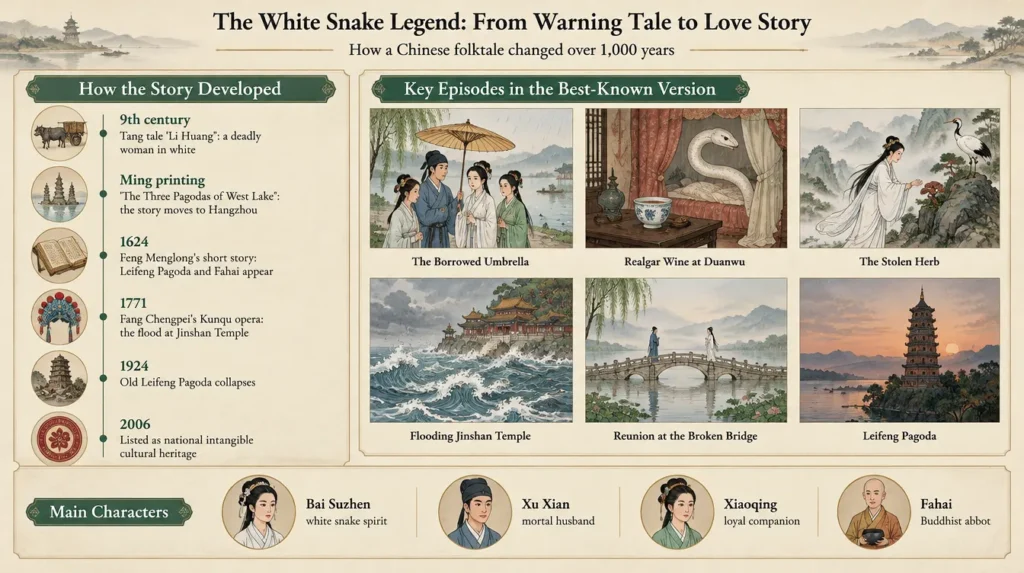
The White Snake Legend: Story, Characters and How the Tale Changed
The White Snake legend (白蛇传, Báishé Zhuàn) is a Chinese folktale about Bai Suzhen, a white snake spirit who takes human form, marries a young man named Xu Xian, and is finally imprisoned beneath Leifeng Pagoda in Hangzhou by the Buddhist monk Fahai. It is usually counted among China’s Four Great Folktales, alongside the Butterfly Lovers, Lady Meng Jiang, and the Cowherd and the Weaver Girl.
It is not an ancient myth with one fixed text. The story grew over roughly a thousand years: from Tang-dynasty tales of a deadly snake-woman, to Feng Menglong’s Ming short story of 1624, to Qing opera, ballads and “precious scrolls,” and finally to modern film and television. The loyal, sympathetic White Snake most readers know today is largely the creation of those later retellings.
| At a glance | Details |
|---|---|
| Chinese title | 白蛇传 (Báishé Zhuàn), “Tale of the White Snake” |
| Classification | Folktale and literary/theatrical legend, not an early mythological text |
| Main characters | Bai Suzhen, Xu Xian (earlier Xu Xuan), Xiaoqing, Fahai |
| Main setting | West Lake, Hangzhou; also Suzhou and Zhenjiang |
| Key written stages | Tang tale “Li Huang”; “The Three Pagodas of West Lake”; Feng Menglong (1624); Qing opera and precious scrolls |
| Best-known episodes | The borrowed umbrella, the realgar wine, the stolen herb, the flooding of Jinshan Temple, the Broken Bridge, Leifeng Pagoda |
| Status today | Listed among China’s national intangible cultural heritage items in 2006 |
The Story in Brief
The summary below follows the outline shared by most Peking opera, regional opera, and television versions. Older texts differ at nearly every step, and those differences are explained further down.
1. A snake who wanted a human life
In many later versions, a white snake spends a thousand years cultivating spiritual power, often on Mount Emei (峨眉山, Éméi Shān), until she can take the form of a young woman. She calls herself Bai Suzhen (白素贞, Bái Sùzhēn). A green snake, Xiaoqing (小青, Xiǎoqīng), becomes her maid and sworn sister. Some versions add a debt from the past: as a small snake she was once saved by the man she will later marry, and the romance becomes a way of repaying that kindness.
2. The borrowed umbrella at West Lake
On a spring outing at West Lake, the two women are caught in the rain and meet Xu Xian (许仙, Xǔ Xiān), a modest pharmacy assistant who lends them his umbrella. Returning it leads to a second meeting, and soon to marriage. The couple opens a medicine shop, and Bai Suzhen’s healing skill makes it prosper.
3. Fahai’s warning and the realgar wine
Fahai (法海, Fǎhǎi), abbot of Jinshan Temple, recognizes Bai Suzhen as a snake spirit and warns Xu Xian. On the Duanwu or Dragon Boat Festival, the fifth day of the fifth lunar month, households traditionally drank realgar wine (雄黄酒, xiónghuáng jiǔ) to drive away snakes and other harmful influences. Xu Xian persuades his wife to drink. She reverts to her serpent form, and he dies of fright at the sight.
4. Stealing the reviving herb
To bring her husband back, Bai Suzhen travels to a sacred mountain, usually Kunlun, to steal a life-restoring herb, often described as lingzhi (灵芝). It is guarded by the crane and deer attendants of the Old Man of the South Pole (南极仙翁, Nánjí Xiānwēng), a longevity figure usually identified with Shouxing, the god of longevity. Overpowered, she is spared once the old immortal learns she has come out of love rather than greed. Xu Xian is revived.
5. Flooding Jinshan Temple
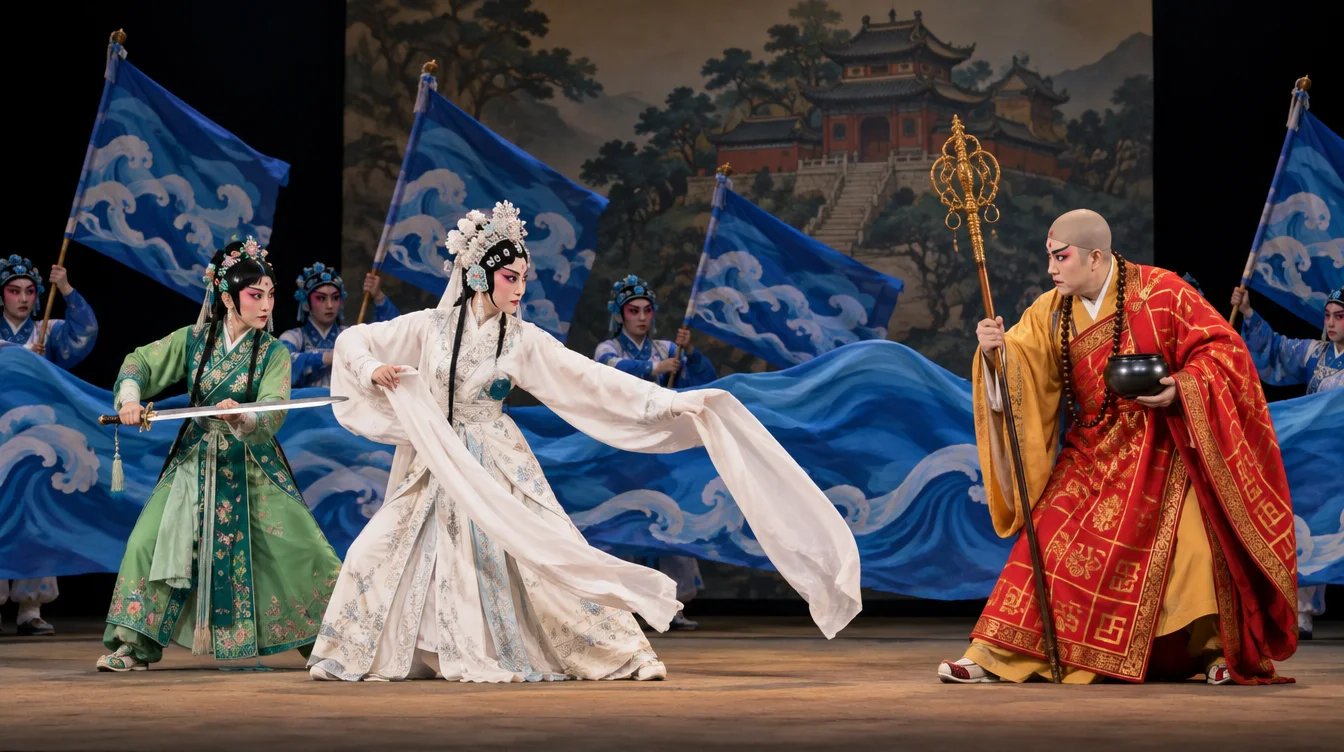
Xu Xian’s doubts return, and he ends up at Jinshan Temple (金山寺, Jīnshān Sì) in Zhenjiang, held there by Fahai. Bai Suzhen and Xiaoqing raise a flood against the temple to win him back. The flood drowns ordinary people as well, a point many versions use to justify her later punishment. Heavily pregnant, she cannot defeat the monk and retreats.
6. Reunion at the Broken Bridge
Back in Hangzhou, the couple meets again at the Broken Bridge (断桥, Duàn Qiáo) on West Lake. Xiaoqing is furious at Xu Xian’s betrayal, but husband and wife reconcile, and Bai Suzhen gives birth to a son.
7. Imprisoned under Leifeng Pagoda
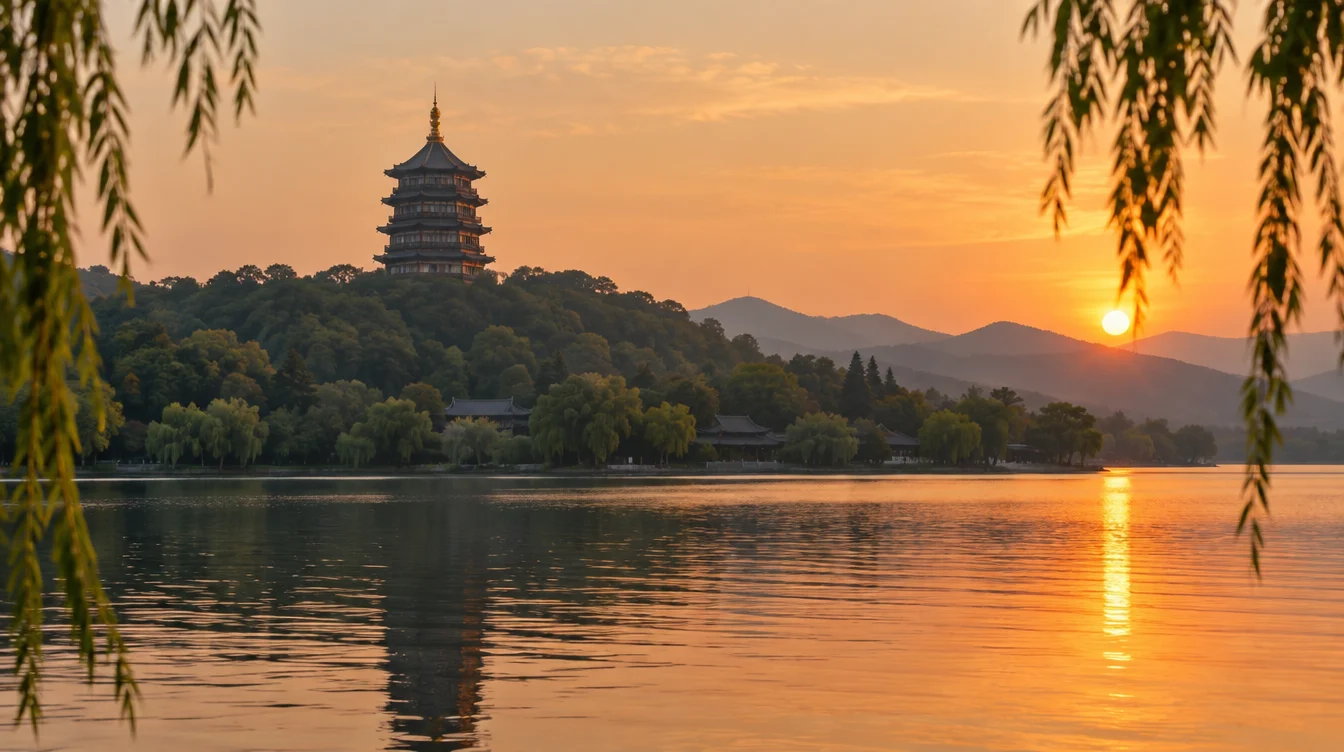
Soon after the birth, Fahai captures Bai Suzhen, commonly with his alms bowl, and seals her beneath Leifeng Pagoda (雷峰塔, Léifēng Tǎ), the “Thunder Peak Pagoda” on the south shore of West Lake. A popular saying holds that she will stay there until West Lake runs dry and the pagoda falls.
8. The son’s return
Many Qing and modern versions continue the story. The son, often named Xu Shilin (许仕林, Xǔ Shìlín), grows up to take first place in the imperial examinations and comes to honor his mother at the pagoda. In some tellings his filial devotion wins her release; in others Xiaoqing returns to defeat Fahai, or the pagoda itself collapses.
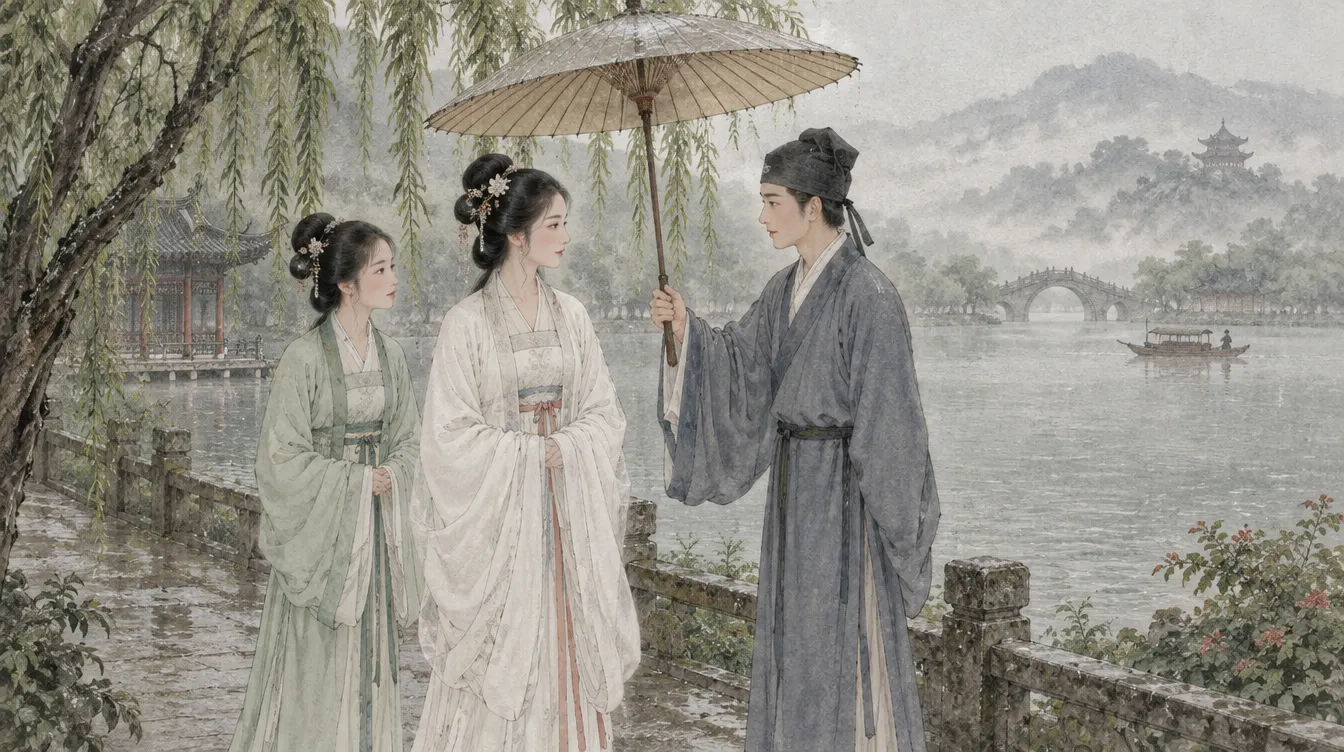
Main Characters
| Character | Chinese | Role | How the portrayal varies |
|---|---|---|---|
| Bai Suzhen (Lady White) | 白素贞 / 白娘子 | White snake spirit in human form; wife and healer | A dangerous seductress in early tales; a devoted wife and mother in later ones. Feng Menglong calls her Bai Niangzi; “Bai Suzhen” became standard later. |
| Xu Xian | 许仙 (earlier 许宣) | Her mortal husband | Named Xu Xuan in Feng Menglong’s story. Often weak-willed and easily swayed, which is central to the plot. |
| Xiaoqing (Little Green) | 小青 | Companion and sworn sister | A large green fish in Feng’s version; a male snake defeated into service in Fang Chengpei’s Qing opera; later a fierce, loyal female snake spirit. |
| Fahai | 法海 | Buddhist abbot of Jinshan Temple | A rescuer of a deluded man in older versions; increasingly an inflexible antagonist in modern ones. |
| Xu Shilin | 许仕林 | Son of Bai Suzhen and Xu Xian | Absent from Feng’s story; added in Qing-era versions to bring a filial resolution. |
How the White Snake Legend Developed
The legend has no single “original version.” Scholars trace it through a chain of texts and performances, each adding, removing, or reinterpreting episodes.
| Stage | Date | What changes |
|---|---|---|
| “Li Huang” (李黄), in Boyi zhi (博异志) | Tang dynasty (9th century) | A young man in Chang’an spends days with a woman in white, returns home, and dies. She turns out to be a great white snake. A warning tale, with no romance. |
| “The Three Pagodas of West Lake” (西湖三塔记) | Storyteller’s tale, printed in a mid-16th-century collection | The action moves to West Lake. A white snake woman and her companions prey on a young man and are sealed under three stone pagodas. |
| Feng Menglong, “Madam White Kept Forever Under Thunder Peak Pagoda” (白娘子永镇雷峰塔) | 1624, in Stories to Caution the World (警世通言) | Generally treated as the first full written form: Xu Xuan, Bai Niangzi, Fahai, and Leifeng Pagoda all appear. Still cautionary, but the snake woman now shows real feeling. |
| Fang Chengpei (方成培), Leifeng Pagoda | Kunqu opera, published 1771 | The flooding of Jinshan Temple becomes a signature scene; sympathy shifts toward the White Snake. |
| Precious Scroll of Thunder Peak (雷峰宝卷) | Popular 19th-century versions | Places the story in a Buddhist karmic frame and ends with the son’s filial piety and the mother’s redemption. |
| Modern stage, film and television | 20th–21st centuries | Bai Suzhen becomes a romantic heroine; Fahai often becomes the villain; new prequels and retellings multiply. |
From predator to wife
The earliest stories belong to a wider Chinese tradition of tales about men drained or destroyed by beautiful animal spirits. The Tang tale of Li Huang has no lake, no monk, and no love story; it simply warns against desire. The West Lake storytelling version adds a Hangzhou setting and the idea of sealing creatures under pagodas, but its snake woman is still a predator.
Feng Menglong’s turning point
Feng Menglong’s 1624 story is set in Southern Song Hangzhou. Bai Niangzi pursues Xu Xuan, and her gifts of stolen silver get him exiled twice, to Suzhou and then Zhenjiang. Fahai finally subdues her, and Xu Xuan, now a monk, raises alms to build the pagoda that holds her. The moral is still a warning, yet the snake woman’s devotion makes her more than a monster, and that ambiguity drove most later rewriting.
Qing opera and the sympathetic heroine
Qing playwrights and performers reshaped the story for the stage. Fang Chengpei’s 1771 version made the battle at Jinshan Temple a showpiece, and later scripts, ballads and precious scrolls added the son’s examination success and the visit to the pagoda. By the nineteenth century, audiences were invited to grieve for the White Snake rather than fear her.
Leifeng Pagoda, West Lake and Jinshan Temple: Real Places in the Story
Leifeng Pagoda was a real Buddhist building. It was built in the 970s under Qian Chu (钱俶), the last king of Wuyue, to house Buddhist relics and printed copies of a dhāraṇī sutra. Only centuries later did it become famous as the White Snake’s prison.
The old brick pagoda collapsed on September 25, 1924, after long neglect. Many of its bricks were found to contain printed sutra scrolls. The writer Lu Xun responded with a well-known essay, “On the Collapse of Leifeng Pagoda,” treating the fallen tower as a symbol of oppressive authority finally giving way. A new pagoda opened on the site in 2002.
Other landmarks in the story are also real: the Broken Bridge on West Lake, and Jinshan Temple on the Yangtze at Zhenjiang. These places explain why the legend is so closely tied to Hangzhou’s identity, but they do not make the story historical.
Snake Spirit, Immortal or Demon? The Religious Background
Bai Suzhen is neither a goddess nor a xian (仙) in the strict sense. She belongs to the large category of animal spirits, called yao (妖) or jing (精), that accumulate power through long cultivation and learn to take human shape. Later versions borrow Daoist language for her training, which links her to wider ideas about how cultivation leads toward immortality in Taoism. But a snake spirit seeking human life is not the same as a recognized immortal, a distinction explored in the difference between Taoist gods and immortals.
Fahai and the pagoda bring a Buddhist frame. In older versions, the monk rescues a man from illusion and attachment. In the precious scrolls, karma governs the whole story: the White Snake’s suffering is a debt to be paid, and her son’s piety helps release her. Modern versions often recast Fahai as a symbol of rigid authority. That reading is powerful, but it is a later interpretation, not the stance of every earlier text. For the broader picture, see how Buddhism shaped Chinese mythology and storytelling.
Snake imagery in China is old and varied. Nüwa and Fuxi, for example, are often shown with serpent tails in Han-dynasty art. The White Snake legend draws on a different strand, though: stories of transforming animal spirits, which also fill the wider world of Chinese mythical creatures.
What the Legend Is About
Because it has been retold for so long, the White Snake legend carries several meanings at once.
- Desire and danger. The early tales warn men against seduction. That theme never disappears; it simply shifts from the snake woman to the question of whether Xu Xian should trust her.
- Love across a boundary. Later versions ask whether a nonhuman being who acts with loyalty, healing skill and sacrifice deserves less than a human. The stolen herb and the flood are both acts of love that cross a line.
- A wavering husband. Xu Xian believes Fahai, then his wife, then Fahai again. His indecision drives the plot and keeps the story uncomfortable.
- Filial resolution. The son’s examination success and devotion bring the story back to family values, giving audiences a moral ending that does not erase the tragedy.
- Festival memory. The realgar-wine scene ties the legend to the Dragon Boat Festival, so many people first meet the story through seasonal customs rather than books.
Twentieth-century writers pushed these tensions further. Lu Xun read the pagoda as tyranny; Lilian Lee’s 1986 novel Green Snake and its film adaptation retold the tale from Xiaoqing’s point of view; and the 1992 Taiwanese television series New Legend of Madame White Snake shaped how a generation of viewers imagines the characters.
Common Misunderstandings
- “It is an ancient Chinese myth.” Its roots go back to Tang tales, but the familiar story is a Ming and Qing literary and theatrical creation that kept changing.
- “The White Snake was always the heroine.” In the earliest versions she is a killer. Sympathy for her developed gradually.
- “Fahai is simply evil.” Older texts treat him as a rescuer. His villainy is mostly a modern reading.
- “The husband is always called Xu Xian.” Feng Menglong’s story names him Xu Xuan.
- “Xiaoqing was always a green snake maid.” She first appears as a fish and, in one major Qing opera, as a male snake.
Related Stories and Figures
The White Snake legend sits within a family of love and fate stories collected in the Legends & Stories directory. Readers interested in another tale shaped by a festival and a sacred elixir can compare it with the story of Chang’e and the moon, where a forbidden medicine also changes a marriage forever.
Frequently Asked Questions
Is the Legend of the White Snake a myth or a folktale?
It is best described as a folktale and literary legend. It developed through Tang stories, storytellers’ tales, a 1624 short story by Feng Menglong, and many Qing operas and ballads, rather than coming from an early mythological text.
Is Bai Suzhen good or evil?
It depends on the version. Early tales present her as a deadly seductress. From Feng Menglong onward she gains real feeling, and Qing and modern versions make her a loyal wife and mother punished for loving a human.
Why does realgar wine reveal the White Snake?
Realgar wine was traditionally drunk at the Dragon Boat Festival to ward off snakes and other harmful influences. In the story, the drink overpowers Bai Suzhen’s transformation and she returns to her serpent form.
Is Leifeng Pagoda a real place?
Yes. It was built in the 970s on the south shore of West Lake in Hangzhou, collapsed in 1924, and was rebuilt in 2002. Its link to the White Snake came centuries after it was built.
Does Bai Suzhen ever escape the pagoda?
Some versions leave her imprisoned forever. Others free her through her son’s filial devotion, through Xiaoqing defeating Fahai, or through the pagoda’s collapse.
What are China’s Four Great Folktales?
The group usually includes the Legend of the White Snake, the Butterfly Lovers, Lady Meng Jiang, and the Cowherd and the Weaver Girl. The grouping is a modern convention rather than an ancient canon.
References and Further Reading
- Luo, Liang. The Global White Snake. University of Michigan Press, 2021. press.umich.edu
- Welter, Albert. “The Origins and Development of Leifeng Pagoda.” In A Tale of Two Stūpas: Diverging Paths in the Revival of Buddhism in China. Oxford University Press, 2022. academic.oup.com
- Heatherly, Bryce. “Leifeng Pagoda (Leifeng ta 雷峰塔).” University of British Columbia, Open Collections. open.library.ubc.ca
- Gay, David Elton. Review of Wilt L. Idema, trans. and ed., The White Snake and Her Son: A Translation of The Precious Scroll of Thunder Peak with Related Texts (Hackett, 2009). Journal of Folklore Research Reviews. scholarworks.iu.edu
- University of Leeds, Chinese Theatre Database. “The Legend of the White Snake 白蛇传.” chinesetheatre.leeds.ac.uk
- USC Pacific Asia Museum. “The Legend of Lady White Snake.” pacificasiamuseum.usc.edu
- Canadian Museum of History. “The Remembrance Ceremony Held in front of the Monument” (Cantonese opera). historymuseum.ca