Chinese God of Agriculture Hou Ji
The Chinese god of agriculture Hou Ji (后稷, Hòu Jì) was the legendary Lord of Millet, an agricultural culture hero and the ancestral figure of the Zhou royal house. The early poem “Sheng Min” describes his miraculous conception by Jiang Yuan, his survival after repeated abandonment and his extraordinary ability to cultivate grain. Later texts place him within the genealogy of Emperor Ku and portray him as an official who taught people to sow crops in their proper seasons. Hou Ji is therefore not simply a harvest god. His identity combines mythology, farming knowledge, dynastic ancestry and state ritual, and different sources emphasize different parts of that tradition.
Hou Ji Quick Facts
| Topic | Details |
|---|---|
| Chinese name | 后稷 |
| Pinyin | Hòu Jì |
| Common English title | Lord of Millet or Lord of Grain |
| Personal name in later tradition | Qi (棄 in traditional Chinese; 弃 in simplified Chinese), usually understood as “Abandoned” |
| Mother | Jiang Yuan (姜媤, Jiāng Yuán) |
| Main identities | Agricultural culture hero, grain deity, Zhou ancestor and legendary official |
| Important early source | “Sheng Min” (生民, “Birth of the People”) in the Classic of Poetry |
| Dynastic connection | Claimed as the founding ancestor of the Zhou royal lineage |
| Important distinction | Hou Ji is connected with agriculture but is not simply another name for Shennong |
What Does the Name Hou Ji Mean?
Hou Ji is conventionally translated as “Lord of Millet.” In this title, hou carries an older sense of lord, ruler or noble authority. Ji (稷) refers to millet or grain and also developed important ritual associations with cultivated food.
“Lord of Grain” is sometimes a useful translation because early accounts connect Hou Ji with more than one crop. Millet, however, was especially important in northern Chinese agriculture and in the ritual world associated with the early Zhou. For that reason, “Lord of Millet” remains the standard English rendering.
Hou Ji and the Zhou surname use different characters. The Ji in Hou Ji is 稷, meaning millet or grain. The Zhou royal surname Ji is 姬. They sound similar in modern Mandarin but are not the same word.
English-language books may write his name as either “Hou Ji” or “Houji.” Both forms refer to the same figure.
The Miraculous Birth of Hou Ji
The most influential early account appears in “Sheng Min,” one of the Major Odes of the Classic of Poetry. The poem is not a biography in the modern sense. It is a dynastic hymn that explains the sacred origin of the Zhou people and the agricultural ancestor from whom their rulers claimed descent.
Hou Ji’s mother, Jiang Yuan, performs a sacrifice and seeks a child. She then steps into the footprint or toe-print of a great divine being and becomes pregnant. The poem connects the conception with the high god Di or Shangdi, but it does not present an ordinary human father. The point is not biological explanation. The miraculous conception establishes that the child’s life and the Zhou lineage have heavenly significance.
After the birth, the infant is repeatedly left in dangerous places. Animals avoid trampling him, people appear where he has been exposed and great birds shelter him on the ice with their wings. When the birds depart, his strong cry reveals that he has survived. Later tradition links this episode to his personal name Qi, “the Abandoned One.”
The repeated abandonment should not be reduced to a simple story of maternal cruelty. Within the poem, every danger becomes proof that the child is protected by forces beyond an ordinary human family. His survival marks him as the future founder of an ancestral line and the bearer of agricultural knowledge.
How Hou Ji Became the Lord of Millet
“Sheng Min” moves from Hou Ji’s childhood to his skill in cultivation. He plants crops that grow vigorously, understands the correct stages of agricultural work and produces grain that can sustain both human life and ritual offerings. The poem mentions several cultivated plants rather than describing one miraculous harvest.
This makes Hou Ji a culture hero as well as a deity. A culture hero is a legendary figure credited with bringing society an essential practice, technology or institution. Hou Ji represents seed selection, seasonal timing, field work, harvest, grain processing and sacrifice. His power is practical knowledge transformed into ancestral memory.
That does not mean he was the historically documented inventor of agriculture. Farming in China developed over a long prehistoric period, and archaeological evidence cannot be reduced to the actions of one individual. The myth gives cultivation a sacred founder and expresses the belief that social order depends on the ability to produce food.
This combination of divine power and civilizing knowledge also appears elsewhere among Chinese gods and culture heroes. Early Chinese figures do not always fit neatly into modern categories such as god, human, ancestor or official.
Hou Ji in the Records of the Grand Historian
The Records of the Grand Historian, compiled by Sima Qian centuries after the formation of the early Zhou traditions, preserves the footprint conception while arranging Hou Ji within a more systematic genealogy. Jiang Yuan is described as the principal wife of Emperor Ku, one of the legendary rulers of antiquity.
In this later narrative, Qi becomes famous for his ability to grow grain. He serves during the legendary age of Yao and Shun, is ordered to sow the different crops in their proper seasons and receives the title Hou Ji. The account also connects him with the Ji clan from which the Zhou rulers traced their descent.
This version presents Hou Ji partly as a miraculous ancestor and partly as an ideal agricultural official. It illustrates a common development in Chinese mythic history: older gods and culture heroes could be placed into genealogies, royal reigns and administrative offices. The later historical framework should not be treated as proof that every element of the story records a verifiable event.
Why the Zhou Honored Hou Ji as Their Ancestor
Hou Ji was remembered as the founding ancestor of the Zhou people and the royal house that eventually replaced the Shang dynasty. This ancestral claim connected Zhou political identity with Heaven, agriculture and moral responsibility.
His miraculous conception linked the lineage with divine authority. His farming skill suggested that the dynasty began by nourishing communities rather than by conquest alone. His association with sacrifice connected grain production to ritual continuity. Together, these themes supported an image of legitimate rule grounded in the welfare of the people.
Academic studies of early Zhou kinship also emphasize the importance of Jiang Yuan as the mother of Hou Ji and of Hou Ji as the Lord of Millet and ancestor of the Zhou kings. The myth was therefore not an isolated folktale. It expressed how lineage, marriage, ritual and political identity could be understood within the Zhou world.
| Source or tradition | Presentation of Hou Ji | How to read it |
|---|---|---|
| Classic of Poetry, “Sheng Min” | Miraculously conceived child, protected infant, skilled cultivator and Zhou ancestor | A dynastic hymn expressing sacred ancestry, not a modern biography |
| Records of the Grand Historian | Son within Emperor Ku’s genealogy, agricultural official and founder of the Zhou line | A later organization of mythic material into a political chronology |
| Early state ritual | An ancestral and agricultural figure honored in connection with grain and royal sacrifice | Evidence of ritual importance, not one universal form of popular worship |
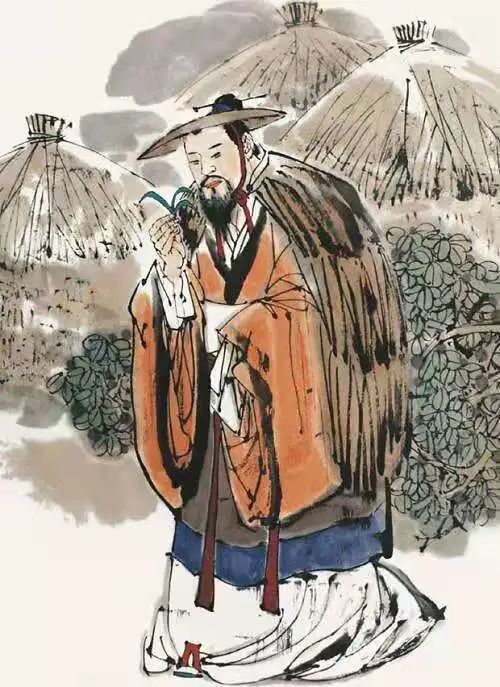
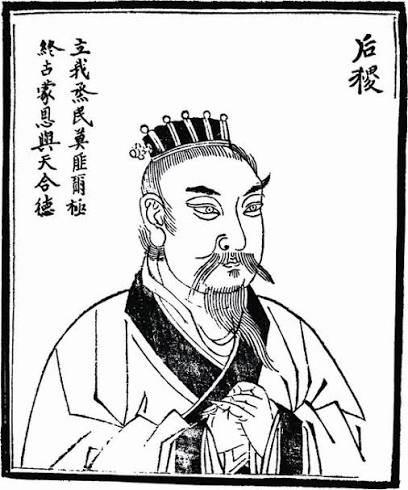
| Later art and cultural memory | A robed sage, farmer or grain-bearing civilizing hero | Later iconography varies and does not preserve one original appearance |
Was Hou Ji a God, an Ancestor or a Human Hero?
He can be described as all three, but each label captures only part of his identity.
As a culture hero, he brings or perfects agriculture. As an ancestor, he stands at the beginning of the Zhou royal lineage. As a deity or sacred recipient, he is honored in rituals connected with grain, dynastic identity and the ruler’s agricultural responsibilities.
Calling Hou Ji the “Chinese god of agriculture” is useful for searchers, but it should not imply that ancient China had one universally recognized agricultural god with a single fixed biography. Chinese traditions include several figures associated with farming, crops, soil, rain, harvests and plant knowledge.
Hou Ji should also not be introduced primarily as a Daoist celestial official. His earliest literary and ritual contexts belong to Zhou ancestral mythology and early state religion, long before organized Daoist traditions developed their later pantheons. Later religious interpretation did not erase those older layers.
Hou Ji in Agricultural and State Ritual
Ritual texts show that Hou Ji’s importance extended beyond narrative. He could be honored as an ancestral figure closely associated with the agricultural work on which the state depended. In early Chinese political thought, rulers were expected to coordinate the calendar, seasonal labor, sacrifice and food production.
Hou Ji therefore represented more than abundance at harvest time. He embodied the origin of cultivated grain, the transmission of farming knowledge and the duty of government to sustain the population. His mythology made agricultural competence a foundation of legitimate rule.
Other divine figures represented different parts of the same environmental system. Yu Shi, the Rain Master, for example, was associated with the rainfall needed by fields. Agricultural religion involved overlapping powers rather than one exclusive divine department.
How Is Hou Ji Shown in Art?
The earliest literary account does not provide a standardized description of Hou Ji’s face, clothing or supernatural attributes. It focuses on conception, survival, crops and sacrifice.
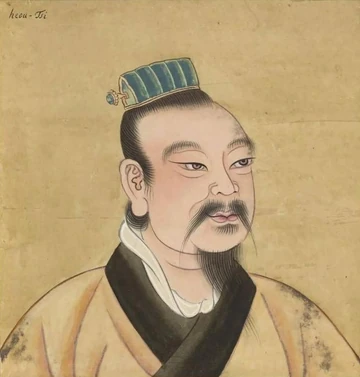
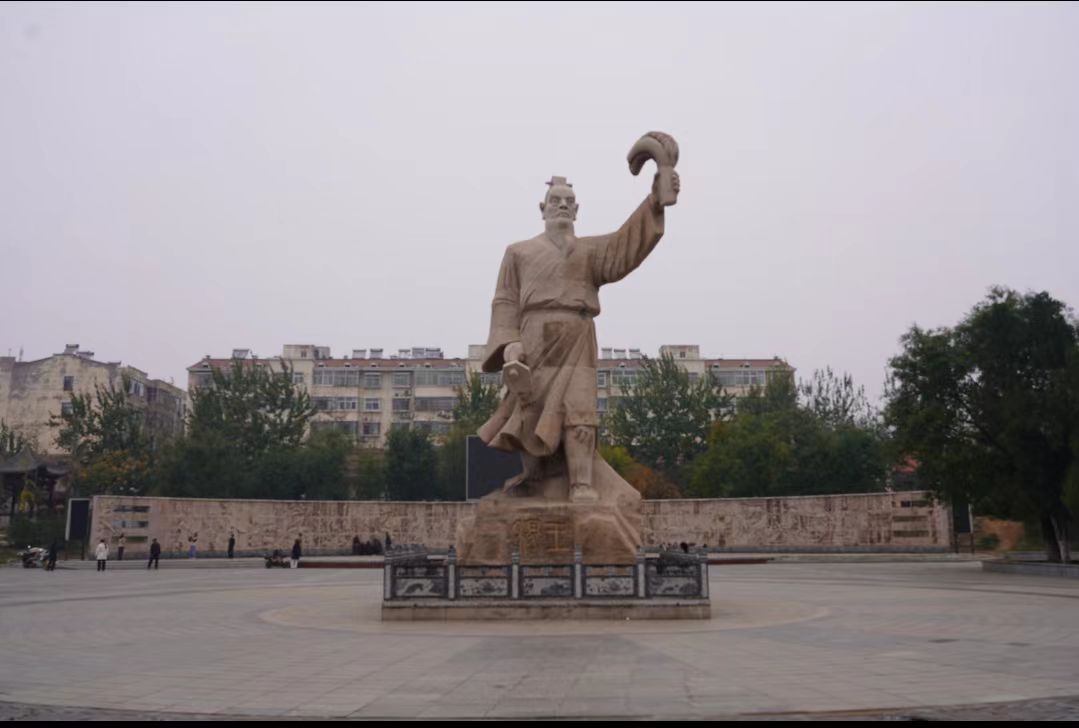
Later portraits usually show him as a dignified ancient ruler or scholar-official. Artists may add stalks of grain, seed, fields or agricultural tools to identify his role. Modern statues often depict him holding a sheaf of grain, turning a complex mythic figure into an immediately recognizable agricultural founder.
Such images are symbolic rather than documentary. Formal robes reflect later conventions for portraying sage rulers and honored ancestors, while grain serves as a visual shorthand for the title Lord of Millet.
Hou Ji and Shennong Are Different Figures
Hou Ji and Shennong are frequently confused because both are associated with agriculture. Their main traditions, however, are not identical.
Shennong, the Divine Farmer, is a wider civilizing figure connected with the beginnings of agriculture, plant knowledge and later traditions of herbal medicine. In some cosmological systems, Shennong is identified with Yandi or the Red Emperor, a relationship discussed in the guide to the Wufang Shangdi and Five Emperors.
Hou Ji is specifically connected with Jiang Yuan’s miraculous conception, millet and grain cultivation, Zhou ancestry and Zhou ritual. Later writers could compare or combine agricultural figures, but readers should not treat Hou Ji and Shennong as automatically interchangeable.
Common Misunderstandings About Hou Ji
Hou Ji was not a verified inventor of farming
His story belongs to mythology, ancestral tradition and ritual history. It gives agriculture a sacred founder but does not replace archaeological evidence for the long development of farming.
The sources do not tell one perfectly uniform story
The early poem emphasizes divine conception and miraculous survival. The later Records of the Grand Historian places Hou Ji within Emperor Ku’s family and an orderly sequence of legendary rulers. These versions are related but should not be collapsed into a single eyewitness account.
“God of agriculture” does not describe his whole identity
Hou Ji is also an ancestral founder, culture hero, ritual recipient and model official. His importance comes from the combination of these roles.
Hou Ji is not Hou Yi
Hou Ji is the Lord of Millet. Hou Yi is the famous archer associated with the myth of the ten suns. Their names use different Chinese characters and their stories are unrelated.
Why Hou Ji Still Matters
Hou Ji expresses a powerful early Chinese idea: stable government begins with the ability to feed people. His mythology connects seed, season, labor, harvest, ritual, ancestry and political legitimacy.
He also demonstrates why Chinese mythology is not best understood as a single fixed pantheon. Hou Ji crosses the boundaries between god, ancestor, hero and official because those categories were never completely separate in the traditions that preserved him.
For readers exploring Chinese mythology stories and ancient legends, his story offers a clear example of how myth can preserve social values without functioning as literal history. Hou Ji’s defining gift is not a magical weapon. It is the knowledge that turns seed into food and agricultural work into a foundation for community.
FAQ About Hou Ji
Who is Hou Ji in Chinese mythology?
Hou Ji is the legendary Lord of Millet, an agricultural culture hero and the ancestral figure of the Zhou royal house. Early and later sources associate him with miraculous birth, grain cultivation and the transmission of farming knowledge.
What does Hou Ji mean?
The name is commonly translated as “Lord of Millet.” The title combines an old term for a lord or ruler with the character 稷, meaning millet or grain.
Who was Hou Ji’s mother?
His mother was Jiang Yuan. In “Sheng Min,” she becomes pregnant after stepping into a divine footprint. The later Records of the Grand Historian also identifies her as the principal wife of Emperor Ku.
Why was Hou Ji called Qi?
Later tradition gives him the name Qi, usually interpreted as “Abandoned.” It refers to the story in which the infant is exposed in several dangerous places but repeatedly survives through extraordinary protection.
Are Hou Ji and Shennong the same god?
No. Both are agricultural culture heroes, but Hou Ji is closely linked with Jiang Yuan, millet and Zhou ancestry. Shennong belongs to a broader group of traditions about agriculture, plant knowledge and herbal medicine.
Was Hou Ji a real historical person?
There is no reliable basis for treating the surviving mythology as a verified personal biography. Hou Ji is best understood as a figure of mythic antiquity, dynastic ancestry and ritual tradition.
References and Further Reading
- Classic of Poetry, “Sheng Min”, Chinese Text Project. The principal early literary account of Jiang Yuan, Hou Ji’s birth, cultivation and sacrifice.
- Records of the Grand Historian, “Basic Annals of Zhou”, Chinese Text Project. A later genealogical and political account of Hou Ji and the Zhou lineage.
- Edwin G. Pulleyblank, “Ji and Jiang: The Role of Exogamic Clans in the Organization of the Zhou Polity”, Early China.
- Anne M. Birrell, Chinese Mythology: An Introduction, Johns Hopkins University Press.
- Lihui Yang, Deming An and Jessica Anderson Turner, Handbook of Chinese Mythology, Oxford University Press.
- Anne Birrell, “From Myth to Pseudohistory”, in Approches critiques de la mythologie chinoise, Presses de l’Universite de Montreal.