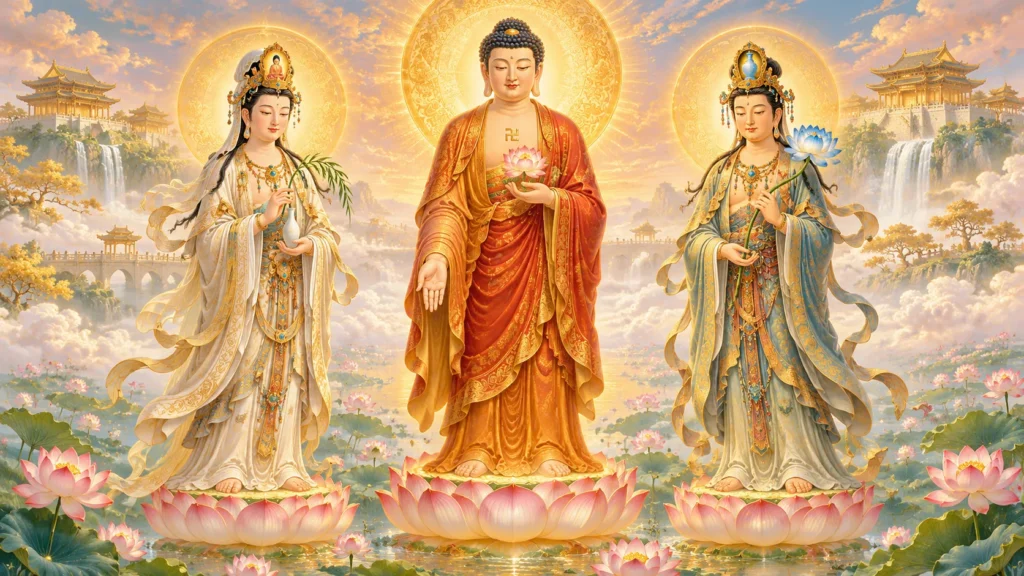
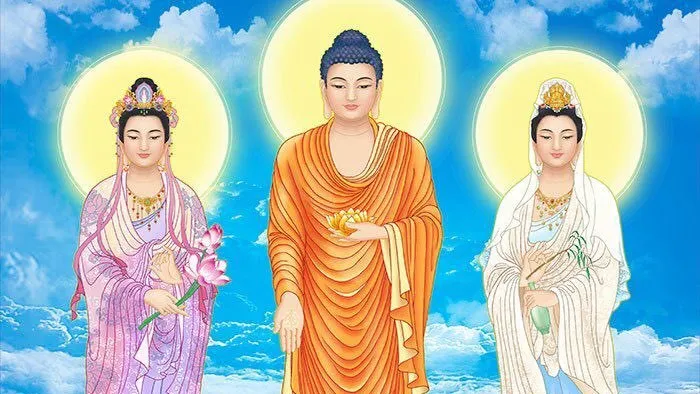
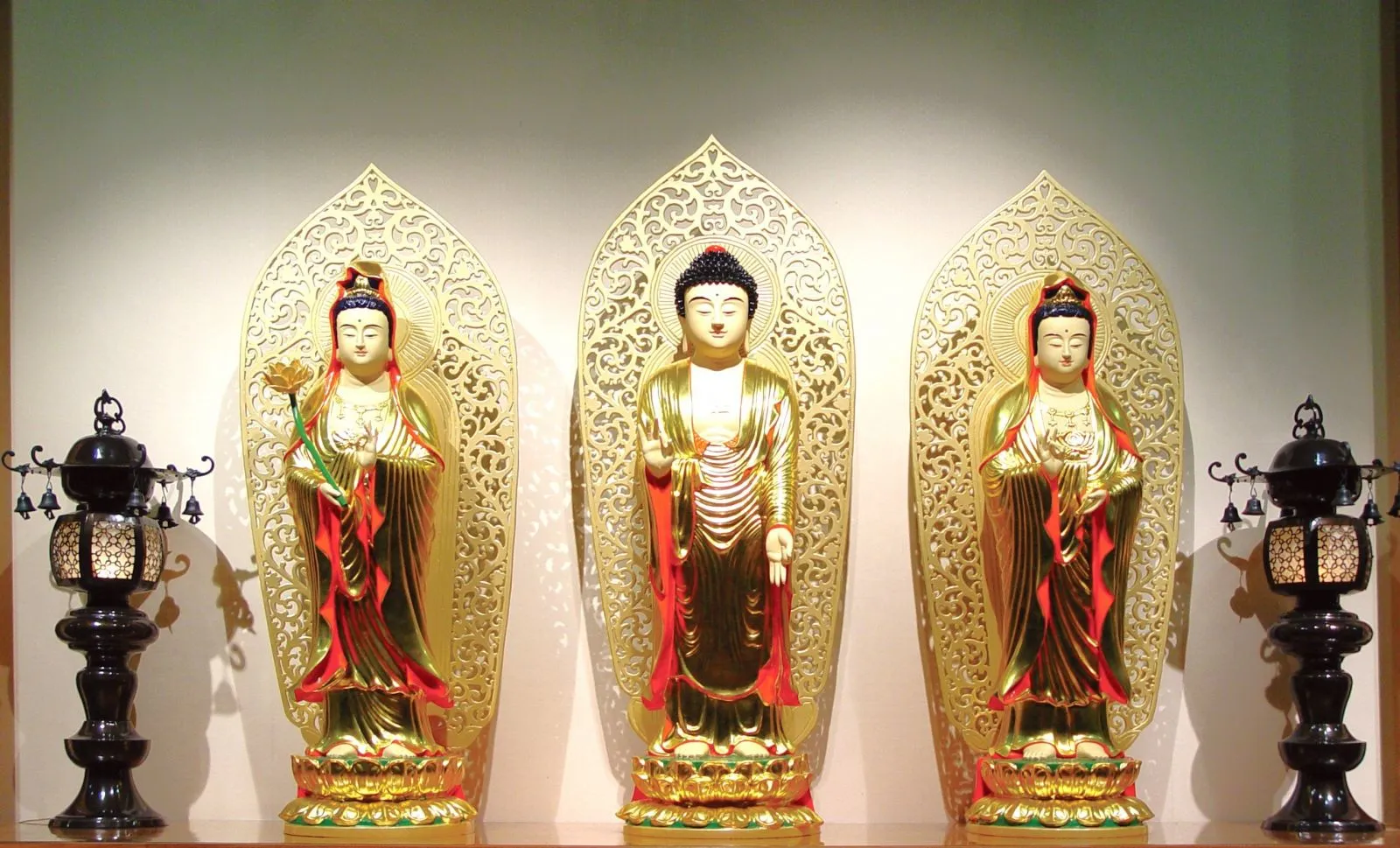
In a Chinese Buddhist temple, you may encounter three serene figures standing or seated together: a Buddha in the center and two richly adorned bodhisattvas beside him. This group is called the Three Saints of the West (西方三圣, Xīfāng Sānshèng). They are among the most recognizable images associated with Pure Land Buddhism.
Who are the Three Saints of the West? They are Amitabha Buddha (阿弥陀佛, Āmítuó Fó), Guanyin (观音菩萨, Guānyīn Púsà; Sanskrit: Avalokiteśvara), and Dashizhi (大势至菩萨, Dàshìzhì Púsà; Sanskrit: Mahāsthāmaprāpta). In Pure Land Buddhist belief, they are associated with compassion, wisdom, and the aspiration to be reborn in Amitabha’s Western Pure Land, Sukhavati.
They are also known as the Amitabha Triad, the Western Pure Land Triad, or the Three Sages of the West. Despite the word “saints,” this is not a group of three buddhas: Amitabha is a buddha, while Guanyin and Dashizhi are bodhisattvas.
Who Are the Three Saints of the West?
The three figures share a place in Pure Land devotion, but each has a distinct identity. Understanding that distinction is the easiest way to read a temple image correctly.
| Figure | Chinese name | Sanskrit name | Principal association |
|---|---|---|---|
| Amitabha Buddha | 阿弥陀佛 (Āmítuó Fó) | Amitābha / Amitāyus | Buddha of the Western Pure Land; infinite light and life |
| Guanyin Bodhisattva | 观音菩萨 (Guānyīn Púsà) | Avalokiteśvara | Compassion and responsiveness to suffering |
| Dashizhi Bodhisattva | 大势至菩萨 (Dàshìzhì Púsà) | Mahāsthāmaprāpta | Wisdom, spiritual strength, and mindfulness |
Amitabha Buddha: The Center of the Triad
Amitabha is the Buddha of Infinite Light. The related name Amitayus means Infinite Life; the two names are closely associated in the Pure Land texts and in Chinese devotion. He is called Amituo Fo in Chinese.
According to the Larger Sutra on Amitayus, Amitabha was once a bodhisattva named Dharmakara who made great vows to establish a realm where beings could pursue awakening under favorable conditions. That realm is Sukhavati, the Western Pure Land. The story belongs to Mahayana Buddhist scripture, rather than to the historical biography of Shakyamuni Buddha.
In a triad, Amitabha normally occupies the central and most prominent position. He may sit in meditation on a lotus throne, stand with one hand raised, or extend a hand in a welcoming gesture. The exact mudra (hand gesture) varies with artistic period and devotional context.
Guanyin: The Bodhisattva of Compassion
Guanyin is the Chinese name most commonly used for Avalokiteshvara, the bodhisattva associated with compassionate attention to the suffering of living beings. In the Western Triad, Guanyin assists Amitabha in the religious imagery of guiding practitioners toward the Pure Land.
Chinese representations of Guanyin often have a feminine appearance, although earlier Indian representations of Avalokiteshvara frequently appear masculine. This historical development is important: Guanyin’s place in the Amitabha Triad comes from Buddhist tradition, while many popular Chinese stories about Guanyin, such as the legend of Miaoshan, developed in different literary and devotional settings.
Dashizhi: The Bodhisattva of Great Strength and Wisdom
Dashizhi, or Mahasthamaprapta, is less familiar to many English-speaking visitors, but he is essential to the traditional triad. His name conveys the idea of having attained great spiritual power. In Chinese Pure Land teaching, he is especially associated with wisdom, concentrated awareness, and the transformative force of remembering the Buddha.
Dashizhi should not be treated as a minor version of Guanyin. The two bodhisattvas have complementary roles: Guanyin prominently expresses compassion, while Dashizhi represents the wisdom and strength that support the path to awakening.
Why Are They Called the Three Saints of the West?
The word West refers to the Western Pure Land, not to Western countries or to an ordinary location that a person could visit. In Pure Land Buddhist cosmology, Sukhavati (极乐世界, Jílè Shìjiè, the World of Ultimate Bliss) is the buddha-field associated with Amitabha.
Devotees seek rebirth there because it is described as an environment especially conducive to hearing the Dharma and progressing toward enlightenment. The Pure Land is sometimes translated as “Western Paradise,” but it should not simply be equated with the Christian idea of heaven. Its place within Buddhist teaching is connected to liberation from the cycle of rebirth.
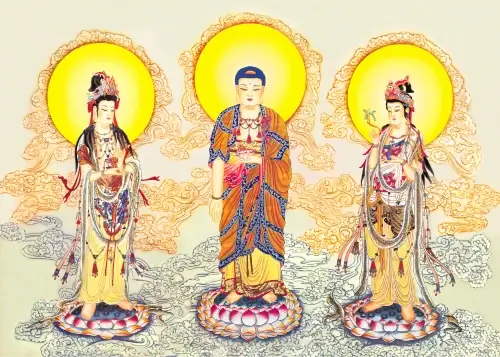
The three figures embody this aspiration together. Amitabha is the Buddha at the heart of the Pure Land, while Guanyin and Dashizhi are the two prominent bodhisattvas who attend him. In traditional images of welcoming the dying, the triad may appear arriving amid clouds and lotus flowers to receive a practitioner.
What Do Buddhist Scriptures Say About the Triad?
The imagery of the Western Three Saints is grounded in Mahayana Buddhist texts, although not every Pure Land sutra gives the same amount of attention to all three figures.
The Larger Sutra on Amitayus (无量寿经)
The Larger Sukhavativyuha Sutra describes Dharmakara’s vows and the Pure Land that becomes associated with Amitabha. It provides much of the doctrinal background for the aspiration to be reborn in Sukhavati and for the role of the bodhisattvas who assist the Buddha.
The Sutra on Contemplation of Amitayus (观无量寿佛经)
The Contemplation Sutra sets out visualizations of the Western Pure Land, including Amitabha and the two attendant bodhisattvas. It helped shape the extraordinarily rich imagery of lotus thrones, radiant bodies, jeweled surroundings, and welcoming assemblies seen in East Asian Buddhist art.
The Smaller Sutra on Amitayus (阿弥陀经)
The Smaller Sukhavativyuha Sutra, often called the Amitabha Sutra, describes Sukhavati and emphasizes faith, aspiration, and recollection of Amitabha. It is one of the principal scriptures recited in Pure Land Buddhist communities, even though its primary focus is the Buddha and his land rather than a detailed visual description of the complete triad.
Scripture and practice are related but not identical. The three-saint image brings together teachings from several texts and centuries of devotional art. Some later ritual details or artistic conventions should not be presented as though every one of them appeared unchanged in a single early sutra.
How to Identify the Three Saints in Buddhist Art
When the triad is clearly labeled, identification is straightforward. When it is not, an art historian looks for a combination of position, clothing, headdresses, and attributes rather than relying only on which side a figure occupies.
The Central Buddha
Amitabha is generally the central, larger, or more prominent image. He wears the robes of a buddha, and may have tightly curled hair, an ushnisha (cranial protuberance), a halo, or a lotus pedestal. His hands may express meditation, teaching, reassurance, or welcome.
The Crown of Guanyin
In many historical sculptures and paintings, Guanyin’s headdress contains a small seated image of Amitabha. This is an important identifying clue. Guanyin may also hold a lotus, a water vessel, or other objects, depending on the specific form and artistic tradition.
The Crown of Dashizhi
Dashizhi is frequently distinguished by a small vase or ritual vessel in the crown. The Metropolitan Museum of Art specifically uses this feature to distinguish Dashizhi from Guanyin in a Tang-dynasty Chinese stele.
Descriptions such as “Amitabha’s left attendant” can be confusing because a figure’s own left is the viewer’s right. Arrangements also vary across cultures and individual works. It is therefore safer to check the identifying attributes before assigning names purely by the viewer’s left or right.
The Three Saints in Chinese Buddhist Temples
Images of the Western Three Saints are especially associated with Pure Land Buddhist practice. They may be found in halls dedicated to Amitabha, on household altars, in memorial contexts, or in paintings depicting the Western Pure Land. However, not every Chinese temple places this triad in its main hall; temple arrangements differ by school, history, and local tradition.
The iconography has deep roots. A sixth-century Chinese stone relief known as the Western Paradise of the Buddha Amitabha, formerly from a cave at Xiangtangshan in Hebei, shows Amitabha in a splendid realm accompanied by Guanyin and Dashizhi. Such works demonstrate that the triad is part of a long East Asian history of religious art, not a modern decorative invention.
As Pure Land practice spread across East Asia, related images appeared in Korea and Japan. In Japanese Buddhism, the corresponding triad is often called Amida Sanzon, with Amida, Kannon, and Seishi. The essential three figures remain recognizable even where artistic styles and ritual emphases differ.
How Do Buddhists Honor the Western Three Saints?
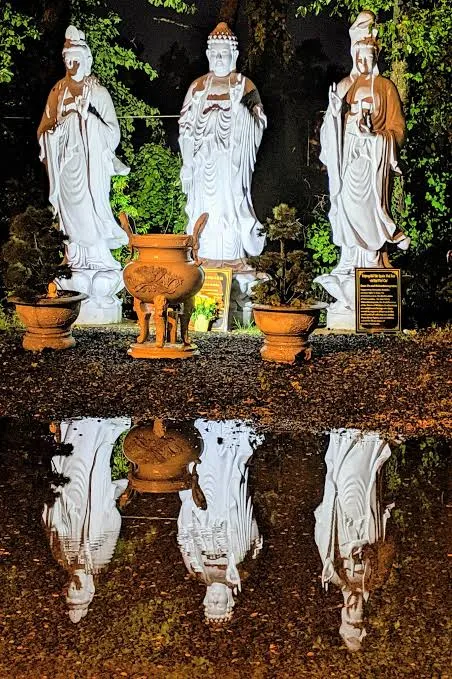
In Chinese Pure Land practice, reciting Amitabha’s name—often as Namo Amituofo (南无阿弥陀佛)—is a familiar expression of devotion. Depending on the community, worship may also include sutra recitation, meditation, prostrations, offerings, ethical conduct, and dedication of merit.
Images of the Western Three Saints are especially meaningful in practices related to death and remembrance. Believers may understand the triad as welcoming a dying practitioner and guiding rebirth in Sukhavati. This is a statement of religious belief, not an empirically verifiable description of what happens after death.
At the same time, the image is not solely about dying. It also reminds living practitioners of three complementary dimensions of Buddhist life: aspiration toward awakening, compassionate action, and wisdom.
Are the Western Three Saints the Same as Other Buddhist Triads?
No. Chinese Buddhist art contains many three-figure arrangements. For example, the Eastern Three Saints commonly feature Medicine Buddha (Yaoshi Fo) with the bodhisattvas Sunlight (Riguang) and Moonlight (Yueguang). Other images show Shakyamuni with different attendant bodhisattvas. A grouping of three statues is therefore not automatically the Amitabha Triad.
The Western Three Saints should also not be confused with the Three Pure Ones (三清), the highest triad in many Daoist traditions. Despite occasional overlap in Chinese popular religious settings, these are fundamentally different religious groupings. For a broader explanation, see our guide to Buddhist influence on Chinese mythology.
Frequently Asked Questions
Who is in the Three Saints of the West?
Amitabha Buddha stands at the center, accompanied by Guanyin (Avalokiteshvara) and Dashizhi (Mahasthamaprapta). The group is also called the Amitabha Triad.
Are the Three Saints of the West three buddhas?
No. Amitabha is a buddha; Guanyin and Dashizhi are bodhisattvas. The word “saints” is an English rendering of the Chinese name, not a precise statement that all three have the same Buddhist status.
Why is Amitabha associated with the west?
Pure Land scriptures describe his buddha-field, Sukhavati, as lying in the western direction. It is a religious and cosmological concept rather than a geographical destination.
Which bodhisattva wears a small Buddha in the crown?
That is usually Guanyin. Dashizhi more commonly has a small vase in the crown, although attributes and artistic conventions can vary.
Is Guanyin the same as Avalokiteshvara?
Yes. Guanyin is the Chinese form of Avalokiteshvara, the bodhisattva of compassion. The figure’s artistic appearance and popular narratives developed in distinctive ways in China.
Is the Three Saints of the West tradition only Chinese?
No. Related Amitabha triads appear across East Asian Buddhism, notably in Korea and Japan. The Chinese name Xifang Sansheng is particularly associated with Chinese Buddhist culture.
What the Three Saints Represent
The lasting importance of the Three Saints of the West comes from the way a complex Buddhist teaching becomes immediately visible. Amitabha stands for the aspiration toward liberation through the Western Pure Land; Guanyin expresses compassion toward suffering beings; and Dashizhi represents the wisdom and spiritual resolve that sustain practice. Together, they are a central expression of Pure Land devotion and a valuable key to understanding the religious art of Chinese Buddhist temples.
If you are exploring similar figures, our guide to Sanskrit names of Chinese Buddhist deities explains how Buddhist identities changed as their names and images moved from India into China.
References and Further Reading
BDK America. The Three Pure Land Sutras. English translation by Hisao Inagaki, with Harold Stewart, 2003. https://www.bdkamerica.org/product/the-three-pure-land-sutras/
The Metropolitan Museum of Art. Stele with the Bodhisattvas Avalokiteshvara (Guanyin) and Mahasthamaprapta (Dashizi). Collection 44798. https://www.metmuseum.org/art/collection/search/44798
Smithsonian National Museum of Asian Art. Diving Deeper into Buddhism: Western Paradise, educational resource discussing the Northern Qi relief of Amitabha’s Western Paradise, Xiangtangshan.
Dharma Drum Mountain. Three Saints of the Western Pure Land. Global website, special topics. https://www.dharmadrum.org/portal_d8_cnt_page.php?cnt_id=298&folder_id=64&up_page=1