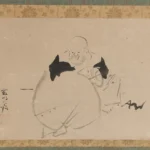
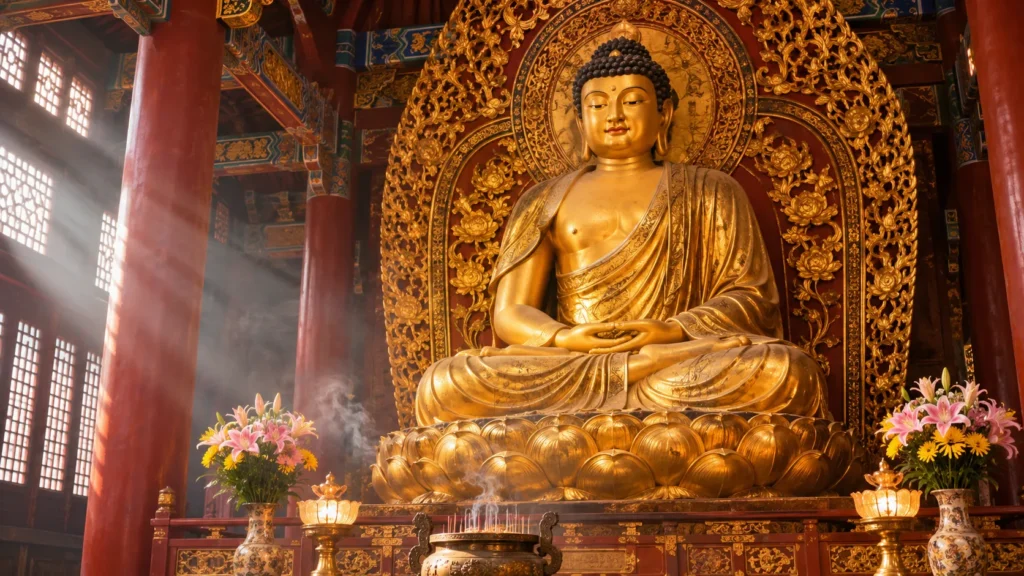
A visitor entering a traditional Chinese Buddhist temple may first meet a smiling, round-bellied figure near the entrance. Farther inside, the main hall often presents a very different image: a serene Buddha, seated in formal robes before an altar. In many temples, this central figure is Shakyamuni Buddha (释迦牟尼佛, Shìjiāmóuní Fó)—the historical Buddha whose teachings gave rise to Buddhism.
Yet identifying a statue is not always as simple as looking for the largest golden figure. Chinese Buddhist halls contain different images, and their arrangements reflect distinct teachings and devotional traditions. Understanding who Shakyamuni is, where he appears, and what his gestures mean makes these temples easier to read.
In brief: Shakyamuni is the Buddha associated with Siddhartha Gautama, the historical teacher from ancient India. He is frequently enshrined in a Chinese temple’s main Buddha hall, often called the Dàxióng Bǎodiàn (大雄宝殿). He may appear alone, beside two disciples, or among other Buddhas. His identity is best established through the temple’s labels, the surrounding figures, and the iconography—not the statue’s size or golden color alone.
Who Is Shakyamuni Buddha?
The name Śākyamuni means “sage of the Śākya clan.” It is a title of Siddhartha Gautama, the teacher whom Buddhists honor as the Buddha, or “awakened one.” Scholars debate his precise dates, but he lived in ancient northern India, centuries before Buddhism reached China.
In Buddhist accounts, Siddhartha left the privileges of his earlier life to confront the problems of suffering, aging, sickness, and death. After years of spiritual searching, he attained awakening and taught a path centered on ethical conduct, meditation, and wisdom. The Four Noble Truths and the Noble Eightfold Path are among the foundational teachings associated with him.
In Chinese, his name is written 释迦牟尼佛 (simplified) or 釋迦牟尼佛 (traditional). The characters primarily represent the sound of his Sanskrit name; they are not a story about a Chinese deity. Fó (佛) means “Buddha.” See our guide to Sanskrit names of Chinese Buddhist figures for more examples of this translation process.
Where Is Shakyamuni Buddha Found in Chinese Temples?
The Mahavira Hall: Dàxióng Bǎodiàn (大雄宝殿)
In many traditional Han Chinese Buddhist monasteries, the principal worship space is the Mahavira Hall, commonly translated as the “Great Hero Hall.” Its Chinese name, Dàxióng Bǎodiàn, honors the Buddha’s spiritual courage in overcoming ignorance and awakening to reality. This is generally the place to look first for a major Shakyamuni image.
The main hall may include one large statue or several images arranged behind a ceremonial altar. Lamps, flowers, fruit, incense vessels, and ritual instruments often surround them. The hall is not merely an exhibition space: monks, nuns, and lay Buddhists gather there for chanting, bows, offerings, and other religious services.
Not every temple follows the same architectural plan. A small neighborhood temple may have a single shrine room, while a large monastery can have separate halls dedicated to Amitabha, Guanyin, the Medicine Buddha, or other revered figures. The name of the hall and any inscriptions are stronger evidence than assumptions based on a standard floor plan.
From the Entrance Hall to the Main Shrine
In a common layout, visitors pass through a gate and a Hall of Heavenly Kings (天王殿, Tiānwáng Diàn) before reaching the central Buddha hall. The cheerful figure at the entrance is frequently Budai, the Chinese monk later identified with Maitreya, the future Buddha. He is not Siddhartha Gautama.
Armored statues in the entrance hall often represent the Four Heavenly Kings, protectors of the Buddhist teaching. Beyond them, Shakyamuni’s calmer image directs attention to awakening, rather than protection or worldly good fortune. The sequence of halls is meaningful, although buildings and local customs vary.
How Can You Recognize a Shakyamuni Buddha Statue?
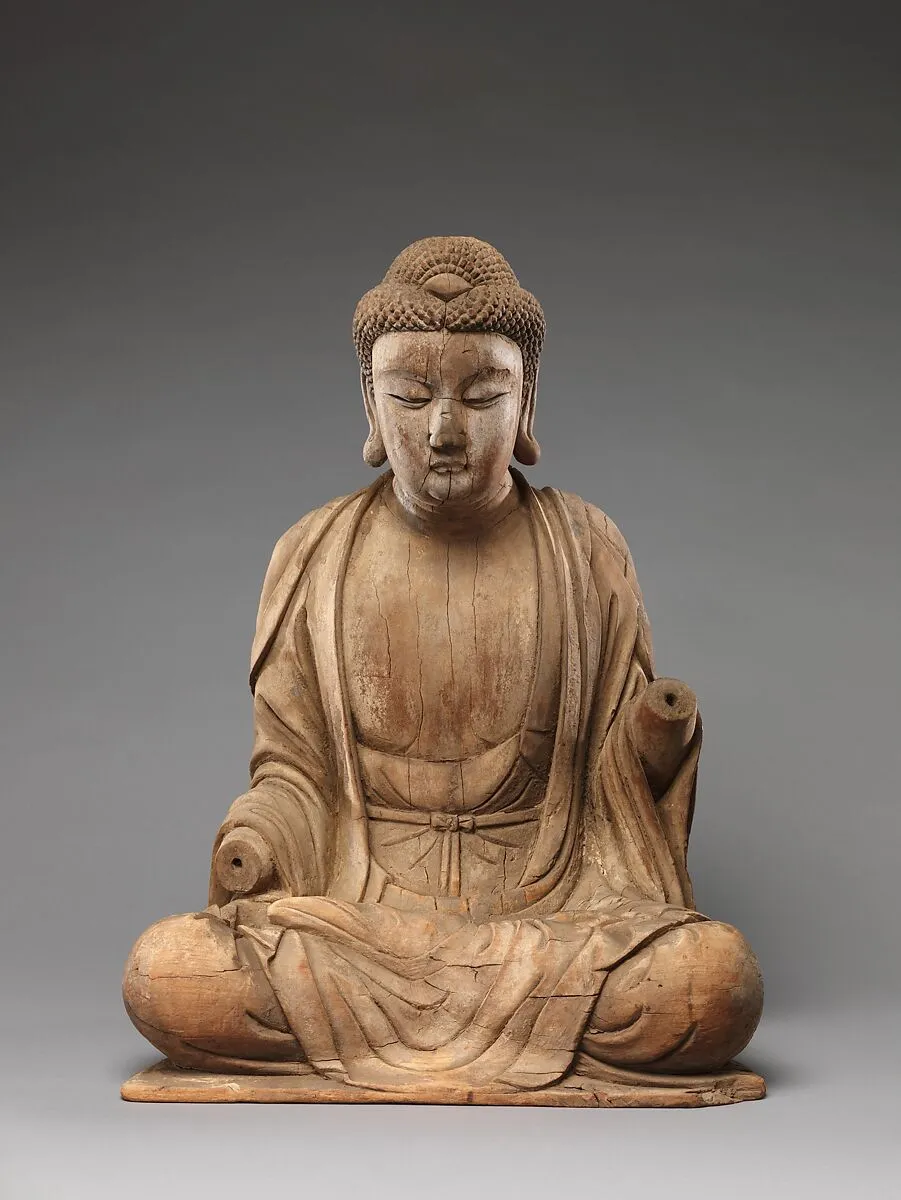
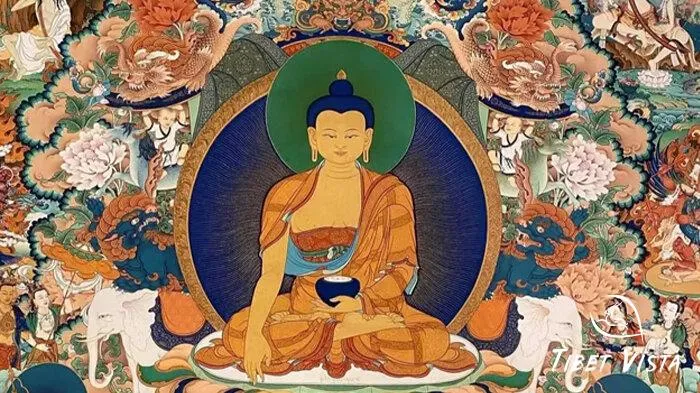
Chinese artists inherited Buddhist visual conventions from India and Central Asia, then adapted them into local styles. Shakyamuni is often shown with a monastic robe, elongated earlobes, a calm expression, curled or patterned hair, and a raised feature on the crown of the head called the uṣṇīṣa. The raised feature symbolizes spiritual knowledge in Buddhist art.
These features are shared by many Buddha images. No single hairstyle, color, or seated posture conclusively identifies Shakyamuni. Hand gestures, called mudras, can offer more specific clues:
- Earth-touching gesture (bhūmisparśa mudrā): one hand reaches down toward the earth, recalling the Buddha’s awakening and the earth as witness. This gesture is strongly associated with Shakyamuni, but it can also occur in images of other Buddhas.
- Meditation gesture (dhyāna mudrā): the hands rest in the lap, expressing concentration and inward stillness. It is common in Buddhist art, not exclusive to Shakyamuni.
- Teaching gestures: hand positions near the chest or with raised fingers may refer to preaching and transmitting the Dharma. Their exact form varies across periods and schools.
Look at the complete group before making an identification. A central Buddha with two plainly dressed monks tells a different story from one surrounded by richly ornamented bodhisattvas. The temple’s Chinese name plaques, interpretive panels, and ritual context often settle ambiguities that posture alone cannot.
Why Are There Sometimes Three Buddha Statues?
Three statues in the main hall do not always represent the same three beings. Different arrangements express different religious ideas. The most useful distinction is between three Buddhas, three ages, and a Buddha with two attendants.
| Arrangement | Figures commonly represented | What it emphasizes |
|---|---|---|
| Shakyamuni with Amitabha and the Medicine Buddha | Śākyamuni (释迦牟尼佛), Amitābha (阿弥陀佛), Bhaiṣajyaguru (药师佛) | The historical Buddha alongside other Buddhas associated with different realms and devotional aims |
| Buddhas of the Three Ages | Dīpaṃkara (燃灯佛), Shakyamuni, and Maitreya (弥勒佛) | Buddhahood across past, present, and future |
| Shakyamuni with two disciples | Shakyamuni with Mahākāśyapa (迦叶) and Ānanda (阿难) | The teacher and the transmission of his teachings through the monastic community |
| Shakyamuni with bodhisattvas | For example, Mañjuśrī (文殊) and Samantabhadra (普贤) | Wisdom, practice, and the wider teachings of Mahayana Buddhism |
These are documented traditions, not an exhaustive catalog. Temple arrangements have evolved over centuries, and the names “Three Buddhas” or “Buddha triad” alone do not establish which figures stand on a particular altar. A fifteenth-century three-Buddha group documented at Beijing’s Zhihua Temple, for instance, represents the Buddhas of the Three Ages; other Chinese temple guides describe Shakyamuni appearing between Amitabha and the Medicine Buddha.
Do not identify the side figures simply by saying “the one on the left” or “the one on the right.” That can be ambiguous because a description might use the worshipper’s perspective or the statue’s own right and left. Inscriptions and a temple-specific guide are more reliable.
Shakyamuni, Amitabha, Medicine Buddha, and the Laughing Buddha: What’s the Difference?
Chinese Buddhism recognizes multiple Buddhas. Although popular English sometimes uses “the Buddha” for any Buddha statue, the figures are not interchangeable.
| Figure | Chinese name | Principal association |
|---|---|---|
| Shakyamuni | 释迦牟尼佛 | The historical Buddha, awakening, and the teaching of the Dharma |
| Amitabha | 阿弥陀佛 | The Buddha of Infinite Light and the Western Pure Land |
| Medicine Buddha | 药师佛 | Healing aspirations, vows, and the Eastern Pure Land in Mahayana tradition |
| Budai / Laughing Buddha | 布袋 / 弥勒佛 (in popular temple identification) | A Chinese monk associated with Maitreya, the future Buddha; not Shakyamuni |
Some Medicine Buddha images hold a small vessel associated with medicine, while Amitabha has distinctive Pure Land iconography in certain settings. But artistic attributes overlap. Even a highly recognizable-looking statue should be interpreted in the context of its shrine.
The Laughing Buddha requires special care because the English name encourages confusion. To trace the Chinese monk’s identification with Maitreya, read our article on Budai, Maitreya, and the Laughing Buddha.
Shakyamuni in Chinese Buddhist Art: Teaching, Awakening, and Nirvana
Not every image of Shakyamuni presents a motionless seated teacher. Chinese Buddhist art also depicts episodes from his religious biography: his departure from ordinary life, his awakening beneath the bodhi tree, his teaching, and his final passing into parinirvana.
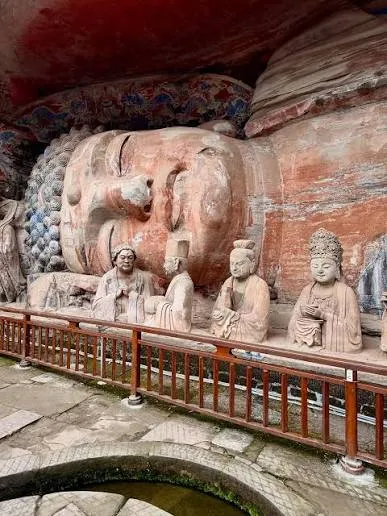
One striking example appears at the Dazu Rock Carvings in Chongqing, where the monumental reclining Buddha at Baodingshan evokes Shakyamuni’s final nirvana. This is not an ordinary altar statue in a main hall. It is a large narrative relief, integrated into a sacred landscape and surrounded by attendant figures.
Early Chinese Buddhist sculpture also shows how religious art changed when Buddhism moved across Asia. Surviving images from the Northern and Southern Dynasties, Sui, and Tang periods demonstrate adaptations in robes, facial features, stone carving, and bronze casting. Museum collections make it possible to compare those changes without assuming that modern temple statues have always looked the same.
How Is Shakyamuni Honored in Chinese Buddhist Temples Today?
For practicing Buddhists, a Shakyamuni statue is more than a historic portrait. It offers a focus for remembering the Buddha’s teachings and cultivating the qualities those teachings describe. Depending on the monastery, visitors may see chanting services, offerings, seated meditation, or people bowing before the altar.
Flowers can recall impermanence, lamps can symbolize wisdom, and incense may be associated with ethical and mental purification. Bowing is commonly understood as a gesture of respect and humility, not evidence that Shakyamuni is a creator god in the way some religious traditions understand divinity.
Visitors who do not practice Buddhism can still engage respectfully. Keep conversations quiet, follow local guidance about photography, avoid blocking ceremonies, and observe any signs about footwear or where to stand. Participation in bows or chanting is not required to appreciate the hall’s cultural and religious significance.
Shakyamuni Beyond China: A Useful Comparison
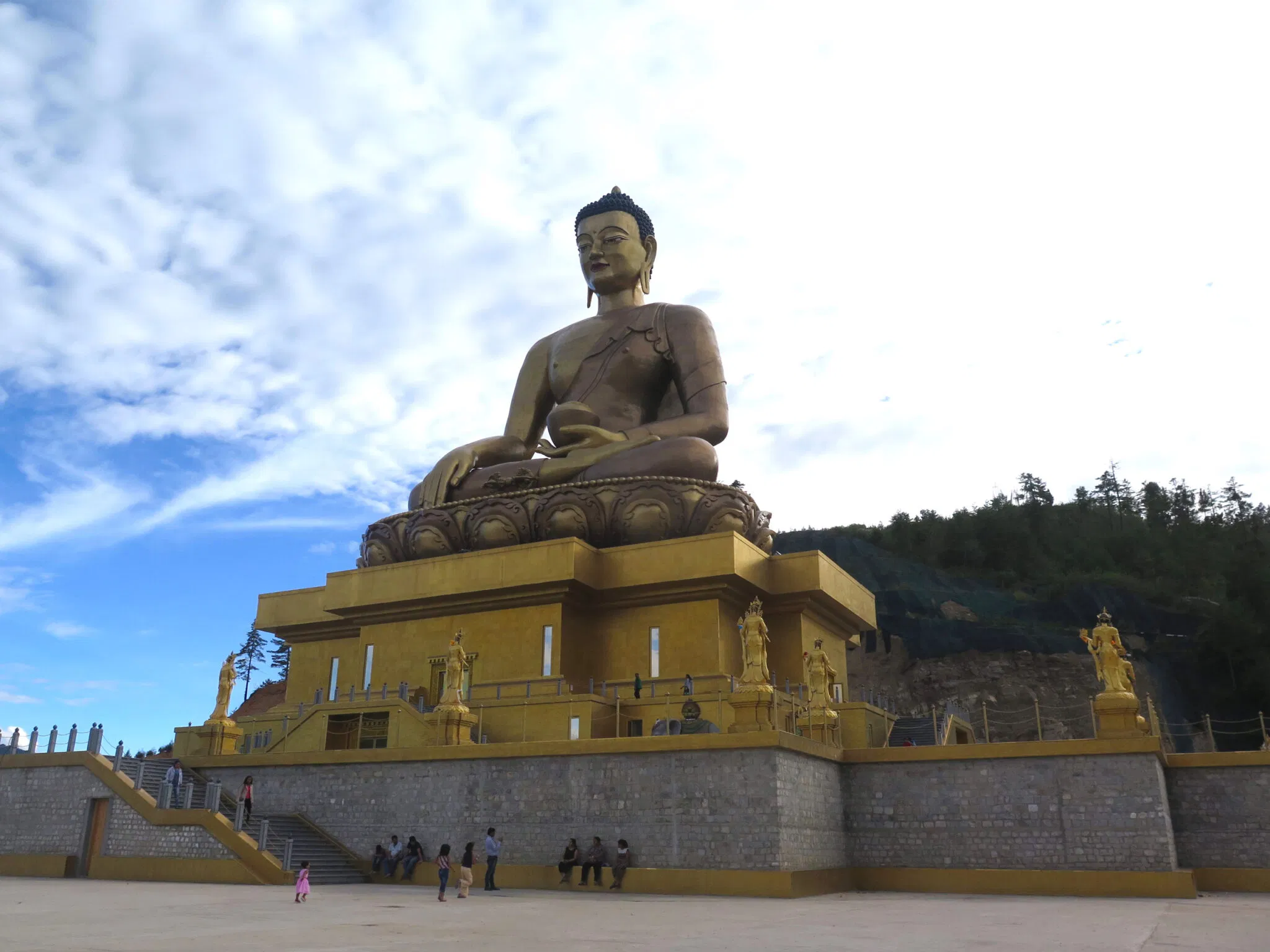
Shakyamuni is revered throughout the Buddhist world, but artistic styles differ substantially. The monumental Buddha Dordenma in Thimphu, Bhutan, for example, depicts Shakyamuni seated above an expansive outdoor platform. It belongs to Bhutan’s Himalayan Buddhist setting and should not be mistaken for a Chinese Mahavira Hall.
What connects these different traditions is their reverence for the Buddha and his awakening. What distinguishes them is the religious setting, the sculptural style, and the local history through which Buddhist teachings took shape.
Frequently Asked Questions
Is Shakyamuni Buddha the same as Gautama Buddha?
Yes. Shakyamuni is a title meaning “sage of the Śākya clan,” while Gautama or Siddhartha Gautama identifies the historical teacher associated with the founding of Buddhism.
Which Buddha is in the main hall of a Chinese temple?
Shakyamuni is frequently the central figure in the Mahavira Hall, but the arrangement depends on the temple. Some main halls contain multiple Buddhas, and other halls may be dedicated to Amitabha, the Medicine Buddha, or another figure.
Why do Chinese temples have three Buddhas?
There is no single explanation. A group may represent Shakyamuni, Amitabha, and the Medicine Buddha, or the Buddhas of past, present, and future. Some apparent three-figure arrangements actually show one Buddha with two disciples or bodhisattvas.
Is Shakyamuni the same as the Laughing Buddha?
No. Shakyamuni is the historical Buddha of ancient India. The familiar Laughing Buddha is Budai, a Chinese monk later associated with Maitreya, the future Buddha.
What does Shakyamuni’s earth-touching gesture mean?
It recalls the moment of the Buddha’s awakening, when the earth is invoked as witness to his spiritual achievement. The gesture is an important clue, but it is not exclusive to Shakyamuni in all Buddhist artistic traditions.
Is Shakyamuni worshipped as a Chinese god?
Shakyamuni is deeply revered in Chinese Buddhism, but he was not originally a Chinese god. He is the historical Buddha, a teacher understood to have attained awakening. Buddhist devotional practice and later Chinese religious culture can be complex, so it is better to describe his role precisely than to call him simply a god.
Why Shakyamuni Remains Central to Chinese Buddhism
Chinese Buddhist temples contain a remarkable variety of sacred images, yet Shakyamuni provides a historical and religious point of reference for understanding them. Amitabha, the Medicine Buddha, Maitreya, Guanyin, and other figures appear within traditions shaped by Buddhist scriptures, practice, and centuries of artistic development.
When standing before a Buddha image in a Chinese temple, the most rewarding question is not only “Which Buddha is this?” but also “What teaching does this image express, and why is it placed here?” Reading the hall, the attendants, the hand gestures, and the inscriptions together offers a fuller answer.
References and Further Reading
- Hsing Yun. Visiting a Buddhist Temple. Fo Guang Shan International Translation Center, 2019 edition. Sections on temple layout, main shrines, and etiquette.
- National Museum of Asian Art, Smithsonian Institution. Promise of Paradise: Early Chinese Buddhist Sculpture. Exhibition overview.
- University of Chicago, Center for the Art of East Asia. Beijing Zhihua Temple collection documentation, especially the Buddha triads of Zhihua Hall.
- The Metropolitan Museum of Art. Buddha Shakyamuni with Attendant Bodhisattvas (object 34.26.1a, b–.3a, b), Southern Song–Yuan dynasty.
- Smarthistory. The Art of Salvation—Mt. Baoding, Dazu Rock Carvings. Discussion of the monumental nirvana relief.