Fu Lu Shou: The Three Star Gods of Blessings, Rank, and Longevity
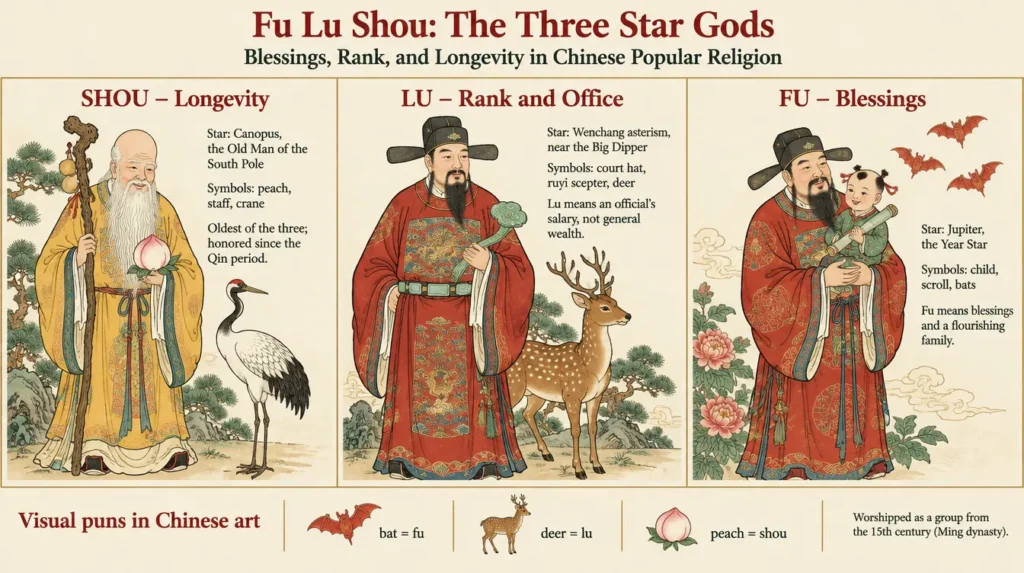
Fu Lu Shou (福禄寿, Fú Lù Shòu) are three star gods of Chinese popular religion: Fuxing, who grants blessings and good fortune; Luxing, who grants official rank and the income that comes with it; and Shouxing, who grants long life. Together they are called the Sanxing (三星, Sānxīng), the “Three Stars.” Each is linked to a different celestial body, and the three were worshipped as a group only from about the fifteenth century, although the longevity star is far older.
The same three syllables also work as a plain phrase. Written on a scroll, a cake box, or a shop sign, “fu lu shou” is a wish for a good life and does not have to refer to the gods at all. This guide covers both uses: the three words and the three figures.
| Star god | Chinese | What he grants | Celestial link | How to recognize him |
|---|---|---|---|---|
| Fuxing | 福星, Fúxīng | Blessings, good fortune, a flourishing family | Jupiter, the “Year Star” | Official’s robe; often a child, a scroll, or a ruyi scepter; bats nearby |
| Luxing | 禄星, Lùxīng | Rank, office, salary, career success | A star of the Wenchang asterism in Ursa Major | Court dress and official’s hat; ruyi scepter or a child; a deer nearby |
| Shouxing | 寿星, Shòuxīng | Long life | Canopus, the “Old Man of the South Pole” | High domed forehead, white beard, staff, peach; a crane or deer nearby |
What Fu, Lu, and Shou Mean
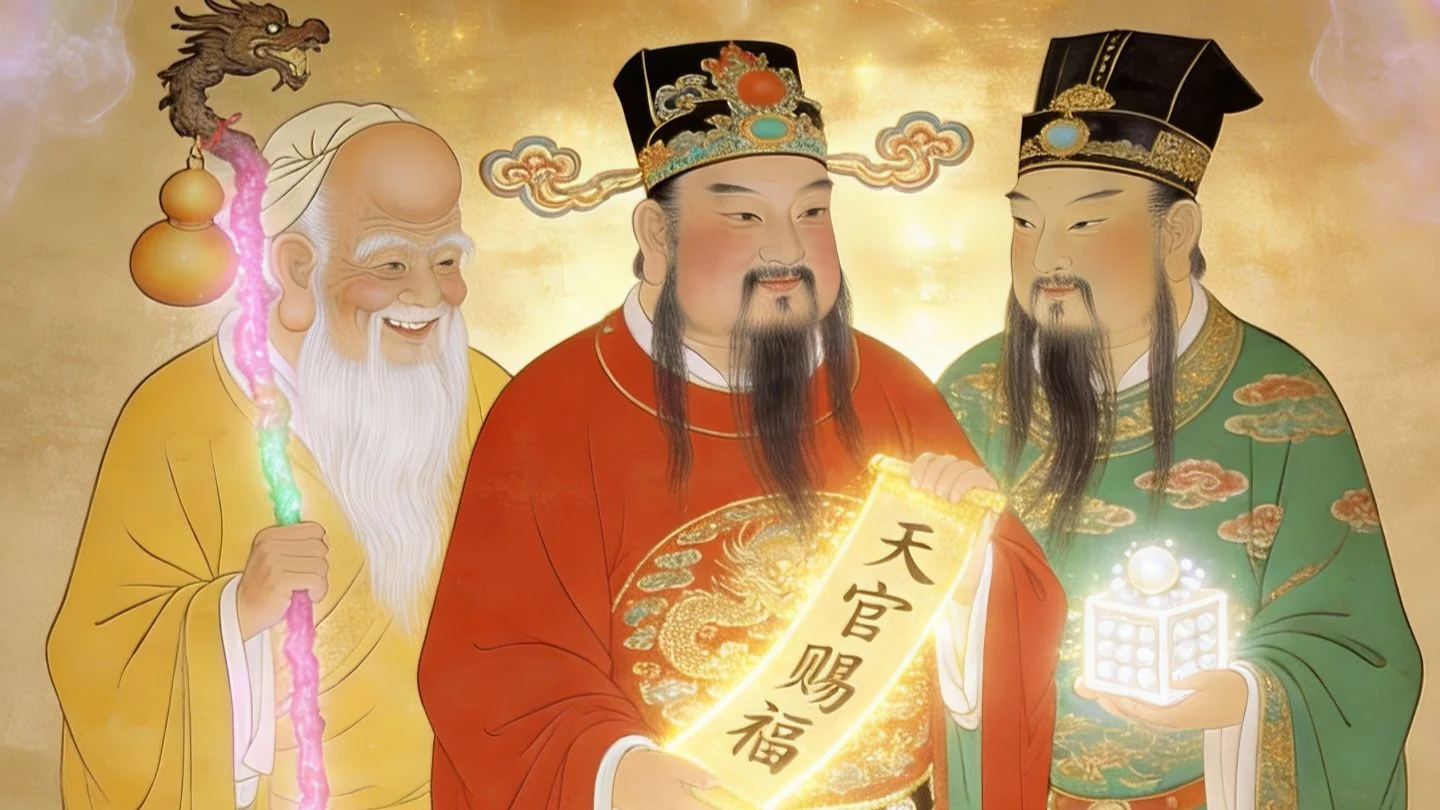
Fu (福) is usually translated “happiness” or “luck,” but both are narrower than the Chinese word. Fu covers blessings in a broad sense: a household that is safe, fed, and growing. This is the character pasted on doors at the Lunar New Year.
Lu (禄) is the hardest of the three to translate. It originally referred to the salary or emolument of a government official, and by extension to the rank that earned it. English labels such as “prosperity” or “wealth” hide that link to office. In a society where the civil service examinations were the main route to status, lu meant a successful career, with income as its result.
Shou (寿) means longevity: a long life lived to its natural end. The character appears in dozens of decorative forms on textiles, ceramics, and birthday gifts.
Because lu is about rank, Luxing should not be confused with Caishen. The Chinese god of wealth, Caishen, is a separate figure with his own stories and festival days.
From Three Stars to Three Gods
The three figures began as objects in the sky. Chinese astronomers and court ritualists watched Jupiter, the stars around the Big Dipper, and a bright southern star long before anyone carved the familiar statues. The evidence for each is uneven, and the grouping came late.
The longevity star has the longest record. Sacrifices to the Star of Longevity are attested for the Qin period in the third century BCE, and the star was associated with peace in the realm when it was visible. The other two have no comparable early cult as gods.
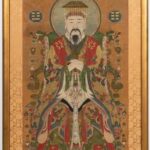
As a set of three, Fu Lu Shou belong to the Ming dynasty. Their worship as a group appears to have begun in the fifteenth century. One of the earliest known images is a hanging scroll dated 1454, now in the Musée Guimet in Paris, which shows the three as star lords in Daoist priestly dress holding court tablets. The earliest known literary source is a play for the New Year festival, printed about a decade before that painting, in which the three stars descend to grant the blessings in their names. Both sources are connected with the imperial family, which suggests the cult spread from the top of society downward.
The three are often labeled Daoist, and they do appear in Daoist temples and paintings. No scripture in the Daoist Canon is devoted to them, however, and they seem to have grown up as popular gods outside the formal Daoist system. They are a different kind of group from the Three Pure Ones, who stand at the head of Daoist theology. One explanation of the triad’s shape links it to an older Daoist set, the Three Officials of Heaven, Earth, and Water, whose Heavenly Official was believed to bestow good fortune.
Fuxing, the Star of Blessings
Fuxing (福星, Fúxīng) is identified with the planet Jupiter, known in Chinese astronomy as the Year Star (岁星, Suìxīng). He overlaps heavily with the Heavenly Official (天官, Tiānguān), and many prints of “the Heavenly Official bestowing blessings” show the same figure.
Later tradition gave the star a human past. A Ming compendium of gods identifies the god of fortune with Yang Cheng (杨成, Yáng Chéng), an official of Daozhou in present-day Hunan. In the story, the court demanded short-statured people from the district as entertainers, and Yang Cheng persuaded the emperor to end the practice. Grateful locals honored him as a bringer of fu. Sources disagree on when he lived, placing him anywhere from the Han to the Tang, so the account is best read as a legend of deification, not a biography.
In art Fuxing wears the robe of a high official. He may hold a child, a scroll, or a ruyi scepter, and children often crowd around him, since descendants were counted among the chief blessings.
Luxing, the Star of Rank
Luxing (禄星, Lùxīng) is linked to the Wenchang asterism, six stars near the Big Dipper in the region Western astronomy calls Ursa Major. That asterism was believed to govern access to office, which is why Luxing sits close to Wenchang, the patron of literature and examinations. The two are related through the same stars but are treated as separate figures.
Luxing’s human identity is even less settled than Fuxing’s. Some traditions identify him with Zhang Xian (张仙, Zhāng Xiān), an immortal from Sichuan in the Five Dynasties period who was also prayed to for sons. Others name Shi Fen, a Han dynasty official who rose to high position under Emperor Jing in the second century BCE. No single account became standard.
He is shown in court dress with an official’s hat and belt. He may carry a ruyi scepter or hold a small boy, the child standing for sons who will go on to pass the examinations.
Shouxing, the Star of Longevity
Shouxing (寿星, Shòuxīng) is the star Canopus, called in Chinese the Old Man of the South Pole (南极老人, Nánjí Lǎorén). Canopus is the second-brightest star in the night sky, but from northern China it stays close to the southern horizon and is seen only briefly. Its appearance was read as a sign of peace. The name Shouxing was also used in early astronomy for a region of sky around the lunar lodges Horn and Neck, so the term did not always point to a single star.
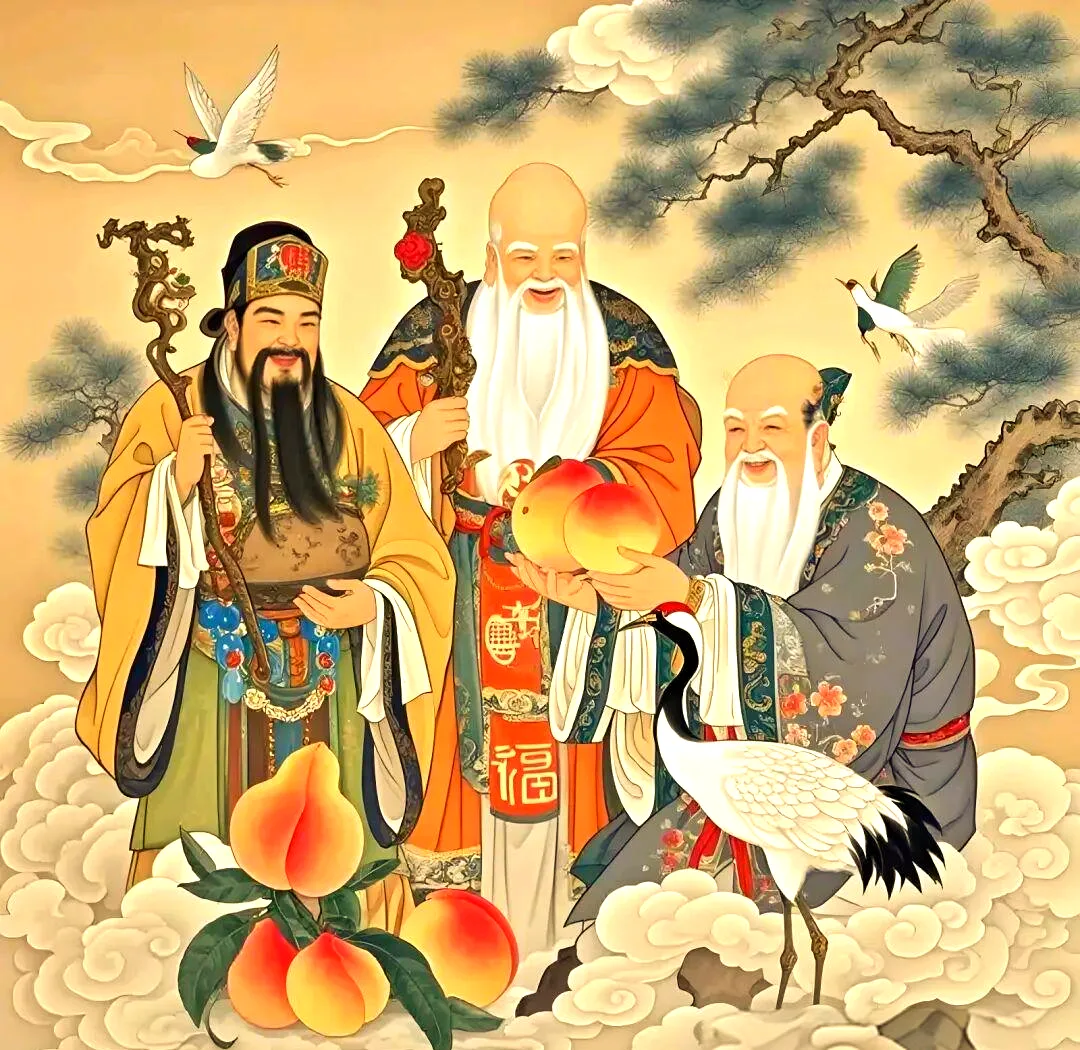
He is the easiest of the three to recognize: an old man with a very high, domed forehead and a long white beard, leaning on a staff and holding a peach. A crane or a deer often accompanies him. The peach refers to the fruit of immortality grown in the orchard of Xiwangmu, the Queen Mother of the West.
Shouxing is also the member of the trio most often shown alone, especially on birthday gifts for older relatives. For his separate history and legends, see the full guide to Shouxing, the Chinese god of longevity.
How to Tell the Three Apart
Start with Shouxing. The forehead, the peach, and the staff settle his identity immediately. The other two are both bearded men in official dress, and their attributes are less fixed than popular guides suggest. Museum descriptions of similar prints sometimes give the child to Fuxing and sometimes to Luxing.
Three things help:
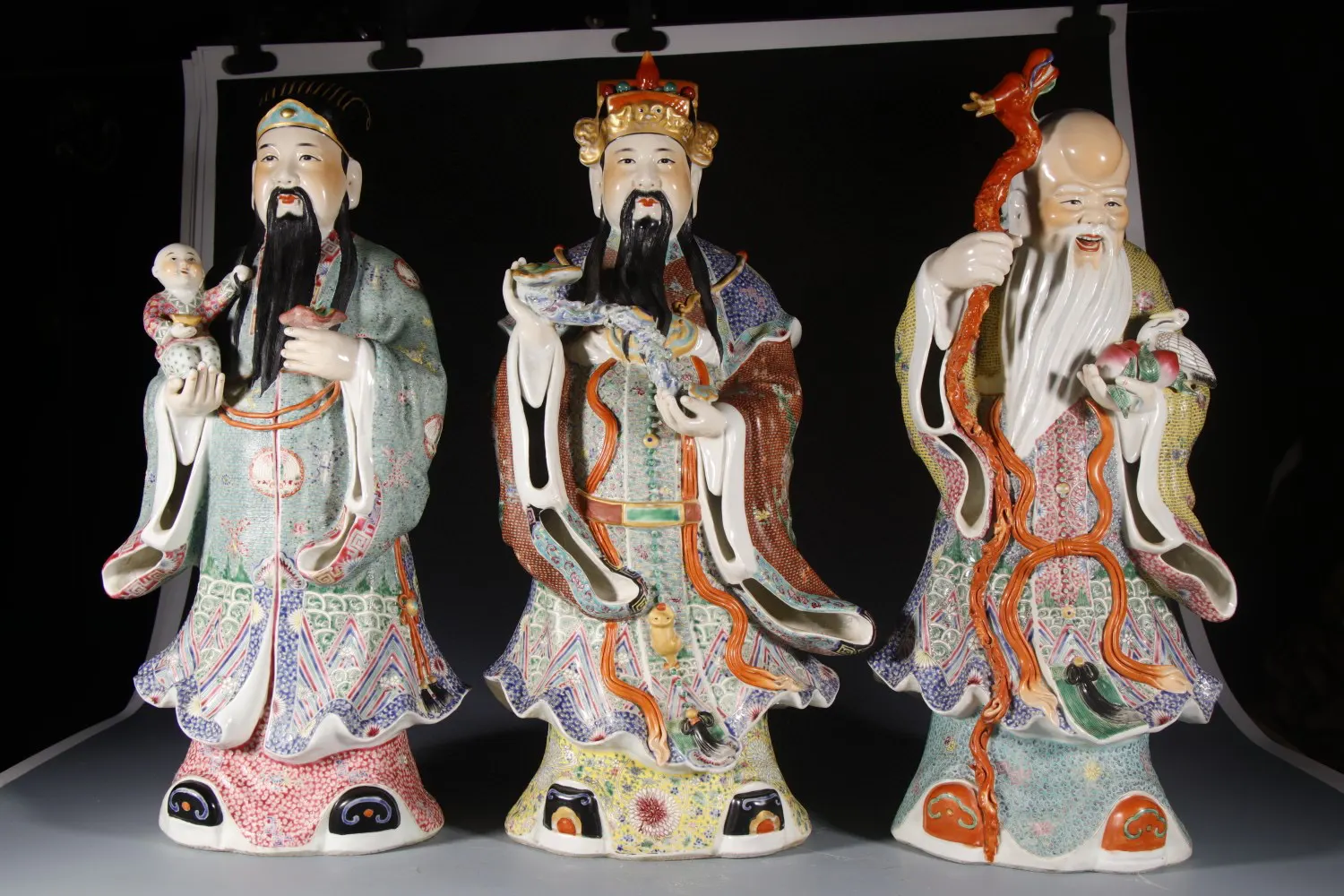
- Position. Statue sets are conventionally arranged to be read from right to left, like traditional Chinese text. From the viewer’s side that puts Fu on the right, Lu in the middle, and Shou on the left. Paintings do not always follow this order.
- Dress. Luxing usually has the most formal court costume, with a winged official’s hat and a stiff belt.
- Visual puns. Chinese decorative art relies on homophones. A bat (蝠, fú) stands for blessings, a deer (鹿, lù) for rank, and a peach or crane for long life. An object decorated with a bat, a deer, and a peach says “fu lu shou” without showing any of the gods.
Fu Lu Shou in Homes, Festivals, and Art
The Three Stars are among the most frequently depicted of all Chinese deities. They appear as porcelain or wooden statue sets in homes, shops, and restaurants, on temple roofs and facades, and across Chinese communities in Southeast Asia and elsewhere. In Cantonese the names are read Fuk Luk Sau.
At the Lunar New Year the trio is printed on woodblock pictures hung in the house. Some of these prints treat them as protective figures on the door, alongside the better-known Door Gods. Birthdays are Shouxing’s occasion. Late imperial birthday paintings, embroideries, and tapestries often show the Three Stars welcoming the Queen Mother of the West, with the Eight Immortals gathered around them.
Modern feng shui guides give detailed advice on where the statues should stand in a room. That advice is recent household custom. It does not come from an early ritual text, and practice varies from family to family.
Common Misunderstandings
- “The three have always been worshipped together.” Only the longevity star has an ancient cult. The triad is a Ming development.
- “Lu is the god of wealth.” Lu concerns rank and official salary. Wealth in the general sense belongs to Caishen.
- “They are ancient emperors or sages.” The human biographies attached to Fuxing and Luxing are later identifications, and the sources do not agree on who they were.
- “They are the same as the Eight Immortals.” Shouxing is sometimes called an immortal in popular usage, but the Three Stars are star deities. The difference between gods and immortals matters here.
For other deities connected with fortune, household protection, and family life, browse the Chinese Gods directory.
Frequently Asked Questions
What does Fu Lu Shou mean in English?
Fu means blessings or good fortune, lu means official rank and the salary that goes with it, and shou means longevity. The phrase is commonly rendered “happiness, prosperity, and longevity,” though “prosperity” loses the original link between lu and a government career.
Which one is which in a Fu Lu Shou statue set?
Shou is the old man with the tall forehead, staff, and peach. Lu wears full court dress and an official’s hat. Fu wears an official’s robe and often holds a child or a scroll. In the conventional arrangement, Fu stands on the viewer’s right, Lu in the middle, and Shou on the left.
Are Fu Lu Shou Daoist gods?
They are honored in Daoist settings and are often described as Daoist stellar gods, but no scripture in the Daoist Canon is devoted to them. They are better understood as gods of Chinese popular religion who were absorbed into Daoist art and temple practice.
How old is the worship of Fu Lu Shou?
Worship of the three as a group appears to date from the fifteenth century, in the Ming dynasty. A painting dated 1454 is among the earliest known images. The Star of Longevity on its own is much older, with sacrifices attested in the Qin period.
Is Fu Lu Shou related to the Japanese god Fukurokuju?
Yes. Fukurokuju is the Japanese reading of the same three characters, 福禄寿. In Japan the tradition was absorbed into the Seven Gods of Good Fortune, where Fukurokuju and Jurōjin both derive from the Chinese longevity star.
Do I have to be religious to display Fu Lu Shou?
No. Many households keep the figures as an expression of good wishes for the family, and the three characters are used as a secular greeting on gifts and decorations. Others place offerings before them, especially at the New Year.
References and Further Reading
- Art Institute of Chicago, Taoism and the Arts of China, “The Star-Lords of Good Fortune, Emolument, and Longevity” (hanging scroll dated 1454, Musée Guimet). https://archive.artic.edu/taoism/renaissance/g92.php
- Ulrich Theobald, “Fu lu shou sanxing 福祿壽三星, the Three Stars,” ChinaKnowledge.de. http://www.chinaknowledge.de/Literature/Religion/personssanxing.html
- Encyclopaedia Britannica, “Fulushou,” “Fuxing,” “Luxing,” and “Shouxing.” https://www.britannica.com/topic/Fulushou
- Joyce Denney, “Longevity in Chinese Art,” Heilbrunn Timeline of Art History, The Metropolitan Museum of Art. https://www.metmuseum.org/essays/longevity-in-chinese-art
- Asian Art Museum of San Francisco, “Three Star Gods,” object 1994.1. https://asianart.emuseum.com/objects/513/three-star-gods
- Seattle Art Museum, “Shoulao (God of Longevity),” object 33.1402. https://art.seattleartmuseum.org/objects/2129/shoulao-god-of-longevity
- University of Michigan Museum of Art, “Fu Lu Shou, Trio of Daoist Stellar Gods of Good Fortune, Wealth, and Longevity,” object 2015/2.167. https://umma.umich.edu/objects/fu-lu-shou-trio-of-daoist-stellar-gods-of-good-fortune-wealth-and-longevity-2015-2-167