Buddhist Influence on Chinese Mythology
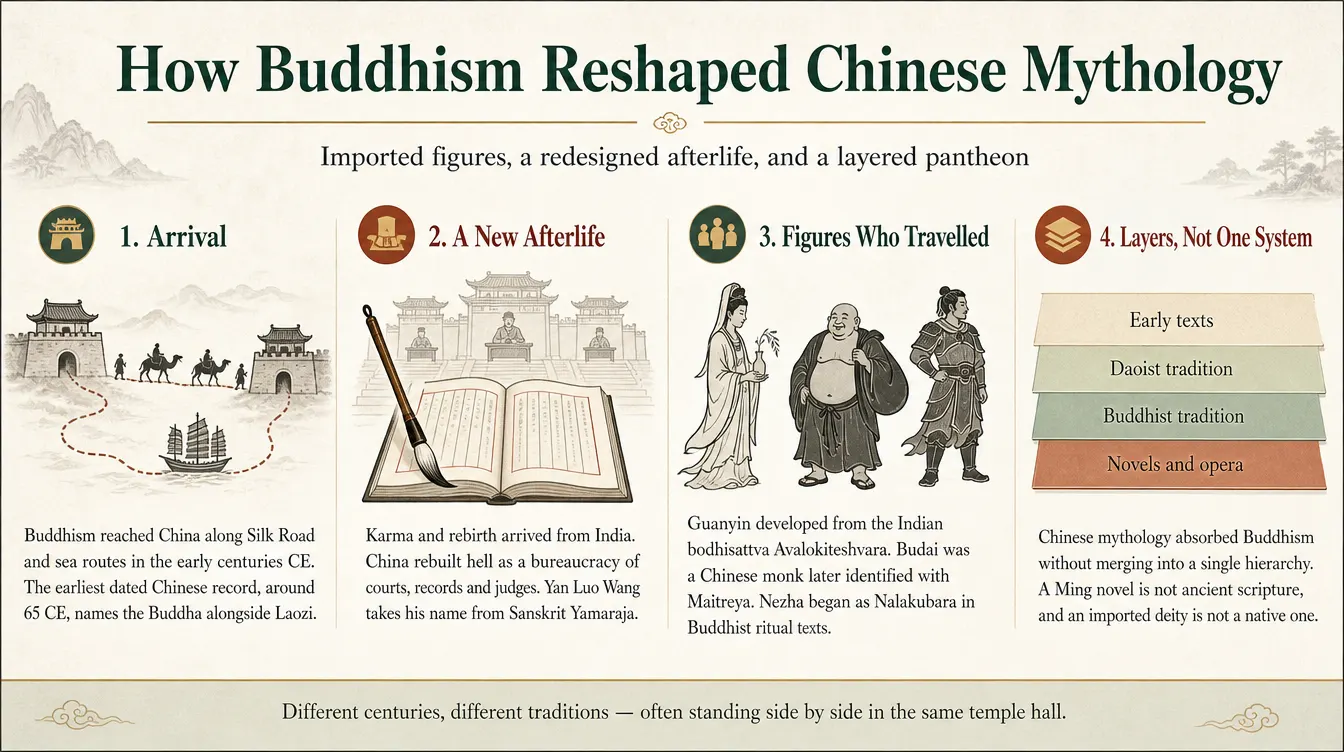
Buddhist influence on Chinese mythology describes the long process by which Buddhism (佛教, Fójiào), arriving from India and Central Asia in the early centuries CE, changed the way people in China imagined gods, death and moral consequence. It did not erase older Chinese myth. It added new figures such as Guanyin (观音, Guānyīn), rebuilt the afterlife around karma and rebirth, and supplied images and vocabulary that Daoist and folk traditions borrowed, adapted and sometimes attacked. Several deities English readers meet as “Chinese gods” — Guanyin, Yan Luo Wang, Nezha — began as Buddhist imports and were then reshaped over roughly fifteen centuries of Chinese storytelling and worship.
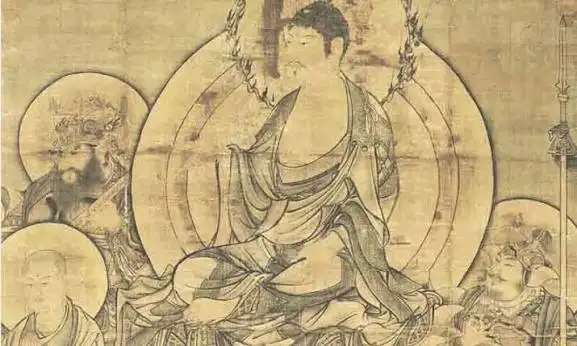
How Buddhism Actually Reached China
The tidiest version of the story — the Han emperor Ming dreams of a golden man, sends envoys west, and founds the White Horse Temple at Luoyang — is a tradition preserved in later sources rather than a documented event. Historians treat it as a founding legend, useful for understanding how Chinese Buddhists later explained their own origins, not as a dated record.
The earliest securely dated notice is duller and more revealing. The Hou Han Shu (後漢書), compiled in the fifth century from earlier materials, reports that Liu Ying, Prince of Chu, was practising fasting and sacrifice to the Buddha — transcribed as 浮屠 (fútú) — around 65 CE. An imperial rescript quoted in his biography praises him for reciting “the subtle words of Huang-Lao” while honouring the Buddha’s shrine. The two are named in one breath. At the very start, the Buddha appears in Chinese records not as the founder of a rival system but as one more powerful being worth offering to, alongside Laozi and the Yellow Emperor.
That pattern set the tone. Buddhism entered along Silk Road and maritime routes with merchants, translators and monks, and it entered a religious landscape that was already crowded and already comfortable adding new deities. What followed was several centuries of translation, argument, imitation and absorption rather than a single conversion moment.
The Main Layers, in Order
Most confusion about Chinese mythology comes from flattening very different periods into one imaginary “ancient tradition.” The table below gives the rough sequence that the rest of this article follows.
| Period | What was happening | Typical result |
|---|---|---|
| Pre-Buddhist (to c. 1st c. CE) | Ancestral cult, nature deities, early texts such as the Shanhaijing | Yellow Springs (黄泉, Huángquán) and Mount Tai (泰山, Tàishān) as vague realms of the dead |
| Han to Six Dynasties (1st–6th c.) | Translation of sutras; Buddha treated as one deity among many; first Daoist–Buddhist polemics | Karma and rebirth enter Chinese thought; Daoist scriptures begin absorbing Buddhist cosmology |
| Tang (7th–10th c.) | Esoteric ritual texts, pilgrimage, cave-temple art, popular preaching | Nezha, Vaiśravaṇa, the Ten Kings of the underworld take shape |
| Song to Yuan (10th–14th c.) | Local cults, printing, monastery halls, sectarian debate | Guanyin widely depicted as female; Budai becomes the standard Maitreya image |
| Ming and later (14th c.–) | Vernacular novels, opera, temple networks overseas | Journey to the West, Investiture of the Gods, modern film versions |
Karma, Rebirth, and the Redesigned Underworld
The single deepest change was the afterlife. Early Chinese sources speak of the dead going to the Yellow Springs, or gathering at Mount Tai, but they do not describe a graded system of posthumous judgement tied to moral accounting across lifetimes. Buddhism supplied exactly that: karma (业, yè) and rebirth (轮回, lúnhuí), with hell realms — Sanskrit naraka — as temporary destinations rather than permanent ones.
Chinese tradition did not simply import the Indian scheme. It reorganised it as a government. Diyu (地狱, Dìyù) became a set of courts with registers, clerks, summonses and sentences, staffed by officials who behave like magistrates because Chinese readers understood magistrates. The presiding judge, Yan Luo Wang (阎罗王, Yánluó Wáng), takes his name from Sanskrit Yamarāja, but his red robes, beard and judicial bench are Chinese. You can read more in our full profile of Yan Luo Wang and the courts of Diyu.
The clearest evidence for how this system was assembled comes from Dunhuang. The Scripture on the Ten Kings, circulating in the ninth and tenth centuries, organises the soul’s passage into a fixed sequence of tribunals matched to memorial rites performed by the living. Stephen Teiser’s study of these manuscripts shows a Chinese purgatory being built in real time out of Buddhist doctrine, Chinese bureaucratic logic and family ritual obligation. The bodhisattva Dizang (地藏, Dìzàng, Sanskrit Kṣitigarbha), vowing to rescue beings from the hells, became the compassionate counterweight to all this judicial machinery.
The layered Diyu familiar from temple murals and modern films is a medieval synthesis, not an ancient Chinese belief. Sources from before the Han say nothing like it.
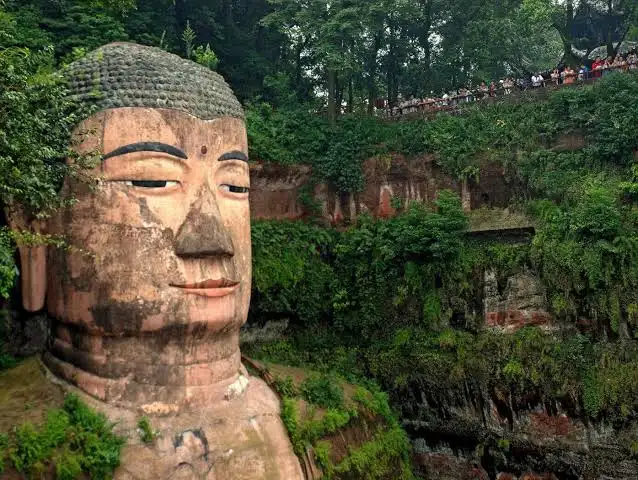
Guanyin: The Bodhisattva Who Became a Chinese Goddess
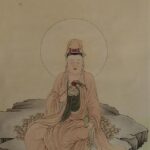
Avalokiteśvara, the bodhisattva of compassion, was male in Indian sources and iconography. In China the figure became Guanshiyin (观世音), “the one who perceives the sounds of the world” — a rendering associated with Kumārajīva’s early fifth-century translation of the Lotus Sutra, whose twenty-fifth chapter promises rescue to anyone who calls the name. The shortened form Guanyin became standard.
The shift to a predominantly female Guanyin happened in China, gradually, and mostly after the Tang. Chün-fang Yü’s study traces it through several channels at once: miracle-tale collections, indigenous Chinese scriptures with no Indian originals, new iconographic types such as the White-Robed Guanyin, pilgrimage to Mount Putuo, and the Miaoshan legend — a wholly Chinese story of a princess who refuses marriage, endures her father’s cruelty, and attains bodhisattvahood through compassion. Its best-known early written form is a Song-dynasty temple stele inscription, not an Indian sutra.
This matters for how Guanyin is described. She is a bodhisattva in doctrinal terms and a goddess of mercy in popular terms, and both descriptions are accurate to different traditions. Buddhist thought also holds that a bodhisattva appears in whatever form helps, which is one reason the gender question was never settled the same way everywhere. Our full article on Guanyin covers the legends and symbols in detail.
The Laughing Buddha Is a Chinese Monk
The round, grinning figure sold in shops worldwide is not Śākyamuni. He is Budai (布袋, Bùdài, “cloth sack”), the popular name of a monk called Qici (契此) who lived in the Fenghua area near present-day Ningbo around the tenth century. Accounts describe an eccentric wanderer with a large belly who begged with a sack slung from a staff, spoke in riddles, and slept wherever he happened to be.
After his death he was identified as a manifestation of Maitreya (弥勒, Mílè), the buddha of the future age. From the Song dynasty onward this Chinese monk’s body became the standard Chinese image of Maitreya, installed in the entrance halls of monasteries. Earlier Maitreya images — including the elegant pensive and cross-ankled bodhisattvas of the Northern dynasties — look nothing like him.
So the “Laughing Buddha” is a genuinely Buddhist figure and a genuinely Chinese invention at the same time. Calling him “the Buddha” collapses a thousand years of local development into a souvenir.
Nezha and the Guardians Who Arrived as Buddhist Deities
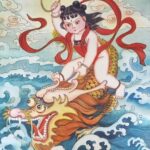
Nezha (哪吒, Nézhā) is now so thoroughly Chinese — wind-fire wheels, fire-tipped spear, lotus rebirth, a Ming-novel childhood — that his origin surprises people. Meir Shahar’s study traces him back to Nalakūbara, a figure from Indian mythology who reached China through the esoteric ritual texts of Tang-dynasty Tantric Buddhist masters, where he functions as a fierce protector attached to Vaiśravaṇa, the heavenly king of the north. Only later was that divine father merged with the Tang general Li Jing, and only in Ming fiction did the story acquire the shape most readers know. Our article on Ne Zha follows that development.
He is not alone. Walk into a large Chinese monastery and the first hall usually contains the Four Heavenly Kings (四大天王), Indian devas given Chinese armour, faces and emblems. Mañjuśrī became Wenshu at Mount Wutai; Samantabhadra became Puxian at Mount Emei. Whole sacred landscapes were mapped onto imported figures. You can browse more of them in our section on Buddhist deities in Chinese tradition.
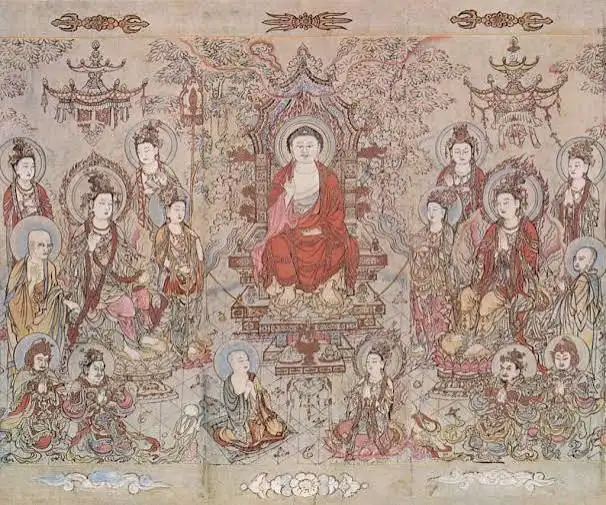
How Daoism Answered Back
Influence ran in more than one direction, and it was not always friendly. Scholars have long observed that the Lingbao (灵宝) scriptures compiled around 400 CE absorbed a great deal of Buddhist material: cosmic aeons, multiple heavens, rebirth, and the ideal of universal salvation. Daoist ritual and canon expanded partly in response to what Buddhism had introduced.
At the same time Daoists produced polemic. The Huahu jing (老子化胡经, “Scripture of Laozi Converting the Barbarians”), attributed to the Western Jin figure Wang Fu around 300 CE and expanded over later centuries, argued that Laozi travelled west and became — or taught — the Buddha, making Buddhism a derivative teaching suited to foreigners. Buddhists contested it for roughly a thousand years, and under Mongol rule the text was condemned and ordered destroyed. Fragments survive among the Dunhuang manuscripts.
The eventual settlement is usually called the Three Teachings (三教, sānjiào): Confucianism, Daoism and Buddhism coexisting, overlapping in practice, and sharing worshippers who did not feel obliged to choose. This is why one caution matters so much. A figure appearing in a Daoist temple is not automatically a Daoist god, and a figure with an Indian name is not automatically understood as Buddhist by the people who burn incense to him.
Journey to the West Is a Novel
The monk at the centre of the story was real. Xuanzang (玄奘, 602–664) travelled to India, studied there, returned with scriptures, and left an account of the regions he passed through. Almost everything else in Journey to the West — the Monkey King, the pig, the demons, the celestial bureaucracy played for comedy — accumulated across centuries of storytelling, drama and popular tale-telling before being shaped into the hundred-chapter novel printed in 1592. The traditional attribution to Wu Cheng’en is disputed by specialists.
The novel is a superb witness to how Buddhist, Daoist and folk material had fused by the late Ming. It is not a religious text, and its heaven is satire as much as theology. Sun Wukong (孙悟空, Sūn Wùkōng) is a literary hero who later acquired temple worship in some communities, which is a different thing from an ancient deity. Guanyin’s role as a supervising presence in the novel comes from that same literary layer, not from sutra. See our guide to Sun Wukong for how the character was assembled.
The Ghost Festival and the Story of Mulian
One of the clearest fusions is the Yulanpen festival (盂兰盆, Yúlánpén), held in the seventh lunar month and widely known in English as the Ghost Festival. Its charter story tells of Mulian (目连, Sanskrit Maudgalyāyana), a disciple of the Buddha who uses meditative vision to find his dead mother suffering, cannot free her by his own power, and is instructed to make offerings to the monastic community so that the collective merit rescues her.
Teiser’s study argues that the festival succeeded because it let Buddhism speak the language of Chinese ancestral obligation. A son’s duty to feed and protect his parents after death was already central; Buddhism supplied a new mechanism, a new priesthood to administer it, and a vivid narrative to carry it. The festival became one of the most widely observed events in the Chinese year, and Mulian plays remained a staple of regional opera.
Telling the Layers Apart
A short reference for figures that are often mislabelled.
| Figure | Where the figure comes from | Where the figure lives today |
|---|---|---|
| Guanyin 观音 | Indian bodhisattva Avalokiteśvara; feminine forms and the Miaoshan legend are Chinese | Buddhist devotion, folk religion, household altars |
| Yan Luo Wang 阎罗王 | Sanskrit Yamarāja, reorganised on a Chinese bureaucratic model | Buddhist, Daoist and folk underworld traditions |
| Budai 布袋 | A tenth-century Chinese monk later identified with Maitreya | Buddhist monastery halls; global popular imagery |
| Nezha 哪吒 | Nalakūbara, via Tang esoteric Buddhist ritual texts | Folk religion and Daoist temples, especially in Taiwan and Fujian |
| Sun Wukong 孙悟空 | Accumulated storytelling, fixed by a Ming novel | Literature, opera, film; localised temple worship in some places |
| Jade Emperor 玉皇 | Daoist and imperial development, prominent from the Song | Daoist liturgy and popular religion; not Buddhist in origin |
| Nüwa 女娲 | Early Chinese textual tradition, pre-Buddhist | Myth and literature; largely untouched by Buddhist influence |
What Buddhism Did Not Change
It is worth stating the limits plainly. The creation myths of Pangu and Nüwa, the culture heroes, the Yellow Emperor, the ancestral cult, the kitchen god, the city gods, the sea goddess Mazu and the enormous apparatus of local tutelary deities all developed on their own tracks. Buddhism affected how death and consequence were imagined far more than it affected the origin stories.
What emerged is not a merged pantheon with a single hierarchy. It is a layered one, where a family might make offerings to ancestors in the morning, visit a Guanyin shrine for a sick child, consult a Daoist ritual specialist about a house, and see no contradiction in any of it. That practical coexistence, more than any doctrine, is the real shape of Buddhist influence on Chinese mythology.
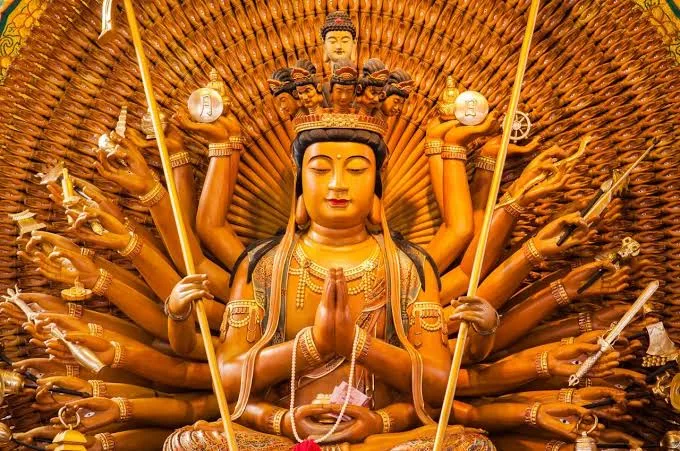
Why the Distinctions Are Worth Keeping
Popular writing tends to present Chinese mythology as one seamless ancient system. Doing so hides the most interesting thing about it: it kept absorbing, arguing and rebuilding. Guanyin’s change of gender took centuries and left a documentary trail. The Ten Kings were assembled from identifiable materials. Nezha’s Indian ancestor is traceable. Budai has a hometown.
Reading these figures as products of specific periods makes them more vivid, not less. It also protects against the two common errors — treating a Ming novel as ancient scripture, and treating an imported deity as though it had never travelled.
Frequently Asked Questions
Is Chinese mythology Buddhist or Daoist?
Neither on its own. Chinese mythology draws on pre-Buddhist textual traditions, Daoist scripture and ritual, imported Buddhist material, local folk cults, imperial state religion and later literature. Most famous figures belong to more than one of these at once, and which label fits depends on which period and which community you are asking about.
Which Chinese gods actually came from Buddhism?
Guanyin, Dizang, Maitreya, Mañjuśrī, Samantabhadra, the Four Heavenly Kings, Yan Luo Wang and Nezha all have Buddhist or Indian origins, though several were substantially reshaped in China. Pangu, Nüwa, the Jade Emperor, Mazu, the kitchen god and the city gods do not.
Did Buddhism invent the Chinese hell?
It supplied the essential ingredients — hell realms, karmic judgement and rebirth — but the familiar Diyu of ten courts and record-keeping officials is a Chinese construction. It took shape mainly between the seventh and tenth centuries, and manuscripts from Dunhuang show the process clearly.
Why is Guanyin female in China but male in India?
Avalokiteśvara was depicted as male in India. In China, feminine forms emerged gradually through miracle stories, locally composed scriptures, new iconographic types and legends such as Miaoshan, becoming dominant roughly from the Song dynasty onward. Buddhist doctrine also holds that a bodhisattva can appear in any form, which made the shift easier to accept.
Is the Laughing Buddha the same as the Buddha?
No. He is Budai, a Chinese monk of around the tenth century who was later identified as a manifestation of the future buddha Maitreya. Śākyamuni, the historical Buddha, is depicted quite differently.
Is Journey to the West a religious text?
No. It is a Ming-dynasty novel, printed in 1592, built from centuries of earlier storytelling around the historical pilgrim Xuanzang. It reflects popular religious ideas of its time but should not be read as doctrine from any tradition.
References and Further Reading
- Chinese Text Project — Hou Han Shu, Biographies of the Ten Kings of Guangwu — original text of the passage on Liu Ying, Prince of Chu, used for the earliest dated reference to Buddhist practice in a Chinese history.
- Metropolitan Museum of Art — Chinese Buddhist Sculpture (Denise Leidy) — used for the visual exchange between Indian prototypes and Chinese sculptural idioms.
- Metropolitan Museum of Art — Buddhism and Buddhist Art (Vidya Dehejia) — background on Indian image traditions carried along the Silk Road into China.
- Columbia University Press — Chün-fang Yü, Kuan-yin: The Chinese Transformation of Avalokiteśvara — the standard study of Guanyin’s feminisation, indigenous scriptures and the Miaoshan legend.
- Princeton University Press — Stephen F. Teiser, The Ghost Festival in Medieval China — used for the Yulanpen festival and the Mulian story as a fusion of Buddhist merit and Chinese filial obligation.
- University of Hawai’i Press — Stephen F. Teiser, The Scripture on the Ten Kings — the formation of the Chinese purgatory and the Ten Kings, based on Dunhuang manuscripts.
- University of Hawai’i Press — Meir Shahar, Oedipal God: The Chinese Nezha and His Indian Origins — traces Nezha back to Nalakūbara and his arrival through Tantric Buddhist ritual.
- Gil Raz, “‘Conversion of the Barbarians’ [Huahu] Discourse as Proto Han Nationalism,” Studies in History — used for the Huahu jing polemic and the Daoist response to Buddhism.
- Metropolitan Museum of Art — Figure of the Buddhist monk Budai — museum catalogue entry identifying Budai as a tenth-century monk regarded as an incarnation of Maitreya.