Shennong
Shennong (神农 in simplified Chinese, 神農 in traditional Chinese; Shénnóng) is the legendary “Divine Farmer” of Chinese mythology. He is remembered as a culture hero associated with agriculture, grain cultivation, medicinal plants, and the search for practical knowledge about nature. Early texts and later traditions do not present one completely fixed biography. Shennong can appear as a primordial ruler, a civilizing sage, an ancestral figure, and, in later religious practice, a deity connected with farming and medicine. He is also frequently associated or identified with Yandi, the Yan or Flame Emperor, although that relationship developed differently across texts and periods.
Shennong Quick Facts
| Topic | Details |
|---|---|
| Chinese name | 神农 / 神農 |
| Pinyin | Shénnóng |
| Name meaning | Divine Farmer or Divine Husbandman |
| Main identity | Legendary culture hero, primordial sovereign, and later religious deity |
| Main associations | Agriculture, grain cultivation, medicinal plants, herbal knowledge, and human welfare |
| Famous story | Tasting plants to distinguish useful substances from harmful or poisonous ones |
| Traditional group | Frequently counted among the Three Sovereigns, although lists vary |
| Related figure | Often identified with Yandi in later traditions |
| Historical status | Legendary and mythological rather than a securely documented historical ruler |
Who Is Shennong in Chinese Mythology?
Shennong is one of the major culture heroes associated with the beginnings of Chinese civilization. His stories are not primarily about creating the physical universe. Instead, they explain how essential forms of human knowledge, especially farming and the use of plants, came into the world.
His strongest association is agriculture. Traditional texts credit Shennong with teaching people to cultivate grain, understand different kinds of land, and use tools for working the soil. In this role, he represents the transition from dependence on wild food toward organized agriculture.
He can be compared with Fuxi, another legendary culture hero associated with the origins of civilization. Both are frequently included among the Three Sovereigns, although ancient and later sources do not preserve one universally accepted list.
Shennong also belongs naturally within the broader tradition of Chinese gods and sacred figures. However, simply calling him a “Chinese god” can hide the complexity of his identity. Depending on the source, he may function as an ancient ruler, ancestral figure, culture hero, or worshipped deity.
What Does the Name Shennong Mean?
The name Shennong combines shen (神), a term that can mean divine, sacred, spirit, deity, or numinous power, with nong (农 / 農), meaning agriculture or farming. The standard English translation is therefore “Divine Farmer.” Older English works sometimes use “Divine Husbandman.”
The name immediately identifies Shennong with his most important cultural role: the transformation of agriculture into organized human knowledge.
You may also encounter the spellings Shen Nong and Shen-nung. Shen Nong simply separates the two syllables, while Shen-nung reflects an older romanization system. They refer to the same mythological figure.
Shennong in Early Chinese Texts
There is no single ancient book that contains a complete and universally authoritative Shennong biography. References to him appear across texts written and transmitted in different periods and intellectual traditions.
Shennong in the Zhuangzi
The Zhuangzi invokes Shennong and his age in philosophical discussions of remote antiquity. These passages are not primarily concerned with telling a detailed mythological adventure. Instead, Shennong can serve as a marker of an idealized earlier social order.
This is an important distinction because later popular stories give Shennong a much more elaborate biography than many early references do.
Shennong in the Huainanzi
One of the most important early accounts appears in the Huainanzi, compiled in the second century BCE. It describes an age when people suffered because they did not yet know which plants could safely be eaten.
Shennong responds by teaching agriculture and personally testing the qualities of plants. The text famously associates him with tasting many herbs and encountering numerous poisonous substances during this process.
This passage provides an early textual foundation for the later and much more elaborate story of Shennong tasting the “hundred herbs.”
Shennong and the Book of Changes Tradition
The received commentary tradition associated with the Book of Changes also connects Shennong with major developments in human civilization. He is credited with agricultural implements and with establishing a market where people could exchange goods.
Here Shennong is not simply a healer. He represents agriculture, technology, exchange, and the organization of society.
The Shennong Story: Tasting the Hundred Herbs
The best-known Shennong story describes him personally tasting plants to discover their effects on the human body.
Some plants provided food. Some had useful medicinal properties. Others were dangerous or poisonous. By testing them himself, Shennong supposedly gave humanity the knowledge needed to distinguish beneficial substances from harmful ones.
The expression often translated as Shennong “tasting the hundred herbs” should not necessarily be understood as a literal count of exactly one hundred plants. In traditional Chinese expression, “hundred” can function more broadly to suggest a great variety or large number.
The early Huainanzi tradition already connects Shennong with tasting plants and repeatedly encountering poison. Later storytellers expanded this core motif into increasingly vivid legends.
Did Shennong have a transparent body?
One famous later version says that Shennong had a transparent or partially transparent body, allowing him to observe how different plants affected his internal organs.
This striking detail is common in later storytelling and visual interpretation, but it should not be treated as a feature found uniformly across the earliest surviving descriptions of Shennong.
How did Shennong die?
Later legends sometimes say that Shennong eventually tasted a plant so poisonous that even his extraordinary knowledge could not save him. Different retellings identify the fatal substance in different ways or embellish the circumstances of his death.
There is therefore no single authoritative ancient account of Shennong’s death. The death-by-poison motif belongs to the broader development of his image as a figure who risks himself to gain knowledge for humanity.
Shennong and Chinese Herbal Medicine
Shennong became one of the most important legendary figures associated with the origins of Chinese herbal medicine. His plant-tasting story made him an ideal symbolic ancestor for traditions concerned with medicinal substances.
That does not mean a historical individual named Shennong literally invented Chinese medicine. Chinese medical knowledge developed over many centuries through numerous practitioners, texts, regional traditions, and intellectual systems.
The importance of Shennong is cultural and symbolic. He represents the idea that systematic observation of the natural world can help people distinguish useful remedies from dangerous substances.
Did Shennong write the Shennong Bencao Jing?
The famous Shennong Bencao Jing (神农本草经 / 神農本草經), commonly translated as the Divine Farmer’s Classic of Materia Medica, bears Shennong’s name and became foundational to the Chinese materia medica tradition.
However, Shennong should not be presented as its historically verified author. The attribution is traditional, while the textual material belongs to a much later period than the legendary age assigned to Shennong.
The use of his name served an important cultural purpose. It connected the classification of medicinal substances with the ancient Divine Farmer who was believed to have first investigated the properties of plants.
Did Shennong Discover Tea?
Shennong is also closely connected with traditional stories about the origins of tea.
Later tea culture frequently identifies him as an early discoverer or user of tea. One family of legends connects tea with his experiments on herbs, describing it as a substance that helped counteract the effects of plants he had tasted.
Another widely repeated modern story says that tea leaves accidentally fell into hot or boiling water prepared for Shennong. He drank the resulting infusion and discovered tea.
These stories are culturally influential, but they are legends rather than documented accounts of a historical discovery. It is safer to say that Shennong became an important legendary figure in Chinese tea origin traditions than to claim that a historically verified Shennong invented tea on a particular date.
Shennong Symbols and Powers
Shennong does not have one standardized list of supernatural “powers” in the way that a modern fantasy character might. His attributes are better understood through the activities, objects, and natural domains associated with him.
| Symbol or Attribute | Meaning |
|---|---|
| Medicinal herbs | His legendary testing of plants and association with herbal medicine |
| Grain | Agriculture, cultivated food, fertility, and the development of farming |
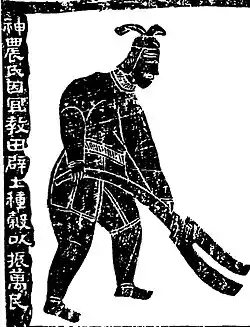
| Plow and farming tools | The practical technologies required to cultivate the land |
| Plants held in the hand | Observation, experimentation, and knowledge of natural substances |
| Ox or bull-like features | A feature found in some later artistic and legendary representations |
| Fire and the color red | Associated especially with traditions identifying Shennong with Yandi or the Red Emperor |
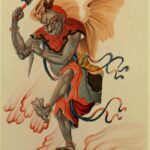
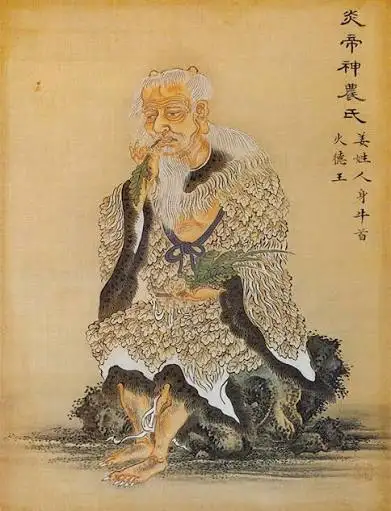
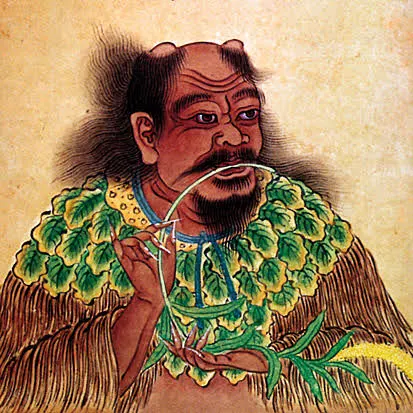
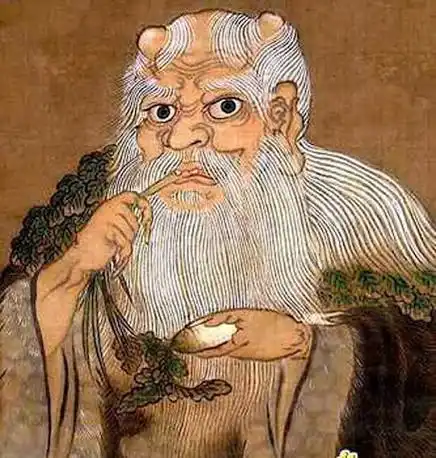
In art, Shennong is often shown examining, holding, or chewing a plant. The image directly communicates his role as the investigator of herbs.
Some depictions give him horns, an ox-like head, or other bovine features. Such imagery reinforces his association with agriculture, but artistic conventions vary considerably across periods and regions.
Is Shennong the Same as Yandi?
Shennong is frequently identified with Yandi (炎帝, Yándì), usually translated as the Yan Emperor or Flame Emperor. Modern summaries often present the two names as if they always referred to exactly the same figure.
The historical development of the traditions is more complicated.
Shennong and Yandi occur within overlapping traditions concerning ancient rulers, agriculture, ancestry, cosmology, and the origins of civilization. Over time, later texts and religious systems increasingly connected them, and the identification of Shennong with Yandi became highly influential.
However, it is safer not to assume that every early reference to Shennong and every reference to Yandi originally meant precisely the same figure.
The association also appears in later cosmological traditions. The site’s guide to the Wufang Shangdi explains how Shennong can be identified with the Red Emperor of the south in one important Five Emperors system.
Shennong and the Three Sovereigns
Shennong is frequently counted among the Three Sovereigns, or Sanhuang (三皇), a group of primordial rulers and culture heroes associated with the distant beginnings of civilization.
However, there was no single universally accepted list of Three Sovereigns throughout Chinese history.
Fuxi and Shennong frequently appear in the group, while other versions may include Nüwa, Suiren, Huangdi, or different primordial figures.
This variation is important. Chinese mythology developed through many texts, local traditions, philosophical schools, religious systems, and later reinterpretations. Modern charts can make ancient divine groups look more standardized than they actually were.
Readers interested in this early civilizational layer of mythology may also explore the site’s broader guide to the Chinese mythology creation story, which explains how figures such as Pangu, Nüwa, and Fuxi belong to different strands of creation and culture-hero tradition.
What Does Shennong Represent?
Shennong represents the transformation of nature into knowledge that can support human society.
His agricultural role transforms uncultivated land into productive fields. His plant-tasting story transforms an unknown and potentially dangerous natural environment into something that can be observed, classified, and used.
His association with markets adds another dimension: organized agriculture produces goods that can be exchanged within a developing society.
For this reason, Shennong represents much more than farming alone. His mythology brings together agriculture, medicine, experimentation, technology, food security, and social organization.
The willingness to taste dangerous plants also gave later audiences a powerful image of self-sacrifice. Shennong gains knowledge through personal risk so that other people do not have to face the same uncertainty.
Shennong Worship in Chinese Culture
Shennong did not remain only a figure in ancient literature. In later Chinese popular religion, he also became a worshipped deity.
He may be honored under titles such as Shennong Dadi, meaning the Great Emperor Shennong, and can be associated with agriculture, grain, medicinal knowledge, farmers, and practitioners connected with traditional medicine.
His religious identity is not completely uniform. Different temples and regional traditions may use different titles, festival customs, images, and stories.
In some communities, agricultural aspects of Shennong are especially important. Elsewhere, his relationship with medicinal plants and healing receives more emphasis. In traditions that strongly identify him with Yandi, ancestral and civilizational themes may also become central.
This is another reason to distinguish ancient texts from later religious practice. A modern temple tradition can preserve culturally important beliefs about Shennong without proving that the same ritual or interpretation existed in the earliest period in which his name appears.
Shennong in Art and Iconography
Shennong is relatively easy to recognize in many traditional artistic representations because plants are often central to the composition.
He may be shown holding a herb near his mouth, examining leaves, carrying agricultural products, or surrounded by vegetation. These images transform the plant-tasting story into a simple visual symbol.
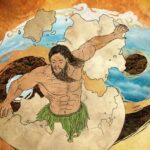
Some works depict him with a rugged appearance, exposed torso, leaf-like clothing, horns, or bovine features. Such details emphasize his imagined closeness to nature and agriculture.
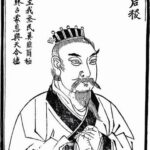
There is no single mandatory appearance for Shennong. Chinese, Daoist, folk religious, regional, and even Japanese representations can differ substantially. Artistic attributes should therefore be described as common conventions rather than a universal physical description of the deity.
Common Misunderstandings About Shennong
Shennong was a proven historical emperor
Traditional accounts place Shennong in extremely remote antiquity, but these legendary dates cannot be treated like securely documented historical reign dates. Shennong is best understood as a mythological and legendary culture hero.
Shennong personally wrote the Shennong Bencao Jing
The text is traditionally attributed to him, but that does not make Shennong its historically verified author. The work belongs to a much later textual and medical tradition.
Every Shennong story comes from the same ancient source
No. His agricultural role, herb-tasting story, Yandi identification, tea legends, unusual bodily features, death stories, religious titles, and regional worship practices come from different layers of tradition.
Shennong and Yandi were always exactly the same figure
The identification became very influential, but the textual relationship is more complicated. It is better to distinguish early references from later systems that explicitly merge the two identities.
There is one fixed list of the Three Sovereigns
Ancient and later sources preserve several different lists. Shennong is a common member, but the complete group is not identical in every tradition.
Why Shennong Still Matters
Shennong remains important because his mythology answers a fundamental cultural question: how did humans learn to live safely and productively within the natural world?
His answer is agriculture, observation, experimentation, and accumulated knowledge.
The Divine Farmer transforms wild plants into understood resources, land into cultivated fields, and individual discoveries into knowledge that can support an entire community. Later traditions expanded this image until Shennong became simultaneously a culture hero, agricultural ancestor, medicinal figure, Yandi-associated sovereign, and religious deity.
That layered development makes him an especially useful example of how Chinese mythology works. There is rarely one fixed canon that preserves every figure in an unchanging form. Stories evolve as philosophical texts, religious traditions, regional cultures, visual art, and popular storytelling reinterpret older material.
For more figures from these overlapping traditions, explore the Chinese gods directory or the site’s collection of Chinese legends and stories.
Frequently Asked Questions About Shennong
Who is Shennong in Chinese mythology?
Shennong is the legendary Divine Farmer, a Chinese culture hero associated with agriculture, grain cultivation, medicinal plants, and the testing of herbs. Later traditions also worship him as a deity connected with farming and medicine.
What does Shennong mean?
Shennong is written 神农 in simplified Chinese and 神農 in traditional Chinese. The name is usually translated as “Divine Farmer” and directly reflects his association with agriculture.
What is the Shennong story?
The most famous Shennong story says that he tasted many plants to learn which were useful and which were dangerous. An early version of the plant-testing motif appears in the Huainanzi, while later folklore adds details such as unusual anatomy and stories about his death from poison.
What are Shennong’s symbols?
Medicinal herbs, grain, agricultural tools, and plants held in his hand are among his strongest symbols. Some later images also give him horns or other bovine features, emphasizing his connection with agriculture.
Is Shennong the same as Yandi?
Shennong is commonly identified with Yandi, the Yan or Flame Emperor, especially in later Chinese tradition. However, their identities developed through overlapping textual and religious traditions, so they should not automatically be treated as identical in every early source.
Did Shennong discover tea?
Later Chinese tea traditions frequently connect Shennong with the discovery or early use of tea. These accounts are important cultural legends, but they are not evidence of a historically documented discovery by a verified individual named Shennong.
References and Further Reading
- Chinese Text Project, Huainanzi, Xiuwu Xun – an important early source for Shennong’s agricultural and plant-tasting traditions.
- Chinese Text Project, Book of Changes, Xi Ci II – preserves traditions associating Shennong with agricultural tools and markets.
- Chinese Text Project, Zhuangzi – includes references to Shennong and the idealized age associated with him.
- Wellcome Collection, Chinese woodcut: Famous medical figures – Shen Nong – historical material relating to Shennong’s medical iconography.
- Wellcome Collection, The Divine Farmer’s Materia Medica – bibliographic material relating to the Shennong Bencao Jing tradition.
- Robert G. Henricks, “Fire and Rain: A Look at Shen Nung (The Divine Farmer) and His Ties with Yen Ti” – scholarly discussion of the relationship between Shennong and Yandi.